Life: What cancer is like edition

“One of the most despicable religious fallacies is that suffering is ennobling—that it is a step on the path to some kind of enlightenment or salvation. Isabel’s suffering and death did nothing for her, or us, or the world. We learned no lessons worth learning; we acquired no experience that could benefit anyone. And Isabel most certainly did not earn ascension to a better place, as there was no better place for her than at home with her family.”

—Aleksandar Hemon, in his astonishing, powerful, gripping, depressing New Yorker essay “The Aquarium: A tale of two daughters.” It’s only available in print. Don’t read it unless you feel you must.

The Gottlieb Paris Review interview

There’s a great Paris Review interview with editor Robert Gottlieb filled with quotable stuff. A sample:

* “I have fixed more sentences than most people have read in their lives.”

* “Your job as an editor is to figure out what the book needs, but the writer has to provide it. You can’t be the one who says, Send him to Hong Kong at this point, let him have a love affair with a cocker spaniel. Rather, you say, This book needs something at this point: it needs opening up, it needs a direction, it needs excitement.”

* From Toni Morrison, who Gottlieb edited: “I never wrote a line until after I became an editor, and only then because I wanted to read something that I couldn’t find. That was the first book I wrote.” This, incidentally, is also what keeps me writing—wanting to read books that no one else has written, though I suspect Morrison and I have very different tastes.

* A long excerpt from John le Carré:

Negotiations were always tight with Bob. He was celebrated for not believing in huge advances, and it didn’t matter that three other houses were offering literally twice what he was offering. He felt that for half the money, you got the best. Most publishers, when you arrive in New York with your (as you hope) best-selling manuscript, send flowers to your suite, arrange for a limo, maybe, at the airport, and then let you go and put on the nosebag at some great restaurant. The whole idea is to make you feel great. With Bob you did best to arrive in jeans and sneakers, and then you lay on your tummy side-by-side with him on the floor of his office and sandwiches were brought up.

After I finished one book, I think it was A Perfect Spy, my agent called me and said, Okay, we’ve got x-zillion yen and whatnot, and I said, And lunch. My agent said, What? I said, And lunch. When I get to New York I want to be taken, by Bob, to a decent restaurant for once and not eat one of those lousy tuna sandwiches lying on my tummy in his room. Bob called me that evening and said, I think we have a deal; and is that true about lunch? And I said, Yup, Bob, that’s the break point in the deal. Very well, he said. Not a lot of laughter. So I arrived in New York, and there was Bob, a rare sight in a suit, and we went to a restaurant he had found out about. He ate extremely frugally, and drank nothing, and watched me with venomous eyes as I made my way through the menu.

* Gottlieb again:

I happen to be a kind of word whore. I will read anything from Racine to a nurse romance, if it’s a good nurse romance. Many people just aren’t like that. Some of my closest friends cannot read anything that isn’t substantial—they don’t see the point. I don’t, however, like a certain kind of very rich, ornate, literary writing. I feel as if I’m being choked, as if gravel is being poured down my throat. Books like Under the Volcano, for instance, are not for me.

And this again describes me, despite my post On books, taste, and distaste. I think my penchant for Carlos Ruiz Zafón falls into the “word whore” category.

* The main thing he gets wrong is regarding science fiction, where he says of Doris Lessing’s The Sentimental Agents that “like all space fiction, or science fiction, it is underlain by a highly moralistic, utopian impulse.” This isn’t true: a lot of science fiction might be, but it’s hard to argue that, say, Stanislaw Lem’s is, or any number of dark, contemporary SF writers who want to describe things, not change them.

People like A Game of Thrones? The novel, I mean?

The writing in George R. R. Martin’s novel A Game of Thrones ranges from pretty good to indifferent to pretty bad to silly: it’s filled with cliches, the characters all sound the same, and I can’t figure out why we should care if one bunch of schemers rules the realm instead of another bunch of schemers. In the end, the peasants are still covered in shit. The politics are complex, but they’re complex in the way of corruption everywhere, with people mostly out for their own interest. This sort of thing led to the U.N. and democracy in the West and Japan.

Presumably the world of A Game of Thrones will head in that direction if it hits an industrial revolution, and you could have a lot of fun grafting contemporary parallels on the world. As this description shows, it’s somewhat hard to take this sort of feudalism seriously.

Corruption can be fun to read about, but the prose doesn’t work in A Game of Thrones. The book can’t decide on a faux medievalism or a relatively current register, so it goes for both. With most sentences, you could remove a sword, drop in a gun, and still have the same basic idea. The language remains modern while the nominal concerns are medieval; this is the problem so many fantasy novels have that Tolkien doesn’t. These problems start early; on the second page, “Will could sense something else in the older man. You could taste it; a nervous tension that came perilous close to fear.” Using “perilous” instead of “perilously” is the kind of thing that might could for style, but the sentence itself is still cliche. How many times has something been so close or immanent that a character could taste it?

The inverted word order is also evident early: “All day, Will had felt as though something were watching him, something cold and implacable that loved him not.” The last few words are equivalent do “didn’t love him,” and they’re okay on their own, I suppose, but such inversions are as far as style goes. You don’t have to be Martin Amis to find this tedious after a while (Another example, this time in dialogue: ” ‘Direwolves loose in the realm, after so many years,’ muttered Hullen, the master of horse. ‘I like it not.’ “). A few pages later, we skip to the point of view of Bran, who “rode among them, nervous with excitement,” another description that I’ve never seen in a novel before. There are repeated appeals to honor throughout, as on page 4: “The order had been given, and honor bound them to obey.” Honor appears to bind them to do things so stupid that they die for them.

Then there are “as you know, captain” speeches: “The blood of the First Men still flows in the veins of the Starks, and we hold to the belief that the man who passes the sentence should swing the sword.” Blood the first man might have been original before the numerous references to the blood of Numenor in Tolkien. By now, appeals to genetic similarity dictating present behavior grow tiresome, along with anger flashing in eyes, “I was born a Tully and wed to a Stark [. . .] I do not frighten easily,” and so on.

Viserys Targaryen gets introduced early too, and in case you didn’t really know he was the bad guy, tells his sister than he’d let a 40,000-man barbarian horde rape her to regain his throne, and he also gives her a terrible “titty twister,” (also known as “purple nurple“) which is a term I don’t think I’ve heard or thought about since middle school. Are these phrases insanely juvenile? Absolutely, but a book like A Game of Thrones calls them forth. The dialogue is precisely what Francine Prose described in Reading Like a Writer:

This notion of dialogue as a pure expression of character that (like character itself) transcends the specifics of time and place may be partly why the conversations in the works of writers such as Austen and Brontë often sound fresh and astonishingly contemporary, and quite unlike the stiff, mannered, archaic speech we find in bad historical novels and in those medieval fantasies in which young men always seem to be saying things like, ‘Have I passed the solemn and sacred initiation test, venerable hunt master?’ “

Prose is parodying bad fantasy novels, but the parody is hardly a parody: most fantasy writers haven’t figured out how to make their characters’ speech work on multiple levels or how people vary their listening and speaking according to status. People assume a great deal; as Prose shows elsewhere, they assume a great deal about their audience, speak obliquely, are riven by multiple desires, and so on. When we read the ponderous speechifying so popular in fantasy, it breaks the very fantasy it’s trying to accomplish for anyone who knows how people actually speak.

There are some good sections but they’re intermittent and relatively simple changes could lead to tremendous improvements.

One thing I like about The Magicians is that it doesn’t succumb to this kind of speechifying: the characters often talk past one another, and they are constantly interrogating themselves. Quentin’s major flaw is his narcissism: he’s so wrapped up in his own misery, and then his own relationship with Alice, and then the consequences of the his-and-her cheating set, that he sets himself up for the pain that follows. Too bad. If you like standard sword-n-sorcery fantasy, you’ll like A Game of Thrones. If you’re looking for something different, like Lev Grossman’s The Magicians, you’ll be disappointed. Martin might admire Tolkien, but he doesn’t have Tolkien’s consistent command of language to make his work comparable.

Since people can’t be reading Martin for the writing itself, what are they reading him for? The most obvious answer is plot, since it’s fun and fast-paced. The novel demands careful reading if you’re going to follow who’s killing whom and why, if not for the quality of its prose. Even if you are following the reasons for murder, expect to be confused at points (in this respect, and only this respect, does A Game of Thrones resemble John Barth’s The Sot-Weed Factor). It’s surprising: in the fist novel, a seemingly major character dies. There are three more published. Maybe other characters will get the unexpected axe too. According to “Just Write It!: A fantasy author and his impatient fans” in The New Yorker, “Martin transgressed the conventions of his genre—and most popular entertainment—by making it clear that none of his characters were guaranteed to survive to the next book, or even to the next chapter.” This is refreshing and a major improvement.

So are the other virtues mentioned:

Martin’s characters indulge in all the usual vices associated with the Middle Ages, and some of them engage in behavior—most notably, incest—that would shock people of any historical period. Characters who initially seem likable commit reprehensible acts, and apparent villains become sympathetic over time. [. . . ] “When Indiana Jones goes up against that convoy of forty Nazis, it’s a lot of fun, but it’s not ‘Schindler’s List,’ ” he explained. He wants readers to feel that “they love the characters and they’re afraid for the characters.”

They’re true, but the article wisely avoids focusing on the sentence-level of each story. The big difference between Martin and a lot of fantasy writers is his relatively realistic depiction of sex: lots of powerful royals aren’t particularly nice to their partners and use their positions to further their sexual agendas, a bit like they did (and do) in real life. Not everyone views life in a realpolitik fashion, of course, and the Starks form the moral center of the show, which is especially important in large-scale works where most people are simple schemers. After all, in tit-for-tat style encounters, people who behave honorably consistently will tend to eventually win out over those who don’t.

There’s not a lot of humor in A Game of Thrones, and what there is is mostly courtesy of the martini-dry Tyrion, a dwarf in a world without the Americans with Disabilities Act. In addition, who cares who sits on the throne? In The Lord of the Rings, the return of the true king symbolizes a wide array of both restoration and advancement. In A Game of Thrones the game is supposed to be a metaphor, since nothing real is at stake in most games. Instead, it feels real, in the sense that a game has no important consequences once it terminates. Does it matter whether one set of schemers or another sits on the throne? Not to this contemporary reader: they have far fewer substantial policy differences between them than, say, Republicans and Democrats.

Still, this doesn’t necessarily bode ill for the much-advertised HBO series; the first two seasons of True Blood rose above their source period through their tongue-in-cheek campiness. One doesn’t often get to say, “The movie was way better than the book,” but for True Blood it was true. I’m hoping for the same in A Game of Thrones. At the very least, it’s unlikely to be worse than Camelot.


Slate’s Nina Rastogi does like A Game of Thrones, although he doesn’t talk a lot about sentences. Here’s the most amusing comment so far in a review of the TV show: “One scene, luxuriantly offensive, involves what is either a gladiatorial rape tournament or a Jersey Shore homage.”

More books I don’t want to read: Theodor Fontane and Teju Cole

The New Yorker has been running a lot of reviews that describe novels I don’t want to read. The latest: Theodor Fontane’s, which Daniel Mendelsohn describes this way:

The topography of his plots is admittedly as flat and monotonous as the notoriously bland landscape of his Prussian homeland, Brandenburg (about which he lovingly wrote in a multivolume work). Most of “Cécile” is devoted to the excursions and the chitchat of those hapless tourists; there’s some gossiping, a halfhearted flirtation, and then everyone goes home to Berlin.

“Flat and monotonous” plots? The “excursions and the chitchat of [. . .] hapless tourists?” Give me the latest thriller about mindless warfare and assassination. Or about fast-talking urbanites and their tedious sexual lives. Or anything. Elsewhere, Mendelsohn says, “Even Fontane’s characters are plagued by a certain anxiety about having nothing very exciting to talk about.” That’s enough of a problem in real life, thanks: give me escapism!

Or there’s Teju Cole’s novel Open City, as described by James Wood:

So the novel does move in the shadow of W. G. Sebald’s work. While “Open City” has nominally separate chapters, it has the form and atmosphere of a text written in a single, unbroken paragraph: though people speak and occasionally converse, this speech is not marked by quotation marks, dashes, or paragraph breaks and is formally indistinguishable from the narrator’s own language. As in Sebald, what moves the prose forward is not event or contrivance but a steady, accidental inquiry, a firm pressurelessness (which is to say, what moves the prose forward is the prose—the desire to write, to defeat solitude by writing).

“A single, unbroken paragraph,” limited conversation (which means we’re stuck in someone’s mind), the lack, again of, “event or contrivance,” as if those are bad things, the mark of a second-rate artist who wants to see how people interact with more than themselves and how they respond to adverse events, like the kinds that sometimes happen in life.

I realize Wood doesn’t like plot: in How Fiction Works, he quotes from Adam Smith writing in the eighteenth century regarding how writers use suspense to keep interest and then says, “But the novel soon showed itself willing to surrender the essential juvenility of plot […]” I don’t think that’s good or that plot is essentially juvenile and tend to like novels in which the proverbial “something happens” and tend to dislike the ones that feel more like philosophy plus characters.

More books I don't want to read: Theodor Fontane and Teju Cole

The New Yorker has been running a lot of reviews that describe novels I don’t want to read. The latest: Theodor Fontane’s work, which Daniel Mendelsohn describes this way:

The topography of his plots is admittedly as flat and monotonous as the notoriously bland landscape of his Prussian homeland, Brandenburg (about which he lovingly wrote in a multivolume work). Most of “Cécile” is devoted to the excursions and the chitchat of those hapless tourists; there’s some gossiping, a halfhearted flirtation, and then everyone goes home to Berlin.

“Flat and monotonous” plots? The “excursions and the chitchat of [. . .] hapless tourists?” Give me the latest thriller about mindless warfare and assassination. Or about fast-talking urbanites and their tedious sexual lives. Or anything. Elsewhere, Mendelsohn says, “Even Fontane’s characters are plagued by a certain anxiety about having nothing very exciting to talk about.” That’s enough of a problem in real life, thanks: give me escapism!

Or there’s Teju Cole’s novel Open City, as described by James Wood:

So the novel does move in the shadow of W. G. Sebald’s work. While “Open City” has nominally separate chapters, it has the form and atmosphere of a text written in a single, unbroken paragraph: though people speak and occasionally converse, this speech is not marked by quotation marks, dashes, or paragraph breaks and is formally indistinguishable from the narrator’s own language. As in Sebald, what moves the prose forward is not event or contrivance but a steady, accidental inquiry, a firm pressurelessness (which is to say, what moves the prose forward is the prose—the desire to write, to defeat solitude by writing).

“A single, unbroken paragraph,” limited conversation (which means we’re stuck in someone’s mind), the lack, again of, “event or contrivance,” as if those are bad things, the mark of a second-rate artist who wants to see how people interact with more than themselves and how they respond to adverse events, like the kinds that sometimes happen in life.

I realize Wood doesn’t like plot: in How Fiction Works, he quotes from Adam Smith writing in the eighteenth century regarding how writers use suspense to keep interest and then says, “But the novel soon showed itself willing to surrender the essential juvenility of plot […]” I don’t think that’s good or that plot is essentially juvenile and tend to like novels in which the proverbial “something happens” and tend to dislike the ones that feel more like philosophy plus characters.

Thinking and doing: Procrastination and the life of the mind

I finally got around to reading James Surowiecki’s “What does procrastination tell us about ourselves?” (answer: maybe nothing; maybe a lot), which has been going around the Internet like herpes for a very good reason: almost all of us procrastinate, almost all of us hate ourselves for procrastinating, and almost all of us go back to procrastinating without really asking ourselves what it means to procrastinate.

According to Surowiecki, time preferences help explain procrastination. For a good introduction on the topic, see Philip Zimbardo and John Boyd’s The Time Paradox. The short, non-technical version: Some people tend to value present consumption more than future consumption, while others are the inverse. And it’s not just time preferences that change who we are; as Dan Ariely documents in Predictably Irrational, we also change our stated behaviors based on whether, for example, we’re aroused. We also sometimes prefer to bind ourselves through commitments to deadlines or to external structures that will “force” us to behave a certain way. How many dissertations would be completed without the social stigma that comes from working on a project for years and failing to complete it, coupled with the threat of funding removal?

The basic issue is that we have more than one “self,” and the self closest to the specious present (which lasts about three seconds) might be the “truest.” This comes out in the form of procrastination. To quote at length from Surowiecki, who is nominally reviewing The Thief of Time: Philosophical Essays on Procrastination:

Most of the contributors to the new book agree that this peculiar irrationality stems from our relationship to time—in particular, from a tendency that economists call “hyperbolic discounting.” A two-stage experiment provides a classic illustration: In the first stage, people are offered the choice between a hundred dollars today or a hundred and ten dollars tomorrow; in the second stage, they choose between a hundred dollars a month from now or a hundred and ten dollars a month and a day from now. In substance, the two choices are identical: wait an extra day, get an extra ten bucks. Yet, in the first stage many people choose to take the smaller sum immediately, whereas in the second they prefer to wait one more day and get the extra ten bucks.

In other words, hyperbolic discounters are able to make the rational choice when they’re thinking about the future, but, as the present gets closer, short-term considerations overwhelm their long-term goals. A similar phenomenon is at work in an experiment run by a group including the economist George Loewenstein, in which people were asked to pick one movie to watch that night and one to watch at a later date. Not surprisingly, for the movie they wanted to watch immediately, people tended to pick lowbrow comedies and blockbusters, but when asked what movie they wanted to watch later they were more likely to pick serious, important films. The problem, of course, is that when the time comes to watch the serious movie, another frothy one will often seem more appealing. This is why Netflix queues are filled with movies that never get watched: our responsible selves put “Hotel Rwanda” and “The Seventh Seal” in our queue, but when the time comes we end up in front of a rerun of “The Hangover.”

The lesson of these experiments is not that people are shortsighted or shallow but that their preferences aren’t consistent over time. We want to watch the Bergman masterpiece, to give ourselves enough time to write the report properly, to set aside money for retirement. But our desires shift as the long run becomes the short run.

This probably explains why you have to like the daily process of whatever you’re becoming skilled at (writing, researching, law, programming) in order to get good at it: if you have a very long term goal (“Write a great novel” or “Write an entire operating system”), you’ll probably never get there because it’s very easy to defer that until tomorrow. But if you break the task down (I’m going to write 500 words today; I’m going to work on memory management) and fundamentally like the task, you might actually do it. If your short-term desires roughly align with your long-term desires, you’re doing something right. If they don’t, and if you can’t find a way to harmonize them, you’re going to be the kind of person who looks back in 20 years and says, “Where did the time go?”

The answer is obvious: minute by minute and second by second, into activities that don’t pass what Paul Graham calls “The obituary test” in “Good and Bad Procrastination” (like many topics others pass over, he’s already thought about the issue). Are you doing something that will be mentioned in your obituary? If so, then you’re doing something right. Most of us aren’t: we’re watching TV, hanging out on Facebook, thinking that we really should clean the house, waiting for 5:00 to roll around when we get off work, thinking we should go shopping for that essential household item. As Graham says, “The most impressive people I know are all terrible procrastinators. So could it be that procrastination isn’t always bad?” It isn’t, as long as we’re deferring something unimportant for something important, and as long as we have appropriate values for “important.”

So how do we work against bad procrastination and towards doing something useful? The question has been on my mind lately, because a friend who’s an undergrad recently wrote:

A lot of my motivation comes from a fantasy of myself-as-_____, where the role that fills the blank tends to change erratically. Past examples include: writer, poet, monk, philosopher, womanizer. How long will the physicist/professor fantasy last?

I replied:

This is true of a lot of people. One question worth asking: Do you enjoy the day-to-day activities involved with whatever the fantasy is? For me, the “myself-as-novelist” fantasy continues to be closer to fantasy than reality, although “myself-as-writer” is definitely here. But I basically like the work of being a novelist: I like writing, I like inventing stories, I like coming up with characters, plot, etc. Do I like it every single day? No. Are there some days when it’s a chore to drag myself to the keyboard? Absolutely. And I hate query letters, dealing with agents, close calls, etc. But I like most of the stuff and think that’s what you need if you’re going to sustain something over the long term. Most people who are famous or successful for something aren’t good at the something because they want to be famous or successful; they like the something, which eventually leads to fame or success or whatever.

If you essentially like the day-to-day time in the lab, in running experiments, in fixing the equipment, etc., then being a prof might be for you.

One other note: writer, poet, and philosopher have some aspect of money involved in it. So does physicist / professor. Unless you’re Neil Strauss or Tucker Max, “womanizer” is probably a hobby more than a profession. And think of Richard Feynman as an example: he sounds like he got a lot of play, but that wasn’t his main focus; it’s just something he did on the side, so to speak. (“You mean, you just ask them?!”). The more you have some other skill (being a writer, a rock star, whatever), the easier it seems to be to find members of your preferred sex to be interested in you. In Assholes Finish First, Max notes that women started coming to him after his website became successful (note that I have not had the same experience writing about books and lit).

As for the physicist/prof fantasy, I have no idea how long it will last. You sound like you’re staying upwind, per Paul Graham’s essay “What You’ll Wish You’d Known“, which is important because that will let you re-deploy as time goes on. To my mind, read/writing and math are upwind of almost everything else; if you work on those two – three subjects, you’ll probably be okay.

One nice thing about grad school in physics is that you can apparently leverage that to do a lot of other things: programming; becoming a Wall Street quant; doing various kinds of business analysis; etc. It’s probably a better fantasy than monk, poet, or philosopher for that reason. The “philosopher” thing is also (relatively) easy to do on the side, and I would guess it’s probably more fun writing a philosophy blog than writing peer-reviewed philosophy papers, which sounds eminently tedious, at least to me.

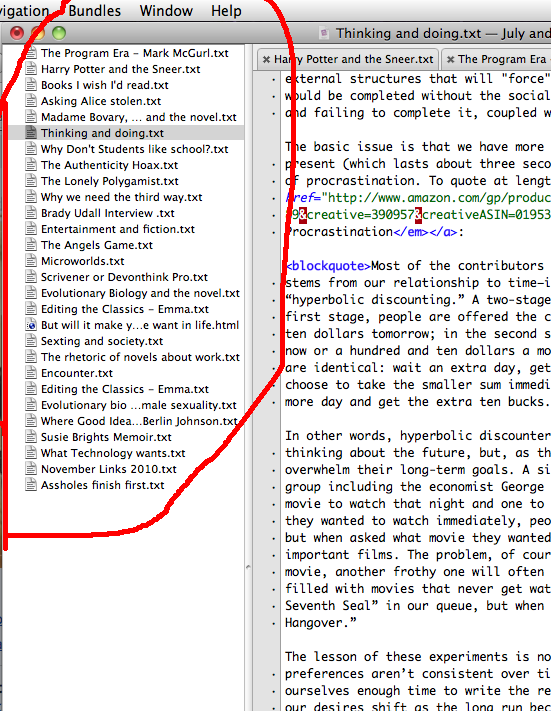
Oh: and I have a pile of unposted, half-written blog posts in my Textmate project drawer:
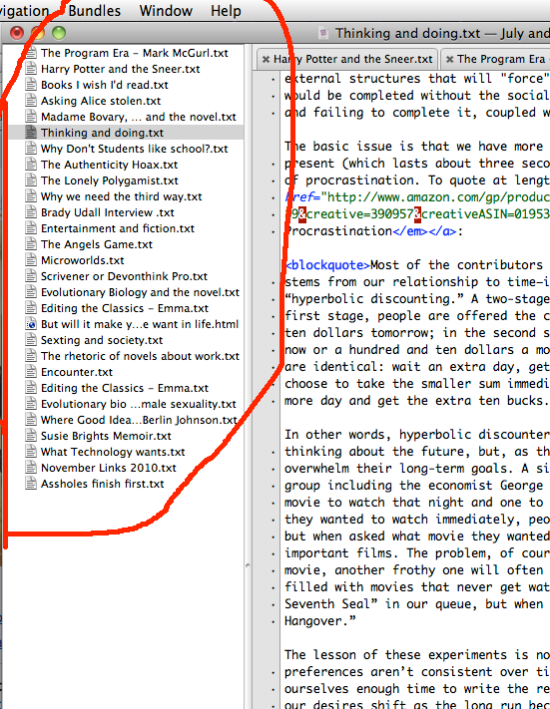
You can see a pile of them on the left. Most will eventually get written. Some will eventually be deleted. All were started with good intentions. Some have been sitting there for a depressingly long period of time. In fact, this post might have found its way among them, if not for the fact that I decided to write it in a single blaze of activity, and if not for the fact that I’m writing about procrastination, this post might have gone the way of many others: half-finished and eventually abandoned.

One reason I’ve had staying power with this blog, while so many of my friends have written a blog for a few months and then quit, is because I basically like blogging for its own sake. Blogging hasn’t brought me fame, power, money, groupies, or other markers of conventional success (so far, anyway!), and it appears unlikely to do so in the short- to medium-term (the long term is anyone’s guess). Sometimes I worry that blogging keeps me from more important work, like writing fiction, but I keep doing it because I like it and because blogging teaches me a lot about the subject I’m writing about and is an excellent forum for small ideas that might one day grow into much larger ones. This is basically the issue that “Signaling, status, blogging, academia, and ideas” discusses.

If the small projects lead to the big projects, you’re doing something right. If the small projects supplant, instead of supplementing, the big projects, you’re doing something wrong. But if you don’t like the small increments of whatever you’re working on, you’re not likely to get to the big project. You’re likely to procrastinate. You’re likely to skip from fantasy to fantasy instead of finding your place. You’re not likely to do the right kind of procrastinating. I wish I’d realized all this when I was younger. Of course, I wish I’d learned a lot of things when I was younger, but I didn’t have Surowiecki, Graham, Zimbardo, Max, and Feynman. Now I do, which enables me to say, “this blog post itself is a form of procrastination, but a productive one, and it’s therefore one I’m going to finish because I like writing it.” That sure beats improbable resolutions.
What an unappealing book description looks like: Jean-Christophe Valtat's 03

In an essay about Jean-Christophe Valtat’s novella 03, James Wood writes that the work is an “eight-one-page monologue, written in one unbroken paragraph, about a teenage boy’s unrequited love for a mentally handicapped girl he sees every day at the bus stop […]”

Although I can’t give a complete theory of what makes a novel unappealing, I do know that Wood’s description of 03 has many elements I might include: very little probably happens in terms of narrative, if the story occurs chiefly a bus stop. A whole book composed of a “monologue” sounds unappealing: the dialogic aspects, to use Bakhtin’s conception, of novels makes them fun and gives their stories urgency as people’s desires collide. I want plot. And “one unbroken paragraph” reads to me suspiciously like a gimmick, and, beyond seeming like a gimmick, this would make the book hard to read. The title, 03, also has the whiff of a gimmick or of existentialism.

The short description Wood offers tells me one major thing: I don’t want to read this book. I would much rather read Wood writing about this book than the book itself; he offers insights that are probably more important, in this case, than the work he’s writing about, which is never a good sign for a novel.

Various writers have raised the rally cry against writers who engage in confusing postmodern game playing for its own sake: this, more or less, describes B.R. Myers’ A Reader’s Manifesto, Tom Wolfe’s “Stalking the Billion-Footed Beast“, Lev Grossman’s “Good Books Don’t Have to Be Hard,” and, most recently, Justin Peacock’s “The New Social Novel,” which actually isn’t new, but I’m willing to spot him the adjective in this case. Although I wouldn’t endorse everything every writer says in each of these essays, I do think they point towards a general idea: give us novels of substance, although we don’t always know what we mean by novels of substance and can’t necessarily define them.

I’m guessing 03 isn’t one, however.

What an unappealing book description looks like: Jean-Christophe Valtat’s 03

In an essay about Jean-Christophe Valtat’s novella 03, James Wood writes that the work is an “eight-one-page monologue, written in one unbroken paragraph, about a teenage boy’s unrequited love for a mentally handicapped girl he sees every day at the bus stop […]”

Although I can’t give a complete theory of what makes a novel unappealing, I do know that Wood’s description of 03 has many elements I might include: very little probably happens in terms of narrative, if the story occurs chiefly a bus stop. A whole book composed of a “monologue” sounds unappealing: the dialogic aspects, to use Bakhtin’s conception, of novels makes them fun and gives their stories urgency as people’s desires collide. I want plot. And “one unbroken paragraph” reads to me suspiciously like a gimmick, and, beyond seeming like a gimmick, this would make the book hard to read. The title, 03, also has the whiff of a gimmick or of existentialism.

The short description Wood offers tells me one major thing: I don’t want to read this book. I would much rather read Wood writing about this book than the book itself; he offers insights that are probably more important, in this case, than the work he’s writing about, which is never a good sign for a novel.

Various writers have raised the rally cry against writers who engage in confusing postmodern game playing for its own sake: this, more or less, describes B.R. Myers’ A Reader’s Manifesto, Tom Wolfe’s “Stalking the Billion-Footed Beast“, Lev Grossman’s “Good Books Don’t Have to Be Hard,” and, most recently, Justin Peacock’s “The New Social Novel,” which actually isn’t new, but I’m willing to spot him the adjective in this case. Although I wouldn’t endorse everything every writer says in each of these essays, I do think they point towards a general idea: give us novels of substance, although we don’t always know what we mean by novels of substance and can’t necessarily define them.

I’m guessing 03 isn’t one, however.

Problems in the Academy: Louis Menand’s The Marketplace of Ideas: Reform and Resistance in the American University

The problems in American universities are mostly structural and economic, and the biggest are occurring on the faculty side of the liberal arts and social sciences: since around 1975, too many professors (or at least people earning PhDs) vie for faculty slots relative to the number of undergraduates. Menand says (twice) that “Between 1945 and 1975, the number of American undergraduates increased by 500 percent, but the number of graduate students increased by nearly 900.” Undergraduates clear out of the system in four to six years; graduate students who get PhDs (presumably) stay or wish to stay for whole careers. Since 1975, college enrollments have grown much more modestly than they did from 1945 – 1975, and the department that’s grown most is business, since so many undergraduates now major in it. But grad programs haven’t scaled back, leaving humanities types to fight for scarce jobs and write polemics about how much it sucks to fight for scarce jobs.

Menand doesn’t identify the supply/demand problems as the major root cause of the other issues around political/social conformity, time to degree for academic grad students, and so forth, but it’s hard not to trace “the humanities revolution,” “interdisiplinarity and anxiety,” and why all professors think alike to supply and demand. Each of those topics are each covered in a long chapter, and Menand’s first, on “The Problem of General Education,” seems least related to the others because it is mostly inside baseball: how we ended up requiring undergrads to take a certain number of courses in a certain number of fields, and what academia should be like. But the others make up for it.

The Marketplace of Ideas is worth reading for knowledge and style: the book has the feeling of a long New Yorker article—Menand is a staff writer there—and if he occasionally pays for it with the generalization that gets coldly stamped out of peer-reviewed writing, the trade-off is worthwhile. Menand is also unusually good at thinking institutionally, in terms of incentives, and about systems: those systems tend to evolve over time, but they also tend to harden in place unless some catastrophic failure eventually occurs. Such failures are often more evident in business than in public life, since businesses that fail catastrophically go bankrupt and are much more susceptible to competitors and regulators than governments. The academic system is, as Menand points out, something out of the 19th Century in its modes of tenure, promotion, displinarity, and so forth. But it’s unlikely to go anywhere in an immediate and obvious way because public universities are supported by taxpayers and even private ones are most often nonprofit. Furthermore, whatever problems exist, universities do well enough, especially from the perspective of students, and having a glut of PhDs to choose from doesn’t harm universities themselves. Consequently, I don’t see as great an impetus for change as Menand implies, very loosely, that there is.

Take, for example, the PhD production problems from earlier in this post. The logical conclusion would be for fewer people to enter PhD programs, for universities to close some programs, for degrees to take less time (the natural sciences often end up requiring five years from entering to conferring degrees, while humanities programs creeping above ten years), and so on. But there’s no real incentive for that on the part of an individual university: having graduate programs is impressive, grad students are cheap teachers, and people keep applying—even though they know the odds (this basically describes me).

Thus supply and demand stay out-of-whack. University departments can remain perhaps more insular than they should be. Publishing requirements increase as publishing becomes more difficult. But there’s little need to change so long as enough students enter PhD programs. Menand suggests shortening the time to graduate degrees, making them more immediately relevant, and closing some programs—none of which seem likely in the near future unless students stop enrolling. But they don’t because, once again like me, they see professors and think, “that looks like fun. I’ll take a flyer and see what happens.” Nonetheless, the professoriate is already changing in some ways: about half of students, as Menand observes and the Chronicle of Higher Education does too, are now taught by part-timers. With as many choices among instructors as universities have, that trend seems ripe for further acceleration.

Menand says that “For most of the book, I write as a historian.” He also says that he’s “not a prescriptivist” and implies pragmatism, rather than polemic. That’s wise: identifying the problems are probably easier than finding those pragmatic solutions to them. He uses English as an example of what’s going on more broadly, and he is an English professor at Harvard. Part of the crisis is within English departments—what exactly does it mean to study “English?”—and part of it is external. The part outside English departments has to do with rationale and economics—as Menand says, “People feel, out of ignorance or not, that there is a good return on investment in physics departments. In the 1980s, people began wondering what the return on investment was in the humanities.” Note his “people feel” formulation, which is unsourced but occurs throughout; most of the time, speaking of a common culture feels right because Menand has his finger on the intellectual zeitgeist enough to pull off such comments, and elsewhere he has the numbers to back those comments up, especially regarding the flatlining and even decline in the absolute and relative percentages of English majors on campus.

The other interesting thing is the word “crisis,” which I’ve used several times. The Oxford American Dictionary included with OS X says that crisis is “a time of intense difficulty, trouble, or danger.” The word “time” implies that crises should pass; but in English, the one or ones Menand identifies has lasted for more than a generation of academics. According to “The Opening of the Academic Mind” in Slate, “The state of higher education in America is one of those things, like the airline industry or publishing, that’s always in crisis.” In Rebecca Goldstein’s The Mind-Body Problem, the protagonist, Renee, thinks:

In the great boom of the late fifties and early sixties, graduate departments, particularly at state universities, had expanded and conferred degrees in great abundance. But then the funds, from both government and private foundations, had dried up, and departments shrunk, resulting in diminishing need. Suddenly there was a large superfluity of Ph.D.s, compounded by demographic changes […] The result has been a severe depression, in both the economic and psychological senses, in the academic community.

That was published in 1983. People are still publishing the same basic argument today, only now they often do it online. Perhaps the real lesson is that academics are great at learning many things, but supply/demand curves and opportunity costs are not among them, except for economists.

The problems are exacerbated in the humanities and social sciences because grad students in those fields don’t have industry to fall back on, but the natural sciences are not immune either. As Philip Greenspun points out in “Women in Science,” America seems more than willing to source its science graduate students from developing countries, which takes care of supply from that angle (if you read his essay, ignore the borderline or outright sexist commentary regarding women, even if his point is that women are too smart to go to grad school in the sciences; pay attention to the institutional and systematic focus, especially when he points out that “Adjusted for IQ, quantitative skills, and working hours, jobs in science are the lowest paid in the United States”).

Of course, even as I make myself aware of works like The Marketplace of Ideas, I continue working toward that PhD, convinced that I’ll be the one who beats the odds that are still better than Vegas, though not by a lot. But I’m also part of the imbalance: too many people seeking PhDs for few too jobs, particularly too few jobs of the sort we’re being trained to do. Yet academics still provide a vital function to society in the form of knowledge, and in particular knowledge that’s undergone peer review, however difficult or abstruse peer review may have become in the humanities (for more, see Careers—and careerism—in academia and criticism).

The question of what academia should be like is to some extent driven by what professors think it should be like, but it’s also driven by what students think it should be like. Students ultimately drive academia by choosing where to go to school. An increasing number of them are choosing community and online higher education. It’s not clear what this shift means either. Still, professors have blame as well: as the aforementioned Slate article suggests, “[…] Professors, the people most visibly responsible for the creation of new ideas, have, over the last century, become all too consummate professionals, initiates in a system committed to its own protection and perpetuation.” True. But given that they have tenure, control departments, and confer the PhDs necessary to become professors, it seems unlikely that major change will come from that quarter.

Ian McEwan and "The Use of Poetry"

The main use poetry in “The Use of Poetry” is seduction: specifically, the seduction of the liberal artist Maisie (recalling shades of Henry James: What did Maisie know?) by the scientist Michael Beard in the late 60s. Michael learns enough Milton to impress Maisie, with her artistic tendencies, a feat that I doubt I’d have the discipline for despite being another liberal artist; they go out, Michael realizes his disdain for what seems the foppish laziness of the liberal arts, and he reinforces the inferiority complex many English majors feel in the face of hard science.

Or maybe not: when we think we see Michael’s perspective on how easy it is to read “four of the best essays on Milton,” McEwan drops this in by airmail:

Many years later, Beard told this story and his conclusions to an English professor in Hong Kong, who said, “But, Michael, you’ve missed the point. If you had seduced ninety girls with ninety poets, one a week in a course of three academic years, and remembered them all at the end—the poets, I mean—and synthesized your reading into some kind of aesthetic overview, then you would have earned yourself a degree in English literature. But don’t pretend that it’s easy.”

That’s the only mention of the “English professor in Hong Kong,” who appears, nameless, only long enough to correct us. He or she disappears: there is no wrapping up, no coming together of the English professor and some deeper meaning. He or she is there to tell us, and “The Use of Poetry” seems like a rebuke to the “Show, don’t tell” school of writing: it is all telling, or nearly all, and it teasingly plays with real world correspondences. “The Use of Poetry” says:

This understanding was the mental equivalent of lifting very heavy weights—not possible at first attempt. He and his lot were at lectures and lab work nine till five every day, attempting to grasp some of the hardest things ever thought. The arts people fell out of bed at midday for their two tutorials a week.

A February 2009 profile of McEwan, also in the New Yorker, says:

McEwan enjoyed studying calculus—“It was like trying to lift a weight that was a little too heavy”—but he settled on literature, and showed enough promise that he was urged to apply for a scholarship at Cambridge.

Maybe McEwan fears the limits of our cognition, or his own cognition. Or maybe I am engaging the intentional fallacy. Surely the editors of The New Yorker noticed this correspondence in their earlier nonfiction piece and this later work of fiction. What, if anything, did they make of it? Were they as uncertain as me?

Finally, what to make of the title: “The Use of Poetry,” rather than “uses?” Apparently poetry has only one use, seduction, as I unfairly said in the first line of this post. But maybe it is not asking, “What is poetry used for?” but rather, “how and why is poetry used by a particular person—Michael—or people in general?” The title probably has other meanings too, like most poems, with their rascally habit of evading a single interpretation.

For some reason, I am reminded of Kundera’s The Unbearable Lightness of Being: both that novel and this story are highly directive, allusive, focusing on what love means in a modern context, using love to examine ideas and ideas to examine love. They both end, not with a statement or feeling of wholeness, but with a feeling of new sight but perpetual incompleteness, like that is our fate, no matter the math we learn or the poems we study. Could “The Use of Poetry” be to remind us of what we can never fully grasp, like Michael trying to understand the liberal arts, or Milton, who was in turn trying to understand us? Hard to say. But then, a lot in life is hard to say. The best we can do with it is try. Maybe with a poem.

Or a story.

EDIT: If you’re here because you’ve been assigned a paper on McEwan, you might find this post to be of great interest.