I’m declaring library bankruptcy

The University of Arizona wants its books back, and many of them have been renewed three or more times and have been squatting in my apartment for more than a year. It’s time to declare library bankruptcy and admit to myself that many of the worthy books towards which I once had such noble and good intentions simply aren’t going to get read:

(I scrounged up a few others, too, because library books proliferate like bad ideas on the Internet if you’re not fastidious about corralling and curtailing them.)

I could imagine some of them being checked out again—the ones about Hollywood novels, or J. Hillis Miller’s work. But Critical Essays on Melville’s Pierre seems like an unlikely choice, and in the immediate future I still have lots of books I’ve picked up from libraries or friends, or been sent by publishers (thanks, publishers!), or that I need to read for exams or my own work. This stack feels a bit like failure, but sending it back also feels like the proverbial fresh.

Have you declared library bankruptcy before? If so, how’d it go?

Even sending back books I know I’m likely to read feels curiously bad, like I’m quitting a race three quarters through.

Acceptable and unacceptable status in America

See this fascinating and largely accurate list of what kinds of inequality are acceptable and what kinds aren’t, by David Brooks; note especially:

Status inequality is acceptable for college teachers. Universities exist within a finely gradated status structure, with certain schools like Brown clearly more elite than other schools. University departments are carefully ranked and compete for superiority.

Status inequality is unacceptable for high school teachers. Teachers at this level strongly resist being ranked. It would be loathsome to have one’s department competing with other departments in nearby schools.

And people involved in each system probably believe in both without questioning why they do or how they came to believe what they believe.

Many English and humanities grad students and professors seem to find differences in income inequality abhorrent and believe they are probably the result of unequal access to resources or education but also believe differences in status and work quality in their own fields largely the result of merit, hard work, tenacity, and determination. When they get lousy papers from students, relatively few seem to attribute lousy papers to various kinds of inequality of opportunity and many attribute them to laziness, poor time management, and so forth.

In addition, academics, at least of the humanities varieties, don’t like flashy cards but do like flashy CVs. So the status of certain activities are different. Teachers appear to dislike both and seem to like markers of perceived equality, even though anyone who’s been through school is doubtlessly aware that not all teachers are equally skilled or passionate.

Also, on a personal note, I am a propagating this kind of inequality:

Cupcake inequality is on the way up. People will stand for hours outside of gourmet cupcake stores even though there are other adequate cupcakes on offer with no waiting at nearby Safeways.

The cupcakes at Magnolia Bakery in NYC and LA or Cupcake Royale in Seattle are so much better than most cupcakes that the difference astonishes. Yet part of my perception might be because they’re very hard for me, in Tucson, to find and acquire. (There is a place called Red Velvet that also sells expensive cupcakes, but they’re too dense and have the wrong mouthfeel.) PinkBerry used to be feel special, but now there’s going to be one a few miles from me, which means I’m much less likely to go out of my way to get one when I’m in LA. So maybe I’m actually consuming status as much as I’m consuming sugary confections. Now PinkBerry is opening at the University of Arizona, which means it won’t be a treat but something I walk past routinely.

I would be interested in seeing other lists of this kind and for other countries.

Brooks ends: “Dear visitor, we are a democratic, egalitarian people who spend our days desperately trying to climb over each other. Have a nice stay.” We may also believe that equality of opportunity doesn’t imply equality of results, although that itself might be acceptable to believe while it might not be acceptable to believe in many circles that we have equality of opportunity.

It is acceptable to believe that many kinds of inequality affect women and few or none do men, which Roy Baumeister writes about extensively in Is There Anything Good About Men?: How Cultures Flourish by Exploiting Men. For most people, it is also acceptable to have a very high number of sex partners as long as you don’t brag too publicly about it; rare, brash exceptions generate hilarity, as in Tucker Max or Chelsea Handler.

The Uses of Poetry and Search Queries

Blog search traffic patterns are fascinating when they clearly relate to someone’s English class—over the past couple days, I’ve seen a few dozen hits on “Ian McEwan and ‘The Use of Poetry.’” Many come in a form like this, from today: “the use of poetry ian mcewan analysis”. On November 15, when I’m writing this, the McEwan piece already has 20 hits, which is very unusual for a two-year-old post that hasn’t been, so far as I know, linked to by other bloggers or discussed on forums. Given the nature of the queries, I would guess that students are the prime consumers, and out there somewhere are papers on “The Use of Poetry” that will claim seduction to be the primary use of poetry, never mind the distinction I make that seduction is the primary use of poetry for Michael Beard, the eventual protagonist of Ian McEwan’s Solar, and what is true of Michael Beard will not necessarily be true of every reader of poetry.

This semester I assigned Tom Perrotta’s Election and Anita Shreve’s Testimony to my own students. When the first draft of the paper came due, I noticed that “Thoughts on Anita Shreve’s Testimony and Tom Perrotta’s Election” was getting an unusual number of hits; points two and seven occurred distressing frequency in the papers I eventually read. Some of that is probably due to those features being obvious in the novels. The rest might be attributable to the Internet. No one outright plagiarized, to my knowledge, though I have heard professors say that students search the Internet, find one of the professor’s articles on a subject, copy it, and then turn it in to the very professor who wrote the article.

These practices remind me of William Deresiewicz’s essay Solitude and Leadership: If you want others to follow, learn to be alone with your thoughts,” where he says

I sat on the Yale College admissions committee a couple of years ago. The first thing the admissions officer would do when presenting a case to the rest of the committee was read what they call the “brag” in admissions lingo, the list of the student’s extracurriculars. Well, it turned out that a student who had six or seven extracurriculars was already in trouble. Because the students who got in—in addition to perfect grades and top scores—usually had 10 or 12.

So what I saw around me were great kids who had been trained to be world-class hoop jumpers. Any goal you set them, they could achieve. Any test you gave them, they could pass with flying colors. They were, as one of them put it herself, “excellent sheep.” I had no doubt that they would continue to jump through hoops and ace tests and go on to Harvard Business School, or Michigan Law School, or Johns Hopkins Medical School, or Goldman Sachs, or McKinsey consulting, or whatever.

What worries me about the people searching for “The Use of Poetry” or Election is simple: I get the sense many of the people doing so are becoming “hoop jumpers,” instead of thinking for themselves. The scholarly and intellectual practice of seeking the opinions of others to stimulate your own thinking is an important one. But how many of the searchers for “analysis” are doing that? I suspect most of them are looking for someone else’s pre-digested work to parrot back to their instructors. And this might be a viable way of getting through school. But the digestion is the point—without the time spent struggling with a problem in your own mind, you’re not going to learn how to identify and solve problems that no one else has seen, or worked on, or discussed.

I see this issue around me among grad students (and, sometimes, professors). A lot of grad students have spent their whole lives trying to please someone else, and when they get to the point in their careers—usually around their dissertation—where they have to work without real guidance or guidelines, many flail. A lot of people in general experience that sense when they leave school, whether they leave at 18 or 38. The externally imposed goals and rules get removed. Instead of being told the use of poetry, or statistics, or calculus, they have to decide it for themselves. But if they haven’t spent time thinking about what poetry might do in “The Use of Poetry,” or how McEwan expresses himself, or any number of other things, they aren’t going to have the skills they need not only to write, but to deal with life.

The Internet is a wonderful thing for seeking the opinions of others, but it’s a mistake to seek them before you’ve taken the time to try and develop opinions and skills of your own. If you lean too much on others, you won’t be able to work through things for yourself. Deresiewicz gets this, and the perils of too much copying and listening to others and going to the Internet for opinions: “I can assure you from personal experience that there are a lot of highly educated people who don’t know how to think at all.” Used wrongly, the Internet can become a vessel not for thinking, but for its opposite. Before you hit the Internet for ideas, you need to give yourself time to develop what Grady Tripp, in Wonder Boys, calls “the midnight disease,” which writers suffer from; he describes it this way:

[… it] started out as a simple feeling of disconnection from other people, an inability to ‘fit in’ by no means unique to writers, a sense of envy and of unbridgeable distance like that felt by someone tossing a restless pillow in a world full of sleepers. Very quickly, though, what happened with the midnight disease was that you began actually to crave this feeling of apartness, to cultivate and even flourish within it. You pushed yourself farther and farther and farther apart until one black day you woke to discover that you yourself had become the chief object of your hostile gaze.

And I don’t think this unique to writer: programmers, hackers, engineers, scientists, and others probably feel too (Richard Feynman in Surely You’re Joking, Mr. Feynman!: “Mr. Frankel [. . .] began to suffer from the computer disease that anybody who works with computers now knows about. It’s a very serious disease and it interferes completely with the work. The trouble with computers is that you play with them”): all the people who, like Gollum in The Lord of the Rings, still desire to walk free under the sun even as they are compelled to return to darkness and solitude. The solitude is what it takes to do the work. Writers, at least of the novelist variety, are usually writing about people, which makes it odd that one needs to get away from people to describe people, but it’s nonetheless true. Tripp calls it a “disease” and “a simple feeling of disconnection,” both with their negative connotations, but Mihaly Csikszentmihalyi calls it Flow and others call it creativity. Creativity needs other ideas to stimulate it—that’s one of Steven Berlin Johnson’s main points in Where Good Ideas Come From—but it also needs silence. It needs to stay away from Google, from other people babbling in your ear and telling you what to think and giving you their dubious “analysis.” The Internet gives us the option of letting others do our thinking for us. So, if you’re reading this on the Internet, let me encourage you to think for yourself before others do it for you.

Bech on writers and publishers

When I think of the matings, the moaning, jubilant fornications between between ectomorphic oversexed junior editors and svelte hot-from-Wellesley majored-in-English-minored-in-philosophy female coffee-fetchers and receptionists that have been engineered with the lever of some of my poor scratched-up and pasted-over pages (they arrive in the editorial offices as stiff with Elmer’s glue as a masturbator’s bedsheet; the office boys use them for tea-trays), I could mutilate myself like sainted Origen, I could keen like Jeremiah. Thank Jahweh these bordellos in the sky can soon dispense with the excuse of us entirely; already the contents of a book count as little as the contents of a breakfast cereal box. It is all a mater of the premium, and the shelf site, and the amount of air between the corn flakes.

That’s Henry Bech by way of John Updike, Bech being Updike’s Jewish, childless alter ego, who wrote one major book (Travel Light) and is the responsible party for a number of others, or so I’m told. He can also turn it on when he needs to—the writing thing, I mean, mostly—and is maybe too self-aware, given his propensity for analogizing writing to sex and sometimes vice-versa.

And he has a taste for obscure, at least to me, allusion. Wikipedia on Origen: “Origen, or Origen Adamantius, 184/5–253/4, was an early Christian Alexandrian scholar and theologian, and one of the most distinguished writers of the early Church.”

Wikipedia on “svelte hot-from-Wellesley majored-in-English-minored-in-philosophy female coffee-fetchers:” “The page “Svelte hot-from-Wellesley majored-in-English-minored-in-philosophy female coffee-fetchers” does not exist. You can ask for it to be created, but consider checking the search results below to see whether the topic is already covered.”

Also, I realize that it’s customary for writers to be cranky on their status as cultural figures; publishers would no doubt like to “dispense with the excuse of us entirely,” but, alas, without books those “oversexed junior editors” and Wellesley grads wouldn’t be employed; it’s hard to imagine them on Wall Street, easier to imagine them unemployed and occupying Wall Street, which is probably even worse paid than publishing. And books endure to the extent a society needs them to endure; what strikes me most about a lot of the older novels I read is that their concerns seem like solved problems. Religion, at least as practiced by most people, seems more about conveying status than it does about the supernatural. Sexual strictures that once bound society have disappeared or shifted, leaving novelists without an obvious source of plot tension and the patina of age on many older novelists who used that as the primary driver of their plots.

Given what’s happened to many—but not all—older writers as a source of cultural authority and importance, and how few people read many of them outside of classrooms, we can easily start to understand how worried Bech is about his life’s work being as important as “the contents of a breakfast cereal box.” He’s tongue-in-cheek, but only halfway. In the age of the “Twilight of the Books,” it’s hard to be a word-slinger of the book variety, especially when so many garrulous bloggers like yours truly are willing to give it away for free.

And people aren’t that inclined to pay for what they can get for free. They also might not value it as much, making high culture-types unhappy about their perceived or actual relevance, which gives us a nice space for mocking and upholding their concerns about relevance at once. Enter Bech, in the fallen age of the novel—though the novel always seems to be dying, but readers don’t seem to have been informed. They keep gathering up words like so many corn flakes, and writers keep the factories running.

Umberto Eco at the New York Public Library for The Prague Cemetery

In a talk with Paul Holdengräber, Umberto Eco said that “I have no particular interest in psychoanalysis,” but the interviewer kept pressing. Eco said, “My problem with psychoanalysis is due to my pride.” He’d be too eager to “trick” the analyst. It’s a writerly comment, and I get the impression that he’s playing tricks with and on readers (and listeners) too, continually pulling himself back from definitive statements and teasing one with the power of narrative (did you guess the murderer and his reasons in The Name of the Rose? Can you reconstruct the weirdly chopped narrative in The Prague Cemetery? For me the answers are no.)

In addition: Eco said he’s not tempted by psychoanalysis because it’s too expensive, which is rather hilarious given his obvious wealth and the relative lowness of monetary concerns compared with the abstract, aesthetic or intellectual concerns around intellectual power and honesty. I identify with Eco, and if I were in psychoanalysis I’d want to trick the therapist too, which might defeat some of the purpose. Besides, Eco says he “doesn’t offer cures,” which is good: novelists should offer stories. Eco’s are tall, and he has the glint of a precocious child caught in a lie but still amused and chuckling at his ability to trick you, and he has that childlike sense of the very intelligent and curious, akin to your favorite professor in college; I’m trying to cultivate the same attitude, but it’s a bit like trying to grow tomatoes in Seattle.
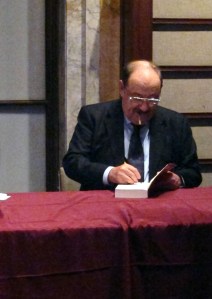
Eco revealed other things: he loves the English words “discombobulation” and “flabbergasted,” both of which I also admire, though not as much as “specious” and “callipygian.” He says “stupidity is fascinating,” which is true, especially because stupidity can often be harder to define, and one can go from feeling pleased with one’s own intelligence to feeling quite the fool with astonishing quickness—which is one of the delights in The Name of the Rose, when William realizes that his vaunted mind has created connections where none exist and that he has been led astray by his own certainty. In The Prague Cemetery, Simonini the forger preys on the trust and paranoia of others. Eco calls him a character without any kind of morality. I would add that he has no epistemological foundation, which lets him ply his trade; Eco says “the world is full of Simoninis,” which also implies we should watch for them and the conditions, like war and paranoia, that allow them to prosper.

The Prague Cemetery is set in the 19th Century, but, like all novels set in a time not our own, it invariably comments on our own. Eco cited the imagined Iraqi weapons that gave a pretext for the second Iraq War in 2003 as an example of Simoninis at work. We tend to have too much credulity. Generalization is a scourge and specifics beautiful—except, of course, for this generalization.

Hearing and reading Eco shows a powerful and finely calibrated mind at work, which is a great and too rare pleasure. Listening to the talk and reading Eco’s work makes me want to be a better writer—and a better reader, since the two can’t be separated from each other. Another point: I can’t convey most of Eco’s hilarity. It’s too dependent on delivery and comic timing. Eco uses timing effectively, and he’s willing to let agonizing silence hang.

In Reflections on The Name of the Rose, Eco said that novels are born of a single, seminal idea; in the case of that novel, the desire to see a monk murdered (he originally wrote that he wanted to poison a monk, but he has since made the subtle but important change to take some of the agency out of his hands). So Holdengräber asked about the seminal idea in The Prague Cemetery. Eco said he didn’t have one. Things change. It might be futile to ask a writer about their methods, since writers, like lovers, might be motivated by all sorts of things at different times and places.

Eco said in the talk that “The novel is always a way of discovering something,” but I wonder if novels are really means of discovering how little we know and how strange things really are if we look closely enough. We really are strangers to ourselves, but we often don’t recognize it. Eco, I sense, does, and that may explain his uninterest in psychoanalysis. He’s essentially wary of the mind’s associative tendencies, which he associates with conspiracy theorists. The idea of conspiracy enters those of his novels I’ve read: The Name of the Rose, where William imagines a possible conspiracy, Foucault’s Pendulum, where Casaubon and the editors make up a conspiracy for their own amusement, The Prague Cemetery, which, so far, is overrun with characters whose dubious ability to infer causal relationships where none exist enables Simonini to flourish.

The end of the talk was disappointing: Holdengräber asked about the role of the Internet in changing research and the role of libraries in the age of the Internet, Eco offered platitudes long familiar to New York Review of Books readers, and, besides, no one really knows what’s going to happen over time.

I haven’t deeply discussed The Prague Cemetery in this post because he didn’t speak much about it. In addition, I’m about halfway through the novel and continue to dislike it—not because of its protagonist, a man as close to wicked, evil deception (as opposed to the humorous kind Eco practices) as Eco can probably make, but because of is narrative structure. The novel is divided between three major narratives, two of which may be multiple personalities from the same person, and much of it is told in diary form. It’s hard to track who is doing what and why he’s doing it.

Narrative games are a long-standing interest of Eco’s; to return to Reflections on the Name of the Rose:

Another problem: the encasement of the voices, or, rather, of the narrative points of view. I knew that I was narrative a story with the words of another person, having declared in the preface that this person’s words had been filtered through at least two other narrative points of view, that of Mabillon and that of the Abbé Vallet, even if they had supposedly operated only as philologists (but who believes that?). The problem arose again, however, within Adso’s first-person narration. Adso, at the age of eighty, is telling about what he saw at the age of eighteen. Who is speaking, the eighteen-year-old Adso or the eighty-year-old? Both, obviously; and this is deliberate. The trick was to make the old Adso constantly present as he ponders what he remembers having seen and felt as the young Adso.

But “the encasement of the voices” is easily followed in The Name of the Rose, and the various voices in Foucault’s Pendulum are anchored by Casaubon. One can follow what someone is doing and, more or less, why they are doing it. That’s not especially true in The Prague Cemetery, where the protagonist, Simonini is mostly writing a “diary,” while other voices track what he’s doing.

Does this sound confusing? I’ve reread the last couple paragraphs a couple times and find no way to simplify my explanation. The novel begins to feel more like an exploration of narrative games, along the lines of late Henry James, Herman Hesse, or Philip K. Dick, and less like a story. In Reflections, Eco writes that “Unquestionably, the modern novel has sought to diminish the amusement resulting from the plot in order to enhance other kinds of amusement. As a great admirer of Aristotle’s Poetics, I have always thought that, no matter what, a novel must also—especially—amuse through its plot.” Maybe he is no longer convinced “a novel must also [. . .] amuse through its plot,” or he has expanded his definition of “amuse,” or Eco has changed his mind, as he has about the need for a novel to come from a seminal image.

I keep reading Eco because I hope for a novel as powerful as The Name of the Rose or Foucault’s Pendulum. I hope to get one.

A writer's complaint about realism

A writer friend: “I’ve suffered from too many books made boring in the name of realism to indulge it myself.”

Amen. If you have a trade-off between verisimilitude and cleverness, choose whichever will be the most fun. I’ll forgive hilarity but not tedium. Most of us are surrounded by boring people with incoherent, shallow thoughts all day long, and we don’t need to read about them too. Many of us are such people, however witty we may want or imagine ourselves to appear in our writing.

A writer’s complaint about realism

A writer friend: “I’ve suffered from too many books made boring in the name of realism to indulge it myself.”

Amen. If you have a trade-off between verisimilitude and cleverness, choose whichever will be the most fun. I’ll forgive hilarity but not tedium. Most of us are surrounded by boring people with incoherent, shallow thoughts all day long, and we don’t need to read about them too. Many of us are such people, however witty we may want or imagine ourselves to appear in our writing.

College graduate earning and learning: more on student choice

There’s been a lot of talk among economists and others lately about declining wages for college graduates as a group (for example: Arnold Kling, Michael Mandel, and Tyler Cowen) and males in particular. Mandel says:

Real earnings for young male college grads are down 19% since their peak in 2000.
Real earnings for young female college grads are down 16% since their peak in 2003.

See the pretty graphs at the links. These accounts are interesting but don’t emphasize, or don’t emphasize as much as they should, student choice in college majors and how that affects earnings. In “Student choice, employment skills, and grade inflation,” I said that colleges and universities are, to some extent, responding to student demand for easier classes and majors that probably end up imparting fewer skills and paying less. I’ve linked to this Payscale.com salary data chart before, and I’ll do it again; the majors at the top of the income scale are really, really hard and have brutal weed-out classes for freshmen and sophomores, while those at the bottom aren’t that tough.

It appears that students are, on average, opting for majors that don’t require all that much effort.

From what I’ve observed, even naive undergrads “know” somehow that engineering, finance, econ, and a couple other majors produce graduates that pay more, yet many end up majoring in simple business (notice the linked NYT article: “Business majors spend less time preparing for class than do students in any other broad field, according to the most recent National Survey of Student Engagement [. . .]”), comm, and other fields not noted for their rigor. As such, I wonder how much of the earnings picture in your graph is about declining wages as such and how much of it is really about students choosing majors that don’t impart job skills of knowledge (cf Academically Adrift, etc.) but do leave plenty of time to hit the bars on Thursday night. Notice too what Philip Babcock and Mindy Marks found in “The Falling Time Cost of College: Evidence from Half a Century of Time Use Data:” “Full-time students allocated 40 hours per week toward class and studying in 1961, whereas by 2004 they were investing about 26 to 28 hours per week. Declines were extremely broad-based, and are not easily accounted for by compositional changes or framing effects.”

If students are studying less, maybe we shouldn’t be surprised that their earnings decline when they graduate. I can imagine a system in which students are told that “college” is the key to financial, economic, and social success, so they go to “college” but don’t want to study very hard or learn much. They want beer and circus. So they choose majors in which they don’t have to. Schools, in the meantime, like the tuition dollars such students bring—especially when freshmen and sophomores are often crammed in 300 – 1,000-person lecture halls that are extraordinarily cheap to operate because students are charged the same amount per credit hour for a class of 1,000 as they are for a seminar of 10. Some disciplines increasingly weaken their offerings in response to student demand.

Business appears to be one of those majors. It’s in the broad middle of Payscale.com’s salary data, which is interesting given how business majors presumably go into their discipline in part hoping to make money—but notice too just how many generic business majors there are. The New York Times article says “The family of majors under the business umbrella — including finance, accounting, marketing, management and “general business” — accounts for just over 20 percent [. . .] of all bachelor’s degrees awarded annually in the United States, making it the most popular field of study.” That’s close to what Louis Menand reports in The Marketplace of Ideas: “The biggest undergraduate major by far in the United States is business. Twenty-two percent of all bachelor’s degrees are awarded in that field. Ten percent of all bachelor’s degrees are awarded in education.” If all these business majors graduate without any job skills, maybe we shouldn’t be all that surprised at their inability to command high wages when they graduate.

I’d like to know: has the composition of majors changed over the years Mandel documents? If so, from what to what? Menand has some coarse data:

There are almost twice as many bachelor’s degrees conferred every year in social work as there are in all foreign languages and literatures combined. Only 4 percent of college graduates major in English. Just 2 percent major in history. In fact, the proportion of undergraduate degrees awarded annually in the liberal arts and sciences has been declining for a hundred years, apart from a brief rise between 1955 and 1970, which was a period of rapidly increasing enrollments and national economic growth. Except for those fifteen unusual years, the more American higher education has expanded, the more the liberal arts sector has shrunk in proportion to the whole.

But he’s not trying to answer questions about wages. Note too that my question about composition is a genuine one: I have no idea of what the answer is.

One other major point: if Bryan Caplan is right about college being about signaling, then there might also be a larger composition issue than the one I’ve already raised: people who aren’t skilled learners and who don’t have the willingness or capacity to succeed after college may be increasingly attending college. In that case, the signal of a college degree isn’t as valuable because the people themselves going through college aren’t as good—they’re on the margins, and the improvement to their skillset is limited. Furthermore, colleges universities aren’t doing all that much to improve that skillset—see again Academically Adrift.

I don’t know what, if anything, can be done to improve this dynamic. Information problems about which college major pay the most don’t seem to be a major issue, at least anecdotally; students know that comm degrees are easy and other, more lucrative degrees are hard. There may be Zimbardo / Boyd-style time preference issues going on, where students want to consume present pleasure in the form of parties and “hanging out” now at the expense of earnings later, and universities are abetting this in the form of easy majors.

This is the part where I’m supposed to posit how the issues described above might be improved. I don’t have top-down, pragmatic solutions to this problem—nor do I see strong incentives on the part of any major actors to solve it. Actually, I don’t see any solutions, whether top-down or bottom-up, because I don’t think the information asymmetry is all that great and consumption preferences mean that, even with better information, students might still choose comm and generic business.

Mandel ends his post by saying, “Finally, if we were going to design some economic policies to help young college grads, what would they be?” The answer might be something like, “make university disciplines harder, so students have to learn something by the end,” but I don’t see that happening. That he asks the question indicates to me he doesn’t have an answer either. If there were one, we wouldn’t have a set of interrelated problems regarding education, earnings, globalization, and economics, which aren’t easy to disentangle.

Although I don’t have solutions, I will say this post is a call to pay more attention to how student choices and preferences affect education and earnings discussions.

EDIT: See also College has been oversold, and pay special attention to the data on arts versus science majors. I say this as someone who majored in English and now is in grad school in the same subject, but by anecdotal observation I would guess about 75% of people in humanities grad schools are pointlessly delaying real life.

Facebook, go away—if I want to log in, I know where to find you

Facebook keeps sending me e-mails about how much I’m missing on Facebook; see the image at the right for one example. But I’m not convinced I’m missing anything, no matter how much Facebook wants me to imagine I am.

In “Practical Tips on Writing a Book from 23 Brilliant Authors,” Ben Casnocha says that writers need to “Develop a very serious plan for dealing with internet distractions. I use an app called Self-Control on my Mac.” Many other writers echo him. We have, all of us, a myriad of choices every day. We can choose to do something that might provide some lasting meaning or value. Or we can choose to tell people who are often effectively strangers what we ate for dinner, or that we’re listening to Lynyrd Skynyrd and Lil’ Wayne, or our inconsidered, inchoate opinions about the political or social scandal of the day, which will be forgotten by everybody except Wikipedia within a decade, if not a year.

Or we can choose to do something better—which increasingly means we have to control distractions—or, as Paul Graham puts it, “disconnect” them. Facebook and other entities that make money from providing distractions are, perhaps not surprisingly, very interested in getting you more interested in their distractions. That’s the purpose of their e-mails. But I’ve becoming increasingly convinced that Facebook offers something closer to simulacra than real life, and that the people who are going to do something really substantial are, increasingly, going to be the people who can master Facebook—just as the people who did really substantial things in the 1960 – 2005 period learned to master TV.

Other writers in the “Practical Tips” essay discuss the importance of setting work times (presumably distinct from Facebook times) or developing schedules or similar techniques to make sure you don’t let, say, six hours pass, then wonder what happened during those six hours—probable answers might include news, e-mail, social networks, TV, dabbling, rearrange your furniture, cleaning, whatever. All things that might be worthwhile, but only in their place. And Facebook’s place should be small, no matter how much the site itself encourages you to make it big. I’ll probably log on Facebook again, and I’m not saying you should never use Facebook, or that you should always avoid the Internet. But you should be cognizant of what you’re doing, and Facebook is making it increasingly easy not to be cognizant. And that’s a danger.

I was talking to my Dad, who recently got on Facebook—along with Curtis Sittenfeld joining, this is a sure sign Facebook is over—and he was creeped out by having Pandora find his Facebook account with no active effort on his part; the same thing happened when he was posting to TripAdvisor under what he thought was a pseudonym. On the phone, he said that everyone is living in Neuromancer. And he’s right. Facebook is trying to connect you in more and more places, even places you might not necessarily want to be connected. This isn’t a phenomenon unique to Facebook, of course, but my Dad’s experience shows what’s happening in the background of your online life: companies are gathering data from you that will reappear in unpredictable places.

There are defenses against the creeping power of master databases. I’ve begun using Ghostery, a brilliant extension for Firefox, Safari, and Chrome that lets one see web bugs, beacons, and third-party sites that follow your movements around the Internet. Here’s an example of the stuff Salon.com, a relatively innocuous news site, loads every time a person visits:

What is all that stuff? It’s like the mystery ingredients in so much prepackaged food: you wonder what all those polysyllabic substances are but still know, on some level, they can’t be good for you. In the case of Salon.com’s third-party tracking software, Ghostery can at least tell you what’s going on. It also gives you a way to block a lot of the tracking—hence the strikethroughs on the sites I’ve blocked. The more astute among you will note that I’m something of a hypocrite when it comes to a data trail—I still buy stuff from Amazon.com, which keeps your purchase history forever—but at least one can, to some extent, fight back against the companies who are tracking everything you do.

But fighting back technologically, through means like Ghostery, is only part of the battle. After I began writing this essay, I began to notice things like this, via a Savage Love letter writer:

I was briefly dating someone until he was a huge asshole to me. I have since not had any contact with him. However, I have been Facebook stalking him and obsessing over pictures of the guys I assume he’s dating now. Why am I having such a hard time getting over him? Our relationship was so brief! He’s a major asshole!

I don’t think Facebook is making it easier for the writer to get over him or improve your life. It wouldn’t be a great stretch to think Facebook is making the process harder. So maybe the solution is to get rid of Facebook, or at least limit one’s use, or unfriend the ex, or some combination thereof. Go to a bar, find someone else, reconnect with the real world, find a hobby, start a blog, realize that you’re not the first person with these problems. Optimal revenge, if you’re the sort of person who goes in that direction, is a life well-lived. Facebook stalking is the opposite: it’s a life lived through the lives of others, without even the transformative power of language that media like the novel offer.

Obviously, obsessive behavior predated the Internet. But the Internet and Facebook make it so much easier to engage in obsessive behavior—you don’t even have to leave your house!—that the lower friction costs make the behavior easier to indulge. One solution: remove the tool by which you engage in said obsessive behavior. Dan Savage observes, “But it sounds like you might still have feelings for this guy! Just a hunch!” And if those feelings aren’t reciprocated, being exposed to the source of those feelings on a routine basis, even in digital form, isn’t going to help. What is going to help? Finding an authentic way of spending your time; learning to get in a state of flow; building or making stuff that other people find useful. Notice that Facebook is not on that list.

Some of you might legitimately ask why I keep a Facebook account, given my ambivalence, verging on antipathy. The answers are several fold: the most honest is probably that I’m a hypocrite. The next-most honest is that, if / when my novels start coming out, Facebook might be useful as an ad tool. And some people use Facebook and only Facebook to send out messages about events and parties. It’s also a useful to figure out when I’m going to a random city who might’ve moved there. Those people you lost touch with back in college suddenly become much closer when you’re both strangers somewhere.

But those are rare needs. The common needs that Facebook fulfills—to quasi-live through someone else’s life, to waste time, to feel like you’re on an anhedonic treadmill of envy—shouldn’t be needs at all. Facebook is encouraging you to make them needs. I’m encouraging you to realize that the real answers to life aren’t likely to be found on Facebook, no matter how badly Facebook wants to lure you to that login screen—they’re likely going to be found within.


By the way, I love In Practical Tips on Writing a Book from 23 Brilliant Authors. I’ve read it a couple times and still love it. It’s got a lot of surface area for such a short post, which is why I keep linking to it in various contexts.

The Steve Jobs Biography

Like everyone else, I started Walter Isaacson’s Steve Jobs biography today. It’s wonderful. In the first pages, Isaacson gives a sense of how Jobs both viewed himself and was viewed in his place at Apple: “When he was restored to the throne at Apple [. . . .]” How many companies could see their CEOs as occupying thrones? Almost no one has or had the medieval level of control Jobs did over Apple. But he didn’t exercise that control capriciously: he used it to make things people want. Lower on the same page, Isaacson describes his unwillingness to write on Jobs at first, but he says that he “found myself gathering string on the subject” of Apple’s early history. “Gathering string:” it’s something I do all the time, using the methods Steven Berlin Johnson describes in this essay about DevonThink Pro. One imagines the string eventually being knit into a sweater, but first one has to have the material.

A page later, Isaacson says “The creativity that can occur when a feel for both the humanities and the sciences combine in one strong personality was the topic that most interested me in my biographies of Franklin and Einstein, and I believe that it will be a key to creating innovative economies in the twenty-first century.” By now, such an assertion is almost banal, but that doesn’t mean it isn’t right and doesn’t mean it shouldn’t be asserted. Whenever you hear someone creating the false binary C. P. Snow discusses deconstructs in Two Cultures, point them to Jobs, who is merely the most salient example of why there aren’t two or more cultures—there’s one. You can call it creative, innovative, human-centered, discovery-oriented, bound by makers, or any number of other descriptions, but it’s there. It’s not just “a key to creating innovative economies in the twenty-first century,” either. It’s a key to being.

One more impression: while discussing the Apple II and the role of marketing guy Mike Markkula, Isaac describes the three principles Markkula adopts: “empathy,” “focus,” and, most interesting to this discussion, the “awkwardly named [. . .] impute.” The last principle “emphasized that people form an opinion about a company or product based on the signals that it conveys. ‘People DO judge a book by its cover,’ he wrote.” He’s right, and that brings up this book as a physical object: it’s beautiful. A single black and white picture of Jobs as an older man, still look vaguely like a rapscallion, dominates the cover. Another picture of him, this time as a younger man, dominates the back. The pages themselves are very white, and the paper quality is high; ink doesn’t bleed through easily, and the paper resists feathering. Jobs agreed not to meddle with the text; Isaacson says “He didn’t seek any control over what I wrote.” But he did meddle around the text, however: “His only involvement came when my publisher was choosing the cover art. When he saw an early version of a proposed covert treatment, he disliked it so much that he asked to have input in designing a new version. I was both amused and willing, so I readily assented.”

Good. I wonder if Jobs had “input” in the paper quality too. Sometimes I wonder if publishers are themselves trying to encourage people to adopt eBooks through the use of lousy paper stock and spines in books, especially hardcovers. Take Steven Berlin Johnson’s excellent book, Where Good Ideas Come From. The cover is black, with yellow text shaped like a lightbulb. Excellent design. But the pages themselves are a brownish gray, like newsprint, and the glued binding feels flimsy. The paperback is probably worse. It’s not the kind of book one would imagine Steve Jobs allowing, but the state of Johnson’s book as a physical object indicates what publishers value: cutting corners, making things cheap, and subtly conveying to readers that the publisher doesn’t care enough to make it good.

Publishers, in other words, are ruled by accountants who probably say that you can save $.15 per book by using worse paper. Apple was ruled by a megalomaniac with a persnickety attention to detail. People love Apple. No one, not even authors, love publishers. The reasons are legion, but when I think about what a lot of recent books “impute” to the reader, I think about how Steve Jobs would make them do it differently if he could. If you’re reading this in the distant future, the idea of reading words printed on dead trees is probably as strange to you as riding a carriage would be to me, but for now it matters. And, more importantly, I think books will continue to exist as physical art objects as well as repositories for knowledge as long as the Jobs and Isaacsons of the world make them.

I’m not far into the biography and feel the call of other responsibilities. But I leave Steve Jobs reluctantly, which happens to too few books of any genre. And I have a feeling that thirty years from now I’ll be reading an interview with some inventor or captain of industry who cites Steve Jobs and Steve Jobs as inspirations in whatever that inventor accomplishes.