Follow-up to the eBook and publishing post

See the original post here, and pay special attention to the thoughtful and informed comments (which are a pleasant change from the usual Internet fare). They also bring up some points I’d like to address:

1) I don’t think publishers will go away altogether, even if they persist in some as mere quality signals or brands. Among the millions of self-published books coursing through the Internet, making informed decisions as a reader gets even harder than it is now. In the previous post, I mentioned the problem of false negatives—books that should’ve been published but are rejected—without reiterating that most negatives are true negatives—that is, books that are rejected because they’re bad. Readers are having and will continue to have problems in this regard. As Laura Miller says in “When anyone can be a published author: How do you find something good to read in a brave new self-published world?“:

You’ve either experienced slush or you haven’t, and the difference is not trivial. People who have never had the job of reading through the heaps of unsolicited manuscripts sent to anyone even remotely connected with publishing typically have no inkling of two awful facts: 1) just how much slush is out there, and 2) how really, really, really, really terrible the vast majority of it is.

2) As a result of 1), I wouldn’t be surprised if “publishing” morphs into a much smaller, broader-based business in which editor-agent hybrids take on promising writers in a somewhat traditional manner but don’t offer advances or some of the conventional “perks.” Instead, they’ll work with writers to improve the writers’ writing, structure, and so forth, in exchange for somewhere in the neighborhood of 10 – 20% of the book’s profits.

Be very wary of writers who say they don’t need editors. Maybe Nabokov didn’t need an editor, but pretty much every other writer did and does. And editors are expensive—I know because I’ve looked into what hiring one would cost—and writers, especially young, untested writers, don’t have a lot of money. So I don’t think lump-sum upfront payments will work for most writers, particularly fiction writers. Editors might judge who is worth investment based on signals like, say, blog posts.

Laments like this one by Kristine Kathryn Rusch make me wonder about what function editors are performing now; I can’t excerpt it effectively, but it observes the extent to which junior editors at publishing houses treat her like an idiot. If the experience described in her post is routine or commonplace, I think it bodes ill for conventional publishing houses (assuming, of course, there’s not some mitigating factor she’s not describing in the post).

A lot of writers say publishers aren’t doing that much to promote their book as it is, which may be true, but they do at least send a quality signal. I wonder, though, about the cost of books—especially hardcovers, and still think this cost is going to fall. Which leads me to. . .

3) I think self-published writers are, over time, going to put pricing pressure on conventionally published books. If you’re a random mystery reader and don’t have especially high quality standards for prose quality or prose originality and consume a very large number of mysteries, self-published ones that aren’t as polished as commercially published fiction might be just as good. If you’re buying books for $2.99 on a Nook instead of $5.99 – $9.99 via Nook or mass-market paperback, then you get a lot more word for your buck. This is especially true, it seems to me, in genre publishing, where series are common and so are relatively rapid and similar books.

Being the kind of “informed” reader discussed in # 1 doesn’t stop most people from being not very discriminating.

4) Desperation is underrated as an inspiration to change. Jeff observes in a comment: “As an author just barely at the bottom of the midlist, if my choice is between self-publishing and not publishing and all, I’ll choose the former.” Me too, although, like him, I’d choose conventional publishing at this point in time, given the choice. But writers without a “choice” will increasingly lean towards self-publishing.

5) Blogs and other non-publisher signals of quality may become more important over time. If readers are debating an author’s merits, looking at their blog or other online writing may be a useful way to decide whether a writer is worth the time it takes to begin a novel. I suspect most non-established writers know or suspect this by now, but it’s worth reiterating anyway. These days, when people say things like, “I want to be a writer” to me, I ask if they have a blog. If the answer is “no,” that signals they’re probably not very serious about writing. Even if the blog only has one post a month, if that post is a substantial or interesting one I take it as a positive sign.

6) If you’re interested in how the publishing industry works now and why, despite the media portrayals, it works better than it’s sometimes depicted, take a look at Charlie Stross’s series of posts Common Misconceptions About Publishing, which were last updated in May 2010 but are still required reading for anyone interested in the subject.

7) I don’t think most of my analysis is terribly original, and you could find similar analyses elsewhere. Nonetheless, I find the changing business interesting both as a reader and writer / would-be writer.

8) I’m not sure much, if any of this, matters to readers, but it should matter a lot to writers who care at all about making some money from their work.

Kitchen Confidential: Adventures in the Culinary Underbelly — Anthony Bourdain

Kitchen Confidential: Adventures in the Culinary Underbelly is as good as a lot of people say it is, which is pretty uncommon. It moves quickly and cleverly: as a young man, Bourdain observes an older cook’s hands, which “looked like the claws of some monstrous science-fiction crustacean, knobby and calloused under wounds old and new.” Notice that word, “crustacean,” and how well it fits, especially since the kitchen is making seafood. The memoir is filled with evocative and expressive moments like that. I’m tempted to start listing them. But that would spoil the surprising pleasure they offer on the page.

There’s a moment when Bourdain points out one of the problems with writing about something as sensual as food, since you can never taste the food through words:

. . . the events described are somehow diminished in the telling. A perfect bowl of bouillabaisse, that first, all-important oyster, plucked from the Bassin d’Arcachon, both are made cheaper, less distinct in my memory, once I’ve written about them.

But the problem of something becoming “somehow diminishing in the telling” or “cheaper, less distinct in my memory” are perils not only of the food writer, although he might be particularly sensitive to them, but to the writer of almost any genre. Tactile sensations like food, sex, water, and the like might be especially susceptible, but even our descriptions of our thoughts are probably different once we’ve “written about them.” But writing about them is the only effective way we have of communicating them to others. And Bourdain is very, very good at that communication. I never thought I cared about what it was like to work in a kitchen, or about the tribulations of the chef. I didn’t realize just how dramatic being a chief could be. Now I understand, and am slightly closer to understanding the fascination with cooking TV shows. I say “closer,” however because I’d still rather be in the kitchen with knife and spatula at hand than watching someone else in the kitchen, much as I’d rather be on the field with a soccer ball at my feet than playing the FIFA soccer video game.

I come out of Kitchen Confidential with a sense that I’ve read a religious story, in which the wayward one day finds God. Except most of us moderns don’t really find God, but we find something abstract to serve, and that something is greater than ourselves. For Bourdain it’s food, despite the many problems that come with it. For others it might be art, science, math, business, the ideal of the family. The things you can choose to admire proliferate. But most of us only choose one or maybe two things. Or the thing chooses us.

You have to love the thing, as Bourdain does cooking, but you can’t love it only for itself. I’ve read the unfortunate prose of plenty of people who say they love “writing” but don’t love it enough to learn basic grammar, expand their vocabularies, or think about the reader more than themselves (Bourdain holds chefs who cook attractive dishes that don’t taste very good in low regard, which is approximately how I feel about people who publish essays in novel format). Love might be necessary if you’re going to go to the distance, but a lot of people have this silly, romantic idea that love is all about the moment, dying for each other, crashing emotional waves, love-at-first-sight, tussles-in-the-bedroom.

And it is about that—we learn about Bourdain’s apprenticeship—but the part is relatively small: a lot of love is about persevering during the tedious, boring parts of life, learning one’s craft, and learning how to get along with others. People who cook because they think they love to cook, without having considered that cooking professionally might mean doing it six to seven days a week for years on end, haven’t realized that no, maybe love isn’t enough. Here’s Michael Idov in “Bitter Brew: I opened a charming neighborhood coffee shop. Then it destroyed my life,” which every aspiring coffee artist should read:

Looking back, we (incredibly) should have heeded the advice of bad-boy chef Anthony Bourdain, who wrote our epitaph in Kitchen Confidential: “The most dangerous species of owner … is the one who gets into the business for love.”

Advice like this by its nature goes unheeded because most people probably can’t project themselves imaginatively into the mind of the advice giver. The advice is “diminished in the telling,” since we don’t have the sensory information and deep background that went into the person giving the advice. We’re bad at thinking about what doing something over and over for months or years at a time is like. We’ll probably never be good at it, but that’s not going to stop us from giving and taking it.

I like to cook and cook for myself and friends with what I imagine to be reasonable skill. If, for some unknown reason, Bourdain showed up at my apartment for dinner, I think I could make something he’d find passable, especially because he likes food you can eat better than food that’s designed to show off the chef’s smarts. But I probably don’t love cooking enough to do it as a pro. I don’t like it enough to put forth my best effort when I’m not in the mood. Maybe I once thought I liked cooking enough, because who hasn’t imagined themselves as a chef somewhere as they grease their pan with olive oil, knowing that an hour later perfect penne a la vodka and tender green beans with garlic will be served? We’ve all probably briefly imagined ourselves giving Nobel and Oscar acceptance speeches too.

But the gap between current skills and the social admiration can only be bridged by the long honing of skill that requires incredibly internal and psychological fortitude (or, possibly, dumb luck and not having anywhere else to go). Even if we do keep trying, the plaudits may never come. I know of Bourdain not because of his work as a chef, but because he’s so skilled a writer that I’ve seen him mentioned often enough to read his book. Which I will now recommend that you do too, because it’s fabulous. He probably could’ve amped up the sex part, though he does say that he doesn’t want the reader “to think that everything up to this point was about fornication, free booze, and ready access to drugs.” But for Bourdain it is, more than anything else, about the food. I think it would be extraordinarily difficult to fake his level of enthusiasm for food. And when you have an enthusiasm that you probably can’t fake, you’ve probably also got a shot at being the best.


I also wrote about Bourdain in “So you wanna be a writer: What Anthony Bourdain can tell you even when he’s not talking about writing.” I like that he views cooking as a craft. “Craft” sounds intellectually honest, as opposed to an art that can fall prey to pretension, and even though all arts require some level of craftsmanship. He raises cooking to an art form without overdramatizing it.

On "Amazon Signs Up Authors, Writing Publishers Out of Deal"

Seemingly everyone in the book “blogosphere” has something to say about Amazon Signs Up Authors, Writing Publishers Out of Deal, which points to Amazon’s growing presence not just in book retailing but in book publishing (“Amazon will publish 122 books this fall in an array of genres, in both physical and e-book form. [. . .] It has set up a flagship line run by a publishing veteran, Laurence Kirshbaum, to bring out brand-name fiction and nonfiction”). And that’s just its big-name efforts: it now offers a platform for any moron, including this one, to upload and publish eBooks.

Naturally, as someone mulling over options, I’ve been thinking about this stuff:

1) There are a couple of problems publishers have. One big problem is simple: they offer lousy standard royalties on eBooks. Publishers apparently offer a measly 17.5%, before the agent cut. Amazon, Barnes & Noble, Apple, and so forth will offer 70% (if the author is using an agent, presumably the agent gets a cut). Big-name authors can presumably get better deals, but probably not 70% deals. So an author can sell many, many fewer eBooks and still make more money.

2) Smart authors are probably thinking about whether publishers are going to be in business at all in anything like their current form five years from now. This means authors, especially younger ones, might not want to lock in their eBooks at a 17.5% royalty rate for the rest of their lives only to discover that, five or ten years from now, virtually no one is reading paper books and virtually no one is using conventional publishers in conventional ways. If you’re a writer and you have a longer-than-the-next-quarter outlook, this makes a lot of sense.

3) On a subject closer to home, publishers and agents probably have too many false negatives—that is, people who they should offer representation to but don’t. For a long time, those people simply had no real recourse: they went away or kept trying through the rejections. Lots of now-famous writers went through dozens or hundreds of rejections. If I one day become a now-famous writer, I’ll have the same rejection story. But we don’t know about the could-have-been-famous writers who had to give up for various reasons. Today, if writers are sufficiently determined, they can start selling on their own (I may fall into this category shortly) and see what happens. Chances are good that “nothing” happens, but chances are good that “nothing” happens in traditional publishing land too. But if something happens, it would be hard to imagine that writers used to taking home 70% will happily roll over and let publishers give them 17.5%.

4) Publishers more generally are facing a classic Innovator’s Dilemma-style problem: what happens when the old model is fading but the new one is less profitable in the short to medium term? You run the risk of startups and new-model companies overtaking your business, leaving you in the position of Kodak, old-school IBM, Polaroid, everyone who ever competed with Microsoft prior to about 2004, and innumerable other companies who’ve been killed by shifting markets.

5) Since the massive bloodletting at publishing companies in the 2008 – 2009 neighborhood, it seems to have gotten even harder to get the attention of publishers, which exacerbates numbers 3 and 4, and probably drives more people toward self-publishing, thus accelerating the overall dynamic.

The major publishers aren’t daft and know all this. But they are constrained and can’t do much about it. They can’t distinguish between standard slush and what I’d like to think is my own worthwhile stuff, because if they could, they wouldn’t say no to duds and pass on hits. So this may simply be the sort of thing everyone can see coming and no one can do anything about.

EDIT: This, from Jamie Byng, is worth remembering too: “Publishing is also about finding new talent, rigorous editing, championing the books you believe in, and all that doesn’t just disappear with digital books.” The essential challenge of writing remains even if the distribution changes.

EDIT 2: Literary agent Jane Dystel:

Last week while I was following up on a proposal I had out on submission to publishers, I heard back from a senior editor at one of the top six publishing houses. This person is someone who I consider to be very smart and who has great taste. I had sent him a proposal which he acknowledged was very well done and which covered a subject he was interested in. In turning it down, he sounded discouraged and demoralized as he said that the higher ups in his company were no longer allowing him to buy mid-list titles that in the past he had been able to turn into bestsellers. Rather, he said, they were only allowing him to buy “sure things,” which I took to mean books that can’t fail.

If this story is actually indicative of a general trend in publishing, the number of false negatives should be going up and, concomitantly, the number of writers willing to try new things should too.

On “Amazon Signs Up Authors, Writing Publishers Out of Deal”

Seemingly everyone in the book “blogosphere” has something to say about Amazon Signs Up Authors, Writing Publishers Out of Deal, which points to Amazon’s growing presence not just in book retailing but in book publishing (“Amazon will publish 122 books this fall in an array of genres, in both physical and e-book form. [. . .] It has set up a flagship line run by a publishing veteran, Laurence Kirshbaum, to bring out brand-name fiction and nonfiction”). And that’s just its big-name efforts: it now offers a platform for any moron, including this one, to upload and publish eBooks.

Naturally, as someone mulling over options, I’ve been thinking about this stuff:

1) There are a couple of problems publishers have. One big problem is simple: they offer lousy standard royalties on eBooks. Publishers apparently offer a measly 17.5%, before the agent cut. Amazon, Barnes & Noble, Apple, and so forth will offer 70% (if the author is using an agent, presumably the agent gets a cut). Big-name authors can presumably get better deals, but probably not 70% deals. So an author can sell many, many fewer eBooks and still make more money.

2) Smart authors are probably thinking about whether publishers are going to be in business at all in anything like their current form five years from now. This means authors, especially younger ones, might not want to lock in their eBooks at a 17.5% royalty rate for the rest of their lives only to discover that, five or ten years from now, virtually no one is reading paper books and virtually no one is using conventional publishers in conventional ways. If you’re a writer and you have a longer-than-the-next-quarter outlook, this makes a lot of sense.

3) On a subject closer to home, publishers and agents probably have too many false negatives—that is, people who they should offer representation to but don’t. For a long time, those people simply had no real recourse: they went away or kept trying through the rejections. Lots of now-famous writers went through dozens or hundreds of rejections. If I one day become a now-famous writer, I’ll have the same rejection story. But we don’t know about the could-have-been-famous writers who had to give up for various reasons. Today, if writers are sufficiently determined, they can start selling on their own (I may fall into this category shortly) and see what happens. Chances are good that “nothing” happens, but chances are good that “nothing” happens in traditional publishing land too. But if something happens, it would be hard to imagine that writers used to taking home 70% will happily roll over and let publishers give them 17.5%.

4) Publishers more generally are facing a classic Innovator’s Dilemma-style problem: what happens when the old model is fading but the new one is less profitable in the short to medium term? You run the risk of startups and new-model companies overtaking your business, leaving you in the position of Kodak, old-school IBM, Polaroid, everyone who ever competed with Microsoft prior to about 2004, and innumerable other companies who’ve been killed by shifting markets.

5) Since the massive bloodletting at publishing companies in the 2008 – 2009 neighborhood, it seems to have gotten even harder to get the attention of publishers, which exacerbates numbers 3 and 4, and probably drives more people toward self-publishing, thus accelerating the overall dynamic.

The major publishers aren’t daft and know all this. But they are constrained and can’t do much about it. They can’t distinguish between standard slush and what I’d like to think is my own worthwhile stuff, because if they could, they wouldn’t say no to duds and pass on hits. So this may simply be the sort of thing everyone can see coming and no one can do anything about.

EDIT: This, from Jamie Byng, is worth remembering too: “Publishing is also about finding new talent, rigorous editing, championing the books you believe in, and all that doesn’t just disappear with digital books.” The essential challenge of writing remains even if the distribution changes.

EDIT 2: Literary agent Jane Dystel:

Last week while I was following up on a proposal I had out on submission to publishers, I heard back from a senior editor at one of the top six publishing houses. This person is someone who I consider to be very smart and who has great taste. I had sent him a proposal which he acknowledged was very well done and which covered a subject he was interested in. In turning it down, he sounded discouraged and demoralized as he said that the higher ups in his company were no longer allowing him to buy mid-list titles that in the past he had been able to turn into bestsellers. Rather, he said, they were only allowing him to buy “sure things,” which I took to mean books that can’t fail.

If this story is actually indicative of a general trend in publishing, the number of false negatives should be going up and, concomitantly, the number of writers willing to try new things should too.

Initial thoughts on Ann Patchett's State of Wonder

I started State of Wonder last night. Today I needed to finish a lot of work. Some got done. A lot didn’t. The novel held me: by the power of its story, by the hypnosis of trying to figure out just who Dr. Swenson was and is, by the dilemmas each character faces, by the writing, by the agony of jungle life. The writing isn’t showy, exactly, but it’s good, strange and normal at the same time, with very average seeming sentences like these: “Marina shrugged. It was a peculiar kind of therapy, lying flat out with the child you had only now realized you wanted while being asked if you had wanted a child.” The wants and desires of the second sentence wrap in on each other, implying paradox in a book full of paradoxes and choices just on the verge of being transcended. A paragraph below there’s this: “That was Dr. Rapp’s great lesson in the Amazon, in science: Never be so focused on what you’re looking for that you overlook the thing you actually find.”

Yes: Marina overlooks everything and finds everything. Not many characters in novels do. Not many people do. Not many characters or people articulate trade-offs like the ones in State of Wonder. Not many live their trade-offs so fully. Too few novels have characters who care about something, anything, with real depth. In State of Wonder, everyone who counts cares.

The last 100 pages are extraordinary, and if the early middle section is sometimes confusing (thanks in part to Marina’s use of Lariam (Wikipedia: “The FDA product guide states it can cause mental health problems including: anxiety, hallucinations, depression, unusual behavior, and suicidal ideations among others”)), the end more than makes up for perceived early deficits. With a novel like this I can’t help but wonder if the sections I perceived as confusing were essential in some way I haven’t grasped.

“Ravishing” is an overused and often stupid word critics use, but I will use it here.

I have other reading to be done but I am still stuck pondering Drs. Swenson and Singh; this doesn’t happen very often.

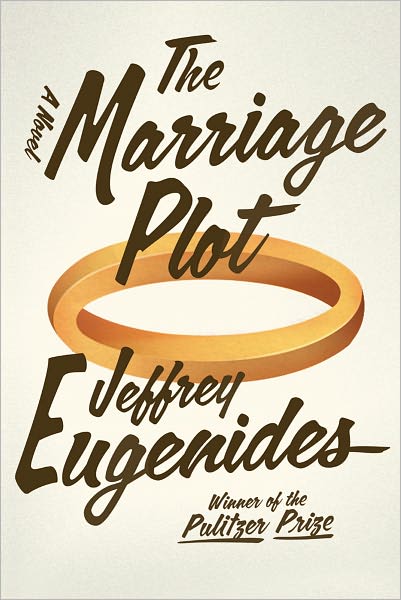
The Marriage Plot — Jeffrey Eugenides

The Marriage Plot is very competently done, and there’s nothing particularly wrong with it; some things may even be done particularly well. The problem is, as my faint praise indicates, a novel isn’t a student essay: it’s not enough for nothing to be particularly wrong. Something has to be smashing and fantastic for it to really matter. The Virgin Suicides, with its ceaseless questioning of what happened to the Lisbon sisters and its unusual narrative structure in the form of a chorus of outsider men who were once boys attempting to understand something they never quite can, had this quality. There’s a haunting, melancholy quality to the story and the way its told. Middlesex is imaginatively powerful because of Cal’s parents’ unusual relationship (does love conquer all, including biology?) and Cal’s own inter- or transexual state, which is so unusual amid novels that mostly cover straight people, occasionally cover gay people, but very seldom cover people whose bodies and minds don’t quite match like they should.

I keep copies of both Eugenides’ earlier novels, but I’m selling my copy of The Marriage Plot. I can’t imagine rereading it. In The Curtain, Milan Kundera wrote something that has long stayed with me because of how right he is:

Every novel created with real passion aspires quite naturally to a lasting aesthetic value, meaning to a value capable of surviving its author. To write without having that ambition is cynicism: a mediocre plumber may be useful to people, but a mediocre novelist who consciously produces books that are ephemeral, commonplace, conventional—thus not useful, thus burdensome, thus noxious—is contemptible.

Eugenides has that ambition. I concede The Marriage Plot might outlast its author. But I’m skeptical it will: the religious stuff Mitchell experiences doesn’t measure up, and the mostly banal problems faced by recent college graduates doesn’t quite live up to anything. Leonard is the only person with real problems, both in terms of his ailment (manic depression) and his work (as a biologist: he is confronting the natural world, and some of the most interesting sections describe both his efforts in taming yeast and his status in a science lab). Madeleine, like so many of us, is committed to love with a person who maybe isn’t worth it. In listening to her sister’s trouble, we find this: “like anyone in love, Madeleine believed that her own relationship was different from every other relationship, immune from typical problems.” She isn’t, and her relationship is more like that of other people than she’d like to imagine it to be. And The Marriage Plot is more like other novels than I want it to be.

There are long sections of background that we might not need. We find that “Leonard had grown up in an Arts & Crafts house whose previous owner had been murdered in the front hall.” Grisly, but not vital to the story. “[. . . ] Madeleine took the opportunity to make herself more presentable. She ran her hands through her hair, finger-combing it.” Nothing wrong with this: it’s just average. Maybe too Victorian. Later: “Ground personnel rolled a metal stairway up to the plane’s first door, which opened from inside, and passengers began disembarking.” Do we need this? Or can it be eliminated? On their own, these sentences are okay, and I’ve committed such sentences many times, despite Martin Amis warning me not to. I want to put this book on a diet, to convince it to render only the essential. Too much of it makes me want to cut more; I can also now say that the only thing worse than taking an essay test of your own is reading about someone else’s essay test, especially when that essay test involves religion.

There are also some strange sentences; this one makes me wonder if the last word is a typo: “Years of being popular had left her with the reflexive ability to separate the cool from the uncool, even within subgroups, like the English department, where the concept of cool didn’t appear to obtain.” What does “appear to obtain” mean? Perhaps it’s supposed to be “appear to apply.” The good ones are still good, though: “Dabney had the artistic soul of a third-string tight end.” I’ve met Dabneys. And I get what Madeleine gets: people who declaim one kind of hierarchy or status system are always setting up another, whether they recognize it or not. I also find it intriguing that Madeleine can be an intense reader and also intensely popular. The two seldom appear together in fiction. Perhaps the combination makes her an astute social reader of everyone but herself.

She also understands Mitchell, who acts as a beta orbiter for most of the novel. He provides her with extra male romantic attention mostly because he’s a fool, and she knows it on some level: “Mitchell was the kind of smart, sane, parent-pleasing boy she should fall in love with and marry. That she would never fall in love with Mitchell and marry him, precisely because of this eligibility, was yet another indication, in a morning teeming with them, of just how screwed up she was in matters of the heart.” Being “smart, sane” and “parent-pleasing” is another way of saying “boring.” He also doesn’t make a move when he’s effectively asked to. At one point, Madeleine takes Mitchell home and goes to his attic room wearing only an old shirt—then resents him for not making a move when he obviously wants to and she does too.

She has a point.

When Mitchell is too eligible, that “eligibility” gets held against him. And he buys into ideologies that encourage him to remain a fool. A priest says to Mitchell: “Listen, a girl’s not watermelon you plug a hole in to see if it’s sweet.” Tell that to most women who do the same of men. There are plenty of sexist assumptions in this statement alone to get a feminist writing an angry paper about women, innocence, desire, and sexuality. Perhaps you shouldn’t take romantic advice from someone sworn to a life of celibacy and thus ignorance in a realm that most of us take to be vitally important. To be fair, Mitchell mostly doesn’t, but that he’s seeking knowledge from a source like that tells us he doesn’t even know where to begin to look for help. And Madeleine exploits this weakness. She says, “[. . .] one night the previous December, in a state of anxiety about her romantic life, Madeleine had run into Mitchell on campus and brought him back to her apartment. She’d needed male attention and had flirted with him, without entirely admitting it to herself.”

Rather nasty. Even worse than he falls for it. The optimal solution for Mitchell: find another girl, ideally one hotter than Madeleine, and use the other girl as leverage. Moping around doesn’t get the girl. As Sean Connery says in an otherwise lousy movie called The Rock, “Losers always whine about their best. Winners go home and fuck the prom queen.” Mitchell hasn’t realized or internalized this. Contrast Mitchell’s neediness with that of his rival’s distance: “The more Leonard pulled away, the more anxious Madeleine became.” She’s desperate for Leonard, which enables him to make her like him even more. Mitchell is on the opposite side of this recusive dynamic. He should read Radway’s Reading the Romance, which describes how women like to read romance novels in which the heroine falls for major alpha males. Radway doesn’t use this term, of course, and works to explain away women’s preferences for alpha males, but the descriptions still shine through.

Still, there are funny bits to The Marriage Plot; on the same page where Madeleine assesses Mitchell as a beta, her mother says that she “saw a program about Indian recently,” as if “a program” on TV could convey much about the country—but wanting to say she’s seen it does convey a lot about her. She goes on to say, “It was terribly depressing. The poverty!” Mitchell says “That’s a plus for me [. . .] I thrive in squalor.” The unexpected reaction to Madeleine’s mother and reframing of expected values makes this funny and shows us that Mitchell isn’t the stiff he might otherwise appear to be. And the book isn’t the stiff it might otherwise be. It’s just not funny consistently enough or deep consistently enough. It’s a muddle, even when I do laugh at lines like, “Madeleine’s love troubles had begun at a time when the French theory she was reading deconstructed the very notion of love.” Love isn’t so easily eliminated, however: it only takes belief to sustain it.

And the characters are more self aware than I’ve sometimes depicted them here. Madeleine, for instance, knows that graduating from college, for a certain class of person who is expected to go to college, just isn’t that hard. On graduation day, “she wasn’t proud of herself. She was in no mood to celebrate. She’d lost faith in the significance of the day and what the day represented.” If college is mostly a test of showing up, it’s hard to blame her; and majoring in English probably isn’t very hard for most hard-core readers (it wasn’t for this one, anyway; to me reading was fun, which meant that I did so much more of it than most of my classmates that class itself wasn’t very hard). And she finds that the deconstructing education she receives isn’t much use when she’s confronted with the messy reality of interpersonal relationships, including her relationship with Leonard. Saying manic depression is a socially constructed discourse won’t get help like lithium will, even with lithium’s side effects.

Leonard’s stay at Pilgrim Lake, a biological research facility something like Cold Springs Harbor Laboratory, is among the novel’s most interesting sections. I would’ve liked it longer and Mitchell’s Indian sojourn shorter. Leonard is researching reproduction in yeast; this yields a predictable but impressive number of metaphors for human dilemmas. His work also can’t be solved by appeals to socially constructed discourse, and I suspect many of the scientists at the lab are more interesting than Madeleine at Mitchell. For example, Madeleine observes one of the very few female research scientists and observes:

Madeleine guessed that MacGregor [who just won a Nobel Prize] made people uneasy because of the purity of her renunciation and the simplicity of her scientific method. They didn’t want her to succeed, because that would invalidate the rationale for their research staffs and bloated budgets. MacGregor could also be opinionated and blunt. People didn’t like that it anyone, but they liked it less in a woman.

Tell us more about the “simplicity of her scientific method.” How does that relate to literary theory? Could we see MacGregor take more of an interest in Madeleine? Who are the people who “didn’t want her to succeed,” and how does she react to them? I wouldn’t want to turn the novel into Atlas Shrugged, but there are rich idea veins here that go unmined in favor of Mitchell’s noodlings. My suggestions are somewhat unfair, as I’m violating Updike’s first rule of book reviewing—”Try to understand what the author wished to do, and do not blame him for not achieving what he did not attempt”—but I think an exploration of gender in science more interesting than an exploration of gender and mating habits among relatively average 20-somethings. Maybe because I fit into that group I’m too close to the subject to find it remarkable, but I think the novel has a smaller-than-life quality to it, in the same way B. R. Myers describes Jonathan Franzen’s novel Freedom at the link:

One opens a new novel and is promptly introduced to some dull minor characters. Tiring of them, one skims ahead to meet the leads, only to realize: those minor characters are the leads. A common experience for even the occasional reader of contemporary fiction, it never fails to make the heart sink. The problem is not only one of craft or execution. Characters are now conceived as if the whole point of literature were to create plausible likenesses of the folks next door. They have their little worries, but so what? Do writers really believe that every unhappy family is special? If so, Tolstoy has a lot to answer for—including Freedom, Jonathan Franzen’s latest. A suburban comedy-drama about the relationship between cookie-baking Patty, who describes herself as “relatively dumber” than her siblings; red-faced husband Walter, “whose most salient quality … was his niceness”; and Walter’s womanizing college friend, Richard, who plays in an indie band called Walnut Surprise, the novel is a 576-page monument to insignificance.

The Marriage Plot is a much better novel than this, but one detects the same kinds of maladies at work: “dull minor characters,” a problem beyond “craft or execution” (which are, again, well done here), “little worries” for the most part (until an unconvincing ending), and a general feel that life is elsewhere. Around the same time, Bill Gates, Steve Jobs, Bill Joy, Richard Stallman, and many others were coalescing around Silicon Valley to change the world. I wouldn’t be communicating with you right now via this medium if it weren’t for their work. Which isn’t to say every novel set in the late 70s or early 80s should be about computers, technology, or technologists: but in the face of banality, I can’t help drifting toward thoughts of people whose work really, incredibly, resolutely matters.

Eugenides is clearly interested in the inner workings of people—the problem is that Mitchell and Madeleine do not have particularly interesting or engaging insides. Mitchell needs a copy of The Game to be time-warped to him, stat, and Madeleine needs to better realize what reading nineteenth-century novels should prime her to know: that she’s not the first person in the universe with unwise love decisions or family problems. Why doesn’t she better analyze her own situation in terms of the novels she loves so much? Why doesn’t she better realize that, yes, her life could be one of the fragments in Roland Barthes’ A Lover’s Discourse? It could be, as Eleanor Barkhorn says in “What Jeffrey Eugenides Doesn’t Understand About Women,” that Madeleine doesn’t have any real female friends, but I’m not convinced: I’ve met women who have few or no real female friends, and I don’t think that aspect of Madeleine’s life is unrealistic. The bigger problem is her lack of friends in general, so those friends can’t say the obvious to her: Why Leonard? Do you realize what you’re giving up? And if she does, and she gives up much of herself anyway, then the problem is her own blindness—a topic that I don’t find tremendously satisfying to read about, since it basically implies Madeleine is stupid. Characters can only be stupidly blinded by love for so long before one removed the “blinded” and turns “stupidly” back into a noun.

Most of my problems with the novel aren’t with its prose on a micro level, although it has those issues: it’s with the dearth of real ideas in the novel. It doesn’t quite go with the literary-theory-as-life metaphors, which drop out partway through. It doesn’t quite go with the alpha-beta-male decision that Madeleine faces. It doesn’t quite go with the manic-depression-as-serious-issue-maybe-linked-with-creativity issue that Leonard has. It’s a host of “almosts” that reminds me some of a sunnier version of Michel Houellebecq, especially in The Elementary Particles and Platform.

Houellebecq, however, is willing to engage in a kind of brutal realism—for lack of a better phrase—that Eugenides doesn’t get to. Yet that’s what the characters need: less understanding of their petty problems and more context, or a harder eye, or someone to smack Mitchell and Madeleine, then explain both their problems. I could explain their problems. I’ve met a million Mitchells and Madeleines. Hell, I used to be one in some respects. But the world has a habit of correcting your faults, if you’re paying attention to the signals the world is giving. Mitchell and Madeleine aren’t. That’s what makes them so unsatisfying. As three of the characters go, so does the very, very competent novel that doesn’t get past competence and into transcendence.


You can read my initial impressions here.

We lack perspective: notes from Alain de Botton's The Pleasures and Sorrows of Work

Yet our world of abundance, with seas of wine and alps of bread, has hardly turned out to be the ebullient place dreamt of by our ancestors in the famine-stricken years of the Middle Ages. The brightest minds spend their working lives simplifying or accelerating functions of unreasonable banality. Engineers write theses on the velocities of scanning machines and consultants devote their careers to implementing minor economies in the movements of shelf-stackers and forklift operators. The alcohol-inspired fights that break out in market towns on Saturday evenings are predictable symptoms of fury at our incarceration. They are a reminder of the price we pay for our daily submission at the altars of prudence and order – and of the rage that silently accumulates beneath a uniquely law-abiding and compliant surface.

1) A lot of engineers like their jobs and look at them as solving a series of puzzles: “theses on the velocities of scanning machines” are only as banal as you make them. In addition, even if you do find them banal, if you can make a faster scanning machine and sell it for a lot of money, you may not care when you retire to paint water colors for the rest of your life.

2) Fights say more about the dumb fighters than about the human condition.

3) Humans might simply never be, as a group, overtly happy in whatever conditions we experience; realizing this might release us from unreasonable expectations. A cultural fixation on happiness might paradoxically prevent us from experiencing what we think or imagine we most want or desire.

4) Related to three, people who leave work to drink on the weekends are probably intentionally looking for fights: I doubt the behavior can be blamed solely on alcohol. Many people seem to undergo a two-step process: they consciously drink so they can unconsciously act out in the ways they’d actually like to. My question is simple: why not just go to step two and be intellectually honest with ourselves?

5) Stumbling on Happiness discusses how and why we feel unhappy when we compare ourselves to others. Most of us don’t compare ourselves to people in the “Middle Ages;” we compare ourselves to our wives’ sisters’ husbands, to paraphrase that famous aphorism (switch gender roles as appropriate to you, the reader, and your gender / sexual orientation).

6) We submit “at the altars of prudence and order” because the alternative is often worse. That being said, I think Western society underestimates the power and importance of trance, ecstasy, transcendence, atë—all things that, denied and repressed, seem to manifest themselves in unusual ways (see The Secret History for more on this. Still, if the alternative to prudence and order is chaos, no iPhone, longer commutes, and living a dicey part of town, prudence and order sound pretty good—as does self-imposed “incarceration.”

7) The Pleasures and Sorrows of Work is, like much of de Botton’s work, nicely balanced between readability and intellectual engagement, reasoned and learned without being pedantic. These are harder notes to strike than may be obvious at first.

We lack perspective: notes from Alain de Botton’s The Pleasures and Sorrows of Work

Yet our world of abundance, with seas of wine and alps of bread, has hardly turned out to be the ebullient place dreamt of by our ancestors in the famine-stricken years of the Middle Ages. The brightest minds spend their working lives simplifying or accelerating functions of unreasonable banality. Engineers write theses on the velocities of scanning machines and consultants devote their careers to implementing minor economies in the movements of shelf-stackers and forklift operators. The alcohol-inspired fights that break out in market towns on Saturday evenings are predictable symptoms of fury at our incarceration. They are a reminder of the price we pay for our daily submission at the altars of prudence and order – and of the rage that silently accumulates beneath a uniquely law-abiding and compliant surface.

1) A lot of engineers like their jobs and look at them as solving a series of puzzles: “theses on the velocities of scanning machines” are only as banal as you make them. In addition, even if you do find them banal, if you can make a faster scanning machine and sell it for a lot of money, you may not care when you retire to paint water colors for the rest of your life.

2) Fights say more about the dumb fighters than about the human condition.

3) Humans might simply never be, as a group, overtly happy in whatever conditions we experience; realizing this might release us from unreasonable expectations. A cultural fixation on happiness might paradoxically prevent us from experiencing what we think or imagine we most want or desire.

4) Related to three, people who leave work to drink on the weekends are probably intentionally looking for fights: I doubt the behavior can be blamed solely on alcohol. Many people seem to undergo a two-step process: they consciously drink so they can unconsciously act out in the ways they’d actually like to. My question is simple: why not just go to step two and be intellectually honest with ourselves?

5) Stumbling on Happiness discusses how and why we feel unhappy when we compare ourselves to others. Most of us don’t compare ourselves to people in the “Middle Ages;” we compare ourselves to our wives’ sisters’ husbands, to paraphrase that famous aphorism (switch gender roles as appropriate to you, the reader, and your gender / sexual orientation).

6) We submit “at the altars of prudence and order” because the alternative is often worse. That being said, I think Western society underestimates the power and importance of trance, ecstasy, transcendence, atë—all things that, denied and repressed, seem to manifest themselves in unusual ways (see The Secret History for more on this. Still, if the alternative to prudence and order is chaos, no iPhone, longer commutes, and living a dicey part of town, prudence and order sound pretty good—as does self-imposed “incarceration.”

7) The Pleasures and Sorrows of Work is, like much of de Botton’s work, nicely balanced between readability and intellectual engagement, reasoned and learned without being pedantic. These are harder notes to strike than may be obvious at first.

Thoughts on the first 100 pages of Jeffrey Eugenides' The Marriage Plot

1) I would have stopped reading The Marriage Plot if it weren’t also related to some of my academic work. It captures the feel of slogging through a 19th Century novel. As you might imagine, this isn’t a compliment.

2) Until about 100 pages in, no characters have real problems. They have fake, rich-college-student problems. I’m not opposed to such problems for the people experiencing them—I remember having similar ones and thinking they were significant at the time, too—but the real problem in the form of Leonard’s psychotic breakdown should arrive closer to page 40 or 50. Madeleine’s minor undergraduate affairs are much less interesting and hilarious than Karen Owen’s “An education beyond the classroom: excelling in the realm of horizontal academics” (which is a PowerPoint document). Owen’s work feels more honest.

3) If you want a better but less hyped novel about the undergraduate experience in an Ivy-League setting, try Tom Perrotta’s Joe College. Notice that you can also get the hardback for $4, shipped, from Amazon. Notice too how Danny in that novel has real problems: he’s a fish-out-of-water, his father’s business might be falling apart, and his actions have real consequences for him and others around him. He has to master a skill (being a lunch-truck driver) and understand that skill. Failure may result in his ejection from Edenic Yale. So far no one in The Marriage Plot has a real job; they’re like characters in Jane Austen. There may be consequences coming in the latter sections, but based on the dust jacket (a trip to India to find one’s self, a possible stint in grad school), I’m not optimistic.

4) Eugenides’ earlier novels both have major conflicts and problems from the beginning: Middlesex asks how to survive and adapt as a transexual (who as a group still have major problems in contemporary society, compared to average heterosexuals) and how to flee dictator-encumbered countries, while The Virgin Suicides (probably my favorite of Eugenides’ work) asks about what really happened to the Lisbon sisters—and, because of the very clever narrative structure, we can never really find out. It’s teasing yet effective, melancholy and happy, a meditation on how we understand the past, deal with love, grow up, don’t grow up, and much more. That last bit sounds grandiose and stupid, but in the context of the novel it’s not.

5) Given the timeline in the section I’ve read so far—late 1970s, early 1980s—I keep thinking about the most consequential thing happening in the world at that time: the personal computer revolution in Silicon Valley. Jobs, Wozniack, Gates, and millions of other, less famous names were building the future. This is an insanely unfair criticism of a novel, but it’s stuck in my mind anyway, like a background process that occasionally pops an alert into my consciousness: some people are doing real things. I dismiss the alert, but it’s set to go off occasionally anyway, and I don’t have the heart to sudo kill -9.

EDIT: I was reading Hacker News this morning and found this:

The offices of Zelnick Media were packed on a recent evening for #DigitalWes, an alumni gathering for the graduates of Wesleyan University who had made their way from jam bands and cultural theory to the warp-speed world of Silicon Alley. Guests nibbled shrimp and steak skewers while taking in a sumptuous view of midtown Manhattan from the roof deck. The hosts were Strauss Zelnick and his partner, Jim Freidlich, both class of ’79, whose Take Two Interactive has produced some of the best-selling and most controversial video games of the past decade.

Same demographic, same timeline, note the mention of “cultural theory.”

6) Reading The Game has spoiled me on excessive beta-male behavior. Watching Mitchell around the beautiful and distant Madeleine mostly makes me want to tell him what he’s doing wrong. The Game was published in 2005, so saying this about a novel set before The Game’s publication isn’t fair, but the book still crystalized for me a) what not to do, b) how to eliminate certain kinds of obviously unsuccessful mating behavior, and c) how to think systematically about useful principles in men dealing with women. Being a whiny hanger-on to a person with relatively high dating market value is not good for Mitchell or for Madeleine, the object of his desire. Note that this is not limited to men: I also have low tolerance for women who spend long periods of time throwing themselves on distant alpha males who at best hook up with and then dump them. Don’t want to be hooked up with and dumped? Don’t chase alpha males whose primary attraction appears to be their unattainability. I don’t love novels whose characters’ primary problems can be solved with a simple, one-line piece of advice that, if followed, will result in the solution to said problem.

7) Nineteenth-century novels are not good guides to behavior in the 21st century. Hell, they’re not even good guides to behavior in Brown in the 1979 – 1983 period. This is as true for Madeline and for others. Literary theory is also a pretty crappy guide to real life, which may be part of the reason theory’s hold on English departments has loosened in the last 30 years. Still, perhaps the most hilarious and best scene involves Madeleine throwing Roland Barthes’ A Lover’s Discourse, which alleges that there is no such thing as love, only the speaking of love, at the boy she loves.

8) I can follow the inside-baseball parts of literary theory (Barthes, Derrida, and other English-department heroes appear, mostly as signals of what various characters believe), but I doubt such things would be of great interest to anyone not in English departments. This relates to #5: it turns out that the really important stuff happening in this time period is happening among tech people, not among grad students in the humanities. A novel about someone who jumps from the one to the other might be interesting, and it could dramatize events with real consequences that don’t automatically revolve around sex and death. Intellectual curiosity is an underutilized motivation in fiction.

9) Another book to read if you want campus-war stuff: Richard Russo’s Straight Man, which is also much funnier.

EDIT: 10) See my full review here.

Process, outcomes, and random discoveries

I was listening to a Fresh Air interview with Brad Pitt, the guy who plays Billy Beane in the Moneyball movie, and Pitt said something very interesting: Billy Beane realized that baseball is mostly about “process” and maximizing your odds. A single pitch or a single at-bat is basically random; a terrible player could homer, a great one strike out. But if you have faith in the process and fidelity to it, you’ll maximize your chance of success over time. Notice those words: “maximize your chance of success.” You won’t automatically succeed in whatever the endeavor might be, but we live in a chaotic, random world where no one is guaranteed anything.

So I heard this interview about a week ago. Since then, I’ve seen a bunch of similar stuff, which keeps reappearing like, if I were a person who wasn’t convinced things are random, the world is trying to tell me something. Here’s a description of Steve Jobs: “What was important to Jobs was not making money per se, but the process of creation.” That word, “process,” appears again: if it’s right, the money will follow if you get the process right. When a Playboy interviewer asks Justin Timberlake “Why [. . .] some celebrities crack and fade and others, like you, just keep on keeping on? Have you figured that out?,” Timberlake says he doesn’t know but will speculate, and he goes on to say:

I think it’s about process. If you care about the process of what you’re doing, you can care about the actual work. You’ll stick around. The other thing is, you always need to be learning something new. In whatever I’ve done, I’ve always looked at myself as a beginner. Hopefully I can continue to do that for the next 30 years as I grow into an older man.

He’s trying to do with music what Billy Beane is trying to do with baseball and what Steve Jobs was trying to do with consumer technology. Or what Alain de Botton describes in The Pleasures and Sorrows of Work, in which the author sees a worker in a Belgian biscuit factory whose “manner drew attention away from what he was doing in favour of how he was doing it.” If you attend to how you do something, the outcome will tend to improve more than absolute attention to the outcome. It seems like a lot of experts, a lot of people who can do good work year after year, are really focusing on process refining. This might map to “experimental” and “conceptual” artists, to use Galenson’s terminology in Old Masters and Young Geniuses: The Two Life Cycles of Artistic Creativity. As I read more about what makes artists, scientists, and others succeed, I increasingly realize that a focus on process is essential, if not the essential thing.

And it’s something I’m noticing over and over again, in a variety of contexts. When I started grad school, I began going to the University of Arizona’s Ballroom Dance Club. This is hilarious: if you asked a girl who had the misfortune of going with me to high school dances about what I’d be like a couple years later, I doubt any would’ve guessed, “Dancing.” Fewer still would’ve guessed, “At least being a competent dancer.” To aspire to “good” or “masterful” is probably unwise, but “competent” is well within my reach—and within almost anyone’s reach, really, if you have the desire. And ballroom club is all about the fundamentals too: here’s how you should move. Here’s how you isolate a single part of your body. The overall look, feel, and flow of any dance is composed of individual motions and a dancer’s control over those individual motions, which eventually come to appear to be a single, fluid motion. But it isn’t. It’s the result of the dancer breaking down each individual part and practicing it until it becomes part of him.

One time, a guy who’d been dancing for about a decade had us spend about half an hour of an hour-long classes on spins. Skilled dancers can perform nearly perfect 360-degree spins every time. I can’t. I usually end up ten to fifty degrees off. I can’t get my body, shoes, and motion harmonized sufficiently to ensure that I can perform perfect spins. But I keep working on it, in the hopes of improving this seemingly simple but actually complex activity. I’m doing in dancing what Billy Beane is doing in baseball, Justin Timberlake is doing in music, Steve Jobs was doing in technology, and you should probably be doing in your own field or fields.

And if your practice isn’t as good as it should be this time, focus on improving your process so you’ll be better next time. As you, the reader, might imagine, the same principle applies to other things. Like classes. Since I now teach and take them, I have a lot of experience with students who want to fight about grades. I don’t budge, but every semester students want to fight either during the semester or the end. I try to convey to them that grades are imperfect but they’re really about learning; concentrate on learning and the achievement, whether in grade or other form, will eventually follow.

Most of them don’t believe me. This is unfortunate, since most students also don’t know that, as Paul Graham writes, there are really Two Kinds of Judgment:

Sometimes judging you correctly is the end goal. But there’s a second much more common type of judgement where it isn’t. We tend to regard all judgements of us as the first type. We’d probably be happier if we realized which are and which aren’t.

The first type of judgement, the type where judging you is the end goal, include court cases, grades in classes, and most competitions. Such judgements can of course be mistaken, but because the goal is to judge you correctly, there’s usually some kind of appeals process. If you feel you’ve been misjudged, you can protest that you’ve been treated unfairly.

Nearly all the judgements made on children are of this type, so we get into the habit early in life of thinking that all judgements are.

But in fact there is a second much larger class of judgements where judging you is only a means to something else. These include college admissions, hiring and investment decisions, and of course the judgements made in dating. This kind of judgement is not really about you.

To be fair, I am trying to judge them correctly. But the second class of judgments bleed into grading: the grade is the means of trying to get students to be better writers. When they want to fight about grades, they haven’t fully internalized that I’m trying to get them into a process-oriented mode despite the school setting. The grades are outcomes and a necessary evil—and, besides, some students are simply more skilled than others.

But if students have fidelity to the process—to becoming, in my classes, better writers, or in other classes, better at whatever the class is attempting to impart—they’re going to maximize the probability of long-term success. And I wonder if students internalize the outcome-oriented mode of school—”My worth depends on my grades”—and then find themselves shocked when they’re plunged into the process-oriented real-world, where no one grades you, success or failure can’t be measured via GPA, and even people who do everything “right” may still fail for reasons outside their control.

This is probably doubly painful because students are used to type one judgments, not type two, and instructors don’t do much to disabuse students. Instructors don’t do enough to encourage resilience, and maybe we should, or should more than we do now.

By the way, I’m not just climbing the mountain and shouting at the unwashed masses below. I tell myself the same thing about writing fiction (or blog posts): I’ve probably gotten dozens of requests from agents for partial or full manuscripts. None have panned out; some still have pieces of the latest novel. But I tell myself that a) I’m going to write a better novel next time and b) if I maintain fidelity to the craft of writing itself, I will eventually succeed. Alternately, I might simply start self-publishing, but that’s an issue for another post. The point here is about writing—and about what I’m doing right now.

I keep writing this blog not because it brings me fame and fortune—alas, it doesn’t—but because I like to write, I think through writing, and because some of the writing on this blog is and/or will be useful to others. And I like to think this blog makes me a better writer not only of blog posts, but also a better writer in other contexts. I’m focused on the process of improvement more than the outcome of conventional publication. Which isn’t to say I don’t want that outcome—I do—but I understand that the outcome is, paradoxically, a result of attention to something other than the outcome.