Most volunteering is a waste of time for anyone except the volunteer

Volunteering is primarily driven by the need of the volunteer to feel good about themselves, not to do the most good; the way to really do the most good is to know how to do something valuable, like make a computer do what a person wants, or building things. Not that many people can or choose to learn how to do something really valuable, but many people can rehab trails or serve meals to the homeless.

Nonprofit and public agencies know this and many don’t really want volunteers, though they also can’t really turn volunteers away for PR reasons.* Nonprofit and public agencies want cash, which is fungible and can then be spent hiring professionals who don’t consume a lot of time and energy. Programmers know that the smallest number of programmers possible should work on a given project, because each additional programmer increases the communication overhead of the project. Sufficiently large projects often collapse because programmers cannot communicate effectively and ensure their code works coherently together. Volunteers face a similar problem, albeit to a lesser extent.

Low-wage labor is also widely available. Someone with a skill that can be sold for a couple hundred dollars an hour is better off doing that, and then donating their wages to hire at least ten people for ten dollars an hour. That’s much more useful to society as a whole. We’re in the habit of automatically admiring volunteers and volunteerism, to the extent that claiming volunteer hours has become yet another way of gaming college admissions through dubious altruism.

The primary way to usefully volunteer is to have a specialized skill that can be effectively deployed by the organization, but that rarely seems to happen. If the organization really needs a given skill, it tends to pay for it, because it needs that skill delivered reliably and, often, to precise specifications.

Mastering a complex skill, however, is a labor-intensive process; it’s famously been said to take ten years. Maybe one can master a skill in less time, but certainly it takes thousands of hours of dedicated practice. No one can wake up and decide to write a (good) novel or (good) operating system or whatever. One can go off and seal envelopes or make cold calls or serve meals for a couple hours.

One sees this at work in the misguided efforts to send expensive American teenagers to developing countries to build houses. Developing countries by and large do not have a shortage of effective construction workers (the U.S. imports plenty of Mexican construction workers)—they have a shortage of money. The thousands of dollars it takes to feed, secure, and transport American teenagers or twenty-somethings would be much more effectively spent on local labor and materials. But the purpose of volunteer trips is of course not about building houses but about making the volunteers feel good and useful.

Still, if the choice is between volunteering or watching T.V., volunteering is probably a “better” thing, but if the choice is between volunteering and mastering a unique skill, master that skill (and perhaps teach it to others). Be an example to others by becoming an expert, instead of by sacrificing time that should be optimally spent doing something useful for a large number of people.


* I’m a grant writing consultant. Many nonprofit and public agencies will admit in private that they don’t want volunteers. I suspect all or nearly all professions generate uncommon or counter-intuitive knowledge. The Internet is pretty good at letting people discuss that knowledge in a pseudonymous environment.

If someone is angry you may be doing something right: Alain de Botton edition

Early negative reviews of his work [How Proust Can Change Your Life], by Proust professors and philosophy dons, devastated him, admitted de Botton. “It was very surprising and upsetting. Then my wife, who is very wise, said to me, ‘It’s obvious, this is a fight.’ This is a turf war, and the battle is about what culture should mean to us.”*

If you’re a) doing significant work and b) making people angry, then you may c) be doing something right. I think the first component is particularly important because it’s easy to needlessly or cruelly piss people off—through rude remarks or punching someone, for example. We’re taught that making other people angry is a bad thing and in most contexts it probably is, but in some it isn’t and may actually be a sign of importance.

Anger is a powerful response and a common one to someone who feels threatened: suggest to a public school teacher that teachers shouldn’t be granted de facto lifetime employment after three years, or that teachers’ unions are serious impediments to education, and you’re not likely to get a reasoned discussion about policy. You’re likely to be treated as someone who violates taboo. To most of us discussions about education policy are benign, but to teachers they’re often sacred (the “benign-violation theory” of humor is similar, as discussed in The Humor Code).

I’ve gotten weirdly vituperative responses from English professors about this blog. Usually those responses are couched in language about being unprofessional or low quality or a waste of time that could be better spent advancing my career. In that worldview, having anyone read your work doesn’t matter. At first I took those responses at face value, but now I’m not so sure: they might have been unhappy that I think most English journals bogus and, worse, treat them as such. It’s dangerous to have people work outside the system they’re highly invested in. If you don’t have the apparatus of peer review and journals and so forth, what separates paid professors from blogger rabble? Some answers to that question may be terrifying.

Philosophers probably guard their jewel basket carefully because there is nothing inside.

To return to de Botton, I also think he calibrates his work towards accessibility. It is easy for a normal person to understand what he says and to judge its truth value. Many philosophers seem to take pride in doing the opposite. In addition, de Botton reaches for a relatively low-knowledge audience; I found his book about architecture charming, for example, but How to Think More About Sex was inane, mostly because of it lacked any familiarity with evolutionary biology. Over the last couple decades, that’s been where the action is. Writing about sex without reading evolutionary biology is pointless, and I know enough to know that. Alternately, even compelling writers produce some bad books, and this could be de Botton’s off book.


* From “The empire of Alain de Botton.”

How I learned about assertiveness and reality from being a consultant

Like many people with such businesses, some friends with a design consulting business say they’re getting jerked around by potential clients. While they’re worried about offending potential clients and don’t want to lose the business, they also don’t like being plied for free samples and they don’t like long conversations that aren’t likely to go anywhere. In the course of talking to them, I realized that they’re discovering that the lessons they’ve taken from school and every day life are wrong or at least not optimal. So I described my own experiences as a consultant and how that taught me about reality and money.

A lot of us—including me—are told from an early age to be polite, take turns, be considerate of other people’s feelings, etc. This is good advice in many but not all circumstances. Among friends you do  want to take turns and reciprocate interests and be warm to other people who are warm. That’s how you build lasting friendship networks. In the business / consultant worlds, however, being overly polite and considerate often leads other people to take advantage of you. Consultants need one very important skill: they need to figure out who is going to give them money and who isn’t. They need to do so relatively quickly. Clients often press to get as much free stuff—often in the form of time and opinions that should cost hundreds of dollars an hour—as they can. They lose nothing by dallying and often gain stuff. Consultants need to learn the killer instinct necessary to know when to stop and say “send me a contract and check or don’t call me until you want to.” Almost all successful consultant learn how to do this and learn when to say no.

(c) Victor WeFoto.com

(c) Victor WeFoto.com

“Talk is cheap” is a cliché for a reason: it doesn’t mean anything. Any talk that’s not a billable hour should be leading, rapidly, to a billable hour. At some point—a point sooner than most novices realize—it’s time to pay or go away. Money talks and isn’t cheap: I’ve been on numerous calls about “collaborations” and what not, when the real thing happens is through subcontracts. I learned to end vapid conversations about “collaboration” that don’t go anyway. Show me the money, or it doesn’t exist.

Someone who wants to hire you knows relatively quickly whether they want to hire you. Anything other than “yes” means “no.” “Maybe” means no. “Later” means no. That’s a hard thing for many of us to accept. My parents founded Seliger + Associates 20 years ago and they learned, the hard way, about how potential clients dangle work that never arrives and waste a lot of valuable time and energy. That means consultants have to get to “no.”

Getting to “no” is actually quite useful and a big improvement over a nebulous maybe. Attention is often your most valuable resource. Don’t let it dissipate over weak leads.

Drawing a clear line can actually turn some “maybes” in “yeses.” Clients will respect you more if you eventually stop negotiating, talking, or communicating unless they pay.

Because of the issues described in the paragraphs above, anyone experienced learns when to stop talking and say “money or nothing.” That means continuing to flirt without cash in hand is also a signal of being inexperienced. The line between being brusque and being direct is thin but when it doubt err on the side of directness rather than meekness.

Directness can actually be a kind of politeness. “Professional courtesy” has an adjective before “courtesy” because it’s different from regular courtesy. Professional courtesy indicates that there’s a different way of being courteous than the conventional way, and one aspect of professional courtesy is there to avoid time wasting people.

That being said, it can be worth exploring new ventures even when those new ventures aren’t immediately remunerative. But money and contracts separate exploration from reality.

These lessons aren’t only applicable to consultant. They apply to almost any form of business and for that matter in dating: if she says “I like you but not in that way,” she means no. I think men tend to learn this faster then women do, in part  because men usually conduct the initial approach to women for dating and sex. There are of course exceptions to this, but as a general principle it holds.[1]

(c) looking4poetry

(c) looking4poetry

My friends are women, and from what I’ve observed guys in their teens have to learn to approach women and risk rejection if they’re going to get anywhere, and a lot of women wait for guys to approach them.

Consequently, guys who want to get anywhere have to get used to rejection in a way a lot of women don’t, and that socialization is probably part of the reason why women like Sheryl Sandberg write books like Lean In. Men figure out relatively early that they have to lean in—or suffer. Like a lot of guys I spent time suffering. I also learned, however, that with women too anything other than “yes” means “no” and that I should move on quickly. Sticking around to beg and plead only worsens the situation.

Disengagement is underrated. In many endeavors one important ingredient in success is fire and motion.


[1] See Tucker Max and Geoffrey Miller’s book Mate for a long description of how and why men tend to initially approach women (giving men the choice of who to approach), women tend to accept or decline sex (giving women the choice of saying yes or no) and men tend to accept or reject long-term relationships (giving men the choice of say yes or no to becoming “official” or “married” or otherwise socially sanctioned).

You may think these principles are bogus or unfair, which is fine, and if you want to change society itself, I wish you luck, but you should at least know they exist. Even among my female friends who identify as hard-core feminists, very rarely will make the initial approach to men in a sex / dating context.

Your hours

Raymond Chen has a hilarious and quietly insightful post in “I wrote FAT on an airplane, for heaven’s sake,” which ends this way:

During the development of Windows 3.0, it was customary to have regular meetings with Bill Gates to brief him on the status of the project. At one of the reviews, the topic was performance, and Bill complained, “You guys are spending all this time with your segment tuning tinkering. I could teach a twelve-year-old to segment-tune. I want to see some real optimization, not this segment tuning nonsense. I wrote FAT on an airplane, for heaven’s sake.”

(I can’t believe I had to write this: This is a dramatization, not a courtroom transcript.)

This “I wrote FAT on an airplane” line was apparently one Bill used when he wanted to complain that what other people was doing wasn’t Real Programming. But this time, the development manager decided she’d had enough.

“Fine, Bill. We’ll set you up with a machine fully enlisted in the Windows source code, and you can help us out with some of your programming magic, why don’t you.”

One deeper point: Bill “wrote” FAT on an airplane, but in a sense he’d been learning how to write it for a decade or decades. Any complex thing anyone does is built on a wide, deep, specialized foundation. Writing works that way too—I may “write” a given post or essay or proposal in a few hours or days, but in a sense I’ve been learning how to write for at least a decade. Maybe longer. When a post is executed cleanly and well, it’s not because I have some magical ability. It’s because any time spent at the keyboard is the tip of a spear that extends back through thousands of books and hours spent practicing things I’ve done wrong or seen other people do wrong.

Everyone has or should have a skill like that, or should be developing one. What’s yours?

(Chen wrote a similar follow-up post.)

How not to choose a college: Frank Bruni ignores the really important stuff

Frank Bruni wrote an essay called “How to Choose a College” without mentioning the most important fact about college for the life outcomes of many students: debt. That’s liking writing about the Titanic and ignoring the whole iceberg thing.

In How to Win at the Sport of Business, Mark Cuban writes, “financial debt is the ultimate dream killer. Your first house, car, whatever you might want to buy, is going to be the primary reason you stop looking for what makes you the happiest.” He’s right about debt often being “the ultimate dream killer,” but he should add student loans to his roster of “whatever you might want to buy,” especially because student loans are effectively impossible to discharge through bankruptcy. I don’t think most 18 year olds really understand what tens or hundreds of thousands of dollars of debt will really mean to them five years, ten years, twenty years after they graduate.

To me, the most interesting metric a university could offer these days is the mean, median, and mode debt of students upon graduation.

Money shouldn’t be the only factor in choosing a college, but it should be a major one, unless one has uncommonly wealthy parents.

Take meaning where you find it: HBO's Girls versus life in startups

My Instapaper queue had its usual dozen or so articles in it, and I noticed a trend or attitude that roughly divided them in two and offered useful juxtapositions on contemporary life: the first bunch involved the HBO show Girls (see here, here, here, and here for examples) and the next ones involve startups (sample: “Inside Instagram: How Slowing Its Roll Put the Little Startup in the Fast Lane, Roberto Caro, and cancer (“Why haven’t we cured cancer yet? (Revisited): Personalized medicine versus evolution). The former articles say things like: “For a certain kind of lucky person, freed of the most immediate financial burdens and rich in a family’s emotional investment, college might have felt like independence or responsibility. But it turns out to be so cosseted and circumscribed that graduating feels a little like leaving the womb.” The latter describe how mind-boggling complex biology really is and say things like, “If [Instagram] can just keep doing what it’s been doing, but bigger, faster, better. If it can do all that, it just may get there. Either way, it’s going to be fun to watch.”

The former group are mostly about how the characters portrayed in the show lack direction and meaning. The latter are about the extraordinary opportunities that exist for doing new, interesting things in the world, especially if you can find a topic beyond yourself that you find fascinating. The Girls articles (not necessarily the show itself, which I haven’t seen) are what happens when you don’t do anything real. You don’t have real problems. Your identity is all about consumption and beliefs instead of production, knowledge, and being able to do things other people can’t. Ennui and anomie threaten to overwhelm. The primal needs of food and shelter are unlikely to become life-threatening.

Instagram, Robert Caro, and cancer research show, by contrast, what happens when do things that are real. Nothing stops the characters in Girls from writing software that people want to use, writing magisterial tomes that plumb the depths of the human experience, or trying to figure out how fundamental biology works. Nothing, that is, except themselves. The world is vast, human desires appear to be infinite, or nearly infinite, and the world’s problems are by no means solved. The girls on Girls should try solving them. And the writers who discuss Girls should be thinking about these kinds of fundamental issues of meaning that one can see peppered across American life.

Anyway: I want to emphasize that I haven’t seen Girls, and it might be very good. But the commentary around the show shows a certain kind of problem in American, and, more generally, affluent Western, life in general. It’s still a problem that the writers of these articles aren’t really acknowledging, and it’s a problem that Instagram, Robert Caro, and cancer research shows us how to solve—if we want to listen.

Take meaning where you find it: HBO’s Girls versus life in startups

My Instapaper queue had its usual dozen or so articles in it, and I noticed a trend or attitude that roughly divided them in two and offered useful juxtapositions on contemporary life: the first bunch involved the HBO show Girls (see here, here, here, and here) and the next ones involve startups (sample: “Inside Instagram: How Slowing Its Roll Put the Little Startup in the Fast Lane, Roberto Caro, and cancer (“Why haven’t we cured cancer yet? (Revisited): Personalized medicine versus evolution). The former articles say things like: “For a certain kind of lucky person, freed of the most immediate financial burdens and rich in a family’s emotional investment, college might have felt like independence or responsibility. But it turns out to be so cosseted and circumscribed that graduating feels a little like leaving the womb.” The latter describe how mind-boggling complex biology really is and say things like, “If [Instagram] can just keep doing what it’s been doing, but bigger, faster, better. If it can do all that, it just may get there. Either way, it’s going to be fun to watch.”

The Girls articles are mostly about how the characters lack direction or meaning. The latter are about the extraordinary opportunities that exist for doing new, interesting things in the world, especially if you can find a topic beyond yourself that you find fascinating. The Girls articles (not necessarily the show itself, which I haven’t seen much of) are what happens when you don’t do anything real. You don’t have real problems. Your identity is all about consumption and beliefs instead of production, knowledge, and being able to do things other people can’t. Ennui and anomie threaten to overwhelm. The primal needs of food and shelter are unlikely to become life-threatening.

Instagram, Robert Caro, and cancer research show, by contrast, what happens when do things that are real. Nothing stops the characters in Girls from writing software that people want to use, writing magisterial tomes that plumb the depths of the human experience, or trying to figure out how fundamental biology works. Nothing, that is, except themselves. The world is vast, human desires appear to be infinite, or nearly infinite, and the world’s problems are by no means solved. The girls on Girls should try solving them. And the writers who discuss Girls should be thinking about these kinds of fundamental issues of meaning that one can see peppered across American life.

The commentary around Girls shows a certain kind of problem in American, and general affluent Western, life. It’s still a problem that the writers of these articles aren’t really acknowledging, and it’s a problem that Instagram, Robert Caro, and cancer research shows us how to solve—if we want to listen.

What people want and what they are: religious edition

Shankar Vedantam’s “Why do Americans claim to be more religious than they are?” dovetails with my theory of why so much political discourse is so unsatisfying: a lot of it is actually about signaling values:

Beyond the polls, social scientists have conducted more rigorous analyses of religious behavior. Rather than ask people how often they attend church, the better studies measure what people actually do. The results are surprising. Americans are hardly more religious than people living in other industrialized countries. Yet they consistently—and more or less uniquely—want others to believe they are more religious than they really are.
Advertisement

Religion in America seems tied up with questions of identity in ways that are not the case in other industrialized countries. When you ask Americans about their religious beliefs, it’s like asking them whether they are good people, or asking whether they are patriots. They’ll say yes, even if they cheated on their taxes, bilked Medicare for unnecessary services, and evaded the draft. Asking people how often they attend church elicits answers about their identity—who people think they are or feel they ought to be, rather than what they actually believe and do.

And if you ask Americans about their sexual habits, you also find that straight women consistently report fewer partners than men; the most fascinating study on this subject, “Truth and Consequences: Using the Bogus Pipeline to Examine Sex Differences in Self-Reported Sexuality,” finds that women who believe their answers about sexual histories will be observed report the fewest partners, while those who believe they are hooked up a lie-detector (which actually does nothing) report the most—a number that puts them on par with the men in the study. The men’s answers do not change much. In both the case of religion and sexuality, “questions of identity” may be at stake. In the case of religion, as I note above, I suspect that religion becomes closer to a political question for many people, and political questions often aren’t really about the costs or benefits or desirability of the policy at hand. They’re about what the person espousing an opinion believes about themselves.

Or, as Julian Sanchez puts it, “a lot of our current politics has less to do with actual policy disagreements than with resolving status anxieties.” I think his overall post is right, but I suspect that people pick their preferred policies (beyond patriotism, which is his example) to signal what they’re really like or want people to believe they’re really like.

Take my favorite example, gun control: the pro-gun types want other to think of them as capable, fierce, tough, and independent. And who isn’t in favor of those things? The anti-gun types want others to think of them as community-oriented, valuing health and welfare, and caring. And who isn’t in favor of those things?

You could extend this to other fields too (tax cuts, health care, whatever the issue du jour is), and they don’t always map to a neat left/right axis. Anyone can have an opinion that signals values on complex political topics in a way they can’t about, say, theoretical physics, mostly because complex political topics often don’t have correct answers. So they can be easily used to signal values that are often divorced from whatever real conditions on the ground look like. Almost no one uses their opinions on vector calculus to signify what they most believe.

Richard Feynman noted this tendency in Surely You’re Joking, Mr. Feynman!. A princess says to Feynman that “[. . .] nobody knows anything about [physics], so I guess we can’t talk about it.” He replies: “On the contrary [. . .] It’s because somebody knows something about it that we can’t talk about physics. It’s the things that nobody knows anything about that we can discuss. We can talk about the weather; we can talk about social problems; we can talk about psychology; we can talk about international finance—gold transfers we can’t talk about, because those are understood—so it’s the subjects that nobody knows anything about that we can all talk about!”

That was the end of his discussion with the princess. But I think Feynman is on to something, and that something has to do with how people use political issues as means to show their values. Since very few people will change their fundamental values over a short period of time (if they ever will), arguing with most people about Republicans and Democrats (or whatever) is usually not about policy, but about belief.

Since picking up on this idea, I’ve become far less interested in political arguments, which are often cover for values arguments, and it’s very hard to change people’s fundamental values. Unless people acknowledge that political and religious debates are often about values, instead of the surface phenomena being discussed, you won’t get good conversation. This is probably one reason why so much political discourse is so unsatisfying: no one will even acknowledge what it’s actually about!

And maybe Americans adopted religious status, as Vedantam has it, because we don’t have as many inborn status markers, as Andrew Potter notes in The Authenticity Hoax:

When most people think of status, they think of the rigid class structures of old Europe. In contrast, North America is considered to be a relatively classless society. Sure, we have various forms of inequality, income being the most obvious and socially pernicious, but we have no entrenched class structure, no aristocracy that enjoys its privileges explicitly by virtue of birth, not merit. Nevertheless, urban North Americans live in what is probably the most status-conscious culture on the face of the Earth. The reason we don’t recognized this fact is that most of us are stuck in a model derived from the old aristo/bourgeois/prole hierarchy, where status is linear and vertical, a ladder on which one may (or may not, depending on the status markers that are in play) be able to move either up or down.

Now, in contrast, Potter sees that hierarchy as “obsolete,” since we now focus more on being “cool” or alternative, not driven solely by money, and known more for what we like than what we have. Forms of status change, but status doesn’t. The “rigid class structures of old Europe” might not apply, but the somewhat rigid ideals of religion might still, even if we’re still shifting towards consumption and opinions as status markers. Religion often functions basically as an opinion—or an “identity.” And people will not readily alter their identity—except for me, of course, because my identity is built around being able to alter my identity.

I’m still not sure why people glom onto politics and religion to signal their identities, but I think Feynman is on the right track: we like things that are large and complex enough that only a very small number of experts can really afford to even understand the domain but that nonetheless lend themselves to sloganeering and the like.

Thinking and doing: Procrastination and the life of the mind

I finally got around to reading James Surowiecki’s “What does procrastination tell us about ourselves?” (answer: maybe nothing; maybe a lot), which has been going around the Internet like herpes for a very good reason: almost all of us procrastinate, almost all of us hate ourselves for procrastinating, and almost all of us go back to procrastinating without really asking ourselves what it means to procrastinate.

According to Surowiecki, time preferences help explain procrastination. For a good introduction on the topic, see Philip Zimbardo and John Boyd’s The Time Paradox. The short, non-technical version: Some people tend to value present consumption more than future consumption, while others are the inverse. And it’s not just time preferences that change who we are; as Dan Ariely documents in Predictably Irrational, we also change our stated behaviors based on whether, for example, we’re aroused. We also sometimes prefer to bind ourselves through commitments to deadlines or to external structures that will “force” us to behave a certain way. How many dissertations would be completed without the social stigma that comes from working on a project for years and failing to complete it, coupled with the threat of funding removal?

The basic issue is that we have more than one “self,” and the self closest to the specious present (which lasts about three seconds) might be the “truest.” This comes out in the form of procrastination. To quote at length from Surowiecki, who is nominally reviewing The Thief of Time: Philosophical Essays on Procrastination:

Most of the contributors to the new book agree that this peculiar irrationality stems from our relationship to time—in particular, from a tendency that economists call “hyperbolic discounting.” A two-stage experiment provides a classic illustration: In the first stage, people are offered the choice between a hundred dollars today or a hundred and ten dollars tomorrow; in the second stage, they choose between a hundred dollars a month from now or a hundred and ten dollars a month and a day from now. In substance, the two choices are identical: wait an extra day, get an extra ten bucks. Yet, in the first stage many people choose to take the smaller sum immediately, whereas in the second they prefer to wait one more day and get the extra ten bucks.

In other words, hyperbolic discounters are able to make the rational choice when they’re thinking about the future, but, as the present gets closer, short-term considerations overwhelm their long-term goals. A similar phenomenon is at work in an experiment run by a group including the economist George Loewenstein, in which people were asked to pick one movie to watch that night and one to watch at a later date. Not surprisingly, for the movie they wanted to watch immediately, people tended to pick lowbrow comedies and blockbusters, but when asked what movie they wanted to watch later they were more likely to pick serious, important films. The problem, of course, is that when the time comes to watch the serious movie, another frothy one will often seem more appealing. This is why Netflix queues are filled with movies that never get watched: our responsible selves put “Hotel Rwanda” and “The Seventh Seal” in our queue, but when the time comes we end up in front of a rerun of “The Hangover.”

The lesson of these experiments is not that people are shortsighted or shallow but that their preferences aren’t consistent over time. We want to watch the Bergman masterpiece, to give ourselves enough time to write the report properly, to set aside money for retirement. But our desires shift as the long run becomes the short run.

This probably explains why you have to like the daily process of whatever you’re becoming skilled at (writing, researching, law, programming) in order to get good at it: if you have a very long term goal (“Write a great novel” or “Write an entire operating system”), you’ll probably never get there because it’s very easy to defer that until tomorrow. But if you break the task down (I’m going to write 500 words today; I’m going to work on memory management) and fundamentally like the task, you might actually do it. If your short-term desires roughly align with your long-term desires, you’re doing something right. If they don’t, and if you can’t find a way to harmonize them, you’re going to be the kind of person who looks back in 20 years and says, “Where did the time go?”

The answer is obvious: minute by minute and second by second, into activities that don’t pass what Paul Graham calls “The obituary test” in “Good and Bad Procrastination” (like many topics others pass over, he’s already thought about the issue). Are you doing something that will be mentioned in your obituary? If so, then you’re doing something right. Most of us aren’t: we’re watching TV, hanging out on Facebook, thinking that we really should clean the house, waiting for 5:00 to roll around when we get off work, thinking we should go shopping for that essential household item. As Graham says, “The most impressive people I know are all terrible procrastinators. So could it be that procrastination isn’t always bad?” It isn’t, as long as we’re deferring something unimportant for something important, and as long as we have appropriate values for “important.”

So how do we work against bad procrastination and towards doing something useful? The question has been on my mind lately, because a friend who’s an undergrad recently wrote:

A lot of my motivation comes from a fantasy of myself-as-_____, where the role that fills the blank tends to change erratically. Past examples include: writer, poet, monk, philosopher, womanizer. How long will the physicist/professor fantasy last?

I replied:

This is true of a lot of people. One question worth asking: Do you enjoy the day-to-day activities involved with whatever the fantasy is? For me, the “myself-as-novelist” fantasy continues to be closer to fantasy than reality, although “myself-as-writer” is definitely here. But I basically like the work of being a novelist: I like writing, I like inventing stories, I like coming up with characters, plot, etc. Do I like it every single day? No. Are there some days when it’s a chore to drag myself to the keyboard? Absolutely. And I hate query letters, dealing with agents, close calls, etc. But I like most of the stuff and think that’s what you need if you’re going to sustain something over the long term. Most people who are famous or successful for something aren’t good at the something because they want to be famous or successful; they like the something, which eventually leads to fame or success or whatever.

If you essentially like the day-to-day time in the lab, in running experiments, in fixing the equipment, etc., then being a prof might be for you.

One other note: writer, poet, and philosopher have some aspect of money involved in it. So does physicist / professor. Unless you’re Neil Strauss or Tucker Max, “womanizer” is probably a hobby more than a profession. And think of Richard Feynman as an example: he sounds like he got a lot of play, but that wasn’t his main focus; it’s just something he did on the side, so to speak. (“You mean, you just ask them?!”). The more you have some other skill (being a writer, a rock star, whatever), the easier it seems to be to find members of your preferred sex to be interested in you. In Assholes Finish First, Max notes that women started coming to him after his website became successful (note that I have not had the same experience writing about books and lit).

As for the physicist/prof fantasy, I have no idea how long it will last. You sound like you’re staying upwind, per Paul Graham’s essay “What You’ll Wish You’d Known“, which is important because that will let you re-deploy as time goes on. To my mind, read/writing and math are upwind of almost everything else; if you work on those two – three subjects, you’ll probably be okay.

One nice thing about grad school in physics is that you can apparently leverage that to do a lot of other things: programming; becoming a Wall Street quant; doing various kinds of business analysis; etc. It’s probably a better fantasy than monk, poet, or philosopher for that reason. The “philosopher” thing is also (relatively) easy to do on the side, and I would guess it’s probably more fun writing a philosophy blog than writing peer-reviewed philosophy papers, which sounds eminently tedious, at least to me.

Oh: and I have a pile of unposted, half-written blog posts in my Textmate project drawer:
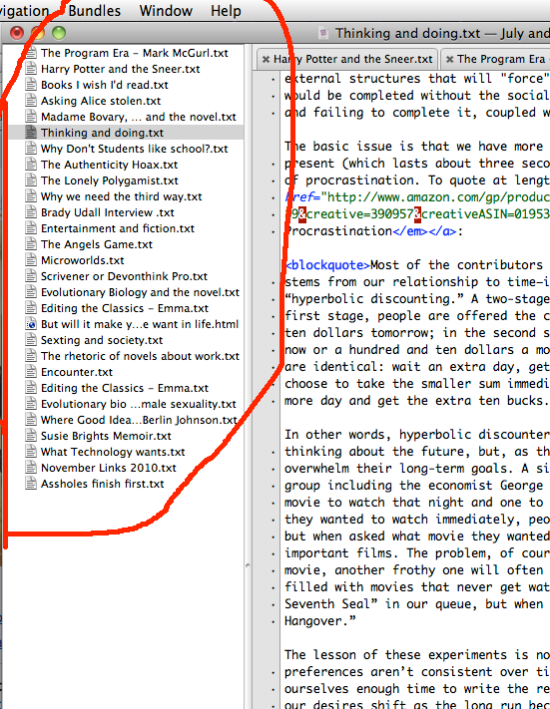
You can see a pile of them on the left. Most will eventually get written. Some will eventually be deleted. All were started with good intentions. Some have been sitting there for a depressingly long period of time. In fact, this post might have found its way among them, if not for the fact that I decided to write it in a single blaze of activity, and if not for the fact that I’m writing about procrastination, this post might have gone the way of many others: half-finished and eventually abandoned.

One reason I’ve had staying power with this blog, while so many of my friends have written a blog for a few months and then quit, is because I basically like blogging for its own sake. Blogging hasn’t brought me fame, power, money, groupies, or other markers of conventional success (so far, anyway!), and it appears unlikely to do so in the short- to medium-term (the long term is anyone’s guess). Sometimes I worry that blogging keeps me from more important work, like writing fiction, but I keep doing it because I like it and because blogging teaches me a lot about the subject I’m writing about and is an excellent forum for small ideas that might one day grow into much larger ones. This is basically the issue that “Signaling, status, blogging, academia, and ideas” discusses.

If the small projects lead to the big projects, you’re doing something right. If the small projects supplant, instead of supplementing, the big projects, you’re doing something wrong. But if you don’t like the small increments of whatever you’re working on, you’re not likely to get to the big project. You’re likely to procrastinate. You’re likely to skip from fantasy to fantasy instead of finding your place. You’re not likely to do the right kind of procrastinating. I wish I’d realized all this when I was younger. Of course, I wish I’d learned a lot of things when I was younger, but I didn’t have Surowiecki, Graham, Zimbardo, Max, and Feynman. Now I do, which enables me to say, “this blog post itself is a form of procrastination, but a productive one, and it’s therefore one I’m going to finish because I like writing it.” That sure beats improbable resolutions.


Being wrong, and a partial list of ways I’ve been wrong

A variety of somewhat big-deal econ bloggers have written about things they now believe they were wrong about. Looking back on changed opinions (which is a slightly more polite of saying “I was wrong”) is a useful exercise in intellectual honesty—a trait most people lack. I might be among them but like to think that I’m more intellectually honest than I actually am.

Still, here are some (unsorted) opinions on topics about which I’ve been wrong or at least not as right as I could be:

1) I basically believed that the stock market’s average rate of return would remain 10% per year over reasonable time periods. That it will still average somewhere close to 10% per year still seems probable, but the “reasonable time periods” (like two decades or so) no longer does, and in the long run, as a famous economist whose name escapes me observed, we’re all dead.

2) Like McArdle, the “Great Moderation” seemed real up until the last six months or so.

3) There are some things I was wrong about that turned out well: I didn’t think we’d see a black president in my lifetime. In 2004, if you’d told me that a black man would be president in 2008, I probably would’ve laughed at you.

4) I didn’t get why people liked Jane Austen until I read James Wood’s How Fiction Works, with its description of free indirect speech, and his examples from Austen. Now I do.

5) The iPhone? Nice, but a fad. I didn’t think it would be as important as it has been, or that other phone manufacturers would be so slow to respond.

6) I didn’t think Facebook would become and stay as popular as it is; I signed as an undergrad chiefly as a quick way of figuring out which girls already had boyfriends. Now I seldom log on, but evidently I’m in the minority.

7) I used to believe that it was possible to have rational discussions about religion and/or politics with most people. Now I don’t. Both subjects is are seldom subjected to empirical tests, so no feedback mechanism can demonstrate when or if a belief is wrong. Politics are (slightly) more subject to such tests, via election, studies, and the like, but the broadest political beliefs aren’t really. See Paul Graham’s “Keep Your Identity Small” for more on this subject, along with “What You Can’t Say.” At best one can have meta-conversations about religion and politics (“Why do people need religion?”)

8) During the ramp-up to the Iraq war, I was in college, and many of my professors were virulently against the war and thought that the government was perfectly capable of dissembling and distorting the debate about weapons of mass destruction; some had lived through Vietnam, with its phony Gulf of Tonkin incident, and the later Iran-Contra hearings. I hadn’t and thought it wildly implausible that so many people and institutions would be hoodwinked by faulty information, so I was more or less in favor of the war, like a lot of my equally gullible compatriots.

Oops.

9) On first reading Carlos Ruiz Zafón’s The Shadow of the Wind, I didn’t appreciate many of its most impressive qualities, especially regarding the narrative, the dialogue, and the extent to which the novel combines post-modern games with immense readability. Now I do.

10) I used to think that the sexual double standard was primarily due to misinformation, the cruel application of religious principles to individual lives, ignorance, and malice. Now I think the sexual double standard is primarily due to daughter-guarding by parents and parents’ influence on culture, female efforts to guard men through slandering their potential competitors’ reputations, general female competitiveness, the fact that the choosier sex is always the one that invests more in offspring, and differing economic and pleasure incentives acting on children than their parents.

These forces help explain a great deal of our culture’s confusion about sexuality and its mixed messages—especially among the young. I used to think this confusion would eventually devolve into a more laissez-faire, I’m-okay-you’re-okay attitude, which it still might, but now that day seems very far off.

(See my essay “The Weekly Standard on the New-Old Dating Game, Hooking Up, Daughter-Guarding, and much, much more” for details.)

11) A student question from two years ago prompted me to realized that, although I used to believe something close to the classical economic model of man in which behavior automatically reveals preferences and if someone does something, it must be because they rationally believe it will benefit them, now I’ve realized that context, framing effects, peer pressure, time preferences, and the like have a far greater effect than I once gave them credit for. Reading Dan Ariely’s Predictably Irrational, Philip Zimbardo’s The Lucifer Effect and The Time Paradox, Neil Strauss’ The Game, and Tim Harford’s The Logic of Life contributed to my change in views.

It might not hurt for you to try this test for yourself: if you can’t think of anything you’ve been wrong about, does that mean that you’re consistently right about everything, or does that mean something quite different? If you need help, there’s an entire book on the subject by Kathryn Schulz named Being Wrong: Adventures on the Margins of Error, although I haven’t actually read said book yet.