And how does this apply to writers? Steve Jobs and the idea of “Ma”

From “How Steve Jobs ‘out-Japanned’ Japan:”

That ability to express by omission holds a central place in Jobs’s management philosophy. As he told Fortune magazine in 2008, he’s as proud of the things Apple hasn’t done as the things it has done. “The great consumer electronics companies of the past had thousands of products,” he said. “We tend to focus much more. People think focus means saying yes to the thing you’ve got to focus on. But that’s not what it means at all. It means saying no to the hundred other good ideas.” . . .

Jobs’s immersion in Zen and passion for design almost certainly exposed him to the concept of ma, a central pillar of traditional Japanese aesthetics. Like many idioms relating to the intimate aspects of how a culture sees the world, it’s nearly impossible to accurately explain — it’s variously translated as “void,” “space” or “interval” — but it essentially describes how emptiness interacts with form, and how absence shapes substance. If someone were to ask you what makes a ring a meaningful object — the circle of metal it consists of, or the emptiness that that metal encompasses? — and you were to respond “both,” you’ve gotten as close to ma as the clumsy instrument of English allows.

I think of the various things I have that might have “ma:” a pretentious Moleskine notebook, a Go board, certain books. But where do objects end and the internalization of an idea begin?

Late December Links: Robertson Davies' stock falls, science fiction, typing speed, Jane Austen meets pornography, censorship, and more

* Does Typing Speed Really Matter For Programmers? Answer: probably not, once you reach a relatively low level of speed. I suspect the same is true for writers: I tend to be more limited by my brain than my fingers.

* Steampunk and the origins of science fiction, which go in directions different than the ones you’re probably imagining.

* Anarcho-Monarchism, Tolkien and Dalí.

* A great comment on blogging:

I think there are two ways to blog: altruistically or narcissistically. If you’re blogging altruistically you’re blogging for others primarily and yourself secondarily. If you’re blogging narcissistically you’re mostly blogging for yourself.

Which am I?

* Possibly NSFW but hilarious: Porn and Penetration, an adaptation of Sense and Sensibility.

* Literary reputations, with Melville falling and Tolkien gaining. Sadly, Robertson Davies is “falling off a cliff,” which I find distressing because I think he might be the most underrated writer I know, and most people I’ve recommended The Deptford Trilogy to love it; they ask why he isn’t better known, but I have no answer I wish to share publicly.

* The [Unjust] war against cameras:

Police across the country are using decades-old wiretapping statutes that did not anticipate iPhones or Droids, combined with broadly written laws against obstructing or interfering with law enforcement, to arrest people who point microphones or video cameras at them. Even in the wake of gross injustices, state legislatures have largely neglected the issue.

* New York Magazine’s Chris Rovzar speciously asks of Taylor Swift and Jake Gyllenhaal, Why Must We Pretend It Is Not Strange When Adult Celebrities Date Underage Celebrities? There are a couple obvious answers:

1) Taylor Swift, at 20, is nowhere near underage; the fact that she “isn’t old enough to legally drink alcohol” (emphasis in original) says more about U.S. law than what it means to be an adult.

2) Most women appear to want to date men of higher status than themselves. If you’re a celebrity, the only way you can effectively do this is by dating another celebrity.

This assumes the post is serious, which it might not be, or that it’s not merely trolling, which it might be.

* Eminent domain now effectively has no limits, and that’s definitely a bad thing.

* Arizona State makes 30 Rock.

* Amazon’s Kindle censorship. This is a great danger, since we’re moving toward a world in which a handful of companies (Amazon and Apple, most probably) may effectively control the vast majority of electronic books.

(See too the Ars Technica take.)

* Shortage of Engineers or a Glut: No Simple Answer. The real answer: there is always a shortage of smart, motivated people at the top of their field and a glut of people at the bottom of any field.

* Not Really ‘Made in China’: The iPhone’s Complex Supply Chain Highlights Problems With Trade Statistics. The short version: beware trade statistics, especially those related to manufacturing.

Late December Links: Robertson Davies’ stock falls, science fiction, typing speed, Jane Austen meets pornography, censorship, and more

* Does Typing Speed Really Matter For Programmers? Answer: probably not, once you reach a relatively low level of speed. I suspect the same is true for writers: I tend to be more limited by my brain than my fingers.

* Steampunk and the origins of science fiction, which go in directions different than the ones you’re probably imagining.

* Anarcho-Monarchism, Tolkien and Dalí.

* A great comment on blogging:

I think there are two ways to blog: altruistically or narcissistically. If you’re blogging altruistically you’re blogging for others primarily and yourself secondarily. If you’re blogging narcissistically you’re mostly blogging for yourself.

Which am I?

* Possibly NSFW but hilarious: Porn and Penetration, an adaptation of Sense and Sensibility.

* Literary reputations, with Melville falling and Tolkien gaining. Sadly, Robertson Davies is “falling off a cliff,” which I find distressing because I think he might be the most underrated writer I know, and most people I’ve recommended The Deptford Trilogy to love it; they ask why he isn’t better known, but I have no answer I wish to share publicly.

* The [Unjust] war against cameras:

Police across the country are using decades-old wiretapping statutes that did not anticipate iPhones or Droids, combined with broadly written laws against obstructing or interfering with law enforcement, to arrest people who point microphones or video cameras at them. Even in the wake of gross injustices, state legislatures have largely neglected the issue.

* New York Magazine’s Chris Rovzar speciously asks of Taylor Swift and Jake Gyllenhaal, Why Must We Pretend It Is Not Strange When Adult Celebrities Date Underage Celebrities? There are a couple obvious answers:

1) Taylor Swift, at 20, is nowhere near underage; the fact that she “isn’t old enough to legally drink alcohol” (emphasis in original) says more about U.S. law than what it means to be an adult.

2) Most women appear to want to date men of higher status than themselves. If you’re a celebrity, the only way you can effectively do this is by dating another celebrity.

This assumes the post is serious, which it might not be, or that it’s not merely trolling, which it might be.

* Eminent domain now effectively has no limits, and that’s definitely a bad thing.

* Arizona State makes 30 Rock.

* Amazon’s Kindle censorship. This is a great danger, since we’re moving toward a world in which a handful of companies (Amazon and Apple, most probably) may effectively control the vast majority of electronic books.

(See too the Ars Technica take.)

* Shortage of Engineers or a Glut: No Simple Answer. The real answer: there is always a shortage of smart, motivated people at the top of their field and a glut of people at the bottom of any field.

* Not Really ‘Made in China’: The iPhone’s Complex Supply Chain Highlights Problems With Trade Statistics. The short version: beware trade statistics, especially those related to manufacturing.

Noticing the detail in James Wood’s How Fiction Works


Literature makes us better noticers of life; we get to practise on life itself; which in turn makes us better readers of detail in literature; which in turn makes us better readers of life. And so on and on. You have only to teach literature to realise that most young readers are poor noticers. I know from my own old books, wantonly annotated twenty years ago when I was a student, that I routinely underlined for approval details and images and metaphors that strike me now as commonplace, while serenely missing things which now seem wonderful. We grow, as readers, and twenty-year-olds are relative virgins. They have not yet read enough literature to be taught by it how to read it. 

You only have to read How Fiction Works to realize you haven’t been as a good a noticer in life or in literature as you once thought you were. This is why I’ve reread it once a year or so since it came out in 2007, and each time I notice different things about it—like in this passage, where the adverb “serenely” is so appropriate despite the many admonishes to avoid adverbs whenever possible. We know precisely what the twenty-year-old is like, mostly like because we’ve met him and her, perhaps been him or her.

I also notice Wood’s phrase “relative virgins,” which is funny because virginity is supposed to be a binary thing: you are one or you aren’t. But in a post-Bill-Clinton age when nominal “abstinence pledges” make the parsing of the relation of act to word important to a surprisingly large number of people, virginity feels a lot more relative than it used to. Maybe I wouldn’t be as aware of this if I hadn’t read Tom Perrotta’s The Abstinence Teacher, which in turn cues me into the kinds of things I hear from undergrads at the University of Arizona—which may in turn feed my own fiction, in the kind of virtuous cycle Wood describes here. And since I have taught literature, I know precisely what he means about “poor noticers,” except that he should probably add that relatively few people become the kinds of dramatically good noticers who really love literary fiction as they get older: hence some of the popularity of the Dan Browns of the world.

Finally, because How Fiction Works is so delightful, one more quote: “The novel is the great virtuoso of exceptionalism: it always wriggles out of the rules thrown around it.”

Why unpublished novelists keep writing: why not? An answer as to why this one does

Alix Christie’s “We Ten Million” asks why unpublished novelists write, the number being an estimate of the number of unpublished novels out there (hat tip Heather Horn). Very few books get published; very few that do get any attention; very few of those even make any money; and delusion is a vital skill for many who continue writing. Rationally, most of these would-be writers would probably be better off if they quit writing and did something more economically and socially more productive with their time, like working for Wal-Mart, digging holes and filing them up, writing blogs about their cats, etc.

According to Horn, possible answers include: the idea of a craft, the importance of literature (even if it’s unread?), the need for story, and art as courage. I’m not sure I buy any of those, or any of Christie’s answers. I think the real reason is simpler: novelists keep writing because they basically like the act of writing novels. Publishing, fame, fortune, and all the rest would be nice, as they certainly would be for this unpublished writer with an inbox full of requests for fulls and partials (industry lingo for “send me the full manuscript” or “send me some chapters”) from agents, but the possibility of future and unlikely accolades don’t fuel the work on a daily basis. Instead, the daily drive to succeed is about the material itself. I’ve mentioned this famous quote before and will do so again: “Robertson Davies, the great Canadian novelist, once observed: ‘There is absolutely no point in sitting down to write a book unless you feel that you must write that book, or else go mad, or die.’ ”

The people writing unpublished novels are presumably doing so in lieu of going mad or dying. They feel they have to or need to write.

In a recent post, I wrote about an exchange with a friend who’s an undergrad:

A lot of my motivation comes from a fantasy of myself-as-_____, where the role that fills the blank tends to change erratically. Past examples include: writer, poet, monk, philosopher, womanizer. How long will the physicist/professor fantasy last? 

I replied:

This is true of a lot of people. One question worth asking: Do you enjoy the day-to-day activities involved with whatever the fantasy is? For me, the “myself-as-novelist” fantasy continues to be closer to fantasy than reality, although “myself-as-writer” is definitely here. But I basically like the work of being a novelist: I like writing, I like inventing stories, I like coming up with characters, plot, etc. Do I like it every single day? No. Are there some days when it’s a chore to drag myself to the keyboard? Absolutely. And I hate query letters, dealing with agents, close calls, etc. But I like most of the stuff and think that’s what you need if you’re going to sustain something over the long term. Most people who are famous or successful for something aren’t good at the something because they want to be famous or successful; they like the something, which eventually leads to fame or success or whatever.

“I basically like the work of being a novelist,” including the writing and so forth. That’s why I keep going. I think anyone who continues for any other reason is probably already mad, to use Davies’ term. Alternately, a lot of the would-be novelists out there are probably writing not because they want to get published, but to work out their inner demons, or signal something, or because they don’t know what else to do with their lives, or because they’re misinformed. They’re doing something other than really trying to write something that someone else might want to read.

I’m reminded of a passage from Norah Vincent’s nonfiction book Self-Made Man, in which she describes dressing like and passing as a man. Vincent, dressed as a man named “Ned,” describes going out with a woman met on an online dating site, who “was either the most conversationally inconsiderate person I’d ever met or the most socially impervious:”

Clearly she wasn’t ready to start dating again. She wasn’t looking for a relationship. She was looking for distraction and an ear to tell her troubles to. She didn’t have enough emotional energy left to get seriously involved with Ned [. . .]

A lot of would-be writers are probably doing much the same. I’d guess that relatively few of those ten million novels are publishable, or that many of the writers of those novels have any clue what something like publishable might mean (I didn’t when I started, which might’ve helped me; more on that below). As Laura Miller says regarding the “slush pile” of unsolicited queries agents and publishers get:

You’ve either experienced slush or you haven’t, and the difference is not trivial. People who have never had the job of reading through the heaps of unsolicited manuscripts sent to anyone even remotely connected with publishing typically have no inkling of two awful facts: 1) just how much slush is out there, and 2) how really, really, really, really terrible the vast majority of it is. Civilians who kvetch about the bad writing of Dan Brown, Stephenie Meyer or any other hugely popular but critically disdained novelist can talk as much trash as they want about the supposedly low standards of traditional publishing. They haven’t seen the vast majority of what didn’t get published — and believe me, if you have, it’s enough to make your blood run cold, thinking about that stuff being introduced into the general population.

So you can probably knock off at least 90% of those unpublished novels as not even being serious attempts, where “serious” means “at least thinking about what makes good novels good and bad novels bad.” Of those serious attempts, a lot of them are probably written by people who will one day be good but aren’t yet (Charlie Stross, the SF writer: “[. . .] I was averaging 1-2 novels a year, for very approximate values of “novel”. (They weren’t publishable. I was writing my million words of crap. You don’t want to read them, honest.)”). John Scalzi says something similar: “Writing an entire novel is something most people have to work up to,” and it’s really hard.

I started four novels and wisely abandoned them. I finally wrote two feature-complete novels in the sense that they started and had ends and had middles that led to the ends, kind of, but they were terrible, and I sent them to agents and got deservedly rejected. If you were one of those slush pile readers, I apologize, but those attempts were so far in the past that you’ve probably forgotten them. Then I wrote the last three novels over the last three or so years and started getting those requests for fulls and partials, which was a lot like the typical dating experience in that they ended with variations of “I like you, but not in that way.”

Nonetheless, I would like to think I can stand far enough back from myself to say that, at the very least, they’re publishable, and I think quite fun. Eventually I assume I will write something that gets a literary agent or press to agree with me—or I’ll go mad or die before that die arrives. Between now and the, I keep writing mostly because a) I’m an idiot (this shouldn’t be discounted) and b) I mostly like the work, as I described above. The second might seem a minor variation on what Christie says—”the only reason is my belief that I have got a story that I must tell”—but it’s a sufficiently important one that I’ll forward it here.

The function of stories in society and some of that other stuff is good, but I’m still guessing that my real reason (and, probably, hers) is that I like to write, which is slightly different from having a story to tell. I suspect the same is true of most artists and intellectuals and hackers; even most hacker/programmer types probably like the fact that they can change the world with their code, and so forth, but their big motivation is probably solving problems and writing code. Notice how the verb “writing” takes on a noun—code—that “writing prose” has lost. The word shows the similar impetus underlying both activities.

I’m not a hacker because, although I’ve written a little bit of code, I don’t like doing it all that much. If I did, it would’ve been vastly smarter to pursue that than it is to continue what I’m doing now. At least I’ve done enough to appreciate how hard it is to write code. And those write good code are rewarded for their skill. Good hackers, programmers, or computer scientists (pick your choice, each with its shades of connotation but denoting more or less the same activity) make a lot of money, and the smart ones often have an immediate, tangible effect on the world. This is sometimes but not always true of writers. But when I began writing fiction with some level of seriousness, I didn’t sit down and say to myself, “What is the optimal path?” I had some ideas and began typing. A depressingly large number of years later, I’m still doing the same basic thing in a way that might be detrimental to my own best interests. So why do I keep going? Why am I part of the ten million?

Because I like the work.

Scrivener or Devonthink Pro, with a side of James Joyce’s Ulysses

James Fallows’ post about the writing program Scrivener “suggests broader truths about the ways computers help and hinder the way we think.” He’s right, although I’ve used Scrivener and didn’t love it enough to switch: for anything beyond blog posts I mostly use a combination of Microsoft Word and Mellel, a word processor that is very fast and stable but can’t track changes. This, for me, is not merely bad: I can’t use Mellel beyond first drafts.

The other problem with Mellel isn’t related to the program itself, but to the release cycle. It’s discouraging when a forum post from the developer says, “Yes, we have been slacking off. The pace of development of Mellel – that is, the number of new releases – have dropped significantly over the last three years.” That’s another way of saying, “We’re not really working on it.”

Word, in turn, gets used for any documents I have to share with others (since they already have Word).

Fallows describes how Scrivener offers “a ‘project’ organization system that makes it easy to amass many notes, files, quotes, research documents, etc related to the essay or article or book you’re writing.” I primarily use Devonthink Pro (DTP) for this kind of purpose, and it connects whatever ideas I have to other quotes, ideas, and the like. The “artificial intelligence” engine is surprisingly useful at making connections that I didn’t realize I had. Obviously I could use DTP with Scrivener, but the use of DTP makes the marginal value of Scrivener somewhat lower.

Scrivener 2.0, however, is intriguing; these videos demonstrate its power. More on that later, as I’d like to follow-up on the idea that computers can “help and hinder the way we work.” Scrivener enables one to rearrange large chunks of materials easily, which is how a lot of writers work in the off-line world. For example, I’ve been reading Critical Essays on James Joyce’s Ulysses for a seminar paper and came across this description of Joyce’s process in A. Walton Litz’s “The Design of Ulysses:”

[Joyce] did not write Ulysses straight through, following the final order the episodes. First it was necessary to determine the design of the novel, to visualize its characters and the course of the action, and this entailed putting scattered portions on paper in order to clarify them. Then, like the mosaic worker, Joyce collected and sorted material to fit the design. Finally, the fragments were placed in their proper positions through a process of rough drafts and revisions.

The “design” and the ability to “visualize its characters and the course of the action” corresponds roughly to Scrivener’s idea pane. The “scattered portions on paper” come next so they can be rearranged, “collected” and “sorted.” There’s nothing wrong with using pieces of paper, of course—it worked for Joyce!—but I wonder what the great novelist would think of working digitally.

Joyce used notecards, and Litz liked the mosaic-worker analogy so much that he uses it again a few pages later:

It was the function of the note-sheets to assure that patterns and relationships already visualized by Joyce reached their fore-ordained positions in the text. Like the mosaic worker, he was continuously sorting and re-grouping his raw materials, assigned each fragment to its proper place in the general design. The mechanical nature of this process emphasizes the mechanical nature of those ordering principles which give Ulysses its superficial unity [. . . ]

I used to write more like this and now I write less like this: it is often my goal to ensure that each chapter follows inexorably from the preceding chapter. The narrative threads and the desires of each character should force the novel in a particular direction. If I can rearrange the chapters relatively easily, then I feel like I’ve done something wrong. I still want “patterns and relationships” to reach conclusions, but I don’t want those conclusions “fore-ordained:” I want them to arise organically, and for them to be inevitable yet surprising. This is a difficult trick to pull off, but it means that the serial nature of the writing I do is probably less likely to be helped by the structure of Scrivener than the writing some others might do.

In the essay after Litz’s, Anthony Cronin’s “The Advent of Bloom” begins with the structure of Ulysses: “[. . .] if Ulysses can be said to have a plot, its plot is formless and does not give form to the book – it is not shaped to produce a series of dramatic sensations for purposes aesthetic or otherwise; it has no conclusion in event, only a termination in time [. . .]” If a plot “does not give form to the book,” then something must; for some writers, Scrivener might organize it and help find a way to present formlessness. The program helps one create a mosaic, but I’m not trying to create a mosaic in my work, at least right now: I’m trying to create a linear plot. So I don’t think the program will help me as much as it could.

Nonfiction books, on the other hand, might be much better with Scrivener: in my papers, I move material around much more frequently than I do in fiction. Since I haven’t written any nonfiction books, however, I can’t comment as much on those.

I suspect that large, high-resolution monitors enable programs like Scrivener: at 24″ or larger, one can have a broad enough swatch of material open to really make a (computer) desktop feel like a (physical) desktop. You can layout and rearrange items much more easily. The new 27″ iMacs in particular are appealing for this purpose, and one can now find 27″ external monitors from Dell, Apple, and others. As desktops become more like desktops, being able to visualize large amounts of information at once makes tools like Scrivener more useful.

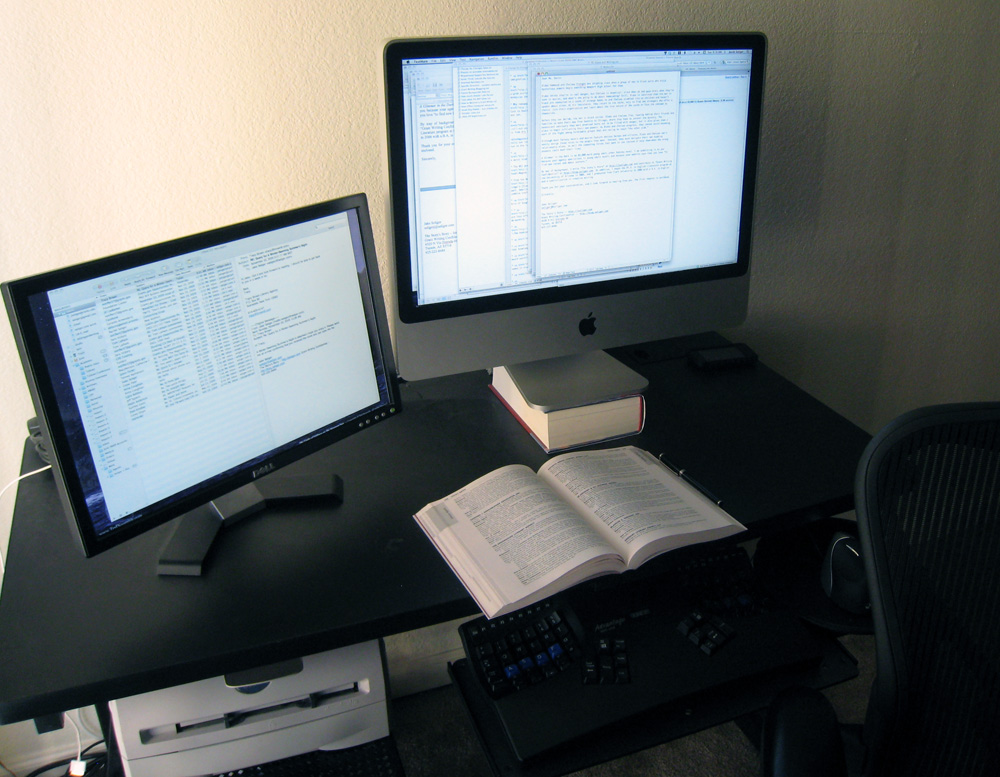
At the moment, I’m about 80K words into a novel that I think will end up in the neighborhood of 100K – 110K words, which is a bit long for a first published work but not impossibly long. Using a 24″ iMac, I can easily have two pages of text open at a time, which is very convenient. That’s what I use for my “notes” section (miscellaneous stuff I want to remember but can’t immediately add to the main narrative) and my main window, which has the novel progressing from Chapter 1 to “### END ###.” On my second monitor, a 20″ cheapie Dell, I have an outline and character list open.

Some of those functions could be taken over by Scrivener, based on what I’ve seen in the videos. For my next novel—if there is another in the immediate future; I need to devote more time to academic writing—I’d be willing to try Scrivener long enough to know if version 2.0 is a good fit. For this one, however, the thought of changing tools in the middle of the process would be too disruptive. There’s no reason, after all, that I can’t use both Scrivener and Devonthink Pro.

Scrivener or Devonthink Pro, with a side of James Joyce's Ulysses

James Fallows’ post about the writing program Scrivener “suggests broader truths about the ways computers help and hinder the way we think.” He’s right, although I’ve used Scrivener and didn’t love it enough to switch: for anything beyond blog posts I mostly use a combination of Microsoft Word and Mellel, a word processor that is very fast and stable but can’t track changes. This, for me, is not merely bad: I can’t use Mellel beyond first drafts.

The other problem with Mellel isn’t related to the program itself, but to the release cycle. It’s discouraging when a forum post from the developer says, “Yes, we have been slacking off. The pace of development of Mellel – that is, the number of new releases – have dropped significantly over the last three years.” That’s another way of saying, “We’re not really working on it.”

Word, in turn, gets used for any documents I have to share with others (since they already have Word).

Fallows describes how Scrivener offers “a ‘project’ organization system that makes it easy to amass many notes, files, quotes, research documents, etc related to the essay or article or book you’re writing.” I primarily use Devonthink Pro (DTP) for this kind of purpose, and it connects whatever ideas I have to other quotes, ideas, and the like. The “artificial intelligence” engine is surprisingly useful at making connections that I didn’t realize I had. Obviously I could use DTP with Scrivener, but the use of DTP makes the marginal value of Scrivener somewhat lower.

Scrivener 2.0, however, is intriguing; these videos demonstrate its power. More on that later, as I’d like to follow-up on the idea that computers can “help and hinder the way we work.” Scrivener enables one to rearrange large chunks of materials easily, which is how a lot of writers work in the off-line world. For example, I’ve been reading Critical Essays on James Joyce’s Ulysses for a seminar paper and came across this description of Joyce’s process in A. Walton Litz’s “The Design of Ulysses:”

[Joyce] did not write Ulysses straight through, following the final order the episodes. First it was necessary to determine the design of the novel, to visualize its characters and the course of the action, and this entailed putting scattered portions on paper in order to clarify them. Then, like the mosaic worker, Joyce collected and sorted material to fit the design. Finally, the fragments were placed in their proper positions through a process of rough drafts and revisions.

The “design” and the ability to “visualize its characters and the course of the action” corresponds roughly to Scrivener’s idea pane. The “scattered portions on paper” come next so they can be rearranged, “collected” and “sorted.” There’s nothing wrong with using pieces of paper, of course—it worked for Joyce!—but I wonder what the great novelist would think of working digitally.

Joyce used notecards, and Litz liked the mosaic-worker analogy so much that he uses it again a few pages later:

It was the function of the note-sheets to assure that patterns and relationships already visualized by Joyce reached their fore-ordained positions in the text. Like the mosaic worker, he was continuously sorting and re-grouping his raw materials, assigned each fragment to its proper place in the general design. The mechanical nature of this process emphasizes the mechanical nature of those ordering principles which give Ulysses its superficial unity [. . . ]

I used to write more like this and now I write less like this: it is often my goal to ensure that each chapter follows inexorably from the preceding chapter. The narrative threads and the desires of each character should force the novel in a particular direction. If I can rearrange the chapters relatively easily, then I feel like I’ve done something wrong. I still want “patterns and relationships” to reach conclusions, but I don’t want those conclusions “fore-ordained:” I want them to arise organically, and for them to be inevitable yet surprising. This is a difficult trick to pull off, but it means that the serial nature of the writing I do is probably less likely to be helped by the structure of Scrivener than the writing some others might do.

In the essay after Litz’s, Anthony Cronin’s “The Advent of Bloom” begins with the structure of Ulysses: “[. . .] if Ulysses can be said to have a plot, its plot is formless and does not give form to the book – it is not shaped to produce a series of dramatic sensations for purposes aesthetic or otherwise; it has no conclusion in event, only a termination in time [. . .]” If a plot “does not give form to the book,” then something must; for some writers, Scrivener might organize it and help find a way to present formlessness. The program helps one create a mosaic, but I’m not trying to create a mosaic in my work, at least right now: I’m trying to create a linear plot. So I don’t think the program will help me as much as it could.

Nonfiction books, on the other hand, might be much better with Scrivener: in my papers, I move material around much more frequently than I do in fiction. Since I haven’t written any nonfiction books, however, I can’t comment as much on those.

I suspect that large, high-resolution monitors enable programs like Scrivener: at 24″ or larger, one can have a broad enough swatch of material open to really make a (computer) desktop feel like a (physical) desktop. You can layout and rearrange items much more easily. The new 27″ iMacs in particular are appealing for this purpose, and one can now find 27″ external monitors from Dell, Apple, and others. As desktops become more like desktops, being able to visualize large amounts of information at once makes tools like Scrivener more useful.

At the moment, I’m about 80K words into a novel that I think will end up in the neighborhood of 100K – 110K words, which is a bit long for a first published work but not impossibly long. Using a 24″ iMac, I can easily have two pages of text open at a time, which is very convenient. That’s what I use for my “notes” section (miscellaneous stuff I want to remember but can’t immediately add to the main narrative) and my main window, which has the novel progressing from Chapter 1 to “### END ###.” On my second monitor, a 20″ cheapie Dell, I have an outline and character list open.

Some of those functions could be taken over by Scrivener, based on what I’ve seen in the videos. For my next novel—if there is another in the immediate future; I need to devote more time to academic writing—I’d be willing to try Scrivener long enough to know if version 2.0 is a good fit. For this one, however, the thought of changing tools in the middle of the process would be too disruptive. There’s no reason, after all, that I can’t use both Scrivener and Devonthink Pro.

So you wanna be a writer: What Anthony Bourdain can tell you even when he’s not talking about writing

There’s a great essay called “So You Wanna Be a Chef” by Anthony Bourdain, who wrote Kitchen Confidential. Based on “So You Wanna Be a Chef,” culinary schools sound rather like MFA programs. Money drives both decisions, even when artistry is supposed to:

But the minute you graduate from school—unless you have a deep-pocketed Mommy and Daddy or substantial savings—you’re already up against the wall. Two nearly unpaid years wandering Europe or New York, learning from the masters, is rarely an option. You need to make money NOW.

You could replace “cooking” with “writing” and “being a chef” with “being a writer” in Bourdain’s essay and have more or less the same outcome. Going into the “hotels and country clubs” side of the business is like getting tenure as a professor. There are a few differences between the fields—you’re never too old to be a writer—but similarities proliferate. Like this:

Male, female, gay, straight, legal, illegal, country of origin—who cares? You can either cook an omelet or you can’t. You can either cook five hundred omelets in three hours—like you said you could, and like the job requires—or you can’t. There’s no lying in the kitchen.

You can either sit (or stand) at a computer for years, producing words, or you can’t. There’s no lying at the keyboard. If you want to be a writer, the keyboard is where you’re going to spend a lot of your time (Michael Chabon on book tour in Seattle for The Yiddish Policemen’s Union: “If you want to write a novel you have to sit on your ass.” I can testify that the same is true of writing a blog). All the chatter in the world about how how you prefer early Ian McEwan to late Ian McEwan isn’t going to help you produce words.

As with many disciplines, what’s important is not just being good or adequate—it’s being amazing. “There is, as well, a big difference between good work habits (which I have) and the kind of discipline required of a cook at Robuchon.” There is a big difference between good work habits and being an artist: a surprisingly large number of people can crap out a novel if given sufficient time and motivation. Milan Kundera in The Curtain:

Every novel created with real passion aspires quite naturally to a lasting aesthetic value, meaning to a value capable of surviving its author. To write without having that ambition is cynicism: a mediocre plumber may be useful to people, but a mediocre novelist who consciously produces books that are ephemeral, commonplace, conventional—thus not useful, thus burdensome, thus noxious—is contemptible.

This overstates the case: an indifferent or “mediocre” novel by a “mediocre novelist” does not tangibly hurt anyone, and its most likely fate is to be ignored—which is the most likely fate of any novelist. But the writer needs to aspire “to a lasting aesthetic value,” which means that merely existing and producing something isn’t enough. Hence my derogatory phrase: “crap out a novel.”

Instead of traveling to “Find out how other people live and eat and cook,” as Bourdain tells the chef to do, the writer must read widely and voraciously and omnivorously. If you’re writing in a genre, read the classics. If you’re a literary novelist, read some of the better genre fiction (it’s out there). Read books about writing. Read books not about writing to learn how the world works. Get out of your literary comfort zone with some frequency. You’ll need it.

Also wise: “Treating despair with drugs and alcohol is a time-honored tradition—I’d just advise you to assess honestly if it’s really as bad and as intractable a situation as you think.” Steven King writes in On Writing about his own problems with drugs. He points out that drinking or taking drugs doesn’t make you a writer—if you’re a writer, you might drink or take drugs, but skipping straight to the drugs doesn’t do anything for you.

The bottom line: creative fields and top performers in many disciplines appear to have more in common than not. From what I’ve read, the same basic dynamic described by Bourdain applies not just to cooking and writing, but to software hacking, most kinds of research, athletes, architecture, music, and most forms of art. Don’t pursue these fields unless you want to master them. And you probably don’t. And if you do, you might be better off not realizing how difficult they are before you start, because you might never start.

So you wanna be a writer: What Anthony Bourdain can tell you even when he's not talking about writing

There’s a great essay called “So You Wanna Be a Chef” by Anthony Bourdain, who wrote Kitchen Confidential. Based on “So You Wanna Be a Chef,” culinary schools sound rather like MFA programs. Money drives both decisions, even when artistry is supposed to:

But the minute you graduate from school—unless you have a deep-pocketed Mommy and Daddy or substantial savings—you’re already up against the wall. Two nearly unpaid years wandering Europe or New York, learning from the masters, is rarely an option. You need to make money NOW.

You could replace “cooking” with “writing” and “being a chef” with “being a writer” in Bourdain’s essay and have more or less the same outcome. Going into the “hotels and country clubs” side of the business is like getting tenure as a professor. There are a few differences between the fields—you’re never too old to be a writer—but similarities proliferate. Like this:

Male, female, gay, straight, legal, illegal, country of origin—who cares? You can either cook an omelet or you can’t. You can either cook five hundred omelets in three hours—like you said you could, and like the job requires—or you can’t. There’s no lying in the kitchen.

You can either sit (or stand) at a computer for years, producing words, or you can’t. There’s no lying at the keyboard. If you want to be a writer, the keyboard is where you’re going to spend a lot of your time (Michael Chabon on book tour in Seattle for The Yiddish Policemen’s Union: “If you want to write a novel you have to sit on your ass.” I can testify that the same is true of writing a blog). All the chatter in the world about how how you prefer early Ian McEwan to late Ian McEwan isn’t going to help you produce words.

As with many disciplines, what’s important is not just being good or adequate—it’s being amazing. “There is, as well, a big difference between good work habits (which I have) and the kind of discipline required of a cook at Robuchon.” There is a big difference between good work habits and being an artist: a surprisingly large number of people can crap out a novel if given sufficient time and motivation. Milan Kundera in The Curtain:

Every novel created with real passion aspires quite naturally to a lasting aesthetic value, meaning to a value capable of surviving its author. To write without having that ambition is cynicism: a mediocre plumber may be useful to people, but a mediocre novelist who consciously produces books that are ephemeral, commonplace, conventional—thus not useful, thus burdensome, thus noxious—is contemptible.

This overstates the case: an indifferent or “mediocre” novel by a “mediocre novelist” does not tangibly hurt anyone, and its most likely fate is to be ignored—which is the most likely fate of any novelist. But the writer needs to aspire “to a lasting aesthetic value,” which means that merely existing and producing something isn’t enough. Hence my derogatory phrase: “crap out a novel.”

Instead of traveling to “Find out how other people live and eat and cook,” as Bourdain tells the chef to do, the writer must read widely and voraciously and omnivorously. If you’re writing in a genre, read the classics. If you’re a literary novelist, read some of the better genre fiction (it’s out there). Read books about writing. Read books not about writing to learn how the world works. Get out of your literary comfort zone with some frequency. You’ll need it.

Also wise: “Treating despair with drugs and alcohol is a time-honored tradition—I’d just advise you to assess honestly if it’s really as bad and as intractable a situation as you think.” Steven King writes in On Writing about his own problems with drugs. He points out that drinking or taking drugs doesn’t make you a writer—if you’re a writer, you might drink or take drugs, but skipping straight to the drugs doesn’t do anything for you.

The bottom line: creative fields and top performers in many disciplines appear to have more in common than not. From what I’ve read, the same basic dynamic described by Bourdain applies not just to cooking and writing, but to software hacking, most kinds of research, athletes, architecture, music, and most forms of art. Don’t pursue these fields unless you want to master them. And you probably don’t. And if you do, you might be better off not realizing how difficult they are before you start, because you might never start.

Working out the plot with the Rejector, Carlos Ruiz Zafón, and other friends

Over at the Rejecter, someone is asking whether an MFA program will teach her how to structure her novels. Actually, she’s asking about the professional and intellectual utility of MFA programs, but I want to focus on the plot issue, since that’s what the Rejecter doesn’t address. I had the same problems as the correspondent, but I don’t think I have them any more.

Specifically, the problem:

I have been writing novels since I was about seven. I literally think about it all the time. However, try as I might I have never been able to get beyond the 40,000 word mark before losing the plot and momentum of my story and deciding to start something else entirely. I’m a journalist on a big women’s glossy in the UK so it’s not getting the words down on paper that’s the problem, it’s rather getting my plot from A to B that stumps me.

That sounds really similar to me: the first two novels I actually completed are now, in retrospect, unpublishable, although I didn’t know that at the time and couldn’t have articulated why. Now I know: nothing happened. The novels had interesting premises but no action. There were a lot of bits of clever dialog and some good scenes, but nothing that held those scenes together. The novels lacked narrative tension.

The next two I wrote were and are publishable; they got a lot of agent activity and requests but no agents who took me on. Ditto for the latest, currently titled Asking Alice, which is still out. Look for my name in lights shortly.

One big thing changed between the first two unpublishable novels and the later three: I started writing outlines, which I’d previously considered unnecessary because I’m so smart that I can hold everything in my head (oops). Those outlines were and are pretty loose and fluid, but they’re outlines nonetheless, in which I asked myself essential questions about each chapter: what happens in it? Why? Why this chapter and not some other? What’s the central tension? What does each character worry about? These kinds of questions guided me toward writing better plots because I thought about how information was doled out and what kinds of things the characters are struggling to achieve. In addition, I thought about how drama works: is something important happening in this chapter? What is it?

If I can’t identify what’s important or why the characters should care, I’m probably doing something wrong.

This doesn’t mean each chapter has to end with someone getting shot, or the heroine declaring her love, or the revelation of a shocking fact, or an alien invasion.* But it does mean that I have to at least think about what the scene or chapter is conveying to the reader, what is happening to the characters, how it relates to the previous scene or the next scene, and, perhaps most importantly, what dilemmas it raise that have to be resolved in the future.

Every scene or almost every scene needs some kind of tension or uncertainty. Once again, this doesn’t necessarily mean a guy holding a gun: it could be highly cerebral. In Adam Foulds’ The Quickening Maze, the tension in some scenes concerns the interior dialog and sanity of John Clare: is he sane? Are we seeing the mind of someone else, or are we seeing his mind, which has assumed the shape of someone else? Those scenes can be quite tense but also quite subtle. Others can hinge on a piece of information, as when Randy Waterhouse realizes he’s actually building a datahaven in Cryptonomicon.

Over time, through reading and writing, you’ll learn where to end scenes and how the form of the novel works, and by “you” I mean “me.” You have to learn if you’re the kind of writer who wants to break that form successfully. I remember being on the high school newspaper and going to journalism contests. A lot of traditional news articles end with a whimsical or funny quote that’s not essential but does a good job of encapsulating the story. I’d read enough articles to have picked that idea up, and at one of the competitions I remember taking notes as a source spoke and putting a star next to something he said and thinking, “that’s my final quote.” I wrote the piece and later looked at what the judges had to say; I don’t think that was one of the times I won anything, but I do remember them commenting on the money quote at the end.

They did it because I’d successfully synthesized a principle no one had explicitly stated but that nonetheless made my article a little bit better.

Learning to write scenes is similar: you can’t enumerate all the principles involved, but over time you start to feel them. Once you become attuned to reading novels for what each scene does or what tensions exist in a scene, you’ll probably become better at plotting them for yourself—if you’re anything like me, at least. And you might start telling stories that build plots. I talked out a lot of Asking Alice, the novel making the rounds with agents right now, with a friend. It didn’t hurt and might’ve helped. Sometimes it’s also fun to make up a plot when you’re out. Michael Chabon portrays this in Wonder Boys, when the blocked English professor Grady Tripp and his gay editor, Crabtree, are in a bar:

‘Hey,’ said Crabtree, ‘look at that guy.’ […]
‘Who? Oh my.’ I smiled. ‘The one with the hair sculpture.’ […]
‘He’s a boxer,’ I said. ‘A flyweight.’
‘He’s a jockey,’ said Crabtree. ‘His name’s, um, Curtis. Hardapple.’
‘Not Curtis,’ I said.
‘Vernon, then. Vernon Hardapple. The scars are from a—from a horse’s hooves. He fell during a race and got trampled.’
‘He’s addicted to painkillers.’
‘He’s got a plate in his head.’

And they go on from there. They could be building a plot (telling the story of Hardapple’s rise and fall as a jockey) or they could be building the background. Either way, they’re doing something useful. Where do stories come from? Everywhere and nowhere. They’re not talking about plot, not just yet, but they begin moving in that direction.

The original querier to the Rejector has identified a particular weakness, which is a good start. My proposed solution: read some novels she admires; pick them apart and write outlines that focus on why characters do what they do, what information they reveal when, and so on. Some writers who I think do this particularly well: Ruiz Zafón, as mentioned; Elmore Leonard, especially in Get Shorty and Out of Sight, which I still think are his best; Anita Shreve in Testimony; Graham Greene in The End of the Affair; Umberto Eco in The Name of the Rose. Mystery and detective novels are often very good at plot because all they have is plot. Note that this path is not recommended.

If anyone out there is sufficiently interested, drop me an e-mail and I’ll send you my quick-and-dirty outline of The Angel’s Game, although I wouldn’t recommend reading it until after you’ve read the novel. Ruiz Zafón is astonishingly good at making each scene count in both this novel and The Shadow of the Wind; one shocking thing about reading The Prince of Mist is how weak that novel is in comparison. Ruiz Zafón is clearly someone who’s learned a lot about writing over the course of his publishing career, and he’s an example that makes me more hesitant to condemn not-very-good first novels—even those that gets published. People learn over time. I’ve read Saul Bellow’s The Dangling Man and thought it was okay—but no Herzog.

That’s not a slam: very few artists of any kind in any medium do their best work on their first try. Like anyone else in any other activity, artists learn as they go along, and they have to assimilate a huge body of material.

Anyway, I’m not sure how many MFA programs teach plot or tell their students some ways to think about plot; if I end up teaching in one, you can bet I’ll talk about it some. As an undergrad, I took a lovely novel writing course from a guy named Bill Tapply, who passed away last year. Although I got a lot out of his class, he seldom talked much about plot, which in retrospect I find curious because his Brady Coyne mysteries work very well in this respect. From chatting with others who’ve taken fiction writing classes, I gather that this is common: they talk about language and ideas and description and all kinds of things, but not plot. If I ever end up teaching one, I’m going to talk about plot—not to the exclusion of everything else, certainly, but enough to give a sense of what my 19-year-old self needed to hear. And, from what the correspondent to the Rejecter says, what she needs to hear too.

This is important because I’ve read so many novels with dynamite first halves and dreary second halves, especially in literary fiction (one reason I like Carlos Ruiz Zafón and have been writing about him a lot lately: his novels hold together). Sometimes otherwise very good novels fall apart plot-wise. I started Sam Lipsyte’s The Ask a few days ago, based on an agents advice,** but gave it up because it feels too episodic and disconnected; the novel strays so fair that it loses me as I find my mind wandering and myself thinking, “So what? What’s at stake here?” By halfway through, the answer frequently felt like “nothing.” Too bad: the first page of The Ask is terrific. A lot of the droll humor works. It just lacks…

something.

Too bad I can’t better define what that something is. But I can talk around it enough to know when it’s missing.***


* For the record, zero of my novels thus far have featured an alien invasion, although I’m not opposed to that sort of thing on principle and my eventually deploy it. One of my ambitions is to eventually write a novel that begins as a fairly straightforward love story about modern urban couples / triangles and angst that suddenly shifts, about halfway through, when aliens attacks. I think this would be totally awesome.

** It was a rejection, but not a form rejection, which counts for a lot when they pile up and you’re looking for some pattern with no more success than people who see secret signals in the white noise of a random universe: “I hope you receive that as no more damning than had I written ‘I like hamburger dill pickles, but I love capers.’ ”

*** I’d like a book on plot that’s as good as How Fiction Works, which I could then add to my post on The very very beginning writer. Suggestions would be appreciated. The books I’ve found that deal with plot tend to be of the “heroine reveals her love” variety that I mocked above, instead of the, “this is how literature might work” variety that James Wood and Francine Prose offer.

Someone has probably already written a lot of what I wrote above. I just don’t know who that person is or where their work is.