The sprawling narrative and Ta-Nehisi Coates’ reading of Middlemarch

In “Into the Canon: ‘Middlemarch,’” Ta-Nehisi Coates says he’s halfway through the novel and that “Eliot’s rather omnivorous employment of voice and excerpt is bracing.” He gives an example and then says: “I wonder if young writers, today, are attempting this sort of sprawling narrative. I’m not particularly well-read–especially in the area of modern fiction.”

My answer: sometimes, but rarely. Two contemporary examples that work come to mind: Susanna Clarke’s Jonathan Strange & Mr Norrell* and Cryptonomicon. Neither is quite the same as each other or two Middlemarch, but great works of art are supposed to be singular, and both contemporary novels are long, have many moments of weird narrative (in which it’s hard to tell who speaks), and are highly detailed. Perhaps overly detailed.

In Encounter, Milan Kundera says, correctly, that “Almost all great modern artists mean to do away with ‘filler,’ do away with whatever comes from habit, whatever keeps them from getting directly and exclusively at the essential (the essential: the thing the artist himself, and only he, is able to say).” Coates is responding to the contrast between the modern tendency to cut “filler” and get at “the essential;” I think consciously about doing both when I write, and the “filler” often bothers me about 19th C novels—but then I suppose his point about voice is that voice can make filler into the essential, at least for some readers. I tend not to be one of them, but I can make exceptions—as I do for Jonathan Strange & Mr Norrell and Cryptonomicon, and as I don’t for the late, tedious novels of Henry James.


* I’m reading Jonathan Strange & Mr Norrell at the moment, and, while it’s hard to give an example of the novel’s vastness (do we really need the level of detail we get in the Spanish campaign sections? and what is “need?”), I would note this description of Jonathan Strange following the apparent death of his wife:

[Jonathan’s] words and his face were what all his friends remembered — with this difference: that the man behind them seemed only to be acting a part while his thoughts and his heart were somewhere else entirely. He looked at them from behind the sarcastic smile and none of them knew what he was thinking. He was more like a magician than ever before. It was very curious and no one knew what to make of it, but in some ways he was more like Norrell.

There are a couple of traits similar to the “sprawling” narratives Coates mentions: most of the time we’re listening, as we are here, to a straightforward third-person omniscient narrator, and we’re not motivated to think this observation comes from a particular character’s point of view. Notice how “no one knew what to make of it:” how does the narrator know what everyone thinks, in order to say that “no one knew?”

This kind of pronouncement is uncommon in contemporary novels, or at least the contemporary novels I read. Perhaps more importantly, the quote above could easily be omitted, and Strange’s behavior left to the reader to interpret, without authorial comment. We should be able to infer Strange’s change in character and manner from the way he acts, but Clarke chooses (or, in her mock-19th Century idiom, “chuses”) to give it to us—as she tells us a few sentences later that “They ordered a good dinner consisting of a turtle, three or four beefsteaks, some gravy made with the fat of a green goose, some lampreys, escalloped oysters and a small salad of beet root.” It’s lovely to know they ate “gravy made with the fat of a green goose,” whatever that means, but I’m not sure how desperately we need to know.

In most books such details would be irritating; in this one they’re mostly charming. Call it the book’s magic.

For a similar example in Cryptonomicon, see the famous Cap’n Crunch scene, a portion of which is at the link.

The sprawling narrative and Ta-Nehisi Coates' reading of Middlemarch

In “Into the Canon: ‘Middlemarch,’” Ta-Nehisi Coates says he’s halfway through the novel and that “Eliot’s rather omnivorous employment of voice and excerpt is bracing.” He gives an example and then says: “I wonder if young writers, today, are attempting this sort of sprawling narrative. I’m not particularly well-read–especially in the area of modern fiction.”

My answer: sometimes, but rarely. Two contemporary examples that work come to mind: Susanna Clarke’s Jonathan Strange & Mr Norrell* and Cryptonomicon. Neither is quite the same as each other or two Middlemarch, but great works of art are supposed to be singular, and both contemporary novels are long, have many moments of weird narrative (in which it’s hard to tell who speaks), and are highly detailed. Perhaps overly detailed.

In Encounter, Milan Kundera says, correctly, that “Almost all great modern artists mean to do away with ‘filler,’ do away with whatever comes from habit, whatever keeps them from getting directly and exclusively at the essential (the essential: the thing the artist himself, and only he, is able to say).” Coates is responding to the contrast between the modern tendency to cut “filler” and get at “the essential;” I think consciously about doing both when I write, and the “filler” often bothers me about 19th C novels—but then I suppose his point about voice is that voice can make filler into the essential, at least for some readers. I tend not to be one of them, but I can make exceptions—as I do for Jonathan Strange & Mr Norrell and Cryptonomicon, and as I don’t for the late, tedious novels of Henry James.


* I’m reading Jonathan Strange & Mr Norrell at the moment, and, while it’s hard to give an example of the novel’s vastness (do we really need the level of detail we get in the Spanish campaign sections? and what is “need?”), I would note this description of Jonathan Strange following the apparent death of his wife:

[Jonathan’s] words and his face were what all his friends remembered — with this difference: that the man behind them seemed only to be acting a part while his thoughts and his heart were somewhere else entirely. He looked at them from behind the sarcastic smile and none of them knew what he was thinking. He was more like a magician than ever before. It was very curious and no one knew what to make of it, but in some ways he was more like Norrell.

There are a couple of traits similar to the “sprawling” narratives Coates mentions: most of the time we’re listening, as we are here, to a straightforward third-person omniscient narrator, and we’re not motivated to think this observation comes from a particular character’s point of view. Notice how “no one knew what to make of it:” how does the narrator know what everyone thinks, in order to say that “no one knew?”

This kind of pronouncement is uncommon in contemporary novels, or at least the contemporary novels I read. Perhaps more importantly, the quote above could easily be omitted, and Strange’s behavior left to the reader to interpret, without authorial comment. We should be able to infer Strange’s change in character and manner from the way he acts, but Clarke chooses (or, in her mock-19th Century idiom, “chuses”) to give it to us—as she tells us a few sentences later that “They ordered a good dinner consisting of a turtle, three or four beefsteaks, some gravy made with the fat of a green goose, some lampreys, escalloped oysters and a small salad of beet root.” It’s lovely to know they ate “gravy made with the fat of a green goose,” whatever that means, but I’m not sure how desperately we need to know.

In most books such details would be irritating; in this one they’re mostly charming. Call it the book’s magic.

For a similar example in Cryptonomicon, see the famous Cap’n Crunch scene, a portion of which is at the link.

Time preferences, character, and The Novel (in my novel)

A friend was reading a novel I wrote called The Hook and asked: “I’m curious. . . Do you believe this?” of this passage, in which the speaker is a teenage girl describing her teacher:*

But Scott sometimes said that if we do something, it shows that we wanted to at that time, even if we regret it later. So other people can’t really “make” us do anything. He said that people want different things over different courses of time—so in the short term, you might want one thing, in the long term, something else, and when you’re in the heat of the moment, the short term is pretty sweet.

The answer to my friend’s question is: mostly but not entirely. Zimbardo and Boyd wrote The Time Paradox, which describes how some people default to “past,” “present,” or “future” orientations or dispositions; hedonic people tend to be present-oriented, high achievers (probably a lot of engineers) tend to be future-oriented, and nostalgic, content, family-centered people tend to be past-oriented. These categories obviously aren’t hard and fast, and everyone has some of all of them, but I think the overall idea stands. And people who have one central orientation probably don’t understand others well, just like extroverts tend not to understand introverts; I think reading helps people better understand others not like themselves.

People are also pretty strongly biased by random emotions, feelings, and environments; for example, in Dan Ariely’s book Predictably Irrational, he describes how people in a sexually aroused state make very different or predictions decisions from those in a “cold” state—one might say they become much more present-oriented, which is probably obvious to those of us who have been in that state and are willing to think consciously and rationally about it afterwards. Most of us have probably been in that state, but relatively few of us want to admit what it’s like when we’re not in it. On a separate note, Ariely speculates that this may apply to hunger and other states too.

Daniel Kahneman’s book Thinking, Fast and Slow describes the numerous biases that we’re prone to, including a bias towards present consumption in lieu of future consumption. So if we’re in the moment being offered the pleasures of alcohol, drugs, sex, gambling, spending, or whatever, the “future” might seem very far away and uncertain (that’s what Karl Smith gets when he writes “If I Were A Poor Black Kid” that so many other commenters miss). So people are inclined to do things they say they “regret” or say “wasn’t them,” even when it probably was: it’s just that the person who gave into their craving was thinking in a different frame of mind, and the person in a “cold” frame of mind probably wants to present themselves differently than a person in a “hot” frame of mind acts. You may notice that a lot of people say, “I was drunk,” as if that means they had no control over what they were doing, but their rational self decided to take the first drink. It seems that many people go through a two-step process to get what they really want: they drink, which gives them an excuse to decry their actions while drunk at a future date while achieving their hedonic ends—which are often sexual.

This is how you get people suffused with regret for acts they very much enjoyed previously. Sex is the most obvious example here, but there are others. What a lot of people call “attraction” or “chemistry” looks to me more like people being attracted to specific behavioral or physical traits they then cloak in other words. This, basically, is what Neil Strauss explains in The Game and other self-proclaimed pickup people discuss in different venues. But it only works if women are attracted to the kind of show that such guys put on; many women in clubs / bars appear to be, at least to some extent, because if they weren’t then “game” wouldn’t work. I find this stuff more intellectually interesting than immediately applicable to my day-to-day life, but it nonetheless shows that a lot of social life happens below the level of consciousness and in ways that I didn’t appreciate when I was younger.

As I said earlier, people who tend to be highly logical and future oriented (I’m somewhat like this; you seem like you are too, although I obviously can’t speak for you and am not totally sure) often don’t “get” or understand people who aren’t. And vice-versa. People who are hedonically oriented in one moment and disavow their hedonism the next seem like hypocrites—and they are. But most people seem to be hypocrites and don’t take the time to deeply analyze what their “feelings” are telling them. Kahneman develops the idea of two “systems” that people use: the first is a fast, heuristic system that guides us to make instant, snap decisions; the second slows us down to analyze situations, but it’s much more laborious and harder to engage. Most people live in system one most of the time, including us. It takes a lot of effort to motivate system two. So we get a lot of biases from system one that sometimes make our system two self unhappy later.

I think one problem intellectuals like me have is an unwillingness to be sufficiently present-oriented, to slip out of our eggheads and into the now. A lot of cultures and societies have festivals or rituals that encourage this sort of thing; you can see a contemporary example in Brazil’s Carnival and numerous examples in older cultures (Donna Tartt’s excellent novel The Secret History exploits this interest for its plot). But ours doesn’t, which might in part be a function of our wacky religious heritage. We don’t have a lot of space for ritual; the closest we get is something like Halloween and extreme drinking parties, where people get to release or transcend the self in ways that may produce great pleasure. But, again, what is pleasure? Merely neurochemical? Or something else? I don’t have good answers, though I’m very curious.

So: do I believe what Stacy says Scott asserts? Somewhat. I think Scott’s mistake is assuming there’s a single, unified person in there somewhere. Either that, or Stacy, who’s speaking in the section you marked, misunderstands Scott, or can’t apply what he says because she doesn’t have the background to do so.

As you can probably tell from the above, I don’t really know what I believe; I’m guided in my thinking by some of the things I’ve read and observed, but the issue is complex enough that I don’t think they tell the whole story. When I was younger, I believed in a unified self; if someone did one particular thing at one particular time, that was a revealed preference, that’s who they were, and that’s the end of the story. Now, a lot of the work of behavioral and evolutionary psychologists and economists has forced me to rethink those ideas, and consciousness is much stranger than I really appreciated!

If you want to judge for yourself, the books I cited above are a good and lucid place to start. But I don’t think they’re the end of the story; maybe the story has no end. That’s not a real satisfying statement, but it’s what I’ve got and where I’ve gotten with my own imperfect thinking. Deep, much-debated issues often are that way because there isn’t a “right” answer per se—only a range of possibilities that are continually deepened over time through research, observation, and writing.

Note: The next paragraph has some material germane to the novel but that won’t make a lot of sense outside the context of the novel.

I mostly wish someone had explained a lot of this to me when I was younger. But they didn’t, which might be why Stacy repeats what Scott says to her (there’s so much I try to convey to people who’re younger than me, but I suspect most of them don’t really have the framework necessary to situate what I’m telling them, and thus they can’t really deploy it in behavioral changes). In the context of The Hook, I think Stacy and Arianna make their video at Sheldon’s coaxing because they’re caught up in the moment, and they’re obviously unhappy when the video gets shown to the whole school. So is Stacy the girl who is willing to bare her stuff for the camera when she’s sexually excited and not really thinking about what comes next, or the girl who can stand up in front of the whole assembly and walk nobly down and out, transcending the moment and trying to show herself beyond high school bullshit?

Both and neither. Which is, I hope, what makes her interesting as a character, and why I suspect narrative fiction will continue to enchant us even when research has surpassed many of the nonfiction writers on whom I’m drawing when I’m drawing characters.


This post started life as an e-mail to my friend, and I’ve edited it some before publishing it here.

Check under the bed for zombies, superheroes, and Mr. Collins

Joe Fassler’s How Zombies and Superheroes Conquered Highbrow Fiction is almost believable, but I don’t buy the premise of his essay: “Realistic stories once dominated American literature, but now writers are embracing the fantastical. What happened?”

Realistic stories might’ve once dominated perceived highbrow fiction, but they’ve always been present in a lot of literature, even capital-L Literature. Notice this from the article: “Led by their patron saint, Raymond Carver, American minimalists like Grace Paley, Amy Hempel, Richard Ford, Anne Beattie, and Tobias Wolff used finely-tuned vernacular to explore the everyday problems of everyday people.” It completely ignores, say, Neal Stephenson, William Gibson, and Ursula K. le Guin, all of whom did significant work during that time that’s also widely respected. If I had to bet, I’d put money on Gibson being more literarily important than than everyone else on Fassler’s list in a hundred years. And, at least outside of MFA programs, more important today.

Hell, even John Updike, who’s sometimes associated with banal domestic problems, wrote The Witches of Eastwick in 1984 and The Widows of Eastwick in 2008. So I think this story says more about people who perceive themselves to be highbrow ignoring everything else that goes on around them, until the “everything else” becomes the mainstream, even in people who perceive themselves to be engaging in highbrow Literary Discourse. The rest of us know that there hasn’t been a period—and I’m speaking from Beowulf to the present—without its share of monsters, demons, and supernatural powers, even if critics sometimes like to pretend there has been.

A writer’s complaint about realism

A writer friend: “I’ve suffered from too many books made boring in the name of realism to indulge it myself.”

Amen. If you have a trade-off between verisimilitude and cleverness, choose whichever will be the most fun. I’ll forgive hilarity but not tedium. Most of us are surrounded by boring people with incoherent, shallow thoughts all day long, and we don’t need to read about them too. Many of us are such people, however witty we may want or imagine ourselves to appear in our writing.

A writer's complaint about realism

A writer friend: “I’ve suffered from too many books made boring in the name of realism to indulge it myself.”

Amen. If you have a trade-off between verisimilitude and cleverness, choose whichever will be the most fun. I’ll forgive hilarity but not tedium. Most of us are surrounded by boring people with incoherent, shallow thoughts all day long, and we don’t need to read about them too. Many of us are such people, however witty we may want or imagine ourselves to appear in our writing.

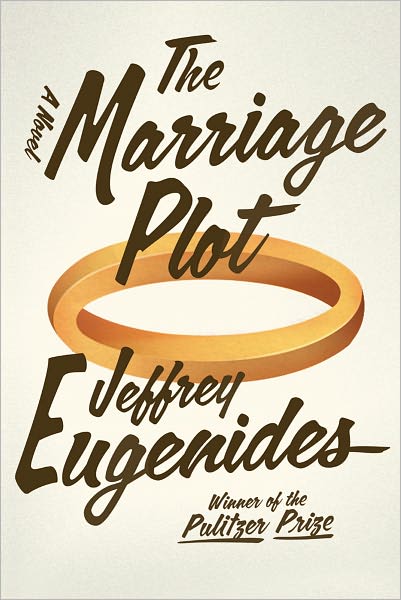
The Marriage Plot — Jeffrey Eugenides

The Marriage Plot is very competently done, and there’s nothing particularly wrong with it; some things may even be done particularly well. The problem is, as my faint praise indicates, a novel isn’t a student essay: it’s not enough for nothing to be particularly wrong. Something has to be smashing and fantastic for it to really matter. The Virgin Suicides, with its ceaseless questioning of what happened to the Lisbon sisters and its unusual narrative structure in the form of a chorus of outsider men who were once boys attempting to understand something they never quite can, had this quality. There’s a haunting, melancholy quality to the story and the way its told. Middlesex is imaginatively powerful because of Cal’s parents’ unusual relationship (does love conquer all, including biology?) and Cal’s own inter- or transexual state, which is so unusual amid novels that mostly cover straight people, occasionally cover gay people, but very seldom cover people whose bodies and minds don’t quite match like they should.

I keep copies of both Eugenides’ earlier novels, but I’m selling my copy of The Marriage Plot. I can’t imagine rereading it. In The Curtain, Milan Kundera wrote something that has long stayed with me because of how right he is:

Every novel created with real passion aspires quite naturally to a lasting aesthetic value, meaning to a value capable of surviving its author. To write without having that ambition is cynicism: a mediocre plumber may be useful to people, but a mediocre novelist who consciously produces books that are ephemeral, commonplace, conventional—thus not useful, thus burdensome, thus noxious—is contemptible.

Eugenides has that ambition. I concede The Marriage Plot might outlast its author. But I’m skeptical it will: the religious stuff Mitchell experiences doesn’t measure up, and the mostly banal problems faced by recent college graduates doesn’t quite live up to anything. Leonard is the only person with real problems, both in terms of his ailment (manic depression) and his work (as a biologist: he is confronting the natural world, and some of the most interesting sections describe both his efforts in taming yeast and his status in a science lab). Madeleine, like so many of us, is committed to love with a person who maybe isn’t worth it. In listening to her sister’s trouble, we find this: “like anyone in love, Madeleine believed that her own relationship was different from every other relationship, immune from typical problems.” She isn’t, and her relationship is more like that of other people than she’d like to imagine it to be. And The Marriage Plot is more like other novels than I want it to be.

There are long sections of background that we might not need. We find that “Leonard had grown up in an Arts & Crafts house whose previous owner had been murdered in the front hall.” Grisly, but not vital to the story. “[. . . ] Madeleine took the opportunity to make herself more presentable. She ran her hands through her hair, finger-combing it.” Nothing wrong with this: it’s just average. Maybe too Victorian. Later: “Ground personnel rolled a metal stairway up to the plane’s first door, which opened from inside, and passengers began disembarking.” Do we need this? Or can it be eliminated? On their own, these sentences are okay, and I’ve committed such sentences many times, despite Martin Amis warning me not to. I want to put this book on a diet, to convince it to render only the essential. Too much of it makes me want to cut more; I can also now say that the only thing worse than taking an essay test of your own is reading about someone else’s essay test, especially when that essay test involves religion.

There are also some strange sentences; this one makes me wonder if the last word is a typo: “Years of being popular had left her with the reflexive ability to separate the cool from the uncool, even within subgroups, like the English department, where the concept of cool didn’t appear to obtain.” What does “appear to obtain” mean? Perhaps it’s supposed to be “appear to apply.” The good ones are still good, though: “Dabney had the artistic soul of a third-string tight end.” I’ve met Dabneys. And I get what Madeleine gets: people who declaim one kind of hierarchy or status system are always setting up another, whether they recognize it or not. I also find it intriguing that Madeleine can be an intense reader and also intensely popular. The two seldom appear together in fiction. Perhaps the combination makes her an astute social reader of everyone but herself.

She also understands Mitchell, who acts as a beta orbiter for most of the novel. He provides her with extra male romantic attention mostly because he’s a fool, and she knows it on some level: “Mitchell was the kind of smart, sane, parent-pleasing boy she should fall in love with and marry. That she would never fall in love with Mitchell and marry him, precisely because of this eligibility, was yet another indication, in a morning teeming with them, of just how screwed up she was in matters of the heart.” Being “smart, sane” and “parent-pleasing” is another way of saying “boring.” He also doesn’t make a move when he’s effectively asked to. At one point, Madeleine takes Mitchell home and goes to his attic room wearing only an old shirt—then resents him for not making a move when he obviously wants to and she does too.

She has a point.

When Mitchell is too eligible, that “eligibility” gets held against him. And he buys into ideologies that encourage him to remain a fool. A priest says to Mitchell: “Listen, a girl’s not watermelon you plug a hole in to see if it’s sweet.” Tell that to most women who do the same of men. There are plenty of sexist assumptions in this statement alone to get a feminist writing an angry paper about women, innocence, desire, and sexuality. Perhaps you shouldn’t take romantic advice from someone sworn to a life of celibacy and thus ignorance in a realm that most of us take to be vitally important. To be fair, Mitchell mostly doesn’t, but that he’s seeking knowledge from a source like that tells us he doesn’t even know where to begin to look for help. And Madeleine exploits this weakness. She says, “[. . .] one night the previous December, in a state of anxiety about her romantic life, Madeleine had run into Mitchell on campus and brought him back to her apartment. She’d needed male attention and had flirted with him, without entirely admitting it to herself.”

Rather nasty. Even worse than he falls for it. The optimal solution for Mitchell: find another girl, ideally one hotter than Madeleine, and use the other girl as leverage. Moping around doesn’t get the girl. As Sean Connery says in an otherwise lousy movie called The Rock, “Losers always whine about their best. Winners go home and fuck the prom queen.” Mitchell hasn’t realized or internalized this. Contrast Mitchell’s neediness with that of his rival’s distance: “The more Leonard pulled away, the more anxious Madeleine became.” She’s desperate for Leonard, which enables him to make her like him even more. Mitchell is on the opposite side of this recusive dynamic. He should read Radway’s Reading the Romance, which describes how women like to read romance novels in which the heroine falls for major alpha males. Radway doesn’t use this term, of course, and works to explain away women’s preferences for alpha males, but the descriptions still shine through.

Still, there are funny bits to The Marriage Plot; on the same page where Madeleine assesses Mitchell as a beta, her mother says that she “saw a program about Indian recently,” as if “a program” on TV could convey much about the country—but wanting to say she’s seen it does convey a lot about her. She goes on to say, “It was terribly depressing. The poverty!” Mitchell says “That’s a plus for me [. . .] I thrive in squalor.” The unexpected reaction to Madeleine’s mother and reframing of expected values makes this funny and shows us that Mitchell isn’t the stiff he might otherwise appear to be. And the book isn’t the stiff it might otherwise be. It’s just not funny consistently enough or deep consistently enough. It’s a muddle, even when I do laugh at lines like, “Madeleine’s love troubles had begun at a time when the French theory she was reading deconstructed the very notion of love.” Love isn’t so easily eliminated, however: it only takes belief to sustain it.

And the characters are more self aware than I’ve sometimes depicted them here. Madeleine, for instance, knows that graduating from college, for a certain class of person who is expected to go to college, just isn’t that hard. On graduation day, “she wasn’t proud of herself. She was in no mood to celebrate. She’d lost faith in the significance of the day and what the day represented.” If college is mostly a test of showing up, it’s hard to blame her; and majoring in English probably isn’t very hard for most hard-core readers (it wasn’t for this one, anyway; to me reading was fun, which meant that I did so much more of it than most of my classmates that class itself wasn’t very hard). And she finds that the deconstructing education she receives isn’t much use when she’s confronted with the messy reality of interpersonal relationships, including her relationship with Leonard. Saying manic depression is a socially constructed discourse won’t get help like lithium will, even with lithium’s side effects.

Leonard’s stay at Pilgrim Lake, a biological research facility something like Cold Springs Harbor Laboratory, is among the novel’s most interesting sections. I would’ve liked it longer and Mitchell’s Indian sojourn shorter. Leonard is researching reproduction in yeast; this yields a predictable but impressive number of metaphors for human dilemmas. His work also can’t be solved by appeals to socially constructed discourse, and I suspect many of the scientists at the lab are more interesting than Madeleine at Mitchell. For example, Madeleine observes one of the very few female research scientists and observes:

Madeleine guessed that MacGregor [who just won a Nobel Prize] made people uneasy because of the purity of her renunciation and the simplicity of her scientific method. They didn’t want her to succeed, because that would invalidate the rationale for their research staffs and bloated budgets. MacGregor could also be opinionated and blunt. People didn’t like that it anyone, but they liked it less in a woman.

Tell us more about the “simplicity of her scientific method.” How does that relate to literary theory? Could we see MacGregor take more of an interest in Madeleine? Who are the people who “didn’t want her to succeed,” and how does she react to them? I wouldn’t want to turn the novel into Atlas Shrugged, but there are rich idea veins here that go unmined in favor of Mitchell’s noodlings. My suggestions are somewhat unfair, as I’m violating Updike’s first rule of book reviewing—”Try to understand what the author wished to do, and do not blame him for not achieving what he did not attempt”—but I think an exploration of gender in science more interesting than an exploration of gender and mating habits among relatively average 20-somethings. Maybe because I fit into that group I’m too close to the subject to find it remarkable, but I think the novel has a smaller-than-life quality to it, in the same way B. R. Myers describes Jonathan Franzen’s novel Freedom at the link:

One opens a new novel and is promptly introduced to some dull minor characters. Tiring of them, one skims ahead to meet the leads, only to realize: those minor characters are the leads. A common experience for even the occasional reader of contemporary fiction, it never fails to make the heart sink. The problem is not only one of craft or execution. Characters are now conceived as if the whole point of literature were to create plausible likenesses of the folks next door. They have their little worries, but so what? Do writers really believe that every unhappy family is special? If so, Tolstoy has a lot to answer for—including Freedom, Jonathan Franzen’s latest. A suburban comedy-drama about the relationship between cookie-baking Patty, who describes herself as “relatively dumber” than her siblings; red-faced husband Walter, “whose most salient quality … was his niceness”; and Walter’s womanizing college friend, Richard, who plays in an indie band called Walnut Surprise, the novel is a 576-page monument to insignificance.

The Marriage Plot is a much better novel than this, but one detects the same kinds of maladies at work: “dull minor characters,” a problem beyond “craft or execution” (which are, again, well done here), “little worries” for the most part (until an unconvincing ending), and a general feel that life is elsewhere. Around the same time, Bill Gates, Steve Jobs, Bill Joy, Richard Stallman, and many others were coalescing around Silicon Valley to change the world. I wouldn’t be communicating with you right now via this medium if it weren’t for their work. Which isn’t to say every novel set in the late 70s or early 80s should be about computers, technology, or technologists: but in the face of banality, I can’t help drifting toward thoughts of people whose work really, incredibly, resolutely matters.

Eugenides is clearly interested in the inner workings of people—the problem is that Mitchell and Madeleine do not have particularly interesting or engaging insides. Mitchell needs a copy of The Game to be time-warped to him, stat, and Madeleine needs to better realize what reading nineteenth-century novels should prime her to know: that she’s not the first person in the universe with unwise love decisions or family problems. Why doesn’t she better analyze her own situation in terms of the novels she loves so much? Why doesn’t she better realize that, yes, her life could be one of the fragments in Roland Barthes’ A Lover’s Discourse? It could be, as Eleanor Barkhorn says in “What Jeffrey Eugenides Doesn’t Understand About Women,” that Madeleine doesn’t have any real female friends, but I’m not convinced: I’ve met women who have few or no real female friends, and I don’t think that aspect of Madeleine’s life is unrealistic. The bigger problem is her lack of friends in general, so those friends can’t say the obvious to her: Why Leonard? Do you realize what you’re giving up? And if she does, and she gives up much of herself anyway, then the problem is her own blindness—a topic that I don’t find tremendously satisfying to read about, since it basically implies Madeleine is stupid. Characters can only be stupidly blinded by love for so long before one removed the “blinded” and turns “stupidly” back into a noun.

Most of my problems with the novel aren’t with its prose on a micro level, although it has those issues: it’s with the dearth of real ideas in the novel. It doesn’t quite go with the literary-theory-as-life metaphors, which drop out partway through. It doesn’t quite go with the alpha-beta-male decision that Madeleine faces. It doesn’t quite go with the manic-depression-as-serious-issue-maybe-linked-with-creativity issue that Leonard has. It’s a host of “almosts” that reminds me some of a sunnier version of Michel Houellebecq, especially in The Elementary Particles and Platform.

Houellebecq, however, is willing to engage in a kind of brutal realism—for lack of a better phrase—that Eugenides doesn’t get to. Yet that’s what the characters need: less understanding of their petty problems and more context, or a harder eye, or someone to smack Mitchell and Madeleine, then explain both their problems. I could explain their problems. I’ve met a million Mitchells and Madeleines. Hell, I used to be one in some respects. But the world has a habit of correcting your faults, if you’re paying attention to the signals the world is giving. Mitchell and Madeleine aren’t. That’s what makes them so unsatisfying. As three of the characters go, so does the very, very competent novel that doesn’t get past competence and into transcendence.


You can read my initial impressions here.

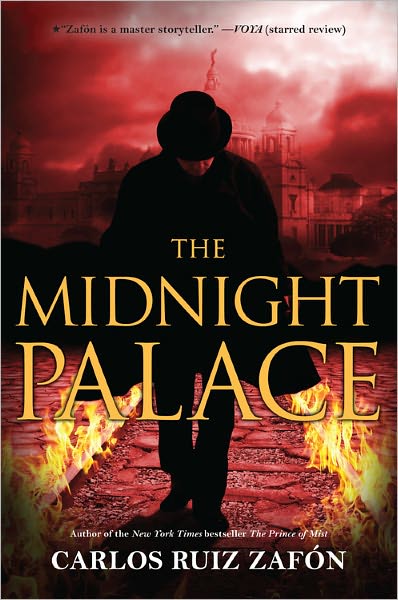
Carlos Ruiz Zafón's The Midnight Palace and The Prince of Mist show moments of promise, and yet. . .

I bought Carlos Ruiz Zafón’s The Midnight Palace and The Prince of Mist because I loved The Angel’s Game and The Shadow of the Wind so much. But The Midnight Palace and The Prince of Mist are disappointing. The most fascinating thing isn’t their generally low quality, however. It’s the moments when the later Zafón pokes through, showing what’s to come. I left The Prince of Mist and The Midnight Palace at my parents’ house, and when my Dad started reading one, he stopped and mentioned how awful they were. But they have moments where Zafón shows what he’ll later become—where he describes places, engages and rewrites cliches, talks about shocking family secrets, reveals the semi-supernatural villain. Unfortunately, cliches dominate, the writing is flat, and characters hold the interest of small-town human interest stories. But his later work gets those things right.

I wrote a whole post describing why the young adult novels are bad and pointing out the germs that later sprouted into his stronger, later work. But you know what? All those examples don’t matter. The books are weak for all kinds of reasons that are obvious on a first reading. I deleted all my earlier commentary because I realized that Zafón is an example of an experimental artist, as defined by David Galenson in his fascinating book Old Masters and Young Geniuses: The Two Life Cycles of Artistic Creativity. Zafón’s books are important only because they also show the danger of assessing an author based on a single work: Zafón’s young adult novels came out before his later, better novels. If I’d read them first, I doubt I would’ve read what came next. Fortunately, however, those books weren’t translated until after Zafón became successful.

In Galenson’s distinction, experimental artists tend to grow slowly; their early work is very seldom considered their important work. By contrast, Galenson describes conceptual artists who tend to do important early work that totally redefines their field; their later work tends not to have the punch it might otherwise have. Experimental artists often don’t have a single defining work, but rather a large body of production that often feels like a unified whole. Conceptual artists often have one or a small number of significant works. The theory is much elaborated from this unfortunate sketch, which naturally loses many of the details that make Galenson good. But you can graft his analysis directly onto Zafón. If I thought the earlier books were worth the effort, I would take your time and mine to do a major compare and contrast between them. They’re not, however. What is important is the lesson one can draw about not prematurely judging a writer based on premature work that might not show the late emergence of talent based on experience and extensive effort in a field.

I’m not going to read Zafón’s other young adult novels; he wrote four prior to The Shadow of the Wind. But when his next novel in the Shadow of the Wind and Angel’s Game sequence emerges, I’ll gladly clear the decks to read it.

“Free Agents,” the TV show, proves itself dumb in the first three minutes through the “slut” debate

Free Agents, the TV show, begins with two characters in bed, and one opens a full condom drawer. The guy sees and says something like, “What are you—a slut?” The woman replies, and they have an excruciating discussion whose underlying content is a typical rehash of an ancient calumny about female sexuality. The scene is neither funny nor genuine, and the two problems are related.

If your characters are old enough to have a B.A., they’re old enough not to care about the idea of the “slut.” Younger characters, especially ones in high school, might still be interested in whether someone is a “slut,” but that’s mostly because a) teenagers are projecting uncertainty and fear regarding their own sexuality on others, b) many have parents who engage in various forms of daughter-guarding and other forms of shame internalization, and c) girls, especially, will use social approbation and shaming as a form of mate guarding behavior. If older characters like those in Free Agents are still concerned about the same problems as high school students, they’ve not matured enough to even be interesting. Even a show like Californication, whatever its other flaws, has moved beyond the “slut” question.

Like Free Agents, it’s also about someone with a stunted emotional life, but at least Californication is intellectually honest enough not to go for the “slut” question. Rather, it assumes that people who want to do it, do it, and people who don’t, don’t, which seems like the way the world is heading. Besides, by college graduation or thereabouts, most people will never really know about their partners’ past, and, again, by the time one graduates from college or reaches the age at which college graduation occurs, everyone is someone’s sloppy seconds. The median age for first sex in the United Sates is somewhere in the neighborhood of 17 (see Google for more); by the time a person hits their 30s, asking number questions becomes pointless if potentially amusing.

I’m not annoyed only because the concept behind word “slut” does, as Mark Liberman put it, “project bad associations based on a framework of ideas that I don’t endorse.” Even if you do do endorse that framework, endorsing it with someone you’re about to have sex with probably isn’t the optimal place to engage the issue. It only makes you look like a hypocrite and a fool, but, from what I can tell, that wasn’t what Free Agents was going for. It played the issue straight. To go back to Liberman—who is himself also writing about a TV show, albeit Sex and the City—”The word slut itself clearly retains strong negative connotations, quite apart from one’s opinions about sexual morality, but such things can change if enough people want them to.” TV shows aren’t necessarily a medium that promotes social and intellectual

I can see why TV show writers might go for the “slut”: they think it can create dramatic tension. But it’s a false dramatic tension, which is why I said the issue isn’t “genuine,” and false dramatic tension leads to jokes that aren’t funny either, because such jokes don’t engage any substantive ideas; really funny jokes often or usually do. Pretty much every single person with the proverbial half a brain has condoms around. Their presence doesn’t mean anything more than, “I’m prepared for the best,” which is a refreshing change compared to people who are prepared for the worst. It would be stranger if the woman in the show was single and didn’t have condoms.

So the “slut” problem reduces to one of two issues: the writers are lazy, so they introduce being a “slut” or not to create artificial tension; or the writers are dumb because they deal with a dead issue. Neither bodes well for the show. But it does hold an important lesson for narrative writers, whether visual or written: don’t focus on dead or dying issues. Focus on live ones. Feminists have been arguing against the “slut” framework of ideas since at least the 1960s if not earlier; Leora Tanenbaum wrote whole book on the subject, subtitled “Growing Up Female with a Bad Reputation.” People’s behavior, if not their rhetoric, shows the issue to be dead. So instead of using it, why not skate to where the puck is going, instead of where it’s been?

The question is supposed to be rhetorical, but I’m going to answer it anyway: knowing the puck’s present location is easy. Knowing where it’s going is much, much harder, and a lot of the big media businesses, including TV, are too big and too expensive to take major risks on the unknown. Better to leave those big risks to dingy writers living in their parents’ basements or hiding from the real world in graduate school. That solution probably worked pretty well in a pre-Internet era. By now, however, people who want to take intellectual, social, and artistic risks can coalesce on the Internet. While Hollywood dithers and debates about sluts, the innovators are moving or have moved online. Don’t be surprised if the audience follows. And if you’re the kind of person who wants to be in the vanguard, don’t watch so much TV. Check out the bookstores and libraries instead. You’ll find it there. TV used to be the medium of the future, but in some ways it feels like the medium of the past.


EDIT: It appears Free Agents is heading towards cancellation. I’m tempted to say something like puerile like “good riddance,” but the problems described above transcend this show and will no doubt be repeated by successors, in more or less subtle guises.

"Free Agents," the TV show, proves itself dumb in the first three minutes through the "slut" debate

Free Agents, the TV show, begins with two characters in bed, and one opens a full condom drawer. The guy sees and says something like, “What are you—a slut?” The woman replies, and they have an excruciating discussion whose underlying content is a typical rehash of an ancient calumny about female sexuality. The scene is neither funny nor genuine, and the two problems are related.

If your characters are old enough to have a B.A., they’re old enough not to care about the idea of the “slut.” Younger characters, especially ones in high school, might still be interested in whether someone is a “slut,” but that’s mostly because a) teenagers are projecting uncertainty and fear regarding their own sexuality on others, b) many have parents who engage in various forms of daughter-guarding and other forms of shame internalization, and c) girls, especially, will use social approbation and shaming as a form of mate guarding behavior. If older characters like those in Free Agents are still concerned about the same problems as high school students, they’ve not matured enough to even be interesting. Even a show like Californication, whatever its other flaws, has moved beyond the “slut” question.

Like Free Agents, it’s also about someone with a stunted emotional life, but at least Californication is intellectually honest enough not to go for the “slut” question. Rather, it assumes that people who want to do it, do it, and people who don’t, don’t, which seems like the way the world is heading. Besides, by college graduation or thereabouts, most people will never really know about their partners’ past, and, again, by the time one graduates from college or reaches the age at which college graduation occurs, everyone is someone’s sloppy seconds. The median age for first sex in the United Sates is somewhere in the neighborhood of 17 (see Google for more); by the time a person hits their 30s, asking number questions becomes pointless if potentially amusing.

I’m not annoyed only because the concept behind word “slut” does, as Mark Liberman put it, “project bad associations based on a framework of ideas that I don’t endorse.” Even if you do do endorse that framework, endorsing it with someone you’re about to have sex with probably isn’t the optimal place to engage the issue. It only makes you look like a hypocrite and a fool, but, from what I can tell, that wasn’t what Free Agents was going for. It played the issue straight. To go back to Liberman—who is himself also writing about a TV show, albeit Sex and the City—”The word slut itself clearly retains strong negative connotations, quite apart from one’s opinions about sexual morality, but such things can change if enough people want them to.” TV shows aren’t necessarily a medium that promotes social and intellectual

I can see why TV show writers might go for the “slut”: they think it can create dramatic tension. But it’s a false dramatic tension, which is why I said the issue isn’t “genuine,” and false dramatic tension leads to jokes that aren’t funny either, because such jokes don’t engage any substantive ideas; really funny jokes often or usually do. Pretty much every single person with the proverbial half a brain has condoms around. Their presence doesn’t mean anything more than, “I’m prepared for the best,” which is a refreshing change compared to people who are prepared for the worst. It would be stranger if the woman in the show was single and didn’t have condoms.

So the “slut” problem reduces to one of two issues: the writers are lazy, so they introduce being a “slut” or not to create artificial tension; or the writers are dumb because they deal with a dead issue. Neither bodes well for the show. But it does hold an important lesson for narrative writers, whether visual or written: don’t focus on dead or dying issues. Focus on live ones. Feminists have been arguing against the “slut” framework of ideas since at least the 1960s if not earlier; Leora Tanenbaum wrote whole book on the subject, subtitled “Growing Up Female with a Bad Reputation.” People’s behavior, if not their rhetoric, shows the issue to be dead. So instead of using it, why not skate to where the puck is going, instead of where it’s been?

The question is supposed to be rhetorical, but I’m going to answer it anyway: knowing the puck’s present location is easy. Knowing where it’s going is much, much harder, and a lot of the big media businesses, including TV, are too big and too expensive to take major risks on the unknown. Better to leave those big risks to dingy writers living in their parents’ basements or hiding from the real world in graduate school. That solution probably worked pretty well in a pre-Internet era. By now, however, people who want to take intellectual, social, and artistic risks can coalesce on the Internet. While Hollywood dithers and debates about sluts, the innovators are moving or have moved online. Don’t be surprised if the audience follows. And if you’re the kind of person who wants to be in the vanguard, don’t watch so much TV. Check out the bookstores and libraries instead. You’ll find it there. TV used to be the medium of the future, but in some ways it feels like the medium of the past.


EDIT: It appears Free Agents is heading towards cancellation. I’m tempted to say something like puerile like “good riddance,” but the problems described above transcend this show and will no doubt be repeated by successors, in more or less subtle guises.