Thoughts on “The Martian,” the movie

* The Martian is thrilling and the best movie I’ve seen in recent memory. The people telling you to see it are right. It’s a definite win in 3D.

* Very few contemporary movies are pro-science and optimistic about the abilities of humans to get things done and solve big problems, as Michael Solana argues in “Stop Writing Dystopian Sci-Fi—It’s Making Us All Fear Technology” and Neal Stephenson argues here (and elsewhere). Although many of us fear what will happen technologically in the future, few of us would want to return to the technologies of the past—which will probably also be true in the future. Few contemporary movies depict engineers as heroes.

* The absence of SpaceX or an analogous company (Blue Origin, for example) seems odd, as private companies seem poised to win the race to Mars. The presence of China’s space agency seems wise, though.

* The movie is a lesson in perspective: most of us are mired in minutia instead of thinking about how to concretely make the world a better place, one day at a time. Spacecraft happen through trillions of tiny decisions. What have you done, today, to make the world a slightly better place? (Imagination can count.)

* The Martian depicts “ah-ha!” moments well, in ways that are compatible with Steven Berlin Johnson’s Where Good Ideas Come From. I also didn’t expect to hear phrases like “The Hohmann transfer window” used correctly.

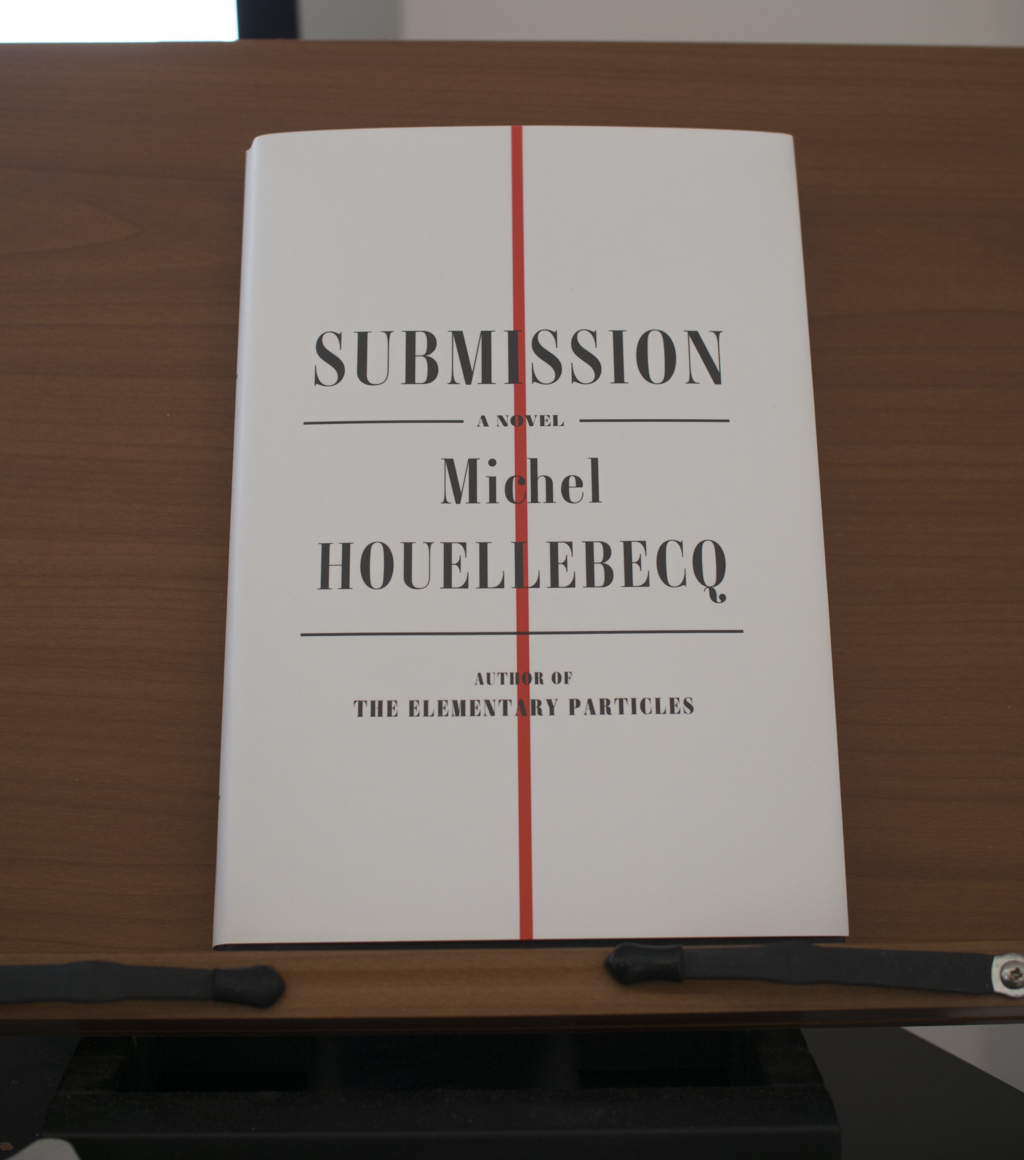
The new Houellebecq is out:

Submission by Houellebecq


And some of its themes will be familiar to fans: On the first page, François is finishing school, and he “realized that part of my life, probably the best part, was behind me.” As it is for everyone Houellebecq character. And, later:

You have to take an interest in life, I told myself. I wondered what could interest me, now that I was finished with love. I could take a course in wine tasting, maybe, or start collecting model airplanes.

My afternoon seminar was exhausting. Doctoral students tended to be exhausting. For them it was all just starting to mean something, and for me nothing mattered except which Indian dinner I’d microwave (Chicken Biryani? Chicken Tikka Masala? Chicken Rogan Josh?) while I watched the political talk shows on France 2.

Most of us take an interest in something instinctively, almost automatically; meaning is a question but not the only one, and if the Indian dinner matters we at least want a good one. The condition of a Houellebecq narrator is boredom punctuated by sex with an improbably attractive woman or an unexpected act of violence. Despite that most of his novels, except for The Possibility of an Island, rivet: He asks questions others may ask but answers in ways few others will. Different but not in a bad way is a small territory that feels expansive in his books, which are an unpassionate redescription of life in the age of pleasure, which so few columnists get. Tom Wolfe gets status; Houellebecq gets apathy.

Houellebecq's novels

Praise, criticism, and hypocrisy around people you know

I got some pushback on two recent posts, in which I said “Bess Stillman is the best med school essay writer there is” and that Mate is good but that I’m not an unbiased observer. The basic thrust of the pushback is that I shouldn’t talk about books or services or people I have a direct connection to. But I don’t think it’s true: Dr. Stillman is the best person in her genre I’ve ever seen, and Mate is the book that young straight guys (and probably some older straight guys) need to read. It’s possible to praise those works without compromising intellectual integrity, and indeed if I thought either of their works weren’t good I’d be silent. Silence is often tact; I’m sure some people I know dislike or feel neutral towards Asking Anna or The Hook, and for the most part they’ve said nothing. But approval matters too, and Dr. Stillman’s admission consulting and Mate are worth your attention; attention is the scarcest commodity in the modern information economy and I don’t want to waste mine or yours.*

We live in an information-rich and insight-poor environment. Much of the writing masquerading as insight isn’t, really, and I want to imagine that I’m ever-so-slightly changing the ratio of information to insight. That happens not only around books or ideas I write about, but also about books or ideas or services by people I know—and there is still a key difference between people who I know in real life and people I don’t. For as long as humans are humans personal interactions will matter. That’s why I only do book interviews in person: there’s a different energy there that unlocks ideas not unlocked via written interviews. I’m not saying one medium is better than the other—they’re different—but I am saying the outcomes tend to be different in ways hard to define but easy to feel and notice.

Within this context, it’s possible to be silent when something is not worth attention and loud when something is. If you’re writing bad things about your significant other in a public space, you should really reconsider who you are married to, dating, or sleeping with. Actually, the person you are married to, dating, or sleeping with ought really to reconsider you. The place to offer (suitable delicately phrased) criticism is in private, not on the public Internet.

I of course am not the first person to discuss these matters and I won’t be the last. They’re matters tact, money, and interest, which never go out of style and are always a challenge for every era, and arguably moreso for ours. Authenticity is a bogus concept and yet it’s everywhere (and its bogosity makes it attractive to marketers and other people with shit to sell). I like to think I’m disinclined towards bullshit, in the Frankfurt sense, while still being able to speak to books, works, products, and services that I know through personal connections. So I include disclaimers about potential conflicts of interest where they’re relevant and otherwise try to say things that are true and interesting. The world has an eternal shortage of statements that are true and interesting.


* That’s also one reason why I no longer write negative reviews of books or other materials that are bad in uninteresting ways.

Links: Electric cars, the booming erotic toy industry, academic freedom’s worst enemies, iMacs get love, and more

* In California, Electric Cars Outpace Plugs, and Sparks Fly.

* “The Race to Build the Perfect Couples’ Sex Toy,” conceivably NSFW but there are no photos or drawings of humans. I found it interesting throughout.

* “Cinemas must ‘drastically improve’ or lose audiences, says Christopher Nolan.” He’s wrong about the “real film” issue: he should be more worried at the shocking level of dilapidation at movie theaters, and the worse level of food available.

* “Professors teach students how to stifle academic freedom, U.K. scholar argues in new book,” and students are oddly eager to do whatever authority figures tell them to do.

* “Inside the lab: Why Apple still sweats the details on iMac,” a fascinating story; Apple also updated iMacs on October 13. I use a 5K iMac, and it’s an amazing machine. If you order one, make sure you get the Fusion drive upgrade. The 21.5″ models are now reasonably affordable.

* What a city designed only for bikes would look like.

* How Harvard fights unions; it is entertaining to me how university people, who are probably the most theoretically pro-union group in the U.S., can’t or won’t allow unions in their institutions, or actively fight against them.

* “The Porn Business Isn’t Anything Like You Think It Is,” which is safe-for-work.

* “Why ‘game’ and ‘pickup’ are popular in the Anglo-sphere” (otherwise titled “The Male Hunger For Endless Shallow Relationships Is A Symptom Of A Fundamentally Broken Society”); speculative. See also “The appeal of ‘pickup’ or ‘game’ or ‘The Redpill’ is a failure of education and socialization.”

When there are too many administrators, which ones do *you* fire?

You know there are too many administrators when even The Nation argues there are too many administrators.* More importantly, though, everyone regardless of political bent is against “administrators” in the abstract but almost no one lists which administrators should be on the chopping block. Too few articles and polemicists say, “These are the 100 positions I’d eliminate at the University of Washington.” If a school decided to fire its “Diversity” department in the name of cost cutting, The Nation would be the first publication screaming about racism and institutional indifference and the betrayal of high-need populations. Everyone rails about administrators, but no one has concrete plans to halt their proliferation.

Consider UC-Berkeley’s “Vice Chancellor’s Office for Equity & Inclusion;” perhaps UC-Berkeley doesn’t need seven “equity and inclusion” teams or 17 employees in the Vice Chancellor’s Office for Equity & Inclusion.** The staff includes several financial analysts and a graphic designer exclusive to that office. California’s public salary database shows that that graphic designer earned $75,800 in 2014. The Development Director earns $109,000. The Executive Assistant earns $91,400. The Vice Chancellor for Equity and Inclusion earns $209,000 a year. And so on. But UC-Berkeley will probably never cut this department (maybe that’s a Good Thing).

One sees this elsewhere. At Marymount Manhattan College, last week I got an email about a “Change of Title IX Coordinator.” That’s another part of one administrator’s job that didn’t exist decades ago. In addition, the email says the school “undertook an assessment of how best to comply with evolving federal and state legislation.” Which is another way of saying, “We spent a bunch of time and man hours.” Followed, since this is a large, modern organization, by numerous email followups. There were also “mandated student, faculty, and staff trainings” (emphasis added). Maybe that work is good and maybe it isn’t, but it’s still indicative of the time and energy and activities that otherwise hated administrators are doing.

(Title IX, by the way, is the subject of Laura Kipnis’s hilarious, expensive Title IX inquisition. I wouldn’t blame you if you left this somewhat dry article to read her funnier, ribald essay.)

I don’t want to pick on any particular school or even the education industry specifically. Regulatory compliance costs are increasing in virtually all industries, including the financial industry (link goes to a PDF) and many others. We rarely consider the systematic effects of regulatory compliance and instead think of each particular regulation / requirement in isolation. Nonetheless, when we get a lot of regulatory and other mandatory or optional costs together, we see the need for more lawyers, bureaucrats, administrators, and other people who all need to be paid and who have to be at least somewhat good at abstract thinking, writing, and statistics.

To be sure, the presidents and so forth making $500,000 or more per year is obscene on its face, but those are a relatively small number of positions, and, while I agree that college presidents should behave more like part of the university and less like corporate titans, I’m not sure that a small number of overly paid people is the biggest problem. I am sure that the next time I see someone announcing that we need to first fire all the administrators I’ll send them this post and get nothing in response.


* But here’s one, alternate explanation.

** Much of this post and its research came from a friend, who gave me permission to publish it.

Links: The intellectual foundations of American democracy, parking costs, more on “Mate,” Neil Strauss of “The Game” is back, and more

* “American democracy is doomed;” don’t attend too much to the clickbait headline, but this may be the most important thing you read all day, week, or month.

* Parking costs are eating our housing.

* Robin Hanson on Mate, and also Tyler Cowen on Mate (see also me on Mate, though note too that I was the precise target audience for this book when I was younger).

* Why aren’t America’s ports automated? Short answer: Unions.

* “How Tasteless Suburbs Become Beloved Urban Neighborhoods.”

* “America: Abandon Your Reverence for the Bachelor’s Degree: Many high-school graduates must choose between two bad options: a four-year program for which they’re not academically or emotionally prepared, or job-specific training that might put a ceiling on their careers.” This should by now be obvious, and I argued the same in “Taking Apprenticeships Seriously: The need for alternate paths.”

* “Soldiers of Reddit who’ve fought in Afghanistan, what preconceptions did you have that turned out to be completely wrong?” The answers are fascinating throughout and demonstrate the total folly of trying to impose democracy on a country that in some respects resembles many “countries” of 3,000 years ago than countries of today. Sample:

I’d have to say this is not a perception but rather a culture shock. I was never part of any interrogations but I was told that some of the Taliban we had been fighting believed we had force fields that were causing their weapons, most notably RPGs, to not hit us.

It had nothing to do with skill of the user or the weapons capabilities. They actually believed our technology was that superior.

And a follow-up:

One of the guys in my unit was monitoring enemy radio traffic with an interpreter. They were flying around a Raven, and listening to the chatter about it. The conversation went something like this:

“Where do they find pilots to fly such a small plane?”

“They have trained mice to fly them, you fool!”

* Neil Strauss, who wrote The Game, is back with a new book and publicity for said book: “Neil Strauss: ‘My thinking was: If this woman’s going to be naked with me – I must be OK. It doesn’t last.’ His book The Game made him a fortune, but left Neil Strauss in treatment for sex addiction. Ten years later, he’s a changed man.” Here is another review / discussion on Slate. Here is a post in which I discuss The Game.

I’m not convinced “sex addiction” exists. I did pre-order The Truth: An Uncomfortable Book About Relationships.

Briefly noted: The Word Exchange — Alena Graedon

The best criticism of this novel is “Human, All Too Inhuman,” in which James Wood, among other things, defines hysterical realism. “Human, All Too Inhuman” was written before The Word Exchange but still applies to it. The novel is good on a sentence-by-sentence level but is poorly and tediously plotted; malformations on the macro level are hard to describe but easily noticeable. I’ll happily start the next Graedon novel because this one shows much promise. The Word Exchange concerns a near-future world in which Anana works with her father, Doug, on the world’s last paper dictionary. Her father disappears, the Dictionary as a product and institution are attacked, and Anana needs to find out why. Yet on page 75 she writes:

But this was no ordinary book burning. Our digital corpus was also being dismantled, by pale, nimble hands. Who, I wondered, would want to destroy the Dictionary? Did Doug know? Was that why he’d vanished?

Word_Exchange_cover this point something more should have happened than random thoughts, discussions about Hegel, Anana’s time in college, her relationship with pseudo-friend Max, and many other threads so random that one has to wonder if or when they’ll cohere.

The novel channels many others: Stephenson, Gibson, even Carlos Ruiz Zafón, all of whose complete works you should try first, especially Snow Crash and Pattern Recognition.

There are echoes, maybe unintentionally, of The Name of the Rose (think of the moment when Ubertino and William are speaking together and William says, “I like also to listen to words, and then I think about them,” which one could say also of Anana and the other characters in The Word Exchange, though they lack Williams’s rigor.) Yet that novel, for all its abstruse Catholic metaphysics, is bound by a murder; people like murder stories because the stakes are plain: Death is bad, preventing it is good, and murderers need to be subjected to justice. In The Word Exchange no stakes are clear. By page 130 the narrative is still wandering and navel gazing; it’s only in the 130 – 140 range that things start to cohere, slightly.

Writers are fond of murder for a reason; if not murder, then comedy, and though there is a disappearance in The Word Exchange there is no murder. John Updike’s novelistic alter ego Bech knows the draw of murder:

Murdering critics is something most writers, I suspect, have wanted to do. The device of poisoning an envelope flap was used, I discovered later, in an episode of Seinfeld, but by then it was too late, my die was cast.

Art imitates other art even unintentionally. Murder and mystery are good too to emulate, and The Word Exchange is conscious, maybe too conscious, of its emulations. It is not consciousness enough of the pleasures of narrative, of structure, of figuring out the “why” and not just the “how.”

In The Word Exchange I want less… Brooklyn? It’s hard to choose an adjective. The novel feels written or narrated by a bright and precocious but ultimately annoying student who has not yet learned how to be in the world. Even the acknowledgements page is annoying, beginning as it does with “I have a real community of minds to thank.” As opposed to a false community of minds? Why not just say, “Group of people?” The sheer number of people thanked may be indicative of the problems with the story: Too many people said too many things and no central person adequately controlled the outcome.

The praise for The Word Exchange indicates why one can’t trust critics.

Guest post: The Match.com date NIMBY who’s intolerant of tolerance and Airbnb

My dad, Isaac, wrote this post.

Faithful readers will know that Jake is fairly obsessed with the impact of NIMBYs on increasing the cost of housing and generally mucking up urban development, no matter how beneficial new housing/development is to the community. Years ago, in a former life as a community development director for several California cities, I had plenty of experience running public hearings in which the Citizens United Against Everything would show up with pitchforks and torches to oppose anything new. Admittedly there were no literal pitchforks and torches, but they definitely had ever-present attorneys and demands for Environmental Impact Reports (EIRs). I agree with Jake that the whole NIMBY stuff is not only counter-productive but also gets tiresome quickly.

These days I find myself trolling Match.com and JDate in search of yet another “new life partner,” as those of us of a certain age say about the singles world. Most of my bad date experiences are typical of the online dating process and not worthy of your time to read about. One, though, shows the incredible hypocrisy of the NIMBY phenomenon.

I met my date, a banking executive, at a Beverly Hills wine bar. She was reasonably attractive and interesting, and the date was going pretty well until the conversation shifted beyond standard first date interview questions (like, “How is it that all three of your ex-husbands died suddenly?” or “I’m curious as to how it is that you remember watching the Liston/Ali fight if you’re actually 51?”).

My date said she owned a house in the Beverlywood adjacent* neighborhood, and for years she’s led neighborhood opposition to various development projects like group homes** and, of all things, the Museum of Tolerance (MOT), which was built a few years a years ago near her neighborhood. The MOT is affiliated with the Simon Wiesenthal Center, an internationally renowned Jewish human rights organization, and it’s dedicated to helping visitors understand the Holocaust.

I was amazed when my date told me proudly that she led her neighborhood group in opposing construction of MOT and held up the project for three years at a cost of $3,000,000 to the Simon Wiesenthal Center. Given Mr. Wiesenthal’s work as perhaps the most dedicated Nazi hunter, it’s hard to think of an organization or project that deserves more support, rather than roadblocks, than MOT, particularly in a largely Jewish neighborhood. The date began to go downhill when I pointed out to her that her opposition to MOT made her “intolerant of tolerance” (and guilty of wasting good money).

I soldiered on, as I was increasingly fascinated by her amazingly strong NIMBY convictions. I ordered a second glass of wine so I could listen to more. Her current NIMBY passion is several nearby houses that are being rented out on Airbnb. In Beverlywood adjacent, like much of prime LA, the relatively modest post-WWII houses in her neighborhood are being torn down and replaced by McMansions, which means lots of empty bedrooms and huge mortgage payments. Since Beverlywood adjacent is handy to Beverly Hills, West Hollywood, UCLA and Santa Monica, and hotel rooms in the area can easily top $500/night, it’s a natural habitat for Airbnb, from both owner and renter perspectives. This somehow offends her and she’s trying to use the City of LA regulations to put a stop to the moral outrage that is Airbnb. So far she’s had no success in this curious crusade, which just makes her more angry in the finest NIMBY tradition.

While my date was busy complaining about Airbnb in her neighborhood, she also offhandedly said that she often uses Airbnb herself when she travels! The date ended quickly when I pointed out the inherent irony/hypocrisy of this absurd juxtaposition, which she’d apparently never recognized. But NIMBYs are rarely actually interested in the greater good—they want their neighborhood/city frozen in time like a bee in amber. This odd aspect of NIMBYs is true even if they moved into the neighborhood last week, as they invariably want to be the last one across the drawbridge before it’s raised.


* In LaLA land, it’s not usual for relatively modest neighborhoods to seek added cachet by adding “adjacent,” as in Beverlywood adjacent, Bel Air adjacent, Santa Monica adjacent and so on. This is often used in real estate listings, even if the property is miles away from the actual glittering neighborhood.

** Since I’m a former community development director, it was my sad duty to tell my date that group homes can be placed in any residential neighborhood in California, without any special permits, as long as the home has no more than six beds. The one she was concerned about is “sober living home” for recovering alcoholics, but it could just as easily be a half-way house for convicted murderers. She should count her blessings.

Links: The Power Broker, bogus pre schools, Conrad, email, sugar, and more

* “‘The Power Broker,’ 40 Years Later,” which is much more moving than it sounds.

* “Preschool Can Be Worse Than the Alternative.” We’ve worked on numerous proposals for New York City’s Universal Pre-Kindergarten (UPK) program, and some of that experience has made us… skeptical… of the push for more structured education for everyone, everywhere, all the time.

* “Joseph Conrad’s powerful novels anticipate the bloody political conflicts of the modern world;” a more accurate essay I’ve rarely read.

* “The Real Anti-Facebook Is Good Old Email.” Which I still use more than any other online system, though sometimes I feel out of time for doing so. I do use Dropbox for distributing pictures, though.

* Terence Tao successfully attacks the Erdős discrepancy problem by building on an online collaboration.

* “The Rise and Fall of Erdogan’s Turkey: No other state has catapulted itself into the future quite as rapidly, nor relapsed back into its dark past as suddenly, as Turkey. First there was modernization, and now the beginnings of a civil war. The country is divided by mistrust and hate.”

* The Money Spent Selling Sugar to Americans Is Staggering: Why do we eat what we eat? Three experts attempt to answer.

* The Case of Richard Glossip, who is about to be murdered by the state—in the United States.

Do millennials have a future in Seattle? Do millennials have a future in any superstar cities?

Over in the Seattle section of Reddit someone asked, “Millennials of Seattle: Do you believe that you have a future in this city?”* My answer started small but grew until it became an essay in and of itself, since “Seattle” is really a stand-in for numerous other cities (like NYC, LA, Denver, and Boston) that combine strong economies with parochial housing policies that cause the high rents that hurt younger and poorer people. Seattle is, like many dense liberal cities, becoming much more of a superstar city of the sort Edward Glaeser defines in The Triumph of the City. It has a densely urbanized core, strong education facilities, and intense research, development, and intellectual industries—along with strict land-use controls that artificially raise the cost of housing.

Innovation, in the sense Peter Thiel describes in Zero to One, plus the ability to sell to global markets leads to extremely high earning potential for some people with highly valuable skills. But, for reasons still somewhat opaque to me and rooted in psychology, politics, and law, (they’re somewhat discussed by Glaeser and by Tyler Cowen in Average is Over), liberal and superficially progressive cities like Seattle also tend to generate the aforementioned intense land-use controls and opposition to development. This strangles housing supply.

The combination of high incomes generated by innovation and selling to global markets, along with viciously limited housing supply, tends to price non-superstars out of the market. Various subsidy schemes generate much more noise than practical assistance for people, and markets are at best exceedingly hard to alter through government fiat. So one gets periodic journalistic accounts of supposed housing price “crises.” By contrast to Seattle, New York, or L.A., Sun Belt cities are growing so fast and so consistently because of real affordable housing. People move to them because housing is cheap. Maybe the quality of life isn’t as high in other ways, but affordability is arguably the biggest component of quality of life. Issues with superstar cities and housing affordability are well-known in the research community but those issues haven’t translated much into voters voting for greater housing supply—probably because existing owners hate anything that they perceive will harm them or their economic self-interests in any way.

Enlightenment_heathSomewhat oddly, too, large parts of the progressive community seem to not believe in or accept supply and demand. Without understanding that basic economic principle it’s difficult to have an intelligent discussion about housing costs. It’s like trying to discuss biology with someone who neither understands nor accepts evolution. In newspaper articles and forum threads, one sees over and over again elementary errors in understanding supply and demand. I used to correct them but now mostly don’t bother because those threads and articles are ruled by feelings rather than knowledge, per Heath’s argument in Enlightenment 2.0, and it’s mentally easier to demonize evil “developers” than it is to understand how supply and demand work.

Ignore the many bogeymen named in the media and focus on market fundamentals. Seattle is increasingly great for economic superstars. Most of them probably aren’t wasting time posting to or reading Reddit. If you are not a superstar Seattle is going to be very difficult to build a future in. This is a generalized problem. As I said earlier, voters don’t understand basic economics, and neither do reporters who should know better. Existing property owners prefer to exclude rivalrous uses. So we get too little supply and increasing demand—across a broad range of cities. Courts have largely permitted economic takings in the form of extreme land-use control.

Seattle is the most salient city for this discussions, but Seattle is also growing because San Francisco’s land-use politics are even worse than Seattle’s. While Seattle has been bad, San Francisco has been (and is) far worse. By some measures San Francisco is now the most expensive place in the country to live. For many Silicon Valley tech workers who drive San Francisco housing prices, moving to Seattle immediately increases real income enormously through the one-two punch of (relatively) lower housing prices and no income tax. Seattle is still a steal relative to San Francisco and still has many of the amenities tech nerds like. So Seattle is catching much of San Francisco’s spillover, for good reason, and in turn places like Houston and Austin are catching much of Seattle’s spillover.

See also this discussion and my discussion of Jane Jacobs and urban land politics. Ignore  comments that don’t cite actual research.

Furthermore, as Matt Yglesias points out in The Rent Is Too Damn High: What To Do About It, And Why It Matters More Than You Think, nominally free-market conservatives also tend to oppose development and support extensive land-use controls. But urban cities like Seattle almost always tilt leftward relative to suburbs and rural areas. Why this happens isn’t well understood.

Overall, it’s telling that Seattlites generate a lot of rhetoric around affordable housing and being progressive while simultaneously attacking policies that would actually provide affordable housing and be actually progressive. Some of you may have heard the hot air around Piketty and his book Capital in the 21st Century. But it turns out that, if you properly account for housing and land-use controls, a surprisingly large amount of the supposed disparity between top earners and everyone else goes away. The somewhat dubious obsession that progressives have with wealth concentration is tied up with the other progressive policy of preventing normal housing development!

This is a problem that’s more serious than it looks because parochial land-use controls affect the environment (in the sense of global climate change and resource consumption), as well as the innovation environment (close proximity increases innovation). Let’s talk first about the environment. Sunbelt cities like Phoenix, Houston, Dallas, and Atlanta have minimal mass transit, few mid- and high-rise buildings, and lots and lots of far-flung sub-divisions with cars. This isn’t good for the amount of carbon in the atmosphere, or for the amount of driving that people have to do, but warped land-use controls have given them to us anyway, and the easiest way to get around those land-use controls is to move to the periphery of an urban area and build there. Instead of super energy efficient mid-rises in Seattle, we get fifty tract houses in Dallas.

Then there’s the innovation issue. The more general term for this is “economic geography,” and the striking thing is how industries seem to cluster more in the Internet age. It is not equally easy to start a startup anywhere; they seem to occur in major cities. It isn’t even equally easy to be, say, a rapper: Atlanta produces a way disproportionate number of rappers (See also here). California’s San Fernando Valley appears to be where anyone who does porn professional wants to go. New York still attracts writers, though now they’re exiled to distant parts of the boroughs. My own novels say, “Jake Seliger grew up near Seattle and lives in New York City” (though admittedly I haven’t found much of a literary community here, which is probably my own fault). And so on, for numerous industries, most of them too small to have made a blip on my radar.

These issues interest me both as an intellectual matter and because they play into my work as a grant writer. Many of the ills grant-funded programs are supposed to solve, like poverty and homelessness, are dramatically worsened by persistent, parochial local land-use policies. Few of the superficial progressives in places like Seattle connect land-use policies to larger progressive issues.

So we get large swaths of people priced out of those lucrative job markets altogether, which (most) progressives dislike in theory. Nominal progressives become extreme reactionaries in their own backyards, which ought to tell us something important about them. Still, grant-funded programs that are supposed to boost income and have other positive effects on people’s lives are fighting against the tide . Fighting the tide is at best exceedingly difficult and at worst impossible. I don’t like to think that I’m fighting futile battles or doing futile work, and I consider this post part of the education process.

Few readers have gotten this far, and if you have, congratulations! The essence of the issue is simple supply and demand, but one sees a lot of misunderstanding and misinformation in discussions of it.

In addition, I don’t expect to have much of an impact. Earlier in this essay I mentioned Joseph Heath’s Enlightenment 2.0: Restoring sanity to our politics, our economy, and our lives, and in that book he observes that rationalists tend to get drown out by immediate, emotional responses. In this essay I’m arguing from a position of deliberate reason, while emotional appeals tend to “win” most intuitive arguments.

By the way: In Seattle itself, as of 2015 about two-thirds of Seattle’s land mass is reserved for single-family, detached houses. That’s insane in almost any city, but it’s especially insane in a major global city. Much of Seattle’s affordability problem could be solved or ameliorated by something as simple as legalizing houses with adjoining walls and no setback requirements. The housing that many people would love is literally illegal to build.

Finally, one commonly hears some objections to any sort of change in cities:

* “It’s ugly / out of character for the neighborhood:” As “How Tasteless Suburbs Become Beloved Urban Neighborhoods” explains, it takes about 50 years for design trends to go from “ugly” or “tacky” to “historic.” It’s hard to rebut people saying “that is ugly!” except by saying “no it isn’t!”, but one can see that most new developments are initially seen as undesirable and are eventually seen as normal. “Character” arguments, when made by owners, are usually code for “Protect my property investment.” It’s also not possible to protect the “character” of neighborhoods.

* “Foreigners and their money are buying everything up and making them more expensive:” Actually, real estate is, properly considered, an incredible export:

The key is to let more development happen in the in-demand, centrally located areas where the economic benefits are largest and the ecological costs the smallest, not just “transitional” neighborhoods and the exurban fringe. Take the existing stacks of apartments for rich people and replace them with taller stacks. Then watch the money roll in.

* “Gentrification is unfair:” Oddly, cities began to freeze in earnest, via zoning laws, in the 1970s. One can see this both from the link and from Google’s Ngram viewer, which sees virtually no references to gentrification until the late 70s, and the term really takes off later than that.

If gentrification is unfair—and maybe it is—the only real solution is to build as much housing as people want to consume, which will lower real prices towards the cost of construction. Few contemporary cities pursue this strategy, though. No other strategy will work.

EDIT: See also “How Seattle Killed Micro-Housing: One bad policy at a time, Seattle outlawed a smart, affordable housing option for thousands of its residents.” The city’s devotion to exclusionary housing policies is amazing. It’s not as bad as San Francisco, but compared to Texas it’s quite terrible.


* I’m reading “Millennials” as referring to people under age 30 who have no special status or insider connections. Few will have access to paid-off or rent-controlled housing in superstar cities. They’ll be clawing their way from the bottom without handouts. In cities like New York and San Francisco, a few older people have voted themselves into free stuff in the form of rent control. Most Millennials won’t have that.