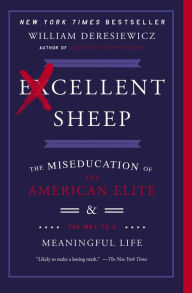
Briefly noted: Excellent Sheep: The Miseducation of the American Elite and the Way to a Meaningful Life — William Deresiewicz

Excellent Sheep is great though polemical—snide remarks about tech companies are neither true nor useful—and one gets a sense of its contents from “Solitude and Leadership: If you want others to follow, learn to be alone with your thoughts,” which went viral for the best of reasons (as opposed to the worst, which is more common). “Eros in the Classroom” is also good, though curiously erotically attenuated, and could be read profitably in tandem with Laura Kipnis’s “Sexual Paranoia Strikes Academe.” The two point to the need for satirization of contemporary academic mores, but that satirization is already so thorough that its failure to make much of a dent inside academia is obvious.

excellent_SheepBut Excellent Sheep is comprehensive, despite its overreach. But major orators know that if they have the audience the audience will forgive much, as such is the case here. The book is situated as one that fills a need and one that speaks to the author’s earlier self:

This book, in many ways, is a letter to my twenty-year-old self. It talks about the kinds of things I wish someone had encouraged me to think about when I was going to college—such as what the point of college might be in the first place.

I was like so many kids today (and so many kids back then.) I went off to college like a sleepwalker, like a zombie. College was a blank. College was the ‘next thing.’ [. . .] Up ahead were vaguely understood objectives: status, wealth, getting to the top—in a word, ‘success.’

I was perhaps slightly less blank but barely so. That being said, I often try to talk to current college students about what college is about and usually get resistance. So it may be that Deresiewicz’s twenty-year-old self wouldn’t listen to older Deresiewicz anyway. And, like almost any book of this sort, Excellent Sheep probably won’t be read by many of the students who could most benefit from reading it. Many who might be handed it might resist it. Slightly analogously, I’m struck by Emily Nussbaum’s description of Mary Gaitskill’s Bad Behavior: “In 1988, when her short-story collection Bad Behavior came out, it became a dorm-room bible for women I knew: Finally, here was a fiction writer unafraid to walk straight through the feminist battlefields of that very strange period.” I’ve assigned it before and it’s not been treated as a Bible; some students cottoned to it but some strongly resisted, though I also don’t think of it as dealing with “the feminist battlefields” of anything: I think of the stories as being about individuals, not dreary ideologies or ideological think-pieces.

Deresiewicz has a keen grasp of what’s happening in contemporary academia and, often, life itself. He writes of a “system,” or “a set of tightly interlocking parts,” including “private and affluent public high schools; the ever-growing industry of tutors and consultants, test-prep courses and enrichment programs; the admissions process itself; [. . .] the brand-name graduate schools and employment opportunities that come after the BA [. . .]” and of course much more. But this paragraph is the most interesting:

What that system does to kds and how they can escape from it, what it does to our society and how we can dismantle it—those are the subjects of this book. I was teaching a class at Yale on the literature of friendship. One day we got around to talking about the importance of being alone. The ability to engage in introspection, I suggested, is the essential precondition for living the life of the mind, and the essential precondition for introspection is solitude. My students took this in for a second—introspection, solitude, the life of the mind, things they probably had not been asked to think about before—then one of them said, with a dawning sense of self-awareness, “So are you just saying that we’re all just, like really excellent sheep?”

He goes on: “The system manufactures students who are smart and talented and driven, yes, but also anxious, timid, and lost, with little intellectual curiosity and a stunted sense of purpose.” I’ve noticed those things. They are of course not pervasive. But I also find them impossible to miss.

Excellent Sheep is a truer work of philosophy than 99% of the stuff published under the banner of “philosophy.”

Already I’ve chewed through a thousand words and two long blockquotes and have gotten to page three of Excellent Sheep. That should speak to the book’s quality. To attend to its every argument would be to almost write another book. As I said before, don’t trust everything. But do read it. It is also interesting to me that this article about Peter Thiel describes his mistrust of the education system, which partially evolved from his unhappiness with a track-based life and system. Yet this system persists for reasons, some of which Megan McArdle articulates in “What Really Scares Helicopter Parents.” The system has been in construction for decades. Startups are one route around them. Self-publishing is another. One can no doubt imagine more.

Many people are bad at being and bad at purpose. Including, possibly, me. Excellent Sheep challenges them, which is to say, us.


Life: The trap edition

The pursuit of easier life resulted in much hardship, and not for the last time. It happens to us today. How many young college graduates have taken demanding jobs in high-powered firms, vowing that they will work hard to earn money that will enable them to retire and pursue their real interests when they are thirty-five? But by the time they reach that age, they have large mortgages, children to school, houses in the suburbs that necessitate at least two cars per family, and a sense that life is not worth living without really good wine and expensive holidays abroad. What are they supposed to do, go back to digging up roots? No, they double their efforts and keep slaving away.

—Yuval Noah Harari in Sapiens: A Brief History of Humankind, which is quite good, though the above is out of context.

I wonder how much of the financial arms race is driven by a) parochial housing policies and b) the number of people who genuinely enjoy the work at high-powered firms. Some small number of people do really enjoy being lawyers. Not many, but they exist.

Praise, criticism, and hypocrisy around people you know

I got some pushback on two recent posts, in which I said “Bess Stillman is the best med school essay writer there is” and that Mate is good but that I’m not an unbiased observer. The basic thrust of the pushback is that I shouldn’t talk about books or services or people I have a direct connection to. But I don’t think it’s true: Dr. Stillman is the best person in her genre I’ve ever seen, and Mate is the book that young straight guys (and probably some older straight guys) need to read. It’s possible to praise those works without compromising intellectual integrity, and indeed if I thought either of their works weren’t good I’d be silent. Silence is often tact; I’m sure some people I know dislike or feel neutral towards Asking Anna or The Hook, and for the most part they’ve said nothing. But approval matters too, and Dr. Stillman’s admission consulting and Mate are worth your attention; attention is the scarcest commodity in the modern information economy and I don’t want to waste mine or yours.*

We live in an information-rich and insight-poor environment. Much of the writing masquerading as insight isn’t, really, and I want to imagine that I’m ever-so-slightly changing the ratio of information to insight. That happens not only around books or ideas I write about, but also about books or ideas or services by people I know—and there is still a key difference between people who I know in real life and people I don’t. For as long as humans are humans personal interactions will matter. That’s why I only do book interviews in person: there’s a different energy there that unlocks ideas not unlocked via written interviews. I’m not saying one medium is better than the other—they’re different—but I am saying the outcomes tend to be different in ways hard to define but easy to feel and notice.

Within this context, it’s possible to be silent when something is not worth attention and loud when something is. If you’re writing bad things about your significant other in a public space, you should really reconsider who you are married to, dating, or sleeping with. Actually, the person you are married to, dating, or sleeping with ought really to reconsider you. The place to offer (suitable delicately phrased) criticism is in private, not on the public Internet.

I of course am not the first person to discuss these matters and I won’t be the last. They’re matters tact, money, and interest, which never go out of style and are always a challenge for every era, and arguably moreso for ours. Authenticity is a bogus concept and yet it’s everywhere (and its bogosity makes it attractive to marketers and other people with shit to sell). I like to think I’m disinclined towards bullshit, in the Frankfurt sense, while still being able to speak to books, works, products, and services that I know through personal connections. So I include disclaimers about potential conflicts of interest where they’re relevant and otherwise try to say things that are true and interesting. The world has an eternal shortage of statements that are true and interesting.


* That’s also one reason why I no longer write negative reviews of books or other materials that are bad in uninteresting ways.

Do millennials have a future in Seattle? Do millennials have a future in any superstar cities?

Over in the Seattle section of Reddit someone asked, “Millennials of Seattle: Do you believe that you have a future in this city?”* My answer started small but grew until it became an essay in and of itself, since “Seattle” is really a stand-in for numerous other cities (like NYC, LA, Denver, and Boston) that combine strong economies with parochial housing policies that cause the high rents that hurt younger and poorer people. Seattle is, like many dense liberal cities, becoming much more of a superstar city of the sort Edward Glaeser defines in The Triumph of the City. It has a densely urbanized core, strong education facilities, and intense research, development, and intellectual industries—along with strict land-use controls that artificially raise the cost of housing.

Innovation, in the sense Peter Thiel describes in Zero to One, plus the ability to sell to global markets leads to extremely high earning potential for some people with highly valuable skills. But, for reasons still somewhat opaque to me and rooted in psychology, politics, and law, (they’re somewhat discussed by Glaeser and by Tyler Cowen in Average is Over), liberal and superficially progressive cities like Seattle also tend to generate the aforementioned intense land-use controls and opposition to development. This strangles housing supply.

The combination of high incomes generated by innovation and selling to global markets, along with viciously limited housing supply, tends to price non-superstars out of the market. Various subsidy schemes generate much more noise than practical assistance for people, and markets are at best exceedingly hard to alter through government fiat. So one gets periodic journalistic accounts of supposed housing price “crises.” By contrast to Seattle, New York, or L.A., Sun Belt cities are growing so fast and so consistently because of real affordable housing. People move to them because housing is cheap. Maybe the quality of life isn’t as high in other ways, but affordability is arguably the biggest component of quality of life. Issues with superstar cities and housing affordability are well-known in the research community but those issues haven’t translated much into voters voting for greater housing supply—probably because existing owners hate anything that they perceive will harm them or their economic self-interests in any way.

Enlightenment_heathSomewhat oddly, too, large parts of the progressive community seem to not believe in or accept supply and demand. Without understanding that basic economic principle it’s difficult to have an intelligent discussion about housing costs. It’s like trying to discuss biology with someone who neither understands nor accepts evolution. In newspaper articles and forum threads, one sees over and over again elementary errors in understanding supply and demand. I used to correct them but now mostly don’t bother because those threads and articles are ruled by feelings rather than knowledge, per Heath’s argument in Enlightenment 2.0, and it’s mentally easier to demonize evil “developers” than it is to understand how supply and demand work.

Ignore the many bogeymen named in the media and focus on market fundamentals. Seattle is increasingly great for economic superstars. Most of them probably aren’t wasting time posting to or reading Reddit. If you are not a superstar Seattle is going to be very difficult to build a future in. This is a generalized problem. As I said earlier, voters don’t understand basic economics, and neither do reporters who should know better. Existing property owners prefer to exclude rivalrous uses. So we get too little supply and increasing demand—across a broad range of cities. Courts have largely permitted economic takings in the form of extreme land-use control.

Seattle is the most salient city for this discussions, but Seattle is also growing because San Francisco’s land-use politics are even worse than Seattle’s. While Seattle has been bad, San Francisco has been (and is) far worse. By some measures San Francisco is now the most expensive place in the country to live. For many Silicon Valley tech workers who drive San Francisco housing prices, moving to Seattle immediately increases real income enormously through the one-two punch of (relatively) lower housing prices and no income tax. Seattle is still a steal relative to San Francisco and still has many of the amenities tech nerds like. So Seattle is catching much of San Francisco’s spillover, for good reason, and in turn places like Houston and Austin are catching much of Seattle’s spillover.

See also this discussion and my discussion of Jane Jacobs and urban land politics. Ignore  comments that don’t cite actual research.

Furthermore, as Matt Yglesias points out in The Rent Is Too Damn High: What To Do About It, And Why It Matters More Than You Think, nominally free-market conservatives also tend to oppose development and support extensive land-use controls. But urban cities like Seattle almost always tilt leftward relative to suburbs and rural areas. Why this happens isn’t well understood.

Overall, it’s telling that Seattlites generate a lot of rhetoric around affordable housing and being progressive while simultaneously attacking policies that would actually provide affordable housing and be actually progressive. Some of you may have heard the hot air around Piketty and his book Capital in the 21st Century. But it turns out that, if you properly account for housing and land-use controls, a surprisingly large amount of the supposed disparity between top earners and everyone else goes away. The somewhat dubious obsession that progressives have with wealth concentration is tied up with the other progressive policy of preventing normal housing development!

This is a problem that’s more serious than it looks because parochial land-use controls affect the environment (in the sense of global climate change and resource consumption), as well as the innovation environment (close proximity increases innovation). Let’s talk first about the environment. Sunbelt cities like Phoenix, Houston, Dallas, and Atlanta have minimal mass transit, few mid- and high-rise buildings, and lots and lots of far-flung sub-divisions with cars. This isn’t good for the amount of carbon in the atmosphere, or for the amount of driving that people have to do, but warped land-use controls have given them to us anyway, and the easiest way to get around those land-use controls is to move to the periphery of an urban area and build there. Instead of super energy efficient mid-rises in Seattle, we get fifty tract houses in Dallas.

Then there’s the innovation issue. The more general term for this is “economic geography,” and the striking thing is how industries seem to cluster more in the Internet age. It is not equally easy to start a startup anywhere; they seem to occur in major cities. It isn’t even equally easy to be, say, a rapper: Atlanta produces a way disproportionate number of rappers (See also here). California’s San Fernando Valley appears to be where anyone who does porn professional wants to go. New York still attracts writers, though now they’re exiled to distant parts of the boroughs. My own novels say, “Jake Seliger grew up near Seattle and lives in New York City” (though admittedly I haven’t found much of a literary community here, which is probably my own fault). And so on, for numerous industries, most of them too small to have made a blip on my radar.

These issues interest me both as an intellectual matter and because they play into my work as a grant writer. Many of the ills grant-funded programs are supposed to solve, like poverty and homelessness, are dramatically worsened by persistent, parochial local land-use policies. Few of the superficial progressives in places like Seattle connect land-use policies to larger progressive issues.

So we get large swaths of people priced out of those lucrative job markets altogether, which (most) progressives dislike in theory. Nominal progressives become extreme reactionaries in their own backyards, which ought to tell us something important about them. Still, grant-funded programs that are supposed to boost income and have other positive effects on people’s lives are fighting against the tide . Fighting the tide is at best exceedingly difficult and at worst impossible. I don’t like to think that I’m fighting futile battles or doing futile work, and I consider this post part of the education process.

Few readers have gotten this far, and if you have, congratulations! The essence of the issue is simple supply and demand, but one sees a lot of misunderstanding and misinformation in discussions of it.

In addition, I don’t expect to have much of an impact. Earlier in this essay I mentioned Joseph Heath’s Enlightenment 2.0: Restoring sanity to our politics, our economy, and our lives, and in that book he observes that rationalists tend to get drown out by immediate, emotional responses. In this essay I’m arguing from a position of deliberate reason, while emotional appeals tend to “win” most intuitive arguments.

By the way: In Seattle itself, as of 2015 about two-thirds of Seattle’s land mass is reserved for single-family, detached houses. That’s insane in almost any city, but it’s especially insane in a major global city. Much of Seattle’s affordability problem could be solved or ameliorated by something as simple as legalizing houses with adjoining walls and no setback requirements. The housing that many people would love is literally illegal to build.

Finally, one commonly hears some objections to any sort of change in cities:

* “It’s ugly / out of character for the neighborhood:” As “How Tasteless Suburbs Become Beloved Urban Neighborhoods” explains, it takes about 50 years for design trends to go from “ugly” or “tacky” to “historic.” It’s hard to rebut people saying “that is ugly!” except by saying “no it isn’t!”, but one can see that most new developments are initially seen as undesirable and are eventually seen as normal. “Character” arguments, when made by owners, are usually code for “Protect my property investment.” It’s also not possible to protect the “character” of neighborhoods.

* “Foreigners and their money are buying everything up and making them more expensive:” Actually, real estate is, properly considered, an incredible export:

The key is to let more development happen in the in-demand, centrally located areas where the economic benefits are largest and the ecological costs the smallest, not just “transitional” neighborhoods and the exurban fringe. Take the existing stacks of apartments for rich people and replace them with taller stacks. Then watch the money roll in.

* “Gentrification is unfair:” Oddly, cities began to freeze in earnest, via zoning laws, in the 1970s. One can see this both from the link and from Google’s Ngram viewer, which sees virtually no references to gentrification until the late 70s, and the term really takes off later than that.

If gentrification is unfair—and maybe it is—the only real solution is to build as much housing as people want to consume, which will lower real prices towards the cost of construction. Few contemporary cities pursue this strategy, though. No other strategy will work.

EDIT: See also “How Seattle Killed Micro-Housing: One bad policy at a time, Seattle outlawed a smart, affordable housing option for thousands of its residents.” The city’s devotion to exclusionary housing policies is amazing. It’s not as bad as San Francisco, but compared to Texas it’s quite terrible.


* I’m reading “Millennials” as referring to people under age 30 who have no special status or insider connections. Few will have access to paid-off or rent-controlled housing in superstar cities. They’ll be clawing their way from the bottom without handouts. In cities like New York and San Francisco, a few older people have voted themselves into free stuff in the form of rent control. Most Millennials won’t have that.
A world without work might be totally awesome, and we have models for it, but getting there might be hard

Derek Thompson’s “A World Without Work: For centuries, experts have predicted that machines would make workers obsolete. That moment may finally be arriving. Could that be a good thing?” is fascinating and you should read it. But I’d like to discuss one small part, when Thompson writes: “When I asked Hunnicutt what sort of modern community most resembles his ideal of a post-work society, he admitted, ‘I’m not sure that such a place exists.'”

I can imagine such a place: A university. At one time, most professors made enough money to meet their basic material needs without making extravagant amounts of money (there were and are some superstar exceptions). Today, a fair number of professors still make enough money to meet their basic material needs, though proportionally fewer than, say, 30 years ago. Still, universities have always depended on peer effects for reputation; they’ve tended to convince smart people to do a lot of meaningful activities that are disconnected from immediate and often long-term remuneration. Many professors appear to have self-directed lives that they themselves structure. The average person with free time doesn’t explore build-it-yourself DNA or write about the beauty of Proust or do many of the other things professors  do—the average person watches TV—but perhaps norms will change over time.

I don’t want to overstate the similarity between a potential low-work future and contemporary tenured professors—many professors find grading to be mind numbing, and not everyone handles self-direction and motivation well—but they are similar enough to be notable. In a world of basic incomes and (relative) economic plenty, we may get more people writing blogs, making art, and playing sports or other games. People may spend more time in gyms and less time in chairs.

The open-source software software community as it currently exists tends to intersect with large companies, but there are fringes of it with a strongly non-commercial or academic ethos. Richard Stallman has worked for MIT for decades and has written enormous amounts of important open-source code; the primary PGP maintainer made almost no money until recently, though he could almost certainly make tons of cash working for big tech company. Many people who make money in tech are closer to artists than is commonly supposed. Reading Hacker News and the better precincts in Reddit will introduce you to other open-source zealots, some of whom mostly blow hot air but others of whom act and think like artists rather than businessmen.

Many programmers say publicly that they consider programming to be so much fun that they’re amazed at the tremendous sums they can earn doing it. A small but literate part of the sex worker community says something similar: like most people they enjoy sex, and like most people they enjoy money, and combining the two is great for them. They may not enjoy every act with every client but the more attractive and attentive clients are pretty good. One could imagine an activity that is currently (sometimes) paid and sometimes free being used to occupy more time. I’ve met many people who dance and make their money putting on and teaching dances. If they had a guaranteed annual income they’d probably dance all the time and be very pleased doing that.

Already many professions have turned into hobbies, as I wrote in 2013; most actors and musicians are essentially hobbyists as well, at least in the revenue sense. Photographers are in a similar situation, as are many fiction writers. Poets haven’t been commercial for decades, to the extent they ever were (they weren’t when the Metaphysicals were writing, but that didn’t stop Herbert or Donne). Today many of my favorite activities aren’t remunerative, and while I won’t list them here many are probably similar to yours, and chances are good that some of yours aren’t remunerative either. Maybe our favorite activities are only as pleasurable as they are by contrast with less desirable activities. Maybe they aren’t. Consider for a moment your own peak, most pleasurable and intense experiences. Did they happen at work? If you worked less, would you have more?

In short, though, models for non-commercial but meaningful lives do (somewhat) exist. Again, they may not suit everyone, but one can see a potential future already here but unevenly distributed.

A lot of white-collar office work has a large make-work component, and there’s certainly plenty of literature on how boring it can be. If people really, really worked in the office they could probably do much of their “work” in a tiny amount of the allotted time. Much of that time is signaling conformity, diligence, and so forth, and, as Tim Ferris points out in The Four-Hour Work Week, people who work smarter can probably work less. To use myself as an example, I think of myself as productive but even I read Hacker News and Reddit more often than I should.

Some people already do what appears to me to be work-like jobs. People who don’t like writing would consider this blog to be “work,” while I consider it (mostly) play, albeit of an intensely intellectual sort. It already looks to me like many moderators on Reddit and similar sites have left the world of “hobby” and entered the world of “work.” The border is porous and always has been, but I see many people moving from the one to the other. (As Thompson observes, prior the late 19th or early 20th Century the idea of unemployment was itself nonsensical because pretty much anyone could find something productive to do.) Wikipedia is another site that has adverse effects in that respect, and I can’t figure out why many disinterested people would edit the site (my edits have always been self-motivated, though I prefer not to state more here).

One can imagine a low-work future being very good, but getting from the present to that future is going to be rocky at best, and I can’t foresee it happening for decades. There are too many old people and children to care for, too many goods that need to be delivered, too much physical infrastructure that needs fixing, and in general too much boring work that no one will do without being paid. Our whole society will have to be re-structured and that is not likely to be easy; in reality, too, there has never been a sustained period of quiet “normalcy” in American history. Upheaval is normal, and the U.S. has an advantage in that rewriting cultural DNA is part of our DNA. That being said, it’s useful to wonder what might be, and one can see the shape of things to come if we see radically falling prices for many material goods.


There’s one other fascinating quote that doesn’t fit into my essay but I want to emphasize anyway:

Decades from now, perhaps the 20th century will strike future historians as an aberration, with its religious devotion to overwork in a time of prosperity, its attenuations of family in service to job opportunity, its conflation of income with self-worth. The post-work society I’ve described holds a warped mirror up to today’s economy, but in many ways it reflects the forgotten norms of the mid-19th century—the artisan middle class, the primacy of local communities, and the unfamiliarity with widespread joblessness.

*Do* we need Shakespeare?

Megan McArdle asks: “Do We Need Shakespeare?“, and she offers some theories about why we might that don’t rely on “Because we’ve always done it that way,” including “What remains is a sort of stubborn belief that people ought to study literature because it is somehow good for them” and “Maybe the best argument you can make for English class is that it offers a way for people like myself, and many thousands of future English teachers, to find out that they like English class.”

OLYMPUS DIGITAL CAMERA

OLYMPUS DIGITAL CAMERA

Still, I’m not so sure. I began imagining reasons almost immediately, but most reduced to, “Because we’ve been doing it that way for a long time.” Which can be reduced to “path dependence.” Teaching a writer who seems incomprehensible at first glance and requires experts to decipher also raises the status of (some) teachers and professors, who have knowledge that can’t be readily accessed by every day people. That Hansonian reason, however, isn’t real good reason why we should choose Shakespeare plays over some other means of teaching English.

Let me try to develop an alternate possibility that will likely make many people unhappy. I’ve begun to think that education is really about cultivating a relatively small elite who really push forward particular domains (which is a variant of McArdle’s comment about the thousands of future English teachers). In other words, mass education doesn’t matter nearly as much as intensely educating a small number of very high skill people, but those people probably aren’t identifiable in advance. This idea isn’t purely mine, and I’ve been thinking about it explicitly since reading Joel Mokyr’s The Enlightened Economy, in which he writes:

It is important to stress that the Industrial Revolution was the creation of an elite, a relatively small number of ingenious, ambitious, and diligent persons who could think out of the box, and had the wherewithal to carry out their ideas and to find others who could assist them. This is not to return to the heroic interpretations of the Victorian hagiographers such as Samuel Smiles and credit a few famous individuals with the entire phenomenon […] Even these pivotal people were a minority, perhaps a few tens of thousands of elite workers, well trained through apprenticeships supplemented sometimes by informal studies.

Wow: Something as big a deal as the Industrial Revolution may have been driven by a small number of people. I’ve also read a lot about the early computer industry and the early development of integrated chips, and that too seems to have been driven by a small number of physicists and mathematicians, with particularly important companies like Fairchild Semiconductor and later Intel starting off with tiny workforces. Most of the world didn’t matter much to the development of those industries, even though those industries are now so large that a large part of the workforce spends our time in front of glowing screens that show executed code most of us don’t understand and can’t write. Computers and the Internet are the biggest stories of our age, possibly excepting global warming and mass extinction, yet many of us aren’t substantially participating and don’t care to.

What gives?

The unpleasant answer may be that most of us don’t matter that much to the process. By the same token, most people who learn to despite reading from being made to read Shakespeare may never be good readers, writers, or thinkers—but they’re not the ones who push the world forward, intellectually speaking. Instead, those of us who go on to realize that, say, “
Shakespeare’s Genius Is Nonsense: What the Bard can teach science about language and the limits of the human mind
” are the ones who matter, at least in this domain.

Most Westerners are uncomfortable with outright elitism, but I’d ask: How many of us really work as hard as we can at a given domain? In “How A Slight Change In Mindset: Accelerated My Learning Forever,” Tristan de Montebello observes that few of us really throw ourselves into learning. Most of us learn as much as we need to to survive and do okay and reproduce, but not much more than that. You can tell as much via behavior.

That may be true in language as a domain as well. I read more than the vast majority of people I know, and yet there are people who read and write much more than even I do.

To return to Shakespeare, I’d also argue that sometimes complex, weird, or seemingly outdated works force us to read closer and more carefully than we might otherwise. Shakespeare makes contemporary readers work harder to understand what the writer means—which is ultimately a useful and under-used skill. Just look at most Internet forums: since the 1980s and Usenet, going forward all the way to today with Reddit, we have numerous places where people gather online and utterly fail at basic reading comprehension (this is one reason I spend little time posting there and much more posting here).

Under this theory, reading someone like Shakespeare is akin to lifting weights: a 500-pound deadlift may not translate directly into 500 pounds of force in a game, but it sure translates more force than a guy who can’t deadlift 500 pounds.

Still, I’m treating the argument that Shakespeare-is-good like a lawyer and trying to come up with the best possible argument, rather than arguing from first principles. I’m not fully convinced we need Shakespeare, as opposed to some other writer or group of writers, as a necessary component of teaching English.

Two visions for the future, inadvertently juxtaposed: Nell Zink and Marc Andreessen

Last week’s New Yorker inadvertently offers two visions for the future: one in a profile of the writer Nell Zink and the other in a profile of the venture capitalist Marc Andreessen. Both profiles are excellent. One of their subjects, however, is mired in a fixed, contemporary mindset, while the other subject looks to a better future.

This is Schultz’s description of Zink: “Zink writes about the big stuff: the travesty of American apartheid; the sexual, economic, and intellectual status of women; the ephemerality of desire and its enduring consequences.” Is any of that stuff really big? Does it matter? Or is it just a list of somewhat transitory issues that obsess modern intellectuals who are talking to each other through magazines like The New Yorker? The material well-being of virtually any American is so much higher than it was in, say, 1900, as to diminish the relative importance of many of the ideas Zink or Schultz considers “big.” At one point Zink “delivered a short lecture on income stagnation: a bird ridiculing its fellow-bird for stupidity.” But global inequality is falling and, moreover, the more interesting question may be absolute material conditions, rather than relative ones. One gets the sense that Zink is a more parochial thinker than she thinks. I sense from The Wallcreeper that she writes about the motiveless and pathless.

Here, by contrast, is Andreessen as described by Tad Friend:

Andreessen is tomorrow’s advance man, routinely laying out “what will happen in the next ten, twenty, thirty years,” as if he were glancing at his Google calendar. He views his acuity as a matter of careful observation and extrapolation, and often invokes William Gibson’s observation “The future is already here—it’s just not very evenly distributed.” Jet packs have been around for half a century, but you still can’t buy them at Target.

and:

The game in Silicon Valley, while it remains part of California, is not ferocious intelligence or a contrarian investment thesis: everyone has that. It’s not even wealth [. . . .] It’s prescience. And then it’s removing every obstacle to the ferocious clarity of your vision: incumbents, regulations, folkways, people. Can you not just see the future but summon it?

Having a real vision counts, and it seems that too few people have a vision for the future. Andreessen is thinking not of today but of what can be made better tomorrow. I would not deny the impact of slavery on contemporary culture or the importance of desire on life, but I would ask Zink: if the U.S. is doing things poorly, who is doing them better? And if the U.S. is doing things poorly why then is Silicon Valley the center of the future?

One of these people reads as an optimist, the other as a pessimist. One reads as someone who makes things happen and the other as someone who complains about things that other people do. One reads as a person with a path. The other doesn’t.

Don’t get me wrong. I liked The Wallcreeper when I read it a couple months ago. I didn’t have much to say about it on this blog because it seems kind of interesting but left me without much feeling. But I can’t help thinking that Andreessen’s vision for the future is big, while Zink’s vision of the present is small.

As a bonus, check out “All Hail the Grumbler! Abiding Karl Kraus,” which is poorly titled but describes Jonathan Franzen’s relationship to art, technology, and other matters. He’s in the Zink school; perhaps something about studying German inculcates an anti-technology backlash among writers, since Germany and the U.S. are both among the most technophilic societies in the world (for good reasons, I would argue). From the article:

Kraus’s savage criticism of popular newspapers, suspicion of technology, and defense of art all appeal to Franzen, whose nonfiction essays strike similar notes. For instance, in the spirit of Kraus, Franzen has attacked the intrusiveness of cellphones and the loss of private space as people bark out the dreck of their lives.

But even “privacy” is a relatively new idea: being alone to read books only really got going in the 18th Century, when books got cheap enough for normal people to borrow them from libraries. The luddites of the day lamented the withdrawal from the private sphere into onanistic privacy. They asked: Why wrap yourself in some imaginary world when the big real world is out there?

As you may imagine I’m more neutral towards these developments. Like many literary types I think the world would be a better place with more reading and less reality TV, but I’ll also observe that the kind of people who share that view are likely to read this blog and the kind of people who don’t aren’t likely to give a shit about what I or anyone like me says.

Much later in the essay its author, Russell Jacoby, writes: “Denouncing capitalist technology has rarely flourished on the left, which, in general, believes in progress.” I get what he’s saying, But denouncing technology in general has always been a fool’s game because a) pretty much everyone uses it and b) to the extent one generation (or a member of a generation) refuses a given technology, the next generation takes it up entirely. Franzen may not like technology circa 2015 but he is very fond of the technology of the printing press. At what point does Franzen think “good” technology stopped?

I’m reminded, unfairly perhaps, of the many noisy environmentalists I’ve known who do things like bring reusable bags to grocery but then fly on planes at least a couple times a year. Buy flying pollutes more than pretty much anything anyone else does. A lot of SUV-drivers living in exurbs actually create less pollution than urban cosmopolitans who fly every two months. By the same token, the same people who denounce one set of technical innovations are often dependent on or love some other set of technical innovations.

Almost no one wants to really, really go backwards, technologically speaking, in time. Look at behaviors rather than words. I do believe that Franzen doesn’t use Facebook or write a blog or whatever, but he probably uses other stuff, and, if he has kids, they probably want smart phones and video games because all their friends have smart phones and video games.

I’m not saying smart phones and video games are good—quite the opposite, really—and I’m sympathetic to Zimbardo’s claim that “video games and porn are destroying men.” But I am saying that the claims about modern technology doing terrible things to people or culture goes back centuries and has rarely if ever proven true, and the people making such claims are usually, when viewed in the correct light, hypocrites on some level. Jacoby does hit a related point: “Presumably, if enough people like SUVs, reality TV, and over-priced athletic footwear, little more may be said. The majority has spoken.” But I want to emphasize the point and say more about not the banal cultural stuff like bad TV (and obviously there is interesting TV) but the deeper stuff, like technology.

The Andreessens of the world are right. There is no way back. The only way is forward, whether we want to admit it or not. The real problem with our cultural relationship to technology—and this is a Peter Thielian point—is that we’re in denial about dependence, need, and the need to build the future.

Novelty, art, business

“[T]he most important task in business—the creation of new value—cannot be reduced to a formula and applied by professionals,” as Thiel says in Zero to One, which, if you haven’t read it, you should stop reading this post and go read it instead. Read properly it’s about art as much as business. The most important task in art may also explain why art schools bother us (sample: “Why Writers Love to Hate the M.F.A.?“): they take what might be successful master-apprentice relationships and make them professional—that is, more like consultants than like artists. Maybe the best consultants are artists.

There’s more evidence for this: Genre writers often bother literary writers, perhaps because genre writers tend to execute a formula rather than innovate (the word “tend” is key here). If genre writers do come up with a new formula, they tend to iterate on that formula rather than seeking to discover a whole new one; while this might be admired in science and to some extent business it rarely is by artists, who often value noble, large-scale failure over commercial success. It’s easier to scorn what people want than it is to give them what they want, or make what they want.

Many writers of literary fiction are attempting to be novel, though I would argue that most attempts, even those that are highly praised, are actually bad. They may be bad in a way likely to provide tenure for future English professors, but the badness remains, and it isn’t clear that MFA and related programs help inculcate the idea that the most important task is the creation of new value, which by definition can’t be foreseen ahead of time. If someone foresaw it, they would execute, and the value would be there. Unpredictability may also be why so many artistic careers are difficult: you don’t know if you’re really creating value until it’s too late. Efforts at standardization are futile. Value may not even be recognized in your lifetime. You really are Sisyphus. When I first read the core part of The Myth of Sisphyus, in high school, I thought it stupid, yet it remains with me because it touches something at the core of not just art but life.

As Jonah Lehrer wrote, “although we are always surrounded by our creations, there is something profoundly mysterious about the creative process.” That mystery exists across fields.

The moderator problem: How Reddit and related news sites decline

Online communities often grow from a small, enthusiastic, intelligent niche group that is relatively self-policing to a larger, amorphous group that becomes stupider at a rate that’s an exponent of the number of users (the linked book is excellent on this topic). Initial moderators are usually enthusiasts and small groups are more like communities than cities. Later moderators, though, are usually adversely selected: What kind of person would voluntarily spend lots of time and energy policing a community for no money? Consequently, online community decline is often exacerbated by the moderator or moderators who eventually take over or seek power.

The psychology of someone who is willing to moderate a Reddit subsection—or any similar site, like many mailing lists—is not good. This sort of person is willing to spend a time at a thankless task that is hard to do well and rarely if ever remunerative.

Those who start at that task do so optimistically but often quit as their lives change or the task becomes more onerous. Who gets left? People with axes to grind; people with no sense of perspective; petty tyrants; and so on. I don’t use Reddit much for many reasons, but low moderator quality is one. I rarely bother messaging them because doing so is largely a waste of time.

The problem with moderators is not dissimilar from the problem of users: People who regularly have something interesting to say and the means to say it well get blogs, as I wrote in “Social news sites and forums should encourage users to blog.” Those who don’t stay on Reddit. The average Reddit contributor has little stake in long-term reputation—unlike bloggers, journalists, and academics who use real names—and that shows in the quality and quantity of posts. That may not hurt the site—the popularity of bad TV shows over many years demonstrates lowest-common denominator issues—but it should hurt in terms of high-quality users.

A form of Gresham’s Law applies to social sites and to moderators: bad commentary pushes out the good, and smart people flee stupid comments. One could alternately call this a tragedy of the commons, in which communal spaces become overrun with spam or commentary so stupid that it might as well be spam.

Reddit and similar sites can have an orthogonal problem, however, as they become so afraid of self-interested commentary or posts that they forbid it—thus causing smart people to go elsewhere with their thoughts, and leaving the dregs unwilling or able to create standalone communities or blogs.

This may be part of the reason why Reddit—even on the “good” subsections—tend to be better for beginners: anyone who gets past the beginning stages needs more expert advice than Redditors can provide. The same is happening to Hacker News, too, or it has already happened, though not as severely: Hacker News has an advantage in that its survival and the intelligent commentary on it is tied to a business that is in turn tied to ideas. Its moderators have a stronger incentive to get it right, since they’re not driven primarily by ego or overwhelming fear of “spam.”

That being said, anyone who has seen an unmoderated forum is aware of the fact that unmoderated forums are unusable. So getting rid of moderators is not a solution. In general the mechanisms of exit, voice, and loyalty, as described by Hirshman at the link, apply on the level of online communities. But constantly shifting for newer communities where smart people congregate is at best difficult and at worst a waste of time in and of itself. Reddit has to some extent worked on this problem through the sub-Reddit system, which is a better-than-nothing solution but not a great one.

Maybe there is no good solution to this from the perspective of smart users other than withdrawal. Better blogs written by smart individuals or groups are better than virtually any online, Reddit-like community I’ve found. Which is too bad. But I doubt most people in latter-day moderator positions are even willing or able to read this post, and, if they are, I don’t think they’ll understand it, and, if they do, I don’t think they’ll accept any of it.

Does IKEA enable mobility?

In “How Ikea took over the world” Beth Kowitt writes:

In the furniture world there’s an oft-cited statistic that we have our sofas longer than our cars and change our dining room tables as frequently as our spouses. Furniture can be its own kind of ball and chain. It’s passed down from generation to generation, or it’s so expensive that people feel it’s forever. From the get-go, Ikea shook up that paradigm. “It traumatized furniture retailing,” says Martin Toogood, who has run several companies that have competed against Ikea over two decades.

Ikea kept its prices down with an obsessive focus on costs. It might skip an extra coating of lacquer on the underside of a table that people never see or use. The company has also stripped out as much labor as possible from the system, pushing tasks that were once done by traditional retailers onto the customer. Flat packed furniture made it easier for customers to take purchases with them, cutting out the expense of stocking and delivery. (Ikea figured out flat packing in 1956, when a designer took the legs off a Lövet table to get it in his trunk.)

I’ve read that IKEA might enable greater mobility by making moving cheaper. Rather than buying a bunch of expensive furniture and then spending thousands of dollars to haul it, IKEA allows people to quickly, and with low search costs, buy functional stuff when they move—and sell or throw away what they don’t use. I’ve been the beneficiary of lightly used stuff: Kowitt says that “One Billy bookcase, an Ikea classic, is sold every 10 seconds,” and the couple of them in my apartment came from Craigslist, either free or for $10.

A modern person looking for a job might find it easier to pack a laptop, a Kindle, a (few) paper books, some pots and pans, and clothes into a couple boxes, ship them, and re-buy everything else on the other side. Being able to focus more experiences, and spending on experiences, might be enabled by IKEA. And with more and more other stuff available cheaply online—Tuft & Needle beds are my favorite pet example, but Campaign Living also makes interesting and movable furniture—a lot of people can be substantially more mobile. Craigslist may be a substitute for U-Haul.

Furniture isn’t “forever” anymore, and I’ve met “minimum furniture” people who seem very happy with not much stuff: usually they want a desk of some sort, a bed, and maybe a small table and chairs. They rarely have friends over, or if those friends do come over it’s to pre-game, and the apartment is mostly for the big “S”es: sleeping, showering, or sex. Why bother with more?

EDIT: In “A Dozen Things I’ve Learned from Chris Dixon About Venture Capital and Startups” Tren Griffin writes:

McKinsey placed little or no value on what Craig McCaw called the ability of people to be “nomadic.” The mobile phone had each of the attributes Chris Dixon noted above. Some people thought of the mobile phone as a toy. Since my first mobile phone cost more than $4,000 dollars I actually felt awkward using it in some social settings. Talking into a mobile phone in some pubic settings would cause people to frown at you.

To continue my example, Craig McCaw was also an enthusiastic personal user of what we then called “cellular” phones. Craig McCaw loved working out of the ‘mobile office’ – meaning cars, planes, boats and ships. Which meant he was a natural enthusiast for the product. When the time came to sell his cable TV business in order to double down on the mobile phone business, the choice was made easy by his love of the mobile phone.

Mobility seems like a long-term secular trend. Cheryl Strayed glamorizes it in Wild: From Lost to Found on the Pacific Crest Trail. Her writing is as excellent as her life choices are dubious yet revealing of modern character. Bet against a wandering lifestyle at your own peril, and invest in it when you can.

EDIT 2: Older books show evidence of a pre-IKEA world. In Mary Gaitskill’s novel Veronica, Alison moves from New York to L.A. and when she gets there:

John took me to flea markets to shop for furniture: a polka-dot rug, an orange sectional couch, a red Formica table with matching chairs. He took me to lunch and sometimes to dinner.

That rug, couch, and table are probably ugly, not very functional, and take a lot of time to search for and acquire. One trip to IKEA can replace a lot of time in “flea markets,” leaving flea markets for those who really, really like them. This may say more about my cultural milieu and friend set than about culture, but I’ve never heard anyone around me talk about going to flea markets. Pretty much every move any of my friends has ever done has entail a trip to IKEA.