Lost technologies, Seveneves, and The Secret of Our Success

Spoilers ahead, but if you haven’t read Seveneves by now they probably don’t matter.

Seveneves is an unusual and great novel, and it’s great as long as you attribute some of its less plausible elements to an author building a world. One plausible element is the way humanity comes together and keeps the social, political, and economic systems functional enough to launch large numbers of spacecraft in the face of imminent collective death. If we collectively had two years to live, I suspect total breakdown would follow, leaving us with no Cloud Ark (and no story—thus we go along with the premise).
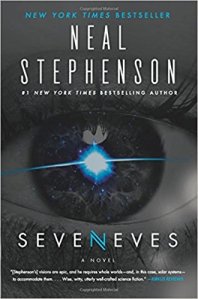
But that’s not the main thing I want to write about. Instead, consider the loss of knowledge that inherently comes with population decline. In Seveneves humanity declines to seven women living in space on a massive iron remnant of the moon. They slowly repopulate, with their descendants living in space for five thousand years. But a population of seven would probably not be able to retain and transmit the specialized knowledge necessary for survival on most parts of Earth, let alone space.

That isn’t a speculative claim. We have pretty good evidence for the way small populations lose knowledge. Something drew me to re-reading Joseph Henrich’s excellent book The Secret of Our Success, and maybe the sections about technological loss are part of it. He writes about many examples of European explorers getting lost and dying in relatively fecund environments because they don’t have the local knowledge and customs necessary to survive. He writes about indigenous groups too, including the Polar Intuit, who “live in an isolated region of northwestern Greenland [. . . .] They are the northernmost human population that has ever existed” (211). But

Sometime in the 1820s an epidemic hit this population and selectively killed off many of its oldest and most knowledgable members. With the sudden disappearance of the know-how carried by these individuals, the group collectively lost its ability to make some of its most crucial and complex tools, including leisters, bows and arrows, the heat-trapping long entry ways for snow houses, and most important, kayaks.

As a result, “The population declined until 1862, when another group of Intuit from around Baffin Island ran across them while traveling along the Greenland coast. The subsequent cultural reconnection led the Polar Intuit to rapidly reacquire what they had lost.” Which is essential:

Though crucial to survival in the Arctic, the lost technologies were not things that the Polar Intuit could easily recreate Even having seen these technologies in operation as children, and with their population crashing, neither the older generation nor an entirely new generation responded to Mother Necessity by devising kayaks, leisters, compound bows, or long tunnel entrances.

Innovation is hard and relatively rare. We’re all part of a network that transmits knowledge horizontally, from peer to peer, and vertically, from older person to younger person. Today, people in first-world countries are used to innovation because we’re part of a vast network of billions of people who are constantly learning from each and transmitting the innovations that do arise. We’re used to seemingly automatic innovation, because so many people are working on so many problems. Unless we’re employed as researchers, we’re often not cognizant of how much effort goes into both discovery and then transmission.

Without that dense network of people, though, much of what we know would be lost. Maybe the best-known example of technology loss happened when the Roman Empire fell, followed by the way ancient Egyptians lost the know-how necessary to build pyramids and other epic engineering works.

In a Seveneves scenario, it’s highly unlikely that the novel’s protagonists would be able to sustain and transmit the knowledge necessary to live somewhere on earth, let alone somewhere as hostile as space. Quick: how helpful would you be in designing and manufacturing microchips, solar panels, nuclear reactors, plant biology, or oxygen systems? Yeah, me too. Those complex technologies have research, design, and manufacture facets that are embodied in the heads of thousands if not millions of individuals. The level of specialization our society has achieved is incredible, but we rarely think about how incredible it really is.

This is not so much a criticism of the novel—I consider the fact that they do survive part of granting the author his due—but it is a contextualization of the novel’s ideas. The evidence that knowledge is fragile is more pervasive and available than I’d thought when I was younger. We like stories of individual agency, but in actuality we’re better conceived of as parts in a massive system. We can see our susceptibility to conspiracy theories as beliefs in the excessive power of the individual. In an essay from Distrust That Particular Flavor, William Gibson writes: “Conspiracy theories and the occult comfort us because they present models of the world that more easily make sense than the world itself, and, regardless of how dark or threatening, are inherently less frightening.” The world itself is big, densely interconnected, and our ability to change it is real but often smaller than we imagine.

Henrich writes:

Once individuals evolve to learn from one another with sufficient accuracy (fidelity), social groups of individuals develop what might be called collective brains. The power of these collective brains to develop increasingly effective tools and technologies, as well as other forms of nonmaterial culture (e.g., know-how), depends in part on the size of the group of individuals engaged and on their social connectedness. (212)

The Secret of Our Success also cites laboratory recreations of similar principles; those experiments are too long to describe here, but they are clever. If there are good critiques of the chapter and idea, I haven’t found them (and if you know any, let’s use our collective brain by posting links in the comments). Henrich emphasizes:

If a population suddenly shrinks or gets socially disconnected, it can actually lose adaptive cultural information, resulting in a loss of technical skills and the disappearance of complex technologies. [. . . ] A population’s size and social interconnectedness sets a maximum on the size of a group’s collective brain. (218-9)

That size cap means that small populations in space, even if they are composed of highly skilled and competent individuals, are unlikely to survive over generations. They are unlikely to survive even if they have the rest of humanity’s explicit knowledge recorded on disk. There is too much tacit knowledge for explicit knowledge in and of itself to be useful, as anyone who has ever tried to learn from a book and then from a good teacher knows. Someday we may be able to survive indefinitely in space, but today we’re far from that stage.

Almost all post-apocalyptic novels face the small-population dilemma to some extent (I’d argue that Seveneves can be seen as a post-apocalyptic novel with a novel apocalypse). Think of the role played by the nuclear reactor in Steven King’s The Stand: the characters in the immediate aftermath must decide if they’re going to live in the dark and regress to hunter-gatherer times, at best, or if they’re going to save and use the reactor to live in the light (the metaphoric implications are not hard to perceive here). In one of the earliest post-apocalyptic novels, Earth Abides, two generations after the disaster, descendants of technologically sophisticated people are reduced to using melted-down coins as tips for spears and arrows. In Threads, the movie (and my nominee for scariest movie ever made), the descendants of survivors of nuclear war lose most of their vocabulary and are reduced to what is by modern standards an impoverished language that is a sort of inadvertent 1984 newspeak.* Let’s hope we don’t find out what actually happens after nuclear war.

In short, kill enough neurons in the collective brain and the brain itself stops working. Which has happened before. And it could happen again.


* Check out the cars in Britain in Threads: that reminds us of the possibilities of technological progress and advancement.

Links: Ben Sasse, housing, grifting, Margaux Fragoso, cryptocurrencies (not in an SF context), and more!

* To no one’s surprise, “evidence for harm caused by microaggression is incoherent, unscientific and weak.” But virtue-signaling enabled by complaining about “microaggressions” remains robust.

* Ben Sasse’s conversation with Tyler. If I lived in Nebraska I’d likely vote for him for Senator.

* “The only thing the Bay Area’s tenant activists hate more than high rent is each other.” Comedy. If this weren’t already so absurd I’d encourage a modern-day Trollope to write a satire of it. Barchester Towers lives.

* “Why are so many American men so easily grifted?” A term I’ve rarely heard yet it’s oddly accurate.

* “California lawmakers have tried for 50 years to fix the state’s housing crisis. This is why they’ve failed.”

* Margaux Fragoso dies at 38, of ovarian cancer. She wrote Tiger, Tiger, a strange, haunting, memorable book that I never wrote about; it’s one of those books whose reviews tend to say much more about the reviewer than about the book itself.

* “A Path Less Taken to the Peak of the Math World.”

* “ Will social media kill the novel? Andrew O’Hagan on the end of private life.” Overwrought but useful.

* “A generational failure: As the U.S. fantasizes, the rest of the world builds a new transport system.”

* “Are cryptocurrencies about to go mainstream?” A year ago I would’ve said no; now I’m not so sure. Here is an intelligent but not super technical description of ethereum. I don’t grok it in fullness.

Links: The great melt, the bike, social media and the novel, and more

* “Antarctica Is Melting, and Giant Ice Cracks Are Just the Start.” And: “95-Degree Days: How Extreme Heat Could Spread Across the World.”

* Why is cycling so popular in the Netherlands? Also: Japan shows the way to affordable mega cities.

* Social media and the novel: “Writers thrive on privacy, not on Twitter. What does a world in which our interior lives are played out online mean for the novel?” Still, I’d argue that the amount of our “real” or “interior” selves we put on social media is pretty small. Among people I know really well, I’m struck by the wide gap between what their Facebook presents and what they say over coffee or beer.

* “OnePlus 5 review—The best sub-$500 phone you can buy.” Good news for everyone: Apple has more competition and Android users have a good phone that doesn’t cost as much as or more than an iPhone.

* “Making cities denser always sparks resistance. Here’s how to overcome it.”

* “Why It’s No Longer Possible for Any Country to Win a War.”

* St. John’s college teaches every student the exact same stuff. Interesting. Odd though that they appear to teach no computer science.

* There is a new Charles C. Mann book coming out:

In forty years, Earth’s population will reach ten billion. Can our world support that? What kind of world will it be? Those answering these questions generally fall into two deeply divided groups–Wizards and Prophets, as Charles Mann calls them in this balanced, authoritative, nonpolemical new book. The Prophets, he explains, follow William Vogt, a founding environmentalist who believed that in using more than our planet has to give, our prosperity will lead us to ruin. Cut back! was his mantra. Otherwise everyone will lose! The Wizards are the heirs of Norman Borlaug, whose research, in effect, wrangled the world in service to our species to produce modern high-yield crops that then saved millions from starvation. Innovate! was Borlaug’s cry.

HT TC.

Violence and the sacred on campus

Read Dan Wang’s “Violence and the Sacred: College as an incubator of Girardian terror,” before you read this essay, because I’m going to agree slightly and disagree slightly with it. Wang writes:

Where should we expect Girard’s predictions for mimetic crises to run most rampant? At places where values are confused and people are much the same. To me, that description best fits one place in particular: the American college.

I agree that American colleges are homogeneous and that homogeneity can create mimetic conflict, but I also think that kind of mimetic conflict is limited to a relatively small group and, in a political sense, they’re mostly activists (I argue something very similar in “Ninety-five percent of people are fine — but it’s that last five percent,” which is based on my experience teaching college students). Ninety-five percent of college students are not that susceptible to mimetic contagion for many reasons, an important one being that, most have no idea what’s going on (and I include myself when I was a college student and arguably now). Most college students at most colleges are more interested in self development, partying, getting a job, and getting laid than they are in mimetic competition for status-oriented pursuits.

Still, I suspect that, the richer the students and the society, the more prone we are to mimetic conflict. In the absence of real problems, humans tend to invent ones, including status driven ones. “Inventing problems where none [or only status-driven ones] exist” is one of the more charitable readings of Trump as president: we’re so rich that we feel we can elect an unqualified buffoon to office and get away with it. If we felt we were facing real crises and problems, we’d be warier of electing a buffoon.

Back to Wang:

Mimetic contagion magnifies small fights by making people focus on each other. These processes follow their own logic until they reach conclusions that look so extreme to the outside world. Once internal rivalries are sorted out, people coalesce into groups united against something foreign. These tendencies help explain why events on campus so often make the news. It seems like every other week we see some campus activity being labeled a “witch hunt,” “riot,” or something else that involves violence, implied or explicit. I don’t care to link to these events, they’re so easy to find. It’s interesting to see that academics are increasingly becoming the target of student activities. The Girardian terror devours its children first, who have tolerated or fanned mimetic contagion for so long.

Remember, though, that the crazy campus protests and the abuse of the campus bureaucracy occur among a small number of students at a small number of schools—to return to an earlier point, the students at Yale are rich and satisfied enough to go bonkers over Halloween costumes; students at community colleges are too worried about paying the rent to ignite mimetic rivalry. Most students, to the extent they think about free speech, respect and admire it. Most get the importance of free ideas. Those events that “so often make the news” make the news because they’re pretty uncommon, even at rich, well-marketed schools.

On problem campuses, more reasonable students are often reluctant to challenge the crazier, noisier ones—which is a problem. At the same time, the growing contingent faculty (like myself) are reluctant to explicitly challenge the crazier and noisier students,  because when college administrators see a ruckus they above all else want that ruckus to go away. One easy way to make it go away is to make sure there are no extra sections next semester for any contingent instructors who are involved with problems. The problem student soon graduates and the adjunct goes away even sooner. Ruckus solved! On to seeking donations and good PR and collecting a fat salary.

Don’t get me wrong—those mimetic-rivalry driven events are bad and the administrators (and sometimes faculty) should stand up for the freedom to speak and think. But always consider the incentives facing the actors in a given situation when you start applying highly abstract moral reasoning from outside the situation.

Wang notes many of the ways that students engage in zero-sum competition:

Once people enter college, they get socialized into group environments that usually continue to operate in zero-sum competitive dynamics. These include orchestras and sport teams; fraternities and sororities; and many types of clubs.

There’s a lot of truth there, but I’m not sure fraternities and sororities are good examples. I think the students are less in the grip of mimetic contagion and more in the grip of simple libido (which brings us to an easier supply-demand story and perhaps evolutionary biology story—as I argue at the preceding link). Frats and sororities have zero-sum qualities, but people can and do start new fraternities and sororities, and I don’t know that most fraternities and sororities have the kinds of hard caps that make them truly zero sum. They do practice a lot of exclusion, again primarily on sexual and sexual desirability grounds.

I’d say that the worst mimetic crises are actually experienced not by undergrads but by humanities grad students (Wang addresses grad students towards the end of his essay). In the humanities, there are almost no real jobs after graduation. The field has become highly political and grad school has become cotillion for eggheads, even more than it used to be. The dearth of jobs and challenges in getting them is one reason grad students are willing to do and think whatever their professors say: the students need to do everything right if they’re going to have an even remote chance of getting a real gig. Over time you get nonsense like most of “literary theory,” “intersectionality,” and Alan Sokal debunkings.*

Science isn’t immune to mimetic crises, but at least scientists have the real world as a fairly objective measuring stick. From what I’ve observed, the humanities have the most serious crises, followed by the social sciences, and followed finally by the hard sciences. Business and law schools are probably somewhere near the rank of the social sciences (and Wang’s Thiel quotes about MBAs are great).

Then Wang shifts to talk about Big Little Lies, and his reading of the show is also excellent:

I haven’t watched much TV recently, but the new show I’ve liked best is Big Little Lies on HBO. Rich suburban moms, with desires mediated by their children, are incited towards violence against each other in gorgeous Monterey, California. Who can resist?

I can! I watched a couple episodes and while the murder premise held my attention initially, the stultifying atmosphere of stupendously rich, childish idiots drove me away. It wasn’t funny enough to justify itself. In other words, I dislike it for some of the reasons Wang likes it. But seeing it through that Girardian lens makes me like it better, or at least understand it better. You could also do a good Girardian reading of the first season of UnREAL, which is my favorite recent TV show.

Then there’s this, which is just important and probably underrated:

Because acts of youth are more easily recalled, our future elites will be made up of people who’ve managed to keep their records unsullied. What happens when most records of our life are accessible via Facebook, Snapchat, Twitter, or blogs? I think that makes it so that our future leaders will be selected for whether they were willing to be really boring in their 20s, who have no recorded indiscretions that might derail a Senate confirmation. Are these the people we want to be governed by?

Among my friends I hear a common joke or refrain: “I could never run for office after last weekend.” Or: “I could never run for office after the pics I sent her.” Except it’s not really a joke (though in the age of Trump I begin to wonder how true it is: maybe the electorate is more accepting than I’d previously thought). And you know what? I could never run for office. I also have a terrible personality for politics, but many people who show political promise can’t run in a polarized world that remembers everything. Not until the culture changes.

I’m not a Girardian and whenever I’ve started his books I’ve felt torn in two: some passages and sections are brilliant and some are idiotic, and sometimes brilliance and idiocy are right next to each other. Is the latter the price of the former? I just looked for my copy of Deceit, Desire, and the Novel, but I can’t find it and suspect I must have donated it somewhere along the way, assuming that I’d never read it again. My copy of Things Hidden Since the Foundation of the World seems to have also disappeared.

Still, after the thousand words above, I do wonder if it might be a good idea to tell college students that they are susceptible to mimetic crises. I also favor explicitly telling students that some majors and paths to graduation are pretty bogus in terms of learning and are mostly there to keep students happy (they get a degree), professors happy (they get a job), and administrators happy (they get tuition money). One could at least conceive of colleges telling students to be wary of mimetic desire. One cannot conceive of them telling students to be wary of the incentives the college itself faces.

EDIT: I also thought, and maybe still think to some extent, that sexual attractiveness is not that subject to mimetic desire, at least among men. But while reading Henrich’s The Secret of Our Success I came across this passage, which supports the sexual aspects of mimetic desire (though not mimetic crises):

neuroscientists have examined the process by which people change their ratings of facial attractiveness in response to cultural learning. In one experiment, male participants rated 180 female faces on a seven-point scale from 1, unattractive, to 7, attractive. After each rating, they were then shown what they believed to be the average rating for that face by other men. In reality, however, on 60 random faces this rating was generated by computer to be 2 to 3 points higher or lower than the participants’ ratings. The rest of the time, the ‘average rating’ was calculated to be close to the participant’s own rating. Then, a half an hour later, participants underwent brain scanning while they rated all 180 faces again, though no average scores were provided this time. The questions are, how did seeing others’ attractiveness ratings influence their subsequent ratings of the same faces, and what was going on in their brains?

As usual, participants raised their attractiveness ratings when they saw higher averages from others and reduced them when they saw lower ratings. The brain scans reveal that seeing the different ratings of others altered their subjective evaluations of those faces. Combined with data from other similar studies, it appears that shifting to agree with others altered their subjective evaluations of faces. Combined with data from other similar studies, it appears that shifting to agree with others is internally (neurologically) rewarding and results in enduring neural modifications that change preferences or valuations. (265)

So we have at least one experimentally verified example of mimetic desire operating on men’s views of women. The faking of other people’s evaluations is a particularly nice touch!

This may also argue that we have much stronger incentives to manipulate user reviews than I’d previously thought. If so, that in turn applies we should not trust Amazon reviews that much.


* It’s still possible to find humanities articles that would make the kinds of moves that Wang does in his post: take someone interesting, comment on its relationship to some larger society, and tie it into some work of art in a novel-but-readable way. Today, though, that style of peer-reviewed article has mostly disappeared under an avalanche of bad writing and “theory.”

Why read bestsellers

Someone wrote to ask why I bother writing about John Grisham’s weaknesses as a writer and implied in it is a second question: why read bestsellers at all? The first is a fair question and so is the implication in it: Grisham’s readers don’t read me and don’t care what I think; they don’t care that he’s a bad writer; and people who read me probably aren’t going to read him. Still, I read him because I was curious and I wrote about him to report what I found.

The answer to the second one is easy: Some are great! Not all, probably not even most, but enough to try. Lonesome Dove, the best novel I’ve read recently, was a bestseller. Its sequel, Streets of Laredo, is not quite as good but I’m glad to have read it. Elmore Leonard was often a bestseller and he is excellent. Others seemed like they’d be bad (Gillian Flynn, Tucker Max) but turned into favorites.

One could construct a 2×2 matrix of good famous books; bad famous books; good obscure books; and bad obscure books. That last one is a large group too; credibility amid a handful of literary critics (who may be scratching each other’s backs anyway) does not necessarily equate to quality, and I’ve been fooled by good reviews of mostly unknown books many times. Literary posturing does not equate to actual quality.

Different people also have different views around literary quality, and those views depend in part on experience and reading habits. Someone who reads zero or one books a year is likely to have very different impressions than someone who reads ten or someone who reads fifty or a hundred. Someone who is reading like a writer will probably have a different experience than someone who reads exclusively in a single, particular genre.

And Grisham? That article (which I wish I could find) made him and especially Camino Island sound appealing, and the book does occasionally work. But its addiction to cliché and the sort of overwriting common in student writing makes it unreadable in my view. But someone who reads one or two books a year and for whom Grisham is one of those books will probably like him just fine, because they don’t have the built-up stock of reading that lets them distinguish what’s really good from what isn’t.

Briefly noted: Camino Island — John Grisham

Somewhere I read an article, now lost to me, about Grisham that convinced me to try Camino Island. Unfortunately, it’s bad from the first page and even the second sentence:

The imposter borrowed the name of Neville Manchin, an actual professor of American literature at Portland State and soon-to-be doctoral student at Stanford. In his letter, on perfectly forged stationary, “Professor Manchin” claimed to be a budding scholar of F. Scott Fitzgerald [. . .]

You don’t need the word “budding.” It’s a cliché and adds nothing to the description. Almost any “soon-to-be doctoral student” is a “budding scholar.” On the same page we learn that the letter “arrived with a few others, was duly sorted and passed along [. . .]” How does one “duly” sort things? Are some things “unduly sorted?”

A little later, a sentence begins, “His was a gang of five [. . .]” Even something simple like “His gang had four other members” is less awkward.

Some dialogue is good:

“The manuscripts, all five of them, were insured by our client, a large private company that insures art and treasures and rare assets. I doubt you’ve heard of it either.”
“I don’t follow insurance companies.”

That comeback is nice, but even the first part is repetitive. If an insurance company is willing to insure manuscripts, then it’s obviously not, say, a car insurance company—we don’t need to know that it “insures art and treasures” because we already know it insures this company’s.

I gave up after about a quarter of the book because it’s so consistently badly written. If you read any Grisham revisionism articles, don’t believe them. Choose something else. The collected works* of Elmore Leonard are a fine place to start.


* This is no longer a figure of speech: the Library of America is collecting and publishing Leonard’s works, as the link shows.

Briefly noted — Do I Make Myself Clear? — Harold Evans

If you’ve read in the vast genre of how-to-write books—everything from Steven Pinker’s The Sense of Style to John Trimble’s Writing With Style to Zinsser’s On Writing Well—you’ve already in effect read Do I Make Myself Clear? Why Writing Well Matters. It’s a good book, just not one that advances the art or covers material you’ve not seen covered elsewhere.

It starts with Orwell and “Politics and the English Language,” which indicts “bad English for corrupting thought and slovenly thought for corrupting language,” then goes to say that “eternal vigilance is the price of intelligent literacy.” Problem is that I don’t think we’ve been vigilant and I don’t see signs of increasing literacy—in political terms, if anything we see the opposite. The kinds of people who need to read Do I Make Myself Clear? don’t read and don’t care.

Elsewhere we find that

There is no compulsion to be concise on either the Internet or the profusion of television and radio channels; and in writing of every kind, Twitter apart, we see more words, more speed, less clarity, and less honesty, too, since with “demand media” you never know whether a review of Swan Lake will conceal a hard sell about toenail fungus.

I like a good rant as much as the next guy, but do we know we’re seeing “more words, more speed, less clarity?” How do we know? How would we even measure this? I don’t know. Does “speed” mean speed of writing, speed of reading, both, or neither? I don’t know that either. Knowing is hard.

To be sure, there’s a long history of language exhortations violating the very rules they posit (few of those who decry adverbs and passive voice fail to use both). But it can be interesting to apply the same principles being espoused to the work doing the espousing, to see if it follows its own command.

Links: Typewriters, generational conflict, yoga and Houellebecq, MacBooks, and more!

* Call it a comeback: Typewriters attracting new generation of fans.

* “The Old Are Eating the Young.” And the young don’t realize it and/or aren’t voting appropriately to it.

* “There is no ‘Thucydides Trap,’” on China and many other topics. Here is another piece on similar topics: “Are China and the United States Headed for War?” The answer is “Probably not,” but on the other hand countries have historically done stupid, counterproductive things for no good reason.

* “Nobody Will Make Us Do Yoga: A Conversation with Michel Houellebecq.” As weird and hilarious as you’d like it to be.

* “Air Force budget reveals how much SpaceX undercuts launch prices.” Wow.

* “Mini-review: The 2017 MacBook could actually be your everyday laptop.” I may switch my laptop to one, but I also have an iMac.

* “Why Fathers Leave Their Children,” yet it oddly never mentions financial incentives or child support—a bizarre oversight, even in a short piece.

* “The U.S. has forgotten how to do infrastructure.”

* When pop stars have Instagram, they no longer need record labels.

* Fundamentals in fiction and the question of obligations.

Links: Maryland comedy, car sharing, the structure of politics, sexuality, and more!

* “Battle over bare-breasted women brews at one of Maryland’s busiest beaches” Likely SFW, as it’s in the Washington Post, and one gets the sense the writer had a good time with this one. The illustrative photo included shows a seagull, alas. When we fight over this maybe things are pretty good because we have time to worry about the dangers(?) of bare-breasted women on beaches.

* “Automakers Race to Get Ahead of Silicon Valley on Car-Sharing.” Good news all around.

* “How Insurance Companies Can Force Bad Cops Off the Job.” A novel approach to a serious problem.

* “Why Sacrifices by the Rich Won’t Fix Social Welfare;” points rarely made. Notice:

If we look at the overall fiscal position of the U.S. federal government, we are spending beyond our means and the future will require some mix of spending cuts and tax increases. According to a report from the Government Accountability Office: “To close the gap solely by raising revenues would require a revenue increase of about 33 percent, and maintaining that level of revenue, on average, each year over the next 75 years.” I would submit that revenue increases of such magnitude are unlikely or perhaps even impossible, and thus any new spending will have to come out of other government spending. In other words, for better or worse, we’ve already committed to spending that tax increase on the wealthy that you were planning to use for other purposes.

* “Get Congress Back to Legislating, Not Just Budgeting: Yuval Levin, an expert on the budget process, explains how a congressional power grab in the ’70s led to paralysis today.” Again, not the sexiest or most fun piece, but it is essential for understanding what’s amiss in government today.

* “Congressman Is Hit in Multiple Shooting;” maybe something like this is what it will take to get gun control back on the agenda, since Congress may become much more interested in it if Congresspeople have a personal stake. We’ve already somehow decided as a society that routine mass shootings, including mass shootings of children, are just, you know . . . something that happens.

* Pornhub is the Kinsey Report of our time? (At New York Magazine and likely SFW.)

* “Why Ethereum is outpacing Bitcoin,” noting that I don’t understand Ethereum well.

* On “Why Women Have Sex: Understanding Sexual Motivations from Adventure to Revenge (and Everything in Between) — Cindy M. Meston David M. Buss.”

Briefly noted: Deep Thinking — Garry Kasparov

If you’ve read Average is Over you’ve gotten enough of Kasparov’s book to skip it; the abstract lessons from the second section of Average is Over are similar to Deep Thinking‘s. Still, human-computer play remain underrated and also remains a key metaphor for what human-computer interaction will look like in the near future. Computer-assisted driving is maybe the most familiar aspect right now, and that sort of dynamic will likely increase as time goes on and as the number of transistors that can inhabit a given area continues to increase.

Deep Thinking is most interesting about halfway through when Kasparov describes in detail the conditions under which he played the famous 1997 Deep Blue match. Before and after there is some interesting material but less than one would like. Maybe I’m just a sucker for narrative, and the middle section is primarily narrative. Still, the more I read of Kasparov the more I think I should read more, and his writing about Putin and Russia is consistently insightful. If you want a conventional review of Deep Thinking, Robin Hanson’s “Grandmasters vs. Gigabytes” is good.

There are few aesthetically beautiful sentences but still some useful observations. For example:

Connections between chess skill and general intelligence are weak at best. There is no more truth to the thought that all chess players are geniuses than in saying that all geniuses play chess. In fact, one of the things that makes chess so interesting is that it’s still unclear exactly what separates good chess players from great ones.

That last sentence is true of novelists and other writers too. “Good” and “great” can be felt and the critical faculty can be honed over time, but specific definitions remain elusive. Oddly, though, two pages later Kasparov returns to notions of greatness in a way that almost contradict the quote above:

When Der Spiegel asked me what I thought separated me, the world champion, from other strong chess players, I answered, ‘The willingness to take on new challenges,’ the same answer I would give today. The willingness to keep trying new things—different methods, uncomfortable tasks—when you are already an expert at something is what separates good from great. Focusing on your strengths is required for peak performance, but improving your weaknesses has the potential for the greatest gains.

So there is an answer to what separates good from great (“The willingness to try new challenges”) or there isn’t? Both sections are interesting and both might be true, but this is the sort of internal contradiction editors (or Kasparov’s ghost writer / assistant, Mig Greengard) are supposed to find.

Then there are sentences like, “It’s a privilege to be able to focus on the negative potential of world-changing breakthroughs like artificial intelligence. As real as these issues may be, we will not solve them unless we keep innovating even more ambitiously, creating solutions and new problems, and yet more solutions, as we always have.” Everyone else seems to be for innovation, making me tempted to come out as anti-innovation simply to be contrary.

But there are very useful sentences too, like the last one here:

How professional chess changed when computers and databases arrived is a useful metaphor for how new technology is adopted across industries and societies in general. It’s a well-established phenomenon, but I feel that the motivations are underanalyzed. Being young and less set in our ways definitely makes us more open to trying new things. But simply being older isn’t the only factor that works against this openness—there is also being successful. When you have success, when the status quo favors you, it becomes very hard to voluntarily change your ways.

Success is never final. Yet we, collectively, never seem to know that. Peak performance sustained over a lifetime may have to incorporate this idea.