Brief Priority Classic Plus bike review

Edit: While I still think the Priority Bike is great, I also think that even the large size is too small for anyone over six feet tall. I eventually sold mine and bought a bigger bike. I hope Priority eventually makes an extra large for those of us at the right end of the height bell curve.

I’ve been riding a Priority Classic Plus bike and it’s been great, especially consider on a cost-adjusted basis: put simply, Priority bikes are a great deal. The most important part of the Classic Plus is the belt drive, which replaces the typical chain used to transfer power from pedaling to wheel with a carbon fiber belt. I can’t remember where I first heard about the company, but it may have been from “How Priority Bicycles Made a ‘Maintenance Free’ Bike For Under $400.” Priority’s bikes are meant for urban riders and they naturally compete with inexpensive single-speed bikes like those from State.

There isn’t much to write about because the bike is fun to ride, light (the frame is made of aluminum), and quiet. The largest frame size may still be a bit small for me, but I’m out on the right side of the bell curve distribution for height so that may not be too surprising. The front stem and seat post are highly adjustable, so I didn’t need to add a stem extender. I ordered a rack, which dramatically improves cargo capacity. Now I’m looking at panniers, which may prove to be a cost that’s sizable compared to the overall bike.

The bike retails for $469, but by the time I got add-ons, tax, and assembly, it was a little over $600 (Fun fact: New Yorkers can pick up their bikes from Priority’s TriBeCa offices). The next-least-expensive belt-drive bike I’ve seen is over $1,000, so the the Classic Plus is still a substantial improvement. At $469, it’s also in the same price ballpark as many hybrid city bikes. For a belt-driven bike, that’s impressive.

The Classic Plus is not a single-speed model and if this bike were made as a single-speed I’d have picked it. While I don’t know this for sure, I’d guess that the three-speed version adds minimal weight and cost, so choosing it may make more sense for the company and for riders.

There is no chainguard, or rather belt guard, and that may be a problem in lousy weather; I’ll report back on whether this actually matters. My last bike had one, but I don’t know if it needed one or if it the guard was only there for psychological prophylactic purposes. Still, not even offering the option to buy one is a strange oversight, given their ubiquity on city bikes.

It’s hard to understand why belt-driven bikes are more fun to ride without riding one, so I’ll suggest finding a bike shop and trying. You’ll likely notice that peddling feels smoother. Over time, chains also tend to work themselves out of whack and become noisy; belts should remain very quiet for the life of the belt. Maintenance time and costs should also be lower. Belt-drive bikes are supposedly more popular in Europe, where more people commute via bike.

Priority also makes a bike called the Continuum Onyx, which comes with a wider gearing range, disc brakes, fenders, a built-in light that recharges from peddling (a very cool feature) and possibly some other stuff I missed. Fully configured it would likely still be about $500 more than the bike I have, and the cheaper one will be less painful to lose via theft, if theft happens.

I wouldn’t be surprised to see the Classic Plus become the go-to, default urban bike. It’s got a lot of advantages and few disadvantages compared to chain-driven models. I don’t know how the company managed to get belt-drive bikes down to such a low price, but I’m glad it did.


Links: Short books, free thought, unfree devices, male contraception, Google’s politically correct monoculture, and more!

* “In praise of short books.” No argument here. I’d rather write, “In praise of books that are the right length for their material,” which may be short (Rapture is short) or long (Cryptonomicon is long).

* Math journal editors resign to start rival journal that will be free to read.

* “Apple and other tech companies are fighting to keep devices hard to repair.” It’s not hard to understand why.

* Ninni Holmqvist’s novel The Unit imagines a dystopia for the childless.

* “Why We Can’t Have the Male Pill: A condom alternative could be worth billions. What’s taking so long?”

* “Why I left Academia: Part I.” This is an impressively brazen and horrible story and maybe the worst I’ve heard. One of the (many) reasons not to go to grad school in the humanities is that a single person can so easily halt or retard your progress. That’s rarely if ever true in the rest of the working world.

* “Trump’s Fledgling Presidency Has Already Collapsed.” Seems overly optimistic to me.

* “Modern American elites have come to favour inconspicuous consumption.” Seems like conspicuous precision is an improvement on conspicuous consumption.

* Google promotes and enforces politically correct monoculture, although the headline is different. Or maybe no one comes out looking good. It’s disappointing to read so few sentences like, “I think it’s really important to discuss this topic scientifically, keeping an open mind and using informed skepticism when evaluating claims about evidence,” even if I’m not sure the evidence is as strong as claimed at the link.

Briefly noted: “The Little Hours,” the movie

The Little Hours is charming and I laughed; the trailer is worth watching because it gives the flavor of the movie without ruining the narrative or many of the jokes. The best moment of the trailer is a quote from the Catholic League, “It was trash. Pure trash.” I was ready to walk out if it was dumb (a good strategy for all movies) but instead was happy to stay and to leave refreshed. It’s hard to define what a “taut” movie is, but I know one when I see it, and this one is taut. Too many indie movies, as well as some studio movies) have 40 minutes of material in a 120-minute movie. This one has 90 minutes of material in a 90-minute movie, and if anything I wouldn’t have minded it being longer.
Transposing modern concerns, tone, and language into a medieval setting works for me but some of you may hate that. In some ways you can think of this as Monty Python but with a more forward sex plot and more female rivalry (too rarely depicted in film). I don’t know The Decameron well enough to get callbacks to it.

All the actors are just right.

Sounds weirdly like modern politics, no?

“When we feel like victims, all our actions and beliefs are legitimized, however questionable they may be. Our opponents or simply our neighbors, stop sharing common ground with us and become our enemies. We stop being aggressors and become defenders. The envy, greed, or resentment that motivates us becomes sanctified, because we tell ourselves we’re acting in self defense. . . . The first step for believing passionately is fear. Fear of losing our identity, our life, our status, or our beliefs.”

That’s a speech given by Andreas Corelli in The Angel’s Game (a great novel, and its English translation came out in 2009).

Oh, and he’s the devil. So we probably ought to be wary of what he says.

Reading such passages is a reminder of why politics in the post-literacy era may not be going so well. It would be hard for a high-literacy person—like most of the “founding fathers” were—to have made some of the recent political choices that voters have made.


Links: The boring sense of the “party,” reading, pigs, college, and more!

* “My Party Is in Denial About Donald Trump: We created him, and now we’re rationalizing him. When will it stop?” A fantastic question.

* Want Teenage Boys to Read? Easy. Give Them Books About Sex. By Lemony Snicket. Seems pretty obvious, no? See also my long-ago post, “Reading: Wheaties, marijuana, or boring? You decide.”

* “14 Years After Decriminalizing Drugs, Portugal’s Bold Risk Paid Off.” Except I’d call it an “obvious policy” rather than a “bold risk.”

* Tesla Model 3 first drive review. Or here is another variant, from The Verge instead of Motortrend. And: “Driving Tesla’s Model 3 changes everything.”

* 34 criminal cases tossed after body cam footage shows cop planting drugs.

* Pigs are smart and sensitive, yet we continue to justify killing them for food.

* “The Heretical Things Statistics Tell Us About Fiction.”

* “Colleges say they could lower tuition — if only they could talk to each other about it.” I’m not convinced this is true, but it is intersting, and certainly the current approach has not yielded good outcomes for many people. See e.g.:

On the other hand, said Scherer, “it’s just possible that collusion in tuition-setting could be reflected on the cost side by an above-average increase” in the price. “If you relaxed the pressure even more, where would it go? To a general reduction of tuition or to higher educational spending generally on the facilities and staff side? I, frankly, am skeptical.”

* U.S. Nuclear Comeback Stalls as Two Reactors Are Abandoned. Ill news.

* Have smartphone destroyed a generation? Yes, it’s almost pure clickbait, but isn’t it delicious clickbait? Maybe you’ll read the headline and first paragraph on your phone.

* Cars and generational shift.

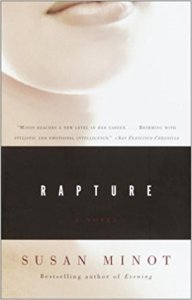
Rapture — Susan Minot

I like Rapture but it’s not for everybody: it’s too focused on relationships, too explicit (though I would prefer the word “realistic,” many would disagree), too much about artistic educated urban people who want some things that are incommensurate with other things, too didn’t-Anna-Karenina-already-do-this?. It dissects the moment into a million little pieces, like Ian McEwan’s On Chesil Beach; we experience a succession of moments in a rush, and in writing we can slow them, reexamine them, reexperience them, or experience them from a new vantage.

Still, to my mind it’s about three people who aren’t ready or able to leap towards the obvious relationship-structure conclusion, even if the wrapping around that core idea is Kay’s afternoon with Benjamin. The narrative perspective shifting from Kay to Benjamin and back. Their thoughts are not so dissimilar but retain dissimilar enough to retain interest. They think in similar ways, as perhaps people in similar milieus and with similar “wrong” desires might. Neither Benjamin nor Kay knows each other, like we all don’t really know anyone, and we get that from the first page:

He had no idea what had gotten her there.
He certainly wasn’t going to ask her about it. There was no way he was going wade into those dangerous waters and try to find out why she’d changed her mind…

Probably wise on his part. We also get a similar idea later on, midway through: “What did other people know about what really went on inside a person?” Some things are unknowable, and fiction likes to remind us of this.

A few pages into the novel, we switch to Kay’s perspective for the first time:

It was overwhelming, the feeling that this was pretty much the only thing that mattered, this being with him, this sweetness, this . . . communing . . . this . . . there was no good word for it.

(Ellipses in original.)

It raises questions: how much does “pretty much” elide here? And if this is “pretty much the only thing that mattered,” why do we spend so much time and energy doing other things, like building civilization? This is an analytic novel, so Kay doesn’t answer, but we might consider it as we read. I also don’t know what to do with later, similar thoughts, like “This was real, this was the most real thing.” Getting down to what is really real is tricky, and answers tend to vary based on the moment a person happens to be in. Are things that matter real? Are real things things that matter? I don’t know either.

Sometimes the vision is blank:

He shut his eyes. He saw the empty landscape. He knew he had to get out of bed and get going and soon, but he was mesmerized by this vision of emptiness. It was telling him something.

Maybe I like the novel because I’m working on one that uses somewhat similar narrative perspective on material that isn’t so different. We all fantasize about knowing what someone else is thinking, but only in fiction do we actually get to switch perspective to see. That fantasy is as potent as flying, and while we can fly via planes or rockets or other external apparatus, we never get to fly the way we do in our dreams.

Links: Claude Shannon, the housing mess, the squat, HPV vaccines, pseudo-public space, and more!

* 10,000 Hours With Claude Shannon: How A Genius Thinks, Works, and Lives. Adapted from the book A Mind at Play, which is good but not great.

* Learning to Squat; unexpectedly found in The New Yorker.

* A decade on, HPV vaccine has halved cervical cancer rate. The real tragedy is that vaccine compliance is so low.

* Are college costs finally declining, along with enrollments?

* “Busy, distracted, inattentive? Everybody has been since at least 1710 and here are the philosophers to prove it .” A useful historical perspective.

* Revealed: the insidious creep of pseudo-public space in London.

* Google enters the nuclear fusion race.

* “A promising new coalition looks to rewrite the politics of urban housing: An end to defensive planning could unleash huge change.”

* “The Swedish Novel That Imagines a Dystopia for the Childless.”

* Regional income convergence in the U.S. has declined because of zoning and land-use policies. Regular readers are familiar with the many pernicious consequences of modern zoning practices. Basically, we feel poorer than we should because we’ve systematically raised the cost of housing, which we must pour our newfound wealth into, causing us to scramble to pay for the housing that ought to be cheaper than it is.

Links: Zoning and the quality of human life, great art, the institutional climate, and more!

* David Brooks: “How We Are Ruining America.” Notice that residential zoning restrictions are number one. Improve that and you get a lot of secondary and tertiary improvements “free.”

* “The Obsessive Art and Great Confession of Charlotte Salomon: Painter, auteur, enigma, murderer. The work of the German Jewish artist, killed in the Holocaust, has long been overshadowed by her life and times.” Article by Toni Bentley of The Surrender fame.

* “A Conversation with Malcolm Gladwell: Revisiting Brown v. Board.” Extremely interesting and contrarian in an intelligent way that shows many familiar things in a light I’d never considered.

* Does a secret yearning for monarchy and hierarchy attract us to Game of Thrones?

* “The planet will be too hot for humans much sooner than you think.” Yet seemingly almost no one is paying attention, or voting as if they are paying attention.

* “What Russian journalists think about how American reporters cover Putin and Trump.”

* Underreported Chinese investment in U.S. industries; not an overtly contrarian piece but definitely one that shows the complexity behind typical headlines and assertions.

* “As opioid overdoses exact a higher price, communities ponder who should be saved.”

* “As companies relocate to big cities, suburban towns are left scrambling.” I’m a city person, and while I understand why some people would want suburban towns in theory, I’ll never want to live in one.

* “Jane Austen, Emma, and what characters do.”

* Should community colleges abolish mandatory algebra classes? I’m admittedly 50/50 on this one, leaning towards “no” yet simultaneously aware that I took no real math classes as an undergrad. This question is also hard because the real question underlying it is, “What is education for?” And that brings us towards questions of signaling versus skill acquisition.

Links: Model 3, transit success in Chicago, Hollywood memoir, markets, free speech and free minds

* Tesla to hold “Handover party for first 30 customer Model 3’s on the 28th! Production grows exponentially, so Aug should be 100 cars and Sept above 1500.” That is the entire text of the announcement tweet.

* The guilty pleasures of Hollywood memoirs.

* Rahm Emmanuel: “In Chicago, the trains actually run on time.” This is actually productive, not gloating; some of the dumber responses online have attributed bad motives to Emmnauel that he does not evince in the text.

* “Why market competition has not brought down health care costs.” History and analysis are good but I don’t buy the solution. I’d like to see mandatory price transparency, savings accounts, and (government-run) catastrophic insurance. Oddly, we are evolving towards a world where basically all insurance is catastrophic insurance. I think my deductible is now something like $5,000.

* “Why Did a UCLA Instructor with a Popular Free-Speech Course Lose His Job?

* I wrote a snarky title saying, “President who understands nothing of Western Civilization gives speech urging defense of Western Civilization,” but then I realized, why bother with the link? The headline is enough, and many of you likely know the reference.

* “What on Earth Is Wrong With Connecticut?” The state seems to combine high taxes with suburban-style development (without a major city to mediate).

* “This Is How Big Oil Will Die,” with the author’s 1999 interview at Kodak being particularly funny.

* Canadian money is better than U.S. money.

* Are the Social Sciences Undergoing a Purity Spiral?

* “America’s First Postmodern President: Trump’s ascendance is no accident. He’s the culmination of our epoch of unreality. What does that herald for the resistance?” Oddly, some of the academic left has contributed to the intellectual environment that spawned Trump.

* Grid Batteries Are Poised to Become Cheaper Than Natural-Gas Plants in Minnesota.

Life: What is happiness? edition

“I do not promise happiness, and I don’t know what it is. You New World people are, what is the word, hipped on the idea of happiness, as if it were a constant and measurable thing, and settled and excused everything. If it is anything at all it is a by-product of other conditions of life, and some people whose lives do not appear to be at all enviable, or indeed admirable, are happy. Forget your happiness.”

—Robertson Davies, The Manticore