Grass Roots is about marijuana, yes, but it’s also about what it means to live in society and what it means to be:
The battle over the drug has always been about much more than whether individuals have the right to smoke, eat, or vape it for effect. Instead, questions about marijuana have long been tied to ideas about freedom and liberty, safety and security, and the rights of an individual versus the collective good—themes that are at the core of many other historical debates.
 Much of the book is new to me: I didn’t know how much decriminalization happened in the ’70s, when 11 states decriminalized weed. I didn’t realize how much anti-drug hysteria occurred in the ’80s. I didn’t know the specific mechanisms that drove drug policy back and forth. Now I do, but I’ll warn that the book is often more detailed than most readers want. There is a lot of organizational discussion (“Given his former affiliation with the NFP, Turner encouraged the first lady to work specifically with that organization. PRIDE and FIA did good work, Turner knew, but the NFP was led by social conservatives…”); be ready to skip parts, unless you are uncommonly engaged by bureaucratic jousting—you may be. You may also read the book in conjunction with Daniel Okrent’s Last Call: The Rise and Fall of Prohibition. And of course the subtitle of Grass Roots is clever.
Evidence and knowledge play small roles in the periods that see relatively legal weed and relatively illegal weed. Dufton notes:
Despite its popularity, Just Say No did little to actually decrease youth drug use. In 1988 … the University of Michigan’s “Monitoring the Future” survey found that, although rates of adolescent drug use in the United States had dropped over the past seven years, they were still “the highest in the industrialized world.”
The United States is an outlier in many respects, and this is, or was, apparently one of them. I got “Just Say No” drug education in schools and it seems to have been, at least anecdotally, not productive. It’s also not productive to lump all illegal drugs together, as many “education” programs do: drugs vary considerably in their danger and uses. Michael Pollan’s new book, for example, describes the many ways psychedelics may be therapeutic. And thinking about actual danger is important; I don’t know that there are any documented cases of overdosing on marijuana, but the opioid epidemic is well-known and is killing tens of thousands of people per year. Why do we treat weed, LSD, and morphine and heroin similarly? They’re not.
Other aspects of ignorance drove and still drive drug policy. “A 1917 report from the Treasure Department noted that in Texas, only ‘Mexicans and sometimes Negroes and lower class whites’ smoked marijuana for pleasure and warned that ‘drug-crazed’ minorities could harm or assault upper-class white women.” Then, “films like Reefer Madness, released in 1936, associated marijuana use with murder, miscegenation, and suicide.” Which could only be convincing to someone who has never seen a person high on weed: they are dangerous only to pizza and other snack foods.
Money and sex play major roles in the Grass Roots story. The desire for tax revenue entices some states. And the desire to sell paraphernalia entices entreprenurs. Playboy offers some grants to marijuana-focused organizations; it exists at the nexus of sex and money. And some of the early advocates for marijuana have, uh, personal problems that retard their advocacy:
Two months after moving in with Stroup, Newman and Stroup’s wife took MDA, a powerful psychoactive amphetamine known for enhancing sex, and spent the night together while Stroup was visiting the Playboy Foundation in Chicago to solicit funds.
By 1978, we saw “a flood of additional states passing new marijuana laws and the president decriminalizing the drug at the federal level.” But “the downfall of Peter Bourne and the subsequent downfall of Keith Stroup brought the country’s first experiment with decriminalization to a close.” Sort of like Parnell and Kitty O’Shea in nineteenth-century Ireland. I wonder if anyone has yet written the definitive book on the role of sex scandals in world political history.
Another pro-pot politico working for the Carter administration got in media trouble through sex, or a perceived connection with sex; he was a doctor whose secretary was “struggling emotionally,” and
To help Metsky relax, Bourne wrote her a prescription for fifteen Quaaludes, a mild tranquilizer that, though often used to treat insomnia, was also known socially to enhance sex.
This eventually got to the press. My impression, too, is that, regardless of what is “known socially,” Quaaludes just make people sleepy or lethargic, which would not seem to offer the erotic boost that they apparently did in the popular imagination—another example, maybe, of the small role played by knowledge and evidence in the marijuana saga.
Dufton also writes, “Cannabis was believed to be so safe [in the late 1800s] that the drug was marketed to women through romantic postcard campaigns that showed concerned mothers applying a cannabis salve to soothe the gums of teething babies and relieve children’s colds. As a pain reliever, marijuana worked wonderfully.” Does it work better and more safely than Tylenol (which is extremely dangerous, though not addictive)? I wonder if we know that, today: conducting the research may itself be illegal.
Two things strike me as odd or missing (or I missed them). One is the absence of any discussion of lead in gas in the rise of drug use. This may sound esoteric, but leaded gas has been implicated in “violent crime, lower IQs, and even the ADHD epidemic.” Leaded gas may also have led to higher drug use in the ’60s and ’70s. The other is the absence of any discussion of age cohorts. In the ’60s and ’70s, baby boomers were teens and young adults—ages at which drug experimentation is common and favoring drugs is common. By the ’80s, many were parents themselves—and parents are much more conservative, especially about their own children (several chapters of Grass Roots focus intelligently on the role of parent movements), than experimental 21-year olds. I don’t think and wouldn’t argue that either factor is dispositive, and both can coexist with Dufton’s other work.
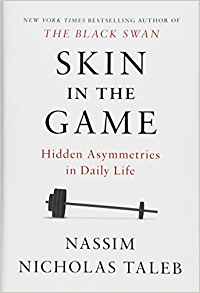 In Skin in the Game Taleb has many, many unusual examples, many of them good; he reads more like an old-fashioned philosopher (that is: one who wants to be read, heard, and understood, as opposed to one who wants tenure), and I mean that as a compliment. One of his rules is, “No person in a transaction should have certainty about the outcomes while the other one has uncertainty.” I wonder how this rule could be applied to colleges, especially under a student-loan system, in which the college is certain to be paid by the student, the student’s family, or the student’s bank (which is really to say, the bank’s student), while the student may see a variable return on investment—especially
  Although neither book makes this point, I think they’re part of the continuing social reaction to the Industrial Revolution. “What,” you might be thinking, “does the Industrial Revolution have to do with contemporary books on love, marriage, and dating?” Prior to the Industrial Revolution, most societies were (relatively) stable most of the time, at least for the duration of a human life; the technological and social conditions one’s parents faced were likely the same an individual would face and the same that individual’s children would face. Cultural and technological change was of course real for much of human history, but it was also relatively slow, allowing people to acclimate to it over generations instead of years or decades.
 Persuader is a fairy tale about a knight who is caught between the dark forces of chaos, evil, and greed on the one side and the grinding powers of bureaucracy—FBI and military—on the other. He’s a kind of small-c conservative who is interested in the intensely personal and where it intersects with larger forces of darkness, chaos, and excessive order. Chaos is bad because of the way it destabilizes relationships; excessive order is bad in the Reacher universe because it inhibits Reacher from inflicting his own moral code on the universe, and it’s a universe where the bad guys are conveniently universally bad and the good guys are conveniently universally good.
 We should. For reasons that become apparent as the book moves forward, we may be repeating many histories of mass extinctions. Brannen traces how. Each chapter is set up like a detective story: People figure out that a mass extinction occurred, and paleontologists and geologists have to work backward from crime to culprit, examining various hypotheses along the way. The structure is effective but also difficult to excerpt.
 There isn’t much to write about because the bike is fun to ride, light (the frame is made of aluminum), and quiet. The largest frame size may still be a bit small for me, but I’m out on the right side of the bell curve distribution for height so that may not be too surprising. The front stem and seat post are highly adjustable, so I didn’t need to add a stem extender. I ordered a rack, which dramatically improves cargo capacity. Now I’m
  Priority also makes a bike called the
 It is always useful to call for free thought and speech, especially when both seem weirdly under fire, from left and right (later in the introduction, Paglia writes, “The title of this book exalts freedom as an indispensable condition for the incubation and flourishing of individualism”). Despite how tedious reading yet more about Doris Day and Madonna may be, sometimes we look to past predictions to see how they might be right. This Paglia line, originally from 1997, is particularly prescient: “Too much tolerance too fast can produce a puritanical or fascist backlash” (142). Had I read that in August I would’ve laughed. Now I realize that I was wrong and that is fascist backlash is possible. We don’t really learn from history—not collectively, anyhow—and
  In some ways the novel is about all the things the narrator, Selin, has never heard of. The novel captures well the feeling of not knowing anything, surrounded by others who don’t, but is that desirable in a novel?
 I’m not going to summarize The Complacent Class because it’s already been well-summarized in many places, like “
 The Story's Story