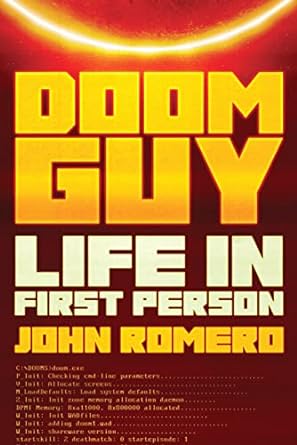
Let’s start with the Doom Guy money shot, which occurs about two-thirds through the book:
As a child, when things got bad, out of necessity, I stayed quiet and waited for it to pass. When Carmack sent out his report card, I stayed quiet and waited for it to pass. When people were upset at things happening within Ion Storm, I stayed quiet and waited for it to pass. Everything that happened at Ion Storm is a direct result of that flaw in my character. Had I taken action, had I talked to people, had I prevented issues from developing when they were just emerging, so many things in my career and in my life would have been different and so many people would have been spared the difficulties this flaw created.
That’s a, and perhaps the, key takeaway from Doom Guy: inaction is itself a form of action and character is closer to destiny than many of us would like to admit. Our flaws are often as invisible as water is to fish, and it often takes catastrophe to reveal them in undeniable ways. Most of us are masters at ignoring or excusing our flaws, and I don’t excuse myself from that generalization, and I admire Romero for his willingness to state what he did wrong, so that the rest of us can learn from him.[1] Id software and then Ion Storm may have stayed small in part because of the flaws of their leaders. No one is without flaws, but the more I live and the more I see of the world, the more I think that the most effective people are also often the ones with the greatest capacity to see their own flaws and either ignore them (by focusing on strengths) or mitigate them.
He got to the high points, though, by being an incredible programmer—and he attributes success to his ability to memorize and synthesize information. Romero says he is hyperthymesic, which Merriam-Webster defines as “the uncommon ability that allows a person to spontaneously recall with great accuracy and detail a vast number of personal events or experiences and their associated dates: highly superior autobiographical memory.” Romero’s not sure of the extent to which he was born with it and the extent to which he created it via practice: “There is an argument to be made that I sharpened my memory, that I created my condition due to my obsession with programming and games.” People who try to cultivate an ability will see that ability improve, and then perhaps attribute that ability to something inborn. Derek Sivers has written about using spaced-repetition software to memorize programming facts and ideas (“I wanted to deeply memorize the commands and techniques of the language, and not forget them, so that they stay at the forefront of my mind whenever I need them”).
For Romero, “Having the ability to absorb massive amounts of detail and retain that information was a great advantage,” and he “was obsessed with retaining everything I learned.” Maybe more people should be obsessed with retaining everything they learned: it’s not possible to learn higher-order concepts without a bedrock of primitives. Yet many people believe this, seemingly, including younger me.[2]
I’m not as accomplished as Romero or Sivers, but I do get asked how I connect so many disparate ideas and sources in my writing. One answer is “reading a lot.” Another answer is that I put many notes, quotes, and ideas into Devonthink Pro, using the strategies I describe here, and use that when I write. For example, when I plug the first quote in this essay into Devonthink Pro, I don’t find anything incredibly useful, but I do find: “Perhaps, in a period when we are communicating more than ever, the difficulties of communication are growing more obvious,” which is from 2014, and also “[George Gershwin] was dismissive of inspiration, saying that if he waited for the muse he would compose at most three songs a year. It was better to work every day. ‘Like the pugilist,’ Gershwin said, ‘the songwriter must always keep training.'” Neither is germane to this essay, but both are interesting and, in re-reading them, I’m more likely to cite them in the next few weeks. I also have a text file with top-level ideas from books I’ve read, and a file with key takeaways from podcasts I’ve listened to. I periodically read through those files, although without the aid of Anki or similar spaced-repetition software. What I do is enough to make some readers amazed at my apparent memory. I’m not sure I have an especially good memory, but I do diligently use memory-aid systems to augment my memory and that creates the effect of me having a wizardly command of unexpected connections. I hate to reveal my secrets, but in doing so I’m hoping to help others in the same way others have helped me.
Romero also came of age in a different epistemic environment than the one that exists now. In the ’80s, Romero “realized information on programming was hard to come by, so I forced myself to retain technical information and memorize the internal details of computers—memory maps, ROM locations, hardware switches, and tons more stuff. I did it quickly, which, in turn, expanded my ability to retain and access precise memories of almost everything else.” Today, memorizing details still matters, because memory is so much faster than looking information up—even via systems like ChatGPT. The more one knows, the less one has to pause to look things up, which reduces latency and increases clockspeed.
Facebook, according to Steven Levy’s eponymous book, is similar:
What characterized Facebook’s method was the speed with which new code got pushed out. For instance, when Agarwal was at Oracle, he worked for months before he was allowed to make his first “commit” to the code base, and even then, his work went through four reviewers to make quadruple sure that the changes wouldn’t affect anything. Even then, the actual change didn’t appear to customers for years, because products were on a two-year release cycle.
At Facebook, they pushed out code four or five times a day.
There’s an analogy to what I do in that I’ve been asked how I write so fast. I’m again not sure that I write fast, but I write a lot, and when I start, I aim to remove the typical Internet distractions and keep racing ahead until I’m done. “Finish it” is one the most important things anyone trying to achieve anything can do, and many wannabe writers err in waiting for inspiration or the right level of energy or something else outside the individual’s control. Professional writers know that inspiration is nice but rare, and the key is finishing something, getting feedback on it, and iterating. People who can’t finish things are especially deleterious to any kind of team effort. In 1986, Bill Gates gave an interview[3] that bears both on this problem and on Doom Guy:
Before Paul and I started the company, we had been involved in some large-scale software projects that were real disasters. They just kept pouring people in, and nobody really knew how they were going to stabilize the project. We swore to ourselves that we would do better. So the idea of spending a lot of time on structuring groups has always been very important.
The best ideas are the obvious ones: Keep the group small, make sure everybody in the group is super smart, give them great tools, and have a common terminology so everybody can communicate very effectively. And outside the small groups, have some very experienced senior people around who can give advice on problems. There is an amazing commonality in the types of difficulties you run into. In design reviews, I really enjoy being able to provide advice, based on programs that I have done.
“Pouring people in” often doesn’t work because those people need time to get to the frontier of the project, and, worse, if they’re the wrong people, they’ll not finish things fast enough. There are a lot of markets in which the maniacal obsessives win big, and video games appear to be one of those, particularly in the ’80s and early ’90s, when individuals or tiny groups could still massively succeed. Microsoft wasn’t a game company but it massively succeeded, maybe in part because of practices like this:
In the first four years of the company, there was no Microsoft program that I wasn’t involved in actually writing and designing. In all those initial products, whether it was BASIC, FORTRAN, BASIC 6800, or BASIC 6502, not a line of code went out that I didn’t look over. But now we have about 160 programmers, so I mostly do reviews of products and algorithms.
Gates was early and so was Romero. Romero says that “In 1983, the average adult had no real idea about computers. I was so far ahead of the curve that I wasn’t just a novelty, I was an in-demand rarity.” Scarce skills command premiums. Common skills don’t. He recognized an important trend early and was rewarded for it (“the remaining id founders were fortunate to be millionaires”).
Developing and deploying those skills has a cost, in terms of time and attention.[4] Romero wasn’t only obsessed with memorization:
Once again, we were on a 10-to-2 death schedule. In hindsight, I know this schedule sounds nuts, and the fact that we did this to ourselves may seem even nuttier, but at the time this didn’t at all feel like work. We were chasing greatness, and we ran as fast as we could. We knew someone would get to the finish line, and we wanted to get there first.
I doubt most people can or would do this—”10-to-2” refers to “ten a.m. to two a.m.” That seems challenging, but the team consisted of guys in their 20s, and so their clock speed could be incredible (“The biggest determinant for success in a technology company is the speed at which it operates and learns”).
Doom Guy is a very Silicon Valley story, but without much of it occurring in Silicon Valley. Back in the ’80s, small software teams could cohere almost anywhere; they still can, obviously, and yet the biggest tech companies are clustered in Northern California. Decades of poor government policy in California haven’t dislodged them, maybe because California bans non-competes, and most municipalities don’t (yet). The non-compete is a drag on progress and innovation and it ought to be banned globally, although starting with a national ban in the U.S. would be good.
Should you read Doom Guy? I’m not sure, particularly if you’re outside the software industry. There’s a reason why people like Phil Knight or Andre Agassi hire J. R. Moehringer. Writing a compelling, fast-moving book is hard—notice how, for example, the quoted passage from Levy’s book uses “even then” in two consecutive sentences. Doom Guy is useful for specialists interested in building tech companies, software development in the ’80s and ’90s, and people who played id software games as a kid and want to learn more about where those games came from.
Romero had a painful childhood and dysfunctional parents, but I don’t see a causal link between that and his later success. Some people come from dysfunction and succeed; some people come from warm, loving homes and succeed; and the inverse of both is also true. I note that, as a child Romero “learned to escape into my imagination as a protective device.” I did something similar, except with books and stories rather than video games; emotional privation may have facilitated an imaginative capacity that let me conceive of a world better than the one I was living in, though at the time I didn’t understand why I thought what I thought (what kid does? few adults do).
Doom Guy‘s end is sad: decades later, Romero is designing Doom levels again. A person ideally takes on new challenges and develop new ideas over the course of his life, but Romero is retreating to retread ancient history. The contrast with his former partner John Carmack is instructive: Carmack worked on video games, and then on a rocket company (Armadillo Aerospace), and then on Facebook’s Oculus, and now an AI company called Keen Technologies. Each major period builds on and extends the one before. He kept growing. Will you?
[1] I try something similar in posts like this one.
[2] More teachers, especially in high school STEM courses where the question “Why do we need to know this?” is rarely answered, should emphasize the utility of rote memorization. Too many students, who are encouraged to “find what they’re interested in,” are—not shockingly—not interested in memorizing a bunch of data points. Until more Richard-Feynman-like professors teach intro courses, it’d be helpful to demonstrate what a student can eventually do with the basics as motivation to slog through the early process of learning a new scientific language.
[3] Hat tip (h/t) Byrne Hobart at The Diff. Byrne writes a lot more than I do: his clock speed is impressive. Whenever someone thinks I’m fast, I think of the good writers faster than me. I feel dragged down by the fatigue that’s dogged me since I got radiation treatment in Dec. – Jan. 2023-3. It got much worse after the May 25 surgery that took my tongue. And then chemo. And now petosemtamab, a clinical trial drug that is keeping me alive, but that may also be keeping me tired.
[4] Based on Doom Guy, it would be interesting to read Romero’s kids’ impressions of their childhood and their relationships to Romero.
 Patterned on the American mind, in ways we rarely stop to notice, are layers of zoning and land-use rules that say what can be built where. They are so central to how American cities look and operate that they have become a kind of geographic DNA that forms our opinion of what seems proper and right.
 Since the ’60s, American parents seem to have become less inclined to say no and let kids live with some frustration, and yet we need some frustration and difficulty in order to become whole people. I’m sure many teachers and professors are reading the quotes above and connecting them to their own classroom experiences. The tie into Jean Twenge’s book iGen and Jonathan Haidt’s The Coddling of the American Mind is almost too obvious to state; Haidt and Twenge’s books concern what smartphones are doing to the state of education, educational discourse, and educational institutions, and, while they cover smartphones and social media, those two technologies aren’t occurring in isolation. Excessive permissiveness appears to create neuroticism, unhappiness, and fragility, and excessive permissiveness seems to start for American parents somewhere between a few weeks and a few months after birth—and it never ends. But most of us don’t recognize it in the absence of an outside observer, the same way we often don’t recognize our psychological challenges in the absence of an outside observer.
 Thompson disagrees, it seems. He writes, “the software industry has long cherished its self-image of a pure meritocracy.” I don’t think many people think a “pure” meritocracy is possible, so this notion has a whiff of the strawman about it because of the word “pure.” A better question might be, is the software business meritocratic compared to many other industries? Sure seems like it, given the way the Internet opens the field to talented but uncredentialed outsiders. Thompson goes on to assert it’s not true, without providing real evidence (though he has some typical media stories). For example, the chapter “10x, rock stars, and the myth of meritocracy” has lots of stories but very little, if any, data, and none that supports the central point. Chapter 7 is worse.
 A hardboiled French detective (or “Superintendent,” which is France’s equivalent) must team up with a humanities lecturer to find out, because in the world of The Seventh Function it’s apparent that a link exists between Barthes’s work and his murder. They don’t exactly have a Holmes and Watson relationship, as neither Bayard (the superintendent) or Herzog (the lecturer) make brilliant leaps of deduction; rather, both complement each other, each alternating between bumbling and brilliance. Readers of The Name of the Rose will recognize both the detective/side-kick motif as well as the way a murder is linked to the intellectual work being done by the deceased. In most crime fiction—as, apparently, in most crime—the motives are small and often paltry, if not outright pathetic: theft, revenge, jealousy, sex. “Money and/or sex” pretty much summarizes why people kill (and perhaps why many people live). That sets up the novel’s idea, in which someone is killed for an idea.
 Tolentino writes that one of her essays is “about ‘optimization,’ and the rise of athleisure as late-capitalist fetishwaear.” First, athleisure is not, to my knowledge, associated at all with fetish sexual practices (I could be wrong on that but didn’t see any citations or experiences to the contrary in the essay). Second, I’m not sure I’ve ever seen “late capitalism” intelligently defined, or that I’ve ever read a sentence that was improved by including the phrase. How do we know we’re in late capitalism? Is it possible we’re experiencing early capitalism? She later writes that our world is “utterly consumed by capitalism.” What’s that mean? What’s the alternative? We’ve seen examples of the state directing all or almost all economic activity (the Soviet Union, Venezuela), and the result is not good.
 That said, Perel also says, “Because I meet with partners alone as well as together, I have been afforded an unusual window into the experience of the unfaithful partner.” The “unusual window” is the view she affords us,
  There’s a lot of great dialogue, which I can be a sucker for:
 I don’t want to spoil those surprises; if the regular writerly bildungsroman is about books progressively emerging, this one is about the ambition monster getting progressively bigger, like a dragon, until it eats its owner. Or does the owner thrive at the end? I can’t say more here.
 Who would want to live this way? It sounds exhausting and tedious. If we’ve built exhausting and tedious ways to live into the college experience, perhaps we ought to stop doing that. I also find it strange that, in virtually every generation, free speech and free thought have to be re-litigated. The rationale behind opposing free speech and thought changes, but the opposition remains.
 The Story's Story