A.S. Byatt and Tracy K. Smith speaking in New York

A.S. Byatt and poet Tracy K. Smith spoke in New York last night, and my favorite moment may have been Byatt’s comment on influence: she said, “I learn from dead people. I read books.” Which is accurate, simple, and too seldom mentioned. She also said, “If there is one thing I shall never do it is write a memoir.” But Byatt does watch viral YouTube videos, though I won’t offer the context. No word on whether she’s seen “Gangnam Style.” I wanted to listen to her indefinitely; she seemed low bullshit and subtly, Britishly funny in a way not conveyed by these quotes and perhaps not conveyed by any quotes. I would take her seminar despite the danger of being assigned Henry James and Melville.

IMG_2029Byatt also said that at some point “I got sick of realism. . . and I realized realism is only one way of putting prose together.” That remark—”putting prose together” was deliberate. English’s promiscuous borrowing also delights her (as it does pretty much anyone who really writes), and to that I would add that English has a sophisticated technical vocabulary offering a rich lode of metaphors not always available, or easily available, in other languages, unless they’ve borrowed from English (often in turn borrowing from other languages).

One senses that literature for her is urgent, as it is for Roland Mitchell in Possession (in one of my favorite moments in the novel, Roland Mitchell explains that he stole letters from the British Library “Because they were alive. They seemed urgent,” implying that much of what happens in the British Library and academia is so not urgent that one must wonder if and why it should happen at all) and many characters in The Children’s Book. She makes me want to be a better writer.

Smith said, in the context of mentorship, that having someone ask different kinds of questions of your work can be useful. She’s right, though I’d never conceptualized the issue in those terms, and it’s difficult to find people who will ask questions different but still useful than those you ask yourself.

Does she like Billy Collins?

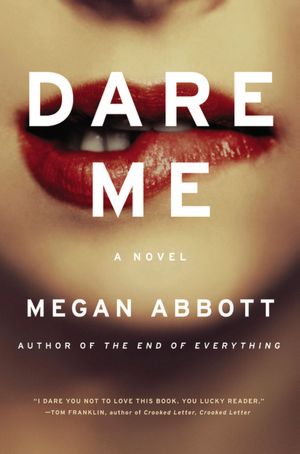
Dare Me — Megan Abbott

There’s something compelling about Dare Me that shouldn’t be compelling: stripped of its narrative voice, Dare Me is about teenage cheerleaders and their coach, who may as well be a teenager, competing to be the neighborhood’s queen bee. It’s unfair to summarize a novel like this—Lord of the Ring could be reduced to, “Midget chucks ring into mountain; local vagrant crowned king”—but it’s also useful, because interesting novels usually have characters who are trying to learn something about the world and who have larger ambitions to do things that will have more than just local effects.

Addy narrates the novel in an insistent present-tense voice that offers a sense of immediacy. Her primary aspiration, however, is to maintain her status on the cheer squad, chiefly as the “lieutenant” of the captain, Beth, who is the chief bad girl and doer of drugs, men, and deeds that Addy might want to do but can’t bring herself to. Beth, however, is stripped of her captaincy by the new Coach, who demands more from the girls than their previous coach:

Back then, we could hardly care, our moves so sloppy and weak. We’d just streak ourselves with glitter and straddle jump and shake our asses to Kanye. Everybody loved us. They knew we were sexy beyotches. It was enough.

But part of life is the “it” not being enough: skills count, more than merely being admired. Plus, contrary to what Addy thinks, it’s unlikely that “Everybody loved us.” The cheerleaders in Dare Me love themselves much more than any outsiders could possibly love them. And the cheerleaders never quite ask if they should want to be anything more than “sexy beyotches.” They certainly have a strong sense of sexuality, although sexuality in the novel is primarily used to express dominance among the various girls (and their Coach), rather than as an end in itself. The novel’s prime source of antagonism is between Beth and the new Coach, whom Beth describes this way: “Colette French [. . . ] Sounds like a porn star, a classy one who won’t do anal.” Beth tells us more about herself than she does about Coach: that she thinks about porn stars, that she has a dirty yet moralistic streak at the same time.

Most of the girls do. They want what most of us want, but that doesn’t stop them from castigating others. None of them recognize their own hypocrisy, and they probably wouldn’t care if someone did point that hypocrisy out to them. At one moment, Addy says, “Beth and I made loud comments across the gym about how Brinnie’s slutty sister got caught making out with the assistant custodian until Brinnie ran off to the far showers to cry.”

Women really do slut-shame each other much more vigorously than men slut-shame women. Addy doesn’t notice that, however. She only notices how she can use what she perceives to be raw power: the “loud comments” and the derogatory adjective, “slutty,” forming without much thought about what’s underneath her ideas. Despite what the two say about Brinnie’s sister, Addy also reports that “In eighth grade, no, summer after, at a beer party, Beth put her scornful little-girl mouth on Ben Trammel, you know where. I remember the sight.” Why is Beth’s mouth scornful? We don’t find out. But she says a moment later that “We don’t judge,” when the page prior Beth and Addy were judging Brinnie’s sister.

Dare Me, however, isn’t about consistency. It’s about inconsistency, expressed through power and dominance. Beth versus Coach, but sexuality is the weapon—not fists. The girls use it against each other, although I won’t describe how here. The only character who apparently isn’t competing is Addy. She doesn’t really get much in the novel, and she gives a weak excuse about why: “There’s not a lot to interest me at Sutton Grove High.” That’s another way of saying that being alone and being the cheer squad’s resident observer is more valuable to her than the experience of a “real” relationship. About Jordy, a boy at the school, the best Addy can summon is that “He looks like he’s thinking things [. . .] Like maybe he actually thinks about things.” Does that mean Addy and her friends don’t? And, if so, perhaps we again shouldn’t be reading about them. She does get with him, after a fashion, and his giving in disappoints Addy: “His wanting, so easily won—well, it bores me.” Everything does. The boredom she feels at his being “so easily won” is how guys end up affecting cruel uninterest in order to win women. But that’s another thing Addy doesn’t know. Her lack of sophistication is realistic but grating; there are answers to the questions she doesn’t know to ask.

She does know, however, that a military recruiter is aloof and thus desirable. He has a nickname that denotes his position: “Sarge, though, is above all this. All the girls are hurling themselves at him, but he never blinks, not once. He smiles, but his smile doesn’t really seem like a smile but the kind of thing you do with your mouth when you know everyone is watching.” He’s smiling that way because he has to, and he knows that the penalties for indulging in “the girls” who “are hurling themselves at him” is probably worse than the pleasure that he might gain from indulging them. There’s also a link between the two: by apparently standing above the girls making offers, he’s making himself more alluring. He contrasts with the “easily won” Jordy. The harder the prize, the sweeter the accomplishment, at least in Addy’s eyes, and hence the challenge of being a better cheerleader is the challenge of doing harder stunts, of doing more than “shak[ing] our asses to Kanye.”

The physicality of motion counts for a lot, and so does the wanting eyes Addy imagines her body inspiring. Addy thinks, “This is my body, and I can make it do things. I can make it spin, flip, fly.” She can also make it the object of male adoration, which, regardless of what else cheerleading might do, does that first. Addy also doesn’t perceive the way the boredom of her own life is partially of her own making, as when she says

Ages fourteen to eighteen, a girl needs something to kill all that time, that endless itchy waiting, every hour, every day for something—anything—to begin.
‘There’s something dangerous about the boredom of teenage girls.’

This is given like a law of the universe, an ahistorical fact that must be true of all times and places, like respiration. It isn’t. For all I know, in many hunter-gatherer tribes fourteen year olds were often mothers, or members of adult societies: their life had already begun. Addy is really commenting on contemporary Western society, even if she doesn’t have the language to realize it.

Has she read Paul Graham? Boredom is endemic to the high school experience. But boredom itself is dangerous to the mind, because it’s a waste of the planet’s most valuable resource: minds. I don’t need to rely on vague assertions like “There’s something dangerous;” I know what’s dangerous, in part because I was reading enough at the time to eventually learn how to use words to express complex ideas. Addy hasn’t gotten there yet.

That should make her an uncompelling narrator, but she isn’t. She’s naive in some ways, which shouldn’t be a surprise given her age, but she also observes the bad-girl behavior around her, and that bad-girl behavior is underappreciated in much of the larger society. Addy can also see what boys see, at times, as when she describes her teammate: “Emily whose balloony breasts and hip-cascades are the joy of all the boys, their ga-ga throats stretched to follow her gait, to stretch around corridor corners just to see that cheer skirt dance.” Addy’s awareness is a form of power, but it’s a limited form of power, and it’s counteracted by the limits that she accepts. The “endless itchy waiting” is imposed in part because we, collectively, don’t want to believe in the bad girl and want to see fourteen to eighteen year olds of both sexes as children, even when they’re clearly not. So we, collectively, take their autonomy away and are surprised when they’re unhappy. To return to Graham, in “Why Nerds Are Unpopular:”

What bothers me is not that the kids are kept in prisons, but that (a) they aren’t told about it, and (b) the prisons are run mostly by the inmates. Kids are sent off to spend six years memorizing meaningless facts in a world ruled by a caste of giants who run after an oblong brown ball, as if this were the most natural thing in the world. And if they balk at this surreal cocktail, they’re called misfits.

Addy doesn’t even bother with the “memorizing meaningless facts,” but she does accept high school as “the most natural thing in the world.” In her own way, she’s a misfit by believing in “this surreal cocktail,” and believing that the world of cheer is the only one that counts.

The only real hope of the society is that the “teenage girls” who Addy represents don’t realize the power of their bodies over men. Addy realizes it. Beth does too. They find cheer to be ridiculously helpful: Addy says that “It made things matter. It put a spine into my spineless life and that spine spread, into backbone, ribs, collarbone, neck held high.” If cheer is enough to make things matter, she must have a dull life—but she’s already established that she does.

She says that “Coach gave it all to us.” Meaning, in other words. And that “She was the one who showed me all the dark wonders of life, the real life, the life I’d only seen flickering from the corner of my eye.” But whose fault is it that Addy hasn’t seen “real life” before? And what is this “real life” that Addy keeps mentioning? It sounds like something she herself has constructed.

The questioning of what is “real,” however, reappears again and again in the novel. Addy says, “Could [Coach] see past all of that to something else, something quivering and real, something poised to be transformed, turned out, made?” Addy’s repeated use of “real” makes her seem convinced of her own unreality (“By Saturday practice [. . .] we’re already—some of us—starting to look forward to that pain, which feels like something real”). If it takes pain to be “real,” something in your life might be amiss. When the girls learn to do a pyramid, Addy says that “the momentum makes you realize that you are part of something. Something real.” Was she not part of something before? Does she have any theory or coherence beyond her theory of reality? She doesn’t, not really, and it takes death and rivalry to make something real.

Addy could say no to cheer and yes to Python, or sculpture, or the guitar, buts he doesn’t. She isn’t really interested in being real, in doing the things that other people might value. The only real value she, and Beth, offer to the world is sexuality, but they don’t even ask, really ask, what their sexuality means. At one point Beth says that “I’m not even interested in our lives.” This, however, raises an important point: Why should readers be? Addy as a narrator is one answer. The fact that she constructs a story out of something other than who gets to take the most popular boy to Prom is another. Her moments of inchoate realization is a third:

We’re all the same under our skin, aren’t we? We’re all wanting things we don’t understand. Things we can’t even name. The yearning so deep, like pinions over our hearts.

She should learn the names, and the things that most people most desire are obvious, money, sex, and social status, in some tangled, interdependent triangle. For a smaller but still significant number of people, intellectual curiosity is as or more important as those first three. Those things can be understood, especially by people who want to understand them. Addy doesn’t, or doesn’t have the intellectual context she needs to understand them. As someone very happy to be out of high school, I see a lot of the things that Addy doesn’t, though she should: she’s narrating the story from an unnamed future point, even as she drops into the present tense.

One problem with Addy or her narration is that we don’t know what any of these characters are like, other than mean and, in a petty, squabbling fashion, stupid. But Addy’s voice carries the novel, along with her fascination with Beth, which in Addy’s view is like staring at a serpent: fascinating, even as you hope it doesn’t bite. What do Addy and Beth do when they’re not cheerleading? What is Beth’s favorite color? If she had to answer the question, “What do you want to do when you grow up,” what might she say? Is the prospect of college or a technical school anything more than a distant glimmer in their eyes, along with a source of older boys?

To the extent Beth and Addy have character beyond their sexuality and social status, we don’t see it. If the slice of character we see is their primary character, then they’re not very nice people, and, perhaps worse, they’re not very interesting people. Beth is willing to violate taboo by sleeping with older men, which speaks well of her low opinion of convention, but is she willing to extend taboo violation to, say, playing the corporate game as hard as the cheer game, or cutting across gender stereotype to build web apps for bad girls? The interesting thing is not just her as a bad girl, but what she can do with being a bad girl.

Perhaps that kind of question is for the sequel. Dare Me deals in a surprisingly plausible murder plot, with Addy and the reader the last to know what all the other characters seem to. The frustrations of Addy and Beth as characters doesn’t prevent the book from being compelling, in part because the girls’ blindness to anything important seems characteristic of their age, time, and generation. That should be scary.

Coach’s husband, Matt French

There are men in the novel: the aforementioned Sarge, is one. The other major male character, Matt French, is Coach’s husband. He misallocates resources. Coach says, “Oh, you know him, he’s working. He never, ever stops.” On the next page: “He is always on his cell phone and he always looks tired.” Addy says, “He works very hard, and he’s not interesting at all.” This misallocation of time and energy leads his wife to seek sexual solace elsewhere, as it so often does, and Matt apparently doesn’t realize that she, like most women, need tending. If he won’t keep the garden, someone else will.

Predictably, someone else does. When the girls catch Coach in the act with another man, she explains that “what [. . .] I have is a real thing [. . .] A true thing.” By that standard, what she has with Matt must not be a true thing. It must not count. She excuses herself by saying, “I never thought I’d feel like this,” as if the invocation of feelings trumps any and every other consideration. The girls don’t challenge her. They probably believe the same thing.

But the affair is a commentary on Matt’s folly. He should cut work and increase sex. We never learn why he doesn’t, or anything about his job. He’s a pathetic ghost of a man who enables the fake world of high school, which his wife joins. Addy and Beth show little interest in him, while they show a lot of interest in Will. The only exception comes at a moment when Addy tries to imagine what Matt is like:

Poor Matt [French], in some airport or office tower in Georgia, some conference room someplace where men like Matt French go to do whatever it is they do, which is not interesting to any of us, but maybe it would be if we knew. Though I doubt it.

Except sometimes I think of him, and the soulful clutter in his eyes, which is not like Will’s eyes because Will’s eyes always seemed about Will. And Matt French’s seem only about Coach.

That he is only about Coach, and not about anything else, makes him seem weak and replaceable to her; still, Addy’s analysis appears to be wrong because Matt is really about work, at least as measured by time spent doing an activity. We don’t get enough information about Matt French’s thought process to understand why he ignores his wife in favor of constant work that appears to weaken, not strengthen, his relationship, and leave his wife bored and frustrated. It should be obvious to anyone who has observed the people around them or been in serious relationships that bored, sexually frustrated people will find ways to get their needs met.

To return to the point I raised in the first paragraph, the problem with realistic but limited perspective Beth, Addy, and Coach have is with the scope of their vision and concerns. Adam Gopnik’s essay “The Unreal Thing” encapsulates some of their problems:

In a long article on the first “Matrix” film, the Princeton philosopher James Pryor posed the question “What’s so bad about living in the Matrix?,” and, after sorting through some possible answers, he concluded that the real problem probably has to do with freedom, or the lack of it. “If your ambitions in the Matrix are relatively small-scale, like opening a restaurant or becoming a famous actor, then you may very well be able to achieve them,” Pryor says. “But if your ambitions are larger—e.g., introducing some long-term social change—then whatever progress you make toward that goal will be wiped out when the simulation gets reset. . . . One thing we place a lot of value on is being in charge of our own lives, not being someone else’s slave or plaything. We want to be politically free.”

For Beth, Addy, and Coach, political freedom isn’t important. Competing with each other is the only important thing. Their ambitions are so “small-scale” that they don’t matter. Their achievements will be “wiped out” when they leave high school, which is its own Matrix-like simulation, and the smarter, more aware residents know it. So do adults who remember what high school was like: Paul Graham says in “Lies We Tell Kids:”

By 15 I was convinced the world was corrupt from end to end. That’s why movies like The Matrix have such resonance. Every kid grows up in a fake world. In a way it would be easier if the forces behind it were as clearly differentiated as a bunch of evil machines, and one could make a clean break just by taking a pill.

I don’t think it’s a coincidence that he uses The Matrix as an analogue for high school. Both high school and The Matrix put a natural cap on ambition, which the better high school students will challenge. Beth, Addy, and Coach don’t challenge that system; Addy even thinks that it’s the only thing that matters: “God it must be terrible not to be on cheer. How would you know what to do?” You wouldn’t know what to do, but pretty much anything you do in lieu of cheer, aside from watching T.V., vegging out, or playing on Facebook is likely to be more substantive than cheer. But Addy is so firmly plugged in that she doesn’t recognize her “fake world,” to use Graham’s term, and maybe she can’t. Maybe, if she were a different sort of person, someone would point it out to her, like the teacher in The Perks of Being a Wallflower implicitly does. Cheer for Addy is a kind of Matrix-within-a-Matrix, a way of further shrinking her social and competitive world. Addy wants to give up the kind of political freedom Gopnik and Pryor are describing. Abrogating freedom makes her seem like a fool, or a slave to the conformity imposed most obviously by Beth; perhaps this is why Addy wants to be Beth’s lieutenant, and why she doesn’t aspire to be the top girl.

Not wanting to be the top girl makes sense. But wanting to be in a social milieu where all that matters is being the top girl makes less sense; it’s like aspiring to slavery, or perpetually wearing glasses with a red tint, such that you can’t experience the full richness of the world. Addy doesn’t realize that she’s wearing those glasses, and that, finally, makes her seem sad. She’s missing so much, and she doesn’t even realize it.

Warning: Don’t buy James Scott Bell’s Plot & Structure: (Techniques And Exercises For Crafting A Plot That Grips Readers From Start To Finish)

I bought Plot & Structure because the issue of how a novel’s narrative moves seems to be understudied by academics, who tend to produce jargon-laden, overly analytical nonsense, and by novelists themselves. I’d really like an equivalent of How Fiction Works, but for an important matter that James Wood disdains (“the novel soon showed itself willing to surrender the essential juvenility of plot”). My ideal book would, as Wood says, ask “a critic’s questions and [offer] a writer’s answers.”

Unfortunately, Bell asks few questions and offers fewer answers. This is frustrating to me because, when I started writing, plot was a major weakness. The first two novels I actually wrote to completion had no real plots and thus weren’t very good novels (my Dad pointed out the former and let me infer the latter). Since then I’ve spent a lot of time thinking about plot, and being dissatisfied that I’ve never seen it addressed well elsewhere. Self-consciously literary writers and critics tend to discount it (as Wood does), sometimes to the detriment of their own work.

Genre writers tend to understand plot but either aren’t known to me, critically speaking, or write so poorly on a sentence-by-sentence level that their work isn’t interesting. To me, the best novels combine plot/story and language in a single, cohesive package. That, however, is difficult to do, and the difficulty may explain why we see so many arid academic-feeling novels about, oh, I don’t know, language and pure consciousness and What It Means To Be Alive Today, while so many genre novels with ticking bombs and handsome heroes and buxom heroines who put out surprisingly easily and simple words laid out in simple ways that won’t confuse anyone.

Not only is this dearth annoying because of my own flaws, but because I can’t point aspiring writers to a particular book and say, “Read this.” I can talk about some of my own techniques—I’ve written plot outlines for a number of books I admire, like an artist tracing his favorite paintings in order to imbibe their spirit and technique. With scenes, I’ve learned to ask what each character wants, what stands in his or her way, and why he or she is doing to overcome that barrier. I don’t always have answers—the characters often don’t have them, either—but at least asking the questions provides some structure to what might otherwise be a misaligned mess.

One can’t, of course, separate plot from character, setting, narrating, and other technical features in a novel. It would be stupid to try. But plot is a great blindspot in Wood’s criticism, and it’s a blind spot I aspire to see, or to see someone else seeing.

Bell, however, is blind.

Summary Judgement: Sweet Tooth — Ian McEwan

For a novel about a spy, Sweet Tooth is surprisingly slack. Maybe it’s slack in defense of realism. The cause eludes me, since the writing is as customarily crisp as the story isn’t. Excellent quotes are easy, from the first page, with this description of Serena’s father, an Anglican Bishop: his “belief in God was muted and reasonable, did not intrude much on our lives and was just sufficient to raise him smoothly through the Church hierarchy and install us in a comfortable Queen Anne House.” The parents are distant to the point of barely believable indifference: much later in the novel, Serena thinks, “Would the Bishop even notice I’d been away?” She’s free of parents, like an orphan in a 19th Century novel or a teenager in a contemporary TV show.

That doesn’t detract from the aforementioned beauty, like this, to go back to the second page: “We liked to think of ourselves as bad girls, but actually we were rather good.” Serena, on learning about the difficulties of writing, “went for important walks,” the silliness and accuracy of the phrase “important walks” working so well to conceptualize her state of mind and what many people with intellectual dispositions end up doing.

But the beauty of sentences eventually feels like backdrop when a second or third act fails to develop. The novel ends with a great, revisionary secret, the sort of secret that powers PhD dissertations more often than it does readerly love. We’ve seen these surprise techniques before—most notably in Atonement, but also, after a fashion, On Chesil Beach.

Like many writers, including this one, McEwan, through Serena, is at least interested in and perhaps obsessed by what reading and books do to people. Serena works in books as much as she’s a spy and sleeps with authors (which is the sort of practice I’d like to encourage). She notes what she reads and how she reads it. The book becomes about a love of books, but it does so to the point that the occupant of this book becomes dull. What does the book talk add up to? I’m a person sympathetic to books and book talk, but in Sweet Tooth the answer is “not much.” It becomes easy to lose focus midway through. Sure, for Serena, reading is how she both constructs and understands her world, but then you have to, you know, go do something. That’s not to say that she isn’t artful or funny. Consider this problem, about Jeremy, Serena’s first lover who turns out, predictably, to prefer men:

I wanted him to have a secret and shameful desire that only I could satisfy. I wanted to make this lofty, courteous man all mind. Did he want to smack my backside, or have me smack his? Was he wanting to try on my underwear? This mystery obsessed me when I was away from him, and made it all the harder to stop thinking about him when I was supposed to be concentrating on the maths. Colette was my escape.

Colette was her escape, but into what and from what? From mysteries? From something she can’t quite articulate, perhaps. And Serena, as a narrator, is also willing to ostentatiously tell us that she’s older and wiser now: “What I took to be the norm—taut, smooth, supple—was the transient special case of youth. To me, the old were a separate species, like sparrows or foxes. And now, what I would give to be fifty-four again!” This intrusion of the future self reminds us that we’re reading something from the future of events, with two pairs of eyes: the eyes of the undergraduate Serena and the eyes of the much older Serena, imagining her younger self from a position of greater articulacy and knowledge. Done too often, though, it becomes tedious. The notes in my copy trail off as the novel advances, and as I hope for Serena to become more than an acted-upon reporter of events. Her own life feels like it happened to someone else. Later in the novel, much later, the reason for this is revealed. But the view at the end of a long trail doesn’t always redeem the journey. The reason is clever, cerebral, not expected and not forced, and doesn’t make me want to read Sweet Tooth again, unless the next reading is part of some academic project about the usual sorts of academic things.

Serena says this of her reading habit:

All thanks to my mother, I didn’t stop reading. I’d never read much poetry or any plays at school, but I think I had more pleasure out of novels than my university friends, who were obliged to sweat over weekly essays on Middlemarch or Vanity Fair. I raced through the same books, chatted about them perhaps, if there was someone around who could tolerate my base level of discourse, then I moved on. Reading was my way of not thinking about maths. More than that (or do I mean less?), it was my way of not thinking.

Reading can be a powerful way of not thinking. I know from experience, even if most people think of reading as a highbrow, intensely intellectual activity these days. It isn’t, necessarily. And the assigned essay can be a chore instead of a pleasure. Serena wants it to be a pleasure:

My needs were simple. I didn’t bother much with themes or felicitous phrases and skipped fine descriptions of weather, landscapes, and interiors. I wanted characters I could believe in, and I wanted to be made curious about what was to happen to them. Generally, I preferred people to be falling in and out of love, but I didn’t mind so much if they tried their hand at something else. It was vulgar to want it, but I liked someone to say ‘Marry me’ by the end. Novels without female characters were a lifeless desert. Conrad was beyond my consideration, as were most stories by Kipling and Hemingway. Nor was I impressed by reputations. I read anything I saw lying around. Pulp fiction, great literature and everything in between—I gave them all the same rough treatment.

Simple intellectual and erotic needs might be easier to fulfill than complex ones, in one sense, but also harder, in the way that a simple task executed perfectly may be harder than a complex task executed with a margin for error. Still, Serena should have known that it isn’t vulgar to want love and marriage and plot. It’s vulgar that professors and highbrow critics might make her think it is vulgar to want those things, to want fiction that might be, to use that overused term, “relatable.” That one might be able to follow effectively. Serena isn’t a close reader, or someone practicing towards being a professional.

But she is someone who learns how to be through books, which makes her different from someone who learns how to be from in other ways, or someone who never learns how to be. She says, “I caused amusement among my Newnham friends studying English when I told them that Valley of the Dolls was as good as anything Jane Austen ever wrote. They laughed, they teased me for months. And they hadn’t read a line of Susann’s work.” Her friends are snobby and dismissive. Given the choice between snobby and unrefined but passionate, I’ll take the latter. The difference between those becomes a running issue, as when Serena begins to write a little column, and, like bloggers, something unfortunate happens: “I had written half a dozen jaunty pieces when something went wrong. Like many writers who come by a little success, I began to take myself too seriously.”

It’s a narrow act, the stance that straddles too serious and not serious enough. When I’m waffling between them, I try for “not serious enough:” after all, we’re talking about fiction here, not life and death. But for Serena the two become bound together because of her work. That’s an interesting theme; if only the plot were drilled more vigorously through the loam of Serena’s mind and story.

Alif the Unseen — G. Willow Wilson

Alif the Unseen almost works, but it persistently mischaracterizes technology in a distracting, false-sounding way that its eponymous hacker protagonist wouldn’t. On the first page of Alif’s narration, we find this about his phone: “Another hack had set this one up for him, bypassing the encryption installed by whatever telecom giant monopolized its patent.” But encryption algorithms are math, and math can’t be patented. Furthermore, a patent is by definition a limited monopoly right. As a result, the last part of the sentence seems incoherent. And what is being encrypted? The phone’s operating system? Its user data?

A few pages later, Alif is “watching as a readout began to scroll up the screen, tracking the IP address and usage statistics of whoever was attempting to break through his encryption software.” But reading “usage statistics” makes no sense here: Alif isn’t, say, providing blogging software or an e-commerce platform (a few pages later, he installs a keystroke logger and other software on the computer of his love interest, and says that he does so “to track her usage statistics.” This makes more sense). Someone wouldn’t “break through his encryption software;” he or she would attempt to penetrate Alif’s firewall. The same would-be intruder leaves after “executing Pony Express, a trojan Alif had hidden in what looked like an encryption glitch.” I don’t know what “an encryption glitch” means here, and I don’t think the author does either.

Alif notes that, in the Arab Spring, “the digital stratosphere became a war zone. The bloggers who used free software platforms were most vulnerable.” If anything, open-source software should be less vulnerable, because well-known open-source software systems won’t have obvious backdoors (because they’d be found) and they have the advantage of many eyes on their source code. There’s an equally jarring moment when Alif says that he’s written a piece of software in “C++. But the type system is soft of—new. I’ve made a lot of modifications.” But he probably is referring to whether it’s dynamically or statically typed—that is, checking whether a program’s internal variables and other values are computable and safe when the program is run or when it’s compiled. It isn’t clear why Alif would change C++’s type system. At another moment, Alif worries that a malevolent, governmental entity is watching him: “The Hand would see Alif using his e-mail and cloud computing accounts, but until he could crack his algorithm, Alif would appear to be working from Portugal, Hawaii, Tibet.” The phrase “crack his algorithm” is meaningless here. “Cloud computing” is the kind of term marketers use; programmers or hackers would probably say “servers.”

These kinds of persistent, distracting errors detract from the story and the novel’s realism. It might seem strange to discuss realism in a book that features Djinn, vampires, and other supernatural elements, but any writer still has a duty to get the language of the “real” or mundane world right. Wilson doesn’t, and that makes the whole novel feel fake when it shouldn’t. In The Name of the Rose, religious language and medieval thought infuse every line, even when contemporary philosophical ideas are being expressed through the language of the time. Eco knows the period like Wilson doesn’t know the language of hackers, programmers, and computer science. I’m not an expert, but I’ve read enough in the field to understand what she misses.

Still, there’s a sense of hidden knowledge that runs throughout Alif the Unseen, and a melding of old ideas with new technology. That’s an appealing idea, and so is the idea of an Arab Golden Compass. It’s got some religious elements that could come from The Name of the Rose. Much of the writing is skillful if not particularly memorable. Funny moments appear: Vikram the Vampire, on hearing one of Alif’s schemes, says, “I don’t want foreigners involved in my business. Jinn are one thing but I draw the line at Americans.” Such moments are just not common enough to merit reading this book over something better, like The Golden Compass or Gillian Flynn’s Gone Girl or Carlos Ruiz Zafon’s recent novels, all of which do language better.

Martin Amis, the essay, the novel, and how to have fun in fiction

There’s an unusually interesting interview with Martin Amis in New York Magazine, where he says:

I think what has happened in fiction is that fiction has responded to the fact that the rate of history has accelerated in this last generation, and will continue to accelerate, with more sort of light-speed kind of communications. Those huge, leisurely, digressive, essayistic, meditative novels of the postwar era—some of which were on the best-seller lists for months—don’t have an audience anymore. [. . .]

No one is writing that kind of novel now. Well [. . . ] David Foster Wallace—that posthumous one looks sort of Joycean and huge and very left-field. But most novelists I think are much more aware than they used to be of the need for forward motion, for propulsion in a novel. Novelists are people too, and they’re responding to this just as the reader is.

I think people aren’t reading the “essayistic, meditative novels” because “essayistic, meditative novels” reads like code-words for boring. In addition, we’re living in “The Age of the Essay.” We don’t need novelists to write essays disguised as novels when we can get the real thing in damn near infinite supply.

The discovery mechanisms for essays are getting steadily better. Think of Marginal Revolution, Paul Graham’s essays, Hacker News, The Feature, and others I’m not aware. Every Saturday, Slate releases a link collection of 5 – 10 essays in its Longform series. Recent collections include the Olympics, startups, madness in Mexico, and disease. The pieces selected tend to be deep, simultaneously intro- and extrospective, substantive, and engaging. They also feel like narrative, and nonfiction writers routinely deploy the narrative tricks and voice that fiction pioneered. The best essay writers have the writing skill of all but perhaps the very best novelists.

As a result, both professional (in the sense of getting paid) and non-professional (in the sense of being good but not earning money directly from the job) writers have an easy means of publishing what they produce. Aggregators help disseminate that writing. A lot of academics who are experts in a particular subject have fairly readable blogs (many have no blogs, or unreadable blogs, but we’ll focus on the readable ones), and the academics who once would have been consigned to journals now have an outlet—assuming they can write well (many can’t).

We don’t need to wait two to five years for a novelist to decide to write a Big Novel on a topic. We often have the raw materials at hand, and the raw material is shaped and written by someone with more respect for the reader and the reader’s time than many “essayistic” novelists. I’ve read many of those, chiefly because they’ve been assigned at various levels of my academic career. They’re not incredibly engaging.

This is not a swansong about how the novel is dead; you can find those all over the Internet, and, before the Internet, in innumerable essays and books (an awful lot of novels are read and sold, which at the very least gives the form the appearance of life). But it is a description of how the novel is, or should be, changing. Too many novels are self-involved and boring. Too many pay too little to narrative pacing—in other words, to their readers. Too many novels aren’t about stuff. Too many are obsessed with themselves.

Novels might have gotten away with these problems before the Internet. For the most part, they can’t any more, except perhaps among people who read or pretend to read novels in order to derive status from their status as readers. But being holier-than-thou via literary achievement, if it ever worked all that well, seems pretty silly today. I suppose you could write novels about how hard it is to write novels in this condition—the Zuckerman books have this quality at times, but who is the modern Zuckerman?—but I don’t think anyone beyond other writers will be much interested.

If they’re not going to be essayistic and meditative, what are novels to be? “Fun” is an obvious answer. The “forward motion” and “propulsion” that Amis mentions are good places to start. That’s how novels differ, ideally, from nonfiction.

Novels also used to have a near-monopoly on erotic material and commentary. No more. If you want to read something weird, perverse, and compelling, Reddit does a fine job of providing it (threads like “What’s your secret that could literally ruin your life if it came out?” provides what novels used to).

Stylistically, there’s still the question of how weird and attenuated a writer can make individual sentences before the work as a whole becomes unreadable or boring or both. For at least a century and change, writers could go further and further in breaking grammar, syntax, and point of view rules while still being comprehensible. By the time you get to late Joyce or Samuel Beckett’s novels, however, you start to see the limits of incomprehensibility and rule breaking regarding sentence structure, grammar, or both.

Break enough rules and you have word salad instead of language.

Most of us don’t want to read word salad, though, so Finnegans Wake and Malone Dies remain the province of specialists writing papers to impress other specialists. We want “forward motion” and “propulsion.” A novel must delight in terms of the plot and the language used. Many, many novels don’t. Amis is aware of this—he says, “I’m not interested in making a diagnostic novel. I’m 100 percent committed in fiction to the pleasure principle—that’s what fiction is, and should be.” But I’m not sure his fiction shows this (as House of Meetings and Koba the Dread show). Nonetheless, I’m with him in principle, and, I hope, practice.

Those are European ideas in Anaïs Nin’s Little Birds

Anaïs Nin’s story “A Model” begins with this:

My mother had European ideas about young girls. I was sixteen. I had never gone out alone with young men, I had never read anything but literary novels, and by choice I never was like girls of my age. I was what you would call a sheltered woman [. . .]

(I think a character in one of Michel Houellebecq’s novels says something about American movies’ influence on European sexuality and implies Europeans are somehow behind in this regard at some point in the past, though I can’t find the quote.)

Today’s stereotypes depict “European ideas” as being sexually hedonistic, especially regarding teenagers who are supposed to be under their parents’ control. One can such ideas manifested in discussions of, say, the Dutch response to emerging sexuality, or in Amy Schalet’s “Sex, love, and autonomy in the teenage sleepover.” If widespread assumptions about European and American sexual ideologies flipped at some point in the 20th Century, I’d be curious to know why and how.

Those are European ideas in Anaïs Nin's Little Birds

Anaïs Nin’s story “A Model” begins with this:

My mother had European ideas about young girls. I was sixteen. I had never gone out alone with young men, I had never read anything but literary novels, and by choice I never was like girls of my age. I was what you would call a sheltered woman [. . .]

(I think a character in one of Michel Houellebecq’s novels says something about American movies’ influence on European sexuality and implies Europeans are somehow behind in this regard at some point in the past, though I can’t find the quote.)

Today’s stereotypes depict “European ideas” as being sexually hedonistic, especially regarding teenagers who are supposed to be under their parents’ control. One can such ideas manifested in discussions of, say, the Dutch response to emerging sexuality, or in Amy Schalet’s “Sex, love, and autonomy in the teenage sleepover.” If widespread assumptions about European and American sexual ideologies flipped at some point in the 20th Century, I’d be curious to know why and how.

TV had to learn everything novelists already knew: an example from The Sopranos

From Vanity Fair’s brilliant Oral History of The Sopranos:

ALLEN COULTER (director): Sopranos gave the lie to the notions that you had to explain everything, that you always had to have a star in the lead, that everybody had to be ultimately likable, that there had to be so-called closure, that there was a psychological lesson to be learned, that there was a moral at the center that you should carry away from the show, that people should be pretty, that people should be svelte. The networks had essentially thrown in the towel on good drama. It’s like changing the direction of an ocean liner. But Sopranos did it. They changed the game.

It’s strange to read this, because it feels to me like novelists have always known this, or have at least known it since the 1920s. I think of writers like Henry Miller or James M. Cain, who were experts at unlikable characters and showing the only “psychological lesson to be learned” is that there is no psychological lesson to be learned.

Later, I think of someone like George V. Higgins, who specialized in unpretty, ungainly characters. But I wonder if TV took so long to learn these lessons because a) it was a mass medium that required appealing to everyone and b) because up until recently, there were only a handful of real outlets that could afford to produce real shows. So there wasn’t the same kind of experimentation that novelists could conduct, since a novelist needed nothing but time and paper (or, today, time and a computer) and a publisher.

Today, Amazon, Barnes and Noble, Apple, and the Internet more generally are creating another shift, to the point where you don’t even need a publisher. We’ve already seen some fruit from that shift in the form of Belle de Jour and Tucker Max. Instead of the “ocean liner” that is television, writers get to pilot skiffs and other small craft that go places the big ships can’t or won’t go. In doing so, writers chart the courses that might one day be followed by the video people, who are so encumbered by budgets and specialization and accountants and executives.

(See also Edward Jay Epstein’s Role Reversal: Why TV Is Replacing Movies As Elite Entertainment.)

Raylan and the pursuit of cool — Elmore Leonard

The major problem in Raylan is an implausibility the novel itself mocks. In the novel, marshal Raylan Givens investigates kidney theft—as in, thieves sedate a victim, surgically remove his kidneys, and leave him in ice water. Rumors about this have circulated on the Internet for more than a decade, and debunkers have attacked those rumors for almost as long; it does appear that a kidney theft ring operated in India, but the idea that drunken idiots in rural Kentucky would steal kidneys is simply ludicrous and, more than that, sloppy—much like the oil-tanker-shooting plotline in Djibouti. Leonard’s best novels, like Get Shorty and Out of Sight don’t resort to such dubious ideas.

Still, his characters are at least aware of the problem. Tim, one of the marshals, says, “It’s like that old story [. . .] Guy wakes up missin a kidney. Has no idea who took it. People bring it up from time to time, but nobody ever proved it happened.” Raylan replies, “It has now.” The problem is, I still don’t believe it, and the novel never really resolve the incongruity for reasons that I don’t want to reveal here. For one thing, if you had a fence for a kidney, you could probably find people to sell them for not much more than it costs to steal them, and without the police hassle involved.

Outside of that problem—and it’s a major problem, but one I’m willing to overlook for the laconic beauty of Leonard’s writing and the speed of his plots—Raylan has all the usual Leonard virtues, even if over the course of a dozen books they become less pronounced, like the gorgeous view of an apartment you own. But one thing I notice more and more is the drama of status that plays out, over and over, in his novels. In this one, for example, one of the cops named Rachel says of Cuba Banks, who might be one of the bad guys, “Slim body, has that offhand strut.” Raylan says that “He’s got a bunch of white genes but not enough to pass,” making Rachel speculate, “Or maybe he did but didn’t care for the life.” Raylan continues, “Lost his sense of rhythm [. . .] but he’s still cool.” Rachel shows that she’s cool too, by not having to ask what it means to be cool, by simply rolling with Raylan’s ideas. A few pages later, Raylan is talking to Cuba, and asks if “They call you ‘boy’?” Cuba says, “They do, I’m gone,” because he’s too cool to put up with that kind of racial slur. The lesser kinds of racial slurs he’ll tolerate, as long as he knows he’s willing to tolerate them, but not being called boy. He has pride. He’s cool enough to. He’s cool enough to know what he does, why he’s doing it, and why he’s willing to admit it: to gain status in the eyes of Raylan.

By contrast, drug dealers and idiots Coover and Dickie aren’t cool; Coover, for example, throws a dead rat on Raylan’s car, but in response Raylan didn’t move, “didn’t glance around.” He says, though, “What’re you trying to tell me?” and Coover says, “Take it any way you want, long as you know I’m serious.” There’s only one way to take it, as a threat, and Coover in effect accomplishes the opposite of what he says: someone serious doesn’t signal their intentions through something as strident and dumb as a dead rat. Someone cool doesn’t don’t need something as obvious or ugly, and Raylan has seen the general class of behavior before: “You’re telling me you’re a mean son of a bitch [. . .] You know how many wanted felons have given me that look? I say a thousand I’m low. Some turn ugly as I snap on the cuffs; they’re too late. Some others, I swear, even try to draw down on me. All I’m asking, how’d you come to take Angel’s kidneys?” He doesn’t need to react through further, explicit macho posturing: Raylan has already proven himself through the number of “wanted felons” who’ve “given me that look,” and delivers an implicit threat in the form of cuffs or drawing. Then he moves back to the central matter: kidneys. If he weren’t cool, he’d respond. As it is, he knows enough to wait.

The drama of cool pervades the whole novel, and there’s even a subtle dig at artistic pretension, as when marshal Bill Nichols says of a son, “Tim’s writing his second novel in New York. The first one sold four thousand. I asked him what it’s about, the one he’s writing. He [BREAK] said the subtext is the exposure of artistic pretension.” Which is itself pretentious and silly; start with a text before you focus on subtext. He’s not as cool, in Nichols’ reading, as the guys hunting down felons.

Cool extends to sex, too, and Raylan can decline without seeming prude. When sexy company woman Carol offers it, he says no, and she says, “You’re turning me down? [. . .] I’m surprised.” Raylan isn’t above sex, but he’s not going to reduce his perceived integrity, either, and he says, “You aren’t the only one.” Admitting to his own surprise is part of what’s cool: he doesn’t claim the mantle of dubious purity, which he establishes through admitting surprise. Later, when the sexy, knowing female poker star Jackie finds herself with Raylan, she says, “I might as well tell you now, because I know I will later. I’ve got a serious crush on you. I’m excited by how cool you are. You carry and gun and’ve used it.” She admits she sees Raylan is cool, while simultaneously establishing her own coolness through ditching games and simply saying she has “a serious crush.” The cool gain coolness by recognizing coolness in others; Jackie’s, however, isn’t derived from her looks, or at least not primarily from her looks: it’s derived from her ability to play poker and to talk, and to talk straight: hence the crush (in this respect, even Carol is cool, though not as cool as Jackie, because she approaches sex without obvious pretense or as a quid pro quo arrangement—still, as the company woman, she’s not as cool as freelancer Jackie).

Describing cool is antithetical to having it, but hey—I’m an academic, which means I’ve already forfeited cool to the pursuit of ceaseless questioning. So it goes. Some guys gotta chase felons. Others ask what the chase means and, more generally, what things mean and how they mean them. Raylan might look at me askance, and really look at me askance for using the word “askance,” but it’s what I do: notice. Here, I’m noticing what Leonard does, and I’ve been thinking about writing an academic article about Leonard’s dramatization of cool, which his characters so often use to establish a firm yet shifting landscape of values distinct to the peculiar world of hustlers and players write about so effectively. Most writers try to be cool and in the process fail; Leonard, through trying by not trying, succeeds. Establishing this idea textually is part of the challenge in writing the paper, because it requires a finely honed theory of mind and theory of cool, but I think I’m cool enough to recognize cool, even if I’m not quite cool enough to be it.