The purpose the Canon serves

What Is Literature? In defense of the canon” has a lot of interesting things to say but one thing it doesn’t mention is the purpose served by the Canon, or a canon: as a guide through infinity. An individual needs some means for sorting through the millions of books that have been published, and an agreement on some of the “good” ones, even for an imperfect definition of “good,” is better than nothing. A map that says “there are mountains a hundred miles away” when there are actually mountains fifty miles away is better than no map at all: an awareness of mountains ahead is useful. Some writers also do more sophisticated and interesting things with words than others, and those are for the most part the writers who endure.

Krystal does write, towards the end of his essay:

Here’s the trick, if that’s the right word: one may regard the canon as a convenient fiction, shaped in part by the material conditions under which writing is produced and consumed, while simultaneously recognizing the validity of hierarchical thinking and aesthetic criteria

“Convenient” is key. An unusually dedicated reader of books for adults might get two books a week; a “professional” reader (academics, critics, some writers) might do more, but even five books is probably a stretch for all but the most voracious and speedy fast. If one reads two books a week starting at say age 15, that’s only 3,120 books over the next 30 years. There are more novels than that being published this year. How does one search and sort?

There is no perfect answer, but a canon of some sort, that other hard-core readers have thought about, is one possible and perhaps most importantly reasonable method. Krystal writes of how

canon formation was, in truth, a result of the middle class’s desire to see its own values reflected in art. As such, the canon was tied to the advance of literacy, the surging book trade, the growing appeal of novels, the spread of coffee shops and clubs, the rise of reviews and magazines, the creation of private circulating libraries, the popularity of serialization and three-decker novels, and, finally, the eventual takeover of literature by institutions of higher learning.

but while that is true “convenience” should probably appear as well, and appear prominently.
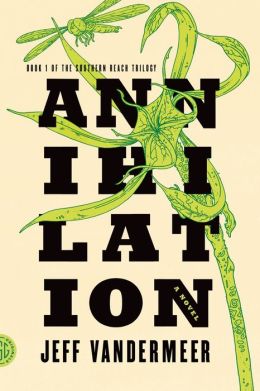
Annihilation — Jeff Vandermeer

Annihilation works and lives up to its hype but may not live up to predecessors like Solaris or Peter Watt’s brilliant, bizarre novel Blindsight. I say “may not” because Annihilation is a simpler book, which I say descriptively rather than derogatorily, written in an easy-to-understand style that isn’t as demanding as Blindsight. Because the protagonist of Annihilation knows very little, she doesn’t have the knowledge or vocabulary to explain what is happening to her. Most of the characters in Blindsight speak in sentences like this: “The geometry—it’s not so symmetrical. Looks almost like the Phaistos Disk.” The what disk? And the chapters skip confusingly around.

Annihilation_coverBlindsight is much harder SF, but the last third, like the novel as a whole, is as good as any fiction I’ve read, ever. It is a book that needs to be started again from the beginning to be understood, which is both a strength and weakness. One could say that Ulysses is the greatest novel ever written—I don’t think so, despite the commonness of the view—but it is also not for everyone or even most people.

Annihilation and Blindsight should be compared because they share an important theme: what happens when we can’t trust our own senses. Annihilation is scary not just because it’s about exploring the unknown but because the protagonist can’t trust memory, which can be directly manipulated in the novel. In a world without reliable memory it becomes impossible to know what you know or don’t. There is no real way to make sense of human life or to receive meaningful feedback from the environment.

This isn’t a totally new fear—Lovecraft’s stories often involve cosmic horror overcoming the senses of humans and causing madness in them, such that they can no longer rationally evaluate what they see and process with their senses. Descartes asked how we know what we know and how we can trust it in 1641’s First Meditation. The difference between then and the near future is the possibility of being able to systematically alter memories. Contemporary science fiction (and, increasingly, science), however, points out that we’re getting much closer to the point at which direct brain or sensory manipulation could be used to make it impossible to trust one’s senses. That sort of thing existing as a fantastical horror scenario is very different from knowing that it could be done to you and, almost as bad, you might not even know.

The narrator’s epistemological gaps are wide. She says: “We had also been assured that it was safe to live off the land if necessary.” Who had done the assuring? When? Why? The party reaches “the camp” and “set about replacing obsolete or damaged equipment.” What equipment is gone and what remains? The narrator doesn’t say. She hears “a lot, powerful moaning at dusk,” but no one tries to figure out what it is. Blindsight is a voyage of discovery; Annihilation is a voyage of strange passivity.

The part of the brain that deals with curiosity seems to have disappeared, and a few pages later the narrator says as much: that “Curiosity could be a powerful distraction.” For someone exploring the unknown, however, curiosity is a motivator, not a distraction. The term “unreliable narrator” is common, but it doesn’t describe Annihilation’s narrator, who better be termed “wildly delusional.” She seems not to search for explanations when the explanation might save her life and its lack might kill her. At times she is anti-rationalist:

I found the psychologist’s faith in measurements and her rationalization for the tower’s absence from maps oddly. . . endearing? Perhaps she meant only to reassure us, but I would like to believe she was trying to reassure herself. Her position, to lead and possibly to know more than us, must have been difficult and lonely.

Almost no one could know less than the narrator. She knows nothing at the beginning of the novel: of one of her party, she says “I think we all believed she came from some kind of management background.” I’d want to know more about someone I hired to edit proposals, let alone someone I’m accompanying into an unknown area long cut off from the rest of the world and human society. She realizes that “we might now be living in a kind of nightmare,” and that sense never goes away. Neither do questions about the narrator’s reliability; towards the end of the novel, she says:

It may be clear by now that I am not always good at telling people things they feel they have a right to know, and in this account thus far I have neglected to mention some details about the brightness. My reason for this is, again, the hope that any reader’s initial opinion in judging my objectivity might not be influenced by these details.

Worries about “objectivity” are standard fare in novels. The quality of the writing in Annihilation, on a sentence-by-sentence basis, is average, but the novel remains fun, even if the narrator’s ineptness is not to my taste. That the ineptness may be an artifact of whoever sent her is scarier than the things she sees, or think she sees, in Area X.

The Death of the Novel and Ryan Holiday’s “Trust Me, I’m Lying”

“As Chris Hedges, the philosopher and journalist, wrote, ‘In an age of images and entertainment, in an age of instant emotional gratification, we neither seek nor want honesty or reality. Reality is complicated. Reality is boring. We are incapable or unwilling to handle this frustration.’

As a manipulator, I certainly encourage and fuel this age. So do the content creators.” (67-8)

We have met the enemy, and he is us.

Trust Me LyingI have read a million essays, most dumb, about the Death of the Novel or the Death of Literature; “Anxiety of influence: how Facebook and Twitter are reshaping the novel” is one recent specimen, though there will no doubt be others: the topic seems as attractive to the essay writing set as cat pictures and porn are to Internet users. Yet the quoted passage from Ryan Holiday’s Trust Me, I’m Lying: Confessions of a Media Manipulator resonates more than most samples in the genre. Reality is complicated and the best novels, and narrative art generally, strives to capture that reality. Does a novel make a cultural sound if no one is there to read it?

“In an age of images and entertainment” it might also be useful to recall the Stephenson quote posted a few days ago:

Literate people used to spend a lot of time reading books, but during the Internet years those have begun to seem more and more like a distinct minority: a large and relatively well-off minority, to be sure, but one that simply doesn’t register in the electronic media, as vampires are invisible to mirrors. [. . .] Books, though, and the thoughts that go through the heads of their readers, are too long and complex to work on the screen—but it a talk show, a PowerPoint presentation, or a webpage. Booksih people sense this. [. . .]

If bookishness were just a niche pastime, like stamp collecting or waveboarding, none of this would really matter. But it’s more than that. It is the collective memory and accumulated wisdom of our species.

Not all hobbies are created equal. I wonder too if bookishness makes one less susceptible to the media manipulations Holiday describes in Trust Me, I’m Lying. “Less susceptible” is of course not the same as “immune.” Nonetheless, I would take from the book several lessons:

1. Beware the cheap, faux outrage that is seemingly everywhere online.

2. Realize that people are still herd animals—a point Holiday makes—and that while this is often adaptive (if everyone is literally running in one direction, there’s probably a reason) it has many drawbacks. Intellectually and economically it is often not good to be part of the herd.

3. Most people don’t separate news and entertainment, though few think explicitly about this point. Whatever larger cultural structures might have existed to enforce this separation at one point are if not gone altogether then mostly gone, and Trust Me, I’m Lying is a eulogy of sorts.

4. The environment in which we evolved for tens of thousands of years or more is very different from the one in which we live now; though that’s an obvious point, the many ways in which now and then are different still surprise me. Consider:

the public is misinformed about a situation that we desperately need to solve. But heartbreaking sadness does not spread well. Through the selective mechanism of what spreads—and gets traffic and pageviews—we get suppression not by omission but by transmission.

5. Trust Me, I’m Lying raises my estimation of academia, at least slightly.

Briefly noted: Decoded – Mai Jia

Decoded suffers in comparison to Cryptonomicon, a novel whose explanations of cryptography are brilliant. Both novels, interestingly and perhaps significantly, start with the parents or grandparents of the nominally central characters. There are comments about the nature of stories:

It all happened so long ago that everyone who saw her suffer and die is now dead themselves, but the story of the terrible agony that she endured has been passed down from one generation to the next, as the tale of an appalling battle might have been.

How much are we to trust stories “passed down from one generation to the next?” Maybe only as little as we are to trust that cryptographic protocols have been properly implemented. The woman giving birth in this passage was part of a rich clan that, like most rich clans, can’t maintain its structure over time, since, “very few of the young people who had left were interested in returning to carry on the family business.” The family doesn’t get enmeshed in the new government, either, at least until the “hero,” Rong Jinzhen, comes along.

I’m looking for some evocative quote to give a sense of the writing, but it feels flat and there is very little dialogue. Perhaps I’m missing something as Tyler Cowen finds its compelling.

How to Sell — Clancy Martin

How to Sell works, or at least the first half does while the second descends to melodrama. It’s a novel of surfaces and not an easily quotable book. The narrator notices but doesn’t do up the descriptions:

I should have known that as soon as the pitch started Jim believed the lines he was throwing me. It’s like being an actor or prime minister, you get all worked up with the audience and you think can can say nothing false or unbelievable.

How to sellOne could say many professions involve lying as a central component of the work; one could say that science does the opposite and is one of the only fields in which lying, while possible, is at least also discoverable. In How to Sell the narrator and his brother, Jim, work the jewelry business in a pre-Internet age, though I’m not sure how much the Internet has changed that business.

How to Sell starts with an Elmore Leonard-esque word slide: “Our father told it that Jim was caught dressing up in my grandmother’s black Mikimotos when he was scarcely two years old.” He “told it?” To who, when, how? It doesn’t matter since we don’t find it, but it and that weird “scarcely” tell us that the narrator isn’t quite level and maybe the story won’t be either.

It isn’t, not really, and much of the discussion revolves around who is lying (everyone) and who isn’t (no one, not really, including the narrator). Yet a lot of people want to be lied to and put themselves in a position to be lied to and then others do the lying and justify it, as Jim explains:

Look, Bobby, the appraisal is not a lab report. [. . .] We are not calculators, we are people and so are our customers.

W’re people and we want to be lied to. The people who want the truth take the time to learn how jewelry works and the rest take the bullshit the salesman tells them. But information has a cost and so in some circumstances it’s easier to just do it without paying attention to the niggling gaps between details; a lot of romantic relationships function on the same principles as selling jewelry, as the novel makes clear since it is about how the one activity is a metaphor for another. Jewelry is a potent metaphor here because it’s also unnecessary: no one dies because they can’t wear it. As a pure luxury item it is sold as glamor, and one element of glamor is a lie plausible or well-presented enough to be believed.

No one in this book should be married or in a monogamous relationship, yet many characters are and their dilemmas would go away if they could undergo that simple change. But they can’t, or won’t.

Characters are constantly giving bad advice. One, a man named Kizakov, says “In this business, always trust your eyes.” Except that eyes can be deceived, which is why humans build so many tools to augment what we can see. Our senses should be verified rather than trusted; in this way do they also resemble lovers? In that domain broken promises may not be the norm but the evolutionary and other pressures are so strong that everyone at least knows stories about crumbling and breakage and base metals.

Jim gives brotherly advice: “Sometimes it’s better to stay on the surface with somebody.” People who say that often mean, “Stay on the surface with me.” Jim is a man of surfaces more than most people, and when he stays “on the surface” he means that he’ll do what he wants, when he wants it, and you’re only “in” with him to the extent you can do something for him. For men that means selling and for women that not surprisingly means something else.

The owner of the store, Mr. Popper, has a post-modernist view of the truth, as when he says that “It don’t really matter [what’s real and what’s fake], so long as she’s done right.” The similarities to love are again obvious; the bad outcome for Mr. Popper is also not surprising.

A few other points: Clancy knows enough about the jewelry business to describe it or learned enough about the jewelry business to fake it. There is substance amid the love lines and too many novels forget that. The second half of the novel is less about the technical facets of the jewelry business and that’s part of why it is weaker.

* There is more in common with selling jewelry and religion than is commonly supposed.

* To some extent no one knows anyone and that fact continues to drive fiction.

Thoughts on A Man of Parts — David Lodge

* A Man of Parts is surprisingly dull despite H. G. Wells’s salacious, important life; there are too many passages like this:

Amber seemed to him a golden girl that summer and autumn, an almost mythical creature, such as the gods of classical Greece coveted and descended from the heights of Olympus to ravish in human disguise or in the form of some animal or bird.

The novel is dutiful yet has a limited feeling for what it’s like to be a writer; the novel deserves comedy but it isn’t particularly funny. There are good moments:

“You hear so much talk about sex, and read about it in books, and you don’t know what or who to believe, and anyway, words can never tell you what it’s actually like. Is it wonderful, or just ordinary?”
“It’s both wonderful and ordinary,” he said.

which capture the feeling of much of life; so often it’s two or more contradictory things at once, and the question of ordinariness or extraordinariness say much about the temperament of the consciousness doing the observing.

* The travails and politics of the Fabian Society arise in so many novels set in the 1890 – 1929 period, but in this novel their machinations are dull. Something like A. S. Byatt’s The Children’s Book covers similar territory but much more effectively, and more strangely.

* Science itself is mostly absent, as it is not from, say, Ian McEwan’s Solar or Peter Watt’s Blindsight.

* Novels about people who really know things are surprisingly rare.

Why fiction? Why reading?

When we pick up a decent book, we live not once but twice, and each new book allows us to live again and absorb the thoughts of someone who has absorbed thousands of other people’s thoughts. The book is the most powerful medium yet invented for intellectual stimulation, growth, and change. The bounty is endless and in the contemporary world very cheap. Most, though, reject the gift. Is this not strange?

Pretty much everyone who is deeply interested in reading gets and/or writing gets some version of the utility question that I answered in the first paragraph (and have answered in other places). Each answer has its own idiosyncrasies, but I think they have a common core that revolves around knowledge and pleasure. The issue is on my mind because a friend wrote me to say regarding Asking Anna, “thanks for having thought through that book content and made it available for people like me to read and then not have to do some of the work. I like that.” The crazy thing is that crazy people have been doing this for centuries: packaging many thousands of hours of thinking into works that take only a few hours to read.

That’s true of fiction and nonfiction, and in some ways lately nonfiction has been leading the perceive quality race. But historically fiction has tended to advance the state of the art in prose, with novelists especially leading the charge towards renewing the language. Arguably this tendency has decreased over time, but I’ve never read a great nonfiction writer who didn’t also read fiction, or read a lot of fiction at one point.

Good novelists tend to be obsessed with the quality of their prose in a way fewer nonfiction writers are. Too many nonfiction writers focus on content at the expense of form and beauty; some have been glamored by some of the stupid literary theory that passes for erudition in some academic circles (Katharine Frank’s books, like Plays Well in Groups: A Journey Through the World of Group Sex, suffer from this, though she is merely a salient example and far from the only offender).

Fiction tends to train us to attend to language, and books like Wood’s How Fiction Works and Francine Prose’s Reading Like a Writer do the same. When one becomes sufficiently attuned to language, poorly written work or even work that is merely competent becomes aggravating, like a song messed by a drunk guitarist.

That’s my short utilitarian defense of fiction, but I read it for pleasure. The history of the West is one in which pleasure is suspect, especially in the Judeo-Christian tradition; sometimes for good reasons and sometimes for less-good reasons. That tradition encourages us to make sure that pleasure is always deferred, and that’s the tradition that led to the Enlightenment and Industrial Revolution and hence to the present day. We’re still getting somewhat used to enormous material wealth, at least by historical standards. But pleasure has its own importance, and there is pleasure in the many lives we can choose to live through books. Perhaps the most interesting thing is that so many people do not make the choice.

Every great book is the result of years or decades of studying and experience, distilled into a volume you can read in a few hours. How could you not want that?

Fundamentals in fiction and the question of obligations

The context is David Leavitt’s The Indian Clerk and the great mathematician G. H. Hardy’s hatred for the “tripos,” a now-defunct series of math tests at Cambridge that served as a sort of hazing ritual something like modern-day dissertations (Hardy despises them for “The tedium. The sense of energy diverted, imagination stifled”). To pass, many candidates received encouragement and expert tutoring. In this exchange a character named Gaye speaks first, after learning that Hardy, despite his feelings about the Tripos as an institution, will tutor someone about to undergo them:

“Coaching an undergraduate for the tripos. The tripos, of all things! And after all the screeds I’ve heard you deliver against the damned—”
“He won’t make it otherwise,” [Hardy said.]
“Is it your job to save him?”
“Someone saved me.”
“But Love didn’t coach you. He just sent you back to Webb. [. . .] Yours is a more specialized erotic thrill, that of rescuing the fair damsel from the jaws of the dragon.”

There is a perpetual tension discussed here: how much, if any, obligation do we have to others and do they have to us? The question can never be satisfactorily resolved, only explored, and for that reason it is likely to be of interest to novelists (or anyone creating narrative art). Gaye and Hardy are both in their own ways right. Two or more people or viewpoints who both have reasonable claims to rightness is a fertile place for intelligent drama.

One joy of Ann Patchett’s State of Wonder is the conflict between Marina and Dr. Swenson: when one speaks I agree with her; when the other speaks I agree with her. It’s not easy to sustain this level of conflict without giving one character the upper-hand, the right answer. Novels that do so often descend to the level of propaganda rather than art.

To return to Hardy and Gaye: Relatively few of us go through life completely, callously indifferent to the suffering and travails of others but equally so very few of us devote everything we can to “saving” others (for one thing, they often don’t want to be saved, and can’t be saved from themselves). Somewhere between those poles of total indifference and utter devotion we wander erratically, with no consistent reason, helping some—even making it our “job”—and ignoring others.

Often, however, in helping others we are also helping ourselves in some sense. Hence Gaye’s reference to the erotic thrill: it’s easier to innocently “help” someone attractive, or who is likely to be in a position to pay back a favor, but very easy to deny mixed motivations—until someone else, or some other character, points them out.

Links: James Wood, news and fiction, sexuality and narrative, the paperback, bars and babysitting

* James Wood: “On Not Going Home.”

* “Is the News Replacing Literature?” Unlikely, but high-quality analysis of the news often has a literary quality. But quantity still has a quality all its own and writing 800 words, 8,000 words, and 80,000 words are all very different beasts and having written pieces of all three lengths I can say that what works at one length won’t at another.

I’m also fond of saying that not-very-good nonfiction can still be useful while not-very-good fiction rarely is.

* Someone on Reddit “capture[s] the vagaries of sexual consent through a series of personal stories;” many people have such stories but few share them widely, for obvious reasons. See also “The power of conventional narratives and the great lie.”

* The tooth fairy and the traditionality of modernity.

* “How Paperbacks Transformed the Way Americans Read;” ebooks are now doing something analogous.

* Smartphone sales growth slows, presumably for obvious reasons: when I first got one I used it for the same stuff everyone else does: maps, looking up random stuff, sending/receiving naked pictures, listening to music, and maybe one or two other things. With the model I have now I do basically the same stuff, as well as find Citi Bike locations and coffee shops. The new version does some of those things slightly better / faster, but were it not a business expense I doubt I’d bother.

* “Bars are too loud and cafes too quiet.” Mostly, bars are too loud.

* “My bad baby sitters year;” mostly a lost world, especially when it comes to finding forbidden objects / photos.

Why “tit-for-tat” might be so hard to implement in a romantic/dating context

The other day a friend with love problems described them, and I offered a solution applicable to a wide range of similar issues: tit-for-tat, in which you respond to another person’s response. If the other person is cooling off, cool off in turn; if the other person is heating up, heat up in turn. This avoids wasted effort in pursing someone unavailable and also prevents the (frequently) unattractive behavior of being too available.*

There’s a large challenge in TFT, however: it’s really hard for most of us to implement, even among people who know, intellectually, that it’s a good idea. We often want the world to arrange itself according to our wishes. In most endeavors increased effort leads to increased reward. But there is a class of endeavors—getting a job, finding romance, succeeding in book proposals—where too much effort is a negative signal that shows desperation or low status.**

In that problem class, TFT is a pretty good way of checking a sense of hope against the reality of a situation. In the real world we can’t control what other people do but we can control our reactions. That’s not a new idea but it is a really important one, and one that a lot of people (especially when they’re romantically inexperienced) fail to really understand.

I suspect that the roots of misunderstanding romantic behavior starts in childhood. When you’re a child your parents love you unconditionally and tell you that you’re special (because you are, to them), and your teachers try to help you (for the most part) and encourage you even when you fuck up. If you show your parents or family or teachers that you’re really trying hard or care or whatever they usually reward you.

But eventually you hit puberty, get some hair on your beanbag or a righteous set of jugs, and you start splashing around with dating. Except in that domain a lot of people you may be interested in don’t care about you no matter what you do or how much you care. You care so much—why don’t they? If you’re overly demonstrative in this, however, at best you’ll be taken advantage of and at worse you’ll be ignored.

smoking-0730The real solution is to realize that you can’t force other people to be romantically (or otherwise) interested in you. In a romantic context, extended ambiguity sucks, and one effective way to end it may be to introduce a rival. Find some guy or girl and make sure the real target knows. If that doesn’t spur the love interest to action nothing will, because it says, “Hey, either take this spot or lose it.”

That’s not quite TFT, but it is one way to force decisions.

In books and movies, almost no one employs TFT, and things tend to work out anyway—but that’s because most books and movies are fantasies that give us what we wish were true, rather than what is true. Which may be why inexperienced people have so much trouble: their only guidelines are really poor.

Most of the stuff I imbibed from pop culture between birth and age 16 or so, for example, did absolutely nothing to prepare me for the real world and if anything it was harmful. Part of this was my own fault—I had a penchant for pulp fantasy novels in which not only the dragons were imaginary but so too were the female characters—but not all of it. Consequently, almost everyone has to discover the same lessons for themselves, over and over again, often without any useful guidance whatsoever. Parents are of little help because their own interests diverge in systematic ways from their children’s interests. Peers are often equally ignorant. Non-parent adults by and large don’t interact with highly inexperienced teens or early 20-somethings. So people are left with pop culture and its wish-fulfillment fantasies.

There are some people building a theory of reality—like Esther Perel or Roosh—but little of it has filtered into the culture at large so far. Maybe it never will.


* I’m not the first to notice these issues: “Sexual Attraction and Game Theory” popped up in my RSS feed about a week after the discussion.

** This post had its origins in a much more specific (and explicit!) email, but it’s been generalized and (somewhat) sanitized.