Effi Briest — Theodore Fontane, with a side of James Wood and Samuel Delany's Paris Review interview

Despite what I wrote in this post, I got a copy of Effi Briest. And you know what? I couldn’t finish it. There were some great lines—my favorite is Effi’s father saying, “There’s nothing so good for one as a wedding, provided of course it isn’t one’s own”—but I couldn’t take the rest, even though I stopped reading the very nice introduction by Helen Chambers after realizing it was prejudicing me against the book:

The sexual dimensions of the age gap [between Effi and her husband] remain beneath the surface of this discreet and allusive novel. They are suggested, as is much that is vital in the inner action, by the symbolic texture of the narrative. Effi’s sexual inexperience at the beginning of the novel is beyond question, and the premature loss of her virginity is prefigured by the twins calling her back to the garden through a window framed by Virginia Creeper

This explains why little seems to happen, since “remain beneath the surface” feels like another phrase for “buried so deeply that you need an even dirtier mind than mine to excavate it. In a Paris Review interview, Robertson Davies says:

I do not respond quite so immediately and warmly to writers in the United States, because their concerns are different from mine and their approach to them is different from mine. They seem to be infinitely concerned with very subtle details of feeling and life. I find this exemplified, for instance, in many stories in The New Yorker where whether the family will have pumpkin pie or something else on Thanksgiving Day is a decision with infinite psychological and sexual repercussions. I take this quite seriously. I admire their subtlety—but I get so sick of it. I wish they would deal with larger themes.
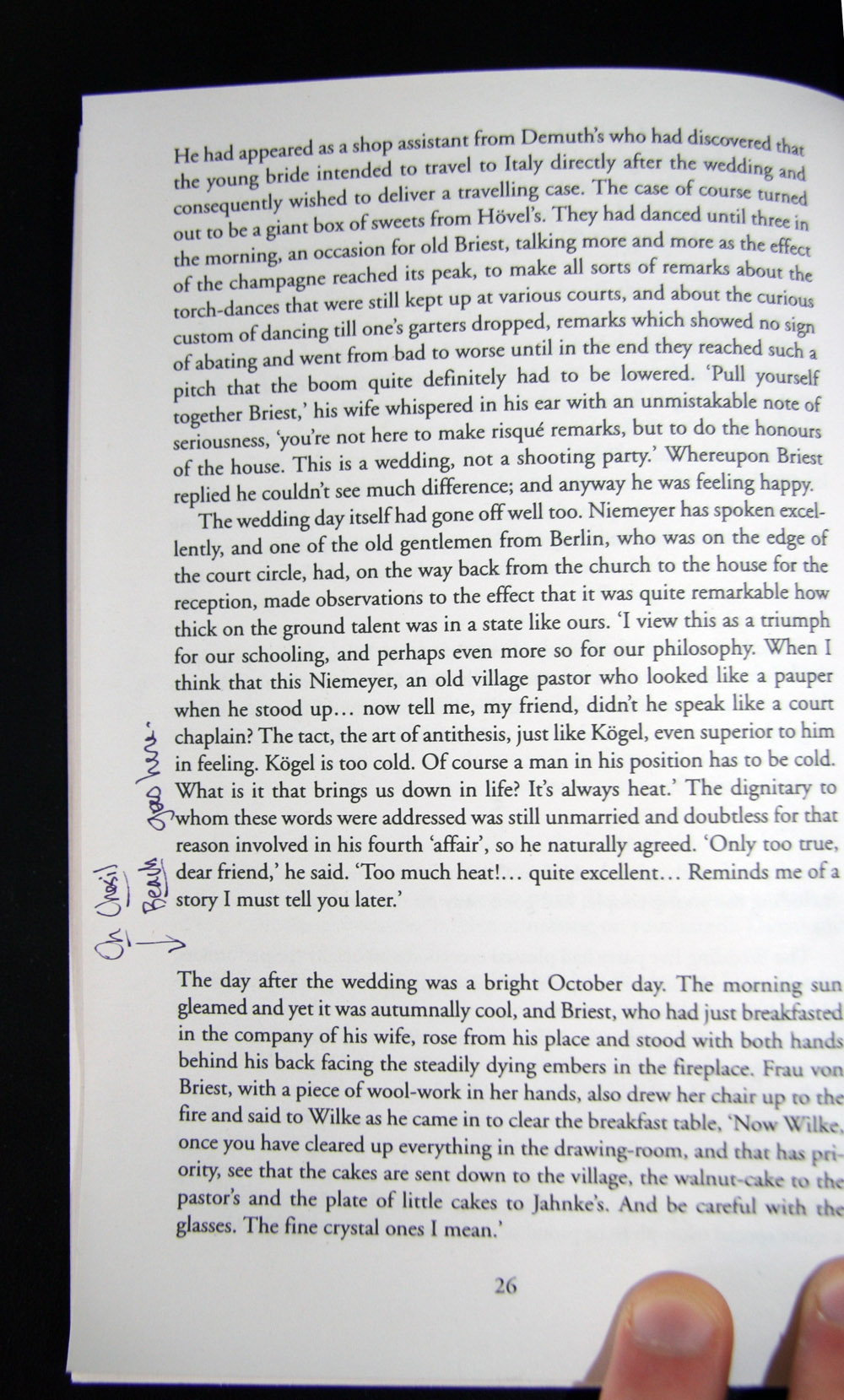
With enough subtlety, substance disappears, and I love his characterization of American Thanksgivings as portrayed in stories. Anyway, Chambers also says of Effi’s husband, “It seems that after years of self-discipline and mortification of the flesh Innstetten has regulated his natural urges into a state of atrophy.” In the margin I wrote, “Yawn,” a judgment that still seems reasonable a week later. Practically the entire text of Ian McEwan’s On Chesil Beach could fit between the end of the wedding scene on page 26 and the next paragraph, which begins, “The day after the wedding was a bright October day,” as if one of the presumably major events of Effi’s life hadn’t just happened. And I’m not talking about the wedding.

I was thinking about Effi Briest when I read Samuel Delany’s Paris Review interview in the Summer 2011 issue. He talks about two characters in his work Nova who almost have an incestuous relationship. The interviewer begins this exchange:

Did you intentionally want to make something the reader could only speculate about, rather than be certain of?

Delany: Certainly as far as the incest goes. Suggestion is a literary strategy. But when, in 1968, works like Henry Miller’s Tropic of Cancer and Black Spring and Lawrence’s Lady Chatterley’s Lover were legal to publish and sell in this country, the age of innuendo and the coyly placed line of white space, as the hero envelops the heroine in his arms, ended. Fifteen years later, AIDS rendered them permanently obsolete.

Today, I watch seminar rooms full of graduate students misread both [Alfred] Bester and [Joseph] Conrad, because they no longer have to wonder about the possibility of such illegal elements occurring in the story and the compensating possibility of suggestion as a writerly strategy for representing sex and violence.

I am one of those graduate students, and I evidently don’t have the exquisitely tuned sex detector that pre-’68 readers might have developed. This became especially clear in a seminar on Henry James’ The Golden Bowl, when one of my professors at the University of Arizona began to point out the many euphemisms and double entendres left by James, beginning with the name “Assingham” and proceeding from there. I mostly wondered what the big fuss was about, given the modesty of the phrases in questions, but I didn’t realize how generational my readings were until I discovered the Delany interview an hour ago.

Delany is right—I don’t have a lot of tolerance of “innuendo and the coyly placed line of white space.” That doesn’t mean I want every novel to be wildly explicit, or that I want pornography to merge with literary fiction, but it does mean that a lot of older books seem coy. Like Effi Briest. Today, when McEwan’s aforementioned novel takes those white spaces and turns them into entire works of their own, it’s hard to accept the white space, or an extraordinarily “discreet and allusive novel” where Virginia Creepers (or pumpkin pie) have “infinite psychological and sexual repercussions”

I didn’t expect to have my malady so accurately and suddenly diagnosed, however, and it wasn’t until I read Delany that I was able to write this post. He makes me want to be a more careful and considerate reader. Or maybe novels do have a sense of technological progression, or something like progress, or even progress itself. James Wood speculates on the subject in his review of Chang-Rae Lee’s The Surrendered:

Does literature progress, like medicine or engineering? Nabokov seems to have thought so, and pointed out that Tolstoy, unlike Homer, was able to describe childbirth in convincing detail. Yet you could argue the opposite view; after all, no novelist strikes the modern reader as more Homeric than Tolstoy. [. . .] Perhaps it is as absurd to talk about progress in literature as it is to talk about progress in electricity—both are natural resources awaiting different forms of activation. The novel is peculiar in this respect, because while anyone painting today exactly like Courbet, or composing music exactly like Brahms, would be accounted a fraud or a forger, much contemporary fiction borrows the codes and conventions—the basic narrative grammar—of Flaubert or Balzac without essential alteration.

If literature progresses technologically, it still doesn’t do so in quite the same way as technology: no one would use a camera from 1925 unless they were a masochist, had a historical fetish, or were trying to achieve some very peculiar artistic effect. The rest of us use digital cameras manufactured in the last five years, or phones, given the obvious advantages of convenience. But many writers from 1925 still feel quite modern—Fitzgerald, most obviously, but many others too. Yet I don’t find that much 19th Century fiction really moves me (exceptions: Moby-Dick, The Scarlet Letter). Contemporary writers have a greater and perhaps infinite rein to express what they need to express, and by contrast older writers do seem coy, even if this is an unfair judgment on my part—or the kind of judgment that might be tempered by age. The more I think about the idea, the more I see how others have considered it. For example, this review of William Deresiewicz’s A Jane Austen Education is bizarre because it’s like reading about myself, right down to the love for Madame Bovary:

In 1990, William Deresiewicz was on his way to gaining a Ph.D. in English literature at Columbia University. Describing that time in the opening pages of his sharp, endearingly self-effacing new book, “A Jane Austen Education,” Deresiewicz explains that he faced one crucial obstacle. He loathed not just Jane Austen but the entire gang of 19th-century British novelists: Hardy, Dickens, Eliot . . . the lot.

At 26, Deresiewicz wasn’t experiencing the hatred born of surfeit that Mark Twain described when he told a friend, “Every time I read ‘Pride and Prejudice’ I want to dig her up and hit her over the skull with her own shinbone.” What Deresiewicz (who has considerable fun at the expense of his pompous younger self) was going through was the rebel phase in which Dostoyevsky rules Planet Gloom, that stage during which the best available image of marriage is a prison gate.

Sardonic students do not, as Deresiewicz points out, make suitable shrine-­tenders for a female novelist whose books, while short on wedding scenes, never skimp on proposals. Emma Bovary fulfilled all the young scholar’s expectations of literary culture at its finest; Emma Woodhouse left him cold. “Her life,” he lamented, “was impossibly narrow.” Her story, such as it was, “seemed to consist of nothing more than a lot of chitchat among a bunch of commonplace characters in a country village.” Hypochondriacal Mr. Woodhouse, garrulous Miss Bates — weren’t these just the sort of bores Deresiewicz had spent his college years struggling to avoid? Maybe, he describes himself conceding, the sole redeeming feature of smug Miss Woodhouse was that she seemed to share his distaste for the dull society of Highbury.

I’m 27. Maybe I’ll have considerable fun at the expense of my pompous younger self one day.

I bought A Jane Austen Education, which shouldn’t be surprising given my feelings about Deresiewicz. Maybe he will teach me to read Austen more kindly, more attentively (Wood has succeeded at least somewhat in that respect: his discussion of free indirect speech in How Fiction Works finally gave me the tools to figure out why people like Austen). I’m still not sure that it will bring Effi Briest to life, and even if it does, it might be more like reanimating a corpse (which, as genre fiction teaches us, is replete with dangers) than interacting with a live person.

How should teenage characters speak? Engaging Janet Reid, Gossip Girl, and 90210

In a query letter critique, Janet Reid says:

If you’re writing a 14-year old character, you need to know how they talk: “Threatening us with violence” sounds like a sociologist; “told us he’d mess us up” sounds like what the kids on my corner say to each other.

This might be true in many instances, but I’m reminded of something this Salon.com review of “Gossip Girl” and “90210” says:

Where Blair and Serena’s lines snap, crackle and pop with wit and cleverness, the soggy stars of “90210” stumble over one cliché after another. “Awkward!” Annie blurts at Ethan after they encounter Ethan’s ex Naomi, then Annie does her best impression of the cynical teenage eye roll, as Ethan mutters, “Good times!” Oof.

But every scene is filled with such teen-bot tripe: “Whatever works for you.” “Helloo-ooo?” “Shut up!” “Me and Ethan? Not so much.” Maybe real teens sound like that, but real teens are repellent and worthless, remember? Plus, nothing’s worse than shoving such drivel into the mouths of a bunch of airbrushed anorexics and overgrown child actors.”90210’s” Annie has more in common with Broadway’s Annie than a real human being. Putting teen lingo in her mouth is like dressing a cat in a little nurse outfit. It’s sort of cute at first, but then it just gets sad.

“Repellant and worthless” is overstatement, very. The characters from “Gossip Girl” are more interesting because they don’t speak like teenagers, or like regular ones. If they did, they’d be boring (or, depending on your view, more boring than they already are). I suspect that’s why so many teen narrators are “precocious.” The alternative is dull. If you have a normal 15-year old, even 15-year olds will find them boring and insipid on the page. So you need a precocious 15-year old who adults can tolerate, and perhaps enjoy, while 15-year olds will imagine themselves to be equally witty even if they’re probably not. But your precocious 15-year-old still probably shouldn’t sound like Umberto Eco. That’s the challenge: giving a character enough of a voice and enough intelligence to make them interesting while not overwriting them. This challenge might explain why so many books starring teenagers are told from a distant, adult future recalling events from the past.

The first season of Gossip Girl, by the way, is pretty funny. I referenced it in class one day because, being a West Coaster, I had no idea what “cotillion” was until an episode featured it. That allusion elicited shock from students. Apparently I come across as a very hard core literary type. Which, of course, I am. A friend and I watched a few episodes and the last one from the second season, but it was so repetitive that we gave up.

On another note, the rest of Reid’s advice on the query letter is typically accurate. If you’ve ever wanted to try and get a literary agent or publisher to read your manuscript, take a couple hours to look through Query Shark first.

More on fiction versus nonfiction

Most of the books I’ve been wanting to write about and not getting around to are nonfiction, and I’m not sure why this is. It might be because both good and bad nonfiction are easier to write about than good fiction. Good fiction demands attention and time, which are in chronically short supply for me and virtually everyone else. So I foolishly put off writing about good fiction and instead spread time among lesser though still interesting vessels (this post comes as a followup to Nonfiction, fiction, and the perceived quality race, which got started from the question, “The quality of fiction seems to be decreasing relative to the quality of non-fiction, or am I just biased against active fiction writers vs. dead ones?”).

I expend a lot of my time thinking about good fiction in the context of making my own novel writing better, instead of writing about what makes good fiction good on this forum. So even though I think a lot about good novels, I write about them in a different context. For instance, the last novel I finished stole from Alain de Botton’s On Love and Rebecca Goldstein’s The Mind-Body Problem; I’ve written about both books here, but not nearly to the proportion I’ve been thinking about. Alas: the novel I wrote got the most encouraging rejections, many along the lines of “I like it but can’t sell it.” If it had sold and eventually been published, I think it would be much easier for me to write about novels I care deeply about.

Even so, there are a bunch of novels—a couple by Michel Houellebecq, Elmore Leonard’s latest, Brady Udall’s The Lonely Polygamist, more about Robertson Davies—I mean to write about, but but they’re outnumbered by nonfiction. This might seem strange, coming from a person in English graduate school, where we study nonfiction all the time, and when we study fiction, it’s often more like studying nonfiction than we care to admit.

I also simply don’t read as much fiction as I used to; I wonder if fiction is most useful to the young (who are trying to figure out who they are and how the social world works) and the old (who are trying to figure out what this crazy thing they just did actually means). A lot of people in the middle don’t appear to derive as much immediate benefit from reading fiction, although I have no data on this idea.

Finally, I can often read nonfiction much faster than fiction. This isn’t a change, but it is true: nonfiction often telegraphs where it’s going, which makes skipping large sections easier. Being able to read faster also indicates that too many books are too long, as Cowen has argued in various places, but it nonetheless means I very seldom have to invest as much in deep, close reading. I wish more nonfiction books rose to the level of deep, close reading, but few do, relative to good fiction.

George Eliot’s Daniel Deronda and the Graham Handley’s description of it

In his introduction to George Eliot’s Daniel Deronda, Graham Handley writes:

Yet if all the research and criticism of Daniel Deronda, including scholarly articles of the type which discover but do not evaluate, were put together, a consensus would doubtless reveal that it is generally thought of either as a remarkable failure, a flawed success, or even an aberration unredeemed by incisive insights or distinguished writing. The character of Gwendolen is always praised; those of Mirah, Mordecai, and Daniel are often denigrated.

It is my opinion, as someone who regularly miscegenates evaluation and discovery, that the critical consensus is correct. I particularly like the description of the novel as an “aberration unredeemed by incisive insights or distinguished writing.” I’m also still amused that Handley would announce this in the introduction, as if inviting us to agree with the consensus and not his defense.

Reading Handley’s defense, it’s hard not to like the critical consensus more:

It is my contention that Daniel Deronda needs no apology. [. . .] Its greatness consists in its artistic integrity, its moral and imaginative cohesion, its subtle and consistent presentation of a character with psychological integration as its particular strength, together with what Colvin called the ‘sense of universal interests and outside forces.’

Most of those words and phrases don’t mean anything on their own. What is “moral and imaginative cohesion?” Do you get it or them with glue and spackle? And how does the “subtle and consistent presentation of a character” work? Those sound like code words for “nothing happens,” other than that characters talk to each other about who’s going to boff who after they get married or, if we’re lucky, before.

The introduction goes on:

The form is fluid and vital, not static and diagrammatic, and the sophisticated and studied use of image and symbol is tremulous with life, with the feelings, responses, and pressures of the individual moral and spiritual experience of fictional character registering with the factual reader.

Spare me “sophisticated and studied use of image and symbol” when they aren’t deployed to tell much of a story. “Moral and spiritual experience” sounds remarkable tedious. Once again, with accolades like these, who needs haters?

I will say, however, that Daniel Deronda makes me feel incredibly virtuous for having read it, or at least parts of it. This is more or less true of every novel I’ve read whose title consists solely of a name.

George Eliot's Daniel Deronda and the Graham Handley's description of it

In his introduction to George Eliot’s Daniel Deronda, Graham Handley writes:

Yet if all the research and criticism of Daniel Deronda, including scholarly articles of the type which discover but do not evaluate, were put together, a consensus would doubtless reveal that it is generally thought of either as a remarkable failure, a flawed success, or even an aberration unredeemed by incisive insights or distinguished writing. The character of Gwendolen is always praised; those of Mirah, Mordecai, and Daniel are often denigrated.

It is my opinion, as someone who regularly miscegenates evaluation and discovery, that the critical consensus is correct. I particularly like the description of the novel as an “aberration unredeemed by incisive insights or distinguished writing.” I’m also still amused that Handley would announce this in the introduction, as if inviting us to agree with the consensus and not his defense.

Reading Handley’s defense, it’s hard not to like the critical consensus more:

It is my contention that Daniel Deronda needs no apology. [. . .] Its greatness consists in its artistic integrity, its moral and imaginative cohesion, its subtle and consistent presentation of a character with psychological integration as its particular strength, together with what Colvin called the ‘sense of universal interests and outside forces.’

Most of those words and phrases don’t mean anything on their own. What is “moral and imaginative cohesion?” Do you get it or them with glue and spackle? And how does the “subtle and consistent presentation of a character” work? Those sound like code words for “nothing happens,” other than that characters talk to each other about who’s going to boff who after they get married or, if we’re lucky, before.

The introduction goes on:

The form is fluid and vital, not static and diagrammatic, and the sophisticated and studied use of image and symbol is tremulous with life, with the feelings, responses, and pressures of the individual moral and spiritual experience of fictional character registering with the factual reader.

Spare me “sophisticated and studied use of image and symbol” when they aren’t deployed to tell much of a story. “Moral and spiritual experience” sounds remarkable tedious. Once again, with accolades like these, who needs haters?

I will say, however, that Daniel Deronda makes me feel incredibly virtuous for having read it, or at least parts of it. This is more or less true of every novel I’ve read whose title consists solely of a name.

More books I don’t want to read: Theodor Fontane and Teju Cole

The New Yorker has been running a lot of reviews that describe novels I don’t want to read. The latest: Theodor Fontane’s, which Daniel Mendelsohn describes this way:

The topography of his plots is admittedly as flat and monotonous as the notoriously bland landscape of his Prussian homeland, Brandenburg (about which he lovingly wrote in a multivolume work). Most of “Cécile” is devoted to the excursions and the chitchat of those hapless tourists; there’s some gossiping, a halfhearted flirtation, and then everyone goes home to Berlin.

“Flat and monotonous” plots? The “excursions and the chitchat of [. . .] hapless tourists?” Give me the latest thriller about mindless warfare and assassination. Or about fast-talking urbanites and their tedious sexual lives. Or anything. Elsewhere, Mendelsohn says, “Even Fontane’s characters are plagued by a certain anxiety about having nothing very exciting to talk about.” That’s enough of a problem in real life, thanks: give me escapism!

Or there’s Teju Cole’s novel Open City, as described by James Wood:

So the novel does move in the shadow of W. G. Sebald’s work. While “Open City” has nominally separate chapters, it has the form and atmosphere of a text written in a single, unbroken paragraph: though people speak and occasionally converse, this speech is not marked by quotation marks, dashes, or paragraph breaks and is formally indistinguishable from the narrator’s own language. As in Sebald, what moves the prose forward is not event or contrivance but a steady, accidental inquiry, a firm pressurelessness (which is to say, what moves the prose forward is the prose—the desire to write, to defeat solitude by writing).

“A single, unbroken paragraph,” limited conversation (which means we’re stuck in someone’s mind), the lack, again of, “event or contrivance,” as if those are bad things, the mark of a second-rate artist who wants to see how people interact with more than themselves and how they respond to adverse events, like the kinds that sometimes happen in life.

I realize Wood doesn’t like plot: in How Fiction Works, he quotes from Adam Smith writing in the eighteenth century regarding how writers use suspense to keep interest and then says, “But the novel soon showed itself willing to surrender the essential juvenility of plot […]” I don’t think that’s good or that plot is essentially juvenile and tend to like novels in which the proverbial “something happens” and tend to dislike the ones that feel more like philosophy plus characters.

More books I don't want to read: Theodor Fontane and Teju Cole

The New Yorker has been running a lot of reviews that describe novels I don’t want to read. The latest: Theodor Fontane’s work, which Daniel Mendelsohn describes this way:

The topography of his plots is admittedly as flat and monotonous as the notoriously bland landscape of his Prussian homeland, Brandenburg (about which he lovingly wrote in a multivolume work). Most of “Cécile” is devoted to the excursions and the chitchat of those hapless tourists; there’s some gossiping, a halfhearted flirtation, and then everyone goes home to Berlin.

“Flat and monotonous” plots? The “excursions and the chitchat of [. . .] hapless tourists?” Give me the latest thriller about mindless warfare and assassination. Or about fast-talking urbanites and their tedious sexual lives. Or anything. Elsewhere, Mendelsohn says, “Even Fontane’s characters are plagued by a certain anxiety about having nothing very exciting to talk about.” That’s enough of a problem in real life, thanks: give me escapism!

Or there’s Teju Cole’s novel Open City, as described by James Wood:

So the novel does move in the shadow of W. G. Sebald’s work. While “Open City” has nominally separate chapters, it has the form and atmosphere of a text written in a single, unbroken paragraph: though people speak and occasionally converse, this speech is not marked by quotation marks, dashes, or paragraph breaks and is formally indistinguishable from the narrator’s own language. As in Sebald, what moves the prose forward is not event or contrivance but a steady, accidental inquiry, a firm pressurelessness (which is to say, what moves the prose forward is the prose—the desire to write, to defeat solitude by writing).

“A single, unbroken paragraph,” limited conversation (which means we’re stuck in someone’s mind), the lack, again of, “event or contrivance,” as if those are bad things, the mark of a second-rate artist who wants to see how people interact with more than themselves and how they respond to adverse events, like the kinds that sometimes happen in life.

I realize Wood doesn’t like plot: in How Fiction Works, he quotes from Adam Smith writing in the eighteenth century regarding how writers use suspense to keep interest and then says, “But the novel soon showed itself willing to surrender the essential juvenility of plot […]” I don’t think that’s good or that plot is essentially juvenile and tend to like novels in which the proverbial “something happens” and tend to dislike the ones that feel more like philosophy plus characters.

How could Twitter not change how protests happen?: Egypt and the history of the novel

There’s been a lot of talk about the role Twitter, text messaging, and other communication mediums are playing in the unfolding drama in Egypt. Malcolm Gladwell basically says the role isn’t great: “People with a grievance will always find ways to communicate with each other. How they choose to do it is less interesting, in the end, than why they were driven to do it in the first place.”

But I am not convinced this is true: by lowering the friction of communication, thus making it real-time and instantaneous, Twitter and other technological tools are almost certainly changing what is said. Quantity has a quality all its own, and how we speak has a habit of changing what we say.

Gladwell’s post (and others) remind me of the arguments in English literature the field around the development of the novel as a genre (see, for example this post on Steven Moore’s The Novel: An Alternative History). Basically, a lot of people want to argue about the development of the novel without taking into account the printing press.

To me this is silly because mass cheap printing was a precondition to the novel as we know it. Without that, we would have fictional prose narratives of some length, but we probably wouldn’t have them alluding to one another, we wouldn’t have large portions of the population reading them, and we wouldn’t have (relatively) large portions of the population with enough disposable income to avoid them. If you look at surviving works that we would now classify as fiction that were written prior to ~1600, almost all of them are religious in nature because only the church had the resources to fund writing, maintain large collections of writing, and bother writing anything down.

After ~1600 (or ~1500, if you prefer, but that’s about it), you have a lot of things written that would previously not have been considered “worth” writing down because writing and copying manuscripts was so expensive and time consuming. Technology did change what was said. How something was said changed what was said. Technology is doing the same thing now. I don’t know how the current drama will play out; if you looked at the printing press around the time it was first created, it was mostly used to print religious stuff (hence the “Gutenberg Bible”). Elizabeth Eisenstein’s The Printing Press as an Agent of Change describes some of this. By the nineteenth century, however, writers are grappling with the idea of a world without God, per J. Hillis Miller’s Form of Victorian Fiction, or a world where “God is dead,” to use Nietzsche’s famous and misunderstood proclamation: he wasn’t saying that people would stop believing in God or that would religion would stop being a force society, but rather that religious studies were a dead end and people would cease to attribute everything in their life to God or God’s will.

In 1500, the material published via printing press looked basically continuous with what came about in 1400. By 1850, things are looking pretty different, and the diversity of printed materials has fundamentally changed what people could say. The printing press allowed people with grievances, to use Gladwell’s formulation, to communicate with each other much more efficiently than they previously could, which leads to a lot of political, social, scientific, and philosophical developments that most of us living today approve of. How many of us want to return to being illiterate serfs toiling in fields for distant masters?

Gladwell is right in one sense: the media is probably overstating the importance of Twitter and SMS. But both of those still play an important role in what’s going on. Somehow, people with grievances against monarchs and dictators weren’t all that successful on average in the years prior to ~1600. After that, they got more and more successful, to the point where a fair bit of world’s population now lives without dictators. Part of the reason is because ideas about freedom and good governance could be disseminated cheaply, where before they couldn’t, and everyone spent most waking hours covered in shit, farming, and hoping they’re not going to starve to death in late winter / early spring.

Mark at the computing education blog says, “A particularly interesting anecdote for me is the below: That the Internet was turned off in Egypt, but the protests continued. So what role was Facebook and Twitter playing, really?” Depends on the timeframe. Various technological tools helped people initially organize and helped the conditions for organization come about. They will probably do so again in the future. In the long term, such tools will probably create the conditions for much larger projects that we only dimly perceive now. I would predict what those will be, but things have a habit of turning out much stranger than random prognosticators like me can predict.

Missing the point with Guy Ritchie’s Sherlock Holmes — like Rambo with poetry

My Dad watched the latest version of Sherlock Holmes (the one with Robert Downey Jr. in it) and observed that Guy Ritchie missed the whole point of the novels: Holmes doesn’t solve crimes by kicking ass; he solves them by being smarter than everyone else and noticing things. Holmes is fundamentally cerebral, which made and makes him different. My Dad’s observation: it’s like having Rambo recite poetry. The change completely defeats the point of the character.

The IMDB blurb says, “Detective Sherlock Holmes and his stalwart partner Watson engage in a battle of wits and brawn with a nemesis whose plot is a threat to all of England” (emphasis added). When the brawn outweighs the wits, you’ve done something fundamentally wrong.

Missing the point with Guy Ritchie's Sherlock Holmes — like Rambo with poetry

My Dad watched the latest version of Sherlock Holmes (the one with Robert Downey Jr. in it) and observed that Guy Ritchie missed the whole point of the novels: Holmes doesn’t solve crimes by kicking ass; he solves them by being smarter than everyone else and noticing things. Holmes is fundamentally cerebral, which made and makes him different. My Dad’s observation: it’s like having Rambo recite poetry. The change completely defeats the point of the character.

The IMDB blurb says, “Detective Sherlock Holmes and his stalwart partner Watson engage in a battle of wits and brawn with a nemesis whose plot is a threat to all of England” (emphasis added). When the brawn outweighs the wits, you’ve done something fundamentally wrong.