Links: Data and stories, cops, bikes, governments, cities, and more!

* “Data Mining Reveals the Six Basic Emotional Arcs of Storytelling,” and their conclusions are likely to be of near-zero help to actual storytellers.

* “End Needless Interactions with Police Officers During Traffic Stops,” another of these “should be obvious” things. And: “My husband is a cop. I’m tired of trying to convince my fellow liberals he’s not a monster.”

* “The Surprising Health Benefits of an Electric Bike.”

* “Sonnen’s new battery for solar self-consumption could succeed in US.”

* From Grant Writing Confidential, a post about an aspect of government few people understand: “It’s possible to get re-programmed funds, if you’re tight with your federal agency program officer.”

* “Thoughts on possible and perceived income inequality.”

* Transit Tax-Increment Financing (TIF) in Chicago.

* “How Expensive Cities Hurt Workers,” which regular readers no doubt know.

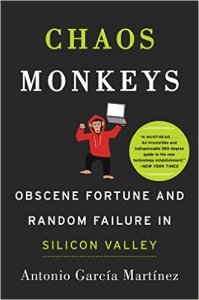
Briefly noted: Chaos Monkeys: Obscene Fortune and Random Failure in Silicon Valley – Antonio Garcia Martinez

Chaos Monkeys is supposed to be refreshingly honest but instead feels slimy; it feels like Martinez is ripping off other people’s good will and earnestness, which is deeply unattractive and raises the urge to altruistically punish. Martinez is aware of it enough to cite it but not enough to surmount it:

Cynicism is the last refuge of the shiftless. I don’t cite this absolutist tendency for the cheap sardonic joke, the asshole hipster who’s too cool for school to believe in anything. No, I cite it because I was as seduced as the next guy sitting there in Pong [the Facebook conference room], perhaps even more.

chaos_monkeysExcept that he is a cynic, he reaches for the sardonic joke, he is the asshole hipster, he grabs the clichés. He has much mud to sling, but he ought to also know the problem with mud as a weapon. What kind of person calls out everyone else for being a poseur and faker? It is odd to read about “a man [who] oozed an off-putting smarminess” in a book about a man who oozed an off-putting smarminess.

The sentence-by-sentence is okay and the content is often interesting. There are details of the ad world I didn’t know about and details about the startup world most people won’t know about. Then there are parts so conceptually and linguistically confused and muddled that I want to take back compliments like “okay” and “interesting:”

This was the major-league, serious shit, take-on-prisoners championship of thee tech entrepreneurship, and if you were going to play, you’d better show up ready to bite the ass off of a bear.

So the sentence moves from sports, to abstraction mixed with the scatological, to warfare, back to sports, to companies, to sports, and then to nonsense. It sort of works as long as you don’t pay too much attention. Chaos Monkeys rewards inattention. But you can’t get away from tone, which wafts through the book like a foul odor from a superficially attractive person. I don’t want to snark at others; I want to know, and Martinez makes snark seem like knowing, which may bedazzle or bamboozle the young or unwary but should put off the people who are building the future, not just manipulating social status symbols.

Like so many stories, the book is also about the madness of coastal real estate markets; in one year Martinez makes a million dollars, which in San Francisco feels justifiably middle-class due to outrageous land-use restrictions that drive up the price of housing and income taxes. I live in New York, which is afflicted with similarly maddening maladies that some subset of voters nonetheless likes.

Sections of the book are inadvertently revealing, which describe problems with the higher education system and the signaling madness that has overtaken it:

it would be my Facebook stock vesting yet to come that would pay for private high schools and Stanford, so Zoë and Noah wouldn’t have to sneak into this country’s elite through the back door from the cattle class, as I had to do.

Ignore even the extraneous “do” at the end of that sentence, as it should’ve been edited out. So much is wrong with that sentence and the mind behind it that my own mind boggles. Let me ignore most of it and I wonder if Zoë and Noah would prefer $300,000 in cash at age 22 rather than private high schools and Stanford. I know I would!

By far the worst part about Chaos Monkeys is that it’s an okay book within which there’s a great book—written perhaps by Tom Wolfe. Wolfe’s books reward attention. The more attention you give Chaos Monkeys, the more its weaknesses show.

Links: Marriage questions, nuclear fusion, boring kids, academia, subways, and more!

* “Is American Culture Asking Too Much of Marriage? The relationship therapist Esther Perel thinks so—and argues that it’s time to rethink matrimony and, with it, infidelity.” Points rarely made, and Perel’s book Mating in Captivity is one of the most interesting and unexpected I’ve ever read. It was published in 2007 and feels equally shocking today.

* “A fieldtrip to the International Thermonuclear Experimental Reactor (ITER), a work-in-progress that will test fusion’s feasibility.” Progress has been made since 2014’s article, “A Star in a Bottle: An audacious plan to create a new energy source could save the planet from catastrophe. But time is running out.” Both are excellent.

* Kids are more boring than they used to be: They’re drinking less, using fewer drugs, and having less sex. What’s the point of being young?

* Synthetic spider silk could be the biggest technological advance in clothing since nylon.” Cool if true.

* “Building My $1,200 Hackintosh,” which is pretty attractive compared to Apple’s anemic lineup of desktop Macs.

* “Let’s make peer review scientific,” something that ought to have happened ages ago.

* “Italian banking is the next shoe to drop,” a story that has gotten weirdly little play.

* “What’s the point of the PhD thesis? Doctoral courses are slowly being modernized. Now the thesis and viva need to catch up.”

* Speaking of the PhD thesis, “Universities May Be Contributing to High Attrition Rates Among Graduate Students.” See also my posts “Why do so many people continue to pursue doctorates?” and “What you should know BEFORE you start grad school.”

* New York City’s subway agency loses six billion dollars a year—and nobody cares.

Why do so many people continue to pursue doctorates?

In “The Ever-Tightening Job Market for Ph.D.s: Why do so many people continue to pursue doctorates?”, Laura McKenna reviews the data on how terrible grad programs and the academic job market are, then goes on to ask: “Why hasn’t all this information helped winnow down the ranks of aspiring professors—why hasn’t it proved to be an effective Ph.D. prophylactic?” Having observed and participated in the mass delusion, I have some possible answers:

1. It’s a way to (pointlessly) delay adulthood.

2. Fear of the job market.

3. Don’t know what else to do.

4. Magical thinking (despite the numerous articles out there, like mine) that attempt to dissuade it). I think this is the biggest issue. In addition, there seems to be a Lake Woebegone effect: Everyone thinks they’re going to be above average.

5. Contrary to what grad students often say, in many disciplines and programs grad school is pretty easy and fun! You get to hang out on campus, think about ideas, take a minimal number of classes, do a bit of teaching, and have copious free time. Also, let me be euphemistic and say that many straight guys spend a lot of time with female undergrads. The problem is that, as time advances and your priorities start changing (want a real life / job, date people who don’t date people whose lives aren’t together, etc.), reality starts to intrude. Many grad students have an unacknowledged Peter Pan complex.

6. For most, academic success has been rewarded every step of the way (thanks to Hacker News reader mathattack for this point). The individuals who’ve gotten the most mileage listening to their teachers are also the ones who most need to stop listening to them. Professors are very keen on producing more professors and reproducing themselves, even though doing so is often not in the best interests of a particular individual.

7. People mistakenly focus on the outliers who accomplish major, important breakthroughs and think that they’ll be like the outliers, not the medians. This is another variant of the Lake Woebegone effect.

Note that a few fields (econ, computer science) appear to have relatively robust job outcomes for PhDs, so some of the above likely doesn’t apply to them.

The Truth: An Uncomfortable Book About Relationships — Neil Strauss

The Truth is poorly named but it’s also amazing and you should read it, preferably in the biblical, imitation-leather edition. Unfortunately, The Truth buries the lede: the weakest, most tedious section by far is the beginning, when Strauss goes to therapy for “sex addiction” (which may not exist, at least for reasonable definitions of “exist”).* Don’t give up. Get past the first third and pay special attention to the rest, where Strauss’s sharp, comedic / absurdist observations strike.

the_truthIn the first section, we learn that there is such a thing as “a CSAT,” that is, “a Certified Sex Addiction Therapist.” The therapists seem at least as mad as the patients, which seems to be a recurring theme in life (you know what they say about psych majors…). The treatment does not work, at least at first. Strauss, seeking answers, gets what appears to be an fMRI, hoping that his brain makes hedonic and novelty-seeking, only to be told that he chooses relationships or the chase. Score one for free will or something like it.

The middle section is about the chase. The chase is about women, yes, but it’s also about finding a way to be. Strauss meets people whose new-age and pseudo-religious or -mystical bullshit is vile. At one moment, meeting a woman who presents herself as a guru, “Common sense tells me to leave; curiosity drives me forward.” That’s the writer coming out. I wish I could say that I always follow common sense. I don’t, for the same reason. Strauss’s Guru attempts “mix spirituality with business” and then says, “Let me know if you have any ET experiences in Peru.”

He doesn’t. He runs.

Unfortunately he runs to a polyamory retreat that’s also infused with spirituality nonsense that should’ve died with the ’70s. That doesn’t work out either:

I look up and see a yoga stud from Kamala’s pod.

“Have you rounded up any more girls?” the orbiter asks him.

Kamala Devi and Shama Helena said polyamory was about loving relationships, not casual sex. But these guys seem more like next-level pickup artists, coming to these conferences with the intention of sucking any available women into their powerful reality.

Understanding things as they are, as opposed to how they “seem,” is rarely easy for anyone, anywhere—which may be one reason we have literature. The supposedly selfless caring for others that Strauss hears about is more like socialism, with its attendant problems: Equality for you and special privileges for me.

Later, things do not improve for Strauss: “This is truly the blackest day of my life: I’ve been kicked out of an orgy for eating popcorn.” He’s eating popcorn because he can’t fake bogosity at the level necessary for that world.

So he tries another (there are more worlds out there than most of us know). His next stop involves something like conventional swingers, if that phrase isn’t an oxymoron, at a club or party called Bliss. Towards the height of his first experience, he writes that “I would’ve paid every penny in the bank for this experience ten years ago—If I’d known it was even possible.” Many things are possible, but the mind holds us back; the same theme in a different context plays out repeatedly in Elon Musk: Tesla, SpaceX, and the Quest for a Fantastic Future. For Strauss, that moment is “the closest thing to heaven I’ve ever experienced.”

Then he passes out. He’s taken too much GHB.

So, in short, Strauss attends an orgy that should be everything he’s ever wanted, but he takes drugs he shouldn’t and doesn’t have the sex he should, or that he thinks he wants. While there, he meets a woman who seems mostly like a groupie but who also demands monogamy and yet goes to an orgy, chiefly because her “friend” is there (that people are not internally consistent or even interested in internal consistency could be a shadow theme of The Truth—or maybe it’s just been written by an “ambivalent,” as Strauss is, or is termed).

He goes to another and decides he is “determined not to wreck this orgy like all the others.” I won’t speak to what happens, but one does get the sense that Strauss is well attuned to self-criticism and understanding how others will see him.

Wanting to be a swinger or polyamorous person can make internal, logical, and consistent sense; one cannot say the same for what comes next, when Strauss, on his own, sticks three straight women in the same domicile and attempts to date all of them, simultaneously, while living with them. The preceding sentence’s length and complexity is deliberately designed to evoke the complexity of Strauss’s arrangement.

In sports there is a term called “unforced errors,” which occur when a player does something transparently wrong that is not caused by the opponent or some other outside force. What Strauss attempts is an unforced error and one that ought to be easily foreseen. But one might attribute this to that previous mentioned issue between common sense and curiosity. The three women more or less come to Strauss, in his telling. Mastering “the game” has evidently done things for him.

In The Truth Strauss ultimately assigns the genesis of his adult relationship habits to his upbringing. In his case maybe that’s true, but I’m reluctant to assume a casual relationship between upbringing and adult life: how many people who had childhoods similar to his grew up to be functional adults? Since at least the time of Freud it’s been popular to ascribe adult personality traits to childhood, but I’m not convinced those are robustly supported and that they’re more than just-so stories we tell ourselves to make sense of a deeply chaotic, multi-faceted world.

Psychiatry and psychology in particular are deeply troubled fields because we don’t have good models for the brain. In those domains it may be obvious when someone is too dysfunctional to live independently, but the supposed treatments and models are derived from poor or nonexistent premises. Imagine trying to start a car and discovering that one third of the time it starts, one third it doesn’t nothing, and another third of the time the engine dies. That’s close to the current state of real knowledge about psychiatry and psychology.

We tell ourselves stories, which is great—in some ways I am a professional storyteller—but we use science to figure out what’s reliably and consistently true, and the childhood traumas leading to adult reenactments does not appear to be reliably and consistently true. Perhaps the stories Strauss tells himself now allow him to live in a particular and better way, and in that sense they’re functional. But they may not be causal.

On page 10 of The Truth Strauss writes of his then-girlfriend and now-wife, “She is reliving her mother’s relationship with her cheating father. I am reliving my father’s secret sex life. We are repeating a pattern handed down by generations of lying, cheating assholes and the poor fools who trust them.” They specifically seem to be repeating generational trauma. The idea that we repeat our childhood experiences has been commonplace since Freud, but is it true? Do we really have any evidence of it, or, again, are we just telling ourselves stories? Pop culture loves Freudian ideas. I’m not so sure that the psychosexual narrative Strauss constructs is more real than one that accepts the null hypothesis.

By the end Strauss is married. I wonder how Strauss’s marriage will hold up over time. I wouldn’t bet on “well” without favorable odds. Many beliefs that feel firm at a given moment turn out to be provisional in the fullness of time. It’s striking that Strauss never, so far as I know, mentions his age or the age of his lover, Ingrid.

For all of his problems, I can’t imagine most guys doing what Strauss has done or accomplishing what Strauss has accomplished. For all the psychic trauma in his childhood, the outcome is impressive.

The Truth is the sort of book I can’t imagine being made, in any sort of honest way, into a movie. Oddly, perhaps, I can imagine The Game being made into a reasonably honest movie and am somewhat surprised that it hasn’t been.

The final truth about relationships is that there is no final, universal truth about relationships. We make things up as we go along and universal experiences aren’t universal. It’s not a real sexy truth. It also doesn’t require a book to say. Instead, we tell all our stories about relationships in the book of life and the stories we draw from it.**

Let us return to the beginning of The Truth again. Strauss starts by saying he is “the king of ambivalence.” He wants what he can’t have or doesn’t have at that moment. This is not good and is perhaps generalizable:

Most married people I know don’t seem to be any happier. One day Orlando Bloom, an actor I’d written a Rolling Stone article about, came over to visit. At the time he was married to one of the world’s most successful and beautiful women, Victoria’s Secret supermodel Miranda Kerr [. . .] And one of the first things out of his mouth? “I don’t know if marriage is worth it. I don’t know why anyone does it. I mean, I want romance and I want to be with someone, but I just don’t think it works.”

My other married friends haven’t fared much better.

Yet he does it anyway. To his credit, Esther Perel’s Mating in Captivity does eventually get name-checked, since Perel has done unusual work in questioning our usual arrangements. Still. On the first page Strauss considers a woman and writes a sentence that could be an alternate title: “Not my type, but I would.” The book processes his motion from “but I would” to “but I won’t,” even if she is his type (and it seems that most women are).


* Psychiatry and psychology in general aren’t in good epistemological shape. There is no good functional, reproducible model of the brain. Both fields may essentially be wielding beads and rattles rather than science and be closer to shamanism than medicine.

** This is a post I’ve meant to write for a long time, but it hasn’t been an easy write.
Links: Surprisingly SFW links, family mysteries, notebooks, new cities, violence, Tolkien, and more!

* “Casual Sex: Everyone Is Doing It?” This is in the New Yorker, so it’s not the usual, and the website itself is interesting (likely SFW, as it’s text only, but clicker beware).

* “In Berlin, Unraveling a Family Mystery,” an incredible, beautiful, and moving story: “And so in the year 2015, names and faces were put to two more victims of the Holocaust — my mother’s brother, Szilard Diamant, and his wife, Hella.” Particularly given the current rhetoric around immigration, the story of Szilard Diamant’s struggles matter.

* “Professors investigated by a ‘Bias Response Team’ for presenting opposing viewpoints.” This is not The Onion.

* “Why the Humble Notebook Is Flourishing in the iPhone Era.” This should sound familiar to you.

* Y Combinator is looking into building new cities.

* “Enforcing the law is inherently violent,” a point that ought to be more salient.

* “How J.R.R. Tolkien Found Mordor on the Western Front.” Maybe.

* “What you read matters more than you might think;” this is part of the reason I oppose showing movies in class, at least in most circumstances.

Life: Henry Green edition

“To me the purpose of art is to produce something alive, in my case, in print, but with a separate, and of course one hopes, with an everlasting life of its own.”

—Henry Green, from his Paris Review interview; this collection is a good introduction to him, though Party Going eludes me.

Links: Email, money and writing, fighting back against the carceral state, stupidity and nationality, and more!

* “Review: Airmail, an OS X e-mail client that Chris lee doesn’t hate: It integrates everything beautifully and lets you focus your attention.”

* Do only 1,340 authors earn $100,000/year or more? I don’t see a definition of “author.”

* “Tech Companies Fight Back After Years of Being Deluged With Secret FBI Requests,” the fighting back is good if true. Also, if the Attorney General and FBI can’t even understand the law, what hope do normal people have? Three Felonies A Day: How the Feds Target the Innocent remains underrated.

* “The Sotomayor and Kagan Dissents in Utah v. Strieff:” Yet another Supreme Court case weakens the Fourth Amendment. Again, Three Felonies A Day is essential reading.

* BMW Is Turning Its Electric Vehicle Batteries Into a New Business.

* “British Lose Right to Claim That Americans Are Dumber.” Still, on the other hand, “Americans Regain Their Appetite for Gas Guzzlers,” demonstrating that Americans are also stupid and short-sighted.

* “My four months as a private prison guard,” which should make you even more skeptical of the prison-industrial complex than you already should be.

Briefly noted: The Course of Love — Alain de Botton

You don’t need to read The Course of Love: instead read Mating in Captivity or Neil Strauss’s book The Truth or even Gillian Flynn’s Gone Girl, which, despite its murder premise, is truer to modern relationships than The Course of Love. You may be tempted by The Course of Love because of de Botton’s charming, hilarious, earlier novels On Love and Kiss & Tell. You’ll recognize callbacks to On Love; the new novel mentions a Chloe who the narrator broke up with, and the love interest in On Love is conveniently named Chloe.

Still, those novels work because they’re funny and this one you will forget because it’s not. There is a lot of tedium in sentences like “At the center of Kisten’s love is a desire to heal the wound of Rabih’s long-buried, largely unmentioned loss.” The characters never stop saying things like, “Everything around here is deeply sensible, rational, worked out, policed—as if there were a timetable all laid out from now till the moment we die.”

Perhaps the point is that we never emerge from our adolescent philosophical stupor, when people complain about sensible, rational, worked out lives—the sorts of things that many modern Syrians would probably like.

The good news is that the last pages work. The bad news is that neurotic humor is missing, and so is a real understanding of male-female dynamics. There are some good inversions of conventional thinking, as when Kirsten seems to think, “she knows, better than most, that there is no one more likely to destroy us than the person we marry.” But most of it is closer to the banal sentences quoted previously. One hopes for Flaubert and gets this. Wasn’t it Flaubert who said that every writer should write with a hard-on? Or is that a spurious quotation? Regardless of its genesis, one senses few if any hard-ons inspired this novel, to the novel’s detriment given its subject matter.

Maybe it is not coincidence that in the first sentence of this post two of the better-than suggestions are nonfiction. If you’re militantly opposed to nonfiction, maybe The Course of Love is okay. For anyone not so militantly opposed, you can get similar subject matter that’s actually better written on a sentence by sentence level. Too much of the book feels like an amalgamation of nonfiction trend pieces and books rather than a novel. Here is one sample, chosen at random: “I Can’t Stop Bashing My Husband to Other Moms, and I’m Sorry.” Kirsten has problems bashing her husband to her friends and her husband’s response is basically to shrug. Perhaps the lesson is “Don’t get married” (or expect to grind it out if you do). That may be a valid reading of the novel. Rabih’s improbable affair may be the high point.

Unlike in, say, Michel Houellebecq, the sense of fiction never overwhelms the sense of outside reading in The Course of Love. Much of it feels ripped from time-wasting websites or New York Times trend pieces. I’ve followed de Botton for years and his books vary in quality from the sublime to the wasteful. His nonfiction, except for How to Think More About Sex, is fun and informative. One wishes for more of the good here.

There is too much good stuff for The Course of Love to matter.

I’ve been writing for money

A couple readers have asked where I’ve been lately. The short answer is, “Writing for money.” So much writing-for-money that it crowds out other writing. I’m still reading—to me, reading and writing are always intimately connected—but all the excess words and attention have been going into proposals, and occasionally other projects, rather than to posts here. Hence the links posts: I’m still reading, something, and passing on the best stuff.

A friend and I have also been discussing the state of reading books in an age of distraction, and I’ve definitely noticed that a Kindle, Instapaper, and the many long-form sites out there are a killer confluence of technologies. At the margin I read much more long-form nonfiction than I used and fewer books than I used to. To be sure, I still read books and write them, but a book needs to be of higher quality than it once did if it’s to compete with the good, low-cost alternatives.

There are still many books that surpass this threshold. Insides Jokes and Seveneves come to mind.  There are numerous others. The best books still reward re-reading in a way few articles do. The best books bring a sensibility and depth to a topic in a way few articles do. The trick is finding those books, which seems as hard as it’s ever been.