Links: Software, divorce from the practitioner’s perspective, problem cops, Vienna, and more!

* “Writing software is hard,” an important point often not understood by those outside the industry.

* Divorce lawyers explain that divorces are much more similar than different, and yes, they all know that “your ex is an asshole,” just like everyone else’s ex.

* Why some problem cops don’t lose their badges.

* How Vienna produced ideas that shaped the West.

* The Twin Prime Hero: Rags, riches, and fame in mathematics.

* Robin Hanson’s idea trade engagement. I feel bad that I can’t think of good ideas he should blog!

* How Watership Down was written.

* “When city retirement pays better than the job: One in four El Monte residents lives in poverty. Yet taxpayers pay a steep price to fund bonus pensions and other perks for city workers.” I try not to post outrage reads, yet sometimes I can’t resist.

* The red Solo cup is a marvel of modern engineering.

* Women Who Count: 3 Smart STEM Romances.

* On The Fever by Megan Abbott.

The Trespasser — Tana French

I don’t remember where I first learned about French, but “Women Are Writing the Best Crime Novels” inspired me to read The Trespasser. The novel is not bad and if you like the genre you might dig it—it’s not offensively written—but halfway through one feels like nothing much has happened, the dead girl, Aislinn, remains a cipher, and maybe a bunch of stuff will add up to something but maybe it won’t. Comparisons to Gone Girl are not quite apt because in that novel something changes virtually every chapter, and around halfway through the big reveal occurs.

trespasserIn The Trespasser things meander to no particular end. From a marketing perspective the endless comparisons to Gone Girl makes sense, but from a narrative perspective they rarely do. Gone Girl does seem to break the narrative pattern in a way that’s difficult to repeat, and that may help explain why it is so read and still so good.

Still, reading a competently executed book is refreshing, and there are crisp descriptions like, “Breslin likes thinking he’s Mr. Indispensable; he’ll show up just as fast for a shitty domestic as he would for a skin-stripping serial killer, because he knows the poor victim is bollixed until he gets there to save the day.” Arguably the part of the sentence before the semicolon could be omitted, with the reader left to infer it, but one gets a sense of someone whose virtue is motivated by self-love more than caring for mankind. We also get a lot of standard detective-fiction patter, like “I didn’t use to be like this. I’ve always had a temper on me, but I’ve always kept it under control, no matter how hard I had to bite down.” Why are tempers always under control and not over control? What does control of a temper mean, versus a temper having control? The kinds of standardized language one finds in the novel never gets to those questions. It’s actually hard to find really characteristic quotes because The Trespasser doesn’t stray far enough from its genre:

The point is, this isn’t the telly, where cops are all blood brothers and anyone who gets on the wrong side of a cop ends up dead in a ditch while the rest of us lose the evidence. I don’t have any squad loyalty.

The writing is often good but not quite good enough to justify the plot. I still await “the next Gone Girl.”

A surprisingly large amount of the novel describes the bureaucracy of police departments (which is a surprisingly large amount of many contemporary detective novels and maybe novels set more generally in offices). Bureaucracy may be the characteristic fact of life. See also “Bartlebys All.”

The Second Avenue Subway, opening day

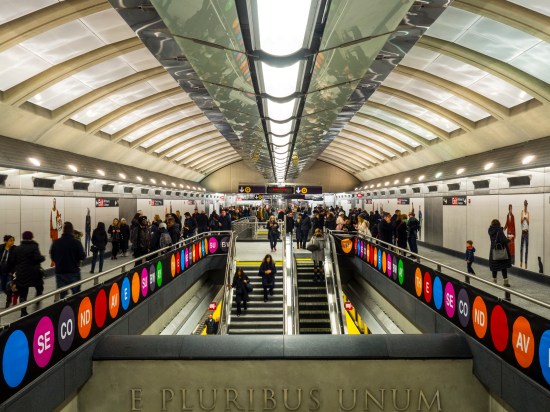
We have entirely too few epic engineering projects; to finally get to ride one is fun! Today the Second Avenue Subway, a century in the making, opened:

second avenue subway

The subway stops don’t feel like typical subway stops because they lack the grime that usually marks them in the same way cold marks the winter solstice.

second avenue subway 2

The active part of this round of subway construction began in 2007; while the subway should’ve opened years ago, it is nice to see it open at all. One gets a sense of the sublime from epic engineering works, and, as Zero to One argues, we’ve collectively lost faith in our ability to build big things and tackle serious problems. The new subway is evidence to the contrary.

Still, one hopes the next phase of the line goes better. Matt Yglesias explains some of this phase’s problems in “NYC’s brand new subway is the most expensive in the world — that’s a problem: The tragedy of the Second Avenue Subway.” On a per-mile basis the Second Avenue Subway is the by far the most expensive subway in the world, and it’s by far more expensive than similar projects in crowded first-world cities like London, Paris, and Tokyo. We’re not getting much bang-for-the-buck and that needs to change.

New York has so far been “Slow to Embrace Approach That Streamlines Building Projects.” Management and labor have been eagerly lining each other’s pockets. That’s particularly unfortunate because the infrastructure is desperately needed and has been desperately needed for decades if not longer.

Second Avenue Subway 3

To be sure, the stations are much more functional than most others, and their mezzanine levels impress. One wishes, however, for fewer mezzanines and more total stations.

Second Avenue Subway selfie art

As you can see above, someone thought through the selfie-friendly art that lines the stations.

Today is still a historic occasion and one does not so often get the chance to participate directly and obviously in history. It may be churlish to note this, but my train spent five to ten minutes waiting due to “train traffic ahead of us” between 63rd Street and 72nd Street. Some things may be new but others are too familiar.

Links: Food, odd campus culture, ebikes, quality literary feuds, and more!

* “Quinoa is the new Big Mac: Can Eatsa succeed in delicious and inexpensive plant-based fast food?”

* The inventor of the red Solo cup has died. Real tragedy.

* “Student Accused of Rape By ‘Mattress Girl’ Sues Columbia U., Publishes Dozens of Damning Texts.” See a related discussion in this post.

* “The personal is political” (note: the personal is not necessarily political and if someone tells you it is, tell them to get stuffed).

* Low Definition in Higher Education: When college students are told what to think and what not to say, who suffers in the end?

* Ebikes: I Sing the Ride Electric.

* “When did Literary Feuds Become So Boring? Duels between writers were once epic. Now they’re just petty.”

* “The long political history of sneakers;” the article sounds dumb but is actually good.

* Trump’s Narcissistic Personality Disorder (NPD).

* “Why People Vote for Counterproductive Policies.” And: “‘What the Russians Did Was Utterly Unprecedented.’” Voter irrationality has always been an interesting topic but it’s become more interesting and salient since 2010, with a special rise this year.

* Open societies are facing major crises. I don’t think Soros’s answer is the right one or that most people even know who or what they might mean by “elites,” but the problems are clear and not going away.

Links: The widowhood effect, Mac desktops, nuclear power, campus identity politics, and more!

* “The widowhood effect: What it’s like to lose a spouse in your 30s.” Brutal, moving, and you may cry. Consider yourself warned.

* Tim Cook alleges that great desktop Macs are in the works. I’ll believe it when I see them.

* To Slow Global Warming, We Need Nuclear Power.

* “How Silicon Valley Nails Silicon Valley,” unexpectedly hilarious.

* Campus Identity Politics Is Dooming Liberal Causes, according to Mark Lilla, who you may remember from The Shipwrecked Mind.

* “How Amazon’s problems with cheap knockoffs got real.” I’ve become much more sensitized to this issue and less likely to buy non-books from Amazon for precisely this reason.

* “World War III, by mistake.” See also “Trump fears and the nuclear apocalypse.”

* “If anyone is alive in 100 years to write a history of the 2016 U.S. election they will not believe how dumb it was.”

* “Automakers Prepare for an America That’s Over the Whole Car Thing.” The bizarre thing to me is that Americans ever loved cars in the first place. See also “Cars and generational shift” and “Owning vs sharing: Don’t get caught in the ugly middle.”

Thoughts on the movie “Arrival”

* Trust the good reviews, as they’re correct about Arrival.

arrival* I like the movie’s implicit criticism of morons, which is too rare. Too often in movies the institution is the bad guy and the uncredentialed are, automatically and by virtue of being outsiders, the good guys. Contagion (the movie) also has this quality. It’s also rare to see academics depicted as admirable (or useful).

* It’s a stranger and somber movie, maybe not keeping with the times. It’s also weirdly applicable to current politics.

* Think of it too as a modern The Day the Earth Stood Still, especially because few of us will want to watch the original as a movie. As a cultural artifact and statement of its times it is still interesting.

* See also my 2013 comments on Gravity.

Circumstances under which going to law school can make sense

The reasons you should avoid law school are well known and I won’t repeat them here, but the other day I was explaining to a former student why she shouldn’t go to law school and she asked a perceptive question: Who should go? Under what conditions should a person go?

The answer is “almost no one” and “almost never,” but law school can be okay in a handful of circumstances:

* People who have already worked in law firms, probably as a paralegal but maybe under other circumstances, and who thus understand what the day-to-day life of a lawyer is like. That firm should have a job waiting and ready to go for the person before the person starts law school.

* People who have family (or close family friends) in law firms who can set the law school applicant up with a job straight out of school. If your uncle has a firm and wants you to take over that firm, law school can make sense.

* People with a very specific sense of what they want a law degree for and what they want to do with it—for example, people who desperately want to fight for voting rights, or immigrant rights, or something along those lines, and are convinced that those fights will be their life’s work, regardless of other challenges.

That’s really it; if I’m missing something, leave a comment or send an email. Law school mostly works for people who don’t need law school and only need the credentials that law school entails. There is a reason why most lawyers learned the craft on the job as apprentices, and law school only became a requirement in the post-World War II-era as a way of raising the salaries and status of then-existing lawyers.

Even going to highly ranked schools doesn’t make sense because, while you may get a big-firm job straight out of school, you’ll still be shackled to the work by student loan debt slavery, and you’ll still have to be a lawyer at the end (which most people don’t really want to do), and you’ll still probably not make partner (which means that you’re mostly working to line someone else’s pocket).

Don’t go to law school.

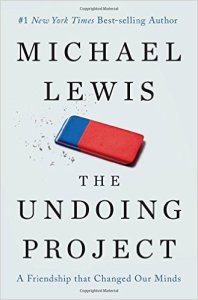
The Undoing Project: A Friendship That Changed Our Minds — Michael Lewis

The Undoing Project is entertainingly written, appears well-researched, and is also tremendously important—three things that, while not intrinsically opposed, occur together too infrequently. It’s so funny that I burst out laughing during class, while students were engaged in peer review, and every pair of eyes turned to me. I wanted to stop myself but couldn’t. It’s the best book I’ve read in recent memory and you should stop whatever else you’re doing to read it.
undoing_projectThe “tremendously important” part is important for many reasons, one being that most people don’t seem to even know the (many) biases humans are prone to, let alone that knowing the biases often isn’t enough to change the behavior. We can understand the problems and still not turn understanding into action.*

Still, there are steps we can consciously take to attempt to minimize or combat our biases. For example, “People had trouble seeing when their minds were misleading them; on the other hand, they could sometimes see when other people’s minds were misleading them.” That means we have to minimize hierarchy in many situations; empower people to speak up when they perceive problems; and listen to those who have differences of opinion, even if we want to immediately assume they’re wrong.

There are too many good sections in the book to cite them all. One example:

People did not choose between things. They chose between descriptions of things. Economists, and anyone else who wanted to believe that human beings were rational, could rationalize, or try to rationalize, loss aversion. But how did you rationalize this? Economists assumed that you could simply measure what people wanted from what they chose. But what if what you want changes with the context in which the options are offered to you?”

Conveying the humor in The Undoing Project is hard, maybe impossible, because so much of it is embedded in larger stories.

“Amos approached intellectual life strategically, as if it were an oil field to be drilled, and after two years of sitting through philosophy classes he announced that philosophy was a dry well. ‘I remember his words,’ recalled Amnon. ‘He said, “There is nothing we can do in philosophy. Plato solved too many of the problems. We can’t have any impact in this area. There are too many smart guys and too few problems left, and the problems have no solutions.”’”

I wonder if English lit suffers from the same (or a similar) problem. There’s been little progress since the advent of close reading, and the development of “critical theory” or “theory” is often if anything a step back. If there is anything interesting going on right now it seems to be in some aspect of applying computers to literature, but that is likely more a CS problem than an English lit problem.

We do get an ethnology of academia, too. Like:

Economists were brash and self-assured. Psychologists were nuanced and doubtful. ‘Psychologists as a rule will only interrupt a presentation for clarification,’ says psychologist Dan Gilbert. ‘Economists will interrupt to show how smart they are.’ ‘In economics it is completely normal to be rude,’ says economist George Loewenstein. ‘We tried to create a psychology and economics seminar at Yale. We had our first meeting. The psychologists came out completely bruised. We never had a second meeting.’ In the early 1990s, Amos’s former student Steven Sloman invited an equal number of economists and psychologists to a conference in France. ‘And I swear to God I spent three-quarters of my time telling the economists to shut up,’ said Sloman. ‘The problem,’ says Harvard social psychologist Amy Cuddy, ‘is that psychologists think economists are immoral and economists think psychologists are stupid.’

There seems to be no solution.

There also seems to be no solution for the systematic errors in human cognition. As I noted above, awareness is not enough. Even imagining possible futures is not enough, because one may come to predominate and stifle the others before they can be explored:

What people did in many complicated real-life problems—when trying to decide if Egypt might invade Israel, say, or their husband might leave them for another woman—was to construct scenarios. The stories we make up, rooted in our memories, effectively replace probability judgements. ‘The production of a compelling scenario is likely to constrain future thinking,’ wrote Danny to Amos. ‘There is much evidence showing that, once an uncertain situation has been perceived or interpreted in a particular fashion, it is quite difficult to view it in any other way.

The parallels to present world politics are too clear. We have forgotten the lessons of totalitarianism in just a generation and a half. We are too fond of constructing Kahneman’s rosy scenarios, which replace probability judgments. The probability of nuclear conflagration has grown in recent times. Yet we discount it. Recent elections in the U.S., U.K., Poland, and Hungary are systematic cognitive errors writ large.

The number of cognitive errors we’re subject to staggers. It’s “not just that people don’t know what they don’t know, but that they don’t bother to factor their ignorance into their judgments” (192). This book should above all make us doubt ourselves more, and especially doubt ourselves even when we think ourselves sophisticated. Over and over, we see people who receive training in statistics make basic statistical errors. We see people violate the law of small numbers.

I cannot recall all the times I’ve explained sample bias problems to people—rarely clients but more often students or friends—only to sense that no one is getting what I’m saying, or, if they do get it, they don’t care. The more one understands recurring cognitive weaknesses the more one sees them, the more I worry about succumbing to them myself. I myself succumbed to them in the last election, by substituting the opinions of people who are readily observable around me for the opinions of the much larger political body. And I myself wonder how often people have explained cognitive biases to me, or pointed out cognitive biases in action, only for me to ignore them.

The secret to the successful friendship between Kahneman and Tversky seems to have been pleasure: “‘We just found each other more interesting than anyone else,’ said Danny. ‘Even if we had just spent the entire day working together.’ They’d become a single mind, creating ideas about why people did what they did, and cooking up odd experiments to tests them.” The joint mind: It seems beautiful. I wonder how many of us accomplish such a feat. Lewis does cite a writer who began a book about productive pairs but never finished it. Another writer, Joshua Wolf Shenk, wrote and published Powers of Two: Finding the Essence of Innovation in Creative Pairs.

Lewis quotes his beautifully articulate subjects: “It is sometimes easier to make the world a better place than to prove you have made the world a better place.”

This is a kind of boring NYT review. This is a better New Yorker review, from Cass Sunstein and Richard Thaler, who are both cited repeatedly in the book itself. For example:

[Cass] Sunstein was particularly interested in what was now being called ‘choice architecture.’ The decisions people made were driven by the way they were presented. People didn’t simply know what they wanted: they took cues from their environment. They constructed their preferences. And they followed paths of least resistance, even when they paid a heavy price for it.

How are you paying?


* Maybe the robots do deserve to win.

Links: The politics of resistance, cars, Peter Watts on Westworld, reading, traffic patterns, and more

* “We’re about to see states’ rights used defensively against Trump,” a frequently misunderstood point.

* “Investors Get Ready for the Coming Electric Car Revolution.”

green_machine-0460* “Russia and the Threat to Liberal Democracy: How Vladimir Putin is making the world safe for autocracy.” File under, “Headlines I never thought I’d see.”

* Peter Watts on Westworld. Here is me on Watts’ Blindsight.

* GM begins delivering the first Chevy Bolts. Good news and an important milestone.

* The Iago problem.

* Doug Lemov on reading, a podcast.

* “Why Obamacare enrollees voted for Trump,” a weird and fascinating piece of journalism as well as further confirmation of The Myth of the Rational Voter.

* “Why So Few Resisted Hitler,” which has striking applications today.

* Fear is a totally rational reaction to the Donald Trump presidency.

* “Los Angeles Drivers on the 405 Ask: Was $1.6 Billion Worth It?” The answer is “probably not,” and we can never build enough freeways because of induced demand. The only real way to improve transport is via subways.

* “Will the man running a sex party like a startup be able to leave anyone satisfied?” I would love a two-year moratorium on the word “disrupt” and ideally for the word “startup” to mean what it actually means.

Life: Myth and biology edition

“But if art… is a harmony parallel to nature, as I’ve said, then the exploration of nature should be no less exciting and no less spiritually rewarding than the function of art. I mean, it’s the same field. When one’s bliss is actually science… it has to be. I remember that when I was in prep school, biology was the thing that grabbed me, and now I think of mythology as a function of biology, a statement of the impulse system and the organs. Not something that’s made up in the head. What’s made up in the head is the fiction; what comes out of [the heart]  is a myth.”

—Joseph Campbell, The Hero’s Journey