“Whatever the subject, a real critic is a cultural critic, always: if your judgment doesn’t bring in more of the world than it shuts out, you shouldn’t start.”
—Clive James, “Hollywood: A Love Story“
“Whatever the subject, a real critic is a cultural critic, always: if your judgment doesn’t bring in more of the world than it shuts out, you shouldn’t start.”
—Clive James, “Hollywood: A Love Story“
Most of my writing happens on a computer, which means it’s pretty hard to depict the final product in a visually satisfying way.* But I also carry around a pretentious Moleskine™ notebook for the random ideas that strike in grocery stories or at parties. The latest notebook, however, developed a split binding:
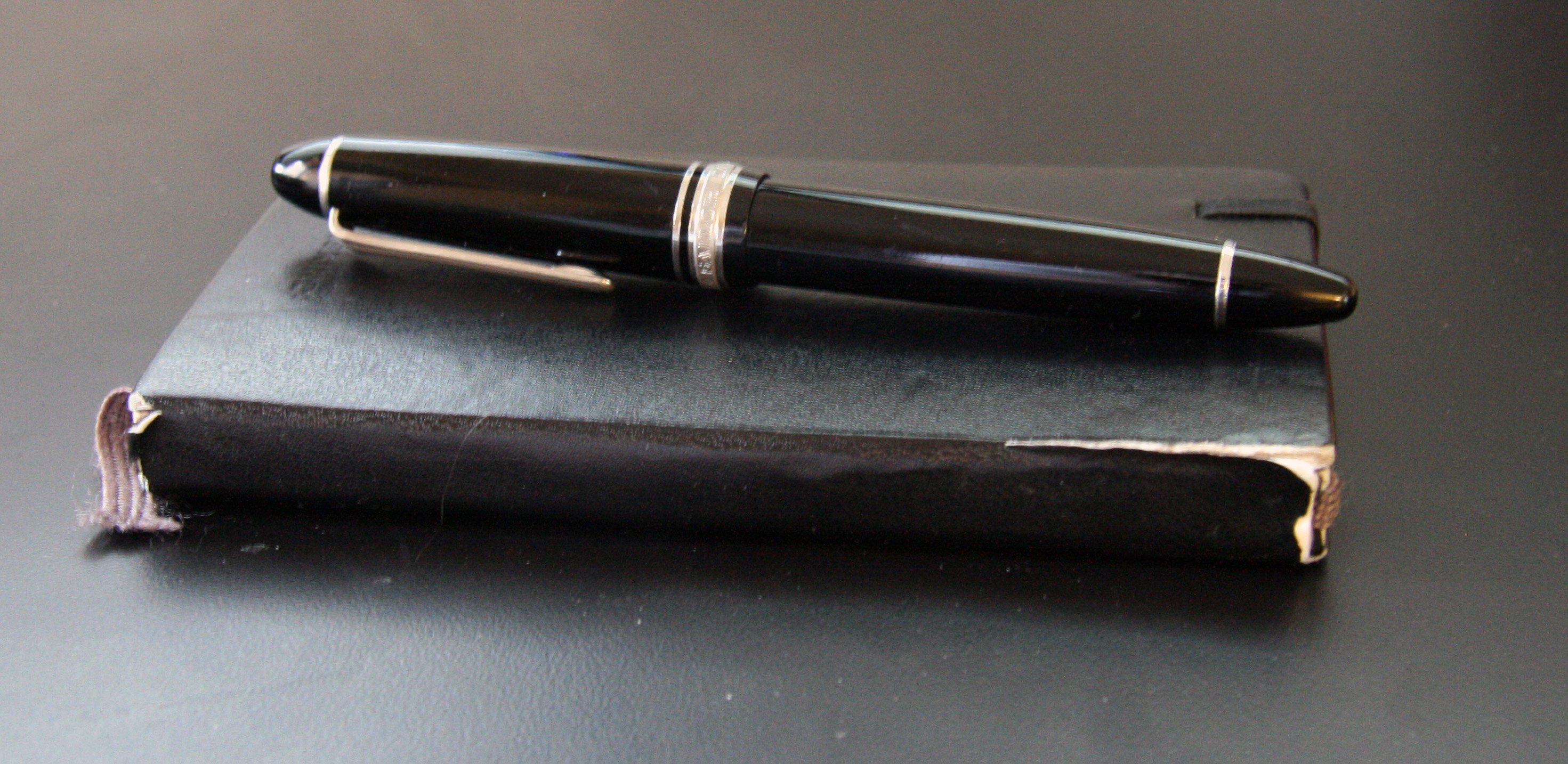
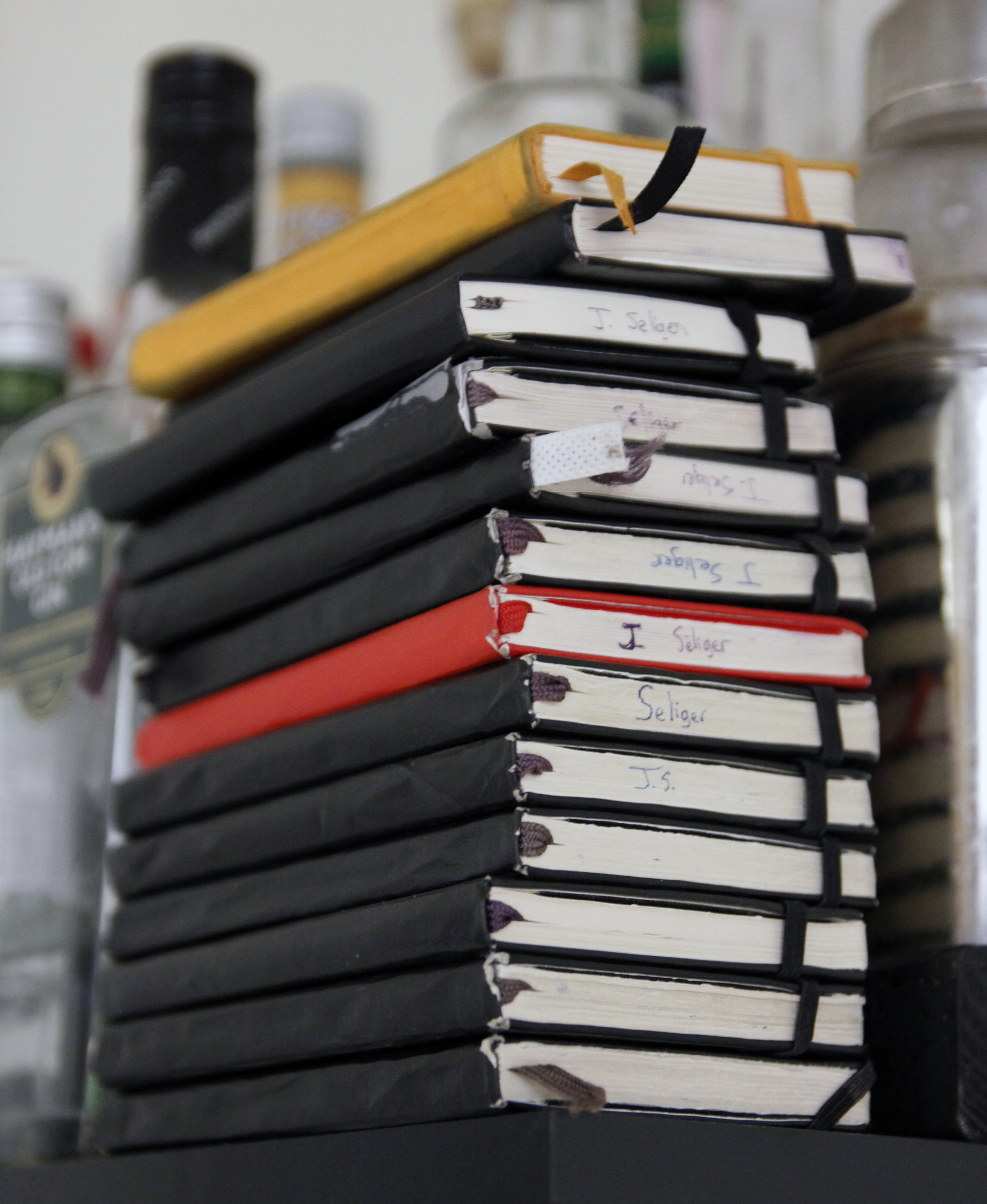
I’ve been using Moleskines for about eight years, which means I go through about two of them per publishable novel:

Notice how none of the others have the binding split that afflicted the latest one. I haven’t consciously treated this one differently from its predecessors or used it any longer. Maybe the quality control at Moleskine central has declined, although people have made claims in that direction for a very long time.
Regardless of the reason, the latest notebook has about twelve usable pages left; I tend to write nonfiction, blog post ideas, things I need to remember, reminders about e-mails, entries from an unkept diary, and stuff like that in the back. Ideas, quotes, things people say, and other material related to fiction goes in front. When back and front meet in the middle, it’s time to get a new one.
When I start working on a new novel, I usually go back through all the old notebooks at the beginning to see what material might be usable and when I started taking ideas for that specific project. Some ideas for novels have been burbling in the back of my mind for a very long time, waiting for me to have the time and skill to move them from a couple of scrawled lines to 80,000 words of story. The oldest Moleskines I have were bought in the 2002 neighborhood. They’ve held up pretty well; the ones I started buying in the 2005 neighborhood are showing their age. Tough to say if this is an indication of falling quality control or something else altogether.
While Googling around for the complaint about Moleskine quality I linked to above, I also found a site that recommends The Guildhall Notebook. I’ve already ordered one, although apparently Guildhall doesn’t have a U.S. distributor, so I have to wait for mine to ship from the UK. I hope the improved binding is worth the wait. EDIT 1: They weren’t worth the wait, or the hassle; if that weren’t enough, Christine Nusse of Exaclair Inc. /Quo Vadis Planners, which distributes or distributed Guildhall notebooks, said in an e-mail that her understanding is that the notebooks are being discontinued. She recommends the Quo Vadis Habana instead (although I think it too big) or a Rhodia notebook (which I think just right, as I said below.
So even if you want a Guildhall pocket notebook, you probably won’t be able to find one for long; fortunately, the Rhodia Webbie is a better alternative.
EDIT 2: Someone found me by asking, “are moleskines pretentious”? Answer, in post form: “Are Moleskines pretentious? Yup. Guildhall Notebooks are worse.”
EDIT 3: I’ve settled on the Rhodia Webbie as a full-time notebook: it’s expensive but much more durable than other notebooks I’ve found. I’ll write a full review at some point.
EDIT 4: I posted an updated photo of the stack. Or you can see it here:
* Even describing it using conventional prepositions is tough: do I write “on” or “in” or “with” a computer? Good arguments exist for any of the three.
* The educational value of booze. See further The Joy of Drinking.
* How the World’s Most Famous Computer Scientist Checks E-mail Only Once Every Three Months. I shoot for once every two days and often miss. Paul Graham’s “Disconnecting Distraction” is also on point. Before I open my e-mail in box, I try to ask myself, “Will doing so get me paid or laid or make me happier?” The answer is almost always “no.”
* I sympathize with the argument in “Death to high school English,” especially where Brooks says:
Only now, a decade and a half later, after seven years of teaching college composition, have I started to consider the possibility that talking about classics might be a profound waste of time for the average high school student, the student who is college-bound but not particularly gifted in letters or inspired by the literary arts. I’ve begun to wonder if this typical high school English class, dividing its curriculum between standardized test preparation and the reading of canonical texts, might occupy a central place in the creation of a generation of college students who, simply put, cannot write.
Problem is, I’m not sure the structure of high school English is the biggest problem so much as the generally uninspiring teachers in front of the classroom. Paul Graham’s The Age of the Essay is also on point here.
Although I’m in grad school for English lit, I find most capital-C Classics pretty tedious.
* What you can do instead of grad school, good advice. You should also read Robert Nagle’s Straight Talk About Grad School if you haven’t already. I find it more true as I go on.
* “Even as more people are struggling to pay medical bills and being rushed through office visits with their doctors, an elite group with money has another option: exclusive medical care, around the clock and anywhere in the world, including on a yacht or private plane.” Expect this dynamic to increase as insurance worsens and government becomes more tied to health care; this also basically describes how English health care works.
* FBI: If We Told You [All the Nasty Shit We Do, Like Spying], You Might Sue. Which sounds like an excellent reason. . . to sue. And a great ad for the ACLU!
* It’s hard to read about books like “A Billion Wicked Thoughts without thinking that a lot of what we think we know, we don’t.
* ‘The Entire Ukraine Is a Brothel’. Sounds far more entertaining than most protests.
* I’ve started reading Tim Harford’s Adapt, which is interesting so far but makes me worry that he might be going in an Gladwellian direction.
* Among the strangest queries that have brought people to The Story’s Story recently: “teen jeans ass.”
I’ve been reading Dave Winer’s blog Scripting News since long before I’d heard the word “blog.” Scripting News been covered in Say Everything: How Blogging Began, What It’s Becoming, and Why It Matters and countless other profiles as one of the early examples of a blog. Imagine my delight when:

Yes, that’s a link my post on the sad and stupid demise of Flip at the hands of Cisco. I wouldn’t call Winer’s Retweet “a dream come true” or any other phrase that should be reserved for acts of extreme achievement or copulation (which can sometimes be an extreme achievement), but it’s certainly gratifying—like getting e-mails or comments from writers and critics I admire.
Now I only need a link from Marginal Revolution and my blogging life will be, if not complete, then at least substantially more satisfying than it might be otherwise.
There’s a great Paris Review interview with editor Robert Gottlieb filled with quotable stuff. A sample:
* “I have fixed more sentences than most people have read in their lives.”
* “Your job as an editor is to figure out what the book needs, but the writer has to provide it. You can’t be the one who says, Send him to Hong Kong at this point, let him have a love affair with a cocker spaniel. Rather, you say, This book needs something at this point: it needs opening up, it needs a direction, it needs excitement.”
* From Toni Morrison, who Gottlieb edited: “I never wrote a line until after I became an editor, and only then because I wanted to read something that I couldn’t find. That was the first book I wrote.” This, incidentally, is also what keeps me writing—wanting to read books that no one else has written, though I suspect Morrison and I have very different tastes.
* A long excerpt from John le Carré:
Negotiations were always tight with Bob. He was celebrated for not believing in huge advances, and it didn’t matter that three other houses were offering literally twice what he was offering. He felt that for half the money, you got the best. Most publishers, when you arrive in New York with your (as you hope) best-selling manuscript, send flowers to your suite, arrange for a limo, maybe, at the airport, and then let you go and put on the nosebag at some great restaurant. The whole idea is to make you feel great. With Bob you did best to arrive in jeans and sneakers, and then you lay on your tummy side-by-side with him on the floor of his office and sandwiches were brought up.
After I finished one book, I think it was A Perfect Spy, my agent called me and said, Okay, we’ve got x-zillion yen and whatnot, and I said, And lunch. My agent said, What? I said, And lunch. When I get to New York I want to be taken, by Bob, to a decent restaurant for once and not eat one of those lousy tuna sandwiches lying on my tummy in his room. Bob called me that evening and said, I think we have a deal; and is that true about lunch? And I said, Yup, Bob, that’s the break point in the deal. Very well, he said. Not a lot of laughter. So I arrived in New York, and there was Bob, a rare sight in a suit, and we went to a restaurant he had found out about. He ate extremely frugally, and drank nothing, and watched me with venomous eyes as I made my way through the menu.
* Gottlieb again:
I happen to be a kind of word whore. I will read anything from Racine to a nurse romance, if it’s a good nurse romance. Many people just aren’t like that. Some of my closest friends cannot read anything that isn’t substantial—they don’t see the point. I don’t, however, like a certain kind of very rich, ornate, literary writing. I feel as if I’m being choked, as if gravel is being poured down my throat. Books like Under the Volcano, for instance, are not for me.
And this again describes me, despite my post On books, taste, and distaste. I think my penchant for Carlos Ruiz Zafón falls into the “word whore” category.
* The main thing he gets wrong is regarding science fiction, where he says of Doris Lessing’s The Sentimental Agents that “like all space fiction, or science fiction, it is underlain by a highly moralistic, utopian impulse.” This isn’t true: a lot of science fiction might be, but it’s hard to argue that, say, Stanislaw Lem’s is, or any number of dark, contemporary SF writers who want to describe things, not change them.
According to the San Francisco Chronicle, “Cisco Killed The Flip Cam A Day Before It Was Going To Get A Cool New Live Broadcast Feature.” Which is pretty frustrating: why kill the unit right before a major upgrade that’s presumably all sunk costs? The WSJ has one possible answer in “After Cisco Sacrifices His Baby to the Gods of Wall Street, Flip Founder Jon Kaplan Speaks!“, where Kara Swisher says that axing Flip was an “effort to assure Wall Street that it was no longer serious about its wacky foray into the consumer market.” But does it have to be so public? So symbolic?
And it is symbolic: Arik Hesseldahl points out that Cisco lumps the revenue from Flip into an “other” category on its financial statements. He then goes on: “This ‘other revenue’ totaled $2.6 billion in Cisco’s fiscal 2010, up from $1.6 billion in fiscal 2009. The biggest single factor for that billion-dollar boost was $317 million in Flip camera sales. You read that right: Cisco just shut down a business that brought in $317 million in sales in its last fiscal year.”
He says, “Make no mistake, the Flip was and is a culturally significant product.” It was, and, as regular readers know, I almost never write about consumer gadgets because most of the time there’s no point and people who write about them are just wasting their breath. But the Flip was fun in that shocking, surprising way that the original iPods were. Gadgets rarely have that effect—they’re as rare, or maybe rarer, as a book that really speaks to me. But a book is forever while gadgets come and go.
I think it’s the pointlessness of closing Flip that annoys me so much. They made a fun product that a corporate leviathan is killing just because it can. Unfortunately, posts like this one aren’t likely to have much of an effect. There’s a Facebook page devoted to saving Flip, but it only has 407 members as of this writing, and, in Cisco terms, that’s indistinguishable from zero.
Still, David Pogue’s post “The Tragic Death of the Flip” has 13 pages of comments, most from people with the same reaction I did. Killing a beloved product is counterproductive, considering how hard it is to develop and sell a beloved product, and I still wonder why Cisco axed instead of sold the company. A hundred million dollars is presumably better than zero. But I’m not sure we’ll ever find out.
EDIT: Some feedback points out that still-video hybrid cameras like Panasonic’s will likely take over Flip’s market. Could be, but I think the two serve different people. Those Panasonic cameras are a lot more expensive and in key ways less fun to use. I have a Canon camera for pictures and while it’s great for what it is, Flips are more approachable and more portable.
Dean Dad has an interesting post named “Three Flavors of Dual Enrollment,” which deals with high school students taking community college classes. Read the whole thing, but note this comment:
In the “everyone” version, the idea is to replace the last year or two of high school — widely acknowledged to be an academic wasteland — with the first year or two of college. Those who tout this version point out the time and cost savings to the student; some colleges have seemingly bought in, seduced by the promise of a mighty river of tuition.
I agree with the point about the dubiousness of many dual enrollment versions. That being said, the problem as a whole is a superficial one that really points to a larger problem in the way our society itself is structured: people aren’t children at the age of 16. As Paul Graham says in “What You’ll Wish You’d Known,” by the age, “Childhood was getting old.” Virtually everyone is biologically an adult at that age, and, perhaps not surprisingly, a lot of them are pretty annoyed at being treated like they’re still 10—which is what schools effectively do. And the problems of public schools mean they’re not really imparting much knowledge by that point—hence the “academic wasteland” comment earlier in his post.
Sixteen year olds are people, but schools don’t treat them as such. This is part of the point of The Case Against Adolescence and, to a lesser extent, of Adolescence: An Anthropological Inquiry. People can figure out that school is bogus. The smart ones want something better, and they often read essays like “Why Nerds Are Unpopular,” which explain exactly why high school is bogus. Community college is one outlet for these problems. Not an ideal one, as Dean Dad says, but it’s at least a possible one.
The best solution, of course, is the one Dean Dad posits: “If the high schools need fixing, then the high schools need fixing.” But you can’t really change the form of high school save through some form of charter school, voucher system, or moving to suburbs. There are lots of barriers to improving high schools, and you can read about them in this compilation post. Since high schools change with torturously slow speed, smart people try to route around the problem.
I agree with this: “the obvious remedy is to improve the junior and senior years of high school.” There’s no effective way to do this within the current constraints of school systems (local monopolies, nearly impossible to get rid of very bad kids or teachers). So the community college idea is probably a second- or third-best option. The high schools do need fixing, but I wouldn’t be surprised if this alternative becomes more popular when high schools can’t be effectively fixed.
I would’ve been a good candidate for dual-enrollment—in Washington State, it’s called Running Start—if I hadn’t been such an idiot and sacrificed eighth – tenth grades on the alter of Starcraft. School seemed very small, and to most moderately smart people it probably still does. Although she’s writing in a different context, I think Megan McArdle points out the problem:
A significant number of teens didn’t know who Osama Bin Laden was until we killed him. I can’t believe it–and yet I do believe it. I didn’t know what Iran Contra was when I was in high school, and I was a sophomore when it happened. Teenagers live in their own little world, only tangentially connected to the one the rest of us occupy.
Teenagers do “live in their own little world”—the world adults put them in. It’s such a commonplace that McArdle can say it, and nobody comments the statement. Why should we expect students to behave otherwise? I wonder if the popularity of world-is-a-lie fiction (1984, Brave New World, Lord of the Flies) among high school students is in part because the smarter among them are dimly aware of how their own world is constructed. Teachers don’t really tell them, most of the time. I suspect most people don’t figure it out until college or later—by which point they don’t care much anymore.
* “[. . .] I think the first prerequisite to civilization is an ability to make polite conversation.” — W.H. Auden.
The PhD problem: are we giving out too many degrees?
* Long After Microsoft, Allen and Gates Cast Shadows Over City.
* Hilarious: Obama’s Birth Certificate Through The Eyes Of A Birther.
I also heard George Lakoff give a talk on metaphors, politics, and the failure of what he calls “Enlightenment reasoning” for Democrats. His basic argument is that Republicans are better are framing issues than Democrats and have built a large, alternate media ecosystem where facts don’t matter and mantras get repeated until they bleed into the regular system. As you can probably guess, he’s a liberal and his analysis favors liberals, but I liked the talk anyway; I suspect his books The Political Mind: A Cognitive Scientist’s Guide to Your Brain and Its Politics and Don’t Think of an Elephant!: Know Your Values and Frame the Debate–The Essential Guide for Progressives tie into it.
* A few months ago, I began working on a novel that has a lot of common elements with the story “In college, she stripped. In graduate school, she sold sex on Craigslist. Then Melissa Petro became a popular grade-school teacher, known for inspiring her students. Her secret past could have stayed that way — until she blogged about it.” It’s somewhat disconcerting to find that life is busy pillaging my work for material.
* Today Now! Interviews The 5-Year-Old Screenwriter Of “Fast Five.”
* Who owns a Mac? I fulfill a depressingly large number of Mac stereotypes. From the comments: “In other words ‘HIpsters’….”
* This is supposed to be a positive description of a book?: “a body count that makes a Jason Bourne book look like a Disney film.”
* Why Don’t We Have Better Birth Control? Some depressing answers.
From Steven Levy’s In the Plex; How Google Thinks, Works, and Shapes our Lives, an astonishingly good and detailed book that, as of page 146, doesn’t feel padded:
[. . .] the founders themselves embraced ‘Don’t be evil’ as a summation of their own hopes for the company. That was what Google was about: two young men who wanted to do good, gravitated to a new phenomenon (the Internet) that promised to be a history-making force for good, developed a solution that would gather the world’s information, level the Tower of Babel, and link millions of processors into a global prosthesis for knowledge. And if the technology they created would make the world a better place, so would their company; Google would be a shining beacon for the way corporations should operate: an employee-centric, data-driven leadership pampering a stunningly bright workforce that, for its own part, lavished all its wit and wizardry on empowering users and enriching advertising customers. From those practices, the profits would roll in. Ill intentions, flimflammery, and greed had no role in the process. If temptation sounded its siren call, one could remain on the straight path by invoking Amit Patel’s florid calligraphy on the whiteboards of the Googleplex: ‘Don’t be evil.’ Page and Brin were good, and so must be the entity they founded.
Ambition linked to knowledge of how to execute is evident throughout the book, but especially here, given that the company’s major players aren’t just content with being big—they want to be big and be good, with a presumably evolving definition of what “good” means. This is a bit like the United States itself, which isn’t collectively content to merely be—there’s a very long cultural strain of being an icon or role model. Such a desire often leads the country to unfortunate lurches that mostly seem to be corrected as time goes on.
Reading the news on a day-to-day basis often gives one a sense of doom and disaster. Reading a book like In the Plex reminds one that the world is going places even if politicians and the politics they make don’t realize it. The world is big and strange, and it’s getting more so over time—if one takes the time to realize it. Google may or may not “be a shining beacon,” but its goals are hard not to admire, even if they’re cloaked i religious language (“the straight path”). I use Google most days without thinking about all the thought behind the company, which is busy making the world a different place very fast.
It helps that Levy is telling the story; much like Insanely Great: The Life and Times of Macintosh, the Computer that Changed Everything, he manages to compress a great deal of information and personality into a small space. He imparts some of the sense of magic Google itself is supposed to inculcate—notice the reference to “wit and wizardry”—and some of the sense of optimism that we can do things if we really want to.
For the last couple weeks I’ve been spending a lot of time on my (second) publishable paper, this one on the contrasting temperaments in Elaine Dundy’s The Dud Avocado and Ernest Hemingway’s The Sun Also Rises. They share many superficial characteristics: both tell the stories of decadent Americans in Europe shortly after World Wars; both feature protagonists who do not have major or pressing financial responsibilities; both feature a period of time in Paris punctuated by a trip to Spain that ends up back in Paris; both include characters lacking specific, tangible objectives that propel their travels. Thirty years after The Sun Also Rises, The Dud Avocado continues the tradition of having Americans wander through Europe, but the attitude it takes is predominantly comic, in contrast to the tragic temperament its predecessors shows.
I think it’s an interesting paper—but authors are inclined to think as fondly of their papers as parents are of their children—but writing it sucks up most of the time I’d otherwise use to blog. Blogging and academic writing are usually complements, not substitutes, but in this case the increasing price of blogging relative to paper writing makes me do less of it.
For now.

