Links: Movies, critics, Franco Moretti, love and sex, peak oil, and other affairs of the mind and soul

* Why do so many movies feel formulaic? Because they’re using a formula: “Save the Movie! The 2005 screenwriting book that’s taken over Hollywood—and made every movie feel the same.

* The case for professional critics.

* On Franco Moretti: “Adventures of a Man of Science,” which is about the effort to apply statistical methods to literature.

* “Role Reversal: How the US Became the USSR.”

* “Love, Actually: Adelle Waldman’s Brilliant Debut;” though I feel like I have read the book after reading the review.

* Robert Kolker’s Lost Girls: An Unsolved American Mystery is both interesting and painful; it brings to mind Coming Apart: The State of White America 1960 – 2010, much like the movie Rust and Bone. In the backstory to Lost Girls, there are many moments like this, when Megan, one of the eventual victims, “found out she was pregnant. The father was a DJ, thirty-two, with one child already in New Hampshire. Megan met him at a club in Portland—a bathroom hookup, nothing more. ‘I don’t know what I’m going to do,’ she said softly” {Kolker “Girls”@53}.

If you’re going to get pregnant from a stranger, a random DJ seems like a bad choice, but it’s the sort of choice that millions of women appear to be making (which may explain why millions of men are responding by learning game, so they can be more like the DJ and less like the guys playing Xbox and watching porn at home.)

* “Has peak oil been vindicated or debunked?” A little of both, but mostly vindicated.

* “Difficult Women: How ‘Sex and the City’ lost its good name.” I especially like this:

So why is the show so often portrayed as a set of empty, static cartoons, an embarrassment to womankind? It’s a classic misunderstanding, I think, stemming from an unexamined hierarchy: the assumption that anything stylized (or formulaic, or pleasurable, or funny, or feminine, or explicit about sex rather than about violence, or made collaboratively) must be inferior.

* Wealth taxes: A future battleground.

* “Let’s shake up the social sciences;” the humanities could also use a strong shaking as long as we’re at it.

Daily Rituals: How Artists Work — Mason Currey

Daily Rituals is charming, and almost every entry feels like the right length; if anything, I would have liked each to be slightly longer, perhaps because the quirks and weirdnesses of the famous artists described provide justification for the quirks and weirdnesses of non-famous artists.

daily_ritualsThe answer to the title is “divergently,” but with some patterns. Many like walks, routines, and stimulants. Exasperation with TV is common, and even the non-writer artists tend to read. Many artists also exasperated lovers and spouses through their compulsions and tics. Given the low remunerative value of art and the low probability of success through recognition, being an artist is a compulsion for many of those described within—Currey even uses the word in his description of Patricia Highsmith: “Writing was less a source of pleasure for her than a compulsion, without which she was miserable.” Daily Rituals may be best read by anyone romantically entangled with or biologically related to artists, as well as any artists who want to justify their own weird predilections. I love it when people explain myself to me.

Currey wants to answer questions like, “are comfort and creativity incompatible, or is the opposite true: Is finding a basic level of daily comfort a prerequisite for sustained creative work?” But they don’t have answers, because artists work in all sorts of places in all sorts of ways. It’s like asking about alcoholics: people who really want to drink will drink in elegant bars like Pouring Ribbons or chug Natty Lites in a dark Chinatown alley. Most might prefer the former to the latter but will settle for the latter when necessary. Currey also writes:

“The book’s title is Daily Rituals, but my focus in writing it was really people’s routines. The word connotes ordinariness and even a lack of thought; to follow a routine is to be on autopilot. But one’s daily routine is also a choice, or a whole series of choices.

Most of the artists in here establish routines whenever they can, much like the writers in Writers on Writing. The number of people who need routine, who need defaults, speaks to its utility, among artists or anyone trying to accomplish a task with an artist’s dedication (like entrepreneurs, who might be the artists of the modern age). Distraction might also be handier than ever, giving rise to essays like “Disconnection Distraction:

Some days I’d wake up, get a cup of tea and check the news, then check email, then check the news again, then answer a few emails, then suddenly notice it was almost lunchtime and I hadn’t gotten any real work done. And this started to happen more and more often.

If you get into that habit, you’ll be well-informed on unimportant news and less likely to make the thing that becomes the news. One question you might ask is: “Are you reading or making the news?” Aim for the latter. The former isn’t wrong, exactly, and it’s worth reading a lot, but as a secondary, not a primary, activity. Reading the news on the Internet or checking e-mail are especially dangerous in this regard because they can feel like working though they’re not.

I mentioned the compulsive aspect of art. That reappears again and again. Currey writes of Simone de Beauvoir that “when she took her annual two- or three-month vacations, she found herself growing bored and uncomfortable after a few weeks away from her work.” Long, pointless idleness is is boring, like binging on TV, but that’s because most artists seem to like what they do, or like it like an addict likes. Voltaire’s secretary “estimated that, all told, they worked eighteen to twenty hours a day. for Voltaire, it was a perfect arrangement. ‘I love the cell,’ he wrote.”

Such stories may be why, in Currey’s words, “Looking at the achievements of past greats is alternately inspiring and utterly discouraging.” The line made me laugh because of the juxtaposition of opposites, but also because he’s expressing a fundamental truth: if you look at the work as work, it can be “discouraging,” since so many artists do so much of it, but if you look at it as an extended form of play, it should be “encouraging.” It should also be “encouraging” because you can do it too—if you want to. Which means the limiting factor between you and art is you—which oscillates back to discouragement.

Still, Daily Rituals is at its heart a manual for dealing with and/or understanding someone with an artistic disposition, which might be described as imagination and execution. A surprisingly large number of people seem to imagine that being an artist is all about the “imagination” part and not much at all about the execution part; wandering around coffeeshops, bars, and parties, doffing a funny hat, and making enigmatic pronouncements is not the majority of what being an artist, broadly defined, is about. It’s about results, and Daily Rituals is about getting them and enabling the conditions necessary to get them. “Necessary” is the key word: a condition may be necessary but not sufficient, and it’s possible to treat a daily ritual as an empty ritual with no real output.

There are also a fairly wide range of ways to succeed. Some artists do spend a lot of time drunk or at parties. At least one prefers to work hungover, which would make me crazy. The artists appear approximately split between those who like noise and those who prefer quiet. I’m among the latter and can barely believe that anyone really gets anything done in noisy coffeeshops, tapping on laptops, but enough successful writers have testified to the contrary that I’m forced to believe them. The fundamental idea remains, however, that artists are artists because of their output. That’s it.

Some passages in Daily Rituals are funny; you wouldn’t expect this book to be a comedy and yet I laughed frequently. Two examples:

[John Cheever] had what appears to have been an unusually robust sex drive (the actress Hope Lange, who had a brief affair with Cheever, said that he was ‘the horniest man [she] ever met’) combined with frequent bouts of impotence, probably brought on by his alcoholism but no doubt made worse by his sexual guilt and a frequently rocky marriage. All of this was distracting from his work, especially since Cheever placed a high value on the salutary effects of erotic release. He thought that his constitution required at least ‘two or three orgasms a week’ and he believed that sexual stimulation improved his concentration and even his eyesight: ‘With a stiff prick I can read the small print in prayer books but with a limp prick I can barely read newspaper headlines.’

or:

The German poet, historian, philosopher, and playwright [Friedrich Schiller] kept a drawer full of rotting apples in his workroom; he said that he needed their decaying smell in order to feel the urge to write.

Links: National security letters, car culture, hookup culture and moral panic, art, booze as muse, and more

* “What It’s Like to Get a National-Security Letter,” which should scare you.

* The End of Car Culture; I view this as a positive development.

* What makes a work of art seem dated.

* Booze as Muse; yes!

* Thoughts about rice and men.

* Programming for everyone. Cool.

* “Quinoa should be taking over the world. This is why it isn’t.” This describes me: “But it’s also about the demographics of the end-user in developed countries–the kind of people who don’t think twice about paying five bucks for a little box of something with such good-for-you buzz.”

* “Special Deal: The shadowy cartel of doctors that controls Medicare.” One problem with centralizing government control of certain industries is that a small number of hidden players can control a larger and larger share of the economy, making it difficult or impossible for non-insiders to compete.

* “There’s an awful lot wrong with moral panic stories about “hookup culture” on campus [. . . ] I’m also struck that [. . .] these stories fail to reflect the very sound basis for engaging in casual sex if you’re a college student, and the folly of pining away for the traditional relationships of yore.”

Counterpoint to the sex-plot post: Jenny Diski on The Sexual Life of Catherine M.

It’s intellectually important to acknowledge being wrong and to look for ways you can be wrong and yet very few people do this or do it honestly. I probably don’t do it honestly either, but I will still post a long quote that somewhat contravenes my recent essay “The sex plot: a discussion for novelists and readers:”

the great open space of sexuality permits all the possibilities of abjection, power, narcissism, pleasure-seeking, dour determination, creativity and mechanisation. It would be very hard to devote such a great deal of life and thought, time and effort to it as Millet does without getting it all pretty much confused. Everyday pornography is linear in order to keep a single idea afloat in an ocean of polymorphous potential. Sexuality gets out of hand, it runs rampant with meaning unless you keep to a very firm remit. The sexual story can transform from pumpkin to princess to swan with injured wing and back again in the blink of a thought. It is a nothing, an empty arena, that might be everything. And everything is more than we can cope with. The obsessive, fetishistic, single account that pornography provides is what keeps sexuality within bounds. Here is the danger of writing the sexual life: you lose the boundaries unless you steadfastly restrict yourself to the detail. At times Millet seems to be attempting to do this, but again and again, like a painter who writes explanatory notes over her picture, she tries to explicate, to flesh out the doing with her intellect, and then the sexual life is shown up for the kaleidoscopic and random playground of ideas it is.

That’s from Jenny Diski’s 2002 review of The Sexual Life of Catherine M; if sexuality is “a great open space” that “permits all the possibilities of objection, power, narcissism” and so forth then sex plots really can or should propel a lot of fiction. Diski’s view (I believe she is speaking for herself here and not describing the memoir in question) is not necessarily incompatible with the essay but certainly it feels different, especially with the way she says that “sexuality gets out of hand, it runs rampant with meaning.”

A subject or person or feeling that “runs rampant with meaning” could be one surprisingly complete definition of art, which may also encourage “the kaleidoscopic and random playground of ideas” that nonetheless must be somehow restricted if a work of art is going to take any form at all. Art without some form does not exist, like a platonically perfect work of art that never goes further than conception. Execution is everything.

Still, I’m not sure that sexuality can really get “out of hand” and run “rampant with meaning,” at least in terms of the physical act itself, because there are a limited number of physical acts and, in practical terms, a limited number of partners and configurations. Contrast this with, say, science: there doesn’t appear to be any obvious limits to the things that people want or the weirdness of the present universe. That doesn’t mean that sexuality doesn’t usually interact with other parts of life, but in the modern Western world I’m not sure that sexuality and relationships need to be the primary focus of so many novels.

Jane Jacobs is everywhere, even when you don’t see her

In a Reddit thread someone recently asked:

Who the hell actually thinks Jane Jacobs has any influence on Seattle’s urban planning?

Through The Death and Life of Great American Cities, Jacobs has influenced urban planning in every American city at the very least and perhaps every city in the world, though I can’t speak to the experience of other countries.

Jacobs correctly observed that city planners, most notably and famously Robert Moses, were bulldozing important areas for highways and other sub-optimal uses, and that communities should have more of a say in what happens regarding development, especially development that uses eminent domain. In addition, she correctly observed that city planners were frequently disconnected from the way people actually live, which is somewhat similar to the way academic literary critics today are disconnected from the way people actually read.

But by now the pendulum between “planners ruler” and “community veto” has swung too far in the opposite direction: today NIMBYs and People United Against Everything (PUAE) have too much power, and we’re seeing the consequences in most places anytime anyone tries to build subways, rail, or housing. In many places, with San Francisco and New York leading the pack, supply restrictions on building have led to enormous housing cost increases, but markets can’t effectively respond because a small number of incumbent property owners can block new, private developments.

I’m optimistic about cities over the medium term, but in the short term the real problem faced by cities is not too little “community” input but too much, usually represented by a relatively small number of NIMBYs and busybodies—the process privileges existing homeowners and the fact that “only socially and psychologically abnormal people want to waste their evening showing up to neighborhood hearings.”

Still, Jacobs’ influence remains, and this essay by Edward Glaeser, comparing Jacobs and Robert Moses, demonstrates how their ideas have come to define a great deal of what people think about cities. This is especially important:

Moses was also right that cities need infrastructure. People cannot just argue forever on an unpaved street corner. They need homes to live in and streets to travel along and parks for relaxation. Jacobs underestimated the value of new construction—of building up.

Jacobs didn’t understand one important part of basic economics, which is that restricting supply in the face of increasing demand raises prices. Someone like Jacobs can’t afford to live in Greenwich Village today because the housing is too expensive. Most of Manhattan and much of New York more generally has priced out the middle class, in part due to the rules and laws that stem from Jacobs’ victories; instead of living in the city, those people are now driving cars in Atlanta, Houston, and Phoenix. Places like Seattle and Portland are somewhere between Atlanta and New York, but even Seattle won’t allow sufficient development to allow for middle-class growth.

The language Jacobs uses in The Death and Life of Great American Cities is sometimes dangerous, as when she says that “streets or districts which do have good primary mixtures and are successful at generating city diversity should be treasured, rather than despised for their mixture and destroyed by attempts to sort out their components from one another.” She’s right about mixed-use areas being valuable, but the word “treasured” is a problem: a mixed-used building that is three stories tall can be equally good at being mixed-use with thirty stories. Treasuring buildings that already exist can lead to the San Francisco problem, and San Francisco itself is only the furthest along example of what happens when supply can’t meet demand.

There is one thing I think Glaeser gets wrong in his article:

Jacobs was right that cities are built for people, but they are also built around transportation systems. New York was America’s premier harbor, and the city grew up around the port. The meandering streets of lower Manhattan were laid down in a pedestrian age. Washington Square was urban sprawl in the age of the omnibus. The Upper East Side and Upper West Side were built up in the age of rail, when my great-grandfather would take the long elevated train ride downtown from Washington Heights. It was inevitable that cars would also require urban change. Either older cities would have to adapt, or the population would move entirely to the new car-based cities of the Sunbelt. [. . . ] No matter what Jacobs thought, there simply was not a car-less option for New York.

The issue with older cities is less about cars than about older cities doing what they do well: density, public interfaces, and so forth. Instead of trying to capitalize on the strengths of older cities, older cities built the massive highways and parking lots Jacobs and her acolytes eventually learned to fight. Sometimes the response to a technology shift isn’t to attempt to ape the shift but to make sure you focus on doing your core strength better—which many cities have utterly failed to do.

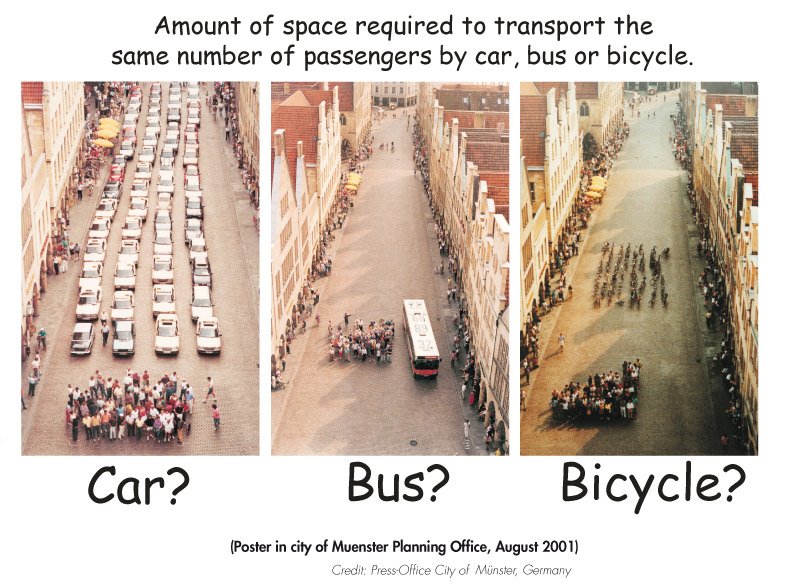
When the car began spreading in earnest in the 1920s, the total U.S. population was 106,021,537. In 1930 it was 122,775,046. Today it’s approximately 316,000,000. Moving to a highly car-dependent lifestyle made sense for a long time, but now a lot of urban areas are simply choked by them. This famous photo from the City of Muenster Planning Office succinctly demonstrates the problem, as does L.A. during rush hour:

Cities, buses, and bikes

Education is also part of the city puzzle, since it’s provided publicly and, usually, on a per-city basis. For much of the period from approximately 1970 – 2010, it was possible for parents to outrun well-meaning but poorly executed court degrees pertaining to school districting. It’s hard to measure the extent to which school busing and similar schemes drove many parents to the suburbs, even if they would’ve liked to stay in cities. This 2006 WSJ piece describes some of the pernicious consequences that are still reverberating in Seattle, which is a microcosm for the problems elsewhere. Schools and real estate both show the same basic principle: when principles meet self-interest, self-interest usually wins. Everyone favors low- and moderate-income housing in theory but don’t want it in their neighborhood, and everyone favors racial integration in theory unless their kid gets moved to the worse school.

Still, that’s tangential to Jacobs’s main points and how they affect contemporary decisions in cities. That I’m still citing Jacobs’ work more than 50 years later demonstrates its importance. To the extent any normal person has heard of anyone having anything to do with urban planning, they’ve heard of Jacobs and Moses. Pretty much anyone with any formal education in the subject has not only heard of them but read at least excerpts of their writing. It’s like being in English lit and wondering who this Shakespeare guy is.

The Lost Girls interview, war, and its relationship to sex

In the Lost Girls interview I linked to recently, one thing that Alan Moore says stands out as resolutely wrong:

War, I still believe, is a complete and utter failure of the imagination. It’s when everything else has been abandoned or hasn’t worked. It’s what destroys the imagination. It set back the progress of the human imagination.

It’s true that war “set[s] back the progress of the human imagination,” but war is actually about resource control, with “resources” defined broadly. Resources may be primarily geographic (one thinks of the recent U.S. invasions of Iraq and Afghanistan) or they may be about commodities (one thinks of Japan capturing oil fields in World War II) or they may be people themselves (one thinks of innumerable pre-modern religious wars). They are also often sexual, or have a sexual tinge, which Moore and Gebbie do get right in Lost Girls and foreground, since sexual behaviors and motives tend to be glossed or ignored in most histories.

There are exceptions, however; consider, for example, this passage from Savage Continent: Europe in the Aftermath of World War II:

The number of sexual relationships that took place between European women and Germans during the war is quite staggering. In Norway as many as 10 per cent of women aged between fifteen and thirty had German boyfriends during the war. If the statistics on the number of children born to German soldiers are anything to go by, this was by no means unusual: the numbers of women who slept with German men across western Europe can easily be numbered in the hundreds of thousands.

Resistance movements in occupied countries came up with all kinds of excuses for the behaviour of their women and girls. They characterized women who slept with Germans as ignorant, poor, even mentally defective. They claimed that women were raped, or that they slept with Germans out of economic necessity. While this was undoubtedly the case for some, recent surveys show that women who slept with German soldiers came from all classes and all walks of life. On the whole European women slept with Germans not because they were forced to, or because their own men were absent, or because they needed money or food – but simply because they found the strong, ‘knightly’ image of German soldiers intensely attractive, especially compared to the weakened impression they had of their own menfolk. In Denmark, for example, wartime pollsters were shocked to discover that 51 per cent of Danish women openly admitted to finding German men more attractive than their own compatriots. (164–166)

That wartime behavior became a topic of community discussion and cathartic release and punishment after the war. Still, this passage and other, similar ones from Savage Continent demonstrate that a lot of men treat women like resources in the context of war. Saying that war “is a complete and utter failure of the imagination” implies a level of goodwill that often doesn’t exist. To continue with the World War II example, it’s evident that Hitler had a phenomenal imagination, to the point that most of his adversaries and victims couldn’t believe the staggering, cruel audacity of what he was attempting. In a more recent example, in the first Gulf War it was apparent that Saddam Hussein imagined himself taking over Kuwait and perhaps Saudi Arabia, although he didn’t presumably imagine that he’d provoke a world-wide counter-reaction.

Nonetheless, the rest of the Moore and Gebbie interview is excellent and unexpectedly moving, and Lost Girls itself is, from what I know, still a singular, highly unusual, and highly recommended book.

Life: Artist Edition

“Inspiration is for amateurs. The rest of us just show up and get to work.”

—Chuck Close, quoted in Daily Rituals: How Artists Work

Links: Denmark, Lost Girls, Human Rights, Houston Adventures, Austin, Biking, and more!

* Divorce, Custody, Child Support, and Alimony in Denmark, which arguably has better outcomes than the U.S.

* Usually I don’t care for graphic novels, but Alan Moore and Melinda Gebbie’s Lost Girls is an exception; this interview with the authors is also excellent and new to me.

* A Cruel and Unusual Record: The United States is abandoning its role as the global champion of human rights. (Endorsed.)

* Robert Nagle: “‘That Fish has been fried’–definition and explanation;” I would add that many disagreements end or should end not with agreement, but when both sides have run out of facts, evidence, or ideas.

* Strictly textual but possibly NSFW: “Houston Adventures.”

* Can Austin stay weird as it grows?

* Worse than Manhattan? Bike expert rattled by ride through Seattle.

* “Why the U.S. is being humiliated by the hunt for Snowden,” emphasis added, as the “why” has been largely neglected.

* Stop Attacking Male Writers for Being Sexist: Protagonists don’t have to be likable to be great.

* “Voyager 1 Discovers Bizarre and Baffling Region at Edge of Solar System.”

The sex plot: a discussion for novelists and readers

I wrote to a friend:

I wonder about the extent to which novels in general are continuing to have trouble with sexual liberalization; so many major novels in the canon deal with that topic, but it’s much harder to use those tropes in a permissive age.

He replied: “This intrigues me, but I’m not sure what you mean. Can you elaborate?”

Yes!

The novel as a genre has tended to thrive on sexual repression, and has used steadily increasing sexual liberation as fuel for plots. Leslie Fiedler wrote about this in Love and Death in the American Novel, and Tony Tanner wrote about it in Adultery and the Novel. In taking courses about the novel as a genre, I was struck by how many times I heard or read phrases like, “X pushed the limits of the sexual mores of his / her day,” where X is any number of writers ranging from Richardson to Flaubert to Dreiser to Roth and Updike. (Weirdly, however, the Marquis de Sade has always been lurking beneath the history of the novel as a genre, mostly unacknowledged and often hidden from the reading public).

But working against sexual repression as such doesn’t really work so well as a plot device anymore because the barriers are mostly down. If you’re over age 18 today, you can more or less do whoever you want as long as they’re not under 18. This may be why professor-student plots are somewhat popular: it’s one of the few forbidden-but-plausible-and-not-gross relationships left.

There are only so many sexual lines one can cross, and too many books like 100 Strokes of the Brush Before Bed, to make the mere crossing of the few lines left all that interesting. When an entire society is set up to repress, re-channel, and control sexuality, a novel like Lady Chatterley’s Lover is shocking. In our society, it’s not. Today, if you want it, go get it—just don’t make promises you can’t keep. It’s not hard to live a life of constant sexual novelty and most parts of society won’t really censure you, provided that you don’t marry someone else, and even then lots of people divorce.

It’s much harder to get wring major consequences from affairs and what not. Don’t want to cheat? Don’t get married. It’s not impossible to use sex and romance plots—my to-be-self-published novel, Asking Anna, is a comedy about such subjects—to get material from these fields, but it’s a greater challenge than it used to be, and hard if not impossible to shock. A novel with the sexual politics of Stranger in a Strange Land wouldn’t have the same shock-value today then it did when it was published, though actually now that I think about it I still think it would raise a few eyebrows.

Some genres, like science fiction, don’t rely on sex plots as much, but even in SF sex plots are still often present. The growth of murder mysteries and thrillers may also represent some veering from sex plots, since premature death is still a big deal and is likely to remain so for the foreseeable future.

On a separate but related note, it also seems that many “literary” writers borrow SF-ish ideas. Think of Ian McEwan’s Solar. Not a great novel, but I liked a lot of what McEwan was doing by meshing discovery, politics, social ideas, environmentalism, science, and a not-very-nice character into one bunch. It’s McEwan, so the writing is good on a sentence-by-sentence level. The technical descriptions are also interesting and too uncommon in novels. I like the idea of writing about intellectual, social, technical, or business discovery as a motive. It’s underutilized as a driver of plot.

One section of Paul Graham’s essay “The Word ‘Hacker’” addresses this point and continues to have a profound impact on me:

Hacking predates computers. When he was working on the Manhattan Project, Richard Feynman used to amuse himself by breaking into safes containing secret documents. This tradition continues today. When we were in grad school, a hacker friend of mine who spent too much time around MIT had his own lock picking kit. (He now runs a hedge fund, a not unrelated enterprise.)

It is sometimes hard to explain to authorities why one would want to do such things. Another friend of mine once got in trouble with the government for breaking into computers. This had only recently been declared a crime, and the FBI found that their usual investigative technique didn’t work. Police investigation apparently begins with a motive. The usual motives are few: drugs, money, sex, revenge. Intellectual curiosity was not one of the motives on the FBI’s list. Indeed, the whole concept seemed foreign to them.

Most novels focus on money, sex, revenge. Why don’t they focus more on intellectual curiosity: perhaps how intellectual curiosity relates to money, sex, revenge, and similar topics? That seems like a fruitful avenue, especially because we might be moving towards a world where many people’s material needs are met, making money less immediately important; though of course many people are still driven by keeping up with the Joneses, in large swaths of the industrialized world we have plenty of money and plenty of stuff.

(A relevant side note about money: Among people interested in “game” and picking up women, it has become a common observation that additional money above the amount needed to buy drinks, dress reasonably well, and live independently doesn’t do much help most guys. A guy making $50,000 a year and a guy making $200,000 a year are mostly on a level playing field, and if the guy making $200,000 has to work 60+ hours a week, he’s at a disadvantage. Personalities and tenacity count far more than incomes, all else being equal. This could be seen as a variant on one of Geoffrey Miller’s points in Spent: Sex, Evolution, and Consumer Behavior.)

I don’t see money, sex, or revenge—and motives for revenge usually reduce to money and sex—becoming unimportant as long as humans remain humans and not brains in vats or on chips, but intellectual curiosity and a sense of wonder and discovery should be more emphasized in narrative. I think the tedium of Jonathan Franzen’s novels can in part be explained by the tedium of his characters: if those characters had a greater sense of discovery and possibility, they wouldn’t be so annoying. The other day I was listening to a friend describing single electron chain reactions in photosynthesis and how she misses research and life in the lab. It’s very interesting stuff, and the sort of thing that is rarely really discussed in novels.

But it should be!

Plus, the progression of science, technology, economics, and the attitudes that go along with them have ameliorated a lot of the money-revenge resource-distribution fights that used to define every aspect of human existence, instead of most aspects of human existence. To the extent major societal problems in the future are going to be solved—most obviously involving energy, but certainly involving other topics too—the solutions are going to come from intellectual curiosity and the intellectually curious. Maybe we, collectively, should be thinking about art that cultivates and glorifies those traits, instead of art that cultivates or glorifies simple status domination, or the ability to be cooler than the other guy or girl.

Another Paul Graham quote, from “How To Make Wealth:”

Making wealth is not the only way to get rich. For most of human history it has not even been the most common. Until a few centuries ago, the main sources of wealth were mines, slaves and serfs, land, and cattle, and the only ways to acquire these rapidly were by inheritance, marriage, conquest, or confiscation. Naturally wealth had a bad reputation.

Two things changed. The first was the rule of law. For most of the world’s history, if you did somehow accumulate a fortune, the ruler or his henchmen would find a way to steal it. But in medieval Europe something new happened. A new class of merchants and manufacturers began to collect in towns. Together they were able to withstand the local feudal lord. So for the first time in our history, the bullies stopped stealing the nerds’ lunch money. This was naturally a great incentive, and possibly indeed the main cause of the second big change, industrialization.

A great deal has been written about the causes of the Industrial Revolution. But surely a necessary, if not sufficient, condition was that people who made fortunes be able to enjoy them in peace. One piece of evidence is what happened to countries that tried to return to the old model, like the Soviet Union, and to a lesser extent Britain under the labor governments of the 1960s and early 1970s. Take away the incentive of wealth, and technical innovation grinds to a halt.

People still steal to get rich, and even more people make many movies and write many books about stealing, along with efforts to thwart thieves. Making stuff people want is, again, an under-explored avenue. It’s also harder to represent dramatically. The movie The Social Network does this successfully, albeit at the expense of accuracy; most of the important parts of Facebook actually happened in the heads of Zuckerberg and other programmers, not in interpersonal drama.

Still, The Social Network works as a movie, and it does something very different than yet another version of Fast & Furious, which is about sex, power, tribal loyalty, and blowing shit up—like most movies (sample from the link: “Like any reasonable person, I watch the Fast and the Furious film franchise primarily for its insights into moral philosophy and political economy. At a fundamental level, the franchise is about what Harvard philosopher Christine Korsgaard identifies in The Sources of Normativity as the ‘intractable conflicts” that arise from our conflicting practical identities'”). I like Solar despite its flaws in part because the protagonist, Michael, makes his money and gains status by discovering something that may turn out to be essential in solar panels.

Solar and The Social Network don’t deploy straightforward sex / family plots, and that’s refreshing. They’re part of an answer to the question of what happens in a world where you can, if you have sufficient skill or are sufficiently desirable, sleep with anyone who’ll have you? Because that’s the world most people above the age of 18 or 19 find themselves in. Marriage rates are dropping. Arguably the most interesting parts about marriage and children right now are economic: what’s happening with alimony and child support, and how those issues affect behavior and emotions.

Moreover, for the highly sexually experienced—people who’ve had their share of three-ways, sex work, group sex, etc.—the sex plot is going to be dull. Juvenile. If you’ve slept with five people in a week, agonizing over who you’re going to sleep with for the rest of your life isn’t going to seem that important. It’s going to be more important that you find someone who loves you but who also has an sufficient level of adventure compatibility. Arguably a more interesting question is what it takes to be a highly desirable person, which a lot of romance novels appear to be exploring (strangely enough) and how to become that desirable person if you aren’t already. Becoming the sort of person who can get the man / woman / men / women of your dreams is often more interesting than the immediate process of getting him / her / them.

Sex plots need a sense of the sacred attached to sex, along with the dangers of pregnancy that can be ameliorated by IUDs and other forms of birth control. Danger used to generate sacredness. Most people today still don’t want their significant others to sleep with random people, even though many obviously do anyway, but taking away or reducing the risk of pregnancy also reduces the fear and risk of affairs or multiple partners. One reason Vow: A Memoir of Marriage (and Other Affairs) got written is not just because of the affairs Plump and her husband have, but because he knocks up the other woman, or the other woman deliberately gets knocked up by him. Women tend to fear that their man will impregnate another woman and thus split his resources / time / affection, and men tend to fear that their woman will be impregnated by another man and thus stick them with the costs of raising another man’s child. While these fears can obviously be alleviated by the judicious use of birth control, not everyone is diligent about birth control and deeply seated fears aren’t always allayed by modern technologies laid over atavistic drives.

The highly adventurous and experienced probably don’t represent a hugely overwhelming portion of the general population, but they probably represent a portion that is either growing or coming out of the closet. Through divorce and other means, many people are already leading a serially monogamous and/or hypocritically adventurous life, though perhaps because they are bad at anticipating what temptation and desire feel like in the moment and good at rationalizing. The only thing missing is intellectual honesty, which may itself be rarer than fidelity.

There will probably always be challenges in admitting to fantasies or taboo desires, and it will probably always be difficult to find another person with roughly similar tastes, predilections, and preferences, but I’m not sure how easy it is to build a novel around those ideas. That question might be best answered in novel form.

Once you get away from the sex plot, where do novels go? Martha McPhee’s Dear Money is one successful recent example. Cryptonomicon is another. Solar, which I mentioned before, is a third. Ann Patchett’s State of Wonder is a fourth. More writers need to get this memo, and more readers need to use their attention to direct writers towards topics that matter instead of those that have been exhausted by the tradition.

Further discussion:

* Sexting and society: How do writers respond? Sample:

Questions like “What happens when people do things sexually that they’re not supposed to? How does the community respond? How do they respond?” are the stuff novelists feed on. They motivate innumerable plots, ranging from the beginnings of the English novel at Pamela and Clarissa all the way to the present.

Pamela and Clarissa are interesting as historical documents, but it’s not easy to project the modern mind backward into the dilemmas of someone with a very different set of social and intellectual concerns.

Links: Unmastered: a bad sex memoir, the humanities in life, bikes, housing, happiness, and more

* “Lust Never Sleeps: An academic’s sexual memoir puts the ire in desire;” sample: “Once in a while a book appears that’s so bad you want it to be a satire. If you set out to produce a parody of postfeminist mumbo jumbo, adolescent narcissism, excruciating erotic overshares, pseudopoetry, pretentious academic jargon, and shopworn and unshocking ‘dirty talk,’ you could not do better than Unmastered: A Book on Desire, Most Difficult to Tell.” I bought Katherine Angel’s Unmastered on the strength of an interesting interview and returned it after a few pages of reading and casually flipping through the remainder. I was hoping for something like Bentley’s The Surrender and sadly didn’t get it.

* This Is How to Leak to the Press Today; parts are overwrought: “With the recent revelation that the Department of Justice under the Obama administration secretly obtained phone records for Associated Press journalists — and previous subpoenas by the Bush administration targeting the Washington Post and New York Times — it is clear that whether Democrat or Republican, we now live in a surveillance dystopia beyond Orwell’s Big Brother vision,” but the how-to is accurate.

* “The Humanist Vocation;” I would add that the humanities are extremely important, but the humanities as currently practiced in most university settings are not, and the distinction is a key one for understanding why many people may be turning away from them.

* “Own Your Neighborhood: The real-estate crowdfunding scheme that could revolutionize urban policy by destroying stupid NIMBYism.”

* Alan Jacobs: “Am I a Conservative?” Notice that he does not see the contemporary Republican party as being particularly conservative; his second and third reasons are more interesting than his first.

* The U.S. has become the kind of nation from which you have to seek asylum—that is, the kind of nation you hide from, not go to for protection.

* A Prolonged Depression Is A Poor Affordable Housing Policy.

* The Netherlands is swamped by bikes, which is pretty cool.

* AAA says that the TCO of a car is $9,000 a year.

* The secret to Danish happiness; not all lessons transfer but I take Citi Bike (for which I’ve signed up) and similar efforts as a small step in a positive direction.