Check under the bed for zombies, superheroes, and Mr. Collins

Joe Fassler’s How Zombies and Superheroes Conquered Highbrow Fiction is almost believable, but I don’t buy the premise of his essay: “Realistic stories once dominated American literature, but now writers are embracing the fantastical. What happened?”

Realistic stories might’ve once dominated perceived highbrow fiction, but they’ve always been present in a lot of literature, even capital-L Literature. Notice this from the article: “Led by their patron saint, Raymond Carver, American minimalists like Grace Paley, Amy Hempel, Richard Ford, Anne Beattie, and Tobias Wolff used finely-tuned vernacular to explore the everyday problems of everyday people.” It completely ignores, say, Neal Stephenson, William Gibson, and Ursula K. le Guin, all of whom did significant work during that time that’s also widely respected. If I had to bet, I’d put money on Gibson being more literarily important than than everyone else on Fassler’s list in a hundred years. And, at least outside of MFA programs, more important today.

Hell, even John Updike, who’s sometimes associated with banal domestic problems, wrote The Witches of Eastwick in 1984 and The Widows of Eastwick in 2008. So I think this story says more about people who perceive themselves to be highbrow ignoring everything else that goes on around them, until the “everything else” becomes the mainstream, even in people who perceive themselves to be engaging in highbrow Literary Discourse. The rest of us know that there hasn’t been a period—and I’m speaking from Beowulf to the present—without its share of monsters, demons, and supernatural powers, even if critics sometimes like to pretend there has been.

November Links: The Dutch and sex, neekerbreekers, Gandalf or Dumbledore?, academia, a rare pair of political links, and more

* Solving America’s teen sex “problem:” The Dutch have dramatically reduced adolescent pregnancies, abortions and STDs. What do they know that we don’t?

* [Ann Patchett] Fights the Tide by Opening a Bookstore. It’s in Nashville, which probably isn’t geographically proximate for most of you. Her new novel State of Wonder is itself wonderful.

* Useful advice: Beware the neekerbreekers.

* An amusing search query that led someone to this blog: “how to respond to sexting”. Answer: in kind.

* Gandalf or Dumbledore? The winning poster gets facts wrong (The end of The Lord of the Rings does not see the world purged of all evil), but I like his style. He also says that Gandalf “shrugs it off LIKE A BOSS,” the latter bit referring a meme, but the phrase is slightly appropriate because Gandalf isn’t supposed to be a boss—he’s supposed to help the natives of Middle-earth, as it were, find and combine their own talents and strengths.

* Why academics should blog, which seems completely obvious to me.

* James Fallows: With Mitt’s Ascent, We’re Back to the ‘Mormon Question’, a very good post and one that changes what I think.

* Without comprehensive sex education, porn is the only solid information kids are getting about sex. File this under “obvious.”

* Trading Up:

When I left academia in 2008 to try to be a full-time writer, the last thing I was looking forward to was the commercial side of my new profession. Like every good leftist and many an academic, I looked on the market as evil, a place that would debase your values and suck out your soul if you gave it half a chance. But here’s what I’ve discovered in the last few years: I kind of like it a little.

At the very least, I far prefer the discipline of the market to the discipline of the disciplines. [. . .]

This is a trivial instance, but I saw far graver versions of it all the time: people who were blocked from getting jobs or keeping them, people whose work was rejected for publication (a body blow in academia, of course), and only because a single individual decided to stand in their way, a single human bottleneck, and often for motives that were purely personal, or self-interested, or just plain arbitrary.

* When did the GOP lose touch with reality? I’m not a tremendously political person but find it worrying when one of the two major political parties in the United States seems to have checked out of “facts,” especially when that party used to consider itself heavily fact-based.

* Slightly more on politics:

In fact, blame for the failure of the congressional super committee belongs with every American who failed to vote in the 2010 midterm election. Nothing encapsulates the dysfunction of American democracy better than the fact that we abdicate responsibility for governing our country (and running our economy) to a radical minority every four years out of laziness and, to a smaller extent, deliberate efforts by both parties to depress turnout they know will favor their rivals.

I do not see a path out of this dynamic.

* Someone found this blog through the search query “penis ass woman tattoo.” I wonder what he sought. . .

* “Beats” (the headphones) appear to primarily be a marketing phenomenon, but the Jesus figure in this video is wearing them.

Google engineer: What I learned in the war.

What does it take to put a past in porn completely to bed?

* Sentences to ponder, job market edition, although I’m not sure how much these anecdotes say about the job market and how much they say about the non-optimal moves of the individuals involved.

Status and sex: On women in bands never getting laid and Norah Vincent’s Self-Made Man

Ellen Campesinos wrote “Female Musicians Never Get Laid: The bassist from Los Campesinos! gives us the awful truth about the sex lives of touring bands,” which is a brief study in gender differences among musicians. Campesinos says, apropos of a Tweet from Neko Case, “‘Ladies in bands don’t get ANY action,’ and as a female musician with a frustrated libido, I can sympathize.” Notice the keyword: “don’t” rather than “can’t.” Female musicians almost certainly can get as much action as they want, if they’re willing to get over the various neuroses and disqualifications that Campesinos brings up in her piece. She starts disqualifying potential guys right away, getting to here:

Having eliminated fans and support-band members, we’re left with the guy hanging out at the bar whose friend has dragged him along to the gig. In a lot of ways, he’s the most appealing choice. I want to hear that someone is not fussed about us. The thing is, this hypothetical guy normally throws me some glances, and I shoot some back, but he still won’t talk to me. And I don’t want to reduce it to status anxiety or a power issue, because obviously it’s intimidating to talk to any stranger, let alone someone who was just performing.

If “this hypothetical guy normally throws me some glances” and you “shoot some back,” the solution is simple: talk to him. Why doesn’t she? I’d like to rhetorically say, “I have no idea,” but I do: she’s been conditioned to want to make the guy make the first move, and she probably wants, on some level, to be chased. She closes off the possibility: “Maybe I could grow a pair and actually talk to that bar-hugging guy myself. But he might think I was making a weird face while I played.” This sounds like a psychological defense she’s using to avoid rejection.

So if she’s not getting laid, it’s in part because she’s not making any moves. Welcome to being a guy.

The bigger issue could be that Campesinos isn’t interested in any guy who’s interested in her. Notice how she says of fans, which male musicians often call groupies: “(And in truth, some male fans actually are slightly creepy)”, which might also transfer to “the guy hanging out at the bar” if he were to do something radical, like, say, open his mouth.

“Creepy” is one of these all-purpose words women use to indicate sexual undesirability for unformed reasons; it doesn’t really mean anything except to the woman using the term. Although I’m sure she’s right about some male fans, the word “creepy” itself also indicates that she’s closing herself off to forms of sexual expression from guys she doesn’t consider eligible—which is another way of saying that she doesn’t perceive those guys to be sufficient alpha for her.

Over the course of her essay, she describes herself as living the anxiety-ridden life of beta males who haven’t read The Game. The start of her last paragraph shows how Campesinos’s view differs from a typical guy’s: “Bottom line: attempting to have sex on tour is an awkward and messy experience with little sense of eroticism.” The bottom line for a guy is that attempting to have or having sex on tour with random hot girls is an awesome experience to be repeated every night, if possible. Campesinos isn’t driven to get laid:

I think Neko should have Tweeted, “Ladies in bands don’t get any action, but that’s okay, because you can make some nice friends and meet some really cool people instead, and worst come to worst, you can always have a wunk — a wank in a bunk. Or not. That’s disgusting.” Probably more than 140 characters, but it’s the truth.

Would most men write that they’d rather make nice friends and meet some really cool people in lieu of getting laid? Campesinos seems satisfied to make the trade-off and would rather live in a paradox where the only men she perceives as being available or interesting are ones she won’t approach.
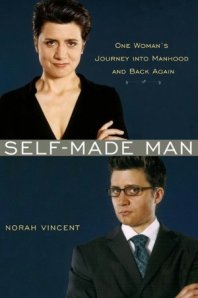
The approach issue reminds me of Norah Vincent’s Self-Made Man. Vincent, who is a lesbian in “real life,” dresses, acts, and lives like a man for about a year. In her first attempt to approach women at a bar, she (as a “he”) is basically rejected and finds that “it didn’t feel good to be on the receiving end of their suspicion” regarding motives. After, she asks a friend, “How do you handle all this fucking rejection?” He answers  in parable:

Let me tell you a story [. . .] When I was in college, there was this guy Dean, who got laid all the time. I mean the guy had different women coming out of his room every weekend and most weeknights, and he wasn’t particularly good looking. He was fat and kind of a slob. Nice guy, though, but nothing special. I couldn’t figure out how he did it, so one time I just asked him. ‘How do you get so many girls to go out with you?’ He was a man of few words, kind of Coolidge-esque, if you know what I mean. So all he said was: ‘I get rejected ninety percent of the time. But it’s that ten percent.’

Campesinos won’t make the first move, apparently doesn’t like the guys who do make the first move, and doesn’t like several general classes of guy available to her as a woman in a band. She’s willing to “make some nice friends and meet some really cool people instead,” which is okay, I guess, but her willingness to substitute nice friends and really cool people for getting laid may explain why she isn’t.

Here’s another theory: she “knows” (in an evolutionary sense, if not a conscious one) she doesn’t really need to get laid at a particular time in order maximize her reproductive success. If or when she wants to find a guy to have a children with, she’ll probably have no trouble finding many candidates; her only real trouble might being too picky.

In the meantime, people who really want to get laid, get laid. (I’m thinking of some of the women I know who are incredible, expert flirts while also not being irrationally picky about guys; watching them do their thing versus normal women is like listening the NY Phil and then a high school orchestra, and it appears that most women don’t care enough to really up their game). I don’t think a lot of women really understand how much rejection men go through, or what the trade-offs involved in masculinity entail. Here’s Roy Baumeister’s description of Self-Made Man in his book Is There Anything Good About Men?: How Cultures Flourish by Exploiting Men:

One of the most interesting books about gender in recent years was by Norah Vincent. She was a lesbian feminist who with some expert help could pass for a man, and so she went undercover, living as a man in several different social spheres for the better part of a year. The book, Self-Made Man, is her memoir. She is quite frank that she started out thinking she was going to find out how great men have it and write a shocking feminist expose of the fine life that the enemy (men) was enjoying.

Instead, she experienced a rude awakening of how hard it is to be a man. Her readings and classes in Women’s Studies had not prepared her to realize that the ostensible advantages of the male role come at high cost. She was glad when it was over, and in fact she cut the episode short in order to go back to what she concluded was the greatly preferable life as a woman. The book she wrote was far different from the one she planned, and any woman who thinks life is better for men will find it a sobering read.

I don’t buy everything Baumeister says, but he’s lucid and skilled at explaining his ideas in terms of medians, averages, and trade-offs, which most polemics and professional gender people don’t or don’t want to address.

He seems open to revision, provided that the revision is based on data and not just belief. But you can take a lot of what he says, a lot of what Vincent says, a little evolutionary psychology, a lot of band culture, and read Campesinos’s piece not as Campesinos herself does, as a means of throwing up her hands and wondering “why?”, but has having a clear theoretical framework explaining why her self-made situation came about.


Randall Munroe also recommends Self-Made Man. This New York Times review is descriptive and reasonably okay.

Status and sex: On women in bands never getting laid and Norah Vincent's Self-Made Man

Ellen Campesinos wrote “Female Musicians Never Get Laid: The bassist from Los Campesinos! gives us the awful truth about the sex lives of touring bands,” which is a brief study in gender differences among musicians. Campesinos says, apropos of a Tweet from Neko Case, “‘Ladies in bands don’t get ANY action,’ and as a female musician with a frustrated libido, I can sympathize.” Notice the keyword: “don’t” rather than “can’t.” Female musicians almost certainly can get as much action as they want, if they’re willing to get over the various neuroses and disqualifications that Campesinos brings up in her piece. She starts disqualifying potential guys right away, getting to here:

Having eliminated fans and support-band members, we’re left with the guy hanging out at the bar whose friend has dragged him along to the gig. In a lot of ways, he’s the most appealing choice. I want to hear that someone is not fussed about us. The thing is, this hypothetical guy normally throws me some glances, and I shoot some back, but he still won’t talk to me. And I don’t want to reduce it to status anxiety or a power issue, because obviously it’s intimidating to talk to any stranger, let alone someone who was just performing.

If “this hypothetical guy normally throws me some glances” and you “shoot some back,” the solution is pretty damn simple: talk to him. Why doesn’t she? I’d like to say, “I have no idea,” but I do: she’s been conditioned to want to make the guy make the first move, and she probably wants, on some level, to be chased. She knows this on some level but closes off the possibility: “Maybe I could grow a pair and actually talk to that bar-hugging guy myself. But he might think I was making a weird face while I played.” This sounds like a psychological defense she’s using to avoid rejection. So if she’s not getting laid, it’s in part because she’s not making any moves. Welcome to being a guy, honey.

The bigger issue might be simple: Campesinos might not be interested in any guy who’s interested in her. Notice how she says of fans, which male musicians often call groupies: “(And in truth, some male fans actually are slightly creepy)”, which might also transfer to “the guy hanging out at the bar” if he were to do something radical, like, say, open his mouth. “Creepy” is one of these all-purpose words women use to indicate unformed sexual undesirability; it doesn’t really mean anything except to the woman using the term. Although I’m sure she’s right about some male fans, the word “creepy” itself also indicates that she’s closing herself off to forms of sexual expression from guys she doesn’t consider eligible—which is another way of saying that she doesn’t perceive those guys to be sufficient alpha males for her.

Over the course of her essay, she’s basically describing herself as living the anxiety-ridden life of beta males who haven’t read The Game. You can get a sense of how Campesinos’s view differs from a typical guy’s by the start of her last paragraph: “Bottom line: attempting to have sex on tour is an awkward and messy experience with little sense of eroticism.” The bottom line for a guy is that attempting to have or having sex on tour with random hot girls is an awesome experience to be repeated every night. It appears she’s just not driven to get laid that much:

I think Neko should have Tweeted, “Ladies in bands don’t get any action, but that’s okay, because you can make some nice friends and meet some really cool people instead, and worst come to worst, you can always have a wunk — a wank in a bunk. Or not. That’s disgusting.” Probably more than 140 characters, but it’s the truth.

It’s hard to imagine most men writing that they’d rather make nice friends and meet some really cool people in lieu of getting laid, but she seems satisfied to make the trade-off and would rather live in a paradox where the only men she perceives as being available or interesting are ones she won’t approach.

The approach issue reminds me of Norah Vincent’s experience in Self-Made Man. Vincent, who is a lesbian in “real life,” dresses, acts, and lives like a man for about a year. In her first attempt to approach women at a bar, she (as a “he”) is basically rejected and finds that “it didn’t feel good to be on the receiving end of their suspicion” regarding motives. After, she asks a friend, “How do you handle all this fucking rejection?” He has an answer of sorts in parable form:

Let me tell you a story [. . .] When I was in college, there was this guy Dean, who got laid all the time. I mean the guy had different women coming out of his room every weekend and most weeknights, and he wasn’t particularly good looking. He was fat and kind of a slob. Nice guy, though, but nothing special. I couldn’t figure out how he did it, so one time I just asked him. ‘How do you get so many girls to go out with you?’ He was a man of few words, kind of Coolidge-esque, if you know what I mean. So all he said was: ‘I get rejected ninety percent of the time. But it’s that ten percent.’

Campesinos won’t make the first move, apparently doesn’t like the guys who do make the first move, and doesn’t like several general classes of guy available to her as a woman in a band. She’s willing to “make some nice friends and meet some really cool people instead,” which is okay, I guess, but her willingness to substitute nice friends and really cool people for getting laid may explain why she isn’t.

So she fears rejection on some level. Here’s another theory: she just doesn’t want to get laid that badly, and she “knows” (in an evolutionary sense, if not a conscious one) she doesn’t really need to get laid at a particular time in order maximize her reproductive success. If or when she wants to find a guy to have a children with, she’ll probably have no trouble finding many candidates; her only real trouble might being too picky.

In the meantime, people who really want to get laid, get laid. (I’m thinking of some of the women I know who are incredible, expert flirts while also not being irrationally picky about guys; watching them do their thing versus normal women is like listening the NY Phil and then a high school orchestra, and it appears that most women don’t care enough to really up their game). I don’t think a lot of women really understand how much rejection men go through, or what the trade-offs involved in masculinity entail. Here’s Roy Baumeister’s description of Self-Made Man in his book Is There Anything Good About Men?: How Cultures Flourish by Exploiting Men:

One of the most interesting books about gender in recent years was by Norah Vincent. She was a lesbian feminist who with some expert help could pass for a man, and so she went undercover, living as a man in several different social spheres for the better part of a year. The book, Self-Made Man, is her memoir. She is quite frank that she started out thinking she was going to find out how great men have it and write a shocking feminist expose of the fine life that the enemy (men) was enjoying.

Instead, she experienced a rude awakening of how hard it is to be a man. Her readings and classes in Women’s Studies had not prepared her to realize that the ostensible advantages of the male role come at high cost. She was glad when it was over, and in fact she cut the episode short in order to go back to what she concluded was the greatly preferable life as a woman. The book she wrote was far different from the one she planned, and any woman who thinks life is better for men will find it a sobering read.

I don’t buy everything Baumeister says, but he’s lucid and skilled at explaining his ideas in terms of medians, averages, and trade-offs, which most polemics and professional gender people don’t or don’t want to address. And he seems open to revision, provided that the revision is based on data and not just belief. But you can take a lot of what he says, a lot of what Vincent says, a little evolutionary psychology, a lot of band culture, and read Campesinos’s piece not as Campesinos herself does, as a means of throwing up her hands and wondering “why?”, but has having a clear theoretical framework explaining why her self-made situation came about.


Randall Munroe also recommends Self-Made Man. This New York Times review is descriptive and reasonably okay.

Acceptable and unacceptable status in America

See this fascinating and largely accurate list of what kinds of inequality are acceptable and what kinds aren’t, by David Brooks; note especially:

Status inequality is acceptable for college teachers. Universities exist within a finely gradated status structure, with certain schools like Brown clearly more elite than other schools. University departments are carefully ranked and compete for superiority.

Status inequality is unacceptable for high school teachers. Teachers at this level strongly resist being ranked. It would be loathsome to have one’s department competing with other departments in nearby schools.

And people involved in each system probably believe in both without questioning why they do or how they came to believe what they believe.

Many English and humanities grad students and professors seem to find differences in income inequality abhorrent and believe they are probably the result of unequal access to resources or education but also believe differences in status and work quality in their own fields largely the result of merit, hard work, tenacity, and determination. When they get lousy papers from students, relatively few seem to attribute lousy papers to various kinds of inequality of opportunity and many attribute them to laziness, poor time management, and so forth.

In addition, academics, at least of the humanities varieties, don’t like flashy cards but do like flashy CVs. So the status of certain activities are different. Teachers appear to dislike both and seem to like markers of perceived equality, even though anyone who’s been through school is doubtlessly aware that not all teachers are equally skilled or passionate.

Also, on a personal note, I am a propagating this kind of inequality:

Cupcake inequality is on the way up. People will stand for hours outside of gourmet cupcake stores even though there are other adequate cupcakes on offer with no waiting at nearby Safeways.

The cupcakes at Magnolia Bakery in NYC and LA or Cupcake Royale in Seattle are so much better than most cupcakes that the difference astonishes. Yet part of my perception might be because they’re very hard for me, in Tucson, to find and acquire. (There is a place called Red Velvet that also sells expensive cupcakes, but they’re too dense and have the wrong mouthfeel.) PinkBerry used to be feel special, but now there’s going to be one a few miles from me, which means I’m much less likely to go out of my way to get one when I’m in LA. So maybe I’m actually consuming status as much as I’m consuming sugary confections. Now PinkBerry is opening at the University of Arizona, which means it won’t be a treat but something I walk past routinely.

I would be interested in seeing other lists of this kind and for other countries.

Brooks ends: “Dear visitor, we are a democratic, egalitarian people who spend our days desperately trying to climb over each other. Have a nice stay.” We may also believe that equality of opportunity doesn’t imply equality of results, although that itself might be acceptable to believe while it might not be acceptable to believe in many circles that we have equality of opportunity.

It is acceptable to believe that many kinds of inequality affect women and few or none do men, which Roy Baumeister writes about extensively in Is There Anything Good About Men?: How Cultures Flourish by Exploiting Men. For most people, it is also acceptable to have a very high number of sex partners as long as you don’t brag too publicly about it; rare, brash exceptions generate hilarity, as in Tucker Max or Chelsea Handler.

September 2011 links: Jobs, leads, feminism, the new pants revue, shoulds and wants, demand for software engineers, plagarism, and more

* This is how you catch someone’s attention with the lead: “I became a feminist the day my sixth-grade math teacher dismembered and spit on a white rose, telling us, ‘This is you after you have sex.’

* The shoulds and the wants, highly recommended and possibly related to the link immediately above. See also the penultimate link.

* One Path to Better Jobs: More Density in Cities.

* My job is to watch dreams die.

* The New Pants Revue, by Bruce Sterling: “Since I’m a blogger and therefore a modern thought-leader type, my favorite maker of pants sent me some new-model pants in the mail.”:

I should explain now why I have been wearing “5.11 Tactical” trousers for a decade. It’s pretty simple: before that time, I wore commonplace black jeans, for two decades. Jeans and tactical pants are the same school of garment. They’re both repurposed American Western gear. I’m an American and it’s common for us to re-adapt our frontier inventions.”

If I didn’t live in Arizona, where pants are appropriate maybe three weeks of the year, I would’ve already ordered a pair. I, too, have too much gear.

(Hat tip Charlie Stross.)

* Demand for software developers is still high.

* Turnitin: Arming both sides in the Plagiarism War. The term “plagiarism war” is part of the problem: it’s not a “war,” and students and instructors shouldn’t be adversaries. I don’t spend a huge amount of time hunting for plagiarism, mostly under the theory that the primary person hurt is in fact the plagiarist, who isn’t developing the writing skills he or she will one day need. The market punishes people without skills harshly enough, as so many of the unemployed have discovered the hard way in the last three years. If I find plagiarism in students papers, I deal with it, but I wonder if schools would be better off adopting honor codes and expecting students to abide by them, rather than militarizing the issue, even metaphorically, and hunting for violators.

* Someone found this blog by searching for “french sex games.” I suspect they were disappointed, although I also wonder what else they found.

* More on that ever-popular topic, “Why does the female orgasm exist? A popular theory has been criticized as male-centric, but it might have unexpected feminist results.”

* Two thousand years in one chart, or, “we make a lot of stuff these days.”

Links: Nicholson Baker, college students drink, college students wear short skirts (a feminist perspective), risk-taking, the "left," publishing, and more

* I’ll Have What He’s Having: Breaking bread with Nicholson Baker, America’s foremost writer of literary sex novels, by Katie Roiphe, whose book The Morning After: Sex, Fear, and Feminism I admire.

* News flash: college students like drinking because it alleviates social anxiety and enables hooking up. I’m tempted to post the video someone took from a couple weeks ago when my team lost at flip cup.

* Leading off the link from above, Smart Girls Wear Short Skirts, Too: Stop Complaining About College Students.

* Reaping the Rewards 0f Risk-Taking, which includes this bit about how many nations lack “a social environment that encourages diversity, experimentation, risk-taking, and combining skills from many fields into products that he calls “recombinant mash-ups [. . .]” ” This is the kind of stuff I want to do and promote in both the fiction I write and classes I teach.

* College football as seen by a (British?) person acting as an anthropologist.

* Born, and Evolved, to Run.

* Articles like Why won’t America embrace the left? annoy me because they’re dumb. Michael Kazin wrote a book about the left, leading to his interview, in which he says things like, “Americans want capitalism to work well for everybody, which is somewhat of a contradiction in terms since capitalism is about people competing with each other to get ahead, and everyone’s not going to be able to do well at the same time.” That’s not really true: capitalism is about a) finding something you do that you want to do and b) producing goods and services other people want enough to pay or barter for. If you don’t make something users want, you have to make something else. Maybe users should want different things, but that’s a separate argument. He also says things like, “The ideas are that if you work hard you can get ahead and that it’s better to be self-employed than employed by the people.” But think of how many Americans have immigrant parents or grandparents for whom that is exceptionally true. Mine fall into that category. Kazin mostly sounds like someone who’s never actually run a business.

If the left believes people like Kazin, we shouldn’t be surprised that America won’t embrace it. But there are smart people on the left, like Tony Judt, and maybe they aren’t getting enough airtime.

* There’s a fabulous interview with Mark McGurl in which he discusses The Program Era, I book I would’ve liked to write in detail about but got so involved with that the writing in this space went away. But you should still read the book! Especially if you’re a writer or would-be writer.

* By the Time A Self-Published Author Hits it Big, Do They Really Need a Publisher? Answer: probably not. Yet. Keep an eye on this space: you may yet see me wade into the self-publishing pool. And:

For publishers, here’s the nightmare publishing path for authors of the future: Author signs with traditional publisher for first book, author hits it big, author says thankyouverymuch I got this now and self-publishes from then on out.

* Speaking of publishers, “Amazon.com is so well positioned to sell digital files that one glance at their list of Contemporary Fantasy bestsellers shows one unsurprising fact: It’s not dominated by books put out by New York publishers.” That’s from “The rising ebook wave,” which I might be joining in the next six months to one year.

* When To Ignore Criticism (and How to Get People to Take Your Critique Seriously).

* The “overlearning the game” problem.

* The Tyranny of Silly Expense Control Rules; notice the comment from yours truly.

* The Freelance Surge Is the Industrial Revolution of Our Time. A lot of academics in the humanities appear to be completely missing this.

Links: Nicholson Baker, college students drink, college students wear short skirts (a feminist perspective), risk-taking, the “left,” publishing, and more

* I’ll Have What He’s Having: Breaking bread with Nicholson Baker, America’s foremost writer of literary sex novels, by Katie Roiphe, whose book The Morning After: Sex, Fear, and Feminism I admire.

* News flash: college students like drinking because it alleviates social anxiety and enables hooking up. I’m tempted to post the video someone took from a couple weeks ago when my team lost at flip cup.

* Leading off the link from above, Smart Girls Wear Short Skirts, Too: Stop Complaining About College Students.

* Reaping the Rewards 0f Risk-Taking, which includes this bit about how many nations lack “a social environment that encourages diversity, experimentation, risk-taking, and combining skills from many fields into products that he calls “recombinant mash-ups [. . .]” ” This is the kind of stuff I want to do and promote in both the fiction I write and classes I teach.

* College football as seen by a (British?) person acting as an anthropologist.

* Born, and Evolved, to Run.

* Articles like Why won’t America embrace the left? annoy me because they’re dumb. Michael Kazin wrote a book about the left, leading to his interview, in which he says things like, “Americans want capitalism to work well for everybody, which is somewhat of a contradiction in terms since capitalism is about people competing with each other to get ahead, and everyone’s not going to be able to do well at the same time.” That’s not really true: capitalism is about a) finding something you do that you want to do and b) producing goods and services other people want enough to pay or barter for. If you don’t make something users want, you have to make something else. Maybe users should want different things, but that’s a separate argument. He also says things like, “The ideas are that if you work hard you can get ahead and that it’s better to be self-employed than employed by the people.” But think of how many Americans have immigrant parents or grandparents for whom that is exceptionally true. Mine fall into that category. Kazin mostly sounds like someone who’s never actually run a business.

If the left believes people like Kazin, we shouldn’t be surprised that America won’t embrace it. But there are smart people on the left, like Tony Judt, and maybe they aren’t getting enough airtime.

* There’s a fabulous interview with Mark McGurl in which he discusses The Program Era, I book I would’ve liked to write in detail about but got so involved with that the writing in this space went away. But you should still read the book! Especially if you’re a writer or would-be writer.

* By the Time A Self-Published Author Hits it Big, Do They Really Need a Publisher? Answer: probably not. Yet. Keep an eye on this space: you may yet see me wade into the self-publishing pool. And:

For publishers, here’s the nightmare publishing path for authors of the future: Author signs with traditional publisher for first book, author hits it big, author says thankyouverymuch I got this now and self-publishes from then on out.

* Speaking of publishers, “Amazon.com is so well positioned to sell digital files that one glance at their list of Contemporary Fantasy bestsellers shows one unsurprising fact: It’s not dominated by books put out by New York publishers.” That’s from “The rising ebook wave,” which I might be joining in the next six months to one year.

* When To Ignore Criticism (and How to Get People to Take Your Critique Seriously).

* The “overlearning the game” problem.

* The Tyranny of Silly Expense Control Rules; notice the comment from yours truly.

* The Freelance Surge Is the Industrial Revolution of Our Time. A lot of academics in the humanities appear to be completely missing this.

How bloggers are made:

“A person whose financial requirements are modest and whose curiosity, skepticism, and indifference to reputation are outsized is a person at risk of becoming a journalist.”

That’s Louis Menand, in “Browbeaten: Dwight Macdonald’s war on Midcult.” Bloggers come from somewhere similar but adjacent—like the relationship between Vancouver and Seattle—though too few have well-developed senses of curiosity and skepticism.

The rest of the article is boring and historical, but one reason to read the New Yorker is that one never knows when a fabulous sentence worth stealing will appear. The article about Timothy Ferris, for example, says of his dwelling: “There was, inevitably, a framed arty photograph of a naked woman.” He sounds capitally tedious. That word, “inevitably:” it’s perfect. We get the author’s skepticism. We know exactly the kind of person Ferris is (and, I wonder: the kind of person I am?). The skepticism of the word “arty” is perfect; so is picking “naked,” which makes one sound merely revealed and pornographic, over “nude,” which glistens with the sheen of art instead of the sheen of Playboy magazine. The sentence is so good I stole a variant on it for a novel (no one notices if you steal in small proportions, except for James Wood, and if I’m at the point where James Wood notices such theft, I’ll consider myself lucky). In fact, speaking of Wood, there’s a section of How Fiction Works where he speaks of “a sentence from a Maupassant story, ‘La Reine Hortense’:”

‘He was a gentlemen with red whiskers who always went first through a doorway.’ [Ford Maddox] Ford comments: ‘that gentlemen is so sufficiently got in that you need no more of him to understand how he will act. He has been “got in” and can get to work at once.’

Ford is right. Very few brushstrokes are needed to get a portrait walking, as it were; and – a corollary of this – the reader can get as much from small, short-lived, even rather flat characters as from large, round, towering heroes and heroines.

Yes, yes, yes, yes: I worry so much about making sure characters are gotten in now, but it’s never quite right, is it? I can imagine Rebecca Mead, who wrote about Ferris, or Menand above, sweating over those sentences, wondering: are they right? Do you put a comma between “framed” and “arty?” Is “outsized” the right word? The comma question could go either way. “Outsized” could be “severe,” like a storm warning. But those sentences still feel so wonderfully, deliciously right, even embedded in articles that otherwise let one flip to the next, searching, as a surfer will flit from blog to blog.

Links: Why Software Is Eating The World, reading for the plot, Brooklyn, the writer as hustler, Moleskine lies, and more

* Why Software Is Eating The World by Marc Andreessen—one of the most impressive essays I’ve read recently.

* Has plot driven out other kinds of story? The market’s stress on keeping stories moving means we’re in danger of losing some truer fictions. If anything, it seems like the opposite to me, but that might be an artifact of the books assigned in graduate school.

* How sad: “It’s a Pattern: London Rioters Are Leaving Bookstores Untouched.” Rather sad, this. When I’m in restaurants or out and about, I make sure to take expensive electronic devices with me if I have to leave for a short period, but I leave books on tables; they’re always untouched.

* File this under, “Really?”:

[Brooklyn] may own only a small sliver of America’s attention, but as Mr. Hughes writes, “more people live in Brooklyn than in San Francisco; Washington, D.C.; Boston; and Miami put together.”

As I wrote in an e-mail to a friend from the borough, “Maybe one day I will be there, with a $4 latte, a fixie, literary pretensions, and a jaunty hat.” Also, the linked essay, “I Write in Brooklyn. Get Over It, is fucking hilarious, as my students say.

* What happens to doctors who think outside the box? Answer: nothing good.

* Goodbye, cruel Word.

But: I’m not sure programs like Scrivener will be useful to most people, for reasons tangentially related to this post on Scrivener and Joyce.

A lot of people, based on the amateur writing I’ve seen, don’t need a fancier way of arranging words so much as they need to improve 1) the quality of their sentences and 2) how one event drives another in their plots. I worry especially regarding point 2) that Scrivener lets people work in parallel when they should be working in serial, with one event driving another organically. Too much amateur writing I see is, for lack of a better term, plotless: meandering around feelings, or random encounters, or designed to show how *deep* the author is—instead of telling a story.

Scrivener will help with some things, as I’ve written elsewhere, but I’m not sure it’s really enough for the vast majority of what writers and would-be writers are working on.

* On English as a language:

[. . .] there’s no subject, however technical or complex, that can’t be made clear to any reader in good English—if it’s used right. Unfortunately, there are many ways of using it wrong

This reminds me of the Grant Writing Confidential post How to Write About Something You Know Nothing About: It’s Easy, Just Imagine a Can Opener.

* Do Sex Offender Registries Reduce Crime? Answer: Probably not, or at best modestly, in part because such registries are too broad. As Tabarrok says:

Bear in mind that teenagers having sex with other teenagers, hiring or trying to hire a prostitute and even streaking can make a person fall under the sex offender statutes. Moreover, contrary to popular belief, sex offenders have low recidivism rates, much lower than for most other crimes.

* I Wrote It, Must I Also Hustle It? Apparently so.

* Does a Moleskine notebook tell the truth? Answer: probably not. I’ve been trying various notebooks over the last couple months and have probably settled on the Rhodia Webbie, an unfortunately named but quite nice notebook that appears much more durable than its competitors. More to follow.