The Library of America and literary canons

Newsweek asks: has the Library of America jumped the shark? If so, you won’t find a good argument for it in this article: there’s a lot of innuendo and little of substance about who deserves to be in the “canon” and why. But the last paragraph gets a (very) little bit deeper:

Kidding aside, one sympathizes with the directors of a publishing venture increasingly dependent on the idea that great American writers just can’t die fast enough. In such a situation, conventional publishing goes head to head with curating, and financial concerns go to war with esthetics, which, depending on how conservative one cares to be, can argue for little or no growth at all. And of course all this plays out against a literary landscape where the idea of a literary canon has been pretty much shot to hell anyway, so maybe no one should care who gets into what anymore. Or maybe they should just turn the whole thing into a—you knew this was coming—lottery.

Shelfari (mostly) agrees with my comments and says:

For me, when the LOA started adding people like Lovecraft, Dick, and Powell (or personal favorite Nathanael West) was when it started getting lively and interesting. I’m glad they do beautiful editions of titans like Lincoln, Whitman, and James, but I’m far more glad that they haven’t just been passive about transmitting the canon, as it was spoken to them from above.

Agreed. I can’t think of anyone I’d love to see included, except perhaps Robertson Davies, who is Canadian (but Canada is part of North America, right?), and Elmore Leonard, who is still alive. Regardless, I’ve been impressed with a lot of the recent picks, like Philip K. Dick, who deserves his spot; tomorrow I’m going to hear a scholarly lecture on his work at the Arizona Quarterly Symposium, and I’ve heard talks on him elsewhere in academic venues. Maybe Jack Vance will be next, although he’s not been as cinematically popular as Dick.

Oh, and one other small note about the LoA: I tend to write in my copies.

How to find books

Apropos of this post on influential books, a reader e-mailed me to ask how to find interesting books to read. My answer: looks for books that are important to people who are smart, and ideally smarter than you. That’s one reason I like the “top ten influential books” meme that’s been going around: it introduces a lot of books I probably wouldn’t have found otherwise.

Other (obvious to me) places: The New Yorker; professors or highly literate friends; the better book/arts blogs, like About Last Night, although you can find others in the sidebar; and author interviews, in which novelists or other writers mention important/influential books. The last one is probably among the most useful because writers, in order to work effectively, have to read almost all the time. As a result, the top few books of the many thousands they’ve read are probably better than the top few of the dozens or hundreds random friends have read. I used to find a lot of books by browsing, either at the library or at used bookstores, but I tend not to find that very satisfying any more.

The problem with books is that you can’t really say whether they’re right for you until you read them, and what’s right for you depends on how much you already know about the subject, taste, what else you’ve read, development, background, and more. So book recommendations are by their nature hard, especially for someone like you, who I (probably) don’t know. I have a few go-to recommendations that many people seem to like—Carlos Ruiz Zafon’s The Shadow of the Wind; Alain de Botton’s On Love; Umberto Eco’s The Name of the Rose; and Robertson Davies’ The Deptford Trilogy are high on that list.

So Many Books: Reading and Publishing in an Age of Abundance discusses how hard the sifting process becomes as more books pile up while time to read remains constant.

Risks, Realizations, and Barry Schwartz’s The Paradox of Choice

People mistook the pervasiveness of newspaper stories about homicides, accidents, or fires—vivid, salient, and easily available to memory—as a sign of the frequency of the events these stories profiled. This distortion causes us to miscalculate dramatically the various risks we face in life, and thus contributes to some very bad choices.

That’s from Barry Schwartz’s The Paradox of Choice: Why More is Less, a book that’s probably easy to misinterpret as arguing that more choices are always bad or always make us unhappy. But it does provide a lot of useful explanation of why many people disproportionately fear crime, which is falling (that link is merely one of the first found in an Internet search; the general trend is well-known), as opposed to, say, car crashes or heart disease, neither of which are as memorable.

Still, I don’t think all choices are bad ones, but the cognitive effort necessary to make a choice should probably make us more wary of doing things like shopping than we, as a society, appear to be. Mental investments in one field (i.e. deciphering features, costs, etc.) might take away from those in another, as cognitive load theory implies. Overall, I think The Paradox of Choice can be usefully combined with a couple of other sources, most notably Paul Graham’s essay Stuff, about the perils of possessiveness in an age of abundance, and The Myth of the Rational Voter, which the New Yorker discusses here. Our (collective) beliefs aren’t very rational, whether you call them a mistake of “pervasiveness,” as Schwartz does, or something else. It’s unfortunate that Schwartz doesn’t go in more depth about the “very bad choices” we might make as a result of availability heuristics.

Tender is the Night — Fitzgerald

Early in Tender is the Night, we find this about a relatively minor character named McKisco:

“I don’t see what it’s all about,” he said helplessly. “I don’t see why I’m doing it.”

The context is a conversation putatively about duels, but one could take McKisco’s confusion as a synecdoche for the novel as a whole: no one see what it’s all about or why they’re doing it. Even Dick Diver, psychologist, doesn’t really; he’s supposed to have mastered the mind but hasn’t mastered his own. Some of the novel’s descriptions and transitions mirror this confusion or uncertainty, which makes Tender is the Night feel more Modernist than its predecessors. Take, for example, this:

When there were enough Americans on the platform the first impression of their immaculacy and their money began to fade into a vague racial dusk that hindered and blinded both them and their observers.

The description goes from a relatively literal rendition of the Americans’ surface into a metaphoric one of their souls. But I have no idea what “vague racial dusk” means, which is perhaps why it needs “vague” out in front, or why that would blind observers; perhaps those theoretical observers are used to judging based on categories that Americans defy, or think they defy. If so, the novel is a journey into the ways Americans are more ensnared by history than we might want to be, and why we might be more obscure than we’d like to imagine. In this way, the structure of the novel mirrors its themes: it cuts many of the “she shifted her attention to the fight” transitions that might otherwise make this easier to follow:

Nicole was glad he had known so many women, so that the word itself meant nothing to him; she would be able to hold him so long as the person in her transcended the universals of her body.
“Hit him where it hurts!”
“Yah-h-h-h!”
“Hey, what I tell you get inside that right!”

A chorus shouts after Nicole’s Deep Thought, and in re-reading Tender is the Night I see where Tom Wolfe got some of his techniques for representing speech.

Some of the stylistic tics, like the “vague racial dusk” are meant to make us poetically see something in a new light, but they often feel more like work compared to a novel like Gatsby. It feels more indulgent, too: this is Fitzgerald wanting to write a novelist’s novel, meaning that it should have enough strangeness to make it hard to figure out what’s happening and why. This brings pleasures of its own, especially on second reads, but the danger of obscurity for obscurity’s sake remains, as when a voice suddenly shifts from third person limited to first:

All that saved it [the offer of marriage? something else?] this time was Nicole finding their table and glowing away, white and fresh and new in the September afternoon.

How do you do, lawyer. We’re going to to Como tomorrow for a week and then back to Zurich. That’s why I wanted you and sister to settle this […] (166)

My confusion mirrored McKisco’s in this narrative jump. Eventually that confusion was (mostly) remedied, but not so remedied as to make the novel boring.

Continuing was worth it: Fitzgerald knows how to end a novel. Tender is the Night isn’t quite so overtly poetic as Gatsby, with its boats being beaten back into the past, but it has a sense of melancholy and emotion that few novels do. I’m being vague because I don’t know how to describe the feelings evoked; perhaps that is one definition of a powerful novel. Melancholy is a part, but like a good wine, it’s only a single strand of a complex weave, one cannot appreciate the whole without appreciating all its parts.

There’s one other thing that Tender is the Night reminds me of: the habit that literary history has of doubling back on itself. Received opinion—so received that I don’t know where I got it from—holds that people didn’t start really writing about divorce and affairs and torrid sex and so forth until Updike and Roth. Marriages were more stable, at least as depicted artistically, and the really great fireworks caused by social changes didn’t hit until the 1960s. But the more I read the less that narrative seems to fit: Tender is the Night encapsulates Updike’s Marry Me: A Romance and maybe even Couples. Middlemarch has marriages that end. Even Pride and Prejudice has its affair between Lydia and Wickham, although the sex they’re having is so powerful that it remains unspoken.

Madame Bovary doesn’t encapsulate Tender is the Night but at least presages it. The drama of adult relationships, which I’d thought a (relatively) recent invention in fiction, isn’t. Neither is the childishness that such relationships sometimes entail. More continuity exists over the course of history than I thought, and what seems new in terms of content no longer does. Even the style of Tender is the Night holds up: if it were published today, I’d not know the difference. one can see greater stylistic continuity from Fitzgerald to the present than from, say, Middlemarch to Fitzgerald (this is part of what James Wood discusses in his nominal discussion of Chang-Rae Lee’s The Surrendered, a topic that I will return to later).

I don’t know what to do with this idea concerning continuity and change save note its existence, at least in my reading. Perhaps the rhetoric of the love story hasn’t changed that much, except perhaps for the inclusion of overt female desire in a larger number of more recent novels; it’s hard to see a good precursor of Allison Poole in Jay McInerney’s Story of My Life. Poole feels a long way from Nicole Diver, but the feeling of a search for something that cannot be adequately defined continues, and the inability to find that absent something propels novels and stories forward.

Ian McEwan day – Solar released

It’s Ian McEwan day: Solar is out, and reviews are easy to find online, and my copy is supposed to arrive in a day or two. Once it does, the calendar gets cleared, other books get bumped down, and reading commences.

Influential books (on me, that is)

Econ (and generally interesting) blogger Tyler Cowen lists the 10 books that have most influenced him and invites other bloggers to do the same. Here’s mine, in the order I thought them up rather than importance:

1. Tolkien’s Lord of the Rings: I think many people find that their first “adult” books is a powerful influence, and I first read Lord of the Rings in late elementary or early middle school and reread it periodically: its commentary on power dynamics, the limits of knowledge, and the challenge of understanding still affect me. And it makes its way into a surprising amount of otherwise unrelated academic work. And the story. And, and, and…

2. Robert Jordan’s The Wheel of Time and the DragonLance series: Another early influence, this time mostly for the worst: the view of sexuality in both series is juvenile, the writing atrocious, and the mindless glorification of battle and power for its own sake is, from my current vantage, almost sickening. But they now show me what not to do as a writer and thinker and probably contributed to the lost, unhappy middle school years so many have.

3. Geoffrey Miller, The Mating Mind: Robin Hanson recommended this. Its ideas about the role of art and culture in sexuality and why the second half of Darwin’s theory—sexual, as opposed to natural, selection—clarified a lot of my thinking. Even today, many people focus on “natural” selection but miss the importance of sexual selection. I still don’t think I’ve exhausted the book, although I have read others in the genre. Along with some of the books below, it pointed me toward a better understanding of how people signal and how people perceive, which I didn’t understand previously.

4. Dan Ariely, Predictably Irrational: I’d read many critiques of our rationality, but before Predictably Irrational I probably would’ve argued that we should look solely at behavior to discern individual wants and that individuals are independent in an almost Ayn Rand way. Although Predictably Irrational isn’t solely responsible for this shift and others, it probably catalyzed them.

5. Conrad’s Heart of Darkness: By most of the conventional tropes of creative writing classes, Heart of Darkness is terrible. But it reminded me of the power of the unknowable and of the limitations of what we know. The most famous scene is of course Kurtz’s “The horror! The horror!”, but what strikes me in rereadiang it is how little time Kurtz actually gets and how great Marlowe’s anticipation of Kurtz is. The novel is more about how Marlowe perceives (and thinks he will perceive) Kurtz than about Kurtz himself, which taught me the power of how perception shapes reality.

6. Paul Graham’s essays: Although not technically a book, some of Graham’s essays have been collected into Hackers and Painters. I pay special attention to the essays about social structure and the role of the individual in social structures. Some of the ones about school, especially high school, I assign to students.

7. Umberto Eco’s The Name of the Rose: This is the kind of novel that I wish someone had demanded that I read earlier than I did. Claiming that something is the “greatest novel” strikes me as silly, but if I were forced to choose one, this would be in the running and seems like it contains the world as few novels do. Is this vague? That’s because trying to encompass it is beyond me.

8. Robert Penn Warren’s All the King’s Men: This book made me more cynical and hopeful about politics—at the same time. Its style isn’t baroque but tends toward long, beautiful sentences; Jack Burden’s understanding of what actually matters, which doesn’t really occur until the last chapter, is so authentic and wonderful that it seems truer to life than the darker ending of Gatsby. Still, its depiction of sexuality now feels very much of its time, rather than of all time.

9. James Wood, How Fiction Works: Wood asks a critic’s questions and gives a writer’s answers with such precision and beauty that this essentially defines the terms of the novel for me. The last two words of the preceding sentence are essential: the joy of the novel is the inability to define or encompass it.

10. Neil Strauss, The Game: I didn’t love The Game for its stories about pickups, but it has a central, important idea: most conversations in most situations are boring and predictable. Solution: shake things up. Predictability can be boring; in social situations around an attractive person, many people (not just men) get scared, and when they’re scared they become more conversationally conservative, and then fail through excess caution. Chances are, no one wants to tell you where they’re from; ask them for an opinion that elicits interpersonal beliefs instead. Most guys are also poorly educated and socialized around dating, women, and sex. The Game may not be a perfect book but it moves the conversation about dating and sexuality forward in a way that few other books have accomplished. Most of the negative discourse around the The Game doesn’t address the elisions The Game is addressing. If you have a prosocial equivalent of The Game I’d be happy to hear about it.

I’ll stress that I’m not most proud of these books: The Wheel of Time is terrible, some seem like lightweight popularization, others are not books I would necessarily recommend today, or to everyone—but they all did their work. If I could pick an 11th I’d choose Daniel Gilbert’s Stumbling on Happiness, which has several core insights that I try (and often) to fail to apply: money above something like the median household income won’t make us happy; our sex and social lives matter more; and our ability to predict what will make us happy is weak. Robertson Davies continues to be a favorite author because he has perspective in a complicated way I can’t easily define, but he combines much of the best of Victorian fiction with a modern sensibility and style that’s his and yet universal. In the His Dark Materials trilogy Philip Pullman shows how fantasy can be done not just right, but spectacularly well.

Another omission: I wish I could think of an individual book that convinced me dense cities are vital because of their networking effects, environmental improvements, the possibility (seldom achieved) of affordability, and the well-intentioned but wrong preservationist/anti-growth types. I’ve had several arguments with people who are a) pro-affordability, b) anti-sprawl and c) anti-height. You can’t consistently have all those things; a) is most often neglected. Newspaper articles in particular like to pretend these trade-offs don’t exist.

Many others have answered the call for books too, and I find their posts fascinating even though I don’t read most of the bloggers involved. But the books themselves (and the rationale for their influence) point to deeper ideas about how influence works and the serendipity of the right person finding the right book at the right time. Most of the answers are political science- and/or economics-oriented, but a fair amount of fiction crops up.

At some point I’ll also post a list of books that I wish someone had shoved into my hands when I was younger with a demand that I read said books.

EDIT: Julian Sanchez has an interesting meta post about influence, in which he posits that people mean influence in two major ways: on a formal/substantive axis (does it show me how to do something?) and on a theoretical/practical axis (does it show me what I should think/believe?). The distinction seems useful. Most of my list is heavier towards the theoretical/practical level. One thing that I’ve noticed about meta lists is that they very seldom have examples of what not to do—in other words, books that one reacts strongly against.
The Art of Teaching — Gilbert Highet

For reasons not clear to me, The Art of Teaching is regularly recommended to teachers or people who want to be teachers. It’s not very good; skip it and read Why Don’t Students Like School: A Cognitive Scientist Answers Questions About How the Mind Works and What It Means for the Classroom instead, which has advice that’s both more practical and more theoretical than The Art of Teaching.

Highet says that “This book is called The Art of Teaching because I believe that teaching is an art, not a science.” He might be right. But he doesn’t present much evidence as to why it is, or how one can become a better artist in a significant way. A lot of his advice is obvious or vague. Among the obvious parts:

The first essential of good teaching… is that the teacher must know the subject That really means he must continue to learn it.
The second essential is that he must like it.

Among the vague parts:

Learn the peculiar patterns of [your students’] thought and emotions just as you would learn to understand horses or dogs—or other animals (for there are all kinds of different animals implicit in children: the very small ones are often more like birds)—and then you will find that many of the inexplicable things they do are easy to understand, and many of the unpardonable thing easy to forget.

What does it mean to “learn the peculiar patterns” of students’ thought? Highet never says. And I’m leaving aside the double aside he uses, or the fact that he compares students to animals. What’s next—the freshman whisperer?

The Art of Teaching is big on ideas and short on execution. There’s not much to say about it other than a warning to stay away from it.

The Possessions Exercise (According to Geoffrey Miller)

I’m re-reading Geoffrey Miller’s books The Mating Mind and Spent: Sex, Evolution, and Consumer Behavior, partially for pleasure and partially because some of his ideas might make it into my dissertation. The latter book is worth reading if for nothing other than the exercises he lists at the end, including “The Possessions Exercise:”

List the ten most expensive things (products, services, or experiences) that you have ever paid for (including houses, cars, university degrees, marriage ceremonies, divorce settlements, and taxes). Then, list the ten items that you have ever bought that gave you the most happiness. Count how many items appear on both lists.

(This exercise ought to be conjoined with the reading of Paul Graham’s essay Stuff.)

For many people, I suspect that relatively few items appear on each list, although that might be projection on my own part.

I do a lot of work on my computer, so many of the “bought” items tend to be related to that: an iMac, an Aeron, a Kinesis Advantage. The “university degree” appears on both lists, although I suspect that I often appreciated the experience of being at a university for undergrad as much if not more than the classes I was actually putatively there to take.

The big takeway from Miller’s exercise is obvious: what we really value often isn’t what we pay the most for, but few of us realize that. We overvalue stuff, to use Paul Graham’s phrase, and we undervalue each other, learning, making things, and interpersonal experience.

The Old Man and Me — Elaine Dundy

The Old Man and Me is The Dud Avocado retold by a slightly older protagonist pursuing a slightly older target man. It has some of the same moments of impressive language use, as when Honey Flood—not her stage name, but apparently an invented one—says that:

Bollie was a sort of chain-talker, lighting one end of a conversation to another without letting the first go out.

The image fits, and with Bollie puffing on both conversations where most of us only have the capacity or manners for one, and the good sense to keep it that way. With that small detail, I feel like I’ve met Bollie, or if not him precisely, than someone much like him. Still, the same page has dated slang (what’s a “mizbag?”), and the dialog can be hard to follow at times. Perhaps that dialog is representative of Honey, another American in Europe whose interests are men, money, status, and fun (not necessarily in that order), ideally combined in the same man. Said man turns out to be, chiefly, C.D. McKee, a writer in a day when writers still had groupies and hadn’t been replaced by celebrities as objects of fixation.

Honey’s voice will make the novel—or not. More often it’s the former; she’s clever if irritating at times, and the banter between her and McKee usually works, although sometimes it feels obvious. Consider this exchange about a park, in which C.D. speaks first:

“Parks are for the poor. Alas, that they haven’t a chance to enjoy them. Only the very young and the time-wasters like us can.”
“That’s because you hide them so well. This beauty, for instance. How d’you expect them to find it. I wouldn’t if you hadn’t led me to it.”

It’s not hard to take the park as a metaphor for Honey’s growth as a person in dealing with C.D. The undercurrent of class, if not warfare, then consciousness, continues (“I had been a rich man’s darling, all right. A very rich man’s very darling”), but not to the point of annoyance. But it gets close enough to that state to warrant a mention; Honey isn’t as developed intellectually or socially as someone like Renee Feuer in The Mind-Body Problem, who’d catch the solipsism in comments like this:

Radiating joy, confidence, and anticipation [C.D.] shone like a beacon in contrast to the milling crowd: the careful ones checking and rechecking their tickets, luggage, and timetables; the frantic ones overburdened and rushing in all directions […]

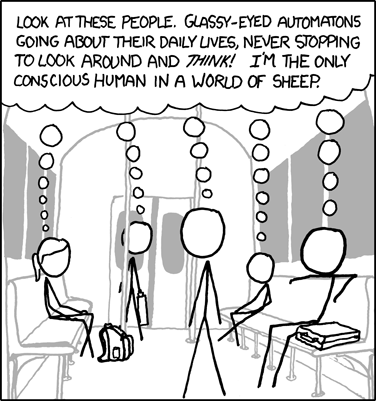
My internal editor drew a line through “the milling crowd,” figuring that we’d understand the milling crowd through the image that follows it. And someone like Renee would catch herself and realize that others are probably having the same thoughts she is, as shown in this XKCD:

It’s the same comic I linked to in my post on Pages For You: narrators and characters who aren’t able to see themselves in the larger sense, or see themselves as other people might see them, become decreasingly satisfying over time, as one reads more novels. Being (or at least feeling) significantly smarter than the character about whom one is reading, without some significantly unusual formal feature to make up for it, makes for tedious reading. The Old Man and Me isn’t tedious, most of the time, and it’s refreshing to find female narrators who are willing to sleep around without shame and connive to get what they want: I’m not sure this is a feminist testament, but at least it makes for an amusing story with writing that keeps Honey from devolving into stereotype and the story from devolving into senescence.

The bottom line: Read The Dud Avocado. Then read The Mind-Body Problem. Still want more? Then find this quasi sequel, but your urge will probably have been satiated unless you’re an American going to Europe, in which case you might empathize with and want to understand those whose footsteps you follow in. Then you can view The Old Man and Me as a learning experience.

The Second Pass also recently wrote on the The Old Man and Me. It’s a blog that I find moving steadily higher in my “must reads.”

The Next 100 Years: A Forecast for the 21st Century — George Friedman

The Next 100 Years is fun because of its contrary, anti-conventional wisdom thinking about the shape of nations: instead of assuming the perpetual rise of China and India, the book sees internal weakness in both, as well as greater problems with a resurgent Russia and a nationalistic Turkey. Rather than focusing on current American battles with what Friedman calls “global jihadist,” which he argues are a passing trend in terms of their overall threat, it examines what a more assertive Russia might look like as it tries to expand its influence in Eastern Europe and the Caucuses. Immigration from Mexico and Latin America is unpopular in the United States today, that immigration might become desired by the late 2020s as industrialized countries age. The United States is a “young” and “barbaric” country using the definitions Friedman gives. And the list goes on.

The problem with The Next 100 Years is that almost every page also contains a wildly implausible assertion or historical reading. To pick one example: after an extended discussion of Russia’s geopolitical interests leading toward 2020, Friedman says that openings in southern Russia combined with a continued American presence in Afghanistan means that “If there were an army interested in invading, the Russian Federation is virtually indefensible.” By conventional metrics, this is true, but it ignores the thousands of nuclear weapons Russia might have. Such an analysis reads like someone planning military adventures in Europe in 1900: it so utterly miscalculates what kind of destruction would occur under its situations that it really doesn’t seem to understand the situation.

Elsewhere, in a specious discussion of the 50-year cycles of American history, Friedman talks about the cycle “From industrial cities to service suburbs,” along with the malaise of the 1970s. He doesn’t mention the Arab oil embargo, energy spikes, or our response to both—instead he focuses on tax policy. Friedman says that in the 1980s, “Reagan’s solution [to economic problems] was maintaing consumption while simultaneously increasing the amount of investment capital. He did so through ‘supply-side economics’: reducing taxes in order to stimulate investment.” But Friedman completely ignores the monetary policy side and Paul Volcker’s efforts to tame inflation (see here, here, and here for more on him). He also ignores the foreign currency issues regarding China, as described, for example, here.

On the war front, the introduction of The Next 100 Years says regarding World War II that “The United States simultaneously conquered and occupied Japan, almost as an afterthought to the European campaigns.” This a) ignores that Japan was the proximate cause of the United States’ entry to the war, b) ignores the enormous strain of fighting World War II in the Atlantic and Pacific, and c) ignores the hundreds of thousands of United States causalities in the Pacific. Calling it an “afterthought” seems wrong. In addition, Friedman writes that:

A country’s grand strategy is so deeply embedded in that nation’s DNA, and appears so natural and obvious, that politicians and generals are not always aware of it.

Funny: I’ve yet to see a country’s “DNA” expressed as a double-helix, and the idea of countries having completely describable characters seems overly limiting and simplistic in this sense.

Still, despite these kinds of problems, Friedman does an admirable if shaky job of refocusing on long-term trends; for example, he says that Vietnam and Iraq were and are, respectively, “merely isolated episodes in U.S. history, of little lasting importance—except to the Vietnamese and Iraqis.” In both cases (at least so far), it appears unlikely that the United States has been permanently hurt, and the great strengths the country possesses, like the universities and immigration that James Fallows writes about here, have not been affected in major ways.

Friedman ties together demographic trends, the status of women, the status of families, and international politics in novel, unusual ways, arguing (for example) that, for example, Osama bin Laden’s rants often include comments about family values and the status of women that indicate he, like Pat Robertson, is riled up about women being independent enough to choose partners, divorce, and so forth. Demographics power some of the major social and political tensions of our era, even when they’re masked by surface reasoning, much as the 100 Years’ War was putatively about the souls of Catholics and Protestants while actually being about the distribution of power and resources in Europe.

I haven’t said much about Friedman’s views about China because those views are so easily arguable. He thinks that China is riven by tensions between wealthy coastal cities and the poor interior, which might eventually tear the country apart again, and that China is heading towards major problems with bad debt, economic structural incoherence, and banking problems. Maybe: but it’s also possible that China will knit itself closer together through telecommunications, roads, and railroads, and that its central leadership is aware of the problems Friedman enumerates.

By the same token, Russia could collapse again around 2020, but one could construct an equally attractive alternative scenario. In his defense, Friedman says that he thinks the broad outlines he gives will be followed even if the specifics are wrong, and in the epilogue he says:

It might seem far-fetched to speculate that a rising Mexico will ultimately challenge American power, but I suspect that the world we are living in today would have seemed far-fetched to someone living at the beginning of the twentieth century.

I’m sure the world of 2100 will seem “far-fetched” to someone from today, but the real question is, “far-fetched in what way?” The way Friedman describes, or some as-yet unforeseen way? I would bet more the latter, amusing though it is to anticipate the former. Too much is left out, including, notably, the threat of nuclear weapons and the possibility of global climate change. He says, however, that “My mission, as I see it, is to provide you with a sense of what the twenty-first century will look and feel like.” On this account he succeeds, provided that he changes the word “will” to “might.”