Effi Briest — Theodore Fontane, with a side of James Wood and Samuel Delany's Paris Review interview

Despite what I wrote in this post, I got a copy of Effi Briest. And you know what? I couldn’t finish it. There were some great lines—my favorite is Effi’s father saying, “There’s nothing so good for one as a wedding, provided of course it isn’t one’s own”—but I couldn’t take the rest, even though I stopped reading the very nice introduction by Helen Chambers after realizing it was prejudicing me against the book:

The sexual dimensions of the age gap [between Effi and her husband] remain beneath the surface of this discreet and allusive novel. They are suggested, as is much that is vital in the inner action, by the symbolic texture of the narrative. Effi’s sexual inexperience at the beginning of the novel is beyond question, and the premature loss of her virginity is prefigured by the twins calling her back to the garden through a window framed by Virginia Creeper

This explains why little seems to happen, since “remain beneath the surface” feels like another phrase for “buried so deeply that you need an even dirtier mind than mine to excavate it. In a Paris Review interview, Robertson Davies says:

I do not respond quite so immediately and warmly to writers in the United States, because their concerns are different from mine and their approach to them is different from mine. They seem to be infinitely concerned with very subtle details of feeling and life. I find this exemplified, for instance, in many stories in The New Yorker where whether the family will have pumpkin pie or something else on Thanksgiving Day is a decision with infinite psychological and sexual repercussions. I take this quite seriously. I admire their subtlety—but I get so sick of it. I wish they would deal with larger themes.
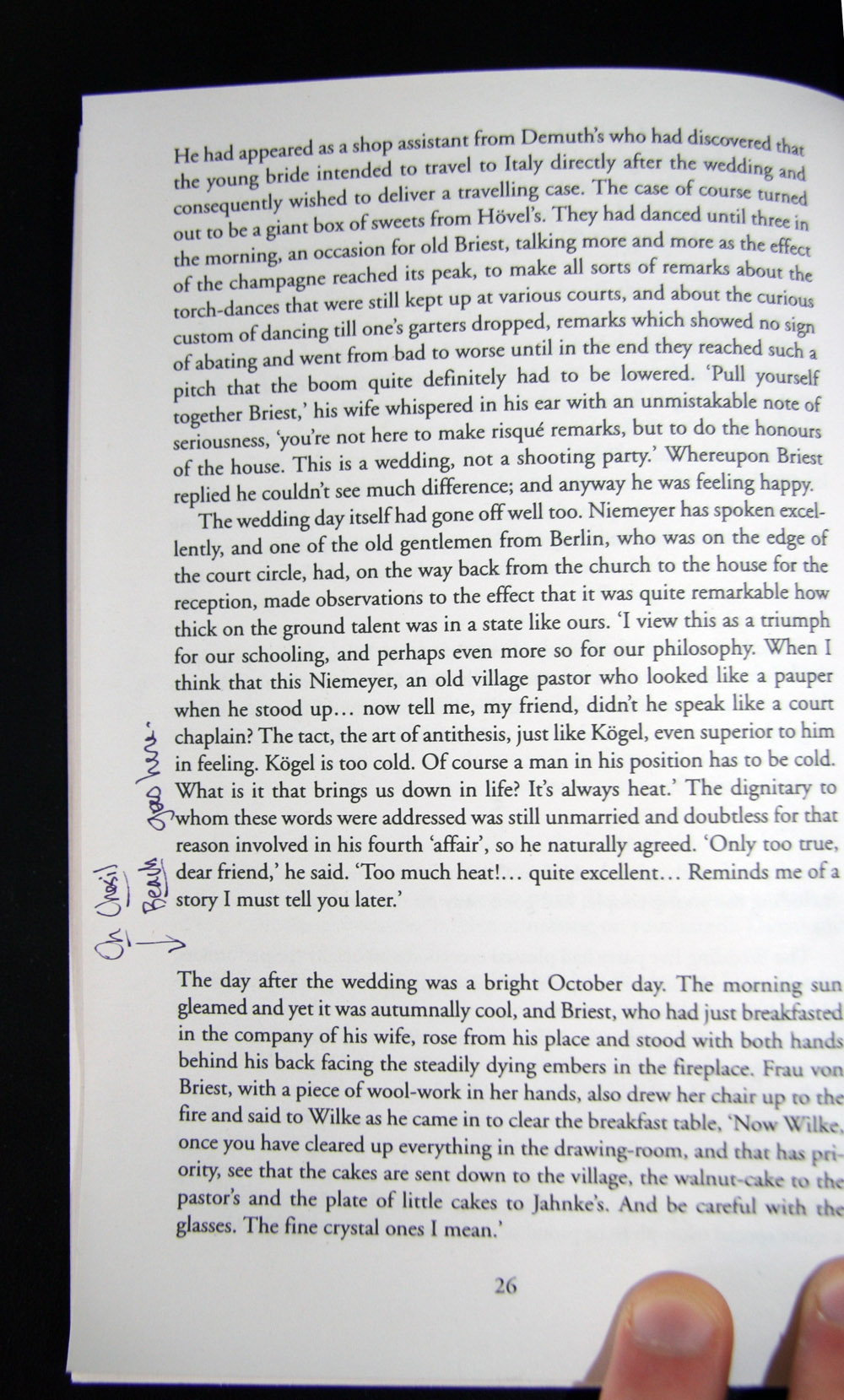
With enough subtlety, substance disappears, and I love his characterization of American Thanksgivings as portrayed in stories. Anyway, Chambers also says of Effi’s husband, “It seems that after years of self-discipline and mortification of the flesh Innstetten has regulated his natural urges into a state of atrophy.” In the margin I wrote, “Yawn,” a judgment that still seems reasonable a week later. Practically the entire text of Ian McEwan’s On Chesil Beach could fit between the end of the wedding scene on page 26 and the next paragraph, which begins, “The day after the wedding was a bright October day,” as if one of the presumably major events of Effi’s life hadn’t just happened. And I’m not talking about the wedding.

I was thinking about Effi Briest when I read Samuel Delany’s Paris Review interview in the Summer 2011 issue. He talks about two characters in his work Nova who almost have an incestuous relationship. The interviewer begins this exchange:

Did you intentionally want to make something the reader could only speculate about, rather than be certain of?

Delany: Certainly as far as the incest goes. Suggestion is a literary strategy. But when, in 1968, works like Henry Miller’s Tropic of Cancer and Black Spring and Lawrence’s Lady Chatterley’s Lover were legal to publish and sell in this country, the age of innuendo and the coyly placed line of white space, as the hero envelops the heroine in his arms, ended. Fifteen years later, AIDS rendered them permanently obsolete.

Today, I watch seminar rooms full of graduate students misread both [Alfred] Bester and [Joseph] Conrad, because they no longer have to wonder about the possibility of such illegal elements occurring in the story and the compensating possibility of suggestion as a writerly strategy for representing sex and violence.

I am one of those graduate students, and I evidently don’t have the exquisitely tuned sex detector that pre-’68 readers might have developed. This became especially clear in a seminar on Henry James’ The Golden Bowl, when one of my professors at the University of Arizona began to point out the many euphemisms and double entendres left by James, beginning with the name “Assingham” and proceeding from there. I mostly wondered what the big fuss was about, given the modesty of the phrases in questions, but I didn’t realize how generational my readings were until I discovered the Delany interview an hour ago.

Delany is right—I don’t have a lot of tolerance of “innuendo and the coyly placed line of white space.” That doesn’t mean I want every novel to be wildly explicit, or that I want pornography to merge with literary fiction, but it does mean that a lot of older books seem coy. Like Effi Briest. Today, when McEwan’s aforementioned novel takes those white spaces and turns them into entire works of their own, it’s hard to accept the white space, or an extraordinarily “discreet and allusive novel” where Virginia Creepers (or pumpkin pie) have “infinite psychological and sexual repercussions”

I didn’t expect to have my malady so accurately and suddenly diagnosed, however, and it wasn’t until I read Delany that I was able to write this post. He makes me want to be a more careful and considerate reader. Or maybe novels do have a sense of technological progression, or something like progress, or even progress itself. James Wood speculates on the subject in his review of Chang-Rae Lee’s The Surrendered:

Does literature progress, like medicine or engineering? Nabokov seems to have thought so, and pointed out that Tolstoy, unlike Homer, was able to describe childbirth in convincing detail. Yet you could argue the opposite view; after all, no novelist strikes the modern reader as more Homeric than Tolstoy. [. . .] Perhaps it is as absurd to talk about progress in literature as it is to talk about progress in electricity—both are natural resources awaiting different forms of activation. The novel is peculiar in this respect, because while anyone painting today exactly like Courbet, or composing music exactly like Brahms, would be accounted a fraud or a forger, much contemporary fiction borrows the codes and conventions—the basic narrative grammar—of Flaubert or Balzac without essential alteration.

If literature progresses technologically, it still doesn’t do so in quite the same way as technology: no one would use a camera from 1925 unless they were a masochist, had a historical fetish, or were trying to achieve some very peculiar artistic effect. The rest of us use digital cameras manufactured in the last five years, or phones, given the obvious advantages of convenience. But many writers from 1925 still feel quite modern—Fitzgerald, most obviously, but many others too. Yet I don’t find that much 19th Century fiction really moves me (exceptions: Moby-Dick, The Scarlet Letter). Contemporary writers have a greater and perhaps infinite rein to express what they need to express, and by contrast older writers do seem coy, even if this is an unfair judgment on my part—or the kind of judgment that might be tempered by age. The more I think about the idea, the more I see how others have considered it. For example, this review of William Deresiewicz’s A Jane Austen Education is bizarre because it’s like reading about myself, right down to the love for Madame Bovary:

In 1990, William Deresiewicz was on his way to gaining a Ph.D. in English literature at Columbia University. Describing that time in the opening pages of his sharp, endearingly self-effacing new book, “A Jane Austen Education,” Deresiewicz explains that he faced one crucial obstacle. He loathed not just Jane Austen but the entire gang of 19th-century British novelists: Hardy, Dickens, Eliot . . . the lot.

At 26, Deresiewicz wasn’t experiencing the hatred born of surfeit that Mark Twain described when he told a friend, “Every time I read ‘Pride and Prejudice’ I want to dig her up and hit her over the skull with her own shinbone.” What Deresiewicz (who has considerable fun at the expense of his pompous younger self) was going through was the rebel phase in which Dostoyevsky rules Planet Gloom, that stage during which the best available image of marriage is a prison gate.

Sardonic students do not, as Deresiewicz points out, make suitable shrine-­tenders for a female novelist whose books, while short on wedding scenes, never skimp on proposals. Emma Bovary fulfilled all the young scholar’s expectations of literary culture at its finest; Emma Woodhouse left him cold. “Her life,” he lamented, “was impossibly narrow.” Her story, such as it was, “seemed to consist of nothing more than a lot of chitchat among a bunch of commonplace characters in a country village.” Hypochondriacal Mr. Woodhouse, garrulous Miss Bates — weren’t these just the sort of bores Deresiewicz had spent his college years struggling to avoid? Maybe, he describes himself conceding, the sole redeeming feature of smug Miss Woodhouse was that she seemed to share his distaste for the dull society of Highbury.

I’m 27. Maybe I’ll have considerable fun at the expense of my pompous younger self one day.

I bought A Jane Austen Education, which shouldn’t be surprising given my feelings about Deresiewicz. Maybe he will teach me to read Austen more kindly, more attentively (Wood has succeeded at least somewhat in that respect: his discussion of free indirect speech in How Fiction Works finally gave me the tools to figure out why people like Austen). I’m still not sure that it will bring Effi Briest to life, and even if it does, it might be more like reanimating a corpse (which, as genre fiction teaches us, is replete with dangers) than interacting with a live person.
Nine and a Half Weeks: A Memoir of a Love Affair — Elizabeth Mcneill

Most novels (and memoirs) leave you with a sense of distance, a sense of being at a comfortable remove. Nine and a Half Weeks doesn’t: it’s too graphic, too immediate, too flat. One sees this effect in the first sentences, without any preamble as to who these people are and how they came to be: “The first time we were in bed together he held my hands pinned down above my head. I liked it. I liked him. He was moody in a way that struck me as romantic; he was funny, bright, interesting to talk to; and he gave me pleasure.” One senses quickening thoughts and pulses in those short sentences, and even in the long one, where semicolons could be periods, and the last descriptor—”he gave me pleasure”—is the really important one. You don’t get the very ironic tone of a book like Alain de Botton’s On Love, letting us see that love is irrational but really understandably so. Alain, the narrator of On Love is basically a needy, endearing, neurotic weakling; his self-consciousness contrasts so much with the man in Nine and a Half Weeks that they’re practically different species.

There are clever phrases in the memoir, as when the narrator says of her lover, “His face turns attractive when he talks;” I like the strange word choice, as if the head is physically turning, or as if he has two, or multiple, faces. A few moments are archaic—the man describes a friend or rival coming over as “This dope” (emphasis in original), which hasn’t been currently slang in decades and stands out in a book that otherwise stands out for not being part of any particular time. The prose holds up, and the narrator has an eye for tedious rituals, as when she tells of a “statistical tale,” where the contrast of statistics and narrative stands out:

In the middle of the statistical tale he’s requested from me—brothers and sisters and parents and grandparents, hometown, schools, jobs—I stop and close my eyes . . . please, I think, inarticulate even in my own mind, unable to turn to him and make the first move, please . . .

There’s a pervasive fear of dullness running through the memoir. The narrator notes that she and her lover looked like “An attractive, well-educated couple in New York City, average, middle-class, civilized.” That contrasts with what came before and will come after. Or does it? The memoir teases us by making us wonder if the the narrator isn’t so unusual as public discourse would make her out to be. I think the story’s flatness, the unwillingness to engage in direct commentary on what’s happening, points us in this direction, as when the narrator says, “I am standing, nearly on tiptoes, across the room from him, my arms raised above my head. My hands are tied to the hook on the wall on which his one large painting hangs during the day.” She’s hung like a painting and enjoys it. There is no further morality or analysis. Sixty Minutes plays in the background, a reminder of the middle America the narrator feels like she’s leaving behind even when she imagines it as a foil to her own actions.

Images repeat through the memoir. Scarves reappear. The words “like” and “love” are reconfigured like body parts. One senses Nabokovian echoes in the prose that one distantly hears on the first read but can’t make out. The narrator also feels her internal sense of self discombobulating, like a washing machine that shakes itself apart from within. She knows this is happening and imagines the reactions of otherwise course, until she writes of her experience.

We don’t know what the narrator wants beyond the obvious: sexual satisfaction. That she might only want the obvious might be the most frightening thing of all. What if everything else she has—a job, presumed communal respect, literary and political opinions—don’t matter very much? What if your real self isn’t those frontal cortex developments, but something deeper, more primal? I find posing the questions unsettling. The answers implied by Nine and a Half Weeks are more so. The patina of everyday experience conceals so much, especially in the realm of inchoate desire that social life is designed to channel. What happens when the channeling breaks? What happens when we want it to break? I’m reminded of Donna Tartt’s The Secret History, which also features the discarding of the mind in pursuit of a mental state or feeling very unlike the one most of us presumably inhabit most of the time—the mental state worried about how much money we have, what other people think about us, whether we’ll get the job / life partner / degree / accommodates of our dreams.

The narrator likes the man’s dominance above all other traits, which derive from that dominance. He says of a friend or rival, “he’s got no guts whatsoever.” Note what she likes in the contrast he offers by comparison. He shows mastery by reading Gide in French and Kafka in German, both implying continental expertise and sexuality. Some moments are obvious, as when the narrator reads with “his thick pen solid and comfortable in my hand.” One doesn’t need to be Freud to imagine that the pen is not just a pen. In the same scene, the narrator says, “I write the letter (‘. . . met this man a few days ago, nice start, very different from Gerry, who’s more than happy with Harriett these day, you remember her . . .’)” (sic). The dig at her ex-boyfriend is subtle but present: he isn’t dominant, won’t tie her up, and presumably has settled with a lesser woman.

He demonstrates great knowledge too: “[. . .] whatever else he may do [in] it, this man clearly does read his original-language books in bed; why would anyone want to miss out on one of the most satisfying pleasures available? All he’d need is a better bulb, a few more pillows, and a reading lamp. . . .” The room sounds sad and denuded, but it doesn’t matter much, even if the narrator is right about beds, which are good for more than just sleeping and that other thing. He offers commands, as when the narrator says:

He guides my hands between my legs and says, ‘I’d like to watch you make yourself come.’

He is sitting idly, comfortably, one leg crossed over the other, the creases sharp in the freshly cleaned suit. I do not try to move my hands. He waits. ‘You don’t understand.’ My voice cracks. ‘I never . . .’ He is silent. ‘I’ve never done that in front of anybody. It embarrasses me.’ “

She does, of course. That it embarrasses her is part of the point. What embarrasses her in the moment becomes the fodder for memoir, even under a pseudonym, long after. She likes giving power to him, which she does by letting him watch her masturbate. She also does by repeating how much she loves him, but I don’t think he ever says it back. It’s like he doesn’t need to, and by withholding the confirmation of his love he creates a neurotic fear in her. Only at one moment does he crack, when “All at once he is a decade my junior, a very young man asking me to have a drink with him, expecting to be refused.” But that doesn’t last long. Little does in this memoir, including their relationship, whose duration is given away by the title. But the narrator learns a lot in a short period. She says, “If you’ve never screamed, out of control, you can’t imagine how it feels. Now I know how it feels, it’s like coming.” She never goes the Biblical or mythological root and thinks there are things we shouldn’t know. For her, all knowledge is knowledge.

You can see that McNeill’s memoir doesn’t sit well with current ideals of equality and mutual respect in all fields. As Laura Kipnis says in “Off Limits: Should students be allowed to hook up with professors?” for Slate.com, “Feminism has taught us to recognize the power dynamics in these kinds of relationships, and this has evolved into a dominant paradigm, the new propriety.” Feminism has taught us to recognize power dynamics, but it should also teach us to recognize points of view. The narrator gets this; she thinks the man’s room is “too plain to be called plain. It’s austere, if you want to be charitable, or chic, if you want to be snide, or boring, if you want to be honest. It is not, in any event, a room you’d call cozy” {McNeill “Love”@9}. So the narrator is aware of angles, points of view, possibilities. I’ve been told I use “or” a lot in my own writing. It’s a useful word for people who perceive many ways of describing things, and here it betrays an openness to experience that the memoir exploits. She has a strong theory of mind that weakens as she awakens to herself.

I should point out that I call the narrator “the narrator” as opposed to “McNeill” or something more conventional because she feels like a fictional person more than a real person (which is strange, given how many fictional characters seem real, but that’s a topic for another time). Elizabeth McNeill is itself a pseudonym. We don’t know who the real author is. The man is never given a name—he’s only given traits, like his penchant for Brooks Brothers and sadomasochism (sometimes, especially when it comes to belts, simultaneously). So I don’t entirely know what to call them, or what to call their madness, if it is indeed madness. Can we find pleasure in madness? The narrator’s point is that many of these normally distinct categories eventually blur. I think that’s one of Tartt’s points in The Secret History too. There is more to be written about the book—its strange tenses, leaping from past to present to future, to what extent we should indulge in or avoid attempting to apply universal lessons—but this gives flavor of it and why its merits still show.

Summary Judgement: In the Basement of the Ivory Tower: Confessions of An Accidental Academic — Professor X

In the Basement of the Ivory Tower is fun, filled with anecdotes, and describes many of the feelings I’ve had in the higher education sausage mill, but you’re better off reading the eponymous Atlantic article from which it sprang. You’ll get 80% of the content with 20% of the time. Still, I especially like this bit from the book because nearly the same thing happened to me four weeks ago:

On the first night, I ask a few questions. How many of you took this class because of an abiding love of literature? No hands go up, ever—they are honest, I will give them that. How many of you are taking this class only because you have to? Now all hands shoot up, to the accompaniment of some self-conscious laughter.

I taught a technical writing course to a room full of public health, nutritional science, and engineering majors and asked how many were in the class because they want to learn more about the great and mysterious power of the English language. No hands. How many were taking it because they had to? All the hands. More of my students could write coherent sentences than Professor X’s students, probably because they’re juniors and seniors who’ve been through a fair number of classes, but “more” is not the same as “all.” Few of them cared. I want to imagine that I imparted real skills through longer and more difficult writing assignments than most of them had faced, but I’m not sure I did. It’s not easy to interest people in a topic when they lack intrinsic interest and don’t see it as valuable to their careers.

Professor X is a good writer (note too that his name is a pseudonym, and he isn’t, to my knowledge, claiming to the leader of the X-Men); he says, for instance, that his students “lack rudimentary study skills; in some cases, they are not even functionally literate. Many of them are so dispossessed of context that every bit of new information simply raises more questions.” Notice that phrase, “dispossessed of context,” which I’ve never thought of in that way before, and yet it fits: the Oxford American Dictionary says that dispossessed means to “deprive (someone) of something that they own, typically land or property,” and one gets the sense that educational system have failed Professor X’s students as much as they have failed the systems (note that there is plenty of blame to go around, and I don’t wish to sling it in this post). There are many moments like this, when unexpected artistry arrives.

This sense of the unexpected extends to Professor X’s grasp of the larger institutional and societal forces at work; he notes that college is supposed to be for everyone even when we’re supposed to have high standards. These two ideals seldom leave unbloodied when they meet in the real world. But he doesn’t have a lot of answers to problems, which is okay because a) large, complex problems often don’t have answers and b) he’s trying to tell his own story, not write a polemic. If you know someone of questionable literacy attempting to go to college and frustrated by the experience, you should recommend this book to them. They probably won’t read it, but if they did, they’d know more. I get the sense that Professor X is working more at the individual than societal level. That might also be what makes his book fun.

Some of the responses to his Atlantic article are bizarre, written by people who seem to have no idea what’s happening on the ground. Some of the later material drags. I like the book but would only recommend it to specialists; I read it because I’m working on my own academic work related to university novels. If it weren’t for that, I don’t think I would’ve gotten enough from it, beyond the Atlantic article, to justify reading.

What Ever Happened to Modernism? — Gabriel Josipovici

I’ve been meaning to write about What Ever Happened to Modernism? for a while, but this This New York Review of Books essay by Eliot Weinberger hits the major points I’d like to make better than I would’ve. It also describes the major issue I have with What Ever Happened to Modernism?: we never really find out what, if anything, happened to Modernism—or who, in Josipovici’s eyes, we should admire. Weinberger notes that “There are some unkind words about Martin Amis, Ian McEwan, and Julian Barnes (“this petty-bourgeois uptightness, this terror of not being in control, this schoolboy desire to boast and to shock”) [. . .]” and that “Regardless of whether a climate can see—and Josipovici’s condescension that laureled mediocrities can’t help being what they are—the argument is undermined by the fact that he declines to name a single living author who should be praised.” Both are true. Polemics work best when we have positive and negative examples. Josipovici mostly gives us the negative.

The other thing I notice in What Ever Happened to Modernism? is the slipperiness of definition, which leads to the larger problem of Modernism and Postmodernism in general: we can get point to some works that we think embody some values of either movement, but we find deriving general principles from those specific works hard, if not impossible. Now, the real question to anyone who says anything about Modernism or Postmodernism is, “What do you mean by those words or artistic movements?” Even the phrase “artistic movements” might be wrong, since some have argued for the political value of them, and to the extent art and politics are separate one should note the binary.

How do we decide on what Modernism is? We can’t, really, as Weinberger notes:

Every general consideration of Modernism quickly crashes on the rocks of categorization: Which Modernism? Is it Rilke or Tristan Tzara? Matisse or Duchamp? Thomas Mann or Gertrude Stein? Arnold Schoenberg or Duke Ellington? Nearly anything that can be said about the one can’t be said about the other. Josipovici attempts to navigate these waters by simultaneously broadening the definition of Modernism itself, while greatly limiting the range of its concerns, its varying contexts, and its enormous cast of twentieth-century characters.

The more specific the definition, the more it leaves out; the more general, the harder the whole idea is to discuss. That doesn’t stop writers of polemics, of course, and as I read What Ever Happened to Modernism? I did think. . . something. I’m just not real sure what exactly I thought or why. I’m flipping through my much-marked copy, looking for a characteristic passage or turn of phrase, but you’d be better off reading Weinberger on Josipovici.

I suspect I’m not the only person with such a hazy reaction. Lately, I’ve been rereading novels I really admire as I start another novel of my own. Those I admire include Donna Tartt’s The Secret History, Umberto Eco’s The Name of the Rose, Tom Perrotta’s Election, and Carlos Ruiz Zafón’s The Shadow of the Wind. After reading them, I almost always have a better sense of what I should be doing as a writer and what a particular book should do. This feeling isn’t limited to fiction: I get the same sense from James Wood’s How Fiction Works, or John Barth’s essays in The Friday Book. They’re all enmeshed in individuality.

Josipovici is aware of his narrativizing tendency and some of the dangers of definition; he says:

Naturally I think the story I have just finished telling is the true one. At the same time I recognise that there are many stories and that there is no such thing as the true story, only more or less plausible explanations, stories that take more or less account of the facts. I am aware too that these stories are sites of contestation; more is at stake than how we view the past.

There are many stories, and I don’t fully buy his.

Speaking of Barth, I find myself most drawn to his formulation in The Friday Book, which is cruelly out of print:

I happen to believe that just as an excellent teacher is likely to teach well no matter what pedagogical theory he suffers from, so a gifted writer is likely to rise above what he takes to be his aesthetic principles, not to mention what others take to be his aesthetic principles. Indeed, I believe that a truly splendid specimen in whatever aesthetic mode will pull critical ideology along behind it, like an ocean liner trailing seagulls. Actual artists, actual texts, are seldom more than more or less modernist, postmodernist, formalist, symbolist, realist, surrealist, politically committed, aesthetically ‘pure,’ ‘experimental,’ regionalist, internationalist, what have you. The particular work ought always to take primacy over contexts and categories.

Notice how Barth conveys his view of generality in a single word: “suffers,” as if literary categorization is a disease. In the wrong person, it is one. Discussing generalities is not much fun unless you have a lot of specifics to back them up, and I have no way to paraphrase or add to Barth’s last sentence from that quote: “The particular work ought always to take primacy over contexts and categories.” Martin Amis’ Money, regardless of how you categorize it, still stands out to me as being a) unique and b) good, which very few novels of any sort achieve. To lambast Amis in general, as Josipovici does, is to miss all those particularities that make him stand out. Of course, I’m committing the same sin here because I’m not citing specifics in Money. But I also sometimes rise to the level of the work being discussed, so perhaps that sin can be excused.

A Billion Wicked Thoughts: What The World’s Largest Experiment Reveals About Human Desire — Ogi Ogas and Sai Gaddam

A Billion Wicked Thoughts is good but not great; it covers a lot of much-discussed studies from an angle that, although novel, isn’t quite novel enough. The book is like Why Women Have Sex: both are written by pairs of popularizing intellectuals who probably want to earn more money and affect the social conversation more than they could through writing purely academic work. Anyone really interested in issues around sexuality and evolution is better served by The Evolutionary Biology of Human Female Sexuality, which is insanely detailed and concomitantly worth reading.

In A Billion Wicked Thoughts, the forward by Catherine Salmon notes, “There is a lot of truth to the belief that if you can imagine it, you can find it as Internet porn.” If you can imagine it and can’t find it, you probably have a good business model. Or you can make the porn yourself. But the ubiquity of online porn, combined with its breadth, makes it a trove of information about behavior that, as Ogas and Gaddam point out, most people are reluctant to share. If they do share, what they share and how they shade information can render that information nearly useless. In contrast, the Internet feels anonymous enough to let your search engine rip. So Ogas and Gaddam decided to study search queries, sort them (apparently using Amazon’s Mechanical Turk), classify them, and analyze them. We also get lots of specific sample search queries, like “family nude beach” (167), “anal sex benefits” (168), and “nude construction workers” (168). These illustrate important points, I’m sure, and I’m not including them in this post purely to ensnare unwary search engine users.

Using Internet search queries reduces some forms of bias while presumably introducing others—like what we know about people who don’t use the Internet. What can see about all those searchers who aren’t looking for porn? What can we say about sample bias?
The authors are aware of this and say, for example:

The male desire for older women is also reflected in the popularity of ‘mom’ searches on PornHub (since teen content is highly visible and easily accessible on PornHub, users may be more likely to manually type in searches for content they don’t immediately seen.

But how do we know about the proportions of searchers to non-searchers? This may be an example of the old joke about the “Streetlight Effect:

A policeman sees a drunk man searching for something under a streetlight and asks what the drunk has lost. He says he lost his keys and they both look under the streetlight together. After a few minutes the policeman asks if he is sure he lost them here, and the drunk replies, no, that he lost them in the park. The policeman asks why he is searching here, and the drunk replies, “this is where the light is.

Internet searches are where the light is right now.

Still, the project is interesting, and, in the absence of other data, it makes some sense to use what’s available. Ogas and Gaddam structure the book as a series of chapters that use Internet porn search classifications as headers, note some of those searches, and explain what those searches might mean using research that draws from evolutionary biology, evolutionary psychology, sexology, and similar fields. It’s a readable introduction, but it’s also part of a torrent of pop sex books over the last decade, which you can find through Amazon’s “if you bought this, you’ll also like this. . .” feature. If you’ve read enough of those books, you probably don’t need this one. Read this Salon Q&A instead.

The prose in A Billion Wicked Thoughts is competent—and, unlike Sex at Dawn‘s whacky metaphors and comparisons that strive for style and instead hit silliness, it rarely strays into the ludicrous. Although the purpose of nonfiction is to convey information, the best nonfiction goes beyond that stage to become art (Umberto Eco makes this as a subsidiary point in Confessions of a Young Novelist). A few jokes might even be intentional—I particularly like “On the web, group sex porn has exploded into a variety of sub-genres” (emphasis added)—but A Billion Wicked Thoughts doesn’t quite get there, although there’s nothing wrong with it.

Having little wrong isn’t enough to be right, and they still use coinages like “The Miss Marple Detective Agency” to describe a large body of research demonstrating that women’s physical reactions to sexual stimuli often differ markedly from their psychological reactions to sexual stimuli. You can get a lot of the material in this chapter from the New York Times article “Women Who Want to Want,” starring psychologist Lori Brotto instead of psychologist Meredith Chivers instead of psychologist Lori Brotto.

The upshot shot of the chapter is that many women appear to physically respond to sexual stimuli even when their conscious minds aren’t responsive or even find it disturbing—and those same women are frequently unaware of the phenomenon. Ogas and Gaddamn analogize the situation to the mind-body problem in philosophy (which also happens to be the name of an excellent novel by Rebecca Goldstein). The upshot: “women need to be psychologically aroused.” This appears to be true, but although the research points in that direction, it isn’t perfect; we have effects, but the causes remain uncertain.

There’s still evidence in that direction, and Ogas and Gaddam discuss much of it, including the female penchant for romance novels (which, although sexual, also focus much more on narrative and emotional connection than porn) and the male penchant for porn featuring anonymous sex focused in particular on body parts. They’re also aware of their own biases, as when they note “We all have our favorite theories that fit our experiences and prejudices.” That’s true, and it’s hard to shake ideology out of sex research. It’s also hard to shake one’s own training, and mine in literature makes me think some of their literary analysis is suspect, but they’re good at a naive version of Franco Moretti’s distant reading, as when they note how rare it is for heroes in romance novels to be truly, consistently poor:

In modern romances, the heroine often has a high-powered, high-paying job of her own. Romances feature women who are corporate executives, politicians, and financiers. Since such heroines no longer require a man to provide for their needs, has this cultural transformation led to more romance heroes with limited resources?

Not at all. If a heroine is rich, then the hero is even more rich.

They cite Janice Radway’s Reading the Romance, which studies the genre from a politically inflected but still fascinating perspective. They cite a lot in general, and their notes / bibliography is close to 100 pages. I always admire a book with a very, very big bibliography. In this respect, A Billion Wicked Thoughts satisfies.

Links: Drinking, e-mail, grad school opportunity costs, ‘The Entire Ukraine Is a Brothel’

* The educational value of booze. See further The Joy of Drinking.

* How the World’s Most Famous Computer Scientist Checks E-mail Only Once Every Three Months. I shoot for once every two days and often miss. Paul Graham’s “Disconnecting Distraction” is also on point. Before I open my e-mail in box, I try to ask myself, “Will doing so get me paid or laid or make me happier?” The answer is almost always “no.”

* I sympathize with the argument in “Death to high school English,” especially where Brooks says:

Only now, a decade and a half later, after seven years of teaching college composition, have I started to consider the possibility that talking about classics might be a profound waste of time for the average high school student, the student who is college-bound but not particularly gifted in letters or inspired by the literary arts. I’ve begun to wonder if this typical high school English class, dividing its curriculum between standardized test preparation and the reading of canonical texts, might occupy a central place in the creation of a generation of college students who, simply put, cannot write.

Problem is, I’m not sure the structure of high school English is the biggest problem so much as the generally uninspiring teachers in front of the classroom. Paul Graham’s The Age of the Essay is also on point here.

Although I’m in grad school for English lit, I find most capital-C Classics pretty tedious.

* What you can do instead of grad school, good advice. You should also read Robert Nagle’s Straight Talk About Grad School if you haven’t already. I find it more true as I go on.

* “Even as more people are struggling to pay medical bills and being rushed through office visits with their doctors, an elite group with money has another option: exclusive medical care, around the clock and anywhere in the world, including on a yacht or private plane.” Expect this dynamic to increase as insurance worsens and government becomes more tied to health care; this also basically describes how English health care works.

* FBI: If We Told You [All the Nasty Shit We Do, Like Spying], You Might Sue. Which sounds like an excellent reason. . . to sue. And a great ad for the ACLU!

* It’s hard to read about books like “A Billion Wicked Thoughts without thinking that a lot of what we think we know, we don’t.

* ‘The Entire Ukraine Is a Brothel’. Sounds far more entertaining than most protests.

* I’ve started reading Tim Harford’s Adapt, which is interesting so far but makes me worry that he might be going in an Gladwellian direction.

* Among the strangest queries that have brought people to The Story’s Story recently: “teen jeans ass.”

The world is getting better, In the Plex edition

From Steven Levy’s In the Plex; How Google Thinks, Works, and Shapes our Lives, an astonishingly good and detailed book that, as of page 146, doesn’t feel padded:

[. . .] the founders themselves embraced ‘Don’t be evil’ as a summation of their own hopes for the company. That was what Google was about: two young men who wanted to do good, gravitated to a new phenomenon (the Internet) that promised to be a history-making force for good, developed a solution that would gather the world’s information, level the Tower of Babel, and link millions of processors into a global prosthesis for knowledge. And if the technology they created would make the world a better place, so would their company; Google would be a shining beacon for the way corporations should operate: an employee-centric, data-driven leadership pampering a stunningly bright workforce that, for its own part, lavished all its wit and wizardry on empowering users and enriching advertising customers. From those practices, the profits would roll in. Ill intentions, flimflammery, and greed had no role in the process. If temptation sounded its siren call, one could remain on the straight path by invoking Amit Patel’s florid calligraphy on the whiteboards of the Googleplex: ‘Don’t be evil.’ Page and Brin were good, and so must be the entity they founded.

Ambition linked to knowledge of how to execute is evident throughout the book, but especially here, given that the company’s major players aren’t just content with being big—they want to be big and be good, with a presumably evolving definition of what “good” means. This is a bit like the United States itself, which isn’t collectively content to merely be—there’s a very long cultural strain of being an icon or role model. Such a desire often leads the country to unfortunate lurches that mostly seem to be corrected as time goes on.

Reading the news on a day-to-day basis often gives one a sense of doom and disaster. Reading a book like In the Plex reminds one that the world is going places even if politicians and the politics they make don’t realize it. The world is big and strange, and it’s getting more so over time—if one takes the time to realize it. Google may or may not “be a shining beacon,” but its goals are hard not to admire, even if they’re cloaked i religious language (“the straight path”). I use Google most days without thinking about all the thought behind the company, which is busy making the world a different place very fast.

It helps that Levy is telling the story; much like Insanely Great: The Life and Times of Macintosh, the Computer that Changed Everything, he manages to compress a great deal of information and personality into a small space. He imparts some of the sense of magic Google itself is supposed to inculcate—notice the reference to “wit and wizardry”—and some of the sense of optimism that we can do things if we really want to.

I've been writing academic

For the last couple weeks I’ve been spending a lot of time on my (second) publishable paper, this one on the contrasting temperaments in Elaine Dundy’s The Dud Avocado and Ernest Hemingway’s The Sun Also Rises. They share many superficial characteristics: both tell the stories of decadent Americans in Europe shortly after World Wars; both feature protagonists who do not have major or pressing financial responsibilities; both feature a period of time in Paris punctuated by a trip to Spain that ends up back in Paris; both include characters lacking specific, tangible objectives that propel their travels. Thirty years after The Sun Also Rises, The Dud Avocado continues the tradition of having Americans wander through Europe, but the attitude it takes is predominantly comic, in contrast to the tragic temperament its predecessors shows.

I think it’s an interesting paper—but authors are inclined to think as fondly of their papers as parents are of their children—but writing it sucks up most of the time I’d otherwise use to blog. Blogging and academic writing are usually complements, not substitutes, but in this case the increasing price of blogging relative to paper writing makes me do less of it.

For now.

People like A Game of Thrones? The novel, I mean?

The writing in George R. R. Martin’s novel A Game of Thrones ranges from pretty good to indifferent to pretty bad to silly: it’s filled with cliches, the characters all sound the same, and I can’t figure out why we should care if one bunch of schemers rules the realm instead of another bunch of schemers. In the end, the peasants are still covered in shit. The politics are complex, but they’re complex in the way of corruption everywhere, with people mostly out for their own interest. This sort of thing led to the U.N. and democracy in the West and Japan.

Presumably the world of A Game of Thrones will head in that direction if it hits an industrial revolution, and you could have a lot of fun grafting contemporary parallels on the world. As this description shows, it’s somewhat hard to take this sort of feudalism seriously.

Corruption can be fun to read about, but the prose doesn’t work in A Game of Thrones. The book can’t decide on a faux medievalism or a relatively current register, so it goes for both. With most sentences, you could remove a sword, drop in a gun, and still have the same basic idea. The language remains modern while the nominal concerns are medieval; this is the problem so many fantasy novels have that Tolkien doesn’t. These problems start early; on the second page, “Will could sense something else in the older man. You could taste it; a nervous tension that came perilous close to fear.” Using “perilous” instead of “perilously” is the kind of thing that might could for style, but the sentence itself is still cliche. How many times has something been so close or immanent that a character could taste it?

The inverted word order is also evident early: “All day, Will had felt as though something were watching him, something cold and implacable that loved him not.” The last few words are equivalent do “didn’t love him,” and they’re okay on their own, I suppose, but such inversions are as far as style goes. You don’t have to be Martin Amis to find this tedious after a while (Another example, this time in dialogue: ” ‘Direwolves loose in the realm, after so many years,’ muttered Hullen, the master of horse. ‘I like it not.’ “). A few pages later, we skip to the point of view of Bran, who “rode among them, nervous with excitement,” another description that I’ve never seen in a novel before. There are repeated appeals to honor throughout, as on page 4: “The order had been given, and honor bound them to obey.” Honor appears to bind them to do things so stupid that they die for them.

Then there are “as you know, captain” speeches: “The blood of the First Men still flows in the veins of the Starks, and we hold to the belief that the man who passes the sentence should swing the sword.” Blood the first man might have been original before the numerous references to the blood of Numenor in Tolkien. By now, appeals to genetic similarity dictating present behavior grow tiresome, along with anger flashing in eyes, “I was born a Tully and wed to a Stark [. . .] I do not frighten easily,” and so on.

Viserys Targaryen gets introduced early too, and in case you didn’t really know he was the bad guy, tells his sister than he’d let a 40,000-man barbarian horde rape her to regain his throne, and he also gives her a terrible “titty twister,” (also known as “purple nurple“) which is a term I don’t think I’ve heard or thought about since middle school. Are these phrases insanely juvenile? Absolutely, but a book like A Game of Thrones calls them forth. The dialogue is precisely what Francine Prose described in Reading Like a Writer:

This notion of dialogue as a pure expression of character that (like character itself) transcends the specifics of time and place may be partly why the conversations in the works of writers such as Austen and Brontë often sound fresh and astonishingly contemporary, and quite unlike the stiff, mannered, archaic speech we find in bad historical novels and in those medieval fantasies in which young men always seem to be saying things like, ‘Have I passed the solemn and sacred initiation test, venerable hunt master?’ “

Prose is parodying bad fantasy novels, but the parody is hardly a parody: most fantasy writers haven’t figured out how to make their characters’ speech work on multiple levels or how people vary their listening and speaking according to status. People assume a great deal; as Prose shows elsewhere, they assume a great deal about their audience, speak obliquely, are riven by multiple desires, and so on. When we read the ponderous speechifying so popular in fantasy, it breaks the very fantasy it’s trying to accomplish for anyone who knows how people actually speak.

There are some good sections but they’re intermittent and relatively simple changes could lead to tremendous improvements.

One thing I like about The Magicians is that it doesn’t succumb to this kind of speechifying: the characters often talk past one another, and they are constantly interrogating themselves. Quentin’s major flaw is his narcissism: he’s so wrapped up in his own misery, and then his own relationship with Alice, and then the consequences of the his-and-her cheating set, that he sets himself up for the pain that follows. Too bad. If you like standard sword-n-sorcery fantasy, you’ll like A Game of Thrones. If you’re looking for something different, like Lev Grossman’s The Magicians, you’ll be disappointed. Martin might admire Tolkien, but he doesn’t have Tolkien’s consistent command of language to make his work comparable.

Since people can’t be reading Martin for the writing itself, what are they reading him for? The most obvious answer is plot, since it’s fun and fast-paced. The novel demands careful reading if you’re going to follow who’s killing whom and why, if not for the quality of its prose. Even if you are following the reasons for murder, expect to be confused at points (in this respect, and only this respect, does A Game of Thrones resemble John Barth’s The Sot-Weed Factor). It’s surprising: in the fist novel, a seemingly major character dies. There are three more published. Maybe other characters will get the unexpected axe too. According to “Just Write It!: A fantasy author and his impatient fans” in The New Yorker, “Martin transgressed the conventions of his genre—and most popular entertainment—by making it clear that none of his characters were guaranteed to survive to the next book, or even to the next chapter.” This is refreshing and a major improvement.

So are the other virtues mentioned:

Martin’s characters indulge in all the usual vices associated with the Middle Ages, and some of them engage in behavior—most notably, incest—that would shock people of any historical period. Characters who initially seem likable commit reprehensible acts, and apparent villains become sympathetic over time. [. . . ] “When Indiana Jones goes up against that convoy of forty Nazis, it’s a lot of fun, but it’s not ‘Schindler’s List,’ ” he explained. He wants readers to feel that “they love the characters and they’re afraid for the characters.”

They’re true, but the article wisely avoids focusing on the sentence-level of each story. The big difference between Martin and a lot of fantasy writers is his relatively realistic depiction of sex: lots of powerful royals aren’t particularly nice to their partners and use their positions to further their sexual agendas, a bit like they did (and do) in real life. Not everyone views life in a realpolitik fashion, of course, and the Starks form the moral center of the show, which is especially important in large-scale works where most people are simple schemers. After all, in tit-for-tat style encounters, people who behave honorably consistently will tend to eventually win out over those who don’t.

There’s not a lot of humor in A Game of Thrones, and what there is is mostly courtesy of the martini-dry Tyrion, a dwarf in a world without the Americans with Disabilities Act. In addition, who cares who sits on the throne? In The Lord of the Rings, the return of the true king symbolizes a wide array of both restoration and advancement. In A Game of Thrones the game is supposed to be a metaphor, since nothing real is at stake in most games. Instead, it feels real, in the sense that a game has no important consequences once it terminates. Does it matter whether one set of schemers or another sits on the throne? Not to this contemporary reader: they have far fewer substantial policy differences between them than, say, Republicans and Democrats.

Still, this doesn’t necessarily bode ill for the much-advertised HBO series; the first two seasons of True Blood rose above their source period through their tongue-in-cheek campiness. One doesn’t often get to say, “The movie was way better than the book,” but for True Blood it was true. I’m hoping for the same in A Game of Thrones. At the very least, it’s unlikely to be worse than Camelot.


Slate’s Nina Rastogi does like A Game of Thrones, although he doesn’t talk a lot about sentences. Here’s the most amusing comment so far in a review of the TV show: “One scene, luxuriantly offensive, involves what is either a gladiatorial rape tournament or a Jersey Shore homage.”

Life – The Dud Avacado Edition

“And I began posing for Jim. Later on somebody told me that there isn’t a girl in the whole world who won’t take off her clothes if she’s convinced she’s doing it for aesthetic reasons, but at the time it seemed to me I had taken one more giant step.”

—Elaine Dundy, The Dud Avocado.