Briefly noted: Decoded – Mai Jia

Decoded suffers in comparison to Cryptonomicon, a novel whose explanations of cryptography are brilliant. Both novels, interestingly and perhaps significantly, start with the parents or grandparents of the nominally central characters. There are comments about the nature of stories:

It all happened so long ago that everyone who saw her suffer and die is now dead themselves, but the story of the terrible agony that she endured has been passed down from one generation to the next, as the tale of an appalling battle might have been.

How much are we to trust stories “passed down from one generation to the next?” Maybe only as little as we are to trust that cryptographic protocols have been properly implemented. The woman giving birth in this passage was part of a rich clan that, like most rich clans, can’t maintain its structure over time, since, “very few of the young people who had left were interested in returning to carry on the family business.” The family doesn’t get enmeshed in the new government, either, at least until the “hero,” Rong Jinzhen, comes along.

I’m looking for some evocative quote to give a sense of the writing, but it feels flat and there is very little dialogue. Perhaps I’m missing something as Tyler Cowen finds its compelling.

Life: The role of luck edition

Luck is without a doubt an important ingredient in creative discoveries. A very successful artist, whose work sells well and hangs in the best museums and who can afford a large estate with horses and a swimming pool, once admitted ruefully that there could be at least a thousand artists as good as he is—yet they are unknown and their work is unappreciated. The one difference between him and the rest, he said, was that years back he met at a party a man with whom he had a few drinks. They hit it off and became friends. The man eventually became a successful art dealer who did his best to push his friend’s work. One thing led to another: A rich collector began to buy the artist’s work, critics started paying attention, a large museum added one of his works to its permanent collection. And once the artist became successful, the field discovered his creativity.

—Mihaly Csikszentmihalyi, Creativity: The Psychology of Discovery and Invention.

Should this be heartening or disheartening. Also: Compare it to “Photography and Tyler Cowen’s ‘Average is Over.’

Photography and Tyler Cowen’s “Average is Over”

Tyler Cowen’s Average Is Over should be read for many reasons, and one of them is a prediction that marketing and similar activities are going to grow in importance over time. At first I thought the claim was bullshit: shouldn’t the Internet make substance win over style? In many ways it does, but I keep seeing evidence that supports Cowen’s point. The latest example: a few years ago I became interested in photography. A few days ago Thom Hogan wrote an essay called “What’s Your Biggest Problem?“, in which he says:

I’d say that the biggest problem I find that most photographers have is a really fundamental one: what is it they’re taking a photo of? And why?

Ironically, pros didn’t use to have this problem. If you were working for a client, generally they were directing you towards what you were taking a photograph of and why. Back in the film days just mastering the technique of getting proper exposure and focus and all the rest was generally enough to set you apart. These days of ubiquitous and cheap stock photography and digital cameras with instant feedback on the basics, for a pro to stand out they need something more than the basics: generally a recognizable and unique style.

Indeed, that is one of the two primary problems pros have these days. Problem 1: standing out amongst all the good imagery that exists, much of it near “free”. Problem 2: marketing yourself so that people know your work. Unfortunately, solving #2 means that you have to be highly visible, which makes more people attempt to copy you, which eventually increases problem #1. Pros have to keep moving, keep reinventing themselves, and above all be great marketers and salespeople.

average_is_overMachines (cameras, in this case) are getting so good that even relatively unskilled photographers like me can take pretty good shots most of the time, and marketing distinguishes a lot of the pros from uncompensated amateurs who share their work online.

A lot of high-skill / low-income photographers disdain Terry Richardson for “boring” shots, blown-out highlights, and other technical flaws, and those photographers say that they could do what Richardson does. (More than a little jealousy also probably animates those attacks, since Richardson appears to lead an active, varied sex life—let’s ignore that for now.) But Richardson has something important almost no one else does: people know his name and to a lesser extent his work. Not many photographers have strangers who know their name—let alone have strong opinions about their work. Whatever his flaws may be, Richardson has what people commenting on the Internet don’t: a brand.

More very good photos are probably being taken today than ever before, and, as I wrote here, I’m a small but real contributor. Writing is still the main focus of my life but I still get some decent shots. Like anything touched by computers and Moore’s Law cameras are getting better all the time, and that makes the shooting envelope more forgiving. I shoot with an Olympus E-M5 that originally retailed for about $1,200 and now goes for half that used.* The E-M5 is better in many respects than most of the professional cameras that cost many thousands of dollars in 2006, and in a year or two it’ll be cheaper still.**

OLYMPUS DIGITAL CAMERASoftware tools like Adobe Lightroom are also making pictures easier to enhance (or “save”) through simple parameter adjustments. Most semi-serious photographers learn to shoot in their camera’s raw file format, which yields greater latitude in post-processing. It’s often possible to get a very professional look by changing a few parameters. Messed-up shots can often be saved in post-processing. That’s always been somewhat true but it’s becoming more true over time.

So what’s going to separate the pros? Marketing. Money in what’s called “stock” photography has already basically disappeared, and journalistic photographers have seen their ranks dwindle along with newspaper subscriptions. Photography is becoming a secondary, not primary, skill for many people. For example, this guy took professional-caliber shots for his friend’s website.

What’s left is finding a way to make people think you’re better than the race-to-the-bottom, even if some people still think some heavily marketed / known photographers are the bottom.


* The people in charge of camera naming and marketing are idiots. Cameras are named with a baffling array of impossible-to-remember letters and numbers, and only obsessive nerds like me take the time to figure out what they mean. The only camera with some mainstream name recognition is the Canon Rebel line; while the name is nonsensical—what exactly is one rebelling from?—it is at least memorable. If I were put in charge of a camera company I’d start by firing everyone in marketing and PR.

** Update from 2015: Olympus just released the OM-D E-M5 II (the successor to my camera), and it’s retailing for $1,100—yet the the updates are, charitably speaking, minor. The new camera will put price pressure on the model I use, which is now under $400 for a still-incredible camera. Camera companies can’t get people to upgrade because existing cameras are so good.

The Innocent — Ian McEwan

The Innocent is deceptively brilliant: for at least the first half of the novel it seems slight, thrillerish without the thrills, about a weakling and pushed-around fool. In the second half it explodes. The character violations that would normally damn the book instead make sense yet aren’t anticipated in advance, at least by me; much of the story is shockingly tense in ways that shouldn’t be. McEwan is very good at delayed resolution and gratification in a way most literary writers aren’t.

There are many essays to be written about The Innocent’s subtleties: about secrets, about sexuality, about the role of the unexpected, about fear, about pride, about loss, about the collision between fantasy and reality, about the instability of personality and its unpredictable development.

McEwan_The_innocentFirework sentences—the ones with elaborate metaphors or epiphanies or rhetoric—are relatively few, but almost all of them hum along and even the mundane sentences like “Maria reached for her skirt and blouse” are often given menace by their context. “Relatively few” does not mean none and some of the obvious ones stand out: “Leonard Marnham [. . . ] had never actually met an American to talk to, but he had studied them in depth at his local Odeon.” An Odeon is a great way to study foreign cultures, of course, a sort of science lab for the soul. Of Maria’s parents, she thinks or explains that “They still resented their daughter for the marriage she had made at twenty against their wishes, and took no satisfaction in the fulfillment of all their worst predictions.” Most of us find our prophecies wrong of failed.

Leonard is the innocent of the title, who discovers emotion at the behest of a woman. He is beset by apparently important work that conflicts with an inner life newly freed from his parents and the constraints of home, and after he meets Maria he thinks that “He knew that if only he had a little more leisure and were a little less tired he could be obsessed, he could be a man in love.” As if he plays a role: he could be “a man in love,” instead of more directly saying that he loves Maria. He needs that mediating, cultural desire to feel his own at this early stage of his development. As the novel proceeds things naturally change.

Without giving anything I’ll also note that the novel uses McEwan’s characteristic end-stage “zoom” effect, in which decades elapse in the final pages. Such a change is disconcerting, disconsoling—yet appropriate. It is brutal but in an acceptable way, or maybe just melancholy.

Here is James Wood on McEwan, though Wood does not share my love of plot. Here is Daniel Zalewski in The New Yorker.

How to Sell — Clancy Martin

How to Sell works, or at least the first half does while the second descends to melodrama. It’s a novel of surfaces and not an easily quotable book. The narrator notices but doesn’t do up the descriptions:

I should have known that as soon as the pitch started Jim believed the lines he was throwing me. It’s like being an actor or prime minister, you get all worked up with the audience and you think can can say nothing false or unbelievable.
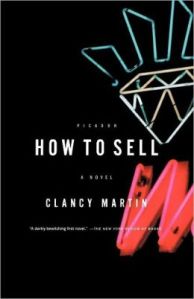
How to sellOne could say many professions involve lying as a central component of the work; one could say that science does the opposite and is one of the only fields in which lying, while possible, is at least also discoverable. In How to Sell the narrator and his brother, Jim, work the jewelry business in a pre-Internet age, though I’m not sure how much the Internet has changed that business.

How to Sell starts with an Elmore Leonard-esque word slide: “Our father told it that Jim was caught dressing up in my grandmother’s black Mikimotos when he was scarcely two years old.” He “told it?” To who, when, how? It doesn’t matter since we don’t find it, but it and that weird “scarcely” tell us that the narrator isn’t quite level and maybe the story won’t be either.

It isn’t, not really, and much of the discussion revolves around who is lying (everyone) and who isn’t (no one, not really, including the narrator). Yet a lot of people want to be lied to and put themselves in a position to be lied to and then others do the lying and justify it, as Jim explains:

Look, Bobby, the appraisal is not a lab report. [. . .] We are not calculators, we are people and so are our customers.

W’re people and we want to be lied to. The people who want the truth take the time to learn how jewelry works and the rest take the bullshit the salesman tells them. But information has a cost and so in some circumstances it’s easier to just do it without paying attention to the niggling gaps between details; a lot of romantic relationships function on the same principles as selling jewelry, as the novel makes clear since it is about how the one activity is a metaphor for another. Jewelry is a potent metaphor here because it’s also unnecessary: no one dies because they can’t wear it. As a pure luxury item it is sold as glamor, and one element of glamor is a lie plausible or well-presented enough to be believed.

No one in this book should be married or in a monogamous relationship, yet many characters are and their dilemmas would go away if they could undergo that simple change. But they can’t, or won’t.

Characters are constantly giving bad advice. One, a man named Kizakov, says “In this business, always trust your eyes.” Except that eyes can be deceived, which is why humans build so many tools to augment what we can see. Our senses should be verified rather than trusted; in this way do they also resemble lovers? In that domain broken promises may not be the norm but the evolutionary and other pressures are so strong that everyone at least knows stories about crumbling and breakage and base metals.

Jim gives brotherly advice: “Sometimes it’s better to stay on the surface with somebody.” People who say that often mean, “Stay on the surface with me.” Jim is a man of surfaces more than most people, and when he stays “on the surface” he means that he’ll do what he wants, when he wants it, and you’re only “in” with him to the extent you can do something for him. For men that means selling and for women that not surprisingly means something else.

The owner of the store, Mr. Popper, has a post-modernist view of the truth, as when he says that “It don’t really matter [what’s real and what’s fake], so long as she’s done right.” The similarities to love are again obvious; the bad outcome for Mr. Popper is also not surprising.

A few other points: Clancy knows enough about the jewelry business to describe it or learned enough about the jewelry business to fake it. There is substance amid the love lines and too many novels forget that. The second half of the novel is less about the technical facets of the jewelry business and that’s part of why it is weaker.

* There is more in common with selling jewelry and religion than is commonly supposed.

* To some extent no one knows anyone and that fact continues to drive fiction.

Thoughts on A Man of Parts — David Lodge

* A Man of Parts is surprisingly dull despite H. G. Wells’s salacious, important life; there are too many passages like this:

Amber seemed to him a golden girl that summer and autumn, an almost mythical creature, such as the gods of classical Greece coveted and descended from the heights of Olympus to ravish in human disguise or in the form of some animal or bird.

The novel is dutiful yet has a limited feeling for what it’s like to be a writer; the novel deserves comedy but it isn’t particularly funny. There are good moments:

“You hear so much talk about sex, and read about it in books, and you don’t know what or who to believe, and anyway, words can never tell you what it’s actually like. Is it wonderful, or just ordinary?”
“It’s both wonderful and ordinary,” he said.

which capture the feeling of much of life; so often it’s two or more contradictory things at once, and the question of ordinariness or extraordinariness say much about the temperament of the consciousness doing the observing.

* The travails and politics of the Fabian Society arise in so many novels set in the 1890 – 1929 period, but in this novel their machinations are dull. Something like A. S. Byatt’s The Children’s Book covers similar territory but much more effectively, and more strangely.

* Science itself is mostly absent, as it is not from, say, Ian McEwan’s Solar or Peter Watt’s Blindsight.

* Novels about people who really know things are surprisingly rare.

Why fiction? Why reading?

When we pick up a decent book, we live not once but twice, and each new book allows us to live again and absorb the thoughts of someone who has absorbed thousands of other people’s thoughts. The book is the most powerful medium yet invented for intellectual stimulation, growth, and change. The bounty is endless and in the contemporary world very cheap. Most, though, reject the gift. Is this not strange?

Pretty much everyone who is deeply interested in reading gets and/or writing gets some version of the utility question that I answered in the first paragraph (and have answered in other places). Each answer has its own idiosyncrasies, but I think they have a common core that revolves around knowledge and pleasure. The issue is on my mind because a friend wrote me to say regarding Asking Anna, “thanks for having thought through that book content and made it available for people like me to read and then not have to do some of the work. I like that.” The crazy thing is that crazy people have been doing this for centuries: packaging many thousands of hours of thinking into works that take only a few hours to read.

That’s true of fiction and nonfiction, and in some ways lately nonfiction has been leading the perceive quality race. But historically fiction has tended to advance the state of the art in prose, with novelists especially leading the charge towards renewing the language. Arguably this tendency has decreased over time, but I’ve never read a great nonfiction writer who didn’t also read fiction, or read a lot of fiction at one point.

Good novelists tend to be obsessed with the quality of their prose in a way fewer nonfiction writers are. Too many nonfiction writers focus on content at the expense of form and beauty; some have been glamored by some of the stupid literary theory that passes for erudition in some academic circles (Katharine Frank’s books, like Plays Well in Groups: A Journey Through the World of Group Sex, suffer from this, though she is merely a salient example and far from the only offender).

Fiction tends to train us to attend to language, and books like Wood’s How Fiction Works and Francine Prose’s Reading Like a Writer do the same. When one becomes sufficiently attuned to language, poorly written work or even work that is merely competent becomes aggravating, like a song messed by a drunk guitarist.

That’s my short utilitarian defense of fiction, but I read it for pleasure. The history of the West is one in which pleasure is suspect, especially in the Judeo-Christian tradition; sometimes for good reasons and sometimes for less-good reasons. That tradition encourages us to make sure that pleasure is always deferred, and that’s the tradition that led to the Enlightenment and Industrial Revolution and hence to the present day. We’re still getting somewhat used to enormous material wealth, at least by historical standards. But pleasure has its own importance, and there is pleasure in the many lives we can choose to live through books. Perhaps the most interesting thing is that so many people do not make the choice.

Every great book is the result of years or decades of studying and experience, distilled into a volume you can read in a few hours. How could you not want that?

Fundamentals in fiction and the question of obligations

The context is David Leavitt’s The Indian Clerk and the great mathematician G. H. Hardy’s hatred for the “tripos,” a now-defunct series of math tests at Cambridge that served as a sort of hazing ritual something like modern-day dissertations (Hardy despises them for “The tedium. The sense of energy diverted, imagination stifled”). To pass, many candidates received encouragement and expert tutoring. In this exchange a character named Gaye speaks first, after learning that Hardy, despite his feelings about the Tripos as an institution, will tutor someone about to undergo them:

“Coaching an undergraduate for the tripos. The tripos, of all things! And after all the screeds I’ve heard you deliver against the damned—”
“He won’t make it otherwise,” [Hardy said.]
“Is it your job to save him?”
“Someone saved me.”
“But Love didn’t coach you. He just sent you back to Webb. [. . .] Yours is a more specialized erotic thrill, that of rescuing the fair damsel from the jaws of the dragon.”

There is a perpetual tension discussed here: how much, if any, obligation do we have to others and do they have to us? The question can never be satisfactorily resolved, only explored, and for that reason it is likely to be of interest to novelists (or anyone creating narrative art). Gaye and Hardy are both in their own ways right. Two or more people or viewpoints who both have reasonable claims to rightness is a fertile place for intelligent drama.

One joy of Ann Patchett’s State of Wonder is the conflict between Marina and Dr. Swenson: when one speaks I agree with her; when the other speaks I agree with her. It’s not easy to sustain this level of conflict without giving one character the upper-hand, the right answer. Novels that do so often descend to the level of propaganda rather than art.

To return to Hardy and Gaye: Relatively few of us go through life completely, callously indifferent to the suffering and travails of others but equally so very few of us devote everything we can to “saving” others (for one thing, they often don’t want to be saved, and can’t be saved from themselves). Somewhere between those poles of total indifference and utter devotion we wander erratically, with no consistent reason, helping some—even making it our “job”—and ignoring others.

Often, however, in helping others we are also helping ourselves in some sense. Hence Gaye’s reference to the erotic thrill: it’s easier to innocently “help” someone attractive, or who is likely to be in a position to pay back a favor, but very easy to deny mixed motivations—until someone else, or some other character, points them out.

The Second Machine Age — Brynjolfsson and McAfee

The Second Machine Age: Work, Progress, and Prosperity in a Time of Brilliant Technologies is worth reading if you haven’t read Tyler Cowen’s Average is Over or the various other books about the influence of computers, networks, and the Internet on society and the labor market. If you’ve already read some of those books, then by osmosis you’ve already The Second Machine Age.

The Second Machine AgeIn it many now-familiar stories appear: Moore’s Law, superstar economics, Coming Apart: The State of White America, 1960-2010, chess-playing computers, the importance of teachers in education. Each subject is worthy in itself but much of the content has appeared elsewhere. Brynjolfsson and McAfee are decent writers but no one, except maybe a machine, will mistake them for excellent stylists. They wisely import wits at appropriate moments, thus achieving specialization and appropriately divided labor:*

The journalist A. J. Liebling famously remarked that, ‘Freedom of the press is limited to those who own one.’ It is no exaggeration to say that billions of people will soon have a printing press, reference library, school, and computer all at their fingertips.

Maybe: but we’re also in a race against censorship, as anyone in China knows well. The UK has instituted a mandatory porn filter on ISPs (which is the start of censorship creep) and that filter has already blocked a videogame update; how long until it “accidentally” blocks the opposition party’s website in the days before an election? The revelations from Snowden indicate that the U.S. may already have the ability to shut down Internet “printing presses” or block dissemination of their content. When such efforts are made in the future the reasoning will no doubt involve Protecting Our Children, which is already how the U.S. limits speech and conduct that is distasteful and/or disliked by most voters and the politicians they elect.

The parts about education stand out for their policy implications:

Conclusions by education researchers Ernest Pascarella and Patrick Terenzini [. . .] summarized more than twenty years of research in their book How College Affects Students. They write that ‘the impact of college is largely determined by individual effort and involvement in academic, interpersonal, and extracurricular offerings on campus.’

This work leads directly to our most fundamental recommendation to students and their parents: study hard, using technology and all other available resources to ‘fill up your toolkit’ and acquire skills and abilities that will be needed in the second machine age.

Schools often won’t do this effectively; right now it’s up to students to take on the burden themselves as best they can. But motivation is hard, and many if not all things are more easily imbibed when they’re presented by a guide who knows how to explain by analogy and where to find effective resources for learning. A lot of books are bad and that includes how-to books; one small but rarely stated purpose of teachers and professors is to read thousands of books and then recommend the handful of really good ones, or the ones most likely to be of utility to students. “Good” and “good for young / inexperienced people” are often different and experienced people can forget such an important difference.

Brynjolfsson and McAfee also write:

Perhaps unsurprisingly, records show that the electric motors did not lead to much of an improvement in performance [in early factories]. There might have been less smoke and a little less noise, but the new technology was not always reliable. Overall, productivity barely budged.

Only after thirty years—long enough for the original managers to retire and be replaced by a new generation—did factory layouts change [to accommodate electric motors]. The new factories looked much like those we see today: a single story spread out over an acre or more. Instead of a single massive engine, each piece of equipment had its own small electric motor.

Universities appear to suffer from this too, as do hospitals; perhaps we will see them change in response to conditions and to pressure generated from rising prices.

I had enough context to read the book in a few hours and wish that I’d waited for a library copy instead of buying. If you’re looking for a big-picture view of the contemporary world that grounds itself in many micro-observations, you should read The Second Machine Age. It will also help you think about your own career and life and where both should go. To some extent everyone is in the technology business, whether they realize it or not.


* Things economists love almost as much as children.

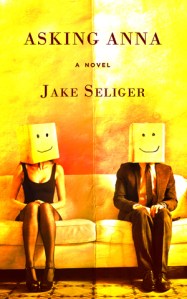
The Asking Anna paperback is out:

Wordpress cover image-3A couple people asked about the paper version of Asking Anna, and it’s now out. Take a look at the link.

(The original announcement is here.)