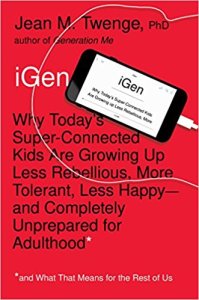
iGen — Jean M. Twenge: The kids aren’t all right?

It’s somewhat hard for me to love iGen because it fits the overall genre of “the kids are going to hell,” even if the author is savvy to that very problem and disavows it in the intro. I’m also now just old enough to no longer be part of the kids but not so old that I’ve forgotten all those “Oh my god the teens!” stories that described me as a teenager and college student.

In grad school, one of my professors had a book that assembled early reactions to the novel, which from the late 18th Century until close to the 20th Century was seen as depraved, a waste of time, a waste of talent, and morally corrupting. In other words, an activity that we now perceive as pretty high status was then seen as very low status, which often caused young men to be lazy and dissolute and young women to be morally impure. Corruption was clear and it came from words.
Oddly, in some ways those early criticisms were right, just too early: as a society we have largely secularized, and, although I wouldn’t lay all or even most of the reason why on the novel as a genre, it likely played a role by more freely disseminating information and letting people think for themselves, rather than having the clergy do all the thinking and information dissemination from the pulpit. When you let people think and read for themselves, many of them become less enamored of tedious religious works and the fellows who interpret those religious works to mean that giving to the church is good and sex is bad—very, very bad.

Today the smartphone is the great bugaboo of the age and we’ve not figured out how it ought to be integrated into society. Among my own peer group it’s now somewhat common to have phone-free parties, the better to be in the moment and avoid incriminating next-morning evidence, but it’s still common to lay a phone face-up on a table over coffee or drinks. But smartphone cultural practices haven’t really firmed up and smartphones have apparently taken over the lives of the Youth. The skeptical word “apparently” probably isn’t needed in the preceding sentence, because Twenge has lots of data demonstrating it.

One of the many admirable things about the book is how data-driven it is. Data, plus mostly avoiding the “The kids are going to hell” stuff, makes the book wildly readable and interesting. Still, not everyone is convinced; here’s one writer’s context and here’s another’s, arguing that smartphones aren’t actually destroying a generation.

The strange thing to me about constant smartphone life is that it seems so boring. Maybe from the inside it’s better. It’s all communication and little if any content underneath that communication. So much chatter and so little to say. Boredom as a theme runs through the book:

More and more teens are leaving high school never having had a paying job, driven a car by themselves, gone out on a date, had sex, or tried alcohol.

Sounds like a boring life. But it may also be a cheap one. Smartphone use may have deleterious effects but it’s also pretty cheap; once you have the phone and the data, marginal use is nearly free. So cost-effectiveness may drive smartphone obsession too, although Twenge doesn’t say it explicitly. Still, at some point I think even teenagers should get exhausted with relentless texting about nothing and want to go do things in the real world. Everyone feels left out but no one does anything about it.

Still, leading a boring life is not unique to this generation, although it’s wasting time online instead of wasting it on TV. For many decades, the average American watched four to five hours of TV a night—a terrible waste, it seems to me, especially given how much space was dedicated to commercials, but that’s what people did and what many people continue to do. If you have a choice of wasting time via TV or smartphone, smartphone seems like a marginal win.

Most likely, I think, teenagers are wasting most of their time, like most teenagers of most developed countries of most of the last hundred or so years, and will probably quit it when they have to pay their own rent.

Yet knowledge of smartphone problems seems also to widespread:

iGen’ers are addicted to their phones, and they know it. Many also know it’s not entirely a good thing. It’s clear that most teens (and adults) would be better off if they spent less time with screens. “Social media is destroying our lives,” one teen told Nancy Jo Sales in her book American Girls. “So why don’t you go off it?” Sales asked. “Because then we would have no life,” the girl said.

That seems unlikely, but logic is tough and most people’s revealed preferences show phone love. Apparently the data show that iGen is “at the forefront of the worst mental health crisis in decades, with rates of teen depression and suicide skyrocketing since 2011.” I wonder if something has really changed, or if something has changed regarding the self-reporting that people do. Perhaps it’s now more socially acceptable to report depression, in surveys or to doctors and others.

We get similar data later in the book: “Nevertheless, the case highlights a nationwide problem: the often inadequate resources for mental health assistance on campus.” If mental health assistance is inadequate today, when was it adequate? Why? What’s changed? And are we looking historically and cross culturally? In 1942 – 45, American men of college age were mostly fighting the Nazis and Japanese and probably also had inadequate mental health resources. Today, Kurdish teenagers fight ISIS. Because someone has a worse problem than you do doesn’t invalidate the problem, but there’s a startling lack of context to assertions like these; if the problem is the phone, turn off the phone.

This generation is supposed to be more inclusive by some measures, which I can believe, but I doubt it’s more inclusive overall; instead I suspect it’s going to be as exclusive as any generation, just based on different criteria. What those criteria are I can’t say, but I’m sure they’ll be there.

I’ve chatted a lot with a friend who grew up in the center of Gen X, and he remembers a generation that, according to the media, was filled with druggie dropouts who totally lack ambition. Those same people are now in the middle of their lives and seem to be fine, with reasonably normal distributions, and most of them seem to do what most people end up doing: getting a job and having kids. The dropouts of the late 80s and early 90s are the dads and moms of today.

One interesting thing for readers of this blog: it seems that iGen teens are “less likely to read than teens of previous eras:”

In the late 1970s, the clear majority of teens read a book or magazine nearly every day, but by 2015, only 16% did. In other words, three times as many Boomers as iGen’ers read a book or magazine every day.

You can quibble with that particular metric but Twenge presents others. Moreover:

Perhaps this move away from print is innocuous, especially if teens are still keeping up their academic skills. But they are not: SAT scores have slid since the mid-2000s, especially in writing (a 13-point decline since 2006) and critical reading (a 13-point decline since 2005).

This is echoed by 2007 article “Twilight of the Books.” One fast trick I use in assessing student writing skills is simple: I ask students to write their favorite book on an index card and why that book is a favorite. Answers tend to correlate to reading and writing skills.

Still, when I was in high school I liked to read and was mostly looked at as a weirdo for enjoying reading. In college I read Richard Russo’s novel Straight Man during a summer when I was a lifeguard, and the other lifeguards thought it weird that I’d laugh because of a book. So while the data may point to a decline in reading, I’m not sure that the overall social situation has changed too much.

Mostly, I wonder what will happen to iGen’ers as they age. The empty-headed seem to have a harder and harder time the older they get and the more the structures that define high school and college fall away. But that too may have been true for a long time: people who try new things and continually learn and grow tend to have better lives than those who don’t.

Recommendations like this: “I believe textbooks also need to stop covering so many topics in so much detail” seem unlikely to help people develop personalities or reading skills. That is a real quote, by the way: it’s on page 308. Twenge qualifies it in the rest of the paragraph, but the real world remains complex and trying to simplify it for the militantly ignorant will not help them or human understanding of the world. Ignorance is a condition we ought to aspire to cure, not perpetuate.

Still, I have seen arguments like this one since forever:

When I’ve polled my students about how they’d prefer to spend class time, most have said they are fine with lectures as long as they convey information that is helpful to doing well on exams. They like discussion but don’t want it to take too much time away from learning the material they’ll be tested on.

Lectures have always been terrible ways of conveying information; they were just technologically expedient for much of human history, and jettisoning them will lose little. Still, when students are very much focused on exam or paper grades, I often like to ask: What’s the point of doing well on the paper? Usually the answer is “to do well in class,” and so on, but if one extends far enough outward the more interesting answers start to pop up.

Bottom line is that the book is interesting but ought to be read skeptically. Overall I’m happy to have read it and read the whole thing carefully, which isn’t so common. It’s fun to imagine how this book will appear 50 years from now, when someone being born today might write about it. I imagine a historian or social critic who analyzes it as a document of its times, when those times and the processes immediately roiling the present have passed. Most of the books about the horrors of the generations that came of age in the 60s or 70s now look at least a little hysterical. From the vantage of 50 years later, I suspect this generation will look like it turned out okay too.

David Kirkpatrick’s “The Facebook Effect,” seven years later

It’s weird reading The Facebook Effect today, because already it feels like ancient history. It celebrates Facebook having 400 million users, when today it has two billion. It was written before the iPhone became the world’s dominant computing platform, so the many references to PCs feels odd. There are bromides like, “Facebook is bringing the world together,” which may not even be meaningful enough to evaluate as true or false. Yet many sections still seem relevant and fortuitous. The suspenseful sections about early fundraising are about humans, incentives, and game theory. The tension between short and long term remain in terms of both companies and individual lives. Others could be listed.

To me Facebook is still kind of boring; I don’t think people’s real selves, to the extent there are such things, get posted often, and when they do, the result is often embarrassment. And I find that the more I see of people on the site, the less I like them, implying that maybe knowing “more,” or more without context, isn’t so good. Yet its sheer popularity is clear, and I expect questions about what that means to persist, maybe throughout my life. “Generation Why?” is one good take in the genre but likely not the last.
The Facebook Effect doesn’t much answer that question and it probably can’t. The “why?” is embodied in millions if not billions of individual choices. But The Facebook Effect has lots of insight, as long as one’s willing to tolerate sentences like, “Facebook is bringing the world together.” For example, if you’re somewhat into photography, like I am, you’ve probably seen people debating various issues around megapixel count, lens quality, and image quality. Except no one cares about photo or picture quality / resolution. People only care about their friends and people they know. These may seem like dumb assertions but Facebook reveals evidence for them.

In 2006 Facebook introduced photo tagging, and one decision “the photos team” was particularly important:

They took a gamble and decided to compress photos into much smaller digital files, so that when they appeared on Facebook they were significantly lower in resolution than the originals. That meant they would upload faster, so users could select a number of photos on their PC and see them online within minutes.

Would people accept low-resolution photos? Would they use the tags?

The short answer to both is “yes.” People don’t give a damn about resolution. They care about the photo’s semiotics: “Ordinary photos had become, in effect, more articulate. They conveyed a casual message. When it was tagged, a photo on Facebook expressed and elaborated on your friend relationships.” Outside of very small sites occupied by photo nerds, like 500px, the photo isn’t about the perceive image quality; it’s about what the photo depicts of the person (and it’s almost always a person) in it. We import our groupishness from real life to photos. Which seems totally obvious now to everyone except people on photography forums yet wasn’t so obvious during Facebook’s earlier forms.

People also relentlessly use Facebook to… criticize Facebook: “As with any Facebook controversy, the viral distribution tools of Facebook itself were used against it.” But in the crucial terms of exit, voice, and loyalty, almost no one exits. Which tells Facebook as much as it needs to know. The company is a case study in stated vesus revealed preferences. However much people may say they revile, distrust, or dislike the company, or however much they may acknowledge that most of Facebook is a time waste, they keep going back. We have clichés like “actions speak louder than words” for a reason.

Briefly noted: The Weight of Ink — Rachel Kadish

The Weight of Ink invites comparison to A. S. Byatt’s , and after I’d read about half of The Weight of Ink I was inspired to re-read Possession, which is amazing and one of the best books I’ve read, ever. In the beginning of Possession I noticed this; the protagonist, Roland, is studying a fictional Victorian poet named R. H. Ash, and his supervisor is Blackadder:

Blackadder was discouraged and liked to discourage others. (He was also a stringent scholar.) Roland was now employed, part-time, in what was known as Blackadder’s “Ash Factory” (why not Ashram? Val had said)…

That re-use of “Ash,” from “Ash Factory” to “Ashram” (which sounds a lot, intentionally, like ass-ram) gives a lot in a short space: about Blackadder’s drudgery; Roland’s feelings towards Blackadder and the work; and even about Val’s witty personality, which is weighted by material circumstances and her shriveling relationship with Roland. We get a lot of material in three sentences that later resonate throughout the novel as a whole. For a while I spent time trying to find something analogously clever in The Weight of Ink, and failed. It’s impossible to prove a negative, but most of the book feels a little dull by comparison.

In The Weight of Ink there are too many sentences like, “He knew that whatever her reputation—and her staunch defense of departmental requirements, her insistence on diversifying the list of acceptable qualifying languages, and a half dozen other hard-fought battles over the years had earned her a fierce reputation—Helen Watt did not make scenes.” As far as I can tell this is meant as straight comment, not as a joke, and the obvious question—who gives a damn?—isn’t asked. People who have actually fierce reputations don’t have them from university department teapot politics. In Possession academic politics are the joke, for good reason, and human needs are at the humane center of things. The Weight of Ink misses this basic philosophical point and feels silly for it.

Or:

Had Aaron Levy chosen to study Shakespeare’s Catholic roots, it would have been different; that field had been blessed relatively recently with the astonishing gift of fresh evidence—a religious pamphlet found in the attic of Shakespeare’s father. That single document had upended and revitalized that arena of Shakespeare studies, leaving young historians room to work productively for years to come.

Perhaps the real answer is, “Go study a field that is vital and important?” Unfortunately, the modern-era scholars don’t, or can’t. Aaron has the same problem in his personal life. He yearns for a woman he had a one-night stand with, right before she left for Israel. Solution: Go find someone geographically proximate and available, like everyone else. In Possession, scholarly and romantic problems beautifully mirror each other; here, they grind against each other and the reader’s patience.

I gave up about halfway through. The re-read of Possession was great, though. Don’t believe the comparisons. They’re superficially right but in terms of depth totally off.

Statistical analyses of literature: let’s see what happens

I got some pushback to the link on what heretical things statistics can tell us about fiction, and I’ve read pushback like it before: the objections tend to say that great literature can’t be reduced to statistics; big data will never replicate the reading experience; a novel is more than the sum of the words chosen. That sort of thing. All of which is likely true, but the more interesting question is, “What kinds of things is nobody doing in the study of fiction?” (Or words, or sentences, of writers’ oeuvres). Lots and lots of people, including me, closely study individual works and connect them to a smallish body of other works and ideas.

Over centuries, if not longer, thousands, if not millions, of people have engaged this practice. Not very many people have attempted to systematically examine thousands if not millions of works simultaneously. So that may tell us something the usual methods haven’t. It’s worth exploring that domain. And just because that domain is being explored, the more usual paths via close reading aren’t closed off.

In other words, don’t think that an argument along the lines of “x is interesting” means “we should always and only do x.”

At the moment, we also appear to be at the very start of the field. Maybe it’ll become extremely important and maybe it won’t. The potential is there. People have (arguably) been doing some form of close reading and analysis, even if the practice didn’t use those specific words, for millennia. Certainly for centuries. So I’d be pretty surprised to see statistical analyses produce whatever good material they’re likely to produce in just a decade or two.

Part of what art and analysis should do is be novel. Another part is “be interesting.” We’re looking for the intersection of those two zones.

Rapture — Susan Minot

I like Rapture but it’s not for everybody: it’s too focused on relationships, too explicit (though I would prefer the word “realistic,” many would disagree), too much about artistic educated urban people who want some things that are incommensurate with other things, too didn’t-Anna-Karenina-already-do-this?. It dissects the moment into a million little pieces, like Ian McEwan’s On Chesil Beach; we experience a succession of moments in a rush, and in writing we can slow them, reexamine them, reexperience them, or experience them from a new vantage.

Still, to my mind it’s about three people who aren’t ready or able to leap towards the obvious relationship-structure conclusion, even if the wrapping around that core idea is Kay’s afternoon with Benjamin. The narrative perspective shifting from Kay to Benjamin and back. Their thoughts are not so dissimilar but retain dissimilar enough to retain interest. They think in similar ways, as perhaps people in similar milieus and with similar “wrong” desires might. Neither Benjamin nor Kay knows each other, like we all don’t really know anyone, and we get that from the first page:
He had no idea what had gotten her there.
He certainly wasn’t going to ask her about it. There was no way he was going wade into those dangerous waters and try to find out why she’d changed her mind…

Probably wise on his part. We also get a similar idea later on, midway through: “What did other people know about what really went on inside a person?” Some things are unknowable, and fiction likes to remind us of this.

A few pages into the novel, we switch to Kay’s perspective for the first time:

It was overwhelming, the feeling that this was pretty much the only thing that mattered, this being with him, this sweetness, this . . . communing . . . this . . . there was no good word for it.

(Ellipses in original.)

It raises questions: how much does “pretty much” elide here? And if this is “pretty much the only thing that mattered,” why do we spend so much time and energy doing other things, like building civilization? This is an analytic novel, so Kay doesn’t answer, but we might consider it as we read. I also don’t know what to do with later, similar thoughts, like “This was real, this was the most real thing.” Getting down to what is really real is tricky, and answers tend to vary based on the moment a person happens to be in. Are things that matter real? Are real things things that matter? I don’t know either.

Sometimes the vision is blank:

He shut his eyes. He saw the empty landscape. He knew he had to get out of bed and get going and soon, but he was mesmerized by this vision of emptiness. It was telling him something.

Maybe I like the novel because I’m working on one that uses somewhat similar narrative perspective on material that isn’t so different. We all fantasize about knowing what someone else is thinking, but only in fiction do we actually get to switch perspective to see. That fantasy is as potent as flying, and while we can fly via planes or rockets or other external apparatus, we never get to fly the way we do in our dreams.

Lost technologies, Seveneves, and The Secret of Our Success

Spoilers ahead, but if you haven’t read Seveneves by now they probably don’t matter.

Seveneves is an unusual and great novel, and it’s great as long as you attribute some of its less plausible elements to an author building a world. One plausible element is the way humanity comes together and keeps the social, political, and economic systems functional enough to launch large numbers of spacecraft in the face of imminent collective death. If we collectively had two years to live, I suspect total breakdown would follow, leaving us with no Cloud Ark (and no story—thus we go along with the premise).

But that’s not the main thing I want to write about. Instead, consider the loss of knowledge that inherently comes with population decline. In Seveneves humanity declines to seven women living in space on a massive iron remnant of the moon. They slowly repopulate, with their descendants living in space for five thousand years. But a population of seven would probably not be able to retain and transmit the specialized knowledge necessary for survival on most parts of Earth, let alone space.

That isn’t a speculative claim. We have pretty good evidence for the way small populations lose knowledge. Something drew me to re-reading Joseph Henrich’s excellent book The Secret of Our Success, and maybe the sections about technological loss are part of it. He writes about many examples of European explorers getting lost and dying in relatively fecund environments because they don’t have the local knowledge and customs necessary to survive. He writes about indigenous groups too, including the Polar Intuit, who “live in an isolated region of northwestern Greenland [. . . .] They are the northernmost human population that has ever existed” (211). But

Sometime in the 1820s an epidemic hit this population and selectively killed off many of its oldest and most knowledgable members. With the sudden disappearance of the know-how carried by these individuals, the group collectively lost its ability to make some of its most crucial and complex tools, including leisters, bows and arrows, the heat-trapping long entry ways for snow houses, and most important, kayaks.

As a result, “The population declined until 1862, when another group of Intuit from around Baffin Island ran across them while traveling along the Greenland coast. The subsequent cultural reconnection led the Polar Intuit to rapidly reacquire what they had lost.” Which is essential:

Though crucial to survival in the Arctic, the lost technologies were not things that the Polar Intuit could easily recreate Even having seen these technologies in operation as children, and with their population crashing, neither the older generation nor an entirely new generation responded to Mother Necessity by devising kayaks, leisters, compound bows, or long tunnel entrances.

Innovation is hard and relatively rare. We’re all part of a network that transmits knowledge horizontally, from peer to peer, and vertically, from older person to younger person. Today, people in first-world countries are used to innovation because we’re part of a vast network of billions of people who are constantly learning from each and transmitting the innovations that do arise. We’re used to seemingly automatic innovation, because so many people are working on so many problems. Unless we’re employed as researchers, we’re often not cognizant of how much effort goes into both discovery and then transmission.

Without that dense network of people, though, much of what we know would be lost. Maybe the best-known example of technology loss happened when the Roman Empire fell, followed by the way ancient Egyptians lost the know-how necessary to build pyramids and other epic engineering works.

In a Seveneves scenario, it’s highly unlikely that the novel’s protagonists would be able to sustain and transmit the knowledge necessary to live somewhere on earth, let alone somewhere as hostile as space. Quick: how helpful would you be in designing and manufacturing microchips, solar panels, nuclear reactors, plant biology, or oxygen systems? Yeah, me too. Those complex technologies have research, design, and manufacture facets that are embodied in the heads of thousands if not millions of individuals. The level of specialization our society has achieved is incredible, but we rarely think about how incredible it really is.

This is not so much a criticism of the novel—I consider the fact that they do survive part of granting the author his due—but it is a contextualization of the novel’s ideas. The evidence that knowledge is fragile is more pervasive and available than I’d thought when I was younger. We like stories of individual agency, but in actuality we’re better conceived of as parts in a massive system. We can see our susceptibility to conspiracy theories as beliefs in the excessive power of the individual. In an essay from Distrust That Particular Flavor, William Gibson writes: “Conspiracy theories and the occult comfort us because they present models of the world that more easily make sense than the world itself, and, regardless of how dark or threatening, are inherently less frightening.” The world itself is big, densely interconnected, and our ability to change it is real but often smaller than we imagine.

Henrich writes:

Once individuals evolve to learn from one another with sufficient accuracy (fidelity), social groups of individuals develop what might be called collective brains. The power of these collective brains to develop increasingly effective tools and technologies, as well as other forms of nonmaterial culture (e.g., know-how), depends in part on the size of the group of individuals engaged and on their social connectedness. (212)

The Secret of Our Success also cites laboratory recreations of similar principles; those experiments are too long to describe here, but they are clever. If there are good critiques of the chapter and idea, I haven’t found them (and if you know any, let’s use our collective brain by posting links in the comments). Henrich emphasizes:

If a population suddenly shrinks or gets socially disconnected, it can actually lose adaptive cultural information, resulting in a loss of technical skills and the disappearance of complex technologies. [. . . ] A population’s size and social interconnectedness sets a maximum on the size of a group’s collective brain. (218-9)

That size cap means that small populations in space, even if they are composed of highly skilled and competent individuals, are unlikely to survive over generations. They are unlikely to survive even if they have the rest of humanity’s explicit knowledge recorded on disk. There is too much tacit knowledge for explicit knowledge in and of itself to be useful, as anyone who has ever tried to learn from a book and then from a good teacher knows. Someday we may be able to survive indefinitely in space, but today we’re far from that stage.

Almost all post-apocalyptic novels face the small-population dilemma to some extent (I’d argue that Seveneves can be seen as a post-apocalyptic novel with a novel apocalypse). Think of the role played by the nuclear reactor in Steven King’s The Stand: the characters in the immediate aftermath must decide if they’re going to live in the dark and regress to hunter-gatherer times, at best, or if they’re going to save and use the reactor to live in the light (the metaphoric implications are not hard to perceive here). In one of the earliest post-apocalyptic novels, Earth Abides, two generations after the disaster, descendants of technologically sophisticated people are reduced to using melted-down coins as tips for spears and arrows. In Threads, the movie (and my nominee for scariest movie ever made), the descendants of survivors of nuclear war lose most of their vocabulary and are reduced to what is by modern standards an impoverished language that is a sort of inadvertent 1984 newspeak.* Let’s hope we don’t find out what actually happens after nuclear war.

In short, kill enough neurons in the collective brain and the brain itself stops working. Which has happened before. And it could happen again.


* Check out the cars in Britain in Threads: that reminds us of the possibilities of technological progress and advancement.

Why read bestsellers

Someone wrote to ask why I bother writing about John Grisham’s weaknesses as a writer and implied in it is a second question: why read bestsellers at all? The first is a fair question and so is the implication in it: Grisham’s readers don’t read me and don’t care what I think; they don’t care that he’s a bad writer; and people who read me probably aren’t going to read him. Still, I read him because I was curious and I wrote about him to report what I found.

The answer to the second one is easy: Some are great! Not all, probably not even most, but enough to try. Lonesome Dove, the best novel I’ve read recently, was a bestseller. Its sequel, Streets of Laredo, is not quite as good but I’m glad to have read it. Elmore Leonard was often a bestseller and he is excellent. Others seemed like they’d be bad (Gillian Flynn, Tucker Max) but turned into favorites.

One could construct a 2×2 matrix of good famous books; bad famous books; good obscure books; and bad obscure books. That last one is a large group too; credibility amid a handful of literary critics (who may be scratching each other’s backs anyway) does not necessarily equate to quality, and I’ve been fooled by good reviews of mostly unknown books many times. Literary posturing does not equate to actual quality.

Different people also have different views around literary quality, and those views depend in part on experience and reading habits. Someone who reads zero or one books a year is likely to have very different impressions than someone who reads ten or someone who reads fifty or a hundred. Someone who is reading like a writer will probably have a different experience than someone who reads exclusively in a single, particular genre.

And Grisham? That article (which I wish I could find) made him and especially Camino Island sound appealing, and the book does occasionally work. But its addiction to cliché and the sort of overwriting common in student writing makes it unreadable in my view. But someone who reads one or two books a year and for whom Grisham is one of those books will probably like him just fine, because they don’t have the built-up stock of reading that lets them distinguish what’s really good from what isn’t.

Briefly noted: Camino Island — John Grisham

Somewhere I read an article, now lost to me, about Grisham that convinced me to try Camino Island. Unfortunately, it’s bad from the first page and even the second sentence:

The imposter borrowed the name of Neville Manchin, an actual professor of American literature at Portland State and soon-to-be doctoral student at Stanford. In his letter, on perfectly forged stationary, “Professor Manchin” claimed to be a budding scholar of F. Scott Fitzgerald [. . .]

You don’t need the word “budding.” It’s a cliché and adds nothing to the description. Almost any “soon-to-be doctoral student” is a “budding scholar.” On the same page we learn that the letter “arrived with a few others, was duly sorted and passed along [. . .]” How does one “duly” sort things? Are some things “unduly sorted?”

A little later, a sentence begins, “His was a gang of five [. . .]” Even something simple like “His gang had four other members” is less awkward.

Some dialogue is good:

“The manuscripts, all five of them, were insured by our client, a large private company that insures art and treasures and rare assets. I doubt you’ve heard of it either.”
“I don’t follow insurance companies.”

That comeback is nice, but even the first part is repetitive. If an insurance company is willing to insure manuscripts, then it’s obviously not, say, a car insurance company—we don’t need to know that it “insures art and treasures” because we already know it insures this company’s.

I gave up after about a quarter of the book because it’s so consistently badly written. If you read any Grisham revisionism articles, don’t believe them. Choose something else. The collected works* of Elmore Leonard are a fine place to start.


* This is no longer a figure of speech: the Library of America is collecting and publishing Leonard’s works, as the link shows.

Briefly noted — Do I Make Myself Clear? — Harold Evans

If you’ve read in the vast genre of how-to-write books—everything from Steven Pinker’s The Sense of Style to John Trimble’s Writing With Style to Zinsser’s On Writing Well—you’ve already in effect read Do I Make Myself Clear? Why Writing Well Matters. It’s a good book, just not one that advances the art or covers material you’ve not seen covered elsewhere.

It starts with Orwell and “Politics and the English Language,” which indicts “bad English for corrupting thought and slovenly thought for corrupting language,” then goes to say that “eternal vigilance is the price of intelligent literacy.” Problem is that I don’t think we’ve been vigilant and I don’t see signs of increasing literacy—in political terms, if anything we see the opposite. The kinds of people who need to read Do I Make Myself Clear? don’t read and don’t care.

Elsewhere we find that

There is no compulsion to be concise on either the Internet or the profusion of television and radio channels; and in writing of every kind, Twitter apart, we see more words, more speed, less clarity, and less honesty, too, since with “demand media” you never know whether a review of Swan Lake will conceal a hard sell about toenail fungus.

I like a good rant as much as the next guy, but do we know we’re seeing “more words, more speed, less clarity?” How do we know? How would we even measure this? I don’t know. Does “speed” mean speed of writing, speed of reading, both, or neither? I don’t know that either. Knowing is hard.

To be sure, there’s a long history of language exhortations violating the very rules they posit (few of those who decry adverbs and passive voice fail to use both). But it can be interesting to apply the same principles being espoused to the work doing the espousing, to see if it follows its own command.

Briefly noted: Deep Thinking — Garry Kasparov

If you’ve read Average is Over you’ve gotten enough of Kasparov’s book to skip it; the abstract lessons from the second section of Average is Over are similar to Deep Thinking‘s. Still, human-computer play remain underrated and also remains a key metaphor for what human-computer interaction will look like in the near future. Computer-assisted driving is maybe the most familiar aspect right now, and that sort of dynamic will likely increase as time goes on and as the number of transistors that can inhabit a given area continues to increase.

Deep Thinking is most interesting about halfway through when Kasparov describes in detail the conditions under which he played the famous 1997 Deep Blue match. Before and after there is some interesting material but less than one would like. Maybe I’m just a sucker for narrative, and the middle section is primarily narrative. Still, the more I read of Kasparov the more I think I should read more, and his writing about Putin and Russia is consistently insightful. If you want a conventional review of Deep Thinking, Robin Hanson’s “Grandmasters vs. Gigabytes” is good.

There are few aesthetically beautiful sentences but still some useful observations. For example:

Connections between chess skill and general intelligence are weak at best. There is no more truth to the thought that all chess players are geniuses than in saying that all geniuses play chess. In fact, one of the things that makes chess so interesting is that it’s still unclear exactly what separates good chess players from great ones.

That last sentence is true of novelists and other writers too. “Good” and “great” can be felt and the critical faculty can be honed over time, but specific definitions remain elusive. Oddly, though, two pages later Kasparov returns to notions of greatness in a way that almost contradict the quote above:

When Der Spiegel asked me what I thought separated me, the world champion, from other strong chess players, I answered, ‘The willingness to take on new challenges,’ the same answer I would give today. The willingness to keep trying new things—different methods, uncomfortable tasks—when you are already an expert at something is what separates good from great. Focusing on your strengths is required for peak performance, but improving your weaknesses has the potential for the greatest gains.

So there is an answer to what separates good from great (“The willingness to try new challenges”) or there isn’t? Both sections are interesting and both might be true, but this is the sort of internal contradiction editors (or Kasparov’s ghost writer / assistant, Mig Greengard) are supposed to find.

Then there are sentences like, “It’s a privilege to be able to focus on the negative potential of world-changing breakthroughs like artificial intelligence. As real as these issues may be, we will not solve them unless we keep innovating even more ambitiously, creating solutions and new problems, and yet more solutions, as we always have.” Everyone else seems to be for innovation, making me tempted to come out as anti-innovation simply to be contrary.

But there are very useful sentences too, like the last one here:

How professional chess changed when computers and databases arrived is a useful metaphor for how new technology is adopted across industries and societies in general. It’s a well-established phenomenon, but I feel that the motivations are underanalyzed. Being young and less set in our ways definitely makes us more open to trying new things. But simply being older isn’t the only factor that works against this openness—there is also being successful. When you have success, when the status quo favors you, it becomes very hard to voluntarily change your ways.

Success is never final. Yet we, collectively, never seem to know that. Peak performance sustained over a lifetime may have to incorporate this idea.