We lack perspective: notes from Alain de Botton’s The Pleasures and Sorrows of Work

Yet our world of abundance, with seas of wine and alps of bread, has hardly turned out to be the ebullient place dreamt of by our ancestors in the famine-stricken years of the Middle Ages. The brightest minds spend their working lives simplifying or accelerating functions of unreasonable banality. Engineers write theses on the velocities of scanning machines and consultants devote their careers to implementing minor economies in the movements of shelf-stackers and forklift operators. The alcohol-inspired fights that break out in market towns on Saturday evenings are predictable symptoms of fury at our incarceration. They are a reminder of the price we pay for our daily submission at the altars of prudence and order – and of the rage that silently accumulates beneath a uniquely law-abiding and compliant surface.

1) A lot of engineers like their jobs and look at them as solving a series of puzzles: “theses on the velocities of scanning machines” are only as banal as you make them. In addition, even if you do find them banal, if you can make a faster scanning machine and sell it for a lot of money, you may not care when you retire to paint water colors for the rest of your life.

2) Fights say more about the dumb fighters than about the human condition.

3) Humans might simply never be, as a group, overtly happy in whatever conditions we experience; realizing this might release us from unreasonable expectations. A cultural fixation on happiness might paradoxically prevent us from experiencing what we think or imagine we most want or desire.

4) Related to three, people who leave work to drink on the weekends are probably intentionally looking for fights: I doubt the behavior can be blamed solely on alcohol. Many people seem to undergo a two-step process: they consciously drink so they can unconsciously act out in the ways they’d actually like to. My question is simple: why not just go to step two and be intellectually honest with ourselves?

5) Stumbling on Happiness discusses how and why we feel unhappy when we compare ourselves to others. Most of us don’t compare ourselves to people in the “Middle Ages;” we compare ourselves to our wives’ sisters’ husbands, to paraphrase that famous aphorism (switch gender roles as appropriate to you, the reader, and your gender / sexual orientation).

6) We submit “at the altars of prudence and order” because the alternative is often worse. That being said, I think Western society underestimates the power and importance of trance, ecstasy, transcendence, atë—all things that, denied and repressed, seem to manifest themselves in unusual ways (see The Secret History for more on this. Still, if the alternative to prudence and order is chaos, no iPhone, longer commutes, and living a dicey part of town, prudence and order sound pretty good—as does self-imposed “incarceration.”

7) The Pleasures and Sorrows of Work is, like much of de Botton’s work, nicely balanced between readability and intellectual engagement, reasoned and learned without being pedantic. These are harder notes to strike than may be obvious at first.

We lack perspective: notes from Alain de Botton's The Pleasures and Sorrows of Work

Yet our world of abundance, with seas of wine and alps of bread, has hardly turned out to be the ebullient place dreamt of by our ancestors in the famine-stricken years of the Middle Ages. The brightest minds spend their working lives simplifying or accelerating functions of unreasonable banality. Engineers write theses on the velocities of scanning machines and consultants devote their careers to implementing minor economies in the movements of shelf-stackers and forklift operators. The alcohol-inspired fights that break out in market towns on Saturday evenings are predictable symptoms of fury at our incarceration. They are a reminder of the price we pay for our daily submission at the altars of prudence and order – and of the rage that silently accumulates beneath a uniquely law-abiding and compliant surface.

1) A lot of engineers like their jobs and look at them as solving a series of puzzles: “theses on the velocities of scanning machines” are only as banal as you make them. In addition, even if you do find them banal, if you can make a faster scanning machine and sell it for a lot of money, you may not care when you retire to paint water colors for the rest of your life.

2) Fights say more about the dumb fighters than about the human condition.

3) Humans might simply never be, as a group, overtly happy in whatever conditions we experience; realizing this might release us from unreasonable expectations. A cultural fixation on happiness might paradoxically prevent us from experiencing what we think or imagine we most want or desire.

4) Related to three, people who leave work to drink on the weekends are probably intentionally looking for fights: I doubt the behavior can be blamed solely on alcohol. Many people seem to undergo a two-step process: they consciously drink so they can unconsciously act out in the ways they’d actually like to. My question is simple: why not just go to step two and be intellectually honest with ourselves?

5) Stumbling on Happiness discusses how and why we feel unhappy when we compare ourselves to others. Most of us don’t compare ourselves to people in the “Middle Ages;” we compare ourselves to our wives’ sisters’ husbands, to paraphrase that famous aphorism (switch gender roles as appropriate to you, the reader, and your gender / sexual orientation).

6) We submit “at the altars of prudence and order” because the alternative is often worse. That being said, I think Western society underestimates the power and importance of trance, ecstasy, transcendence, atë—all things that, denied and repressed, seem to manifest themselves in unusual ways (see The Secret History for more on this. Still, if the alternative to prudence and order is chaos, no iPhone, longer commutes, and living a dicey part of town, prudence and order sound pretty good—as does self-imposed “incarceration.”

7) The Pleasures and Sorrows of Work is, like much of de Botton’s work, nicely balanced between readability and intellectual engagement, reasoned and learned without being pedantic. These are harder notes to strike than may be obvious at first.

Bare: On Women, Dancing, Sex, and Power — Elisabeth Eaves

Bare has lots of good parts but goes on too long, follows too many random tangents (the “Kim” character doesn’t illustrate anything), and repeats itself too often. But I also liked it and learned some things from it I might not have otherwise, and Eaves is usually a perceptive reader of both her own and larger social hypocrisy. She seems sensitive, or she adopts a sensitive persona in the book. I only wish she’d taken more economics classes; the big thing she’s missing is micro 111 and 201. She’s missing game theory. And evolutionary biology and psychology. Those taken together explain a lot about the double standards she justifiably complains about. Take this section, about Eaves’s dawning sexual awareness:

I had this notion until my teens that my body was my own. How to clothe it, how to gratify it, whether to impregnate it—I had believed these to be matters of personal choice. And I had a notion that the rules of society should be applied fairly to all. With the discovery of a sexual morality especially for girls, equality suddenly seemed to have been an idea meant to go the way of Santa Claus. My shock and anger would have been difficult to overstate.

She’s right. But the main disappointment of Bare is that it doesn’t go deeper into why these social forces exist, especially in the discrepancy between what parents want for their offspring and what offspring want for themselves. Girls bear the greater cost of pregnancy, and society believes that they are at greater risk of sexual predators, so parents take much greater efforts to restrict that sexuality (for more on this, see, for example, “The Daughter-Guarding Hypothesis“). If you want to deal with double standards, attack parents first, since a lot of the double standards are parentally inflicted. When parents say, “You can’t go out looking like that,” they usually mean, “you’re sending signals about sexual availability and interest that I disapprove of.” Almost no parents say the second one, however. If you could get them to, you might at least move toward greater honesty. Good luck using this vector, however.

And girls will sometimes impose double standards on themselves. Here’s another example of a spot where Eaves notes this but doesn’t go deeper:

Fraternities permitted the consumption of alcohol, whereas sororities did not. Guys could have girls over to fraternity houses any time of the day or night, but girls could have guys over only under heavy restrictions. In my sorority we could invite boys to our rooms only on Tuesday evenings from seven to ten, and most girls had three or four roommates. The upshot was that boys never made the walk of shame. The rules of the Greek system upheld an intricate web of double standards. Sororities had to have a resident ‘house mother,’ a supervising adult; the fraternities had no equivalent. When I asked other sorority girls about this rule, they told me that a house mother was required to get around an old law that classified a group of women living together as a brothel.

But sorority girls (and, perhaps, the parents who pay for their college experience) are willing to put up with “heavy restrictions”. Why doesn’t a sorority house offer a frat-style experience? If the market is there, girls will join it. That girls are willing to accept sorority rules shows that those same girls are getting something out of them, even if they complain. Think about reveled preferences here: if what people say and what they do diverge, look at what they do first.

If girls refused to enter a system that “upheld an intricate web of double standards,” the system would change. Yet they don’t. Note that I’m not advocating for double standards or saying they should exist: I believe the opposite. But Eaves should look harder for what powers and purposes these guys of social rules serve, who is enforcing them, and why, in the face of logic and the rhetoric of freedom, they persist. As I said previously, I think you can trace a lot of double-standard behavior to parents, and until you deal with that issue, you basically haven’t dealt with anything substantive. You’re making the same arguments women have been making since at least the 1960s and probably earlier. Also, I’m not convinced other sorority girls are a sound source of legal advice, or that such rules about multiple females living together would pass contemporary constitutional muster, especially if a lawsuit regarding them found its way in front of a female judge.

Plus, I can imagine what would happen to a fraternity that forbade its members from having women in their rooms: the fraternity would quickly have no members, since so much of its real purpose is ensuring sex to its members. That women don’t respond similarly en-masse to sorority rules shows that sorority girls are getting something; I could make up stories as to what (many are probably uncomfortable with having strange or partially clothed men wandering their halls), and so could you, but the important thing is starting the analysis.

This leads toward questions of how one can change larger cultures. Eaves does engage those; she starts with whether she’ll speak to others about her profession. She mostly doesn’t:

I was nowhere near as open as Zoe, a dancer with whom I became friends. She believed firmly in telling everyone. Her parents knew, as did her sister, boyfriend, and most anyone she met. I told her once that I didn’t tell certain people because I didn’t want to deal with their judgments and preconceptions. ‘That’s why you have to tell them!’ she said. ‘How are those stereotypes going to change if people like you and me don’t talk about what we do?’ She had an energy for changing minds that I lacked.

Zoe is right: maybe if people were more open about what they actually did, the many stigmas around sexuality would fade over time: but by hiding what one actually does, one allows assumptions to go unchallenged and to calcify into convention. By not speaking of then, Eaves lets the double standard get infinitesimally stronger, and by speaking of it in her writing, she at least makes it slightly weaker. You can’t complain about the double standards and simultaneously lack the “energy for changing minds” someone else has. And it makes sense that Zoe told “most anyone she met.” In high school, the essential question is, “What kind of music do you like?”, in college it’s, “What’s your major?” and once you leave the educational system it’s, “What do you do?” I don’t hide my professions. To do so would seem to hide an essential part of myself.

Still, the mere fact of being a stripper causes some change in the person. Here’s Eaves discussing some:

Stripping put me in a new world with new conventions. Having ditched the moral framework of the outside world, I was now ethically adrift where nudity and sexuality were concerned. I actually felt as if I had divorced myself from the moral norm years previously, simply by growing up and becoming sexual. But when I entered pink-and-red stripperland, my departure became official. Having given up the old norms I needed new ones, and where none were provided, I had to make my own.

Good. That comes from page 88. Two hundred pages later, from 291 – 292, we’re still there:

The sexual morality I grew up with was rife with inconsistencies. It had words to insult promiscuous women but not men, it ticketed strippers but not their customers. It imposed on women, far more than men, an intricate code of modesty that came down to a few inches of fabric, and then read a woman’s clothing or lack thereof as an indication of character. I didn’t want the morality that said I must cover my body, and that if I didn’t I was responsible for whatever came my way. I didn’t want the morality that said I should be coy and shameful about sex.

Again: there’s lots of “what” but very little “why,” which is disappointing. Why do strippers accept a sexual morality that “tickets” them (note the nice word, implying just the right amount of censure). If Eaves doesn’t want the morality—and I can’t blame her—she should be looking for more about why the morality exists. She also understands her power—”Being young, female, and attractive was one long bout of intoxication, with all the dizzy pleasure and vulnerability the word implies. In the careening, can’t-get-off, sex-saturated roller coaster from puberty to adulthood, I discovered I could hold sway over boys and men”—but not why people might use different means of finding what they want. She doesn’t like placing lonely hearts ads:

A column inch of newspaper, struck me as a sterile way to find someone compatible, whether for life or just an affair. I didn’t think of myself as romantic, but when it came to meeting men, I was attached to ideas of chemistry and coincidence. I was convinced that sex and love would follow naturally from other things I did—work, hobbies, or friends. By definition they would be unplanned and messy, but all the more exciting for it. I couldn’t understand why I would want to engineer an affair as though I were buying or selling a used bed.

Spoken truly like someone who’s attractive enough to have plenty of offers to accept or reject. The rest of us need to gin up more offers and do what it takes to do so. It’s easy to be “attached to ideas of chemistry and coincidence” when you’re young and attractive. Lots of men will offer their services, so to speak, and she gets to pick from them. For others—who are either bored with the standard offers or looking for something better—she doesn’t speak or acknowledge why they might do what they do. I know very attractive women who’ve signed up for online dating because they’re tired of the men they meet in their everyday lives. Eaves seems unusually lucky with “work, hobbies, or friends.”

Bear in mind, too, that Bare has over-readings and inconsistencies of its own, as in this description of one of Eaves’s boyfriends who has admitted to hiring a prostitute:

For men to pay for sex as a matter of course seemed to show a profound insecurity or worry about women—that women wouldn’t want to sleep with him without payment, or that when they did they wouldn’t be kind and acquiescent enough, or that a man’s and a woman’s sexual wishes simply couldn’t coincide. I also thought paying for sex indicated a subtle sense of guilt—if a man was uncomfortable facing the women he had sex with, he could pay for the promise that he wouldn’t have to.

Alternately, it’s possible that men paying for sex doesn’t mean anything, and that women who dance for sex doesn’t mean anything more or less than any other profession. She doesn’t consider that the men might just want to get laid. Not everything has to mean something. That would make for a much shorter book, of course, since books about sexuality thrive on analysis even when that analysis might not be warranted. And, sometimes, “a man’s and a woman’s sexual wishes simply [don’t] coincide”: how many women want a tall, handsome, wealthy alpha male with an impressive job who could get any woman he wants but chooses her? How many men want a perky young pneumatic blond with who is, as Ludacris once put it, “a lady in the street but a freak in the bed,” and who also thinks he’s witty and looks up to him and doesn’t make the very reasonable demands women in the real world tend to want?

Maybe Eaves isn’t really unhappy about a subtle sense of guilt: maybe she’s actually unhappy that sex-for-money subverts her own sexual power by making it easier for men to obtain a lot of what they want quickly. She has her own sexual morality that might not be much better than the one she derides. She can’t or doesn’t want to imagine why people would use dating services, and the same is true of prostitution. By writing what she wrote, Eaves has helped ensure that more men will lie about the hookers they’ve hired, since they know they’ll be judged by women like Eaves.

Consider this, on the same subject:

What angered me, specifically, was his easy acceptance of a buyer-seller relationship between men and women. In some ways I came to regard Paul as I would a customer: someone cynical, who didn’t place a high value on sexual honesty, who was easily manipulated by female facades. I could never bring myself to trust him completely. And though I wasn’t fully conscious of it, on some level I decided that he wasn’t due the respect I would have accorded a different kind of man. For me, Paul symbolized men who preferred buying women to knowing them.

Is a “hard” acceptance somehow better? Is nattering on about morality and improvement? And maybe Paul is just a dude, not someone who should be held as a symbol for all men. This preference Eaves expresses actually indicates she doesn’t like conflating market and gift norms, or that she doesn’t like it when a man she’s with does it but doesn’t mind when she herself does. Or this is another random boundary. I suspect it’s conflating gift and market economies; lots of people have addressed this, including Lewis Hyde in The Gift: Creativity and the Artist in the Modern World Geoffrey Miller in Spent: Sex, Evolution, and Consumer Behavior. But these are issues Eaves doesn’t address: her own blindspots are there for people to see. Mine probably are too, but no one has taken the trouble to observe them.

Eaves also makes the mistake some of my freshmen do in their papers: she assumes there is some unified thing called “society” “culture,” or “the media,” which gives her and others a single message. It’s not that easy. Words we use to flatten the dialectical nature of collective individual desires, like “society” or “the media” leave so much out of them. This is one lesson of Michel Foucault, however problematic some of his other comments might be. Eaves, for example, listens to this idea:

There was very little stigma attached to being a passive sex object. Images of the legs, breasts, and lips of strangers suffused my life thoroughly, from billboards to magazines to television. Far from shaming the bodies’ owners, society made them starlets, supermodels, and video queens, glorifying them with money and fame. Yet to actively pursue sex-object status—to say, ‘Okay, I agree, please look at me’—in this I felt as if there was reproach. The difference between a stripper and a woman modeling bathing suits was that the stripper acknowledged her intention to arouse, whereas the model could pretend ignorance.

Do most people make the “passive sex object” and active pursuit of “sex-object status?” Maybe they do, but it seems like an unlikely distinction to me. Plus, as I said in the paragraph above there is no “society” inflicting a sole message on you. There are only individuals who respond. It sounds like Eaves is wrestling with her own feelings and her own internalized demons and then re-projecting those on a nebulous “society” at large. The experiences of someone growing up in a small town with a highly religious family probably experiences a much different “society” than Kate Winslet’s children, since the actress “talks to her kids about same-sex feelings — reminding even liberal parents to go beyond pink and blue.”

Those two are extremes. Eaves probably grew up somewhere in the middle; she says this about when she starts having sex as a teenager:

Sex also mitigated an asphyxiating boredom. I lived on a dead-end street on a hillside, where every house sat in the middle of its own private patch of green, with views of the water and the mountains. The street was surrounded for miles by detached houses and an occasional park or school. It took about an hour on city buses to get downtown, and I had no car. [. . .] It was beautiful, peaceful, and the urban equivalent of a sensory deprivation chamber. [. . .] Boys, though, were a world to be discovered. While I waited for my life to begin, I had sex.

Suburbs are boring. That’s why parents move there: to protect their children from perceived dangers. But they don’t realize that, to a 15-year-old, the boringness of suburbia makes life itself look boring and pointless. No wonder so many yearn for college. Paul Graham gets this too:

If I could go back and give my thirteen year old self some advice, the main thing I’d tell him would be to stick his head up and look around. I didn’t really grasp it at the time, but the whole world we lived in was as fake as a Twinkie. Not just school, but the entire town. Why do people move to suburbia? To have kids! So no wonder it seemed boring and sterile. The whole place was a giant nursery, an artificial town created explicitly for the purpose of breeding children.

Where I grew up, it felt as if there was nowhere to go, and nothing to do. This was no accident. Suburbs are deliberately designed to exclude the outside world, because it contains things that could endanger children.

And as for the schools, they were just holding pens within this fake world.

Notice how Graham goes a little further than Eaves, to the “why:” “Suburbs are deliberately designed to exclude the outside world, because it contains things that could endanger children.” Eaves’s parents, whatever they did right or wrong, presumably thought they were doing the right thing. She was also doing the right thing, since sex does quite effectively mitigate (some might even say “relieve”) “asphyxiating boredom.” But she’s old enough to be able to empathize with her parents—to ask, “Why did they do what they do?” She’s smart enough to empathize with men like the hooker-hiring boyfriend. Unlike, say, Norah Vincent in Self-Made Man, however, she doesn’t. It’s too bad, because the stretch is so easily within her reach.

Bare has its problems, and it has too many weak sentences like this one: “He was tall and angular, with chiseled features, pale skin, and black hair and eyes.” It’s too much description and too little analysis. But it’s fun, and it offers access to a world not easily entered by outsiders. At the very least Eaves starts the conversation, and she does so in a way better than how many others would try to finish it.

Sugar in my Bowl: Real Women Write About Real Sex — Edited by Erica Jong

Sugar in my BowlI can’t really generalize about the pieces in Sugar in my Bowl other than to say that most have a quality of the forbidden about them. Michel Foucault famously argues in The History of Sexuality that we’ve always talked about sex and that the “regressive hypothesis,” which holds sex can’t be discussed, is wrong. But I think he’s wrong, or at least wrong regarding the United States: it’s still difficult for many people, especially women to speak and write of sex, which is why Erica Jong—the editor of Sugar in my Bowl—can cite what amounts to a version of the regressive hypothesis in her introduction. Maybe we’re now collectively allowed to express all kinds of sexual signs, but moving from physical expression of signs like the ones seen in movies and porn to intellectual analysis is or feels forbidden. What happens in the mind is so intimate relative to what you’ve got under your clothes. Anyone can shuck their clothes, and Victoria’s Secret has built a massive business on the promise that most of us will, but relatively few people have the ability to really express what’s happening in their minds. Susan Cheever writes that “A one-night stand is the erotic manifestation of carpe diem—only we are seizing the night instead of the day,” but one has to wonder: how many people have felt precisely that and never found the words to express it?

Without the words to express it, one can’t create the writing that will allow others to feel empathy. I don’t buy the school of thought that holds men and women can’t fundamentally understand each other, or that either sex is incapable of writing characters from the other effectively in fiction. People who want to learn what other people are thinking will find a way to do so, and, if they’re good, they’ll be able to reproduce what other people are thinking. There’s a cultural meme, for example, that women automatically “give up” sex to men who “take” it from women. While that no doubt describes many encounters, especially first encounters, it doesn’t describe all of them. Consider Anne Roiphe describing her first, or what I assume to be her first, time, after playing doctor with a boy as a child:

Years later when Jimmy and I were thirteen we were kissing in the dark at a party. We were sitting on a table in my classmates’ living room. Couples were curled up together in every corner of the floor, despite the fact that the carpet was rough and scratchy. Louis Armstrong was playing softly in the background. Abandoned in a corner was the Coke bottle that had begun it all. It was a game of spin the bottle that had brought Jimmy and I to the moment. ‘Do you remember,’ I said, ‘when we played doctor.’ ‘Yes,’ he said. ‘Do you have hair there now?’ he asked. ‘Yes,’ I said. ‘I really need to see it,’ he said. We found a closet. I showed him. He showed me his penis, larger, straight penis, full of some mysterious fluid.

This isn’t merely a my-first-time description (although it is that too), which litter memoirs and the Internet like discarded water bottles after a concert. It’s her way of delving into what’s nominally about the development of sex but really feels like the growth of an artist:

The thing about sex is that each act while different from the other even with the same person, even with the same person for forty years, is not a single act. It builds on the sex the night before, the year before, the decade before. Sex is a matter that unfolds like an accordion in the brain, the past is connected to the near past to the present and the future stands there waiting to be attached. So the feeling in the body, the feelings for someone else, the excitement of the new or the welcome of the familiar rises and falls, depends on memory, gains its depth from what happened at the beginning, a while ago, in the imagination, in reality.

You get older, you try things, you realize that, say, writing “is not a single act,” that it “builds on the [writing] the night before, the year before, the decade before.” Experience makes you good, and, although, there’s a sense that experience contrasts with innocence and is somehow bad, Roiphe doesn’t buy it. Neither do many of the writers in Sugar in my Bowl. They’re too heavily thinkers to buy the bullshit, and when thinkers break down their lives, they realize how much more valuable experience is than ignorance. It’s ignorance, and the celebration of it, that they’re really fighting, collectively, through writing, which is a powerful and impressive thing if you take the time to think about it. Maybe even more powerful than sex, which is their putative subject and the one that branches into so many other subjects; as so often happens, writers inevitably write about other things while they nominally write about one. Those “other” things can’t help being present to those who care to look. Susan Cheever writes, for example, “Sex feels like a series of shared secrets, a passage through a maze leading to the most wonderful feelings available to human beings.” But it’s so often hidden, and hidden deliberately, that one might ask why something wonderful must be “a passage through a maze,” unless seeking is part of the finding. Others want it to be religious, like Fay Weldon when she says:

I have been convinced not just of the significance and marvel of sex, but also of its sanctity, and its healing power, and the importance it plays in our lives, and how it is wrong to deny this. And if for a time thereafter, as I fled from bed to bed in search of love, I became a positive priestess of Aphrodite, it was not for long. I had a baby, as I was bound to, and steadied up. The psychoanalyst told me I suffered from low self-esteem, but my version is I was just born to like sex, and inherited the tendency from my father.

Notice the “sanctity,” the way she becomes a “priestess,” and the way she might not be in full control of her sexuality—she’s is “just born to like sex.” So if she did it, she did it, and so what?

There’s a wide and funny drift of self-knowing hypocrisy in these essays, many of which feel like the writer is talking to their younger selves, as when Ariel Levy says: “I smoked pot when I was twelve. I dropped acid when I was thirteen. Losing my virginity was the next logical step. It’s not like these things were necessarily fun. Well, the pot, actually, was great—unless you are reading this and you are twelve, in which case it was awful.” This reminds me of the first weekend I smoked pot, in high school (it wasn’t great: I don’t much care for the feeling, although I understand that many others do). The next week, a friend said she was going to the elementary school a block from my house to talk about D.A.R.E., which is a dumb and ineffective program. She invited me to go with her. Most importantly, this got me out of a couple classes. I went, spouted platitudes, felt like the world’s most terrible hypocrite. When we left, I told my friend about my experience with pot. She said, “I got wasted this weekend.”

So far as I know, we both turned out reasonably okay. So why not admit, unabashedly, “the pot, actually was great,” and leave the qualification out? I can imagine reasons, like the ones Megan McArdle pointed out:

In my experience, the big dividing line [between favoring drug legalization and not favoring it] is having kids. Read this interview with P.J. O’Rourke and discover some shocking things coming out of his mouth about how he doesn’t want his kids to do drugs. Having kids makes you realize how narrowly you escaped killing yourself–and remember all the friends who overdosed, or got arrested on a DUI, or spent their twenties working at a job that would let them smoke up three times a day, only to realize at age 35 that they had pushed themselves into a dead end. [. . ..]

in my experience, as the kids approach the teenage years, a lot of parents do suddenly realize they aren’t that interested in legal marijuana any more, and also, that totally unjust 21-year-old drinking age is probably a very good idea.

That’s not a good intellectual argument, but it is a very persuasive one that explains why we are where we are. (Does Levy have children, I wonder?) Still, Ariel’s line is funny precisely because of the discomfort she experiences at imagining a twelve year old wanting to follow in these particular footsteps.

I like Sugar in my Bowl more than it probably deserves, which may say more about my present preoccupations and less than its absolute merit. But, as I said above, while the anthology has the drawback of anthologies it also has the virtue: any piece that doesn’t resonate is only a few pages from being done and is easily skipped. And if you don’t care for reading a collection primarily about sex, you can also read it for what it says about history, relationships, politics, and writing. Jong thinks it’s also important because it equalizes an unlevel playing field some; she writes about

the fear some potential contributors had that they would not be taken seriously if they wrote for my anthology.

Anaïs Nin had made exactly the same argument in 1971 when I asked her why she allowed her diaries to be bowdlerized for publication: ‘Women who write about sex are never taken seriously as writers,’ she said.

‘But that’s why we must do it, Miss Nin,’ I countered.

And that is why we must do it. We must brave the literary double standard.

I can’t tell if she’s right, though she sounds the same note in the “Acknowledgments” section, where she writes that “Women who write about sex still get no respect—but we don’t give a damn!” Really? I don’t think I’d take someone less serious for writing about sex or not writing about it; Jong sounds certain that it’s true, however, and I wonder: who is giving the respect needed here? And, if someone is giving this respect, is it actually worth having? Isn’t an assumed position on the outside of some presumed literary establishment a necessary precondition for eventually getting in the literary establishment? The questions presume the answers, and, by creating this anthology, Jong does imply that 1) she can probably get more respect with it than without and 2) writing about sex is probably more literarily respectable now than it ever has been.

La Seduction: How the French Play the Game of Life — Elaine Sciolino

La Seduction: How the French Play the Game of Life started life as a New York Times article that’s definitely worth reading and retains some of the humor of the book (sample: “The Customer Is Always Wrong”). And the way to read La Seduction is as a comedy. It’s not very deep, but there’s something hilarious about Sciolino’s ceaseless focus on the myriad forms of French seduction, which take a primarily erotic term and extend it as a metaphor throughout French life, or at least a certain segment of French life. There’s a sense of bemusement throughout the book, as when Sciolino indulges a fascination with French sexual practices:

Unlike Americans, who are forced to take up the mantle of purity just when assuming high office might give them an advantage in the sexual game, French politicians are allowed to enjoy their enhance opportunities. This reality flows from centuries of precedent. The kings took sexual seduction to new heights. There was a hierarchy to the women in their lives: wives, significant others (known as ‘favorites’), and women passing through through the court who provided fleeting adventures. To make sure no one forgets France’s royal history today, the kings’ escapades are routinely retold in cover stories in mainstream weekly news magazines.

Notice the Americanisms creeping in her prose: they’re “allowed to enjoy,” rather just “enjoy” or some other verb. They’ve been granted implicit permission to be naughty, and the words that point out that implication sound American. Sciolino takes the role of tut-tutting American even when she doesn’t mean to; whether this is ingrained in her upbringing or part of her schtick is hard to say. France comes off as wildly appealing in this book, which is perhaps as it should be. Sciolino makes it sound delightfully cultured a lot of the time; she doesn’t focus much on what it’s like not to have a lot of money in France, but I bet that would be pretty different. The threads of appeal and privilege come together at moments, like this one:

Growing up in france, my two daughters were allowed to drink legally as teenagers. Champagne was served at their senior prom. They developed a healthy respect for moderation. Perhaps the biggest cultural shock they faced in college in the United States was binge drinking.

The integration of wine into daily life starts early.

If you normalize drinking, it won’t be as much of a problem and can simply be a pleasure. I wonder too if part of the issue is development patterns in the United States: everyone, almost everywhere, has to drive everywhere. So drinking naturally becomes more of a problem, since it’s intertwined with driving. And because it’s forbidden whole institutions, like college fraternities, and cultures, like the high school kegger, grow up to enable drinking. Sciolino doesn’t go in this direction, but she could: she’s bent on staying observational. It’s amusing to watch an anthropologist at work, especially one who’s divided between admiration and distaste. We get this in Sciolino’s discussion of sexual politics, which frankly sound like a lot more fun in France:

The game of the sexes also extends deep into the workplace. In the United States, the mildest playfulness during business hours and in a business setting is forbidden; in France, it is encouraged. In American corporations, men are told routinely that they cross the line when they compliment a female employee on the color of her dress or the style of her hair. In France, flirtation is part of the job.

This also applies to universities: one has the presumed right to be free from unwanted advances, which also has the effect of frequently being free from wanted advances, since it’s hard to tell one from the other until the advance has been made. Much of Sciolino’s chapter deals with this French attitude, where so much is, in one woman’s words, “based on humor, irony, complicity, and what is left unsaid.” Sciolino continues by asking a small, unrepresentative survey of women “whether they are outraged by the perpetual game of seduction in their professional lives. I found that if American women engage in a perpetual battle of the sexes, French women are more likely to collaborate with the opposite sex.” The battle is a game: notice the difference in metaphors. She goes on to say that “The most exasperating thing I heard was that there are no fixed rules. You just have to intuit them, as if you are feeling your way up a vertical rock formation.” Dealing with ambiguity is hard, but, to some people, fun. Yet social rules are notoriously hard to encode; if they weren’t, there wouldn’t be innumerable advice columns advising people on social issues. When you encode a rule like “don’t comment on someone’s shirt,” you get a presumed benefit—someone who doesn’t wish to be complimented on his shirt doesn’t have to be—and a presumed drawback—someone who wishes people would notice her shirt finds that they don’t. One could say that American sexual politics are more rule-based and business less so, while the French do the opposite.

One hundred and fifty pages later, we’re still talking about the sex thing:

[Carla Bruni] didn’t seem to care what others thought of her. She reportedly told Michelle Obama that she and Sarkozy had been late to meet a foreign head of state because they were having sex, a story recounted by journalist Jonathan Alter in his book The Promise. ‘Bruni wanted to know if, like the Sarkozys, Michelle and the president had ever kept anyone waiting that way,’ Alter wrote. ‘Michelle laughed nervously and said no.’ “

It’s hard not to laugh at this paragraph, not just for the reason, but for the question that implies a shared intimacy that evidently has not quite developed, based on the adverb “nervously;” indeed, the whole book makes France sound intensely comic in a way I’d never considered before. If you want to have the stereotype that French people are busily drinking wine, having sex, and discoursing about philosophy, this is not the book for you: although Sciolino takes time to cite statistics about the fall in wine consumption (50% of earlier highs) and the prevalence of fast food (more than 1,000 McDonald’s are open for service in France), the overall feel of the anecdotes is toward whispering about sex and outrageous dalliances, even if said things are more whispered about than done.

Never the Face: A Story of Desire — Ariel Sands

Never the Face starts with the narrator recalling a dream. Or, rather, the dream seeks here, and she “found myself hurtling back across the years, back to a spring morning in California when I was—
Awake.”

This implies she isn’t awake while she’s writing. Notice too how she’s abrogated responsibility for her actions: she “found [herself] hurtling back across the years,” instead of going there willingly. She doesn’t make the choice, implying that she’s metaphorically asleep, waiting for someone to wake her again because she can’t awaken on her own. Dreams run throughout the novel (although this novel feels more like a memoir, given its intimacy and tone). On its penultimate page, the narrator is “Afraid that those fabulous, shimmering dreams he had dreamt for me—for us—were about to shatter.” She’s right, since dreams can’t last forever outside of science fiction. Even at the end of A Midsummer Night’s Dream, the characters must leave Titania’s forest. The same is true of Never the Face, but maintaining the dream isn’t the responsibility of the protagonist—notice how David, the “he” of this love story, is the one who “had dreamt for me—for us.” He does this through sexual bondage. The details are interesting but essential; read the book if you want them. Read this post if you want some of them and some idea of what they might mean.

The narrator says that she had dreams about David, and not about anything else. Still, there’s hesitation: “a dream was one thing. Did I want the reality? Assuming that it was real?” Judging by the 200 pages to follow, we can guess the answer is yes. She feels more real when she’s told what to do. When they begin having sex, David instructs the narrator to open herself. She does. He speaks to her like an animal:

‘Good girl. Now, what do you say?’
I said nothing.
‘You say, “Please fuck your bitch.” ‘
With the involition of someone in a dream, I heard my voice saying, ‘Please fuck your bitch.’

David “accepted the invitation.” The narrator is giving up agency, which gives the encounter its power. We have an effectively infinite array of choices. To have them removed is taboo, and in violating the taboo she feels pleasure. She is both dreaming and awake. Later, the narrator says that she “climbed into bed and surrendered myself to dark dreams, dreams I didn’t like to acknowledge even to myself. I am chained up, spread-eagled. But my lover is ignoring me. Another woman kneels in front of him, and he is fondling her breasts, he is about to—” We don’t know what. The “dark dreams” end, and the narrator “pulled my mind back.” It’s too much, which is strange, given what her fantasy life is like. She says, “I felt as if I was cradling a bomb that at any moment might explode and blow my head off. I pulled the blankets tight around my body.” Maybe she’s missing a sense of danger, and while some might fill that sense of danger with climbing mountains, she fills it with sex. One is socially valorized, the other socially castigated. The sentences the narrator ends with an em-dash represents those places even she feels she can’t go, the places where she needs to break off.

Those points of breaking off leave things to the imagination. At one point, David tells the narrator to “Tell me your fantasies.” She resists, momentarily, but that resistance feels perfunctory, like all or almost all of her descriptions of resistance. She says that she “took a deep breath, snuck up to my place of dark dreams, and opened the door. I am tied up, legs spread. Men, I cannot see their faces—” She says aloud that that she fantasizes about “Rape. Especially gang rape. That’s probably my most common fantasy.” Another metaphor appears here, this time about opening doors instead of sleeping / wakening. Such metaphors point to understanding, growth, development, knowledge, whatever word you want to choose. Of becoming by being.

The narrator notes that she doesn’t “really want to be raped,” and David says, “I know you don’t, Kitten. No one does. It’s the idea that’s powerful. Giving up control.” It’s not just giving up control, however, but giving it up to the right person; in their book Why Women Have Sex, David Buss and Cindy Meston describe some of the research around rape and say that “In erotic rape fantasies, the male is typically attractive, dominant, and overcome with sexual desire for the woman […] the fantasy typically contains no realistic violence.” Those are all traits the narrator sees in David. In addition, you don’t fully need fantasy to become reality; you need enough fantasy to alter your reality. It’s hard to imagine the narrator going back to the Bobbies of the world after she’s been with a David.

Bobby was the narrator’s former lover. While the narrator is speaking with a friend, she says:

A memory from years before came into my head. I am naked. Bobby is whispering, “I’m going to kiss you all over.” He begins kissing my neck, my shoulders, my ears. I know I am supposed to find this sexy, romantic. But while my body is lying there being kissed (now he’s at the small of my back, now at the back of my knees), my mind is thinking about calculus problems, and whether anyone might have taken my clothes out of the dryer.

Note the contrast between what the narrator is “supposed” to feel and what she actually feels. That conflict generates the narrator’s erotic tension; so does the way she wants to live in the radical present. David achieves that through pain. Bobby doesn’t: he lets her mind think “about calculus problems,” instead of jerking her mind into the now, away from the daily grind and towards the moment. She wants to live in the present tense, which is incredibly hard for some people. The narrator understands this to some extent: she says thinks it difficult “To generate a feeling of safe danger.” She’s looking for an oxymoron, and someone who can deliver it is special. She is “Exploring places you don’t normally go, scary places, with someone you trust. It’s very controlled.” The places are slightly physical but mostly mental; they’re about making the mind and body fuse. It helps that David has the traits of a romantic hero: he is self-assured, powerful, knowledgeable. She thinks, “I wonder if he’s good at [going down on women]. He’s good at everything else” (Emphasis in original). Being skilled and competent is attractive; he’s also conveniently rich, a man who “was on the waiting list” for a country club with “a joining fee of $70,000.” Maybe she thinks it easier to trust someone rich.

Regardless, his competence lets her trust. David tells her that what they’re doing “is about surrender, giving up control. It has nothing to do with liking pain or wanting to be hurt.” That’s specious: if it had nothing to do with pain, pain wouldn’t be the mechanism used to achieve the end David perceives as surrender. He would use some other mechanism. You can’t separate ends from means no matter how much you might want to. You don’t beat someone without that beating being somewhat about beating. In this case, the beating also serves as contrast, with poor Bobby being the punching bag. Midway through the novel, the narrator says:

I thought of Bobby, how he always fell asleep after he came. For a moment, I conjured him, sprawled on top of me as if I was part of the bed. He could sometimes manage sex twice a day. But David—

He’s superhuman. No: Superman. I’m fucking Superman!

Or, rather, she makes him into Superman. One wonders if Bobby could’ve been molded in the same way. Still, Bobby’s kisses are quite different than sex with David. When David comes in, he “twisted my hand in my hair, forced my face upward, and kissed me. The kiss was rough, violent.” He leaves, and the narrator’s body reacts in a way that will grow predictable but still perturbs her on some level: “Trying to ignore how aroused I was, I turned back to my books.” She can’t control the way her body feels, which is part of what she likes. It’s part of her divided mind. David has a theory about this: “Pain quiets your mind and opens you to pleasure.” Under this theory, pain is a borderland between normal existence and extraordinary existence. The question remains: how do we get to extraordinary existence? How can we travel there through experience? He says: “It’s that when you cry, I know I’ve got you. I know you’re completely present, a body reacting and responding. You’re not thinking about anything, or worrying: you’re just there.” It’s so hard to live in the present, especially among a certain segmented of the highly educated, highly repressed, highly skilled part of the population. It takes an effort to live in the specious present. You wouldn’t want to live there all the time, but for a while, it can be extraordinarily powerful because we do so so infrequently. Habit becomes stultifying: we need to break from it, at least if we’re unusually open to new experiences. This passage, a conversation between the narrator and her friend Sally, captures the idea:

“Well. I don’t know what your experience has been—do you find that sex with most guys is more or less the same?” I said.
“Yes,” she said, rolling her eyes slightly. “Yes.” She laughed. “Some of them like to carry you about more than others. But that’s about it.”
“This was different. Totally different.”

Difference can be scary; it also can’t be fully explained. Sally wants explanation; the narrator can’t fully give it. She prevaricates, because what else can she do? It’s a bodily experience unlike almost any other. The narrator knows how it would be judged, and she’s internalized her friends’ reactions; at one moment, she says, “I thought of what Sally would say if I told her, ‘You wore his wife’s skirt? To a restaurant? Are you insane?’ ” But that’s the point: to transgress. You aren’t supposed to have affairs, even with the wife’s blessing; you aren’t supposed to be a masochist, even if you are; if you do those two things, you definitely aren’t supposed to wear the wife’s skirt. The question starts to become, where are the lines? If you don’t have any, you become scary. Dangerous. The sort of person who might steal someone else’s mate, who is threatening the foundations of social order. Hence you have to be labeled as “insane.” The idea is hardy a new one: Hester Prynne gets her famous Scarlet Letter for transgression. She’s achieved the state David Axelrod describes in his article “Laws of Life:”

‘Internalization’ is the word psychologists use to describe the compliance with norms out of feelings of right and wrong. A norm is internalized if violating it is psychologically painful even when the consequences are otherwise beneficial. Thus, cheating on an exam might result in persistent guilt even if it were not punished and did succeed in raising the student’s grade […] if everyone [strongly] internalized a norm […], there would be no incentive to defect and the norm would remain stable.

Families and societies work hard to achieve exactly this effect, especially in educating the impressionable young, and they sometimes succeed. Still, it is rare for a norm to be so thoroughly internalized that no one in a group is tempted to defect.

Violation is psychologically painful but also satisfying. In Never the Face, the narrator’s main manifestation of guilt comes from the writing of the novel, and we can’t help but think that guilt is awfully minor. She doesn’t look into where that guilt comes from, but the usual suspects are out there: society, other women, religion, schools. In “Sexual Economics: Sex as Female Resource for Social Exchange in Heterosexual Interactions,” Roy Baumeister and Kathleen Vohs posit that in many societies women are responsible for restricting female sexual agency. They might be right. But Ariel Sands isn’t asking those questions, even though they arise in my mind. Dan Savage said that “When it comes to human sexuality [. . .] deviation from imaginary and tyrannical ‘norms’ is the norm.” He’s probably right. Books like Never the Face make you think “probably” might not be strong enough.

The narrator says that “Those desires, those dark desires that lurked in the shadows of my mind—most of the time I tried to hide them, even from myself. I had never let myself speak of them.” She hasn’t, and relatively few others have. David has a theory, that at her “core,” the narrator is “Someone who wants to surrender, to be taken.” She “started to protest” but doesn’t. What is there to be said? This novel also arouses the fear that, if these “dark desires” lurk in the mind, others might too. What happens if they are awakened? What might we find there? The worst answer might be “nothing.”

While David leaves, the narrator “stood on the sidewalk, thighs and buttocks smarting, my body alive with desire.” If it’s alive with desire, is it dead the rest of the time? Or asleep? If so, then she should be glad: we like being woken up. It disturbs us to be asleep, to be unaware; that’s why so many stories deal with entering an unknown and previously unperceived world. In “The Unreal Thing: What’s wrong with the Matrix?“, Adam Gopnik writes that, in The Matrix, “reality is a fiction, programmed into the heads of sleeping millions by evil computers.” In this book, we get the sense that reality is, if not a fiction, then at least a tedious drag, programmed into the heads of sleeping millions by social convention that binds us without our knowing it. Notice how Gopnik, too, resorts to the language of slumber to convey his point. He goes on to point out the idea’s history:

The basic conceit of “The Matrix”—the notion that the material world is a malevolent delusion, designed by the forces of evil with the purpose of keeping people in a state of slavery, has a history. It is most famous as the belief for which the medieval Christian sect known as the Cathars fought and died, and in great numbers, too. The Cathars were sure that the material world was a phantasm created by Satan, and that Jesus of Nazareth—their Neo—had shown mankind a way beyond that matrix by standing outside it and seeing through it. The Cathars were fighting a losing battle, but the interesting thing was that they were fighting at all. It is not unusual to take up a sword and die for a belief. It is unusual to take up a sword to die for the belief that swords do not exist.

The idea of “what you see is what you get” probably goes back even further: hence the idea of what we might now term magical thinking among many pre-agrarian hunter-gatherers, who so often believe that spirits control and animate the world. Or contemporary people who send mental notes conventionally referred to as prayer, to a fellow who goes by various names but sits (if we imagine him being corporeal) in a cloud, seeing everything and noting down a demerit every time you masturbate. Whether you’r the narrator of Never the Face, Neo in The Matrix, a hunter-gatherer tribesperson, or a modern monotheist, you don’t want your everyday existence to be all there is. You want something more, but how do you get there? Through kinky sex, appeals to the spirits, gathering in a group of people and reciting chants / songs? Given the choice, I know which one I’d choose, but the similarity of the goal—transcendence, extra-normal power—makes me wonder what could connect all these practices, especially given how practitioners often dislike those using other methods. The highly kinky and heavily religious do not appear to have much overlap.

One thing that sets The Matrix apart from the innumerable comic book movies in which good guys and bad guys try to kick each other’s asses is the underlying idea that reality might not exist (Gopnik says the sequel “is, unlike the first film, a conventional comic-book movie, in places a campy conventional comic-book movie”). One thing that sets Never the Face apart from the innumerable books of erotica that describe, in detail, how things feel is the discomforting sense that maybe we never really will awaken from everyday life without the assistance of some activities described in the book; I shy away from using the book’s direct language—do I feel I haven’t earned it? Gopnik says that “the idea that the world we live in isn’t real is one that speaks right now to a general condition,” and I would posit that Sands feels the same way, or that her narrator does. But for her, the fake world is fake because it has been stripped of sensuality, of tactile sensations, of intensity; those feelings have been denuded by Big Macs, large personal spaces, telephones, and a social sense that forbids discussing erotic life for fear of any number of things, including political correctness. We don’t want to acknowledge what we might want if we really freed our minds.

It’s notoriously hard to look past our cultural and biological conditioning, even when part of our cultural conditioning is to recursively question our cultural conditioning. But we try anyway, because a certain number of us don’t like not being to think something that we could possibly think. To return to Gopnik, “In a long article on the first “Matrix” film, the Princeton philosopher James Pryor posed the question “What’s so bad about living in the Matrix?,” and, after sorting through some possible answers, he concluded that the real problem probably has to do with freedom, or the lack of it.” The “freedom” answer, however, still smells to me of cultural conditioning, but I buy it. Plus, it seems like cultures that value “freedom” appear to be better, on average, at getting along with their neighbors and not murdering their neighbors.*

And I buy the value of Never the Face not just for the dirty bits, but also because it seems like we should be free to want to be hit if we want to be hit, regardless of the important political and social convictions we might justifiably hold in other aspects of our lives. As Paul Graham says in his essay “What You Can’t Say,” “To do good work you need a brain that can go anywhere. And you especially need a brain that’s in the habit of going where it’s not supposed to.”** Freedom applies to sexual freedom too, and being able to explore your desires so long as those desires don’t hurt others.

For the narrator, sex and the activities around it let her live in the now. She says, “As usual after a savage beating, I was in a daze. My mind had gone blank; the internal monologue was silent. I as just there, in the now, without thought.” With Bobby, she thought about calculus; with him, she thinks nothing, which might be the greatest challenge for intellectuals. You wouldn’t want to go blank all the time, but for the moment it’s thrillingly, astonishingly different. In the novel’s rhetoric, it wakes her up, as discussed above.

Being awake lets the narrator see and feel things she wouldn’t otherwise. She sees the essential. She feels it. David says that beating someone is “Way more intimate than fucking. [. . .] Because it strips away pretense and self-consciousness, it reduces you to your essence.” The sex and bondage the narrator experiences isn’t, under this reading, about sex and bondage; they’re about understanding yourself and the world around you. The same thing that sports books say sports are about and that art books say art is about. The difference is that sports and art are valorized by society, while sexual exploration isn’t and probably never will be. It’s not just about the sex, either; as David explains in a perhaps self-serving way, the bondage “takes trust [. . .] You don’t need to trust someone to fuck them. But to put yourself in someone else’s power, to make yourself that vulnerable—that takes trust. [. . .] That’s why it brings such closeness.”

Is he right? The question is beside the point: he’s right in the narrator’s eyes. If he wasn’t, she wouldn’t stay with him. She wouldn’t want their relationship to continue when he breaks it off to stay with his wife, who knows about his relationship with the narrator. She encourages it. But the novel ultimately implies that such an arrangement can’t last. Society must be paid its dues. Plus, one challenge is simple: where does it end? Towards the novel’s end, the narrator says that David “had set upon me with if possible, a new level of ferocity.” Eventually, the logical conclusion becomes death, which I doubt the narrator wants. Neither does David. But you have to reach some maximum this side of the underworld.

Normally, I wouldn’t include spoilers in an essay about a book, but in this case “what happens” is besides the point, and the narrative tension doesn’t really exist. The book isn’t about what happens, but how and why it does. The answer is ultimately pre-verbal, like the reason for the adventure that propels Donna Tartt’s The Secret History. We can use language to approximate the feelings invoked by experience, but in this case the approximation is wider than most art. That, I think, is what feels so subversive: Never the Face suggests that you will never understand without trying it for yourself. If you do try for yourself, you will be indulging a set of possible desires that social life tells you you shouldn’t have, and if you do have them, they should be repressed, and if they can’t be repressed, they at least shouldn’t be spoken, and if they are spoken, they at least shouldn’t be written and distributed, and if you write and distribute them, you at least shouldn’t let others read it. The layers of taboo violation go deep.

She says that she had dreams about David, not about anything else. Still, there’s hesitation: “a dream was one thing. Did I want the reality? Assuming that it was real?” Judging by the 200 pages to follow, we can guess the answer is yes.


* Neal Stephenson discusses how our culture propagates itself visually in “In the Beginning was the Command Line,” which should be required reading for people who want to know how things work.

** Graham, later: “If you can think things so outside the box that they’d make people’s hair stand on end, you’ll have no trouble with the small trips outside the box that people call innovative.”


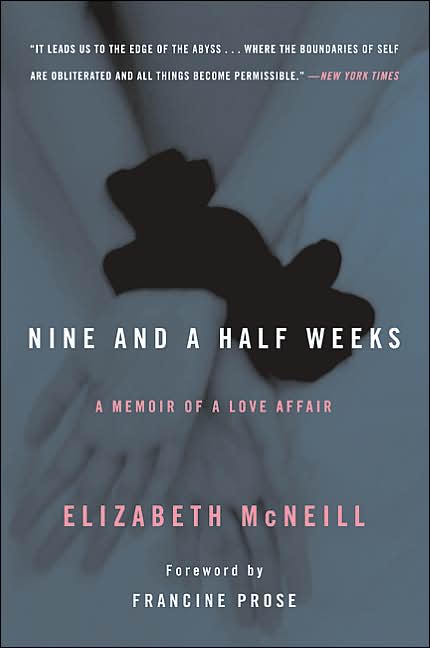
Nine and a Half Weeks: A Memoir of a Love Affair — Elizabeth Mcneill

Most novels (and memoirs) leave you with a sense of distance, a sense of being at a comfortable remove. Nine and a Half Weeks doesn’t: it’s too graphic, too immediate, too flat. One sees this effect in the first sentences, without any preamble as to who these people are and how they came to be: “The first time we were in bed together he held my hands pinned down above my head. I liked it. I liked him. He was moody in a way that struck me as romantic; he was funny, bright, interesting to talk to; and he gave me pleasure.” One senses quickening thoughts and pulses in those short sentences, and even in the long one, where semicolons could be periods, and the last descriptor—”he gave me pleasure”—is the really important one. You don’t get the very ironic tone of a book like Alain de Botton’s On Love, letting us see that love is irrational but really understandably so. Alain, the narrator of On Love is basically a needy, endearing, neurotic weakling; his self-consciousness contrasts so much with the man in Nine and a Half Weeks that they’re practically different species.

There are clever phrases in the memoir, as when the narrator says of her lover, “His face turns attractive when he talks;” I like the strange word choice, as if the head is physically turning, or as if he has two, or multiple, faces. A few moments are archaic—the man describes a friend or rival coming over as “This dope” (emphasis in original), which hasn’t been currently slang in decades and stands out in a book that otherwise stands out for not being part of any particular time. The prose holds up, and the narrator has an eye for tedious rituals, as when she tells of a “statistical tale,” where the contrast of statistics and narrative stands out:

In the middle of the statistical tale he’s requested from me—brothers and sisters and parents and grandparents, hometown, schools, jobs—I stop and close my eyes . . . please, I think, inarticulate even in my own mind, unable to turn to him and make the first move, please . . .

There’s a pervasive fear of dullness running through the memoir. The narrator notes that she and her lover looked like “An attractive, well-educated couple in New York City, average, middle-class, civilized.” That contrasts with what came before and will come after. Or does it? The memoir teases us by making us wonder if the the narrator isn’t so unusual as public discourse would make her out to be. I think the story’s flatness, the unwillingness to engage in direct commentary on what’s happening, points us in this direction, as when the narrator says, “I am standing, nearly on tiptoes, across the room from him, my arms raised above my head. My hands are tied to the hook on the wall on which his one large painting hangs during the day.” She’s hung like a painting and enjoys it. There is no further morality or analysis. Sixty Minutes plays in the background, a reminder of the middle America the narrator feels like she’s leaving behind even when she imagines it as a foil to her own actions.

Images repeat through the memoir. Scarves reappear. The words “like” and “love” are reconfigured like body parts. One senses Nabokovian echoes in the prose that one distantly hears on the first read but can’t make out. The narrator also feels her internal sense of self discombobulating, like a washing machine that shakes itself apart from within. She knows this is happening and imagines the reactions of otherwise course, until she writes of her experience.

We don’t know what the narrator wants beyond the obvious: sexual satisfaction. That she might only want the obvious might be the most frightening thing of all. What if everything else she has—a job, presumed communal respect, literary and political opinions—don’t matter very much? What if your real self isn’t those frontal cortex developments, but something deeper, more primal? I find posing the questions unsettling. The answers implied by Nine and a Half Weeks are more so. The patina of everyday experience conceals so much, especially in the realm of inchoate desire that social life is designed to channel. What happens when the channeling breaks? What happens when we want it to break? I’m reminded of Donna Tartt’s The Secret History, which also features the discarding of the mind in pursuit of a mental state or feeling very unlike the one most of us presumably inhabit most of the time—the mental state worried about how much money we have, what other people think about us, whether we’ll get the job / life partner / degree / accommodates of our dreams.

The narrator likes the man’s dominance above all other traits, which derive from that dominance. He says of a friend or rival, “he’s got no guts whatsoever.” Note what she likes in the contrast he offers by comparison. He shows mastery by reading Gide in French and Kafka in German, both implying continental expertise and sexuality. Some moments are obvious, as when the narrator reads with “his thick pen solid and comfortable in my hand.” One doesn’t need to be Freud to imagine that the pen is not just a pen. In the same scene, the narrator says, “I write the letter (‘. . . met this man a few days ago, nice start, very different from Gerry, who’s more than happy with Harriett these day, you remember her . . .’)” (sic). The dig at her ex-boyfriend is subtle but present: he isn’t dominant, won’t tie her up, and presumably has settled with a lesser woman.

He demonstrates great knowledge too: “[. . .] whatever else he may do [in] it, this man clearly does read his original-language books in bed; why would anyone want to miss out on one of the most satisfying pleasures available? All he’d need is a better bulb, a few more pillows, and a reading lamp. . . .” The room sounds sad and denuded, but it doesn’t matter much, even if the narrator is right about beds, which are good for more than just sleeping and that other thing. He offers commands, as when the narrator says:

He guides my hands between my legs and says, ‘I’d like to watch you make yourself come.’

He is sitting idly, comfortably, one leg crossed over the other, the creases sharp in the freshly cleaned suit. I do not try to move my hands. He waits. ‘You don’t understand.’ My voice cracks. ‘I never . . .’ He is silent. ‘I’ve never done that in front of anybody. It embarrasses me.’ “

She does, of course. That it embarrasses her is part of the point. What embarrasses her in the moment becomes the fodder for memoir, even under a pseudonym, long after. She likes giving power to him, which she does by letting him watch her masturbate. She also does by repeating how much she loves him, but I don’t think he ever says it back. It’s like he doesn’t need to, and by withholding the confirmation of his love he creates a neurotic fear in her. Only at one moment does he crack, when “All at once he is a decade my junior, a very young man asking me to have a drink with him, expecting to be refused.” But that doesn’t last long. Little does in this memoir, including their relationship, whose duration is given away by the title. But the narrator learns a lot in a short period. She says, “If you’ve never screamed, out of control, you can’t imagine how it feels. Now I know how it feels, it’s like coming.” She never goes the Biblical or mythological root and thinks there are things we shouldn’t know. For her, all knowledge is knowledge.

You can see that McNeill’s memoir doesn’t sit well with current ideals of equality and mutual respect in all fields. As Laura Kipnis says in “Off Limits: Should students be allowed to hook up with professors?” for Slate.com, “Feminism has taught us to recognize the power dynamics in these kinds of relationships, and this has evolved into a dominant paradigm, the new propriety.” Feminism has taught us to recognize power dynamics, but it should also teach us to recognize points of view. The narrator gets this; she thinks the man’s room is “too plain to be called plain. It’s austere, if you want to be charitable, or chic, if you want to be snide, or boring, if you want to be honest. It is not, in any event, a room you’d call cozy” {McNeill “Love”@9}. So the narrator is aware of angles, points of view, possibilities. I’ve been told I use “or” a lot in my own writing. It’s a useful word for people who perceive many ways of describing things, and here it betrays an openness to experience that the memoir exploits. She has a strong theory of mind that weakens as she awakens to herself.

I should point out that I call the narrator “the narrator” as opposed to “McNeill” or something more conventional because she feels like a fictional person more than a real person (which is strange, given how many fictional characters seem real, but that’s a topic for another time). Elizabeth McNeill is itself a pseudonym. We don’t know who the real author is. The man is never given a name—he’s only given traits, like his penchant for Brooks Brothers and sadomasochism (sometimes, especially when it comes to belts, simultaneously). So I don’t entirely know what to call them, or what to call their madness, if it is indeed madness. Can we find pleasure in madness? The narrator’s point is that many of these normally distinct categories eventually blur. I think that’s one of Tartt’s points in The Secret History too. There is more to be written about the book—its strange tenses, leaping from past to present to future, to what extent we should indulge in or avoid attempting to apply universal lessons—but this gives flavor of it and why its merits still show.

Summary Judgement: In the Basement of the Ivory Tower: Confessions of An Accidental Academic — Professor X

In the Basement of the Ivory Tower is fun, filled with anecdotes, and describes many of the feelings I’ve had in the higher education sausage mill, but you’re better off reading the eponymous Atlantic article from which it sprang. You’ll get 80% of the content with 20% of the time. Still, I especially like this bit from the book because nearly the same thing happened to me four weeks ago:

On the first night, I ask a few questions. How many of you took this class because of an abiding love of literature? No hands go up, ever—they are honest, I will give them that. How many of you are taking this class only because you have to? Now all hands shoot up, to the accompaniment of some self-conscious laughter.

I taught a technical writing course to a room full of public health, nutritional science, and engineering majors and asked how many were in the class because they want to learn more about the great and mysterious power of the English language. No hands. How many were taking it because they had to? All the hands. More of my students could write coherent sentences than Professor X’s students, probably because they’re juniors and seniors who’ve been through a fair number of classes, but “more” is not the same as “all.” Few of them cared. I want to imagine that I imparted real skills through longer and more difficult writing assignments than most of them had faced, but I’m not sure I did. It’s not easy to interest people in a topic when they lack intrinsic interest and don’t see it as valuable to their careers.

Professor X is a good writer (note too that his name is a pseudonym, and he isn’t, to my knowledge, claiming to the leader of the X-Men); he says, for instance, that his students “lack rudimentary study skills; in some cases, they are not even functionally literate. Many of them are so dispossessed of context that every bit of new information simply raises more questions.” Notice that phrase, “dispossessed of context,” which I’ve never thought of in that way before, and yet it fits: the Oxford American Dictionary says that dispossessed means to “deprive (someone) of something that they own, typically land or property,” and one gets the sense that educational system have failed Professor X’s students as much as they have failed the systems (note that there is plenty of blame to go around, and I don’t wish to sling it in this post). There are many moments like this, when unexpected artistry arrives.

This sense of the unexpected extends to Professor X’s grasp of the larger institutional and societal forces at work; he notes that college is supposed to be for everyone even when we’re supposed to have high standards. These two ideals seldom leave unbloodied when they meet in the real world. But he doesn’t have a lot of answers to problems, which is okay because a) large, complex problems often don’t have answers and b) he’s trying to tell his own story, not write a polemic. If you know someone of questionable literacy attempting to go to college and frustrated by the experience, you should recommend this book to them. They probably won’t read it, but if they did, they’d know more. I get the sense that Professor X is working more at the individual than societal level. That might also be what makes his book fun.

Some of the responses to his Atlantic article are bizarre, written by people who seem to have no idea what’s happening on the ground. Some of the later material drags. I like the book but would only recommend it to specialists; I read it because I’m working on my own academic work related to university novels. If it weren’t for that, I don’t think I would’ve gotten enough from it, beyond the Atlantic article, to justify reading.

The Case Against Adolescence: Rediscovering the Adult in Every Teen — Robert Epstein

The Case Against Adolescence should be a better book than it is, much like Sex at Dawn. The central argument is that we create the contemporary adolescence experience (angst, nihilism, penchants for bad TV shows, temper storms) through social and legal restrictions on teenagers that deprive them of any real ability to be or act like adults. I’m inclined towards it, but the book would’ve been greatly helped by peer review.

Epstein is not the first person to notice. In “Why Nerds are Unpopular,” Paul Graham says that “I think the important thing about the real world is not that it’s populated by adults, but that it’s very large, and the things you do have real effects.” This means that teenagers have no real challenges—high school is so fake a challenge that a lot of people find that it poisons education for them—and that they become “neurotic lapdogs:

As far as I can tell, the concept of the hormone-crazed teenager is coeval with suburbia. I don’t think this is a coincidence. I think teenagers are driven crazy by the life they’re made to lead. Teenage apprentices in the Renaissance were working dogs. Teenagers now are neurotic lapdogs. Their craziness is the craziness of the idle everywhere.

“Coeval” is correct, but it would be more accurate to say that being a teenager was enabled by growing economic wealth more than anything else. Once young people didn’t have to start working immediately, they didn’t. This started happening on a somewhat wide scale in the late nineteenth and early twentieth century. It accelerated after World War II. By now, laws practically prevent people from becoming an adult. The question of why and how this happened, however, remains open.

The Case Against Adolescence offers a dedication: “To Jordan and Jenelle, may you grow up in a world that judges you based on your abilities, not your age.” Unfortunately, we’re not likely to get such a world in the near future because bureaucratic requirements demand hard age cutoffs instead of real judgments. Should you drive when you’re “ready” to drive? How will the DMV decide? It can’t, so laws make 16 the magic age. Based on what I’ve seen at the University of Arizona, most students are “ready” to drink in the sense that they make the choice to do so on their own free will—despite the nominal legal drinking age of 21. But “ready to” can’t be readily gauged by a cop looking at a driver’s license, so we have to choose arbitrary cutoffs.

Many students appear to feel done with high school by the time they’re 16—but high school continues to 18, so, for the vast majority, they stay—not “based on [their] abilities,” but on their age. Without those bureaucratic requirements, judgment based on abilities might be more possible. In some realms, it is: this might be why the image of the teenage hacker has become part of pop culture. In computer programming, one can judge immediately whether the code works and does what its author says it should. There isn’t really such a thing as code that is “avant garde” or otherwise susceptible to influence and taste. In addition, computers are readily available, and posting work online lets one adopt personas that may be “older” than the driver’s license age. As such, working online may alleviate problems with age, sex, race, and other such issues. Online, no one automatically knows you’re a teenager. Offline, it’s obvious.

One reason why contemporary teenagers act the way they do might simply be the “role models” they have—who tend to be each other. As Epstein says, “Because teens in preindustrial countries spend most of their time with adults—both family members and co-workers—adults become their role models, not peers. What’s more, their primary task is not to break free of adults but rather to become productive members of their families and their communities as soon as they are able.” But the term “preindustrial countries” sounds wrong: countries didn’t really coalesce into more than city-states until after the industrial revolution. A lot of contemporary political problems arise from imposing European “countries” on territories with diverse tribal or clan identities. Furthermore, I’m not sure that hunter-gatherers and agrarian societies can be lumped together like this. And I don’t think most agrarians would think of others as “co-workers,” an idea that comes from modern offices.

That’s one example of the book’s sloppiness. The other is simpler: our economy increasingly rewards advanced education, which means that the economic productivity of people without it is going down. So we might have a very good reason for forcing teenagers to attend school for long periods of time, namely that most won’t be able to accomplish much without it. The keyword is “most:” there are obvious exceptions, and the kinds of people likely to be reading this blog are more likely to be the exceptions. Epstein observes that for most of human existence, people we now call teenagers were more like adults. He’s right. But there’s a problem with his argument.

Early on, he says, “For the first time in human history, we have artificially extended childhood well past puberty. Simply stated, we are not letting our young people grow up.” The reasons for this are complex, and Epstein suggests an evolutionary narrative for greater capability earlier in history than we might now assume: “our young ancestors must have been capable of providing for their offspring. . . and in most other respects functioning fully as adults” because, if they couldn’t, “their young could not have survived.” This is true, but most of human history also hasn’t occurred in industrial and post-industrial times. We’re living in a weird era by almost any standard, so the reason teenagers are treated like teenagers might be an economic argument.

They can’t produce much until they have a lot of education, and productive adults don’t usually have time to train them. As Graham says of schools, “In fact their primary purpose is to keep kids locked up in one place for a big chunk of the day so adults can get things done. And I have no problem with this: in a specialized industrial society, it would be a disaster to have kids running around loose.” Teens might have use for adults, but not a lot of adults have much use for teenagers. In my parents’ business, Seliger + Associates, employing me was probably a net drag until I was 17 or 18, and even then I was only productive because I’d been working for them for so long. Epstein underestimates what a “specialized industrial society” looks like. The larger point that young people are probably going to be more capable if we let them be is true. But the flip side of positive capability is the negative possibility of failure.

Epstein does anticipate part of Graham’s argument:

[. . .] in most industrialized countries today teens are almost completely isolated from adults; they’re immersed in ‘teen culture,’ required or urged to attend school until their late teens or early twenties, largely prohibited from or discouraged from working, and largely restricted, when they do work, to demeaning, poorly paid jobs.

But he doesn’t elaborate on why this might be. Delaying adulthood can have a lot of reasons, and he sometimes confuses correlation with causation: just because men and women marry later than they used to, as Epstein argues on page 30, doesn’t mean that they’re delaying adulthood: it means they might want fun, they might not need marriage for economic purposes, and they don’t need marriage for sex. Disconnecting sex from marriage probably explains as much of this as anything else does.

He does notice institutionalized hypocrisy, which is useful. For example, “Whether we like the idea or not, young people who commit serious crimes are indeed emulating adults—adult behavior, adult emotions, adult ideas. They see adults on the streets, on TV, in movies, and in newspapers and magazines doing heinous things every day. What’s more, when a young person commits a crime, he or she is demonstrating control over his or her own life.” A sixteen year old who commits murder can be tried as an adult; a sixteen year old who has sex still has to be protected like a child, even if it’s the same sixteen year old. A twenty year old sends a naked picture of herself to her boyfriend, but a seventeen year old emulating the twenty year old’s behavior can’t.

I think a lot of this has to do with parent desires: they don’t want kids having sex because the economic consequences of pregnancy are severe and because parents are often left to clean up the financial and emotional messes in a way they don’t have to with, say, 21 year olds. Part of this is because of social expectations, but part may still be because of economics, which is the great missing piece of The Case Against Adolescence. Robin Hanson notes the labor component of the child / adolescent argument. I think he’s missing one major component of his argument: parents on average probably don’t want their offspring to leave school because they associate school with higher eventual earnings and economic success that will translate to social / reproductive success. So I don’t think it’s just other laborers who don’t want kids in the workforce—it’s also probably parents as a whole.

You can find more about judicial and sexual hypocrisy in in Judith Levine’s book, Harmful to Minors: The Perils of Protecting Children from Sex, which should probably be better known than it is. As she says:

This book, at bottom, is about fear. America’s fears about child sexuality are both peculiarly contemporary […] and forged deep in history. Harmful to Minors recounts how that fear got its claws into America in the late twentieth century and how, abetted by a sentimental, sometimes cynical, politics of child protectionism, it now dominates the way we think and act about children’s sexuality.

We’re probably afraid of sexuality because we’re afraid of the costs of pregnancy and because of the United States’ religious heritage. Those “fears about child sexuality” are unlikely to go away in part because there is some level of rationality in them: we’re unhappy when people reproduce and can’t afford their offspring. So we call people who mostly aren’t economically viable “children,” even when they’re physiologically and psychologically not. It’s dumb, but it’s what we do.

Furthermore, we don’t really know why adolescence, if it didn’t really exist until the twentieth century, didn’t. Epstein cites a 2003 New Yorker article by Joan Acocella called “Little People: When did we start treating children like children?“, which notes, “If, as is said, adolescence wasn’t discovered until the twentieth century, that may be because earlier teen-agers didn’t have time for one, or, if they did, it wasn’t witnessed by their parents.” Notice the tentativeness of this sentence: “as is said,” “that may be,” “or.” We don’t know. We might never entirely know. Contemporary adolescence might, like being overweight and having a 60″ TV, be a condition of modernity, and earlier peoples might have developed it too if they’d been rich enough.

This is the part of the post where I’m supposed to posit some solutions. Problem is, I don’t have any, or any that are practical. Eliminating middle school and having “high school” go from seventh to tenth grades might one, followed by something more like community college or a real university, would be a good place to start, along with letting people enter contracts at sixteen instead of eighteen. The probability of this happening is so low that I feel dumb for even mentioning it. Not all problems have solutions, but being aware of the problem might be a very small part of the start.

More on fiction versus nonfiction

Most of the books I’ve been wanting to write about and not getting around to are nonfiction, and I’m not sure why this is. It might be because both good and bad nonfiction are easier to write about than good fiction. Good fiction demands attention and time, which are in chronically short supply for me and virtually everyone else. So I foolishly put off writing about good fiction and instead spread time among lesser though still interesting vessels (this post comes as a followup to Nonfiction, fiction, and the perceived quality race, which got started from the question, “The quality of fiction seems to be decreasing relative to the quality of non-fiction, or am I just biased against active fiction writers vs. dead ones?”).

I expend a lot of my time thinking about good fiction in the context of making my own novel writing better, instead of writing about what makes good fiction good on this forum. So even though I think a lot about good novels, I write about them in a different context. For instance, the last novel I finished stole from Alain de Botton’s On Love and Rebecca Goldstein’s The Mind-Body Problem; I’ve written about both books here, but not nearly to the proportion I’ve been thinking about. Alas: the novel I wrote got the most encouraging rejections, many along the lines of “I like it but can’t sell it.” If it had sold and eventually been published, I think it would be much easier for me to write about novels I care deeply about.

Even so, there are a bunch of novels—a couple by Michel Houellebecq, Elmore Leonard’s latest, Brady Udall’s The Lonely Polygamist, more about Robertson Davies—I mean to write about, but but they’re outnumbered by nonfiction. This might seem strange, coming from a person in English graduate school, where we study nonfiction all the time, and when we study fiction, it’s often more like studying nonfiction than we care to admit.

I also simply don’t read as much fiction as I used to; I wonder if fiction is most useful to the young (who are trying to figure out who they are and how the social world works) and the old (who are trying to figure out what this crazy thing they just did actually means). A lot of people in the middle don’t appear to derive as much immediate benefit from reading fiction, although I have no data on this idea.

Finally, I can often read nonfiction much faster than fiction. This isn’t a change, but it is true: nonfiction often telegraphs where it’s going, which makes skipping large sections easier. Being able to read faster also indicates that too many books are too long, as Cowen has argued in various places, but it nonetheless means I very seldom have to invest as much in deep, close reading. I wish more nonfiction books rose to the level of deep, close reading, but few do, relative to good fiction.