The Death of the Novel and Ryan Holiday’s “Trust Me, I’m Lying”

“As Chris Hedges, the philosopher and journalist, wrote, ‘In an age of images and entertainment, in an age of instant emotional gratification, we neither seek nor want honesty or reality. Reality is complicated. Reality is boring. We are incapable or unwilling to handle this frustration.’

As a manipulator, I certainly encourage and fuel this age. So do the content creators.” (67-8)

We have met the enemy, and he is us.

Trust Me LyingI have read a million essays, most dumb, about the Death of the Novel or the Death of Literature; “Anxiety of influence: how Facebook and Twitter are reshaping the novel” is one recent specimen, though there will no doubt be others: the topic seems as attractive to the essay writing set as cat pictures and porn are to Internet users. Yet the quoted passage from Ryan Holiday’s Trust Me, I’m Lying: Confessions of a Media Manipulator resonates more than most samples in the genre. Reality is complicated and the best novels, and narrative art generally, strives to capture that reality. Does a novel make a cultural sound if no one is there to read it?

“In an age of images and entertainment” it might also be useful to recall the Stephenson quote posted a few days ago:

Literate people used to spend a lot of time reading books, but during the Internet years those have begun to seem more and more like a distinct minority: a large and relatively well-off minority, to be sure, but one that simply doesn’t register in the electronic media, as vampires are invisible to mirrors. [. . .] Books, though, and the thoughts that go through the heads of their readers, are too long and complex to work on the screen—but it a talk show, a PowerPoint presentation, or a webpage. Booksih people sense this. [. . .]

If bookishness were just a niche pastime, like stamp collecting or waveboarding, none of this would really matter. But it’s more than that. It is the collective memory and accumulated wisdom of our species.

Not all hobbies are created equal. I wonder too if bookishness makes one less susceptible to the media manipulations Holiday describes in Trust Me, I’m Lying. “Less susceptible” is of course not the same as “immune.” Nonetheless, I would take from the book several lessons:

1. Beware the cheap, faux outrage that is seemingly everywhere online.

2. Realize that people are still herd animals—a point Holiday makes—and that while this is often adaptive (if everyone is literally running in one direction, there’s probably a reason) it has many drawbacks. Intellectually and economically it is often not good to be part of the herd.

3. Most people don’t separate news and entertainment, though few think explicitly about this point. Whatever larger cultural structures might have existed to enforce this separation at one point are if not gone altogether then mostly gone, and Trust Me, I’m Lying is a eulogy of sorts.

4. The environment in which we evolved for tens of thousands of years or more is very different from the one in which we live now; though that’s an obvious point, the many ways in which now and then are different still surprise me. Consider:

the public is misinformed about a situation that we desperately need to solve. But heartbreaking sadness does not spread well. Through the selective mechanism of what spreads—and gets traffic and pageviews—we get suppression not by omission but by transmission.

5. Trust Me, I’m Lying raises my estimation of academia, at least slightly.

Life: The power of the book and the power of memory

“If bookishness were just a niche pastime, like stamp collecting or waveboarding, none of this would really matter. But it’s more than that. It is the collective memory and accumulated wisdom of our species.

The rough-and-ready intellectual consensus of the mid-Twentieth Century is being pushed out by a New Superstition whose victims can find testimony on the Internet for anything they choose to believe. The only cure for it is reading books, and lots of them. When all things bookish are edited out of public discourse, strange things happen, or seem to. When our societal attention span becomes shorter than the lifetime of a steel bridge over a river, what appears to be a solid strip of highway can suddenly fall out from under us. Like a portent from the medieval world.”

—Neal Stephenson, from Some Remarks; see also “Twilight of the Books.”

That being said, I don’t think the Internet is only for “New Superstition,” and some of the “intellectual consensus” was and is wrong. Knowledge that people post and read on the Internet is neither right nor wrong, superstitious nor factual.

Creativity, Inc.: Overcoming the Unseen Forces That Stand in the Way of True Inspiration — Ed Catmull and Amy Wallace

Creativity, Inc. is an interesting book marred by consistently, distractingly bad writing. I read it based on John Siracusa’s review, which doesn’t mention style (and doesn’t quote). But writing about a book without discussing style is like writing about Apple’s laptops without mentioning it.

Many of Catmull’s stories are interesting; for example, he tells one about holding meetings around a long, narrow table that by its physicality tended to exclude people and produce hierarchy, especially since some people would get reserved seats. But he missed the problems at the time: “the seating arrangements and place cards were designed for the convenience of the leaders, including me. Sincerely believing that we were in an inclusive meeting, we saw nothing amiss because we didn’t feel excluded.”

But two of Creativity, Inc.’s main points—about the need to tolerate failure in the right circumstances and the need to foster a creative working environment—are dealt with by much better-written books: Megan McArdle’s The Up Side of Down: Why Failing Well Is the Key to Success and Steven Berlin Johnson’s Where Good Ideas Come From. Not surprisingly they’re both professional writers; either would’ve been a better choice to ghost / “assist” with his book, but they might’ve been a lot more expensive too.

The book should be great; instead, Creativity, Inc. is decent, with redeeming qualities. Had it been a Pixar movie subjected to the process Catmull describes, I think it would’ve been trashed or straightened out before hitting the metaphorical screen. Creativity, Inc. is so painful because it has the potential to be a monument rather than a moment. Its errors are elementary; its insights aren’t. In writing, it appears that Catmull doesn’t know what he doesn’t know. At Pixar he learned to know what he doesn’t know, but in writing he’s not there yet.

There are weird metaphors: “Sutherland and Dave Evans, who was chair of the university’s computer science department, were magnets for bright students with diverse interests, and they led us with a light touch.” So are they like magnets, which attract metal rapidly, or are they like human riding horses, which is probably where the “light touch” metaphor comes from? The mixing in this sentence is jarring. He has “a ringside seat” to ARPANET. Catmull writes that early film editors at Lucasfilm “couldn’t have been less interested in making changes that would slow them down in the short term.” But that seems unlikely: it’s almost impossible to get to a true zero level of interest. Chances are those editors could have been less interested, perhaps through hostility. In 1983, we learn that “George [Lucas] hadn’t lost an ounce of his ambition,” but how many ounces are there in the average person’s ambition? How many in Lucas’s? Talking about ambition in terms of ounces is common but whatever freshness and vitality the metaphor might have once had is gone. These examples come from the first 37 pages. There are so many other examples of weak writing and clichés that I stopped marking them.

Not every sentence must be brilliant or unexpected—that would be alienating—but some should be.

The best part of Creativity, Inc. is the last pages: “Afterword: The Steve We Knew:”

[Steve Jobs] used to say regularly that as brilliant as Apple products were, eventually they all ended up in landfills. Pixar movies, on the other hand, would live forever. He believed, as I do, that because they dig for deeper truths, our movies will endure, and he found beauty in that idea. John talks about ‘the nobility of entertaining people.’

It has fewer clichés, though I’m not sure why. Nonetheless, I wish the rest of the book had been more like the last ten pages. For the right person in the right industry at the right time, Creativity, Inc. is still worth reading. For the rest of us it’s a lesson in what might have and should have been.

Paying for the Party — Elizabeth Armstrong and Laura Hamilton

Paying for the Party is a specialist book likely to be of particular interest to two audiences—university-involved people / researchers and parents of high school and college students—but it has a couple other notable features: it inadvertently shows why so many teachers are so bad, it is broadly compatible with Bryan Caplan’s view of education as a signaling mechanism, and the authors treat the women they write about like passive receptacles for the amorphously described desires of other people.

To construct their narrative, the authors live with a cohort of freshmen girls in a large dorm and then follow the girls’s progress through the university—or away from it. Here’s an example of their paternalism:

Even if women are willing to socialize without alcohol, the university offers comparatively few opportunities [. . .] The women on our floor, who loved to dance, often complained that there was nowhere to do this other than fraternities. [. . .] Fraternity men choose party themes, decide who can enter and who can leave parties, and generally dictate the social lives of the campuses youngest and most vulnerable residents. (53–4)

Paying for the PartyThis passage implies that women have no agency in what they do and aren’t really accountable for their actions: instead, nebulous the “university” or “fraternity men” are the ones who “dictate” what happens to “vulnerable” women. Women can create their own opportunities for socialization (otherwise known, among normal humans, as “hosting a party” or “getting together with friends”). The school in question sounds like the University of Arizona, where innumerable forums were available for dancing: ballroom club, swing club, and a bunch of others. The authors have too much credulousness here; the frat system persists in part because women support it by going to frat parties. That being said, the inability of women to enter bars where older women go to get laid also plays a role; this is an unintended and rarely discussed consequence of making the official drinking age 21 when the unofficial drinking age is much younger.

(EDIT: Sororities apparently pay lower insurance fees in return for not hosting parties. Nonetheless, there are proposals, like mine in the preceding paragraph, to allow sororities to host parties. This seems like a wildly obvious step to me but Armstrong and Hamilton never seem to consider it: Without consciously realizing it, they are determined to frame women as passive victims—and they succeed.)

As with so many social science books, the authors seem to have no familiarity with evolutionary biology or for that matter their own society: “All women had to do to get to a fraternity party was to stand out front.” And they got “free alcohol” at frats. Have they not heard of K-selection? Men compete to be selected by women, but my anecdotal observation is that relatively few women perceive this because they’re in turn focused on a relatively small number of high-status men, with status defined differently in different context. Lower status men can be nearly invisible. Armstrong and Hamilton seem not to realize or understand this.

Beyond that, Harry Brighouse’s Crooked Timber post on the book is good. Of particular interest is this, when Brighouse says that “A typical reaction [from his student reading group] has been ‘I wish I had seen this in my first year of college, I’d have understood the institution and how to navigate it so much better.'” I heard a lot of analogous statements, in many contexts, at the University of Arizona; there is a tremendous amount of tacit knowledge that goes into navigating the educational or health systems successfully, and too little of that knowledge is explicit (that’s one reason I wrote some of my essays about how universities really work). The students who most need to read such essays or a book like Paying for the Party are probably the ones least likely to do so and most likely to pay for their party long after the party is over.

In addition, most of the professors and grad students who teach college classes probably aren’t going to identify with lost or party-oriented students. The kinds of people who become obsessed with a topic enough to go to academic grad school and then make it as a professor are for the most part huge nerds. People tend to self-segregate and consequently the nerds who are teaching classes are looking for the nerds or proto-nerds taking them. That was certainly true of me; the students who didn’t really like reading, English, or thinking weren’t of tremendous interest to me. There’s an inherent culture clash between nerds (who are by and large selected to be grad students and then professors) and party-oriented people. When I was a grad student I provided lots of feedback to students who tended to be nerds (and thus wanted to talk to me) and much less to those who didn’t tend to be nerds (and thus didn’t much want to talk to me).

The culture clash issue is a small example of the general problem that often occurs when taking a thing that was created primarily to do one thing—create knowledge, and train and house future knowledge workers—and then adapt it to do something else—provide job training or at least job signaling for everyone. Nerds, even in a relatively broad sense, have always been and probably always will be a relatively small proportion of the population and by now pretty much every nerd, broadly defined, in the U.S. is going to college. The number of people at the margins who are well-equipped either financially by their parents or intellectually by themselves and their schools to succeed in big research universities is probably small.

Paying for the Party inadvertently mentions why so many teachers in American schools are so bad: they spend much of their life in college partying and know that “education” is an easy major. Hilariously, we find this: “Some women, however, struggled to pass teacher certification tests.” I hope the tests in the Midwestern state studied are harder than the ones in Washington. I’ve written this before, but I took the general teacher test and the English-specific test in Washington State, cold, and got a certificate saying I was in the top five or two percent of the test takers. It was shockingly, insanely easy. I think I would’ve passed when I was in high school. That nominal college grads would struggle on a similar exam could be another datum in Academically Adrift.

The other “easy” majors make college deceptive for marginal students, like many of those Armstrong and Hamilton follow, but from the university’s perspective one should ask: What’re the alternatives? Armstrong and Hamilton recommend making college harder, which sounds fine to me, but students who can’t handle “tourism” or “apparel management” aren’t going to become chemical engineers instead. Even if one somehow removed the easy majors (“somehow” does a lot of work in this sentence), the result would be that marginal students drop out. Showing up in college and not being able to write simple sentences or do algebra means that real intellectual learning is likely to take a long time to develop—if it ever does.

To return to gender politics, the authors say there is a group of women who “were not poised to move upward” economically and “Virtually all [of them] were servicing substantial debt.” “Several of these women actively sought men who could help support them [. . .] Others struggled to find ideal candidates who were willing to commit” (213). But the authors (again) never look at a man’s perspective: Why would a high-status, high-skill man want to marry a random woman with limited skills or prospects? Especially one with high levels of debt?

The phrase “don’t buy the cow when you can get the milk for free” comes to mind. Evidently the women described didn’t learn about empathy while in college. Men are as selective as women regarding long-term relationships (see here for one example of the literature). The authors do get to something like this point around pages 222 – 3. Many of the women look down on otherwise decent-seeming guys; both they and the authors don’t seem to realize that there aren’t a huge number of jobs in glamour industries like “fashion” or “entertainment.” Unless I missed it, words like “computer science” and “electrical engineering” never appear.

I can’t find the quote right now, but I’ve seen something like this: “What the rich accept as their right the poor pay for with their youth.”


* See also Beer and Circus: How Big-Time Sports Is Crippling Undergraduate Education by Murray Sperber, which a friend who owned an LSAT test-prep company recommended. It was an early and effective effort to pop the approval bubble most of the education-industrial complex once lived in; looking at the totality of the evidence, it’s hard to be unambiguously in favor of the current college, and college-subsidy, system.

Life: The role of luck edition

Luck is without a doubt an important ingredient in creative discoveries. A very successful artist, whose work sells well and hangs in the best museums and who can afford a large estate with horses and a swimming pool, once admitted ruefully that there could be at least a thousand artists as good as he is—yet they are unknown and their work is unappreciated. The one difference between him and the rest, he said, was that years back he met at a party a man with whom he had a few drinks. They hit it off and became friends. The man eventually became a successful art dealer who did his best to push his friend’s work. One thing led to another: A rich collector began to buy the artist’s work, critics started paying attention, a large museum added one of his works to its permanent collection. And once the artist became successful, the field discovered his creativity.

—Mihaly Csikszentmihalyi, Creativity: The Psychology of Discovery and Invention.

Should this be heartening or disheartening. Also: Compare it to “Photography and Tyler Cowen’s ‘Average is Over.’

Photography and Tyler Cowen’s “Average is Over”

Tyler Cowen’s Average Is Over should be read for many reasons, and one of them is a prediction that marketing and similar activities are going to grow in importance over time. At first I thought the claim was bullshit: shouldn’t the Internet make substance win over style? In many ways it does, but I keep seeing evidence that supports Cowen’s point. The latest example: a few years ago I became interested in photography. A few days ago Thom Hogan wrote an essay called “What’s Your Biggest Problem?“, in which he says:

I’d say that the biggest problem I find that most photographers have is a really fundamental one: what is it they’re taking a photo of? And why?

Ironically, pros didn’t use to have this problem. If you were working for a client, generally they were directing you towards what you were taking a photograph of and why. Back in the film days just mastering the technique of getting proper exposure and focus and all the rest was generally enough to set you apart. These days of ubiquitous and cheap stock photography and digital cameras with instant feedback on the basics, for a pro to stand out they need something more than the basics: generally a recognizable and unique style.

Indeed, that is one of the two primary problems pros have these days. Problem 1: standing out amongst all the good imagery that exists, much of it near “free”. Problem 2: marketing yourself so that people know your work. Unfortunately, solving #2 means that you have to be highly visible, which makes more people attempt to copy you, which eventually increases problem #1. Pros have to keep moving, keep reinventing themselves, and above all be great marketers and salespeople.

average_is_overMachines (cameras, in this case) are getting so good that even relatively unskilled photographers like me can take pretty good shots most of the time, and marketing distinguishes a lot of the pros from uncompensated amateurs who share their work online.

A lot of high-skill / low-income photographers disdain Terry Richardson for “boring” shots, blown-out highlights, and other technical flaws, and those photographers say that they could do what Richardson does. (More than a little jealousy also probably animates those attacks, since Richardson appears to lead an active, varied sex life—let’s ignore that for now.) But Richardson has something important almost no one else does: people know his name and to a lesser extent his work. Not many photographers have strangers who know their name—let alone have strong opinions about their work. Whatever his flaws may be, Richardson has what people commenting on the Internet don’t: a brand.

More very good photos are probably being taken today than ever before, and, as I wrote here, I’m a small but real contributor. Writing is still the main focus of my life but I still get some decent shots. Like anything touched by computers and Moore’s Law cameras are getting better all the time, and that makes the shooting envelope more forgiving. I shoot with an Olympus E-M5 that originally retailed for about $1,200 and now goes for half that used.* The E-M5 is better in many respects than most of the professional cameras that cost many thousands of dollars in 2006, and in a year or two it’ll be cheaper still.**

OLYMPUS DIGITAL CAMERASoftware tools like Adobe Lightroom are also making pictures easier to enhance (or “save”) through simple parameter adjustments. Most semi-serious photographers learn to shoot in their camera’s raw file format, which yields greater latitude in post-processing. It’s often possible to get a very professional look by changing a few parameters. Messed-up shots can often be saved in post-processing. That’s always been somewhat true but it’s becoming more true over time.

So what’s going to separate the pros? Marketing. Money in what’s called “stock” photography has already basically disappeared, and journalistic photographers have seen their ranks dwindle along with newspaper subscriptions. Photography is becoming a secondary, not primary, skill for many people. For example, this guy took professional-caliber shots for his friend’s website.

What’s left is finding a way to make people think you’re better than the race-to-the-bottom, even if some people still think some heavily marketed / known photographers are the bottom.


* The people in charge of camera naming and marketing are idiots. Cameras are named with a baffling array of impossible-to-remember letters and numbers, and only obsessive nerds like me take the time to figure out what they mean. The only camera with some mainstream name recognition is the Canon Rebel line; while the name is nonsensical—what exactly is one rebelling from?—it is at least memorable. If I were put in charge of a camera company I’d start by firing everyone in marketing and PR.

** Update from 2015: Olympus just released the OM-D E-M5 II (the successor to my camera), and it’s retailing for $1,100—yet the the updates are, charitably speaking, minor. The new camera will put price pressure on the model I use, which is now under $400 for a still-incredible camera. Camera companies can’t get people to upgrade because existing cameras are so good.

Why fiction? Why reading?

When we pick up a decent book, we live not once but twice, and each new book allows us to live again and absorb the thoughts of someone who has absorbed thousands of other people’s thoughts. The book is the most powerful medium yet invented for intellectual stimulation, growth, and change. The bounty is endless and in the contemporary world very cheap. Most, though, reject the gift. Is this not strange?

Pretty much everyone who is deeply interested in reading gets and/or writing gets some version of the utility question that I answered in the first paragraph (and have answered in other places). Each answer has its own idiosyncrasies, but I think they have a common core that revolves around knowledge and pleasure. The issue is on my mind because a friend wrote me to say regarding Asking Anna, “thanks for having thought through that book content and made it available for people like me to read and then not have to do some of the work. I like that.” The crazy thing is that crazy people have been doing this for centuries: packaging many thousands of hours of thinking into works that take only a few hours to read.

That’s true of fiction and nonfiction, and in some ways lately nonfiction has been leading the perceive quality race. But historically fiction has tended to advance the state of the art in prose, with novelists especially leading the charge towards renewing the language. Arguably this tendency has decreased over time, but I’ve never read a great nonfiction writer who didn’t also read fiction, or read a lot of fiction at one point.

Good novelists tend to be obsessed with the quality of their prose in a way fewer nonfiction writers are. Too many nonfiction writers focus on content at the expense of form and beauty; some have been glamored by some of the stupid literary theory that passes for erudition in some academic circles (Katharine Frank’s books, like Plays Well in Groups: A Journey Through the World of Group Sex, suffer from this, though she is merely a salient example and far from the only offender).

Fiction tends to train us to attend to language, and books like Wood’s How Fiction Works and Francine Prose’s Reading Like a Writer do the same. When one becomes sufficiently attuned to language, poorly written work or even work that is merely competent becomes aggravating, like a song messed by a drunk guitarist.

That’s my short utilitarian defense of fiction, but I read it for pleasure. The history of the West is one in which pleasure is suspect, especially in the Judeo-Christian tradition; sometimes for good reasons and sometimes for less-good reasons. That tradition encourages us to make sure that pleasure is always deferred, and that’s the tradition that led to the Enlightenment and Industrial Revolution and hence to the present day. We’re still getting somewhat used to enormous material wealth, at least by historical standards. But pleasure has its own importance, and there is pleasure in the many lives we can choose to live through books. Perhaps the most interesting thing is that so many people do not make the choice.

Every great book is the result of years or decades of studying and experience, distilled into a volume you can read in a few hours. How could you not want that?

The Second Machine Age — Brynjolfsson and McAfee

The Second Machine Age: Work, Progress, and Prosperity in a Time of Brilliant Technologies is worth reading if you haven’t read Tyler Cowen’s Average is Over or the various other books about the influence of computers, networks, and the Internet on society and the labor market. If you’ve already read some of those books, then by osmosis you’ve already The Second Machine Age.

The Second Machine AgeIn it many now-familiar stories appear: Moore’s Law, superstar economics, Coming Apart: The State of White America, 1960-2010, chess-playing computers, the importance of teachers in education. Each subject is worthy in itself but much of the content has appeared elsewhere. Brynjolfsson and McAfee are decent writers but no one, except maybe a machine, will mistake them for excellent stylists. They wisely import wits at appropriate moments, thus achieving specialization and appropriately divided labor:*

The journalist A. J. Liebling famously remarked that, ‘Freedom of the press is limited to those who own one.’ It is no exaggeration to say that billions of people will soon have a printing press, reference library, school, and computer all at their fingertips.

Maybe: but we’re also in a race against censorship, as anyone in China knows well. The UK has instituted a mandatory porn filter on ISPs (which is the start of censorship creep) and that filter has already blocked a videogame update; how long until it “accidentally” blocks the opposition party’s website in the days before an election? The revelations from Snowden indicate that the U.S. may already have the ability to shut down Internet “printing presses” or block dissemination of their content. When such efforts are made in the future the reasoning will no doubt involve Protecting Our Children, which is already how the U.S. limits speech and conduct that is distasteful and/or disliked by most voters and the politicians they elect.

The parts about education stand out for their policy implications:

Conclusions by education researchers Ernest Pascarella and Patrick Terenzini [. . .] summarized more than twenty years of research in their book How College Affects Students. They write that ‘the impact of college is largely determined by individual effort and involvement in academic, interpersonal, and extracurricular offerings on campus.’

This work leads directly to our most fundamental recommendation to students and their parents: study hard, using technology and all other available resources to ‘fill up your toolkit’ and acquire skills and abilities that will be needed in the second machine age.

Schools often won’t do this effectively; right now it’s up to students to take on the burden themselves as best they can. But motivation is hard, and many if not all things are more easily imbibed when they’re presented by a guide who knows how to explain by analogy and where to find effective resources for learning. A lot of books are bad and that includes how-to books; one small but rarely stated purpose of teachers and professors is to read thousands of books and then recommend the handful of really good ones, or the ones most likely to be of utility to students. “Good” and “good for young / inexperienced people” are often different and experienced people can forget such an important difference.

Brynjolfsson and McAfee also write:

Perhaps unsurprisingly, records show that the electric motors did not lead to much of an improvement in performance [in early factories]. There might have been less smoke and a little less noise, but the new technology was not always reliable. Overall, productivity barely budged.

Only after thirty years—long enough for the original managers to retire and be replaced by a new generation—did factory layouts change [to accommodate electric motors]. The new factories looked much like those we see today: a single story spread out over an acre or more. Instead of a single massive engine, each piece of equipment had its own small electric motor.

Universities appear to suffer from this too, as do hospitals; perhaps we will see them change in response to conditions and to pressure generated from rising prices.

I had enough context to read the book in a few hours and wish that I’d waited for a library copy instead of buying. If you’re looking for a big-picture view of the contemporary world that grounds itself in many micro-observations, you should read The Second Machine Age. It will also help you think about your own career and life and where both should go. To some extent everyone is in the technology business, whether they realize it or not.


* Things economists love almost as much as children.

Briefly noted: The Monogamy Gap — Eric Anderson

Any book that claims rigor but approvingly cites Michel Foucault undermines its claim to rigorousness. While the subject of The Monogamy Gap is interesting, the book draws on 120 interviews of university men. That’s all. Its conclusions might be mildly useful for understanding that particular group but its claims shouldn’t be applied beyond that tiny group. There are many useful things to be said about monogamy, but most of them have been and are being said by evolutionary biologists, psychologists, novelists, and memoirists (“memoir writers?”), and to a lesser extent economists.

What Camille Paglia said in “Scholars in Bondage” also applies to The Monogamy Gap.

Antifragile: Things That Gain From Disorder — Nassim Taleb

The Black Swan is so good that I’ve been running around telling everyone to read it, which naturally led me to its successor, Antifragile. It, by contrast, is an excellent book to get from the library (per this accurate warning) and an excellent book to read skeptically, given its many dubious claims and stories.
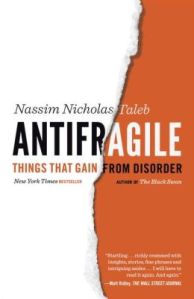
Antifragile_coverThe top-level idea of Antifragile is a good one (many random events trade small gains for tremendous losses, and vice-versa; focus on making sure that you can sustain small losses for big gains, which makes you “antifragile,” as opposed to merely “robust”), but rarely have I read a book with such a correct thesis and so many misrepresentations, needless ad-hominem attacks, and dubious stories that may not demonstrate what the author thinks they demonstrate. Many amuse along the way but could have been removed; for a guy who is fond of the term “narrative fallacy,” Taleb is awfully fond of narratives that could be called fallacious.

I meant to write a real review, but I’ve been beaten to it and would direct you instead to the link, where David Runciman does a better job than I’m likely to. If The Black Swan is an unexpectedly fascinating and insightful work with a deceptively simple main idea that is helpfully explained and elaborated on with virtually every page, Antifragile is the sort of book that can be better read through the reviews than the book itself. As noted in the first paragraph, if you feel the need to verify this claim, at least get Antifragile from the library.

Let’s take one small example of a dubious claim: on pages 83 – 84, Taleb tells a parable about two men, one a banker and one a taxi driver. In that parable the taxi driver differs from the banker:

Because of the variability of his income, [the taxi driver]” keeps moaning that he does not have the job security of his brother—but in fact this is an illusion, for he has a bit more. [. . .] Artisans, say, taxi drivers, prostitutes (a very, very old profession), carpenters, plumbers, tailors, and dentists, have some volatility in their income but they are rather robust to a minor professional Black Swan, one that would bring their income to a complete halt.

But taxi drivers are interesting example because we’re approaching the point at which self- driving cars may become common, which would be a major professional Black Swan for taxi drivers. The Industrial Revolution has been hell on “Artisans,” who today still find it very hard to compete with factories. To be sure, the Internet has made it easier for artisans to do their thing by allowing them to sell on their own websites and on aggregators like Etsy, but artisans as a group are never going to be as important as they were in, say, 1700.

There are also paragraphs so stupid that they defy rational explanation:

both governments and universities have done very, very little for innovation and discovery, precisely because, in addition to their blinding rationalism, they look for the complicated, the lurid, the newsworthy, the narrated, the scientistic, and the grandiose, rarely for the wheel on the suitcase. Simplicity, I realized, does not lead to laurels.

Government and universities have been pivotal in everything from computers to nuclear power to medicine, and saying they “have done very, very little for innovation and discovery” is incredibly, stupidly wrong—the sort of wrong that tempts one to disregard the entire rest of the book. It is useful to have outsiders throwing intellectual stones at academic insiders, but only when the outsiders know more than the insiders. In this case, Taleb is just a crank. A few pages later he does qualify the quoted paragraph, but he shouldn’t have written it.

Elsewhere, Taleb writes that “The intellectual today is vastly more powerful and dangerous than before,” which I find flattering but also unlikely; I also suspect many if not most intellectuals would agree with that assessment, given how many of them write lamentations about their lack of influence.

There are moments like this, which is fascinating: “Criticism, for a book, is a truthful, unfaked badge of attention, signaling that it is not boring: and boring is the only very bad thing for a book,” and then Taleb considers books we now admire that were banned or controversial, like Madame Bovary. But he doesn’t consider other highly criticized books that are now shunned for good reason, like Mein Kampf, or The Protocols of the Elders of Zion. He also doesn’t consider books that are wrong and important and should be relegated to the highly of ideas, like Das Kapital, which still gets read and taken seriously in some academic precincts. All three are bad books for reasons that have been much discussed, and there is something else that can be very bad for a book: it inspires people to steal things from others or hurt others. That’s what all three encourage.

That’s four samples. And yet he also produces gems like “men of leisure become slaves to inner feelings of dissatisfaction and interests over which they have little control.” In many ways I am reminded of Camille Paglia, who also has much to say about the ruthlessness of nature, often mentions prostitutes, and often goes further than her evidence or ideas merit. Yet as far as I and Google know, very few others have observed the connection.

Let’s talk some more about the positive; one chapter in Antifragile, “Skin in the Game,” is an especially important way to assess the world and assess risk. Taleb quotes Hammurabi’s code:

If a builder builds a house and the house collapses and causes the death of the owner of the house—the builder shall be put to death. If it causes the death of the son of the owner of the house, a son of the builder shall be put to death. If it causes the death of a slave of the owner of the house—he shall give to the owner of the house a slave of equal value.

Someone who puts people at risk should be at equal risk themselves. CNN just published “Yemen says U.S. drone struck a wedding convoy, killing 14,” in which 14 people were murdered by the United States; they are probably classified internally as “collateral damage” or by some similarly Orwellian euphemism (although “U.S. officials declined to comment on the report,” because why does the truth matter, anyway?). Imagine that those who ordered or authorized the strike would have their own husbands and wives and children killed in proportion to the number of civilians they killed. No one would order such strikes.

Nor would politicians authorize such strikes if the struck could vote, or if CNN and Fox News covered them for weeks or months at a time, as they would if something similar happened in the U.S. As Conor Friedersdorf correctly observed in The Atlantic, “If a Drone Strike Hit an American Wedding, We’d Ground Our Fleet.” But those who are launching the missiles have no skin in the game, to use Taleb’s favored phrase.

If someone does something wrong, what bad thing happens to them? If a doctor screws up too badly, they at least get sued. But if, say, a teacher’s students can’t read or do math, nothing bad happens to them. Long before I read Taleb, I remember explaining to students that, if they emerge from my classes unable to write effectively, nothing bad happens to me—I’ve never heard about a U of Arizona T.A. being fired for incompetence. The only bad things happen to them, in that they won’t be as good at writing or reading as they would be otherwise. That seemed to be a revelation to them: I don’t think they’d considered how they, not their teachers, bear the risks of a lousy education. Those risks are even more pronounced at the high school level, where most public school teachers are unionized and can’t really be fired.

Academia and government share the property of not having much skin in the game. As Taleb says, “An academic is not designed to remember his opinions because he doesn’t have anything at risk from them.” You often don’t get tenure for being right; you get tenure for publishing, regardless of whether what you’ve said is right.

In his books Taleb is weirdly reluctant to address global warming and climate change, which may be the ultimate nonlinear Black Swan system of our age—prone to sudden shocks that may have catastrophic results. There is a brief mention of the issue on page 415 of Antifragile, but he doesn’t discuss the issue in any detail. The collective response of the world to these dangers is to shrug, make minor changes, and hope for the best.

The danger is real and yet almost no one does anything significant to mitigate those challenges—though the risk of catastrophic change is extraordinarily high and the things that could be done to reduce it are relatively easy compared to what may come. Taleb implicitly endorses action when catastrophic risks are high even when probabilities are low in this section:

which is more dangerous, to mistake a bear for a stone, or mistake a stone for a bear? It is hard for humans to make the first mistake; our intuitions make us overreact to the smallest probability of harm and fall for a certain class of false patterns—those who overreact upon seeing what may look like a bear have had a survival advantage, those who made the opposite mistake left the gene pool.

The metaphor is clear, yet he barely addresses, either in The Black Swan or Antifragile, the way we might be making the global climate extremely fragile through our use of fossil fuels. In the U.S., some of the obvious means to mitigate fossil fuel usage, like building denser urban cores or switching towards nuclear power, are barely on the national agenda and, even when they are on the national agenda, they can easily be blocked by short-sighted local NIMBYs. Nuclear power is particularly curious, since coal power emissions kill far more people in the West than any form of nuclear power. But coal kills people slowly, over time, and mostly invisibly; it never ends up in the news, while any problem with nuclear power sears the media’s collective eyes.

Overall, with climate change, we may be mistaking a bear for a stone, and we may collectively pay the price.

Since Taleb has cultivated an outsider’s persona and portrayed himself, often accurately, as a teller of truths no one else wants to hear, or whose logic others attack despite its accuracy, he seems to have decided that attacks on his logic or his perceived truths automatically make his logic or perceived truths correct. But that’s a simple error in itself, since the attacks are not sufficient to show that he is right, and with any much-attacked thinker there is a danger in becoming so impervious to outside criticism that the work suffers. I suspect that Taleb has moved into that latter category, and there may be an interesting psychological meta narrative about how he moved from his initial outsider, but intellectually rigorous position, to a hybrid insider-outsider in which he no longer feels as compelled to write tightly and correctly as he did before fame (justifiably) found him.

Success breeds the danger of surrounding yourself with yes-men, but a good editor should be the opposite and should tell you hard truths that you don’t necessarily want to hear. Taleb, one feels, is not the sort of guy looking for constructive disagreement. Yet despite the mess in the book, some of its ideas are important. If I were a philosopher I’d be more willing to excuse bad writing and a dubious execution. Since I’m not, it’s hard to get past the book’s many moments in which I went, “That’s not right” or “That doesn’t belong.” But Antifragile also can’t be dismissed outright, because some of its ideas are important and rarely discussed. Given the form those ideas take, I doubt they will get the attention they deserve.