Problems in the Academy: Louis Menand’s The Marketplace of Ideas: Reform and Resistance in the American University

The problems in American universities are mostly structural and economic, and the biggest are occurring on the faculty side of the liberal arts and social sciences: since around 1975, too many professors (or at least people earning PhDs) vie for faculty slots relative to the number of undergraduates. Menand says (twice) that “Between 1945 and 1975, the number of American undergraduates increased by 500 percent, but the number of graduate students increased by nearly 900.” Undergraduates clear out of the system in four to six years; graduate students who get PhDs (presumably) stay or wish to stay for whole careers. Since 1975, college enrollments have grown much more modestly than they did from 1945 – 1975, and the department that’s grown most is business, since so many undergraduates now major in it. But grad programs haven’t scaled back, leaving humanities types to fight for scarce jobs and write polemics about how much it sucks to fight for scarce jobs.

Menand doesn’t identify the supply/demand problems as the major root cause of the other issues around political/social conformity, time to degree for academic grad students, and so forth, but it’s hard not to trace “the humanities revolution,” “interdisiplinarity and anxiety,” and why all professors think alike to supply and demand. Each of those topics are each covered in a long chapter, and Menand’s first, on “The Problem of General Education,” seems least related to the others because it is mostly inside baseball: how we ended up requiring undergrads to take a certain number of courses in a certain number of fields, and what academia should be like. But the others make up for it.

The Marketplace of Ideas is worth reading for knowledge and style: the book has the feeling of a long New Yorker article—Menand is a staff writer there—and if he occasionally pays for it with the generalization that gets coldly stamped out of peer-reviewed writing, the trade-off is worthwhile. Menand is also unusually good at thinking institutionally, in terms of incentives, and about systems: those systems tend to evolve over time, but they also tend to harden in place unless some catastrophic failure eventually occurs. Such failures are often more evident in business than in public life, since businesses that fail catastrophically go bankrupt and are much more susceptible to competitors and regulators than governments. The academic system is, as Menand points out, something out of the 19th Century in its modes of tenure, promotion, displinarity, and so forth. But it’s unlikely to go anywhere in an immediate and obvious way because public universities are supported by taxpayers and even private ones are most often nonprofit. Furthermore, whatever problems exist, universities do well enough, especially from the perspective of students, and having a glut of PhDs to choose from doesn’t harm universities themselves. Consequently, I don’t see as great an impetus for change as Menand implies, very loosely, that there is.

Take, for example, the PhD production problems from earlier in this post. The logical conclusion would be for fewer people to enter PhD programs, for universities to close some programs, for degrees to take less time (the natural sciences often end up requiring five years from entering to conferring degrees, while humanities programs creeping above ten years), and so on. But there’s no real incentive for that on the part of an individual university: having graduate programs is impressive, grad students are cheap teachers, and people keep applying—even though they know the odds (this basically describes me).

Thus supply and demand stay out-of-whack. University departments can remain perhaps more insular than they should be. Publishing requirements increase as publishing becomes more difficult. But there’s little need to change so long as enough students enter PhD programs. Menand suggests shortening the time to graduate degrees, making them more immediately relevant, and closing some programs—none of which seem likely in the near future unless students stop enrolling. But they don’t because, once again like me, they see professors and think, “that looks like fun. I’ll take a flyer and see what happens.” Nonetheless, the professoriate is already changing in some ways: about half of students, as Menand observes and the Chronicle of Higher Education does too, are now taught by part-timers. With as many choices among instructors as universities have, that trend seems ripe for further acceleration.

Menand says that “For most of the book, I write as a historian.” He also says that he’s “not a prescriptivist” and implies pragmatism, rather than polemic. That’s wise: identifying the problems are probably easier than finding those pragmatic solutions to them. He uses English as an example of what’s going on more broadly, and he is an English professor at Harvard. Part of the crisis is within English departments—what exactly does it mean to study “English?”—and part of it is external. The part outside English departments has to do with rationale and economics—as Menand says, “People feel, out of ignorance or not, that there is a good return on investment in physics departments. In the 1980s, people began wondering what the return on investment was in the humanities.” Note his “people feel” formulation, which is unsourced but occurs throughout; most of the time, speaking of a common culture feels right because Menand has his finger on the intellectual zeitgeist enough to pull off such comments, and elsewhere he has the numbers to back those comments up, especially regarding the flatlining and even decline in the absolute and relative percentages of English majors on campus.

The other interesting thing is the word “crisis,” which I’ve used several times. The Oxford American Dictionary included with OS X says that crisis is “a time of intense difficulty, trouble, or danger.” The word “time” implies that crises should pass; but in English, the one or ones Menand identifies has lasted for more than a generation of academics. According to “The Opening of the Academic Mind” in Slate, “The state of higher education in America is one of those things, like the airline industry or publishing, that’s always in crisis.” In Rebecca Goldstein’s The Mind-Body Problem, the protagonist, Renee, thinks:

In the great boom of the late fifties and early sixties, graduate departments, particularly at state universities, had expanded and conferred degrees in great abundance. But then the funds, from both government and private foundations, had dried up, and departments shrunk, resulting in diminishing need. Suddenly there was a large superfluity of Ph.D.s, compounded by demographic changes […] The result has been a severe depression, in both the economic and psychological senses, in the academic community.

That was published in 1983. People are still publishing the same basic argument today, only now they often do it online. Perhaps the real lesson is that academics are great at learning many things, but supply/demand curves and opportunity costs are not among them, except for economists.

The problems are exacerbated in the humanities and social sciences because grad students in those fields don’t have industry to fall back on, but the natural sciences are not immune either. As Philip Greenspun points out in “Women in Science,” America seems more than willing to source its science graduate students from developing countries, which takes care of supply from that angle (if you read his essay, ignore the borderline or outright sexist commentary regarding women, even if his point is that women are too smart to go to grad school in the sciences; pay attention to the institutional and systematic focus, especially when he points out that “Adjusted for IQ, quantitative skills, and working hours, jobs in science are the lowest paid in the United States”).

Of course, even as I make myself aware of works like The Marketplace of Ideas, I continue working toward that PhD, convinced that I’ll be the one who beats the odds that are still better than Vegas, though not by a lot. But I’m also part of the imbalance: too many people seeking PhDs for few too jobs, particularly too few jobs of the sort we’re being trained to do. Yet academics still provide a vital function to society in the form of knowledge, and in particular knowledge that’s undergone peer review, however difficult or abstruse peer review may have become in the humanities (for more, see Careers—and careerism—in academia and criticism).

The question of what academia should be like is to some extent driven by what professors think it should be like, but it’s also driven by what students think it should be like. Students ultimately drive academia by choosing where to go to school. An increasing number of them are choosing community and online higher education. It’s not clear what this shift means either. Still, professors have blame as well: as the aforementioned Slate article suggests, “[…] Professors, the people most visibly responsible for the creation of new ideas, have, over the last century, become all too consummate professionals, initiates in a system committed to its own protection and perpetuation.” True. But given that they have tenure, control departments, and confer the PhDs necessary to become professors, it seems unlikely that major change will come from that quarter.
Rereading A.S. Byatt's Possession: A Romance

The key moment in A.S. Byatt’s Possession: A Romance comes when Roland Mitchell, a prematurely desiccated academic, wonders why he might have stolen letters written by an invented 19th Century poet from the British Library. In explaining why, he says, “Because they were alive. They seemed urgent[….]” Nothing else in his life does, which straddles comedy and sadness. The act propels the action of the novel as well as a return of urgency and of discovery to his own life, implying that when we lack such attributes, we begin to die ourselves.

I’ve previously discussed Possession here), and the novel concerns academics who begin emotionally dead, and their intellects are perilously close to the same state. The key to their resurrection—their return to what one might skeptically call “the real world”—comes in an act of very minor theft by Roland. It’s out of character but brings him rolling to a beautiful academic, to a secret, and to the double discovery of his own romance and of someone else’s. Tracing the path of another person’s romance teaches him how to live his own; without that signal, perhaps he would remain among the academic undead, or the undead more generally. A rare forbidden act—sex has lost its forbiddenness, so theft of an academic nature will have to do—has a rejuvenating effect, reminding us of the limits and limiting nature of bounds and boundaries, sexual, textual, and otherwise. For a novel that is composed heavily of invented texts, stealing carries a larger moral rigor that it might otherwise not, and it helps Roland see his own life and work in way that is, again, finally, urgent.

Susan Engel doesn't get the problems with schools, but she'll tell us to "Teach Your Teachers Well" anyway

Susan Engel’s Teach Your Teachers Well completely misses the point. She says:

And if we want smart, passionate people to become these great educators, we have to attract them with excellent programs and train them properly in the substance and practice of teaching.

But the problems with teacher training probably have less to do with teacher training and more to do with institutional structures and incentives within teaching itself.

She says, “Our best universities have, paradoxically, typically looked down their noses at education, as if it were intellectually inferior.” The reason they probably look down upon education is that most educators, in the sense of public school teachers, have little incentive to excel at teaching once they earn tenure; consequently, most don’t. There’s been a lot of material published on this subject:

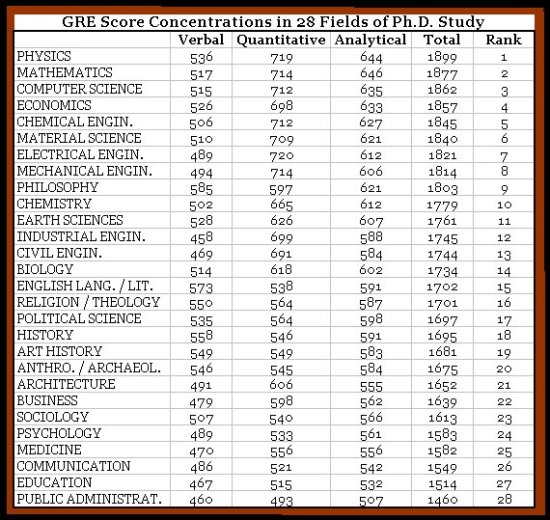
Taken together, these pieces paint the proverbial damning indictment of how teaches are hired, promoted, and (not) fired. Once you’ve read them, it’s hard to accept the dissembling evident from teachers’ unions. Given the research cited regarding the importance of good teachers and how few incentives there are to become a good teacher, maybe it shouldn’t be a surprise that education majors and graduate students typically have incredibly low standardized test scores and GPAs, as shown in the following chart (2002; source):

gre_scores_by_department

Notice that education is at the bottom. Should it be much of a surprise that the best universities, which are almost by definition hyper-competitive, look down on the profession? Susan Engel thinks so.

If you change the incentives around teaching, the programs that teach teachers will change, and so will the skill of the teachers more generally. Over the last thirty years, the larger economy has undergone a vast shift toward greater competition and freer markets—a vast boon to consumers. The market for primary and secondary education has seen virtually none of this competition, or, to the extent it has seen such competition, has seen it on a district-by-district level, which requires geographical moves to take advantage of it.

This topic is one I attend to more than others because I think I’d like teaching high school and that I might even be good at it. But the pay is low, even relative to academia (which isn’t most remunerative field in existence), and, worse, there’s virtually no extrinsic reward for excellence. Almost anyone with a slightly competitive spirit is actively driven out; even those who have it begin with probably lose it when they realize they’ll make the same money for less work than those with it. And you’ll basically have to spend an extra year or two and lots of money to get an M.A. in education, which sounds like a worthless degree.

If you teach computer science in most districts, you make as much as someone who teaches P.E. You might notice that, according to Payscale.com‘s average salary by major table, education majors usually start at about $36,200 and make a mid-career average of $54,100. That’s probably low because it doesn’t take into account the extra time off teachers get during the summer. Still, notice the numbers for Math: $47,000 / $93,600, Computer Science: $56,400 / $97,400 or even my own major, English: $37,800 / $66,900.

But I doubt money will solve the problem without institutional reform, which is very slowly picking up. Susan Engel’s comments, however, only muddy the water with platitudes instead of real solutions.

EDIT: And if you want further hilarity as far as teaching incentives go, check out Edward Mason’s story, “Union blocks teacher bonuses.” As Radley Belko says, “The Boston teacher’s union is blocking an incentive bonus for exceptional teachers sponsored by the Bill and Melinda Gates and Exxon Mobil foundations unless the bonuses are distributed equally among all teachers, good, bad, and average.”

Late September links: Little to do with books, much to do with life

* The best I’ve read concerning “overrated” novels, courtesy of the Little Professor.

* The humanities are in the same state financial markets were in before they crashed. Assessing the growing mountain of toxic intellectual debt, Philip Gerrans considers going short on some overvalued research.

Except that I’m not sure his analogy works, since “intellectual debt” doesn’t have to be “repaid,” doesn’t hurt anyone, and might point the way forward regarding ideas in ways that aren’t necessarily obvious at the time such “debt” is being produced/acquired.

* What kinds of inequalities bother people, and what kind do not?

* In Conniptions from me on urban economics, Tyler Cowen lists his opinions on urban issues, which I essentially agree with save for number 3, which I know nothing about:

1. I would not have brought the U.S. down the path of water subsidies, many of which are pro-suburban. (Admitted they are not always easy to repeal.)

2. I think pollution externalities should be priced in Pigouvian fashion; this would penalize many suburban developments.

3. I oppose the widening of Route 7 at Tysons Corner and I expect a disaster from the current plans.

4. I favor school choice and charter schools, which would make many U.S. cities livable again for couples with children.

5. I would price many roads for congestion, although as Bryan points out this could either help or hurt cars as a mode of transport.

6. I would allow U.S. cities to become much taller, thereby accommodating more residents. I would weaken many urban building codes in the interests of a greener America.

7. I much preferred the time when I lived near a gas station and a 7-11.

* Laws have become too vague and the concept of intent has disappeared. Notice in particular this problematic line: “Prosecutors identify defendants to go after instead of finding a law that was broken and figuring out who did it.” If the theory is that everyone is a criminal if you look hard enough, something very serious has gone amiss in our notions of justice.

* A chat with blogger Penelope Trunk:

Ben: You blog about sex a lot. Why?

Penelope: I think about it all the time. So it comes into my head a lot when I’m writing blog posts. I sort of wonder why it doesn’t come into more peoples’ heads when they are writing blog posts.

Ben: People censor themselves.

Penelope: Yeah. Well. I censor myself too. I guess it’s just we each have different types of self-censoring….

Ben: Alain de Botton has an interesting point on this. He says the professionalization of writing — novelists who write fiction full time — has made it so much fiction is disconnected from life as it’s experienced by most people.

Penelope: Totally agree. And the French have this problem more than any other culture.

* I wasn’t going to write about Dan Brown till I found this hilarious discussion of his expert style. One day I hope to be as great a writer.

* Dvorak keyboard devotees and their battle with smartphones.

* Population growth drives innovation?

* Andrew Sullivan of The Atlantic makes the pitch for print. I subscribe to The Atlantic and recommend that others do as well.

* America can’t be the world’s tech leader without immigration reforms.

* The Man Who Saved a Billion Lives has died.

* Megan McArdle and Matt Yglesias on education, in a post I almost completely agree with.

* Wow: from I was an Ambassador and Taken Hostage by Militants:

I learned a lot from my time as ambassador and Marine. Paperwork means stuff to people: really important stuff. Thinking you have to solve every problem on your own is an additional problem to your other problems: one that makes all the others worse. No matter how much you love something, it’s not going to make a square peg fit into a round hole. What people experience in the service has to do with the type of work they do and the unit they are in. Hidden assumptions hurt. A lot….

This “bad experience” changed a passive, wait-for-life-to-happen person into and active, go-make-it-happen person.

(Emphasis added.)

I wish I’d realized the power of paperwork earlier, or how important documentation is in a modern, complex, and bureaucratic society.

* Two kinds of libertarians.

What I like in this essay is also an acknowledgement of its limitations (the “cartoon” version of libertarian), but also the acknowledgment that those limitations are useful in describing broader phenomenon.

* The value of a college education.

Philip Greenspun's Why I'm Not a Writer and Hacker News

I submitted a Hacker News (HN) link to Philip Greenspun’s essay Why I’m Not a Writer, which begins:

I’m not a writer. Sometimes I write, but I don’t define myself as a career writer. And that isn’t because I couldn’t tolerate the garret lifestyle of an obscure writer. It is because I couldn’t tolerate the garret lifestyle of a successful writer.

He’s right. The garret lifestyle is one reason (there are many others too) why so many writers are now affiliated with universities, as detailed in Mark McGurl’s excellent book The Program Era. In fact, university affiliation has become so pervasive that Neal Stephenson told this hilarious story on the subject in a Slashdot interview:

[… A] while back, I went to a writers’ conference. I was making chitchat with another writer, a critically acclaimed literary novelist who taught at a university. She had never heard of me. After we’d exchanged a bit of of small talk, she asked me “And where do you teach?” just as naturally as one Slashdotter would ask another “And which distro do you use?”

I was taken aback. “I don’t teach anywhere,” I said.

Her turn to be taken aback. “Then what do you do?”

“I’m…a writer,” I said. Which admittedly was a stupid thing to say, since she already knew that.

“Yes, but what do you do?”

I couldn’t think of how to answer the question—I’d already answered it!

“You can’t make a living out of being a writer, so how do you make money?” she tried.

“From…being a writer,” I stammered.

At this point she finally got it, and her whole affect changed. She wasn’t snobbish about it. But it was obvious that, in her mind, the sort of writer who actually made a living from it was an entirely different creature from the sort she generally associated with.

And once I got over the excruciating awkwardness of this conversation, I began to think she was right in thinking so. One way to classify artists is by to whom they are accountable.

In the HN thread, another poster named Quantumhobbit linked to Orson Scott Card dealing with the same subject. As Quantumhobbit says, “Basically his advice is make sure you have another source of income, such as a rich uncle, before you decide to become a full-time writer. There is no guaranty that you will make enough to support yourself, even in genre writing.”

But the most interesting response comes from Gwern, who said, “I note that [Greenspun’s essay is] from 1996, when the bubble was getting hot; are you suggesting that the web has not panned out for writers and that they are equally screwed online as off?” In reply, I said:

I think that the date of Greenspun’s essay is indicative of how little has changed, rather than how much. Most writers didn’t make very much money then, and they still don’t, which many people don’t seem to realize; one writer friend who also teaches university classes recently wrote to me and said that a colleague had asked, in all seriousness, if he was rich now that he’d written a book. Writers often work like astronauts to achieve relatively modest financial success, which people like the poster in the original HN thread might want to know before getting started in earnest at trying to write for the book market. Take a look at these posts from a guy who works in the sales department of a major publishing house regarding current advances for most types of fiction.

“are you suggesting that the web has not panned out for writers and that they are equally screwed online as off?”

Depends on what you mean by “panned out” and “screwed”; I can’t really tell from the nature of the question. If you mean, “Do I think writers can make enough from the Internet to support themselves?” the answer is yes; if you mean, “Will many of them do so, especially relative to the number who would like to?” the answer is “no.” In fact, I even wrote a blog post at Grant Writing Confidential on the subject of how unlikely it is for people to make money from blogging.

(Note: the above is slightly edited from the original.)

Gwern replied:

But to expand on what I meant: I remember that back in the dot-com bubble, the bubble Greenspan wrote that essay in, there was a lot of enthusiasm and hype about how the future would be so much better for authors and artists than the old world of offline publishing – the Web would empower creators, cut out the middlemen, and channel tons of money to them, via the magic of 0-cost publishing, micropayments, and other things like search engines or aggregators. Greenspan’s essay seems to buy into that zeitgeist, albeit relatively modestly.

Of course, that vision has largely come failed to come true (spectacularly so in the case of micropayments and agents). I wondered if the point of your linking this old essay was to emphasize the contrast and make clear that writing is still a marginal business regardless of where it’s being distributed or what neat technical gadgets are involved.

That wasn’t my point, but if I’d been smarter it would’ve been. Half the 1996 equation Gwern describes has come true: the web has vastly empowered writers’ ability to reach readers (and consultants’ ability to reach clients). But it definitely hasn’t channeled vast amounts of money to most writers, and many kinds of writers—like professional journalists—are being laid off en-masse.

In the world of the web, as in the 1849 California gold rush, the people who make real money aren’t the people panning for gold, but the people selling equipment to and building infrastructure for the people panning for gold. So too with online writing: Matt Mullenweg, the founder of WordPress, which drives this blog, probably makes or will make far more than anyone writing on it.

All of this could probably be appended to advice for a very very beginning writer. I think that knowledge for its own sake is valuable, even, or maybe especially, for artists.

Crooked Timber on George Scialabba's What Are Intellectuals Good For?

I’ve ordered What Are Intellectuals Good For? thanks to the many insightful posts at Crooked Timber. See examples here, here, here, and here. I don’t understand all of the arguments well enough to contribute to them—at least not yet—especially those regarding what the political “left” means, which seems based a cursory reading more out of the 1930s or 1950s than today. This might be a function of my age—I’m not a professor (yet?)—or field—English literature—rather than philosophy or government, where most of the Crooked Timber contributors appear to be ensconced.

Of late there have been a large number of posts around the web worthy of more than a brief link, but I think that’s an aberration rather than a permanent trend. Expect more on What Are Intellectuals Good For? shortly, as well as longer essays on books rather than the recent spate of responses to other bloggers/commenters.

Crooked Timber on George Scialabba’s What Are Intellectuals Good For?

I’ve ordered What Are Intellectuals Good For? thanks to the many insightful posts at Crooked Timber. See examples here, here, here, and here. I don’t understand all of the arguments well enough to contribute to them—at least not yet—especially those regarding what the political “left” means, which seems based a cursory reading more out of the 1930s or 1950s than today. This might be a function of my age—I’m not a professor (yet?)—or field—English literature—rather than philosophy or government, where most of the Crooked Timber contributors appear to be ensconced.

Of late there have been a large number of posts around the web worthy of more than a brief link, but I think that’s an aberration rather than a permanent trend. Expect more on What Are Intellectuals Good For? shortly, as well as longer essays on books rather than the recent spate of responses to other bloggers/commenters.

Careers—and careerism—in academia and criticism

Careers in criticism examines what D.G. Myers thinks can be done about the possible problem of lousy literary criticism. It’s worth reading, but I suspect that the other problem, which goes undiscussed in this post, is the difficulty of deciding what is good criticism: many people complain that lots of academic and other criticism is bad (I probably count myself in their ranks much of the time), but they tend to disagree with what would be good in its stead. Deciding is particularly hard in a field where wildly divergent ideas of what constitutes quality exists. Therefore you get… gridlock, high school politics, and so forth.

How to solve this? Myers says:

[Elberry] thinks that I am suggesting that “critics should write about less well-known books,” but I suggest this only as a method, a practical expedient, for undertaking their real responsibility: namely, to contribute to literary knowledge. The demand upon critics (in the university and out) must be, not to “write something new and different,” but to add something new and different to the store of human understanding.

I bet that most people who are writing just to “write something new and different” would argue they are adding to the store of human knowledge. I definitely agree with Myers’ formulation on a high level but am not sure how to implement this on a lower level. The best ideas I can come up resolve issues in academic publishing: right now, it can take years to publish an essay in a peer-reviewed journal, which then locks it behind pay walls on the Internet. The length raises the obvious and uncomfortable question: if it takes three years to publish a paper, is the paper really that important? That this process takes forever is hardly new; Lucky Jim mocked it in the 1950s.

My solution: have peer-reviewed journals “publish” online, and have publication be a link to the author’s paper on the author’s website. The journal’s editor could also copy that paper to their own site after anonymous peer review. That way, the information is freely available, especially to people in countries where most universities can’t afford journal subscriptions under the present model; the theoretical “size” of a journal could be limitless, although the practicalities of reading would probably still limit that size; there would still be a recognized body of work that makes up, say “Modern Fiction Studies;” and the journal could still issue a print edition every n months or years for those who prefer it. This would cause the journal to lose the revenue stream that currently comes from publishers, but that stream seems to be so small that universities could replace it in return for the prestige of housing the journal. Alternately, the exceedingly low cost of web publishing—one could buy server hosting with 200GB+ per month transfer limits and so forth for $100/month—could obviate the (relatively) high cost structures that journals already have while reducing barriers to entry.

Current top-notch journals have no incentive to adopt this model, as it would challenge their hegemony, but if lesser journals began adopting it and scholars preferred it, the quality in my wiki-like journal would rise, and competition might force top-notch journals to adopt the same strategies if they’re going to retain their position. Since publishing in English lit seems mostly a prestige and influence game, this strategy has few drawbacks I can perceive. If anyone knows of a reputable journal (which is to say: one backed by a university with at least a few years of regular publication) that’s already doing this, I’d love to hear about it.

The other change is one I read about in Freakonomics, the blog: require peer reviewers to say publish/no publish on each paper, and give comments, rather than giving comments with the implication that, if they’re not taken, one will automatically be rejected. Rather than having a three- to four-draft round-robin time-waster of questionable benefit, a peer reviewer would have to say “yes/no,” on the first iteration in its current condition, and the reviewer’s comments would be an option rather than requirement. This structural change seems less important than the one above.

Anyway, given that I’m in grad school for English lit, expect more on this topic in the future, since I’m now tasting the peer review that many others have called bitter and find that they’re mostly right.


EDIT: Myers has a follow-up post, with a response to some of my comments, here.

The strange things you learn… this time about John Kenneth Galbraith

I love the astonishing, random facts and commentary one will come across in books. Since the UCLA Southland Conference in early June, I’ve continued to do research on academic novels (among many, many other tasks), which includes reading The Academic Novel: New and Classic Essays—a collection edited by Merritt Moseley that’s so esoteric Amazon doesn’t list it. In the introduction, Moseley says that famous economist John Kenneth Galbraith wrote a novel (and one, he adds, with “almost no literary merit”). Alas, I’ve found many a meritless academic novel, perhaps in part because, as Moseley says, “There is no end to the surprises, when one first beings to discover all the writers who have published an academic novel.”