We are our own enemies: “Arts & Entertainments” edition

In “The Collective Conscience of Reality Television: In a format without a code of conduct, viewers drive the limits of the exploitation and privacy invasions allowed onscreen” Serena Elavia writes that “What viewers will or won’t watch matters immensely to networks; in fact, they seem function as the networks’ sole ‘conscience.'” She’s right, and it’s a point too infrequently made: most of the cultural “problems” that the commentariat identifies arise because the audience responds to whatever the “problem” might be, whether it’s improbably hot and photoshopped models or reality TV or football or soda.

This is important because words like “society” or “the media” are actually shorthands for “the aggregated preferences of many, perhaps millions, of individuals.” You can’t really blame “society” for much of anything; you can at best blame the many individuals who hold and perpetuate beliefs or practices or whatever. “Conscience” is distributed, and it’s arguably becoming more distributed in the Internet age, when the means of discussions are (literally) at everyone’s fingertips. This blog is a good example of that principle in action.

Elavia’s point is also similar to one made by Brian Moody, the producer in Christopher Beha’s novel Arts & Entertainments. Towards the end of the novel he and Eddie, the everyman nebbish protagonist, discuss the nature of TV and, beneath that, the nature of God, and Moody says:

The audience has only way of expressing its interest—by watching. They might watch because they love you. They might watch because they hate you. They might watch because they’re sick. Doesn’t matter. Is that good or bad? The question doesn’t make any sense. Good is whatever the audience watches [. . . .] The audience is all there is [. . . .] I care about the audience, and I won’t defy them.

That last line, about how Moody “won’t defy” the audience, is scary because it implies he’ll do anything. Kill a man? If the audience wants it—and some dark corners of the Internet imply there is a market for murder. Moody is unsettling because he’ll do anything to anyone around him if the audience wills it. Most of us would like to imagine our friends, and even strangers, will not under any circumstances murder, torture, or rape us. Moody implies that in the right circumstances he would, or he would allow it to happen, almost as a form of worship.

Right now we don’t live in Moody’s world: as Elavia observes, producers only stop when audiences protest. Which raises a question: What happens if audiences don’t protest? That sort of question underlies books like The Hunger Games. Over time it may become more salient. Fiction and history teach us that we don’t really know what our neighbors and friends and strangers will do in real crises. Many, however, will indulge or release the darkness within.
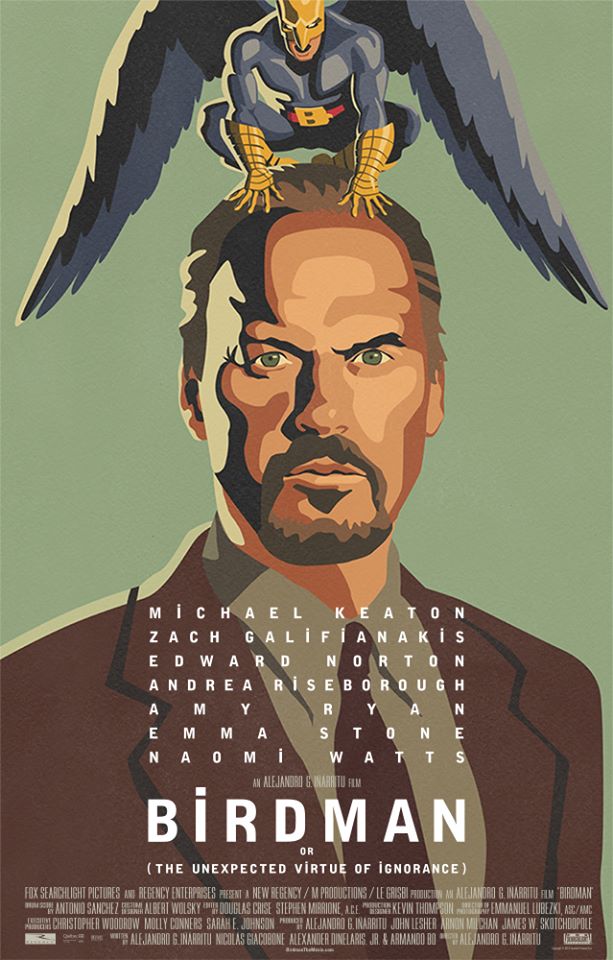
Thoughts on the movie “Birdman”

* The first three quarters are excellent. The last quarter is too long but still good; audiences don’t need to be hit over the head with symbolism. We laughed, though not always at the parts that the rest of the theater laughed at. A few times I was the only person laughing.

* Birdman is among other things functional review of the Transformers series; Birdman is not merely conceptual art, as Transformers 4 may be.

birdman-poster* I didn’t feel stupid watching it.

* What might the camera work signify? To most it will be brilliant or hateful, but it is at least distinctive, and distinctive in a “that must have been very hard to do” way.

* Theater folk are fucked up, but we already know that, don’t we? From the works of Michael Tolkin, among others.

* This is the kind of movie about which movie people like to say, “It’s the kind of movie that doesn’t get made anymore.” See also point #3, above. Good movies are harder to find but still get made.

* Birdman is different than Gone Girl and yet both are absorbing.

* The rants are winners.

Links: What does arousal feel like for women?, campus politics, decision fatigue, geography, and more!

* Mostly SFW: “girls of Reddit what is it like to be horny from a girls perspective?

* “Why One Male College Student Abandoned Affirmative Consent;” I am endlessly struck by the gap between the commentariat and what I observe at Saturday night parties and bars.

* Relatedly, “Neo-Victorianism on Campus: Is this the end of the collegiate bacchanal?”, which is an underreported perspective and yet one Katie Roiphe discussed 20 years ago. The more I know, the more apt I am to be the annoying guy complaining about historical context.

textual-2047* On decision fatigue, which I definitely suffer from.

* Perhaps related to the above, “Doctors Tell All—and It’s Bad,” which can be profitably read in conjunction with “Why you should become a nurse or physicians assistant instead of a doctor: the underrated perils of medical school.”

* “Why Kids Sext,” a 100,000-word article that could be summarized as “For the same reasons adults do” or “cause it’s fun, the same reason why kid these days listen to that infernal devil music: Jazz.”

* “‘The Bell Curve’ 20 years later: A Q&A with Charles Murray;” the section about genetic alteration of genes that affect intelligence is of the most interest. I’m still not convinced our tests for measuring intelligence are great. Then again see “Super-Intelligent Humans Are Coming.”

* Where young college graduates want to live; Portland and Austin are both on my radar.

Tyler Cowen on Paul Krugman on Amazon on the buzz

In “What is the welfare cost of Amazon supply restrictions on books?” Tyler Cowen writes on whether Amazon’s much-publicized maneuvers against publishers are welfare-enhancing or welfare-destroying; most of the former answers tend to come from readers and indie publishers, while most of the latter answers tend to come from publishers and established authors. I however was compelled to comment on a separate and to my mind under-discussed issue: the lack of any sense of history in most of these discussions.

The same class of writers who five years ago were aghast at the lack of support for literary fiction among publishers now decry Amazon; they’re supporting the same publishers who were until recently the cravenly commercial forces destroying “quality” literary fiction. “The plight of literary fiction” has been an evergreen essay topic for as long as I’ve been cognizant of literary culture. Literary fiction was (or is) in plight because publishers supposedly don’t support and readers are too busy masturbating to romance fiction or science fiction tech fantasies (or whatever) to read lit fic.

Tangentially, I’m also amazed that, in rereading the preceding sentence, it seems to make sense and flow nicely without any commas. Perhaps it is the influence of Steven Pinker’s The Sense of Style, which I bought naturally from Amazon and which has me thinking about nesting and recursion more than any time since CS 102.

The link in the preceding paragraph also goes to Amazon.

Links: Are cops dumb?, humiliation, teachers, traffic, fear, how to be attractive to women, and more!

* Speculative, though it would explain a lot: “Can Someone Be Too Smart To Be A Cop?

* This Is How Judges Humiliate Pregnant Teens Who Want Abortions.

* “This Is Not A Startup Story: In 2011, I started a book business with my best friend called Emily Books.”

* “A veteran teacher turned coach shadows 2 students for 2 days – a sobering lesson learned.”

* “Why 12-Foot Traffic Lanes Are Disastrous for Safety and Must Be Replaced Now.”

* Why People Fear Vaccines, and Always Have; per another Slate article, parents who don’t vaccinate their kids should be sued and/or charged.

* How To Be Attractive To Women, Pt.2: Signaling Attractive Traits. Much of this is also applicable to women.

* “What It’s Like to Carry Your Nobel Prize through Airport Security,” a completely hilarious piece one could imagine Feynman writing.

Owning vs sharing: Don’t get caught in the ugly middle

In a tweet Paul Graham writes: “As buying and selling become easier, owning approaches sharing.” That describes my behavior regarding many objects, especially electronics: for as long as I’ve been buying Macs and Mac products, I’ve been selling the old versions on Craigslist for a third to half of their initial value. In some sense I’m actually leasing them, but using myself as the leasing agent. Although I’ve owned a car I actually prefer not to and Uber is accelerating the ability to rent cars when needed and avoid the hassles of ownership. Housing has of course long been both rented and owned, and like many economists I find the U.S. obsession with owning housing to be misguided.

But there are other ways too that owning approaches sharing in my life:

  • Old cameras and lenses get sold to fund new ones. Like Macs, they tend to retain a fair amount of value—usually about half for lenses and a third for camera bodies.
  • It’s not uncommon for me to sell books that look promising but don’t live up to expectations, almost always through Amazon (despite Amazon’s encourage for buyers to scam sellers; for objects worth less than $20 I don’t think the issue is overwhelmingly important).
  • Although I haven’t begun doing this yet, I think that selling bikes may be more economical than moving them. The last bike I moved from Tucson to New York was probably a net loss and should’ve been sold instead of shipped.

There are some items that still aren’t easily sold, like beds and furniture, in part because they’re heavy, in part because they can harbor bed bugs, and in part because they just aren’t that valuable. I don’t have the citation handy, but I’ve read that Ikea might be facilitating mobility by making it cheap and easy to setup new apartments: it’s possible to buy a couch, a chair, some dishes, a bed, and some shelves for under $1,000, in the course of an afternoon (although I’d prefer a Tuft & Needle bed, but that’s an aside).

Among my friends, city-to-city moves often entail dumping most of their stuff and buying it again at the destination, since the moving cost is too high to justify the hassle. That’s less true of me because I have a sit-stand desk and some other pretty expensive gear, but in this respect I’m in the minority. Keeping a minority of one’s stuff may also lead to a more satisfying, experience-rich life, at least for some people.

The habit of either having very expensive and durable stuff or throwaway stuff may also be indicative of the polarization of many domains, in which it makes sense to either buy or be the best, or buy throwaway stuff or don’t bother competing. Don’t get caught in the ugly middle. Like “Death before inconvenience,” “Don’t get caught in the ugly middle,” is something companies should contemplate.

Owning cars and houses in particular is just insanely expensive. In “The Cheapest Generation,” Derek Thompson and Jordan Weissmann observe that

Smartphones compete against cars for young people’s big-ticket dollars, since the cost of a good phone and data plan can exceed $1,000 a year.

But cars cost close to $10,000 a year, according to AAA—or at least an order of magnitude more than a phone. Even if other transportation expenses (Uber, bikes, subways (where available)) cost a couple thousand dollars, they’re still significantly cheaper than owning a car. And a phone plus a data plan enables those alternatives. Owning and sharing may be less opposed than they were once believed to be.

Links: Becoming fluent in math, “How to be attractive to women,” essays, and more

* “How I Rewired My Brain to Become Fluent in Math: Sorry, education reformers, it’s still memorization and repetition we need.”

* “How To Be Attractive To Women, Pt. 1: Our Embarrassing Stories,” which I wish I’d heard and absorbed when I was 12 or 13. I made pretty much all the mistakes discussed at the link.

* “Science proves that you love your dog like a baby,” which is unsurprising given how many people use pets as emotional substitutes for children.

* What is an essay? by John Jeremiah Sullivan, which should be read in tandem with Paul Graham’s “The Age of the Essay.”

* Yet another police brutality video: “Kid tapes cop smashing car window, dragging man away after tasering him.”

Sexual Personae — Camille Paglia

It is shocking to me that I have gone for my entire adult life without anyone recommending Sexual Personae: Art and Decadence from Nefertiti to Emily Dickinson. The book is marvelously full of ideas, making it easy to find ludicrous assertions next to brilliant ones. Rarely have I read a book so full of life yet with so much that is wrong. For example she writes that “Female tragic protagonists are rare. Tragedy is a male paradigm of rise and fall, a graph in which dramatic and sexual climax are shadowy analogy.” The analogy might be “shadowy,” but it is also strained and dubious: there is no reason why sexuality has to be connected to tragedy. But Pagilia also writes from a different underlying philosophical perspective than most of her academic peers:

This book takes the point of view of Sade, the most unread major writer in Western literature. Sade’s work is a comprehensive satiric critique of Rousseau, written in the decade after the first failed Rousseauist experiment, the French Revolution, which ended not in political paradise but the Reign of Terror. [. . .] For Sade, getting back to nature [. . .] would be to give free rein to violence and lust. I agree. Society is not the criminal but the force which keeps crime in check.

sexual_personaeYet few modern sophisticates realize as much. Some contemporary fiction reflects the Paglian-Sadean view—Donna Tartt’s The Secret History is a sterling example—but for the most part it is absent. This passage is also admirable for being comprehensible; compare it to, for example, the passage quotes in “What happened with Deconstruction? And why is there so much bad writing in academia?
Paglia has an important virtue not common to contemporary English professors: she writes clearly and therefore what she says can be evaluated.

The excerpt above is included to give a flavor for Paglia’s writing, but Sexual Personae is impossible to effectively excerpt from, since the book moves from analyses of ancient times up to the late 19th Century, and although common threads bind various sections together it is easy to lose sight of how exactly someone like, say, Emily Dickinson is related to Goethe. I can’t imagine many people will read or want to read the whole book from beginning to end; it covers a fabulous number of artists and periods, and for me the 19th Century and Romantic artists were the least interesting, though you may of course differ. The long introduction and the strongest chapters more than make up for the weakest ones. Even if I had or wanted to develop the knowledge necessary to write such a book I doubt I’d be able to sustain sufficient interest.

Contemporary humanities scholarship has become too focused on pedantry and minutia at the expense of being interesting. Perhaps humanities scholarship has always been like this but the problems are especially evident in an era when relatively few scholars appear to even believe that such a thing as “good writing” can exist. Still, I would like to see a stronger emphasis on “being interesting” and personal experience in most humanities journals. In talking with English professors at conferences about Harold Bloom, I’m struck by their high, level of hostility.

Not all sections are equally strong; the sections on Shakespeare, Sade, and Spencer are amazing, but the closer Paglia draws to the present the less plausible her interpretations become. But her attention to myth, to pattern, and to the ways art and life draw on each other excuse other flaws, which may be the flipside of strengths. As noted above, however, the number of fascinating moments is high:

Theatrical self-transformation, a seductive principle of our time, can never be reconciled with our time. From antiquity on, professional theater has been under a moral cloud. Autocrat, artist, actor: freedom of persona is magical but destabilizing. [. . .] Art remains an avenue of escape from morality. Actors live in illusions; they are skittish shamans, drenched in being.

and one senses that Sexual Personae is a virtuosic display that needs more attention. Hence this post.

New layout and design

If you read this through a regular standard web browser (as opposed to email or an RSS feed), you’ll notice a very different look with a more modern design. Thoughts or observations? Leave a comment or send an e-mail.

Thoughts on the movie “Gone Girl” by David Fincher

Some minor spoilers are below.

Gone Girl is great and you should see it, albeit not on a first or even second date. The spirit and structure of the book are there, and the pivotal murder scene didn’t “feel” as much to me in the book but sure did in the movie. The casting is perfect. The theater was full and there were lines both to buy tickets and to snag a decent seat; I haven’t noticed lines for movies in years.

* The movie is by, for, and about adults, and it’s about adults in an intelligent but well-plotted way. Few modern movies even attempt to hit all those buttons; TV has primarily assumed that role. Attitudes towards and depiction of sexuality are fundamentally adult, not in a pornographic sense but rather in a post-adolescence sense that one finds more often in novels than movies.

* We are often interested, in art and life, in the concept of being “likable,” but that concept is often both poorly defined and easily manipulated. Yet it persists, and Gone Girl effectively criticizes it and criticizes the media more generally by extension the people who create the media—which is to say, “us.”

* Both movie and book work for many reasons, one being that they take existing tensions and faults in many relationships and magnify them by an order of magnitude. A lot of people will walk out of Gone Girl and into discussions about character and compromise. One does not see that in movies about saving the world, in which the good guys are obviously good and the bad guys bad for all the usual reasons.

* Though I’m usually loath to use this term, Desi is the ultimate beta male. Arguably there is no alpha male in the book or movie, with the possible exception of Tanner Bolt, and one could read book or movie as critiquing the “alpha male” ideal.

* David Fincher made Gone Girl and The Social Network, both of which are among the best movies in recent memory.