Links: Rejecting the feminist label, freedom, fusion, reviewing the world, prison life, and more!

* “Why millennial women don’t want to call themselves feminists.” I think the second reason the most plausible answer. (Hat tip Michael Curry.)

* “Why GNU Emacs?” (I don’t use Emacs, though I have installed it at various points and then run away, to easier, friendlier text editors.)

* New finding may explain heat loss in fusion reactors.

* The headline is too polite, but: Left-Leaning Economists Question Cost of Bernie Sanders’s Plans.

* “What Expanded Light Rail Means for Seattle: With new stations opening in March, the city takes a crucial step toward a much-needed transit overhaul.”

* I don’t know if this story is on the level, but: “How schools around the country are turning dead Microsoft PCs into speedy Chromebooks.” See also our post on Geek Heresy and how technology is not going to magically save schools.

* “One Man’s Impossible Quest to Read—and Review—the World.”

* “Risky sex [writing],” though oddly it doesn’t mention The Joy of Writing Sex: A Guide for Fiction Writers, which is pretty good but a smidge too politically correct. Still, overall “Risky Sex” is excellent and is just the right amount of funny.

* Craig Mod on the Leica Q; I’m skeptical and think the Sony RX1R or Fuji X100T are much, much better (and cheaper!).

* Scientists are floored by what’s happening in the Arctic right now.

* The rule of law enforcement, or, a journalist’s diaries / reporting from prison.

Links: Humanities papers, recycling, teachers, death, housing, sexuality and society, and more!

* 82% of humanities papers are never cited by another paper (pdf), which is another datum of evidence about the importance of what most humanities professors are doing.

* Inside the English Prose Factory. It is… not very pleasant.

* “Is it time to rethink recycling? If our current approach to recycling isn’t the best for the economy or the environment, why do we do it?” The short answer is, “signalling.” Recycling small items, like carrying re-usable bags to grocery stories, is a low-cost way of appearing to be environmentally conscious without having to do anything significant. I’ve had innumerable conversations with superficial environmentalists who are determined that every bottle go in the right bin, even as they discuss their last trip to South America and their next trip from one coast to the next. Flying is really, spectacularly bad for the environment, but most putative environmentalists are also in love with the idea of “travel” and “broadening horizons.” Still, to point out this dichotomy is to signal something negative about the person making the observation, so you should probably keep this to yourself, unless you are an anti-social person.

* Stop humiliating teachers.

* “How Yahoo killed Flickr and lost the Internet,” a story I didn’t know, or didn’t know at this level of detail.

* “The poor are better off when we build more housing for the rich,” an underappreciated point—but when most people talk about affordable housing, they’re actually trying to signal how much they care, rather than actually understanding and then solving the problem.

* William Gibson: How I Wrote Neuromancer.

* “The Sexual Misery of the Arab World,” an underappreciated point.

* “Should you learn to program? Yes,” by Derek Sivers.

* The dubious effectiveness of D.A.R.E. and problems in nonprofits.

Submission — Michel Houellebecq

Like almost all Houellebecq, Submission and invites diagnoses of anhedonia (Page 1: “I realized that part of my life, probably the best part, was behind me;” Houellebecq rarely if ever writes of the “best part” of any character’s life). The weird mixture of ideas, from YouPorn (it is namechecked) to Huysmans, works and doesn’t work at the same time, and it is this paradoxical quality that I think attracts readers to Houellebecq.
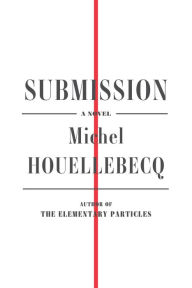
Submission HouellebecqThat, and Houellebecq continues to be different in a way that almost no writers are. See also Adam Gopnik on Submission. Here is The Guardian. I mention Houellebecq in “All American fiction is young adult fiction: Discuss.” Here is Mark Lilla, in the New York Review of Books. All these pieces are excellent.

Oddly, almost no one has noticed Houellebecq’s attraction to Islam. Except for Elif Batuman, in the last part of the linked essay. In Public Enemies: Dueling Writers Take On Each Other and the World, Houellebecq writes:

It’s painful for me to admit, when I think of my atheist, politically committed friends, but I’ve never really understood the root of their commitment, it has always seemed to me to have more to do with a Christian tradition than they themselves suspected. I am speaking from pure intuition here, but in all the Christian groups I tried in vain to belong to, one of the things I completely understood was their commitment. It was very clear: they had accepted the idea that, being sons of God, all men are brothers, and behaved accordingly.

Which is quite close to what the idealized Muslims in Submission do, and, I suspect, quite far from what many real-life Muslims do (or real-life adherents of any high-commitment, high-demand creed). Commitment itself, to something, is appealing, and one characteristic of all Houellebecq’s characters is their seeming lack of commitment (even those seemingly committed to hedonism don’t seem to enjoy it that much, or as much as I would).

There are many of the weird juxtapositions one sees in classic Houellebecq: “Cro-Magnon man hunted mammoth and reindeer; the man of today can choose between an Auchan and a Leclerc, both supermarkets located in Souillac.” Or: “Even the word humanism made me want to vomit, but that might have been the canapés.” Is this no context or overwhelming context? François seems to oscillate between the two. He cares deeply about observing what’s going on and does nothing with those observations; the word “bored” appears repeatedly, almost a stand-in for “whatever.”

Plus, modern grocery stores are amazing: their convenience is incredible and price competition means that consumers win. Grocery stores means that the man of today can choose to worry about something other than where to get food from. Or, maybe, he can worry about nothing at all. Even access to pornography had to be fought for, over decades. Submission implies that maybe we’d be better off without it, but the term “revealed preferences” comes to mind (and there is a small but noisy movement for “no fap,” which is what it sounds like).

No one feels a sense of a job well done. The presence of absence is felt everywhere. François never emerges from a class feeling that he’s reached someone. Has he tried? Does he want to? The answers seem to be no. Even the attractive women he improbably sleeps with seem to move him little. We find this about Steve, his colleague: “He’d almost always invite me for a drink—usually mint tea in the Paris Mosque a few blocks from school. I didn’t like mint tea, or the Paris Mosque, and I didn’t much like Steve, but I still went.” Usually I don’t go out with people I don’t like, and I don’t think I’m exceptional in this regard, but I am capable of liking people, which François it would seem is not.

Houellebecq respects ideas as almost no contemporary novelists do, but he doesn’t do so in an academically trendy way (as, say, Alena Graedon does in The Word Exchange). If anything he does so in an academically un-trendy way.

Houellebecq does not seem to believe in Enlightenment ideas of progress. For François, private tutoring only “soon convinced me that the transmission of knowledge was generally impossible, the variance of intelligence extreme, and that nothing could undo or even mitigate this basic inequality.” The last couple centuries of relentless progress would seem to invalidate this claim, however true it may feel in the moment, at the micro level. François thinks that his “boring, predictable life continued to resemble Huysmans’s a century and a half before.” Odd. I don’t feel like my life resembles the lives of people 150 years ago. Perhaps François has this problem because education as a sector has changed very little. This contrasts with numerous other sectors.

Maybe the problem with Houellebecq narrators is that few if any discover anything or make anything—even dinner. The true hero of Submission may be the microwaved dinner. No one I’ve read more frequently mentions microwaved food. But if microwaved food signifies tedium, what signifies the opposite? Did making food from scratch, as virtually all people 60 years ago had to do for economic reasons, somehow better?

Houellebecq imagines a France in which large, politically active blocs call for Sharia Law. Yet people fleeing from many Muslim and Arab countries in the Middle East are getting fleeing from people who’d like to impose Sharia. To be sure the West imposes major culture shocks. But when you want to see whose ideas are winning, look at where people are fleeing from and where they are fleeing to. During the Cold War the number of French, English, or Americans who wanted to move to Russia was dwarfed by the number of Russians who wanted to get the fuck out.

In “The Sexual Misery of the Arab World,” Kamel Daoud writes of how

Today sex is a great paradox in many countries of the Arab world: One acts as though it doesn’t exist, and yet it determines everything that’s unspoken. Denied, it weighs on the mind by its very concealment. Although women are veiled, they are at the center of our connections, exchanges and concerns.

Daoud ends his essay by saying, “People in the West are discovering, with anxiety and fear, that sex in the Muslim world is sick, and that the disease is spreading to their own lands.” I’m not convinced the sickness is spreading: Ideas in the West about the right of individual to control his or her own body are winning. Terror in many Middle Eastern countries is a sign of weakness, not strength. Ideas cannot win on their merits; they can only be imposed via the gun. There are no real votes for Sharia, even in countries that practice it, or a modified form of it.

Other events have overtaken Submission’s world. It imagines Saudi princes lavishly funding French universities. As of this writing, in February 2016, cheap oil prices are roiling petro economies like Saudi Arabia and Iran. The Chevy Bolt will arrive in the U.S. later this year. Tesla’s Model 3 is going to be unveiled shortly. These cars may permanently cap oil prices by allowing most people to switch to electric cars as oil prices rise. France shouldn’t worry about radical Muslim takeover. Petro states should worry about what will happen when every Western economy is not wildly, wholly dependent on oil.

The previous paragraph may be bizarre in the context of a discussion about a novel, but part of Houellebecq’s world in Submission depends on the financial condition of radically Islamic countries. Those countries’ positions and stability depend on selling oil. Take away the oil and we’ll see how stable and popular many of them really are. Their leaders are able to lead lives of incredible decadence and sexual pleasure because they can afford to. That may not be true three years from now, let alone in the elections of 2022.

In another moment, François asks, rhetorically, “How could anyone argue that Europe wasn’t in decline?” Easily: First, look at where people want to go, as mentioned previously. Second, consider an article like, “Plasma physicist discusses the Wendelstein 7-X stellarator.” That stellerator, built in Germany, is an important step towards fusion power plants. It’s an incredible achievement that is primarily being accomplished by Europeans. If that’s decline then sign me up. And when was Europe in ascent? Robert Rediger notes that Huysmans “was living at at a time when the European nations were at their apogee.” Which led them straight into two insane wars, the lead-up to which can only be compared to mental illness. European temperament may be oddly negative and declinist, but the temperament and being can be further apart than Europe and Mars.

Many of you will dislike Submission. I see people on the subway and in coffeeshops reading Ferrante and Knausgaard, today’s perversely trendy writers, but none reading Houellebecq.

Houellebecq is the sort of writer who makes reading his entire oeuvre rewarding. Not all writers are like this.

It is sometimes hard to write coherently on a work that itself seems to lack coherence.

Links: Casper, space, banned by Tesla, institutions, publishing, solar, and more!

* How Casper Made $1 Million Selling Mattresses in Its First 28 Days.

* “Here’s What We’ll Do in Space by 2116.” We hope!

* Banned by Tesla: a very bad sign for the company.

* “The unsexy truth about why the Arab Spring failed:” the failure of institutions.

* “The Unlikely Writer: Atul Gawande, ‘slightly bewildered’ surgeon and health-policy scholar—and a literary voice of medicine.” A beautiful piece. Note the role of work. I have an increasing allergy to people who say they are “bad” at writing or math.

* There is almost no diversity in the publishing industry. It’s almost entirely composed of white women. Some of the signaling words in the story are annoying but can be ignored.

* “From liquid air to supercapacitors, energy storage is finally poised for a breakthrough.” An important story. Also: “Welsh home installs UK’s first Tesla Powerwall storage battery.”

* “Unobtainium: The Elements of Power: Gadgets, Guns, and the Struggle for a Sustainable Future in the Rare Metal Age.”

* Solar + Storage, another key piece in the energy infrastructure puzzle.

Cameras are above all else about sharing

In “Sony’s latest camera and some disappointing sensor sales results,” Phillip Greenspun writes that the reward for Sony’s technically innovative sensors has been flat or declining sales. That’s because Sony misses the point: The number one thing camera companies need to do is integrate with Facebook. Camera companies have no one but themselves to blame for their decline. Way back in 2011 Flip Video had a plan for Wi-Fi enabled video cameras that had a Vine- or YouTube-like social system and interface. Every Flip camera was going to have Wi-Fi as a first-class feature. Cisco unfortunately killed Flip right before the launch, but Flip was at least a company that understood what was happening. In the intervening year zero camera companies have attempted to do what Flip was ready to launch.

Olympus_OMD-1351Which is an amazing story in the annals of corporate stupidity. For the vast majority of people images are ways of signaling: signaling their character, their sense of fun, their sexuality, their lives. Image quality is not terribly important for that purpose, and image quality became “good enough” for most people with the iPhone 4 (which, not coincidentally, Instagram was founded). In 2010. Six years ago. Normal people don’t do detailed technical comparisons of their phone cameras. At most they ask, “Is yours good?” and the reply is usually “Yeah, it’s pretty good.”

The camera companies are technical geniuses and social morons. They ignore the absolute most important use case for 95 – 98% of their market. By now it may be too late to attract users accustomed to high-quality smartphone interfaces. But the camera companies are still barely even fine. The interface for getting photos from the modern cameras I have to my phone is horrific.

Apart from a relative handful of nerds like me, no one gives a shit about image quality once it reaches some acceptable level that it reached long ago. No one wants to recharge batteries or stick the SD card in the computer. For the last five or so years every camera iteration has gotten better autofocus and better low-light performance and a host of other handy but marginal features that no one cares about except professionals and Internet gear wankers.

I wrote about this dynamic in “Photography and Tyler Cowen’s Average is Over.” Others have written about it elsewhere. In that post I also observed that photography companies are also marketing morons. They still are. Greenspun is excited by the release of the Sony A6300. That camera is technically incredible. It also has a terrible name that likely means nothing to 99% of readers of this blog. Except for people who follow cameras with the passion normal people reserve for sports or celebrities, “A6300” means nothing. Sony is missing the main point with its sensors and its cameras. They need more anthropologists / sociologists and fewer outright engineers.

Links: Book smell, writers and money, the dream factory, victimhood culture, and more!

* The chemistry of book smell.

* How does how writers make money affect what writers write?

* “Betrayed by the Dream Factory: My life and career have been scarred by the naïve exchange I made at college: an education of questionable value for a dangerous amount of debt.” I saw this happen to peers in law school in particular. Large swaths of higher education have become extraordinarily vicious and extractive.

* “Musk vs. Buffett: The Billionaire Battle to Own the Sun: Warren Buffett controls Nevada’s legacy utility. Elon Musk is behind the solar company that’s upending the market. Let the fun begin.”

* Joe’s experience of victimhood culture in SF’s tech industry.

* “The Fire Last Time: Bronze Age apocalypse.” A dark story I didn’t know.

* “Trump, Sanders and the Revolt Against Decadence,” or, as Tyler Cowen puts it, “Douthat on whether Trump and Sanders are a response to the great stagnation and loss of faith in the future”

* “A Tesla in Every Garage? Not So Fast.” Note that this is from an engineering professional association and is written by a historian. The headline is slightly deceptive (“battery electric vehicles represent a more thorough upsetting of the existing order of things than Musk and his acolytes might like to admit” appears in the body) but the discussion is excellent.

The Possibility of an Island — Michel Houellebecq

Houellebecq is not a “good” writer in the way someone like Nabokov, Ann Patchett, Elmore Leonard, Carlos Ruiz Zafón, or countless others whose sentences sing, metaphors work, and who make one stop to save the rightness of their description. But Houellebecq is a different, unusual, or unique writer: he sounds like no one else I’ve read. He’s prone to writing like a nonfiction writer (“Undoubtedly there used to be a form of demotic happiness, connected to the functioning whole, which we are no longer able to understand”), a nonfiction writer who shifts suddenly into overly pornographic registers (“Women give an impression of eternity, as though their pussy were connected to mysteries—as though it were a tunnel opening onto the essence of the world, when in fact it is just a hole for dwarves, fallen into disrepair”), or a more conventional writer (“Fortunately Harry intervened, and the conversation was raised to more transcendent subjects (the stars, infinity, etc.), which allowed me to tuck into my plate of sausages without trembling”). To “tuck into my plate of sausages” is so normal in a book—The Possibility of an Island—so weird.

If you’ve read one or two thrillers you’ve probably read most thrillers; if you’ve read one competently but boringly written commercial novel you’ve read most of them; if you’ve read 50 Shades of Grey you should be ashamed because there’s much better verbal pornography available. But Houellebecq sounds like himself, and his concerns are almost random-seeming (sexuality, contemporary consumerism, philosophy, history) yet they drive me, and I suspect others, to try to figure out what braids them. Story is one possible answer, though it is a bad one and there are others.

Being unique without exactly being good still counts. Too many “good” writers do MFA-approved stuff taken from the Francine Prose and James Wood handbooks. I don’t want to knock that style—arguably I’m doing it at times—but it is a distinctive style (almost like the New Yorker’s) and school and if you read enough lit fic or better commercial fic you’ll recognize it and start to categorize it and start to use annoying abbreviations like “fic.”

I suspect that readers who don’t reject Houellebecq outright for reasons or psychological or moral outrage may worry: what if he does describe the world? That’s why he’s morally outrageous. What if his low-affect, high-description, no-content view of the universe is right? It’s unsettling, and for that reason he may be a bad signal: say you like Houellebecq and you’re saying there may be something amiss in you. I don’t fully buy the Houellebecq worldview—too much sunny American in me, I guess, and too tight an affinity with a Zero to One worldview—but I could probably ape or paraphrase it if need be: everything comes down to material conditions; the spiritual is dead; we’re either monsters of desire or we’re standing novelistically outside it, smoking a cigarette, and commenting on it.

I wish more MFA types would read Houellebecq, and read him with care. But he’s not a writer likely to be politically palatable to university types or to contemporary mores (which is also why I suspect he has a higher chance of enduring when today’s New York Times-approved hot author is forgotten).

In an odd way parts of Houellebecq feel like Elena Ferrante, another European export who in terms of content is the opposite of Houellebecq, and yet one senses that they’re both writing about the same currents and social conditions through fiction that doesn’t feel like fiction. He fascinates instead of bores.

I don’t claim to understand Houellebecq and very few writers do. The best and most convincing reading of his work I’ve encountered is Adam Gopnik’s “The Next Thing: Michel Houellebecq’s Francophobic satire,” which views Houellebecq as nostalgic for the late ’50s and early ’60s. This seems odd to me—I view the present as better than the past and the future likely to be better than the present—but I wonder if my view is the minority one. Houellebecq’s future island is not a good one. He uses the pessimistic strands of SF in Island and The Elementary Particles. I like optimists.

The race to the bottom of victimhood and “social justice” culture

In “A Different Kind of Diversity Fear” Matthew Reed writes of a junior professor who

mentioned that many faculty of his age group get really quiet when diversity comes up because they’re afraid that in saying something inadvertently off-key, they’ll get tagged as anti-diversity. Rather than take the chance, they simply wait for the subject to change.

I’ve witnessed similar things in schools where I’ve taught, and this is happening because the diversity coalition is, weirdly, eating its own supporters. At Seliger + Associates we see related challenges in grant writing and wrote about a particular instance in “Cultural Sensitivity, Cultural Insensitivity, and the ‘Big Bootie’ Problem in Grant Writing.” The story at the link is hilarious and demonstrates the dangers of saying almost anything about diversity or related matters, since the line between cultural sensitivity and cultural insensitivity barely exists and moves constantly, without warning.

It’s virtually impossible for people, even well-meaning people sympathetic to the social justice worldview, to know whether they’re saying the right thing or the wrong thing about diversity, inclusion, or related matters. Inadvertently saying the wrong thing means being accused of insensitivity—or worse (Scott Alexander touches similar themes in “Radicalizing the Romanceless“). People who are actively trying to be sensitive can’t predict whether they’ll be accused of being insensitive.

Jonathan Haidt has also written about the dangers of victim culture, in “Where microaggressions really come from: A sociological account” and “The Yale Problem Begins in High School:”

Their high schools have thoroughly socialized them into what sociologists call victimhood culture, which weakens students by turning them into “moral dependents” who cannot deal with problems on their own. They must get adult authorities to validate their victim status.

Victimhood culture has also taken root in universities. It isn’t a purely left-wing phenomenon anymore, either: right-wing students can also take on the mantle of oppression, especially in a university context when right-wing students are the minority. In the United States, can a religious Christian be a victim? What about Saudi Arabia or Pakistan? That line of thinking, and the competition to be the bigger victim, can lead to a race to the bottom over who is a victim and who isn’t.

From a professor’s point of view, it takes only one well-meaning but inadvertent comment to end up pilloried. As noted previously, the likely reception of the comment is unknowable, while the accusation can be almost as damning as conviction. In that environment, the optimal solution for someone who values their job is the one Reed’s prof came up with: silence.

Silence around important issues is probably bad, but one doesn’t need elaborate game theory to see why it happens. There is no defense against insensitivity or “triggering.” In “The Coddling of the American Mind,” Greg Lukianoff and Haidt write:

Because there is a broad ban in academic circles on “blaming the victim,” it is generally considered unacceptable to question the reasonableness (let alone the sincerity) of someone’s emotional state, particularly if those emotions are linked to one’s group identity. The thin argument “I’m offended” becomes an unbeatable trump card. This leads to what Jonathan Rauch, a contributing editor at this magazine, calls the “offendedness sweepstakes,” in which opposing parties use claims of offense as cudgels. In the process, the bar for what we consider unacceptable speech is lowered further and further.

I’ve seen the offendedness sweepstakes play out in classrooms. It’s ugly. It’s also impossible to adjudicate different people’s different levels of offendedness because there’s no real standard to compare one person’s level of offense to another’s. I can tell whether a paper is poorly written or well written or whether an argument is well-researched or poorly researched, but I can’t tell whether student x has a better “claim” to victimhood than student y.

The obvious counter to perpetual offendedness is that living in the world requires some level of fortitude and resilience. The flipside to that, however, is that people (including professors) can use “fortitude and resilience” as excuses for being jerks or being deliberately provocative in a non-productive manner.

Still, the current academic climate seems to have swung too far towards the offendedness sweepstakes and too far from fortitude and resilience. But we’re unlikely to see a fortitude coalition form, and even attempting to do such a thing risks the “insensitive” label. So we get more and more offense and less thought.

Outside of academia and some media circles none of this matters.

Links: The vile mattress industry, urban change, the ideal marriage, reality, and more!

* Why online mattress companies proliferate; the title is mind because the title of the original is too stupid to repeat.

* “The Heroes of CRISPR,” an incredible story novelistic in detail.

* “60 Years of Urban Change,” or, as Paul Graham put it, “Rather terrifying before and after aerial views of US cities.” The cost of highways is still today underappreciated.

* “The Ideal Marriage, According to Novels.”

* “He taught me that it’s much better to face harsh reality than to close your eyes to it. Once you are aware of the dangers, your chances of survival are much better if you take some risks than if you meekly follow the crowd. That is why I trained myself to look at the dark side.” That’s from a fascinating interview on Europe with George Soros.

* “Poetry used to be performance, not the subject of close textual analysis. The century-old shift from poetry for the ear to poetry for the eye has not been good for poetry.” The most heard “poetry” is pop music, and pop music is performed. Incidentally, in The Lord of the Rings the poetry / songs are all recited rather than read.

* Economics in thrillers and mysteries. Anyone have other recommendations?

* “Seattle Transit Tunneling Is Going Great, and The People Want More.” Headlines rarely seen!

* Howself-driving cars may change cities.

* George’s comment on “Do millennials have a future in Seattle? Do millennials have a future in any superstar cities?”

* “Privilege and inequality in Silicon Valley: Why ‘few successful startup founders grew up desperately poor.’” Note that a startup founder wrote this and it isn’t the usual garbage you’re (legitimately) expecting.

“From Pickup Artist to Pariah” buries the lead

In “From Pickup Artist to Pariah: Jared Rutledge fancied himself a big man of the ‘manosphere.’ But when his online musings about 46 women were exposed, his whole town turned against him,” oddly, the most interesting and perhaps important parts of the article are buried or de-emphasized:

In 2012, he slept with three women; in 2013, 17; in 2014, 22. In manosphere terms, he was spinning plates — keeping multiple casual relationships going at once.

In other words… it worked, at least according to this writer. And:

I met four women at a downtown bar. All were on Jared’s List of Lays. Over cocktails and ramen, the women told me about Jared’s sexual habits, his occasional flakiness, his black-and-white worldview. [. . .] They seemed most troubled by just how fine he had been to date. “I really liked him,” said W. “And that’s what makes me feel so gullible.”

In other words… it worked, at least according to the women interviewed as framed by this writer.

How might a Straussian read “From Pickup Artist to Pariah?” Parts of the article, and not those already quoted, could be inserted directly into Onion stories.

The first sentence of Public Enemies: Dueling Writers Take On Each Other and the World is “Dear Bernard-Henri Lévy, We have, as they say, nothing in common—except for one essential trait: we are both rather contemptible individuals.” Is being contemptible sometimes a sign of status? As BHL implies, the greatest hatred is often reserved for that which might be true.*

In other news, the Wall Street Journal reports today that “Global Temperatures Set Record for Second Straight Year: 2015 was the warmest year world-wide since reliable global record-keeping began in 1880.”

In Julie Klausner’s book, I Don’t Care About Your Band: What I Learned from Indie Rockers, Trust Funders, Pornographers, Felons, Faux Sensitive Hipsters, and Other Guys I’ve Dated, she writes at the very end, “Around this time of graduation or evolution or whatever you call becoming thirty, I started fending off the guys I didn’t like before I slept with them. It was the first change I noticed in my behavior that really marked my twenties being over.” Maybe Rutledge’s mistake is of tone: Comedians are sometimes forgiven and sometimes thrown into the fire. No one is ever forgiven seriousness.


Houellebecq also writes, “there is in those I admire a tendency toward irresponsibility that I find only too easy to understand.” He is not the first person to admire irresponsibility. In Surely You’re Joking, Mr. Feynman!“, Richard Feynman says:

Von Neumann gave me an interesting idea: that you don’t have to be responsible for the world that you’re in. So I have developed a very powerful sense of social irresponsibility as a result of Von Neumann’s advice. It’s made me a very happy man ever since. But it was Von Neumann who put the seed in that grew into my active irresponsibility.