Friday links: Encryption apps, publishing, cash money matters, prosecutors and prostitutes, and more

* Wire: A modern, encrypted communication app. It’s alleged not to have Skype’s backdoors.

* The origin of QWERTY keyboards, which are widely misunderstood. I’m still using a Kinesis Advantage.

* “Handful of Biologists Went Rogue and Published Directly to Internet.” This should really not be shocking or newsworthy in 2016. That it is, is shocking and newsworthy.

* “After Cash: All Fun and Games Until Somebody Loses a Bank Account.” The drive towards cashless societies baffles me, since it further concentrates an enormous amount of power in the hands of unaccountable, indifferent, power-mad bureaucrats.

* “United Launch Alliance (ULA) executive admits company cannot compete with SpaceX on launch costs,” an amazing story.

* Tyler Cowen on * The Curious Connection between Violent Extremism and Education. Note that Diego Gambetta, one of the co-authors, also wrote the excellent Codes of the Underworld, discussed by me at the link in 2010.

* “Prosecutor known for fighting prostitution charged with paying for sex hundreds of times;” the phrase “victimless crime” comes to mind.

* Good news (well, the bringing-killers-to-justice part is good, the death part is not): “A toddler got meningitis. His anti-vac parents gave him an herbal remedy. The toddler died. Now his parents are on trial.”

* How Valley of the Dolls went from a reject to a 30-million best-seller.

Links: HIV stories, High Output Management, Bloomberg, the accusation, writers, and more

* “The forgotten survivors of AIDS,” a shocking and moving story, or rather set of stories, that you should probably not read if you’re at work.

* “Andy: Introduction to High Output Management,” a book I haven’t read but that’s on the list.

* “The Risk I Will Not Take” by Michael Bloomberg, a moment of useful nobility in a presidential race that has on one side been unusually tawdry.

* Stories like this are part the reason it is not smart for men to become teachers. In 2014 I wrote “Why don’t more men go into teaching? Fear of The Accusation.”

* “The Spiritual Shape of Political Ideas,” excellent throughout, and the next section is related to the quote above:

Our social and political life is awash in unconsciously held Christian ideas broken from the theology that gave them meaning, and it’s hungry for the identification of sinners—the better to prove the virtue of the accusers and, perhaps especially, to demonstrate the sociopolitical power of the accusers. Moreover, in our curious transformation from an honor culture into a full-fledged fame culture over the past century, we have only recently discovered that fame proves just as fragile as honor ever was, a discovery hurried along by the lightning speed of the Internet. Twitter and Facebook may or may not be able to make someone famous, but they can certainly make someone infamous in the blink of an eye. And because sinners’ apologies never receive the same publicity as their sins, the Internet both casts its targets from the temple and leaves them out there, lost among the profanities.

* The average “writer” makes £11,000 a year (well under $20,000), and other items of note in this piece. Short version: Don’t attempt to be a writer! Be a “something else” who also writes.

* Hilariously: “Gun-Rights Advocate Who Posed With Small Child and Gun Was Shot by Her 4-Year-Old on Tuesday.”

* “What planet is Young Thug from?“, a different piece than the sort of fare usually posted here.

* “Big solar is heading for boom times in the US.” More good energy news.

* “There has never been a better time to take a long-term view and use technology to solve major problems, and we’ve never needed the solutions more than we do right now.” See also my Grant Writing Confidential post on how to turn that general advice into specific funding: “Should your startup seek Small Business Innovation Research (SBIR) grants?

All Things Shining: Reading the Western Classics to Find Meaning in a Secular Age — Hubert Dreyfus and Sean Kelly

The first chapter of All Things Shining is strong and so is the second, on David Foster Wallace, but the book gets duller as it goes on, sustaining as it does its readings based on other books. There is something curiously empty about it, like a modern art museum that is much duller than a celebrity’s Instagram account. It is too well mannered. Academia’s mores rules. All Things Shining encourages us to find shining meaning in things but it itself doesn’t feel shiningly meaningful, as even sections like Lewis Hyde’s The Gift do.

Deciding that something is boring is easier than fully understanding why something is boring. I haven’t quite figured out the “Why” question regarding All Things Shining. The book does remind one of why great novels endure; story is still powerful and narratives without story are hard to sustain, especially when many claims seem somewhat dubious:

Modern life can seem to be defined by [uncertainty]. An unrelenting flow of choices confronts us at nearly every moment of our lives, and most of us could admit to finding ourselves at last occasionally wavering. Far from being certain and unhesitating, our lives can at the extreme seem shot through with hesitation and indecision, culminating in choices finally made on the basis of nothing at all.

I said that this is “somewhat dubious” because it is, even if we do face many choices. At bottom we each have to choose for ourselves what is important, and then pursue that thing. It might be pleasure or technology or words or research or money. Universals are likely absent and “The burden of choice is a peculiarly modern phenomenon. It proliferates in a world that no longer has any God or gods, nor even any sense of what is sacred and inviolable, to focus on our understanding of what we are.” The “burden of choice” also comes from the fact that many of us can pay the rent and pay for food, which leaves us with more time for self-contemplation. Maybe too much time.

I’m fond of telling students that you know you’re an adult when you realize that, if you can’t pay the rent and pay for food, you won’t have anywhere to live or anything to eat. Sometimes a focus on base material conditions is helpful. And forgetting that a very large number of people are justifiably focused on this issues is sometimes too easy for tenured academics.

Some paragraphs are both useful and yet I wonder what polls would say:

The Greeks of Homer’s era lived intense and meaningful lives, constantly open to being overwhelmed by the shining presence of the Olympian gods. As happy polytheists, their world was the opposite of our contemporary nihilistic age.

Did the average Greek of Homer’s era live intense and meaningful lives? What about their children? What happened when their children died? Or was the average Greek covered in shit (link likely safe for work), slaving away to support a tiny number of nobles who focused on political games, consuming the marginal product of labor of the peasants, and fighting pointless, zero-sum wars with other nobles?

Still, the book has some interesting sections, and it is a deeper discussion of its issues than you’ll find on most of the Internet The discussions of craftsmanship are glancing but perhaps most interesting. Maybe if Wallace had conceptualized himself first as a craftsman and then as an everything else things would have gone better. Maybe not, though, and it’s hard to criticize one of the most truthful writers of his generation for not doing even better than he did.

Man’s search for meaning goes on.

Onwards.

Links: Old people vote, three-party systems, Facebook dangers, academic norms, marijuana, and more!

* “The boomer supremacy: The dominance of baby boomers is becoming total,” although I think “old people vote” matters most here.

* The three party system:

There are three major political forces in contemporary politics in developed countries: tribalism, neoliberalism and leftism (defined in more detail below). Until recently, the party system involved competition between different versions of neoliberalism. Since the Global Financial Crisis, neoliberals have remained in power almost everywhere, but can no longer command the electoral support needed to marginalise both tribalists and leftists at the same time. So, we are seeing the emergence of a three-party system, which is inherently unstable because of the Condorcet problem and for other reasons.

I don’t buy the entire analysis, but the ideas are excellent.

* It’s not smart to post lots of shit to Facebook.

* The Second Avenue Subway is actually happening. Slowly, oh so slowly, but happening.

* Mathematician Timothy Gowers is bent on proving academic journals can and should cost nothing. This ought to be obvious by now.

* “Laura Wasser Is Hollywood’s Complete Divorce Solution,” hilarious (and depressing) throughout, with the real takeaway hidden at the end:

Wasser never remarried. Instead, she prefers long-term, live-in boyfriends. She’s no longer with either of her sons’ fathers, with whom she shares verbal custody agreements that she’s never felt the need to put on paper. “Is it a little bit of the cobbler’s son not wearing shoes? Maybe,” she says. “But I don’t want to get married. I don’t like the idea of entering into that contract.”

This is becoming the new normal, though laws and norms haven’t caught up.

* “Can NATO and the EU survive Donald Trump, French nationalists, and a Brexit?” A much scarier article than I imagined reading. We are our own worst enemies.

* Why public sector unions are poisonous; one can only hope that the Supreme Court limits this kind of folly in the future.

* “It’s time to give up the fight against grade inflation.” See also me, “What incentivizes professors to grade honestly? Nothing.”

* Amazing:

And it’s not just price — Mexican growers are facing pressure on quality, too. “The quality of marijuana produced in Mexico and the Caribbean is thought to be inferior to the marijuana produced domestically in the United States or in Canada,” the DEA wrote last year in its 2015 National Drug Threat Assessment. “Law enforcement reporting indicates that Mexican cartels are attempting to produce higher-quality marijuana to keep up with U.S. demand.”

Briefly noted: The Intel Trinity: How Robert Noyce, Gordon Moore, and Andy Grove Built the World’s Most Important Company — Michael S. Malone

The Intel Trinity is another of these books that one wishes were better written but that remains interesting throughout nonetheless. For one thing, I bought the party line about Intel being essentially indomitable from its inception to the present. It wasn’t (“Frankly, the evidence argues that Intel may have been the most successful technology company ever founded by a dysfunctional start-up team—certainly by such a team that stayed together”). The book also injects ideas about history and legacy into a very contemporary culture:

Thanks to the amnesia of Silicon Valley and the digital world, [Robert Noyce] had almost been forgotten by each subsequent generation of techies as they elbowed their way to fame at a thousand dot-com companies, and then at Google, Facebook, and Twitter.
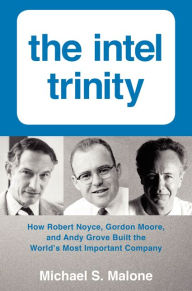
Intel_TrinityOver time, “Silicon Valley had finally and unexpectedly become history,” at least to its founders. Over a long enough time period anything becomes history, although Alan Kay famously said, “I also happen to believe in history. The lack of interest, the disdain for history is what makes computing not-quite-a-field. [. . . Computing is] complete pop culture. I’m not against pop culture. Developed music, for instance, needs a pop culture.”

It will take many more books and maybe many more years before it becomes less of a pop culture, if it ever does. The Intel Trinity is history, but the paper quality of the hardcover is oddly poor, as if the publishers themselves imagined the book to be non-essential and disposable. That contrast between the historical comments and the quality of the physical object itself is odd.

Still, it does trace the story of Intel from its beginnings and from the Fairchild exodus. Fairchild employees were apparently more dissolute and fun than modern tech company workers, or at least compared to the image of modern tech workers:

Just to repeat the anecdotes of the era is insufficient. There were endless after-work drunken gatherings at the nearby Wagon Wheel saloon, where women employees were hustled, marriages were broken, feuds were fed, and in time, employees were stolen by competitors.

Intel itself, however, was apparently less exciting, at least for most people.

The Intel Trinity also points to some of the reasons why Silicon Valley has been so hard to dislodge as a startup capitol (much as NYC is still a publishing capitol, despite outrageously high housing costs): “between 1967 and 1973, [hundreds of new companies] created not only a vast and prosperous business-technology community, but also the greatest start-up company incubator the world had ever seen” (59). At a time when most people were focused on free love and the word “start-up” to connote a new company didn’t really exist, northern California was blossoming. That’s a tremendous head start that’s hard to overcome today and will be hard to overcome tomorrow, despite San Francisco’s completely insane politics.

I haven’t yet got to the stories of Noyce, Moore and Grove. The latter has the most flabbergasting story, since he barely escaped World War II-era Hungary, when Hungary first fought on the side of the Germans, then was occupied by Germany, then was occupied by the Soviets, and eventually had its fledgling democracy crushed by the Soviets. Grove was Jewish and his survival story is amazing enough to have made me order his memoir, Swimming Across, which Malone draws from.

One has to wonder why the Intel trinity is less famous than, say, Bill Gates. I think the answer is simple: there were three of them. Larry Page and Sergey Brin are less famous than Gates, though their company is at least as important, largely because I think the press needs a single person to deify and to hate. Multiple founders makes the process of adulation and despair harder to conduct. Mark Zuckerberg is perhaps the most famous modern startup founder because he stands alone in the spotlight. This reading owes something to Zero to One, which is as much about culture and it is about startups. Culture is everywhere, even in technology, as Malone reminds us.

Links: Teenager hysteria, political mess ups, electric cars, The Anthropology of Childhood, and more!

* “Lives of the Selfie-Centered: What do teenagers use their phones for? Bonding, backbiting, bullying—and texting naked pictures. Lots and lots of naked pictures” and “Open Secrets: The social media–obsessed teens of Nancy Jo Sales’ American Girls never quite come into focus;” both concern American Girls: Social Media and the Secret Lives of Teenagers, a book likely better read about than read. My Dad sent me the first link and observed that, many moons ago when he was a teenager, the scary, virtue-threatening image technology was the Polaroid, which was seen as a danger of virtue and an inflater of vanity in the same way iPhones and Instagram are seen today. I’m just old enough to remember the earthquake that was the first sub-$1,000 DSLR and having conversations with the first guys who bought them; their usual plans for the new purchase were  described as being along the lines of, “I wanna take naked pictures of chicks, man” (I don’t think teenagers have become dramatically less articulate or thoughtful in recent times, and most of my friends who were either subject or photographer are now boringly employed like the rest of us).

In short, today’s OMG WTF BBQ Instragram and Snapchat kids will in fifteen years time be doing the usual things 30 years old do. By the way, when Intel was founded its oldest employee was 29.

* “The top 10 reasons American politics are so broken,” from Jonathan Haidt of The Righteous Mind fame, an excellent piece. And: Democrats appear to not be insane, though the title is different.

* “Here’s How Electric Cars Will Cause the Next Oil Crisis;” one hopes so! And: “The rechargeable revolution: A better battery: Chemists are reinventing rechargeable cells to drive down costs and boost capacity.”

* “There is a better way to parent than the nuclear family” should be obvious; see also The Anthropology of Childhood.

* Why America abandoned nuclear power (and what we can learn from South Korea); could also be titled, “How to reduce the cost of nuclear power.”

* Seattle’s big new transit plans.

* Kofi Annan on why it’s time to legalize drugs.

Life: There is no authority left edition

All modern thought is falsified by a mystique of transgression, which it falls back into even when it is trying to escape. For Lacan, desire is still a by-product of the law. Even the most daring thinkers nowadays do not dare to recognize that prohibition has a protective function with regard to the conflicts inevitably provoked by desire. They would be afraid that people might see them as ‘reactionary’. In the currents of thought that have dominated us for a century, there is one tendency we must never forget: the fear of being regarded as naive or submissive, the desire to play at being the freest thinker—the most ‘radical’, etc. As long as you pander to this desire, you can make the modern intellectual say almost anything you like. This is the new way in which we are still ‘keeping up with the Jonses’.

— Rene Girard, Things Hidden Since the Foundation of the World.

The book itself is a hodgepodge of brilliance and incoherence / irrelevance, but the former outweighs the latter. The notion of defining the difference between “man” and “animal” seems to fascinate older philosophers in a way that I find bizarre or unimportant.

To my mind, the strongest part about American culture American culture’s meta ability to rapidly re-write itself in response to changing conditions and outside influences, including conditions related to Girard’s conception of desire.

Links: Collapse, economic behavior, vaccine success, academic nonsense, and more!

* “Preparing for the Collapse of the Saudi Kingdom.”

* “Divorce laws and the economic behavior of married couples,” an underappreciated point.

* “Vaccine Has Sharply Reduced HPV in Teenage Girls, Study Says.” This one verges on the obvious, but it’s worth reiterating. Vaccines really are a public health free lunch.

* A Long Game: On how California cities became as screwed up as they are, and how to fix them.

* Mindsets for Thinking about Innovation In — and Competition from — China:

China’s largest online/ebook publishing company, Yuewen Group, which has over three million digital books in its catalogue. More notable than the scale here however is how the company monetizes: Chinese readers can pay per every 1000 words (sort of like by chapter), and have been able to do so for more than half a decade.

Brilliant. This is one advantage of avoiding path dependence.

* The Smartest Book About Our Digital Age Was Published in 1929:

The key driver of change, as Ortega sees it, comes from a shocking attitude characteristic of the modern age—or, at least, Ortega was shocked. Put simply, the masses hate experts. If forced to choose between the advice of the learned and the vague impressions of other people just like themselves, the masses invariably turn to the latter. The upper elite still try to pronounce judgments and lead, but fewer and fewer of those down below pay attention.

* “Do teens read seriously anymore?” I can’t tell, but even when I was a teen reading seriously seemed like a thing that only I did. The default meaning of “reading” may also be changing.

* Academic Drivel Report: Confessing my sins and exposing my academic hoax.

Universities treat adjuncts like they do because they can

There Is No Excuse for How Universities Treat Adjuncts: Students are paying higher tuition than ever. Why can’t more of that revenue go to the people teaching them?” is well-summarized by its headline, but there is a very good “excuse” why universities treat adjuncts how they do: because they can. When people stop signing up for grad school and/or to be adjuncts, universities will have to offer better pay and/or conditions. Until that happens, universities won’t.

Markets are clearing.

“There Is No Excuse” keeps popping up in my inbox or in discussion sites, and commenters typically decry administrators (which is fine with me, although I’m not sure they’re the fundamental driver of cost) and promote unions. On unions in universities I don’t have strong opinions; there may be some benefits to the people who get into the union on the ground floor, but raising the pay of some adjuncts will result in shortages of any work for others.

If the market-clearing price is $3,000 per class, and universities have to pay $5,000, there’ll be a large pool of people who can’t get those higher wages because there aren’t a sufficient number of jobs out there for them. So one can trade plentiful but somewhat poorly remunerative jobs for a smaller number of somewhat more remunerative jobs for those who grab them. Supply of adjuncts also seems to change rapidly depending on economic conditions, with the supply contracting when the economy is strong and rapidly expanding when the economy is weak; I’d be curious about empirical work on the elasticities.

If unions become pervasive, universities will also be somewhat less reluctant to hire anyone, because those people who are hired won’t leave—which is already a problem with the tenure system. In the late ’80s and early ’90s, a series of court cases eliminated mandatory retirement policies. Those rulings, combined with lengthening life expectancy, mean that tenured faculty could stay on indefinitely—blocking the path forward for younger academics. Which leads to the explosion of adjuncts presently being decried in the media. Unions (usually) prevent their members from being fired, and, if lay-offs do happen, they happen on a “first-in, first-out” basis. So the youngest and freshest workers will be axed first.

Still, I find the rhetoric of faculty who argue that the job of grad students is to be students hilarious; at the University of Arizona, grad students in English taught the same number of classes for the same number of hours as full-time faculty. Grad students, like medical residents, are workers, regardless of what else they’re called.

It’s also worth contemplating alternatives to academia, which has lots of barriers to entry, formal credentials, and unspoken rules. Marginal product of labor for academics is hard to measure. by contrast, technology employment works well in part because there are close to zero barriers to entry. Someone who wants to learn to code can type “Learn to code” in Google and start. Unions will make the existing barriers to academia higher, and will leave it less like the healthier parts of the economy.

Academics are not exempt from the law of supply and demand, and it turns out that tenured academics are savvy marketers, singing a song of the life of the mind to the unwary who throw themselves onto the shore of a barren island. Supposedly smart people seem to be doing a lot of not-so-smart things.

I personally like teaching as an adjunct because the jobs are plentiful, the hours are flexible, and the work is quite different from what I usually do. On a dollars-per-hour basis the pay is much worse than grant writing, but the work itself is sometimes gratifying, and one gets the usual and much-discussed pleasures of teaching (the joy of young minds, etc.). The online conversation around adjuncts is dominated by people who teach at five different schools and have neither time nor money. Like any job it is not perfect. I do it for the same reason everyone, everywhere, works any job: it beats the alternatives.

Life: Reading Houellebecq edition

“There has been something in my literature, from the first, that goes hand in glove with shame. To be honest, when I published my first books, I expected to bring a certain shame on myself (even though, as I said before, I’ve always hated putting myself forward). What actually happened, and it was a wonderful surprise, was that readers came up to me and said, ‘Not at all, what you describe are human things, some true of human beings in general, others specific to human beings in modern Western societies . . . In fact, we are grateful for you for having the courage to expose them, for having shouldered that part of shame . . .”

—Michel Houellebecq, Public Enemies.

It’s never fully possible to anticipate reader response, which Eco wrote about too.

Shame’s meaning and role does seem to shift with time and place, and yet it gets little airtime in contemporary Western culture.