I never thought I’d vote for Hillary Clinton, yet here I am:

I never thought I’d vote for Hillary Clinton, and I really never thought I’d be excited to do so, but here I am, voting for her today: It turns out that she’s by far the sanest choice in an insane landscape. Most political commentary is really about signalling (including people who say, “most political commentary is really about signalling,” since they’re making a point and trying to signal their intelligence). Still, to understand why I vote for sanity, consider Jonathan Rauch’s argument in “Political Realism: How Hacks, Machines, Big Money, and Back-Room Deals Can Strengthen American Democracy” and “Left-Leaning Economists Question Cost of Bernie Sanders’s Plans.” The former explains that it turns out some level of cash handouts actually make politics function much better.

Many of you may remember the fight over “earmarks” from the 2000s—that is, whether Congresspeople should be able to allocate cash for specific purposes in their districts. I thought eliminating earmarks would be a good idea. Turns out I was wrong: Eliminating earmarks means that it is much harder for party leaders to keep their members in line.

As a result, we get more and more moves towards ideological purity, at the expense of, you know, making the country run. Congress has broken down in the last decade or so in part because party leaders can’t discipline their followers by taking away money that should go to members’ districts. The Tea Party, and, on the left, Bernie Sanders, can become more prominent because of that issue.

I’m not the first person to notice this—”How to fix what ails Congress: bring back earmarks” is one good account—but it is a serious problem that has caused particular dysfunction among Republicans, who appear ready to nominate people who are manifestly unqualified for being a big-city mayor, let alone president.

Ideological purity turns out to be very bad. Jonathan Haidt’s “The top 10 reasons American politics are so broken” (and “The Ten Causes of America’s Political Dysfunction“), along with the paper he links to, “Why the Center Does Not Hold: The Causes of Hyperpolarized Democracy in America,” explains why.

The papers I’ve been citing also explain why it turns out that Obama has been a much better president than most people, including me, realized, or thought in advance. He’s an incrementalist, a negotiator, a thinker, and a realist—all traits that are not selected for amid political polarization. Clinton is too.

Trump and Sanders espouse opposing policies (to the extent Trump espouses any policies), but both are alike in that they are “outsiders” who want to tear down existing systems; they are both temperamentally similar in that they don’t want to work within existing systems. Both are poor traits in leaders and figureheads. We want evolutionaries, not revolutionaries.

It may simply be that, as Matt Yglesias argues, “American democracy is doomed.” I hope not, but the bout of insanity on right and left does not auger well.

I haven’t dealt much with the specifics of Sanders policies apart from the second link in this post because the short version of the critique is, “There’s no way to pay for all this stuff.” Or even a small amount of this stuff. Alvin Chang observes, probably correctly, that “Most Bernie Sanders supporters aren’t willing to pay for his revolution.” If you ask most people if they want more services, handouts, and stuff, they say yes. If you ask most people if they want lower taxes, they say yes. Stated in those terms, you can see the problem.

If you want to understand that people don’t want to pay higher taxes, look at where they’re moving. The major population growth metros are in Texas. Phoenix and Atlanta do really well too. People are moving to lower-cost states, and that should tell us something important about revealed preferences. Hell, I just voted in the New York primary, and I’d like to move to Austin or Nashville, chiefly for cost-of-living reasons.

As for Sanders and banks, the bigger issue than “big banks” is the “shadow” banking system, which I don’t fully understand, but I do understand well enough to know that Sanders is wildly focused on the wrong things.

Still, the last two paragraphs probably don’t matter because the vast majority of Sanders voters aren’t looking at policies; they’re looking at mood and feelings, and I doubt that 1 in 20 people who start this post will have gotten this far, because it’s wonkish, detailed, and not heavily mood affiliated. Out of the who, what, where, when, why, and how of politics, the “How” is often most important and least discussed.

“First, do no harm” is a good political rule, but it’s also kinda boring. I rarely write about politics because most of the time most politics in the U.S. are about incremental changes, about which I have some opinions, but those opinions aren’t important, and they’re as poorly thought out as the political opinions you see on Facebook. In the last couple presidential cycles, I’ve had opinions and voted accordingly, but the major party candidates have mostly been kinda okay. In 2012, Romney would’ve done some things differently from Obama, but I don’t think he would’ve been a total disaster.

This cycle is scary because at least two candidates would likely be total disasters. Yet people keep voting for those candidates and posting mood affiliated comments on them and so forth.

Gay Talese’s “The Voyeur’s Motel”

Gay Talese’s “The Voyeur’s Motel” is one of the most bizarre, compelling, shocking, vile, disgusting, and fascinating stories I’ve ever read. It’s somewhat but not ridiculously explicit (it was published in The New Yorker and consists solely of text), and, about 80% of the way through, the article takes an unexpected twist that deepens the moral questions that haunt the entire thing.

It starts this way:

I know a married man and father of two who bought a twenty-one-room motel near Denver many years ago in order to become its resident voyeur. With the assistance of his wife, he cut rectangular holes measuring six by fourteen inches in the ceilings of more than a dozen rooms. Then he covered the openings with louvred aluminum screens that looked like ventilation grilles but were actually observation vents that allowed him, while he knelt in the attic, to see his guests in the rooms below. He watched them for decades, while keeping an exhaustive written record of what he saw and heard. Never once, during all those years, was he caught.

“WTF?” you may be thinking. That at least was what I was thinking and, even after finishing, still am thinking. “The Voyeur’s Motel” is so unusual that I’m not saving it for a usual links post. An eponymous book will be published in July; I pre-ordered, though doing so has a slightly complicit, slimy feel. Talese feels complicit and by extension so should we, the readers. Is moral contagion a thing? Usually I’d argue no.

Talese also wrote Thy Neighbor’s Wife.

Straight to Hell: True Tales of Deviance, Debauchery, and Billion-Dollar Deals — John Lefevre

Masters of one medium, like Twitter, aren’t necessarily masters of another medium, like the 80,000-word memoir. They can be but don’t have to be. Lefevre mastered Twitter, but his long-form game is not as strong. That being said I did laugh when reading Straight To Hell; I feel like I couldn’t drink anywhere near the amount Lefevre does, or take anywhere near the amount of drugs. I don’t imagine I’d want to be friends with him. As he puts his life philosophy, “As we see it, if you’re dumb enough to get caught cheating, you probably don’t belong on Wall Street.”* That sounds like a sentence from a Bernie Sanders rally. It isn’t.

Straight_To_HellLeFevre writes, “From my experience, the rich and unscrupulous tend to make for entertaining company.” Speaking of political connections, he could be talking about Donald Trump, which is part of the reason he makes a popular, evil presidential candidates (and I don’t use the word “evil” lightly, but he is evil: the evil of pure id, untempered by knowledge or self-awareness). Straight to Hell has more political resonances than it should, and that may help explain its popularity, as it works on readers’ subconscious.

Still, LeFevre’s company is often entertaining, and the best one can say about his scruples is that he makes public what many would like to be private. The speaker of unpleasant truths has a kind of honor. The book is his unpleasant truths, though it is often about the unpleasant truths he dodged (“Now I know for sure, this deal is never going to work. But I still don’t want to be the one who gets blamed for killing it.”) Machiavelli has a vital role in history for a reason.

Even for people like me, who don’t see money as evil, LeFevre will make them want to see money as evil. (Consider how Sylvia Nasar puts it in Grand Pursuit: The Story of Economic Genius: “Historically, money had been seen as powerful, desirable, very likely evil, and mysterious, like natural calamities or epidemics.”) Money can be earned in ways that tend to benefit humanity or, in LeFevre’s world, in ways that tend to be about rent seeking and stealing pieces of the pie, rather than earning them, or expanding the size of the pie. Finance here looks like the latter part. That being said one doesn’t and maybe can’t know whether LeFevre’s book is representative, any more than a movie like Bad Teacher is representative of the teaching industry.

Straight To Hell is a memoir about signaling. The finance world presented in it has descended to an almost-pure signaling hell, in which there is no content, only surface. Hence the ceaseless references to luxury brands and luxury-brand schools. The two have become synonymous, however much humanities-department Marxists may want to deny it. There is a weird kinship between high school memoirs or novels and Straight To Hell. American high schools are painful because there is no content to shape form. Lefevre’s finance world is similar. In it, seniority beats skill (count the number of times the word “senior” appears). Many American high schools are so bad because there is no financially viable way to start an alternative high school that can siphon off smarter students and parents. Banks, in Straight To Hell, operate the same way. If contemporary investment banks operate anything like the way Lefevre depicts them operating, then “fin tech” (or “financial technology companies and products,” to use a phrase du jour) should be a ripe opportunity for startups, because the banks, and their personnel and culture, are so internally fucked up that smart startups ought to be able to eat them.

Unless, of course, regulatory and other barriers kill startups before the startups can really succeed. Still, anyone investing in financial companies should read Straight to Hell. It ought to give them courage, if it’s accurate. I can’t really judge whether it is. I’m too far from the industry. It seems unlikely, but unlikely things turn out to be true all the time. It seemed unlikely that the U.S. government would massively spy on virtually all of its citizens, but Snowden showed that it does. It seemed unlikely that an electric car startup could succeed, but Tesla showed that it can. I won’t discount Straight to Hell without trying to triangulate its portrayals. Still, if it is to be believed then many bankers are redistributing money to escorts and drug dealers. Not that I’m opposed, necessarily, to either group, but it is interesting given recent noise about financial inequality to see money flow from the rich to middle-skill service providers (though the book is not conceptualized or framed in that way; still, often the most interesting parts of a book are those that are unintended).

One could write an interesting piece comparing temperaments in Houellebecq and LeFevre. One could also write an interesting piece comparing Thiel in Zero to One and LeFevre. As Thiel notes, in a discussion about why startups (and other companies) must incentivize their employees with stock and other methods that align incentives:

Cash is attractive. It offers pure optionality: once you get your paycheck, you can do anything you want with it. [. . .] A cash bonus is slightly better than a cash salary—at least it’s contingent on a job well done. But even so-called incentive pay encourages short-term thinking and value grabbing. Any kind of cash is more about the present than the future.

zero to oneStraight to Hell can be seen as a document about “value grabbing” and about living in the hedonistic present. The value grabbing is not purely financial, either: It’s also sexual. The team lives or dies by the current roadshow. Slickness rules. One could also compare Straight to Hell and Zero to One in terms of humor versus earnestness. Zero to One has its moments of humor (think of the brief section comparing hipsters to the Unabomber, or the part about Richard Branson and the naked windsurfing model) but the preponderance of the book is about how to make serious, real improvements in the quality of life for all humans. Straight to Hell is about getting a bonus and getting your dick wet (concern over women’s pleasure is mostly absent, or I’d add something appropriate for women as well). There is nothing intrinsically wrong about either and indeed both have concerned me greatly at various points, but there is something distinctly sublunar about the relentlessness of those concerns, and the way one never looks up from the bonus or the girl or the meal.
Is it a satire? Is the joke on me because I don’t get it? There is much like, “There’s no justice in this world—a valuable lesson to learn at a young age, especially if you want to end up on Wall Street.” Is it bravado, trolling, or truth? After many words I still don’t know.


* If they’ll cheat someone else, they’ll cheat you when they get a chance.

Links: “The Girlfriend Experience,” Hilarious book reviews, “The Red Pill,” oil and climate change, and more!

* The Girlfriend Experience: A show based on Steven Soderbergh’s movie tries to tell a new kind of story about sex and female empowerment.” This is the best of the reviews / discussions about the show, which has generated a lot of smart-ish essays.

* “He Got Greedy,” a crazy story.

* “Review: ‘Maestra,’ a Novel of Sex, Murder and Shopping.” The review sounds more entertaining than the novel:

Advances in publishing industry marketing have allowed G. P. Putnam’s Sons to bring forth “Maestra,” a pornographic shopathon travelogue thriller that has billionaires, art world scheming and a sociopathic heroine who can unfasten belt buckles with her tongue. It should go without saying that this book is part of a trilogy, is headed for the movies and has created a stir in countries where it has already appeared. As one reader reasonably put it on Amazon.uk’s website: “This book’s pomposity is unbelievable and the sex is ludicrous. Will sell millions.” Right now its sales on that site are sinking, and it’s selling only decently. But point taken.

* Swallowing the Red Pill: The online community hosted on Reddit is where men go to air views about women,” an article with a bad frame but that can be interestingly read between the lines. See also “The appeal of ‘pickup’ or ‘game’ or ‘The Redpill’ is a failure of education and socialization” and “Confessions of a Pickup Artist Chaser.”

* “ Oil industry knew of ‘serious’ climate concerns more than 45 years ago.” Then again, we, the public, have known for decades, and have done nothing. But scapegoating is appealing.

* “The Absurd Primacy of the Automobile in American Life: Considering the constant fatalities, rampant pollution, and exorbitant costs of ownership, there is no better word to characterize the car’s dominance than insane.” The most important piece you won’t read today. I just got back from L.A. and L.A. feels insane: a supermassive city built for cars.

* “Glaciers and sex: On the academy’s latest folly,” concerning the bad writing infesting academia. I used to cite examples of awful academic writing, but somewhere along the way I realized that almost no one cares.

* “Why There’s Hope for the Middle Class (With Help From China).”

* “Love in the Time of Monogamy,” a review of the recent evolutionary biology literature.

* On John Colapinto’s novel Undone; I ordered a copy.

* “The Senate’s criminal justice reform repeats one of the worst mistakes of the war on drugs;” depressing: “The Senate’s bipartisan criminal justice reform bill, spearheaded by Sen. Chuck Grassley (R-IA), suggests at least some federal lawmakers have truly learned nothing from the failures of the war on drugs.”

Links: Schools and sleep, money, lies, cities, pleasing the masses, and more

* “Schools Are Slow to Learn That Sleep Deprivation Hits Teenagers Hardest.”

* “Rezoning in the age of hyper-gentrification.” See also, “Do millennials have a future in Seattle? Do millennials have a future in any superstar cities?

* “A C.I.A. Grunt’s Tale of the Fog of Secret War;” the book is Left of Boom and it looks interesting, though I don’t plan to read it because I already agree with its likely conclusions.

* Why college costs are increasing, part #527. See also “When there are too many administrators, which ones do *you* fire?

* Krugman: “Cities for Everyone.”

* “Pleasing the Masses: Jimmyjane took vibrators from sleazy to chic — now, can it take them mainstream?” I think the writer’s name is a pseudonym.

* “My biggest regret as a programmer,” which is more universally applicable than the title suggests.

* “The sugar conspiracy: In 1972, a British scientist sounded the alarm that sugar – and not fat – was the greatest danger to our health. But his findings were ridiculed and his reputation ruined. How did the world’s top nutrition scientists get it so wrong for so long?”

* “The Panama Papers Actually Reflect Pretty Well on Capitalism,” though seemingly no one has noticed.

The real estate market is peaking:

My Dad met a woman in her early 60s who went back to work as a flight attendant on Jet Blue. Which is a fine and excellent occupation. But she also just got a real estate license, and her plan is to buy houses in Culver City for around $600,000 – $900,000, fix them up, and then flip them—for much more, presumably.

Maybe she doesn’t have the cash to pull off the purchases in the first place. Maybe she won’t be able to get the mortgages. Maybe it’s all hot air.

But maybe it isn’t. In the last two years a real estate frenzy seems to have built up in some markets. The flight attendant needs to find a greater fool before she gets crushed by the carry costs of the houses she’s buying or trying to buy.

Have you seen The Big Short, or read the book? History is repeating itself. The car loan market is already flashing warning signs. That woman’s whole financial life is going to fall apart if she starts trying to flip and the housing market falls.

People who bought real estate in 2009 – 2012 look like geniuses today. But by 2017, the people who bought from 2014 – 2016 might not look geniuses. I hear a lot of people around my age who want to buy stuff because they feel like they’ll be priced out forever if they don’t. That’s the kind of talk that makes me nervous.

In college all everyone talked about was art, drugs, ideas, sex, and parties. The shift to real estate and mortgages is a worrisome one.

Links: Education climates, housing, who pays?, fusion, art, and more

* Teacher who got fired after student stole her nude pics sues school district. Good. She should win.

* Welcome to the next housing crisis: chronic undersupply of homes for a growing country. A point I’ve made before but that is worth making again. Housing touches so many other issues: innovation, education, “income inequality,” opportunity.

* “Millennials like socialism — until they get jobs.” Sometimes students express shock and horror that anyone, anywhere would vote for Republicans. When they do, I sometimes ask, “How much did you pay in taxes last year?” They look at me, confused, and then I say something like, “When you can answer that question immediately, you’ll know one reason. Which isn’t an endorsement of the party as a whole or of specific Republicans, but it is a small piece that may offer a partial answer.” People subsidizing others and people being subsidized often have very different views.

* Is the cold fusion egg about to hatch? A question we’ve been asking for 60 years.

* “Why Reston, Virginia, Still Inspires Planners 50 Years Later: How the D.C. suburb’s pedestrian-centric, mixed-use approach came to dominate urban design.” This helps: “Simon’s ideas on urban design dated back to his early twenties, when he bicycled through Europe. As a gregarious conversationalist, he loved how this mode of transit allowed him to meet so many people.”

* “The New Old Masters: New Yorker Jacob Collins and his devoted students seek a radical reclamation of artistic tradition,” which makes many points I’ve long thought about but rarely articulated. For at least the last forty years visual art has been wildly bogus, for reasons Camille Paglia describes in Glittering Images and elsewhere.

* What Higher Education Can Learn From The Fall Of The Newspapers.

* Imagine If Conservatives in Academia Could Safely ‘Come Out.'”

* “Nafta May Have Saved Many Autoworkers’ Jobs.” Things you do not hear from politicians.

* “When will rooftop solar be cheaper than the grid?” In some places, it already is.

* Republican wonk Keith Hennessey: “I oppose Donald Trump.”

Whiskey Tango Foxtrot

* The movie is remarkably funny, and it’s funny in a way that most supposedly funny movies aren’t. Comedies tend towards the scatological or sexual, which I’m not against but the relentlessness of the subject matter does become tiring. This one has a bit of each, but it’s more absurdistly funny. And politically funny.

* Afghanistan really is the forgotten war. I don’t really know what’s going on in Afghanistan right now. Do you? Don’t let this serious bullet point dissuade you from the movie.

* Whiskey Tango Foxtrot sticks the landing: The last two minutes are perfect and in tune with the rest. The last third of Magic Mike is like the first two-thirds but without the “magic” part.

* We are very much outsiders from there. The movie is congruent with “Soldiers of Reddit who’ve fought in Afghanistan, what preconceptions did you have that turned out to be completely wrong?” (See the seventh item at the link.)

* Being able to retreat from history is really, really nice. Even terrorism, while nice, kills less than 1% as many people in Western countries as car crashes alone. The average person has far more to fear from simple carbs than from terrorists.

Links: Spy novels, nurses and doctors, freedom of speech and thought, Saudi menace, and more!

* “Secrets of a Secret Agent,” on spy novelist Jason Matthews, who sounds like he was a better spy than he is a novelist and who also sounds like he knows it: “In retrospect, [the publication of Red Sparrow] wasn’t because the book or my writing was so good [. . . .] It’s because I was a former spook.” I read Red Sparrow but the writing wasn’t good enough to review it. But it shows promise and almost no one’s first book is their best.

* “In a fight between nurses and doctors, the nurses are slowly winning: More states are allowing nurses to provide all the kinds of care they learned about in school.” See also my essay “Why you should become a nurse or physicians assistant instead of a doctor: the underrated perils of medical school.”

* “How ‘Safe Spaces’ Stifle Ideas.” Seems obvious, but…

* Self-driving cars may still be decades out. And light rail can happen now, if we want it to.

* We are witnessing the rise of global authoritarianism on a chilling scale. Perhaps related to the “safe spaces” link.

* “How Saudi Arabia captured Washington: America’s foreign policy establishment has aligned itself with an ultra-conservative dictatorship that often acts counter to US values and interests. Why?” It’s amazing that this story doesn’t get more press. Also: “How the Saudis Churn Out ‘Jihad Inc.:’ From mass executions to ISIS and the San Bernardino attack, the manifestations of Saudi Arabia’s Salafi extremism are everywhere—and it’s time for Muslims to fight back.” The 2016 battery-powered Chevy Volt is getting great reviews.

* “Nixon official: real reason for the drug war was to criminalize black people and hippies.” It worked. Three Felonies A Day: How the Feds Target the Innocent ought to be mandatory reading for American citizens.

* “Russ Roberts and the Quest to Make Economics Interesting.” He often but not always succeeds and I listen to Econtalk.

* “A global experiment in co-living;” has anyone written a novel set in co-living spaces? I feel like there’s one there.

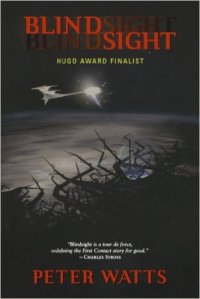
My Amazon review of Peter Watts’s Blindsight

People read Amazon reviews and Watts reads his, so I left this one.

Listen to the positive reviews: Blindsight is one of the most stunning and incredible novels I’ve read, ever, and that’s among all novels, not just SF. To describe Blindsight is not to do it justice: Like Ulysses, the plot can be summarized but the texture of it cannot really be conveyed save through the reading itself. Ulysses might be summarized as, “Neurotic man wanders through Dublin, gets stuck in his own head.” In that sense, Blindsight might be summarized as “The link between humans and post-humans encounters aliens, and nothing will ever be the same.

BlindsightBlindsight is on my mind because I just finished Leviathan Wakes by James S. A. Corey. It’s a competent, fun novel. It’s even good at times. But it covers territory similar to Blindsight’s, only less mind-blowing. It’s less developed. One can have literary blind sight and enjoyable read Leviathan Wakes, as I did, but reading them next to each other will show that something is missing from Leviathan Wakes. One needs total vision and a third eye to get Blindsight. To be sure, most people never reach enlightenment. But without reading it, you’ll never know if you can get there, or if you’ll be left at the foothills like most of us are.

The world is very different from ours in key ways but doesn’t yet have AI; before Firefall, Siri Keeton, narrator, who is supposed to have no feelings and only observation, is doing this:

I’d been liaising for a team at the Kurzweil Institute, a fractured group of cutting-edge savants convinced they were on the verge of solving the quantum-glial paradox. That particular log-jam had stalled AI for decades; once broken, the experts promised we’d be eighteen months away from the first personality upload and only two years from reliable Human-consciousness emulation in a software environment. It would spell the end of corporeal history, usher in a Singularity that had been waiting impatiently in the wings for nigh on fifty years.

But it hasn’t arrived. Not yet. Not in Blindsight’s world, which is also Siri’s world. To us it’s an odd one:

You hire people like me; the crossbred progeny of profilers and proof assistants and information theorists.

In formal settings you’d call me Synthesist. On the street you call me jargonaut or poppy. If you’re one of those savants whose hard-won truths are being bastardized and lobotomized for powerful know-nothings interested only in market share, you might call me a mole or a chaperone.

He works in “the rotational topology of information and the irrelevance of semantic comprehension.” Oddly, that may be what a lot of us do: understanding surfaces without understanding depth, if “surface” and “depth” have any meaning at all. That’s one of the (many) question Blindsight asks (Leviathan Wakes asks political economy and cooperation questions). To restate many of them would take many thousands of words. That is another way the novel is like Ulysses.