A Billion Wicked Thoughts: What The World’s Largest Experiment Reveals About Human Desire — Ogi Ogas and Sai Gaddam

A Billion Wicked Thoughts is good but not great; it covers a lot of much-discussed studies from an angle that, although novel, isn’t quite novel enough. The book is like Why Women Have Sex: both are written by pairs of popularizing intellectuals who probably want to earn more money and affect the social conversation more than they could through writing purely academic work. Anyone really interested in issues around sexuality and evolution is better served by The Evolutionary Biology of Human Female Sexuality, which is insanely detailed and concomitantly worth reading.

In A Billion Wicked Thoughts, the forward by Catherine Salmon notes, “There is a lot of truth to the belief that if you can imagine it, you can find it as Internet porn.” If you can imagine it and can’t find it, you probably have a good business model. Or you can make the porn yourself. But the ubiquity of online porn, combined with its breadth, makes it a trove of information about behavior that, as Ogas and Gaddam point out, most people are reluctant to share. If they do share, what they share and how they shade information can render that information nearly useless. In contrast, the Internet feels anonymous enough to let your search engine rip. So Ogas and Gaddam decided to study search queries, sort them (apparently using Amazon’s Mechanical Turk), classify them, and analyze them. We also get lots of specific sample search queries, like “family nude beach” (167), “anal sex benefits” (168), and “nude construction workers” (168). These illustrate important points, I’m sure, and I’m not including them in this post purely to ensnare unwary search engine users.

Using Internet search queries reduces some forms of bias while presumably introducing others—like what we know about people who don’t use the Internet. What can see about all those searchers who aren’t looking for porn? What can we say about sample bias?
The authors are aware of this and say, for example:

The male desire for older women is also reflected in the popularity of ‘mom’ searches on PornHub (since teen content is highly visible and easily accessible on PornHub, users may be more likely to manually type in searches for content they don’t immediately seen.

But how do we know about the proportions of searchers to non-searchers? This may be an example of the old joke about the “Streetlight Effect:

A policeman sees a drunk man searching for something under a streetlight and asks what the drunk has lost. He says he lost his keys and they both look under the streetlight together. After a few minutes the policeman asks if he is sure he lost them here, and the drunk replies, no, that he lost them in the park. The policeman asks why he is searching here, and the drunk replies, “this is where the light is.

Internet searches are where the light is right now.

Still, the project is interesting, and, in the absence of other data, it makes some sense to use what’s available. Ogas and Gaddam structure the book as a series of chapters that use Internet porn search classifications as headers, note some of those searches, and explain what those searches might mean using research that draws from evolutionary biology, evolutionary psychology, sexology, and similar fields. It’s a readable introduction, but it’s also part of a torrent of pop sex books over the last decade, which you can find through Amazon’s “if you bought this, you’ll also like this. . .” feature. If you’ve read enough of those books, you probably don’t need this one. Read this Salon Q&A instead.

The prose in A Billion Wicked Thoughts is competent—and, unlike Sex at Dawn‘s whacky metaphors and comparisons that strive for style and instead hit silliness, it rarely strays into the ludicrous. Although the purpose of nonfiction is to convey information, the best nonfiction goes beyond that stage to become art (Umberto Eco makes this as a subsidiary point in Confessions of a Young Novelist). A few jokes might even be intentional—I particularly like “On the web, group sex porn has exploded into a variety of sub-genres” (emphasis added)—but A Billion Wicked Thoughts doesn’t quite get there, although there’s nothing wrong with it.

Having little wrong isn’t enough to be right, and they still use coinages like “The Miss Marple Detective Agency” to describe a large body of research demonstrating that women’s physical reactions to sexual stimuli often differ markedly from their psychological reactions to sexual stimuli. You can get a lot of the material in this chapter from the New York Times article “Women Who Want to Want,” starring psychologist Lori Brotto instead of psychologist Meredith Chivers instead of psychologist Lori Brotto.

The upshot shot of the chapter is that many women appear to physically respond to sexual stimuli even when their conscious minds aren’t responsive or even find it disturbing—and those same women are frequently unaware of the phenomenon. Ogas and Gaddamn analogize the situation to the mind-body problem in philosophy (which also happens to be the name of an excellent novel by Rebecca Goldstein). The upshot: “women need to be psychologically aroused.” This appears to be true, but although the research points in that direction, it isn’t perfect; we have effects, but the causes remain uncertain.

There’s still evidence in that direction, and Ogas and Gaddam discuss much of it, including the female penchant for romance novels (which, although sexual, also focus much more on narrative and emotional connection than porn) and the male penchant for porn featuring anonymous sex focused in particular on body parts. They’re also aware of their own biases, as when they note “We all have our favorite theories that fit our experiences and prejudices.” That’s true, and it’s hard to shake ideology out of sex research. It’s also hard to shake one’s own training, and mine in literature makes me think some of their literary analysis is suspect, but they’re good at a naive version of Franco Moretti’s distant reading, as when they note how rare it is for heroes in romance novels to be truly, consistently poor:

In modern romances, the heroine often has a high-powered, high-paying job of her own. Romances feature women who are corporate executives, politicians, and financiers. Since such heroines no longer require a man to provide for their needs, has this cultural transformation led to more romance heroes with limited resources?

Not at all. If a heroine is rich, then the hero is even more rich.

They cite Janice Radway’s Reading the Romance, which studies the genre from a politically inflected but still fascinating perspective. They cite a lot in general, and their notes / bibliography is close to 100 pages. I always admire a book with a very, very big bibliography. In this respect, A Billion Wicked Thoughts satisfies.

Life: Writing edition

“Part of the goal of reading is to make what’s unconscious, conscious.”

—Me, in class earlier today and trying to describe how to write better be a better writer.

Week 33 links: The secret sex lives of teachers, B. R. Myers and A Reader's Manifesto, digital cameras, a book in the home, science fiction writers' picks, adultery and politics

* The secret sex lives of teachers, which notes, “there is clearly something irresistible about teachers with decidedly adult extracurricular activities.”

* The Soul-Sucking Suckiness of B.R. Myers, which I don’t buy. I read A Reader’s Manifesto and loved it. Hallberg says, “It was hard to say which was more irritating: Myers’ scorched-earth certainties; his method, a kind of myopic travesty of New Criticism; or his own prose, a donnish pastiche of high-minded affectation and dreary cliché.” I suppose one man’s weak “method” is the opening of another’s eyes to something he’d long suspected but never quite articulated.

I remember trying to read DeLillo and Pynchon as a teenager, thinking they were incoherent, boring, or both, and putting them back down again—an opinion I haven’t managed to revised.

* Why we’ve reached the end of the camera megapixel race.

* A Book in Every Home, and Then Some.

* The Stockholm Syndrome Theory of Long Novels.

* The stars of modern SF pick the best science fiction. A lot of the choices don’t look very appealing to me; I wonder if this is an example of the values of writers and reading diverging.

* Normally I think the day-to-day of politics is stupid and cruel, but some meta political commentary can be amusing, along the observation of hypocrisy. Like in this New York Times column: “What is it with Republicans lately? Is there something about being a leader of the family-values party that makes you want to go out and commit adultery?”

* The Magician King is done.

* The annoyances of eBooks, and why they will probably win anyway.

Beware the novel – IT LIVES!

“The novel should be known as the undead genre: its history is filled with moments in which it could have, would have, perhaps even should have vanished but did not.

There are two reasons why this is so. First, the novel has proved a durable universal donor. Second, it thrives on its negative capability—its unwillingness, even its inability, to provide definitive answers to the questions it poses. The novel has soldiered on as a set of questions, of open-ended experiments, rather than definitive results. Novels, like viruses, have all the appearances of a set of plausible answers—all the appearances, that is, but the answers themselves. Novels are questions posed as if they were answers. They clarify exactly how hard such judgment can be, and how contingent and provisional our explanations of past events and predictions for future ones will always be, no matter how certain we are about the abstract rules that guide our lives. On the one hand, then, novels live on by giving a push to other artworks. On the other, they survive because they are in themselves incomplete, a set of suggestive vectors and plausible outcomes rather than a sealed solution. Although there often seems to be a good deal of ‘actionable intelligence’ in a novel, it is rarely clear what that action should be.”

That’s from John Plotz’s essay “No Future?“, the rare academic article that might be of interest to people who aren’t academics—like writers producing novels.

Life: The Critic's Role

“Whatever the subject, a real critic is a cultural critic, always: if your judgment doesn’t bring in more of the world than it shuts out, you shouldn’t start.”

—Clive James, “Hollywood: A Love Story

Life: The Critic’s Role

“Whatever the subject, a real critic is a cultural critic, always: if your judgment doesn’t bring in more of the world than it shuts out, you shouldn’t start.”

—Clive James, “Hollywood: A Love Story

Eight years of writing and the first busted Moleskine

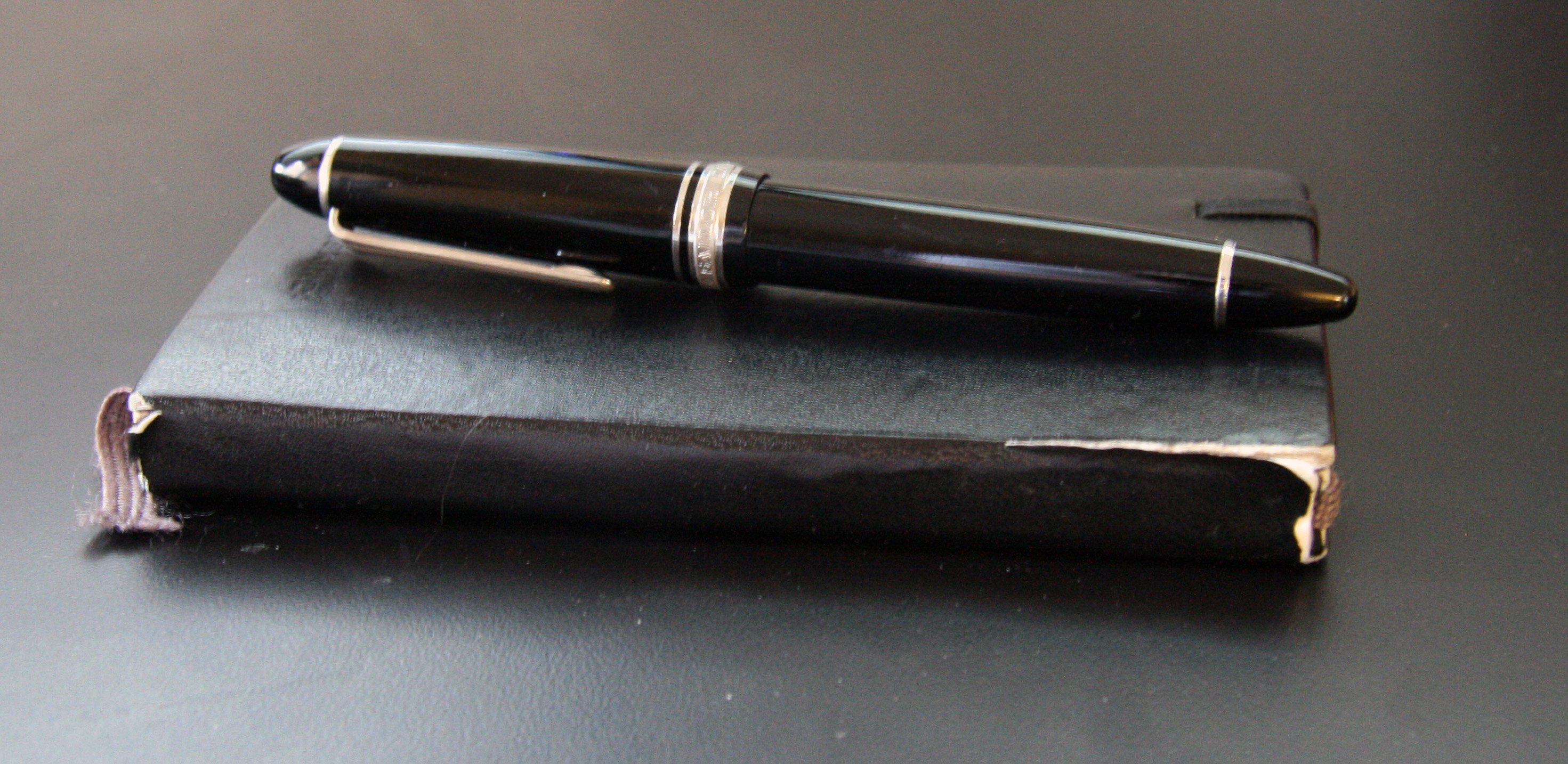
Most of my writing happens on a computer, which means it’s pretty hard to depict the final product in a visually satisfying way.* But I also carry around a pretentious Moleskine™ notebook for the random ideas that strike in grocery stories or at parties. The latest notebook, however, developed a split binding:

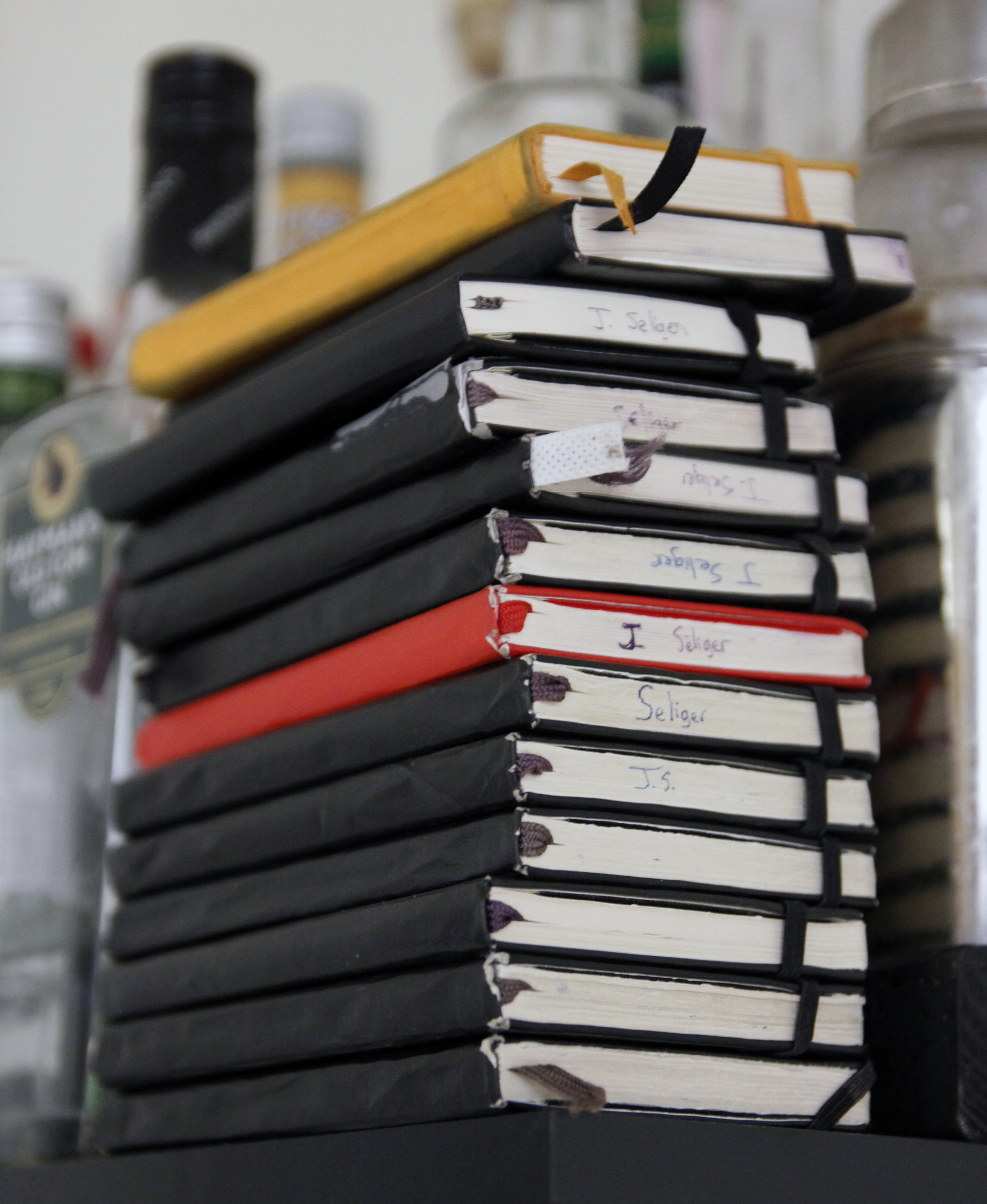
I’ve been using Moleskines for about eight years, which means I go through about two of them per publishable novel:

Notice how none of the others have the binding split that afflicted the latest one. I haven’t consciously treated this one differently from its predecessors or used it any longer. Maybe the quality control at Moleskine central has declined, although people have made claims in that direction for a very long time.

Regardless of the reason, the latest notebook has about twelve usable pages left; I tend to write nonfiction, blog post ideas, things I need to remember, reminders about e-mails, entries from an unkept diary, and stuff like that in the back. Ideas, quotes, things people say, and other material related to fiction goes in front. When back and front meet in the middle, it’s time to get a new one.

When I start working on a new novel, I usually go back through all the old notebooks at the beginning to see what material might be usable and when I started taking ideas for that specific project. Some ideas for novels have been burbling in the back of my mind for a very long time, waiting for me to have the time and skill to move them from a couple of scrawled lines to 80,000 words of story. The oldest Moleskines I have were bought in the 2002 neighborhood. They’ve held up pretty well; the ones I started buying in the 2005 neighborhood are showing their age. Tough to say if this is an indication of falling quality control or something else altogether.

While Googling around for the complaint about Moleskine quality I linked to above, I also found a site that recommends The Guildhall Notebook. I’ve already ordered one, although apparently Guildhall doesn’t have a U.S. distributor, so I have to wait for mine to ship from the UK. I hope the improved binding is worth the wait. EDIT 1: They weren’t worth the wait, or the hassle; if that weren’t enough, Christine Nusse of Exaclair Inc. /Quo Vadis Planners, which distributes or distributed Guildhall notebooks, said in an e-mail that her understanding is that the notebooks are being discontinued. She recommends the Quo Vadis Habana instead (although I think it too big) or a Rhodia notebook (which I think just right, as I said below.

So even if you want a Guildhall pocket notebook, you probably won’t be able to find one for long; fortunately, the Rhodia Webbie is a better alternative.

EDIT 2: Someone found me by asking, “are moleskines pretentious”? Answer, in post form: “Are Moleskines pretentious? Yup. Guildhall Notebooks are worse.”

EDIT 3: I’ve settled on the Rhodia Webbie as a full-time notebook: it’s expensive but much more durable than other notebooks I’ve found. I’ll write a full review at some point.

EDIT 4: I posted an updated photo of the stack. Or you can see it here:


* Even describing it using conventional prepositions is tough: do I write “on” or “in” or “with” a computer? Good arguments exist for any of the three.

Links: Drinking, e-mail, grad school opportunity costs, ‘The Entire Ukraine Is a Brothel’

* The educational value of booze. See further The Joy of Drinking.

* How the World’s Most Famous Computer Scientist Checks E-mail Only Once Every Three Months. I shoot for once every two days and often miss. Paul Graham’s “Disconnecting Distraction” is also on point. Before I open my e-mail in box, I try to ask myself, “Will doing so get me paid or laid or make me happier?” The answer is almost always “no.”

* I sympathize with the argument in “Death to high school English,” especially where Brooks says:

Only now, a decade and a half later, after seven years of teaching college composition, have I started to consider the possibility that talking about classics might be a profound waste of time for the average high school student, the student who is college-bound but not particularly gifted in letters or inspired by the literary arts. I’ve begun to wonder if this typical high school English class, dividing its curriculum between standardized test preparation and the reading of canonical texts, might occupy a central place in the creation of a generation of college students who, simply put, cannot write.

Problem is, I’m not sure the structure of high school English is the biggest problem so much as the generally uninspiring teachers in front of the classroom. Paul Graham’s The Age of the Essay is also on point here.

Although I’m in grad school for English lit, I find most capital-C Classics pretty tedious.

* What you can do instead of grad school, good advice. You should also read Robert Nagle’s Straight Talk About Grad School if you haven’t already. I find it more true as I go on.

* “Even as more people are struggling to pay medical bills and being rushed through office visits with their doctors, an elite group with money has another option: exclusive medical care, around the clock and anywhere in the world, including on a yacht or private plane.” Expect this dynamic to increase as insurance worsens and government becomes more tied to health care; this also basically describes how English health care works.

* FBI: If We Told You [All the Nasty Shit We Do, Like Spying], You Might Sue. Which sounds like an excellent reason. . . to sue. And a great ad for the ACLU!

* It’s hard to read about books like “A Billion Wicked Thoughts without thinking that a lot of what we think we know, we don’t.

* ‘The Entire Ukraine Is a Brothel’. Sounds far more entertaining than most protests.

* I’ve started reading Tim Harford’s Adapt, which is interesting so far but makes me worry that he might be going in an Gladwellian direction.

* Among the strangest queries that have brought people to The Story’s Story recently: “teen jeans ass.”

What success looks like: A link from Dave Winer of Scripting News

I’ve been reading Dave Winer’s blog Scripting News since long before I’d heard the word “blog.” Scripting News been covered in Say Everything: How Blogging Began, What It’s Becoming, and Why It Matters and countless other profiles as one of the early examples of a blog. Imagine my delight when:

Yes, that’s a link my post on the sad and stupid demise of Flip at the hands of Cisco. I wouldn’t call Winer’s Retweet “a dream come true” or any other phrase that should be reserved for acts of extreme achievement or copulation (which can sometimes be an extreme achievement), but it’s certainly gratifying—like getting e-mails or comments from writers and critics I admire.

Now I only need a link from Marginal Revolution and my blogging life will be, if not complete, then at least substantially more satisfying than it might be otherwise.

The Gottlieb Paris Review interview

There’s a great Paris Review interview with editor Robert Gottlieb filled with quotable stuff. A sample:

* “I have fixed more sentences than most people have read in their lives.”

* “Your job as an editor is to figure out what the book needs, but the writer has to provide it. You can’t be the one who says, Send him to Hong Kong at this point, let him have a love affair with a cocker spaniel. Rather, you say, This book needs something at this point: it needs opening up, it needs a direction, it needs excitement.”

* From Toni Morrison, who Gottlieb edited: “I never wrote a line until after I became an editor, and only then because I wanted to read something that I couldn’t find. That was the first book I wrote.” This, incidentally, is also what keeps me writing—wanting to read books that no one else has written, though I suspect Morrison and I have very different tastes.

* A long excerpt from John le Carré:

Negotiations were always tight with Bob. He was celebrated for not believing in huge advances, and it didn’t matter that three other houses were offering literally twice what he was offering. He felt that for half the money, you got the best. Most publishers, when you arrive in New York with your (as you hope) best-selling manuscript, send flowers to your suite, arrange for a limo, maybe, at the airport, and then let you go and put on the nosebag at some great restaurant. The whole idea is to make you feel great. With Bob you did best to arrive in jeans and sneakers, and then you lay on your tummy side-by-side with him on the floor of his office and sandwiches were brought up.

After I finished one book, I think it was A Perfect Spy, my agent called me and said, Okay, we’ve got x-zillion yen and whatnot, and I said, And lunch. My agent said, What? I said, And lunch. When I get to New York I want to be taken, by Bob, to a decent restaurant for once and not eat one of those lousy tuna sandwiches lying on my tummy in his room. Bob called me that evening and said, I think we have a deal; and is that true about lunch? And I said, Yup, Bob, that’s the break point in the deal. Very well, he said. Not a lot of laughter. So I arrived in New York, and there was Bob, a rare sight in a suit, and we went to a restaurant he had found out about. He ate extremely frugally, and drank nothing, and watched me with venomous eyes as I made my way through the menu.

* Gottlieb again:

I happen to be a kind of word whore. I will read anything from Racine to a nurse romance, if it’s a good nurse romance. Many people just aren’t like that. Some of my closest friends cannot read anything that isn’t substantial—they don’t see the point. I don’t, however, like a certain kind of very rich, ornate, literary writing. I feel as if I’m being choked, as if gravel is being poured down my throat. Books like Under the Volcano, for instance, are not for me.

And this again describes me, despite my post On books, taste, and distaste. I think my penchant for Carlos Ruiz Zafón falls into the “word whore” category.

* The main thing he gets wrong is regarding science fiction, where he says of Doris Lessing’s The Sentimental Agents that “like all space fiction, or science fiction, it is underlain by a highly moralistic, utopian impulse.” This isn’t true: a lot of science fiction might be, but it’s hard to argue that, say, Stanislaw Lem’s is, or any number of dark, contemporary SF writers who want to describe things, not change them.