Will we ever find out what happened to Flip Video?

According to the San Francisco Chronicle, “Cisco Killed The Flip Cam A Day Before It Was Going To Get A Cool New Live Broadcast Feature.” Which is pretty frustrating: why kill the unit right before a major upgrade that’s presumably all sunk costs? The WSJ has one possible answer in “After Cisco Sacrifices His Baby to the Gods of Wall Street, Flip Founder Jon Kaplan Speaks!“, where Kara Swisher says that axing Flip was an “effort to assure Wall Street that it was no longer serious about its wacky foray into the consumer market.” But does it have to be so public? So symbolic?

And it is symbolic: Arik Hesseldahl points out that Cisco lumps the revenue from Flip into an “other” category on its financial statements. He then goes on: “This ‘other revenue’ totaled $2.6 billion in Cisco’s fiscal 2010, up from $1.6 billion in fiscal 2009. The biggest single factor for that billion-dollar boost was $317 million in Flip camera sales. You read that right: Cisco just shut down a business that brought in $317 million in sales in its last fiscal year.”

He says, “Make no mistake, the Flip was and is a culturally significant product.” It was, and, as regular readers know, I almost never write about consumer gadgets because most of the time there’s no point and people who write about them are just wasting their breath. But the Flip was fun in that shocking, surprising way that the original iPods were. Gadgets rarely have that effect—they’re as rare, or maybe rarer, as a book that really speaks to me. But a book is forever while gadgets come and go.

I think it’s the pointlessness of closing Flip that annoys me so much. They made a fun product that a corporate leviathan is killing just because it can. Unfortunately, posts like this one aren’t likely to have much of an effect. There’s a Facebook page devoted to saving Flip, but it only has 407 members as of this writing, and, in Cisco terms, that’s indistinguishable from zero.

Still, David Pogue’s post “The Tragic Death of the Flip” has 13 pages of comments, most from people with the same reaction I did. Killing a beloved product is counterproductive, considering how hard it is to develop and sell a beloved product, and I still wonder why Cisco axed instead of sold the company. A hundred million dollars is presumably better than zero. But I’m not sure we’ll ever find out.

EDIT: Some feedback points out that still-video hybrid cameras like Panasonic’s will likely take over Flip’s market. Could be, but I think the two serve different people. Those Panasonic cameras are a lot more expensive and in key ways less fun to use. I have a Canon camera for pictures and while it’s great for what it is, Flips are more approachable and more portable.

Routing around network failure: public schools and community colleges

Dean Dad has an interesting post named “Three Flavors of Dual Enrollment,” which deals with high school students taking community college classes. Read the whole thing, but note this comment:

In the “everyone” version, the idea is to replace the last year or two of high school — widely acknowledged to be an academic wasteland — with the first year or two of college. Those who tout this version point out the time and cost savings to the student; some colleges have seemingly bought in, seduced by the promise of a mighty river of tuition.

I agree with the point about the dubiousness of many dual enrollment versions. That being said, the problem as a whole is a superficial one that really points to a larger problem in the way our society itself is structured: people aren’t children at the age of 16. As Paul Graham says in “What You’ll Wish You’d Known,” by the age, “Childhood was getting old.” Virtually everyone is biologically an adult at that age, and, perhaps not surprisingly, a lot of them are pretty annoyed at being treated like they’re still 10—which is what schools effectively do. And the problems of public schools mean they’re not really imparting much knowledge by that point—hence the “academic wasteland” comment earlier in his post.

Sixteen year olds are people, but schools don’t treat them as such. This is part of the point of The Case Against Adolescence and, to a lesser extent, of Adolescence: An Anthropological Inquiry. People can figure out that school is bogus. The smart ones want something better, and they often read essays like “Why Nerds Are Unpopular,” which explain exactly why high school is bogus. Community college is one outlet for these problems. Not an ideal one, as Dean Dad says, but it’s at least a possible one.

The best solution, of course, is the one Dean Dad posits: “If the high schools need fixing, then the high schools need fixing.” But you can’t really change the form of high school save through some form of charter school, voucher system, or moving to suburbs. There are lots of barriers to improving high schools, and you can read about them in this compilation post. Since high schools change with torturously slow speed, smart people try to route around the problem.

I agree with this: “the obvious remedy is to improve the junior and senior years of high school.” There’s no effective way to do this within the current constraints of school systems (local monopolies, nearly impossible to get rid of very bad kids or teachers). So the community college idea is probably a second- or third-best option. The high schools do need fixing, but I wouldn’t be surprised if this alternative becomes more popular when high schools can’t be effectively fixed.

I would’ve been a good candidate for dual-enrollment—in Washington State, it’s called Running Start—if I hadn’t been such an idiot and sacrificed eighth – tenth grades on the alter of Starcraft. School seemed very small, and to most moderately smart people it probably still does. Although she’s writing in a different context, I think Megan McArdle points out the problem:

A significant number of teens didn’t know who Osama Bin Laden was until we killed him. I can’t believe it–and yet I do believe it. I didn’t know what Iran Contra was when I was in high school, and I was a sophomore when it happened. Teenagers live in their own little world, only tangentially connected to the one the rest of us occupy.

Teenagers do “live in their own little world”—the world adults put them in. It’s such a commonplace that McArdle can say it, and nobody comments the statement. Why should we expect students to behave otherwise? I wonder if the popularity of world-is-a-lie fiction (1984, Brave New World, Lord of the Flies) among high school students is in part because the smarter among them are dimly aware of how their own world is constructed. Teachers don’t really tell them, most of the time. I suspect most people don’t figure it out until college or later—by which point they don’t care much anymore.

Week 30 Links: Auden, PhDs, birth control, political rhetoric, and more

* “[. . .] I think the first prerequisite to civilization is an ability to make polite conversation.” — W.H. Auden.

The PhD problem: are we giving out too many degrees?

* Long After Microsoft, Allen and Gates Cast Shadows Over City.

* Hilarious: Obama’s Birth Certificate Through The Eyes Of A Birther.

I also heard George Lakoff give a talk on metaphors, politics, and the failure of what he calls “Enlightenment reasoning” for Democrats. His basic argument is that Republicans are better are framing issues than Democrats and have built a large, alternate media ecosystem where facts don’t matter and mantras get repeated until they bleed into the regular system. As you can probably guess, he’s a liberal and his analysis favors liberals, but I liked the talk anyway; I suspect his books The Political Mind: A Cognitive Scientist’s Guide to Your Brain and Its Politics and Don’t Think of an Elephant!: Know Your Values and Frame the Debate–The Essential Guide for Progressives tie into it.

* A few months ago, I began working on a novel that has a lot of common elements with the story “In college, she stripped. In graduate school, she sold sex on Craigslist. Then Melissa Petro became a popular grade-school teacher, known for inspiring her students. Her secret past could have stayed that way — until she blogged about it.” It’s somewhat disconcerting to find that life is busy pillaging my work for material.

* Today Now! Interviews The 5-Year-Old Screenwriter Of “Fast Five.”

* Who owns a Mac? I fulfill a depressingly large number of Mac stereotypes. From the comments: “In other words ‘HIpsters’….”

* This is supposed to be a positive description of a book?: “a body count that makes a Jason Bourne book look like a Disney film.

* Why Don’t We Have Better Birth Control? Some depressing answers.

The world is getting better, In the Plex edition

From Steven Levy’s In the Plex; How Google Thinks, Works, and Shapes our Lives, an astonishingly good and detailed book that, as of page 146, doesn’t feel padded:

[. . .] the founders themselves embraced ‘Don’t be evil’ as a summation of their own hopes for the company. That was what Google was about: two young men who wanted to do good, gravitated to a new phenomenon (the Internet) that promised to be a history-making force for good, developed a solution that would gather the world’s information, level the Tower of Babel, and link millions of processors into a global prosthesis for knowledge. And if the technology they created would make the world a better place, so would their company; Google would be a shining beacon for the way corporations should operate: an employee-centric, data-driven leadership pampering a stunningly bright workforce that, for its own part, lavished all its wit and wizardry on empowering users and enriching advertising customers. From those practices, the profits would roll in. Ill intentions, flimflammery, and greed had no role in the process. If temptation sounded its siren call, one could remain on the straight path by invoking Amit Patel’s florid calligraphy on the whiteboards of the Googleplex: ‘Don’t be evil.’ Page and Brin were good, and so must be the entity they founded.

Ambition linked to knowledge of how to execute is evident throughout the book, but especially here, given that the company’s major players aren’t just content with being big—they want to be big and be good, with a presumably evolving definition of what “good” means. This is a bit like the United States itself, which isn’t collectively content to merely be—there’s a very long cultural strain of being an icon or role model. Such a desire often leads the country to unfortunate lurches that mostly seem to be corrected as time goes on.

Reading the news on a day-to-day basis often gives one a sense of doom and disaster. Reading a book like In the Plex reminds one that the world is going places even if politicians and the politics they make don’t realize it. The world is big and strange, and it’s getting more so over time—if one takes the time to realize it. Google may or may not “be a shining beacon,” but its goals are hard not to admire, even if they’re cloaked i religious language (“the straight path”). I use Google most days without thinking about all the thought behind the company, which is busy making the world a different place very fast.

It helps that Levy is telling the story; much like Insanely Great: The Life and Times of Macintosh, the Computer that Changed Everything, he manages to compress a great deal of information and personality into a small space. He imparts some of the sense of magic Google itself is supposed to inculcate—notice the reference to “wit and wizardry”—and some of the sense of optimism that we can do things if we really want to.

I've been writing academic

For the last couple weeks I’ve been spending a lot of time on my (second) publishable paper, this one on the contrasting temperaments in Elaine Dundy’s The Dud Avocado and Ernest Hemingway’s The Sun Also Rises. They share many superficial characteristics: both tell the stories of decadent Americans in Europe shortly after World Wars; both feature protagonists who do not have major or pressing financial responsibilities; both feature a period of time in Paris punctuated by a trip to Spain that ends up back in Paris; both include characters lacking specific, tangible objectives that propel their travels. Thirty years after The Sun Also Rises, The Dud Avocado continues the tradition of having Americans wander through Europe, but the attitude it takes is predominantly comic, in contrast to the tragic temperament its predecessors shows.

I think it’s an interesting paper—but authors are inclined to think as fondly of their papers as parents are of their children—but writing it sucks up most of the time I’d otherwise use to blog. Blogging and academic writing are usually complements, not substitutes, but in this case the increasing price of blogging relative to paper writing makes me do less of it.

For now.

Week 29 Links: Kindle prices, book reviews, fiction in the workplace, fake teen pregnancy

* The rise of the 99-cent Kindle e-book.

* Good Book Reviews Are No Longer Enough: “It is time–probably past time–to declare that traditional book reviews are no longer the dominant measure of a book’s impact, or even necessarily the most effective way to reach the intended audience.” For more on why, see the first link.

* Obsolete Computers That Still Do the Job.

* Workplace Fiction That’s True to Life.

* Toppenish teen fakes pregnancy as school project, which is impressive and ballsy.

* Teaching from the Kindle. Short version: a major pain in the ass.

* Working Best at Coffee Shops. This seems like bullshit to me, and a way to encourage distraction, but it must work for some people.

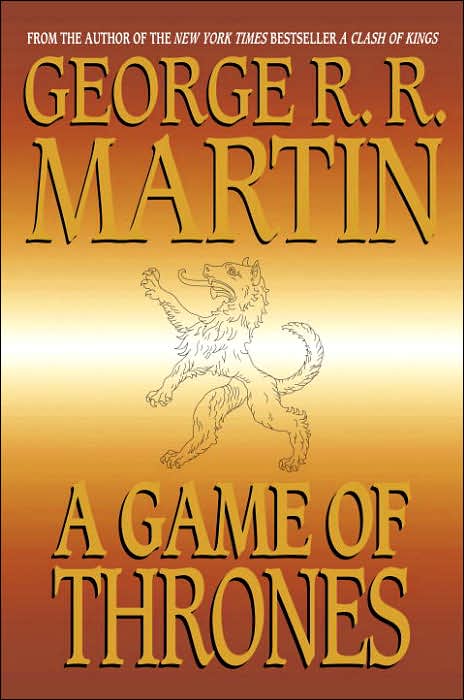
People like A Game of Thrones? The novel, I mean?

The writing in George R. R. Martin’s novel A Game of Thrones ranges from pretty good to indifferent to pretty bad to silly: it’s filled with cliches, the characters all sound the same, and I can’t figure out why we should care if one bunch of schemers rules the realm instead of another bunch of schemers. In the end, the peasants are still covered in shit. The politics are complex, but they’re complex in the way of corruption everywhere, with people mostly out for their own interest. This sort of thing led to the U.N. and democracy in the West and Japan.

Presumably the world of A Game of Thrones will head in that direction if it hits an industrial revolution, and you could have a lot of fun grafting contemporary parallels on the world. As this description shows, it’s somewhat hard to take this sort of feudalism seriously.

Corruption can be fun to read about, but the prose doesn’t work in A Game of Thrones. The book can’t decide on a faux medievalism or a relatively current register, so it goes for both. With most sentences, you could remove a sword, drop in a gun, and still have the same basic idea. The language remains modern while the nominal concerns are medieval; this is the problem so many fantasy novels have that Tolkien doesn’t. These problems start early; on the second page, “Will could sense something else in the older man. You could taste it; a nervous tension that came perilous close to fear.” Using “perilous” instead of “perilously” is the kind of thing that might could for style, but the sentence itself is still cliche. How many times has something been so close or immanent that a character could taste it?

The inverted word order is also evident early: “All day, Will had felt as though something were watching him, something cold and implacable that loved him not.” The last few words are equivalent do “didn’t love him,” and they’re okay on their own, I suppose, but such inversions are as far as style goes. You don’t have to be Martin Amis to find this tedious after a while (Another example, this time in dialogue: ” ‘Direwolves loose in the realm, after so many years,’ muttered Hullen, the master of horse. ‘I like it not.’ “). A few pages later, we skip to the point of view of Bran, who “rode among them, nervous with excitement,” another description that I’ve never seen in a novel before. There are repeated appeals to honor throughout, as on page 4: “The order had been given, and honor bound them to obey.” Honor appears to bind them to do things so stupid that they die for them.

Then there are “as you know, captain” speeches: “The blood of the First Men still flows in the veins of the Starks, and we hold to the belief that the man who passes the sentence should swing the sword.” Blood the first man might have been original before the numerous references to the blood of Numenor in Tolkien. By now, appeals to genetic similarity dictating present behavior grow tiresome, along with anger flashing in eyes, “I was born a Tully and wed to a Stark [. . .] I do not frighten easily,” and so on.

Viserys Targaryen gets introduced early too, and in case you didn’t really know he was the bad guy, tells his sister than he’d let a 40,000-man barbarian horde rape her to regain his throne, and he also gives her a terrible “titty twister,” (also known as “purple nurple“) which is a term I don’t think I’ve heard or thought about since middle school. Are these phrases insanely juvenile? Absolutely, but a book like A Game of Thrones calls them forth. The dialogue is precisely what Francine Prose described in Reading Like a Writer:

This notion of dialogue as a pure expression of character that (like character itself) transcends the specifics of time and place may be partly why the conversations in the works of writers such as Austen and Brontë often sound fresh and astonishingly contemporary, and quite unlike the stiff, mannered, archaic speech we find in bad historical novels and in those medieval fantasies in which young men always seem to be saying things like, ‘Have I passed the solemn and sacred initiation test, venerable hunt master?’ “

Prose is parodying bad fantasy novels, but the parody is hardly a parody: most fantasy writers haven’t figured out how to make their characters’ speech work on multiple levels or how people vary their listening and speaking according to status. People assume a great deal; as Prose shows elsewhere, they assume a great deal about their audience, speak obliquely, are riven by multiple desires, and so on. When we read the ponderous speechifying so popular in fantasy, it breaks the very fantasy it’s trying to accomplish for anyone who knows how people actually speak.

There are some good sections but they’re intermittent and relatively simple changes could lead to tremendous improvements.

One thing I like about The Magicians is that it doesn’t succumb to this kind of speechifying: the characters often talk past one another, and they are constantly interrogating themselves. Quentin’s major flaw is his narcissism: he’s so wrapped up in his own misery, and then his own relationship with Alice, and then the consequences of the his-and-her cheating set, that he sets himself up for the pain that follows. Too bad. If you like standard sword-n-sorcery fantasy, you’ll like A Game of Thrones. If you’re looking for something different, like Lev Grossman’s The Magicians, you’ll be disappointed. Martin might admire Tolkien, but he doesn’t have Tolkien’s consistent command of language to make his work comparable.

Since people can’t be reading Martin for the writing itself, what are they reading him for? The most obvious answer is plot, since it’s fun and fast-paced. The novel demands careful reading if you’re going to follow who’s killing whom and why, if not for the quality of its prose. Even if you are following the reasons for murder, expect to be confused at points (in this respect, and only this respect, does A Game of Thrones resemble John Barth’s The Sot-Weed Factor). It’s surprising: in the fist novel, a seemingly major character dies. There are three more published. Maybe other characters will get the unexpected axe too. According to “Just Write It!: A fantasy author and his impatient fans” in The New Yorker, “Martin transgressed the conventions of his genre—and most popular entertainment—by making it clear that none of his characters were guaranteed to survive to the next book, or even to the next chapter.” This is refreshing and a major improvement.

So are the other virtues mentioned:

Martin’s characters indulge in all the usual vices associated with the Middle Ages, and some of them engage in behavior—most notably, incest—that would shock people of any historical period. Characters who initially seem likable commit reprehensible acts, and apparent villains become sympathetic over time. [. . . ] “When Indiana Jones goes up against that convoy of forty Nazis, it’s a lot of fun, but it’s not ‘Schindler’s List,’ ” he explained. He wants readers to feel that “they love the characters and they’re afraid for the characters.”

They’re true, but the article wisely avoids focusing on the sentence-level of each story. The big difference between Martin and a lot of fantasy writers is his relatively realistic depiction of sex: lots of powerful royals aren’t particularly nice to their partners and use their positions to further their sexual agendas, a bit like they did (and do) in real life. Not everyone views life in a realpolitik fashion, of course, and the Starks form the moral center of the show, which is especially important in large-scale works where most people are simple schemers. After all, in tit-for-tat style encounters, people who behave honorably consistently will tend to eventually win out over those who don’t.

There’s not a lot of humor in A Game of Thrones, and what there is is mostly courtesy of the martini-dry Tyrion, a dwarf in a world without the Americans with Disabilities Act. In addition, who cares who sits on the throne? In The Lord of the Rings, the return of the true king symbolizes a wide array of both restoration and advancement. In A Game of Thrones the game is supposed to be a metaphor, since nothing real is at stake in most games. Instead, it feels real, in the sense that a game has no important consequences once it terminates. Does it matter whether one set of schemers or another sits on the throne? Not to this contemporary reader: they have far fewer substantial policy differences between them than, say, Republicans and Democrats.

Still, this doesn’t necessarily bode ill for the much-advertised HBO series; the first two seasons of True Blood rose above their source period through their tongue-in-cheek campiness. One doesn’t often get to say, “The movie was way better than the book,” but for True Blood it was true. I’m hoping for the same in A Game of Thrones. At the very least, it’s unlikely to be worse than Camelot.


Slate’s Nina Rastogi does like A Game of Thrones, although he doesn’t talk a lot about sentences. Here’s the most amusing comment so far in a review of the TV show: “One scene, luxuriantly offensive, involves what is either a gladiatorial rape tournament or a Jersey Shore homage.”

Life – The Dud Avacado Edition

“And I began posing for Jim. Later on somebody told me that there isn’t a girl in the whole world who won’t take off her clothes if she’s convinced she’s doing it for aesthetic reasons, but at the time it seemed to me I had taken one more giant step.”

—Elaine Dundy, The Dud Avocado.

Week 27 Links: McPhee, Walkability, Flip shutdown, and Ricky Gervais

* Deep Walkability.

* John McPhee on Writing, Teaching, and Programming.

* A sad day: Cisco is shutting down its Flip video camera unit. Amateur, uh, home video makers everywhere mourn. I’ve had a Flip MinoHD for a couple of years, and it’s a delightful little camera. I’m annoyed because the decision to shutter Flip appears to be an annoying corporate one.

David Pogue says Flip had an amazing new product coming out.

You can also see a New York Times article. Note that it doesn’t mention whether a lot of Flip cameras are still selling; I assume they are. See too Ars Technica’s coverage.

* How Black People Use Twitter: The latest research on race and microblogging.

* Less music, more books might boost mental health in teens.

* An (Atheist) Easter Message from Ricky Gervais.

Hulu Owners: Should We Shoot Ourselves in the Foot?

I don’t own a stereotypical TV and almost never watch video that originally appeared on conventional TV stations. I’ve also never had a subscription to cable TV. That being said, I will occasionally use Hulu to watch Glee, which is a lot of fun and not stupid and tedious—unlike most TV shows. I’m apparently not the only person who noticed this; the L.A. Times published “Hulu is popular, but that wasn’t the goal: Its owners — the parents of ABC, Fox and NBC — fear the TV website may hurt their bottom lines.”

Now the website faces changes that could curtail its trove of offerings or require users to pay for episodes they currently watch for free. Once hailed as the networks’ solution in taming the Internet, Hulu’s stunning success is now undermining the very system it was designed to protect, forcing the site’s owners to reconsider what Hulu should be.

The big problem, however, is that Hulu doesn’t just compete against network TV and cable. It also competes against BitTorrent sites. Now, because I enormously respect copyright law, I would never, ever, use such sites because they’re really convenient. Never. Just like as a 16 year old, I didn’t use Napster like all my friends did to download music.

In “The Other Road Ahead,” Paul Graham says, “Near my house there is a car with a bumper sticker that reads “death before inconvenience.” Most people, most of the time, will take whatever choice requires least work.” In this respect, I am most people, and people who want to watch TV are probably thinking the same thing. If Fox, ABC, and NBC don’t want to become tomorrow’s newspapers, they might want to contemplate what death before inconvenience means.