Design.Y Notebook Review: The Record 216

EDIT: I sent an e-mail to Design.Y about the binding breakage described below, and they sent me a new notebook. I’ll write another update when I’ve filled the new one.

EDIT 2: The new one broke too. I’m not going to use these anymore and am switching to the much cheaper and much more durable Rhodia Webnotebooks mentioned below.  

The most salient feature of the Design.Y “Record 216”* is its price, which varies with the Yen-to-dollar exchange rate but currently hovers around $70 with shipping. Those of you who can do simple math are probably thinking that this is about 35 times greater than a drugstore pocket notebook and fives times a Rhodia Webbie. I want the Design.Y notebooks to be five times better. Hell, I want them to be twice as good. But while the notebook is certainly a lovely object that’s been lovingly packed, like a florist’s rose or an undertaker’s corpse, the Record 216 suffers from one major flaw: the paper is too thin.

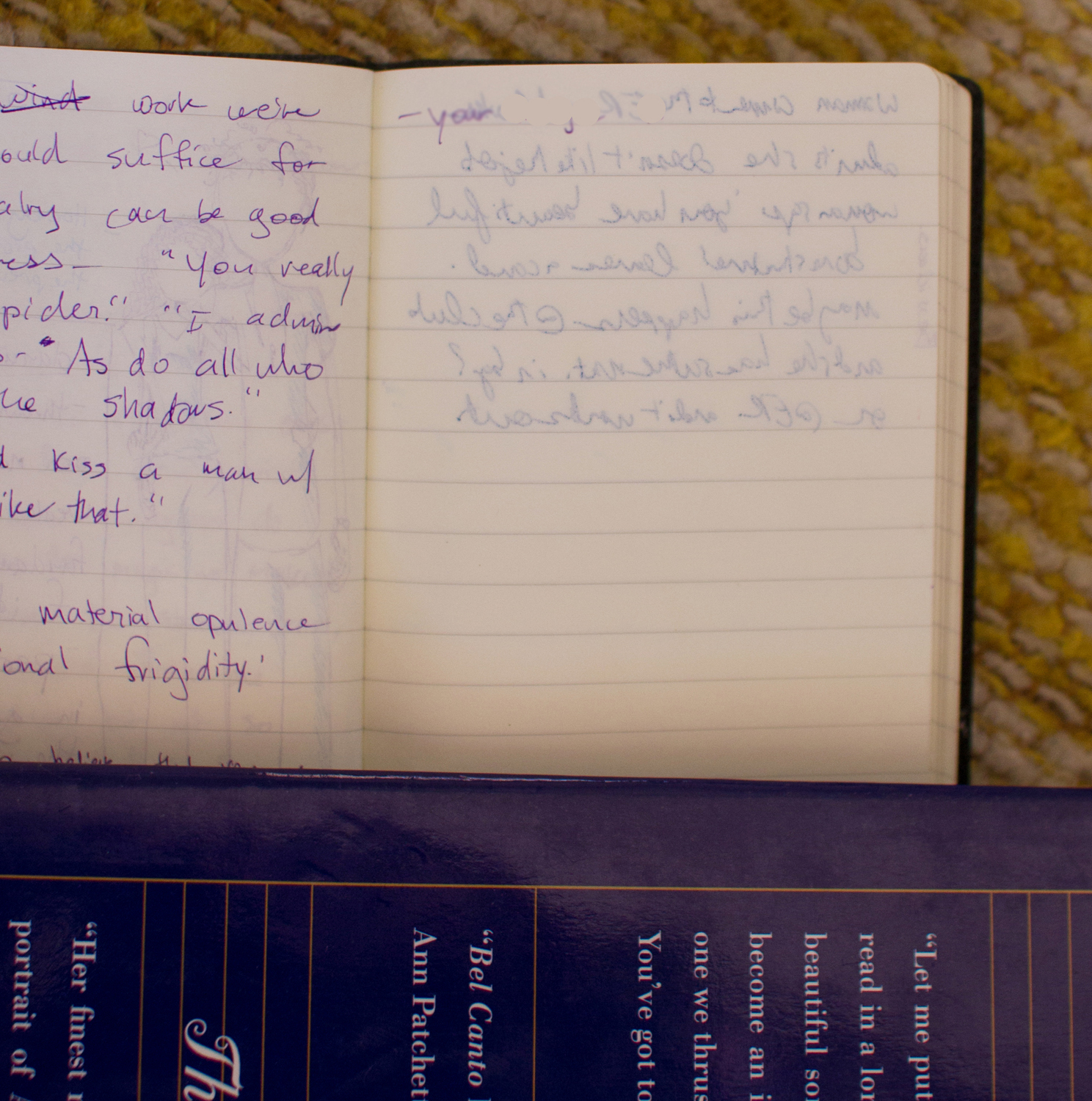
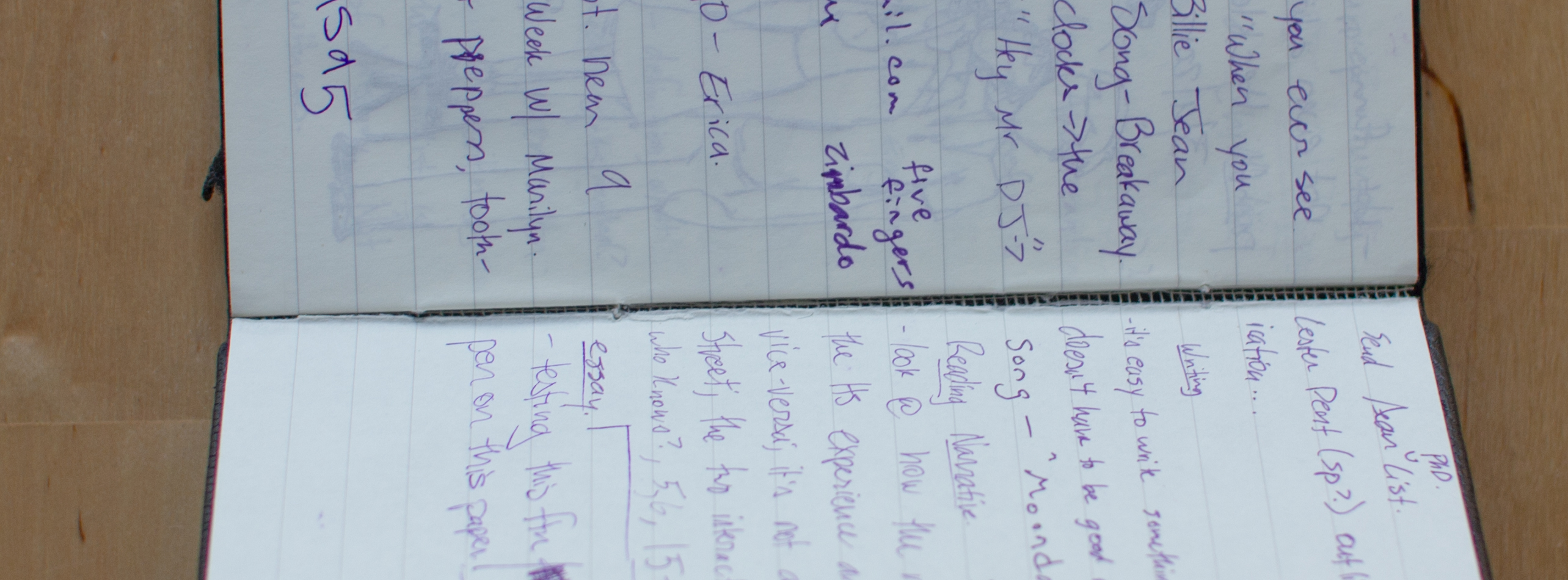
I’m constantly crinkling it or creasing the corners or bending the middle when I mean to turn the page (see the photo below for an example). The paper is definitely a joy to write on, but a heavier version would be an improvement; thinner is not always better, as anorexia counselors will remind us. Some pens will bleed through, as shown in the picture to the right. The bleeding problem is not great with my fountain pen, but then I use a extra-fine nib that’s about as slender, if not more so, as the Pilot G2. Users of thicker nibs may have concomitantly greater problems. Still, I can forgive the bleed-through problem. It’s the lightness that bugs me, and the way I subconsciously worry about bending a page when I’m merely trying to turn it.

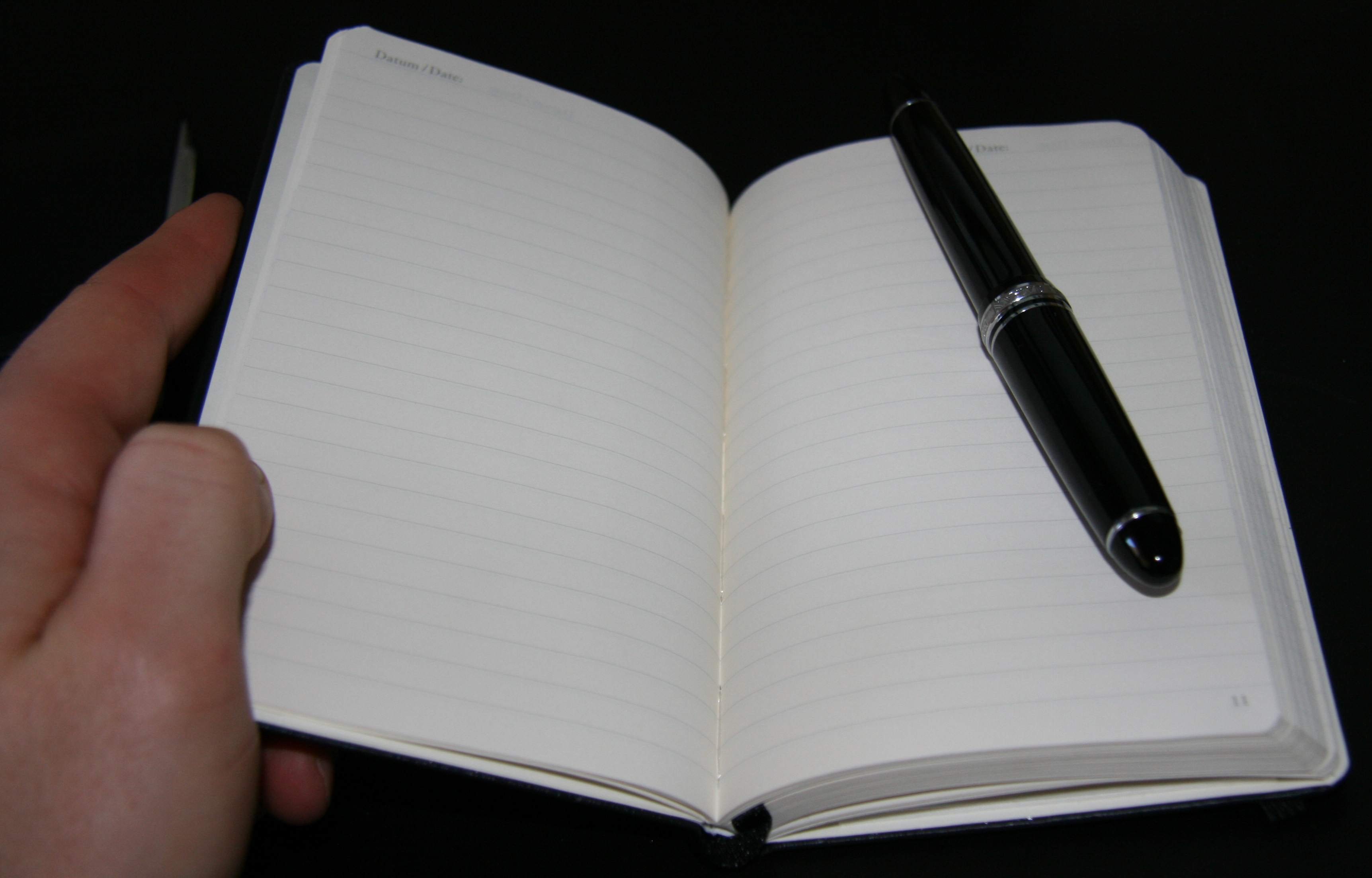
Almost everything else about the notebook is incredible. It’s been in my pocket for months without suffering any problem greater than a frayed band. The size, at 5.3″ by 3.1″, is quite handy, and I’ve come to like it better than the standard 5.5 x 3.5 size of Rhodia Webbies, Guildhall, Leuchtturm 1917, or Moleskine. The 3.1″ width makes it feel much more portable at no cost to usability; if anything, the sense of a long, narrow column is an enhancement. The line spacing on the page is neither too great (as it is on the Rhodia) nor too small, and lines extend to the edge of the page, as they should. The cover has a very slight lip that doesn’t distract. The Design.Y notebook also sits flat “out-of-the-box,” so to speak, and doesn’t suffer from the stiffness of a fresh Rhodia or Moleskine. That stiffness declines with age, but it’s still present. The binding is strong and supple.

These features don’t quite make up for the paper thinness or price, however. I only go through one notebook every six to twelve months, but even so, $70 is a substantial hit for what is basically a consumer trifle. A lovely consumer trifle, but with a fatal flaw that makes justifying its price difficult. Perfection is difficult, and the Rhodia Webbie isn’t perfect: its lines should extend to the end of the page and its lines should be closer to one another. If I were Steve Jobs, I’d be driven mad by these problems. Fortunately, I’m not, but it’s clear that Design.Y has noticed some of the same things Apple has. In the Walter Isaacson biography of Jobs, he writes: “Early on, Mike Markkula had taught Jobs to ‘impute’—to understand that people do judge a book by its cover—and therefore to make sure all the trappings and packaging of Apple signaled that there was a beautiful gem inside.” Design.Y does the same. The company even includes a sheath of extra paper with a hand-written note. I can’t help noticing that one flaw in the gem, however, that keeps me from wanting to give myself over to an otherwise shining light.

As you can probably tell, I want the notebook to be better than it is. A Japanese craftsman named Hiroshi Yoshino makes them (this also explains why their price is denominated in Yen) using “Tomoe River” paper, which the website accurately describes as “very thin and lightweight.” I wouldn’t want him to switch to the Rhodia’s tank-like paper. But something heavier and less bendable would make the Record 216 the perfect notebook.

EDIT: Unfortunately, the front and back of my notebook began to split after about five months of normal use:

And, to me, this disqualifies the Model 216 for day-to-day use; I haven’t had the problem with Rhodia Webnotebooks. Although I wish the Rhodia’s lines went to the edge of the page, and its paper is perhaps slightly too thick, I think the trade-offs—especially accounting for price—make it a better choice. A $70 notebook better be perfect. This one isn’t, and its durability is especially distressing.


* Or “Model 216,” depending on which part of the website you’re reading. Chalk this up to charming translation idiosyncrasies.

The accidentally bent page.

What you should know BEFORE you start grad school / PhD programs in English Literature: The economic, financial, and opportunity costs

This post started life as an e-mail to a high school teacher who is thinking about grad school in English Lit. I expanded and cleaned it up slightly for the blog, but the substance remains.

Pleasure meeting you the other day. I’m too well-versed in the anti-grad school lit, and the short version of this e-mail is “don’t go to grad school in the humanities.” If you go anyway, make sure you have an obvious fallback career; don’t assume that you’ll figure it out after five to ten years. Grad school is not a good place to pointlessly delay adulthood (a phrase we’ll come back to later).

Let me start with Thomas Benton’s articles, like “The Big Lie About the ‘Life of the Mind’” and “Graduate School in the Humanities: Just Don’t Go” in the Chronicle of Higher Education. Read both. Read both twice. Then read Louis Menand’s The Marketplace of Ideas, and pay special attention to the sections where he discusses supply and demand: I get the sense that a lot of people spend more time deeply, critically thinking about fun restaurants for dinner tonight than whether grad school is really a good idea. I’m not saying you’re one of those people, but the number of would-be researchers who do almost no research in evaluating their grad school decisions is astounding. Menand’s basic point is simple: most people in English PhD programs are not going to be researchers and tenure-track professors at universities. [1] Some number will, but that number is tiny.

Don’t put too much stock in stories like “From Graduate School to Welfare: The Ph.D. Now Comes With Food Stamps,” but they’re being told and repeated for reasons. People like the woman featured have made spectacularly bad life choices, and, while she’s an extreme example, many would-be professors eventually curse themselves for starting grad school. If I didn’t have a second job working for a real business for real money, I’d probably be close to qualifying for food stamps (without that real job, however, I wouldn’t have made it this far in grad school, because it’s almost impossible to live a reasonably normal life on $13,000 – $16,000 per year).

I know grad students who can’t get a $7 sandwich at Paradise Bakery because it’ll blow their food budget for the month. They have to bring lunch to campus every day because they can’t afford not to. Tired in the morning? Tough: make your bean-sprout sandwich or your lentil curry. Personally I like bean-sprout sandwiches and lentil curry, but I also like the option of buying lunch on a whim. Not having any money also sucks if you need or want a book and can’t get it easily or expeditiously from the library and find yourself unable to buy it for $30. Someone who’s has four years of undergrad and two or more years of grad school should be able to buy a sandwich without carefully thinking about the financial repercussions.

Consider what you’ve got right now, today. You’re a teacher, so I’ll guess you make ~$30,000 – $40,000 a year. Call it $35,000. If you spend five years getting a PhD, you’ll be giving up at least $100,000 ($35,000*5=175,000; $15,000*5=$75,000) short of what you’d make teaching high school. And that’s not taking into account the raises you might get as a teacher, or the benefits, which can be substantial (especially if you’re on a 30-year retirement track). If you take 10 years, like the median PhD student, you’ll be giving up $225,000, again not counting benefits, which are far better as a teacher than they are as a grad student. Accounting for retirement benefits, you might be giving up more like $300,000. A lot of money, no?

If you get a tenure-track job, you could conceivably make up that amount over the course of your lifetime, but, remember, you’re not even likely to make that much as a TT prof; I’ve asked the University of Arizona’s TT-track but non-tenured faculty gauche money questions, and they report making about $50,000 a year—and U of A is a plum, super-competitive job straight out of grad school. It’s certainly possible to make less and work more. You can do the math on how long you’ll have to work to financially make up for income foregone during grad school. It’s ugly.

If you don’t get a tenure track job, you may wish very deeply for a couple extra hundred thousand dollars. These are loose numbers, but no one I’ve floated them to has disputed them, I’d guess that making them more precise by counting opportunity / investment costs would only weigh them more heavily to being a teacher, given how much of one’s lifetime income from being a teacher is backloaded by retirement pay.

So who’s grad school good for? Again, let’s follow the money, and I’ll use the University of Arizona as an example because that’s where I am. The out-of-state credit-hour fee for undergrads for Spring 2012 was $1,024. For in-state students it was $651. About a quarter of Arizona undergrads come from out-of-state. Grad students teach about 50 freshmen per semester, or about 100 per year. That’s $48,825 in in-state tuition collected, and $25,600 of out-of-state tuition—but each grad student teaches three credit hours. Triple those numbers. They’re $76,800 for out-of-state students and $146,000 for in-state students, for a total of $222,8000. Some of that money goes to profs who run grad seminars, to facilities, to various other administrative functions, and so on. (Grad students also get a couple of one-semester, one-class waivers), but the basic calculation shows why the university as a whole likes grad students, a lot.

Most universities love ABDs, who consume minimal university resources. Menand says:

One pressure on universities to reduce radically the time to degree is simple humanitarianism. Lives are warped because of the length and uncertainty of the doctoral education process. Many people drop in and drop out and then drop in again; a large proportion of students never finish; and some people have to retool at relatively advanced ages. Put in less personal terms, there is a huge social inefficiency in taking people of high intelligence and devoting resources to training them in programs that half will never complete for jobs that most will not get. Unfortunately, there is an institutional efficiency, which is that graduate students constitute a cheap labor force. There are not even search costs involved in appointing a graduate student to teach. The system works well from the institutional point of view not when it is producing PhDs, but when it is producing ABDs […] The longer students remain in graduate school, the more people are available to staff undergraduate classes. Of course, the overproduction of PhDs also creates a buyer’s advantage in the market for academic labor.

There’s little incentive for universities to speed up the grad school process. If anything, their financial incentive is to slow it further, and this is what we see. Regardless of their marketing, remember that universities are businesses, and businesses prefer to pay less for labor, not more, just as you probably prefer to pay less for goods and services, not more. Many articles decry the state of the adjunct labor force, but universities treat adjuncts like they do because they can. Supply and demand exist and they matter.

Most people I know who aren’t in grad school and talk about going discuss the life of the mind, the transformative power of education, how they want to be a professor, their interest in teaching, their love of research and so forth. Most people I know who are in grad school talk about finances, economics, and the job market. Not all the time, to be sure, and I’ve had some lovely conversations about The Professor of Desire and Billy Collins and Heart of Darkness. But jobs and money are on almost everyone’s mind, especially as peers from high school or college are getting jobs at Google, or finishing their residencies, or getting promoted enough to discuss their “401(k),” which is a sure sign of aging, along with in-depth real estate analysis—remember back when we only talked about sex and art? Neither do I.

Many grad students remain in a state of financial adolescence for a decade of their prime career-building years. Don’t do that. Become an adult: you’ll have to eventually, and the skills you build outside the academy are often more valuable than those you might build in humanities grad schools.

Some grad students complain about being financially exploited by universities, but it’s hard to exploit highly educated people who have terrific reading and writing skills and who should know better, or at least do some cursory research before they spend as long as a decade getting a degree. The anti-grad school literature is vast—and highly accessible: type “Why shouldn’t I go to grad school?” into a search engine. Spend a few hours with the results.

People who aren’t in grad school, along with people who are professors and have jobs, also talk about wanting to be involved with “the Conversation” (I capitalize “Conversation” in my head), which means the book chat that happens in peer-reviewed journals and books about writers and ideas. But if you want to contribute to the Conversation, get a blog from http://www.wordpress.com or http://www.substack.com and start producing valuable work. Comment on the work of other book people. Write about what you notice. This won’t get you tenure, and it will probably not get you read by other professors, but, if you’re any good, you will probably have more readers than the average literary journal. See “No One Really Reads Academic Papers” and “The Research Bust.” In writing a blog no one has heard of, I’ve had greater impact and reach than the published work of 98% of tenured humanities professors. The paucity of most humanities professors’ intellectual ambition is astounding, when you really think about it.

To be sure, some people succeed in grad school. Maybe I’ll be one, although this looks increasingly less likely. A PhD is not a lottery ticket, but it can start to feel like one. If you do go, you better know the odds and know the costs, financial and otherwise. You better know that there are very, very few tenure track jobs, though there are a lot of one-year gigs at random places that are happy to offer you not very much money for not very good job security. The system is rigged against you. Humanities academics are often very interested in talking about all kinds of exploitation, but they very rarely want to talk about the exploitation that happens in grad school itself. Play games you’re likely to win, not games you’re likely to lose. Choose status ladders to climb that matter, not ones that mattered 50 years ago.

Too many people—maybe most—enter grad school so they can pointlessly delay adulthood. Adulthood, however, arrives sooner or later anyway. Too many people enter grad school because they’ve succeeded by conventional academic metrics and hoop-jumping through most of their lives and find the big, amorphous real world terrifying. But grad school, if it was ever a good way of avoiding the real world, surely isn’t now, because the real world is a far harsher place when you’re 32 and have a degree of dubious value and are trying to cobble gigs together to pay rent. See again the link above concerning PhDs on food stamps.

There are also dangers that are rarely discussed. In humanities PhD programs, dissertation advisors and committee members may be distant or unhelpful. Outright theft of work is rare, but indifference is common. It’s possible for a single person to outright block or retard individual progress in a way that’s rare in normal jobs. A committee can offer no or positive feedback, then outright reject a dissertation. A sudden retirement, departure, or sabbatical can imperil years of a candidate’s work. You don’t want to get in a situation where a single person can annihilate your career. That’s what grad school in the humanities often means.

I don’t know anyone in the business who is really gung-ho about encouraging smart, motivated undergrads and recent graduates to go to humanities grad programs.

In addition, if you don’t thoroughly read everything I’ve linked to in this post, you shouldn’t go to grad school because you haven’t invested enough time in thinking about and learning about what you’re getting into.

Some of the problems above could be ameliorated, if it were in the system’s interest to do so (it’s not; universities’s finances are enabled by the cruel student loan system, while professors like the system, with the status and modest amounts of power it grants them, as it is). Eliminating tenure would help, because few schools want to make what might be 40+ year commitments to salary + benefits if they don’t have to. A shift to long-term contracts would be an improvement at the margins.

I’ve seen some proposals that universities offer a four-year “teaching PhD” that is awarded primarily on the basis of coursework; since most PhD students are at most going to become adjuncts or lecturers anyway, one might as well quit the facade that currently exists. The teaching dissertation would be a collection of coursework and/or experiment descriptions, depending on the field. Something like this paragraph could have been written any time in the last 15 or 20 years, and the system trundles along because it works well enough and a sufficient number of people are willing to chase the tenure dream to keep it going.

EDIT 2016: When I first wrote this in 2012 I was still in grad school. I’m updating it in January of 2016. Let me be blunter: going to grad school in the humanities is an idiotic life choice that will likely fuck up your life. Of the people I know who were my approximate grad school peers, two live at home; one works at an Apple Store; another works in a preschool; another is teaching the SAT, LSAT, and the like for one of the big companies that pay $15 – $20 an hour for such work; and a couple are adjuncts. A few have short-term contracts. Only one or two have the tenure-track positions they were training for.

If you must, must, must go to grad school despite knowing how dumb doing so is, quit after two years with an M.A. Don’t waste years of your life. There is often a false dichotomy presented between the “life of the mind” and pursuing lots of filthy money. But I like to observe that it’s reasonable to seek reasonable material conditions while pursuing the life of the mind. If you can’t achieve reasonable material conditions you should do something else, and that something else may enable the true life of the mind, not the potemkin life of the mind offered by most humanities graduate degree programs.

Further reading:

* Most universities hire exclusively from elite universities. If you don’t attend an elite university, you’re unlikely to get a job regardless of your publishing record.

* Robert Nagel’s “Straight Talk about Graduate School.”

* “Open Letter to My Students: No, You Cannot be a Professor.

* Penelope Trunk’s “Don’t try to dodge the recession with grad school,” as well as “Best alternative to grad school” and “Voices of the defenders of grad school. And me crushing them.”

* As of 2015, “The Job Market for Academics Is Still Terrifying.” Fewer than half of humanities PhDs are “employed” (using whatever metric they use) and about 35% are unemployed altogether—which is at least three times the national unemployment rate, which also counts high-school dropouts.

* If you are male, see “Insanity in academia, or, reason #1,103 why you should stay out of grad school: Kangaroo courts” to better understand the culture you seek to join. You’re an accusation away from having your career destroyed.

* “The New Intellectuals: Is the academic jobs crisis a boon to public culture?” (Note the sections about the bogosity of peer review and the economic precariousness of the “new intellectuals”).


[1] Menand also writes:

Between 1945 and 1975, the number of American undergraduates increased 500 percent, but the number of graduate students increased by nearly 900 percent. On the one hand, a doctorate was harder to get; on the other, it became less valuable because the market began to be flooded with PhDs.

This fact registered after 1970, when the rapid expansion of American higher education abruptly slowed to a crawl, depositing on generational shores a huge tenured faculty and too many doctoral programs churning out PhDs. The year 1970 is also the point from which we can trace the decline in the proportion of students majoring in liberal arts fields, and, within the decline, a proportionally larger decline in undergraduates majoring in the humanities. In 1970–71, English departments awarded 64,342 bachelor’s degrees; that represented 7.6 percent of all bachelor’s degrees, including those awarded in non-liberal arts fields, such as business. The only liberal arts category that awarded more degrees than English was history and social science, a category that combines several disciplines. Thirty years later, in 2000–01, the number of bachelor’s degrees awarded in all fields was 50 percent higher than in 1970–71, but the number of degrees in English was down both in absolute numbers—from 64,342 to 51,419—and as a percentage of all bachelor’s degrees, from 7.6 percent to around 4 percent.

Fewer students major in English. This means that the demand for English literature specialists has declined.

The number of undergrads in English Lit has declined while the number of people getting PhDs has remained constant or risen. There is basically no industry for English PhDs to enter. You do not have to be an economist to understand the result.

Links: Funny words, climate change, things the U.S. does right, writers, self-publishing, Seattle's Escala condo building as the site of depravity, and ovulation's effect on mate choice

* I got into an argument with a friend about whether “mollusk” is an inherently funny word. I argued yes. Discuss.

* Game over for the climate, which is one of those important articles you won’t read.

* “As an outsider I hear plenty of what America does wrong, I want to hear what they do right.”

* I need this.

* “The Writer in the Family:” “So there I stood at the front of my granddaughter Jessica’s fourth-grade classroom, still as a glazed dog, while Jessie introduced me to her classmates, to whom I was about to speak. ‘This is my grandfather, Boppo,’ she said, invoking my grandpaternal nickname. ‘He lives in the basement and does nothing.'”

* Why Are Teen Moms Poor? Surprising new research shows it’s not because they have babies. They have babies because they’re poor.

* Why self publishing, even if its title is “I May Be Mad I May Be Blind;” see also this post. Both are from literary agent Betsy Lerner.

* ‘Game Of Thrones’ Running Out Of Unkempt Old Men To Cast.

* The Writer in the Family: “If the sad truth be known, writers, being the misfits we are, probably ought not to belong to families in the first place. We simply are too self-interested, though we may excuse the flaw by calling it “focused.” As artists, writers hardly are alone in this failing.” The problem, however, is that families provide a lot of material, and to not have at least one is to deny one’s self a rich vein of material, and possibly several rich veins, which could be turned into a novel, or perhaps several novels, and a poem.

* A lot of what’s wrong with public schools can be surmised from “How did this parent end up in jail? Kelley Williams-Bolar just wanted her kids to go to a safer school — then her story took an unexpected turn.”

* Seattle is famous (?): Seattle’s Escala Condo Building Set Steamy Scenes for “Fifty Shades of Grey”

* Perception of American Women As Masculine Is Going Mainstream.

* “Ovulation Leads Women to Perceive Sexy Cads as Good Dads:”

Why do some women pursue relationships with men who are attractive, dominant, and charming but who do not want to be in relationships—the prototypical sexy cad? Previous research shows that women have an increased desire for such men when they are ovulating, but it is unclear why ovulating women would think it is wise to pursue men who may be unfaithful and could desert them. Using both college-age and community-based samples, in 3 studies we show that ovulating women perceive charismatic and physically attractive men, but not reliable and nice men, as more committed partners and more devoted future fathers. Ovulating women perceive that sexy cads would be good fathers to their own children but not to the children of other women.

* Good news: The End of Soda?

Links: Funny words, climate change, things the U.S. does right, writers, self-publishing, Seattle’s Escala condo building as the site of depravity, and ovulation’s effect on mate choice

* I got into an argument with a friend about whether “mollusk” is an inherently funny word. I argued yes. Discuss.

* Game over for the climate, which is one of those important articles you won’t read.

* “As an outsider I hear plenty of what America does wrong, I want to hear what they do right.”

* I need this.

* “The Writer in the Family:” “So there I stood at the front of my granddaughter Jessica’s fourth-grade classroom, still as a glazed dog, while Jessie introduced me to her classmates, to whom I was about to speak. ‘This is my grandfather, Boppo,’ she said, invoking my grandpaternal nickname. ‘He lives in the basement and does nothing.'”

* Why Are Teen Moms Poor? Surprising new research shows it’s not because they have babies. They have babies because they’re poor.

* Why self publishing, even if its title is “I May Be Mad I May Be Blind;” see also this post. Both are from literary agent Betsy Lerner.

* ‘Game Of Thrones’ Running Out Of Unkempt Old Men To Cast.

* The Writer in the Family: “If the sad truth be known, writers, being the misfits we are, probably ought not to belong to families in the first place. We simply are too self-interested, though we may excuse the flaw by calling it “focused.” As artists, writers hardly are alone in this failing.” The problem, however, is that families provide a lot of material, and to not have at least one is to deny one’s self a rich vein of material, and possibly several rich veins, which could be turned into a novel, or perhaps several novels, and a poem.

* A lot of what’s wrong with public schools can be surmised from “How did this parent end up in jail? Kelley Williams-Bolar just wanted her kids to go to a safer school — then her story took an unexpected turn.”

* Seattle is famous (?): Seattle’s Escala Condo Building Set Steamy Scenes for “Fifty Shades of Grey”

* Perception of American Women As Masculine Is Going Mainstream.

* “Ovulation Leads Women to Perceive Sexy Cads as Good Dads:”

Why do some women pursue relationships with men who are attractive, dominant, and charming but who do not want to be in relationships—the prototypical sexy cad? Previous research shows that women have an increased desire for such men when they are ovulating, but it is unclear why ovulating women would think it is wise to pursue men who may be unfaithful and could desert them. Using both college-age and community-based samples, in 3 studies we show that ovulating women perceive charismatic and physically attractive men, but not reliable and nice men, as more committed partners and more devoted future fathers. Ovulating women perceive that sexy cads would be good fathers to their own children but not to the children of other women.

* Good news: The End of Soda?

Life: The writer edition

In speculating “as to why anyone embarks on the adventure of writing” Bernard-Henri Lévy (BHL) says in Public Enemies that

you write to find out not so much who you are as who you’re becoming. I believe that what is at stake in a book is not being yourself, finding yourself, coinciding with your truth, your shadows, your eternal child within, or any of that other idiotic stuff, but rather changing, becoming other than the person you were before beginning and whom the book’s own growth has rendered obsolete and uninteresting. Do we write to retreat into ourselves or to escape; to disappear or to make an appearance; to occupy a territory or to mine it and, having, mined it, to change it and lose ourselves in the maze of an unreachable identity? For me, the answer is obvious and in itself explains why I couldn’t care less about the nonsense written about the ‘truth’ of my relations with money, media, power [. . . ]

He might even be right.

The book as a whole feels self-indulgent and pointless so far, though it isn’t stupid and could improve with time.

Product Review: The Leuchtturm 1917 notebook

The Leuchtturm 1917 is perfectly competent. It’s slightly larger than a Moleskine, when a notebook should be, if anything, slightly smaller. This is a small point. The paper quality is, to my eye and hand, indistinguishable from Moleskine’s, which in turn is very similar to Guildhall and most of the other non-Rhodia notebooks I’ve tried. It has one other annoying feature: the last 30 or so pages are perforated; this is another way of saying, “They’ll eventually fall out.” If you’re the kind of person who wants to desecrate your notebook by tearing out pages, then the Leuchtturm 1917 is for you. To be sure, perforated pages are a minor annoyance. But if you’re not trying to avoid minor annoyances, stick with Moleskines, since they’re widely available.

The only major problem with the Leuchtturm 1917 simple: it doesn’t offer any major, obvious improvements over the Moleskine. It doesn’t offer any real disadvantages, either, other than its departure from the canonical 3.5 x 5.5 size and the perforated final pages. Unlike the Quo Vadis Habana, however, the Leuchtturm 1917 isn’t so much larger that carrying it around becomes a chore.

If this review seems slight, that’s because it is—the differences between this notebook and a Moleskine are trivial. They experience the same corner tearing, although I didn’t use the Leuchtturm long enough for the tears to develop into the cover partially coming off. If you’ve used a Moleskine, you’ve already in effect used this notebook; both are decent, but neither beats the Rhodia Webbie.

More on that soon.

The new notebook stack:

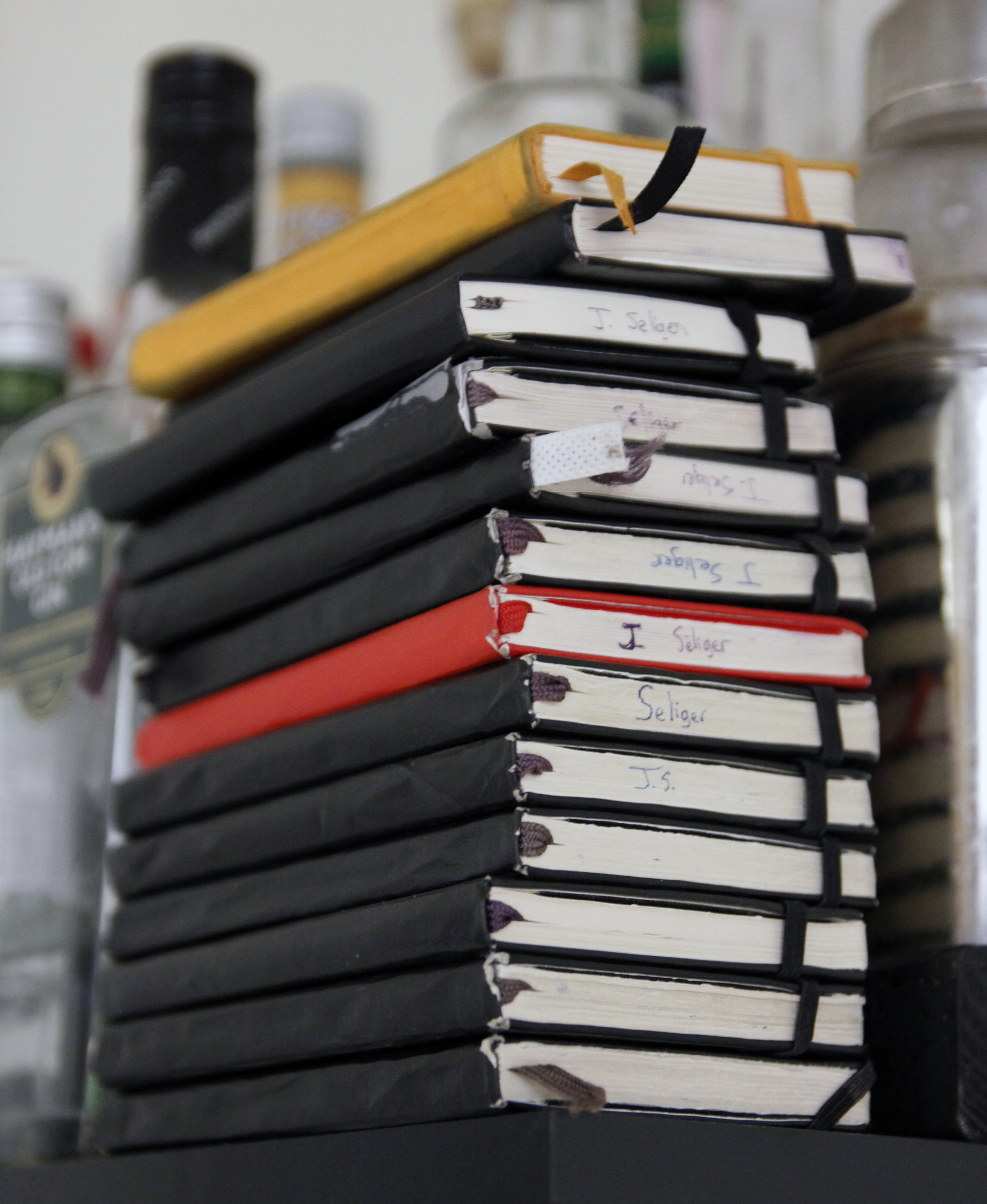
In “Eight years of writing and the first busted Moleskine,” I posted a picture of the notebook stack on one of my bookshelves. It has expanded since:

The orange notebook is a Rhodia Webbie, and I discovered why notebooks should be black the hard way. The notebook was originally a lovely orange color. But riding in cargo pockets, jeans pockets, backpacks, car seats, purses (occasionally), and various other means is a sure way to attract muck. Within two weeks, the notebook simply looked dirty.

The next notebook I bought was black. Notice, however, that despite the Rhodia’s color, its corners have remained intact, unlike most of the rest.

Conversation: Typographers and fontists

Girl: “The guy who did it was a typographer.”
Me: “Notorious perverts, certainly.”
Girl: “Exactly. You understand.”

I mean, have you seen the movie Helvetica?

The Sun Also Rises and meaning through action

Almost none of the characters in The Sun Also Rises and have jobs. Jake Barnes works as a journalist, but during most of the novel he’s on the sort of vacation that makes one long for the office. Bill Gorton writes too, but we don’t see much evidence of his writing. Pedro Romero is a bullfighter who apparently loses his magical bullfighting essence (or “aficion” in the language of the novel, but “magical bullfighting essence” makes it sound sillier) due to Brett. The rest—Mike, Brett, Robert—don’t do much of anything beyond drink.

This might be connected to why they all seem unhappy. Not only are they unhappy, but they don’t even appear to be getting much action (with the exception of Brett), which probably compounds their problems. This may be a feature of hanging out with a large group of guys and only one woman.

When I first read the novel, I didn’t notice how dumb most of the characters are. Perhaps I was at an age when I still considered wandering around and mindlessly drinking to be romantic and logical. Perhaps I was just equally dumb. Now I mostly want to suggest to the characters that, since most of them are in their 30s, they ought to find something to do. What that “something” is isn’t very important. Writing sonnets. Working in nuclear physics (which was big at the time). Inventing a new dance. Opening a bar, instead of consuming in a bar. Just have it be something. In short, I want to them to get a job, or, if not a job, then at least a hobby beyond the bottle. Don’t get me wrong. I like the bottle as much as the next guy, especially when it contains gin, and someone has tonic and lime nearby.

Plus, Brett is overrated. By the time I hit 23 or thereabouts, the allure of the manipulative, dissolute beauty had faded—not, mind you, the allure of beauty, or beauty distributed across a number of women, but of the attention-seeking and thoughtlessly cruel kind, who might be worth going to San Sebastian with, but not worth working one’s self up over when she floats to her next lily pad.

That sentence is convoluted, but I’m pretty sure it makes sense and expresses what Brett does to the inner states of the men around her, who really ought to know better. If one doesn’t want to come around, look for another. Note that this strategy or principle also applies to men. If a rival comes along, there’s a decent shot the wishy-washy person will leap to defend her territory. If she doesn’t, you never had a shot in the first place, and you still have someone to keep you warm at night and do other fun things with. (Change the gender pronouns in this paragraph to suit your own sexual temperament.)

When you’re young, long-winded, elusive chases are kind of appealing. But you really ought to learn to know better by the time you’re, say, 22.

I still admire Hemingway’s use of language and style, but I wonder if one reason high school and college students are drawn to The Sun Also Rises is because school mimics the no-stakes, no-purpose world in which characters live. Once you get into the larger world, where things have real effects, the pleasures of wandering aimlessly, drinking randomly, and chasing mentally unstable girls who mostly want attention becomes much lower. Again: wandering, drinking, and chasing sex can still be quite fun for any and all genders, but they require purpose beyond the mere doing of those activities themselves. In The Sun Also Rises, Jake says, “The things that happened could only have happened during a fiesta. Everything became quite unreal finally and it seemed as though nothing could have any consequences. It seemed out of place to think of consequences during the fiesta.” Everything is “quite unreal” throughout the novel as a whole. It seems “out of place to think of consequences” for any of the characters, ever. They might be Americans in Europe, but their travels do not appear to have enlarged them.

Tina Fey's Bossypants and its relationship to James Fallows' Breaking the News

This passage appears in Tina Fey’s memoir / how-to guide Bossypants:

And Oh, the Cable News Reportage! The great thing about cable news is that they have to have something to talk about twenty-four hours a day. Sometimes it’s Anderson Cooper giggling with one of the Real Housewives of Atlanta. Sometimes it’s Rick Sanchez screaming about corn syrup. They have endless time to filler, but viewers get kind of ‘bummed out’ if they supply actual information about wars and stuff, so ‘Media Portrayal of Sarah Palin’ and SNL and I became the carrageenan in America’s news nuggets for several weeks. I was a cable news star, like a shark or a missing white child!

The downside of being a cable news star is that nay ass-hair with a clip-on tie can come on an as ‘expert’ to talk about you. One day, by accident, I caught this tool Tom something on MSNBC saying that he thought I had not ‘conducted myself well’ during all this. In his opinion, Mrs. Palin had conducted herself with dignity and I had not. (I’m pretty sure Tom’s only claim to expertise is that he oversees a website where people guess incorrectly about who might win show biz awards.) There was a patronizing attitude behind Tom’s comments that I certainly don’t think he would have applied to a male comedian. Chris Rock was touring at the time and he was literally calling George W. Bush ‘retarded’ in his act. I don’t think Tom something would have expressed disappointment that Chris was not conducting himself sweetly. I learned how incredibly frustrating it is to watch someone talk smack about you and not be able to respond.

I love the word “reportage,” which sounds like “personage,” and bears the same relationships to real news or reports that McDonald’s does to real food with real nutritional value. And the phrase “wars and stuff” lets Fey drop into the mindset of a network executive, perhaps just a few years out from his or her MBA, who is trying to decide what might maximize revenue this quarter. Answer: sharks, missing white girls, and fake controversy. We don’t need any stuff about wars, tough compromises, or deep trends! Let’s dazzle them with superficial bullshit, which a subset of them really like, and hope no one notices what we’re not covering!

(Unfortunately, this works because we, collectively, don’t demand better. But that’s a subject for another time.)

Fey’s critique is close to James Fallows’ in Breaking The News: How the Media Undermine American Democracy. Fey is being funny and Fallows serious, and Fey is dealing with a media environment a decade and change later than the one Fallows describes, but on a basic level the environment has barely changed. If anything, the explosion in cable news has made it worse in many ways, with only a handful of exceptions (The Daily Show, which fights against the dumbest parts of the contemporary media, or coverage of Trayvon Martin’s murder). The net result of this is Americans losing confidence in the institutions that are supposed to serve us. The responsibility is partially ours, but it’s also partially that of the people who nominally serve us.

Everyone who pays attention to the media knows it’s broken, and that the brokenness seems to have seeped into the larger culture as a form of blanket cynicism and condemnation. I don’t have a strong sense of how to reverse this dynamic, save perhaps on an individual level.

See also David Brin on how an idea has, over the last twenty years, become “fundamental dogma to millions of Americans:” “The notion that assertions can trump facts.” I wonder if the Western world’s enormous wealth insulates people from the potential consequences of their beliefs; very people die or are seriously injured as a result of dumb beliefs based on erroneous or completely absent information. In other words, it’s now much cheaper to believe nonsense.

On a separate, and more pleasant note, Fallows’ new book, China Airborne, will be published on May 15. In addition, Bossypants itself is funny throughout. Samples:

* “Politics and prostitution have to be the only jobs where inexperience is considered a virtue. In what other profession would you brag about not knowing stuff? ‘I’m not one of those fancy Harvard heart surgeons. I’m just an unlicensed plumber with a dream and I’d like to cut your chest open.’ The crowd cheers.”

* “In 1997 I flew to New York from Chicago to interview for a writing position at Saturday Night Live. It seemed promising because I’d heard the show was looking to diversify. Only in comedy, by the way, does an obedient white girl from the suburbs count as diversity.”

* “I feel about Photoshop the way some people feel about abortion. It is appalling and a tragic reflection on the moral decay of our society . . . unless I need it, in which case, everybody be cool.”

* “If you are a woman and you bought this book for practical tips on how to make it in a male-dominated workplace, here they are. No pigtails, no tube tops. Cry sparingly. (Some people say ‘Never let them see you cry.’ I say, if you’re so mad you could just cry, then cry. It terrifies everyone.) When choosing sexual partners, remember: Talent is not sexually transmittable. Also, don’t eat diet foods in meetings.”