How should teenage characters speak? Engaging Janet Reid, Gossip Girl, and 90210

In a query letter critique, Janet Reid says:

If you’re writing a 14-year old character, you need to know how they talk: “Threatening us with violence” sounds like a sociologist; “told us he’d mess us up” sounds like what the kids on my corner say to each other.

This might be true in many instances, but I’m reminded of something this Salon.com review of “Gossip Girl” and “90210” says:

Where Blair and Serena’s lines snap, crackle and pop with wit and cleverness, the soggy stars of “90210” stumble over one cliché after another. “Awkward!” Annie blurts at Ethan after they encounter Ethan’s ex Naomi, then Annie does her best impression of the cynical teenage eye roll, as Ethan mutters, “Good times!” Oof.

But every scene is filled with such teen-bot tripe: “Whatever works for you.” “Helloo-ooo?” “Shut up!” “Me and Ethan? Not so much.” Maybe real teens sound like that, but real teens are repellent and worthless, remember? Plus, nothing’s worse than shoving such drivel into the mouths of a bunch of airbrushed anorexics and overgrown child actors.”90210’s” Annie has more in common with Broadway’s Annie than a real human being. Putting teen lingo in her mouth is like dressing a cat in a little nurse outfit. It’s sort of cute at first, but then it just gets sad.

“Repellant and worthless” is overstatement, very. The characters from “Gossip Girl” are more interesting because they don’t speak like teenagers, or like regular ones. If they did, they’d be boring (or, depending on your view, more boring than they already are). I suspect that’s why so many teen narrators are “precocious.” The alternative is dull. If you have a normal 15-year old, even 15-year olds will find them boring and insipid on the page. So you need a precocious 15-year old who adults can tolerate, and perhaps enjoy, while 15-year olds will imagine themselves to be equally witty even if they’re probably not. But your precocious 15-year-old still probably shouldn’t sound like Umberto Eco. That’s the challenge: giving a character enough of a voice and enough intelligence to make them interesting while not overwriting them. This challenge might explain why so many books starring teenagers are told from a distant, adult future recalling events from the past.

The first season of Gossip Girl, by the way, is pretty funny. I referenced it in class one day because, being a West Coaster, I had no idea what “cotillion” was until an episode featured it. That allusion elicited shock from students. Apparently I come across as a very hard core literary type. Which, of course, I am. A friend and I watched a few episodes and the last one from the second season, but it was so repetitive that we gave up.

On another note, the rest of Reid’s advice on the query letter is typically accurate. If you’ve ever wanted to try and get a literary agent or publisher to read your manuscript, take a couple hours to look through Query Shark first.

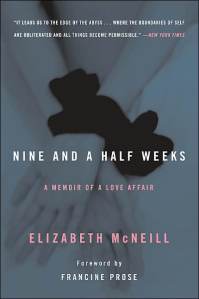
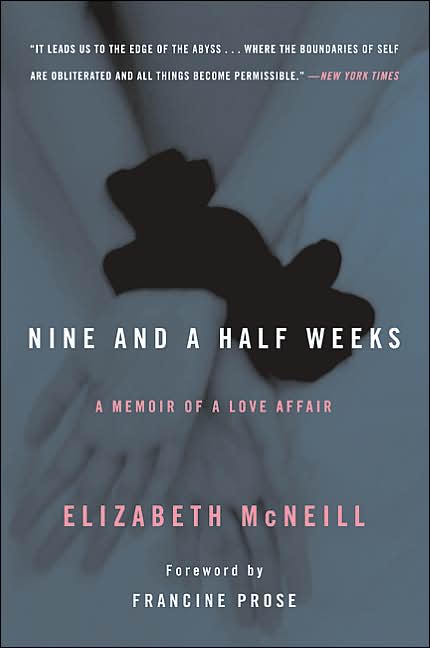
Nine and a Half Weeks: A Memoir of a Love Affair — Elizabeth Mcneill

Most novels (and memoirs) leave you with a sense of distance, a sense of being at a comfortable remove. Nine and a Half Weeks doesn’t: it’s too graphic, too immediate, too flat. One sees this effect in the first sentences, without any preamble as to who these people are and how they came to be: “The first time we were in bed together he held my hands pinned down above my head. I liked it. I liked him. He was moody in a way that struck me as romantic; he was funny, bright, interesting to talk to; and he gave me pleasure.” One senses quickening thoughts and pulses in those short sentences, and even in the long one, where semicolons could be periods, and the last descriptor—”he gave me pleasure”—is the really important one. You don’t get the very ironic tone of a book like Alain de Botton’s On Love, letting us see that love is irrational but really understandably so. Alain, the narrator of On Love is basically a needy, endearing, neurotic weakling; his self-consciousness contrasts so much with the man in Nine and a Half Weeks that they’re practically different species.

There are clever phrases in the memoir, as when the narrator says of her lover, “His face turns attractive when he talks;” I like the strange word choice, as if the head is physically turning, or as if he has two, or multiple, faces. A few moments are archaic—the man describes a friend or rival coming over as “This dope” (emphasis in original), which hasn’t been currently slang in decades and stands out in a book that otherwise stands out for not being part of any particular time. The prose holds up, and the narrator has an eye for tedious rituals, as when she tells of a “statistical tale,” where the contrast of statistics and narrative stands out:

In the middle of the statistical tale he’s requested from me—brothers and sisters and parents and grandparents, hometown, schools, jobs—I stop and close my eyes . . . please, I think, inarticulate even in my own mind, unable to turn to him and make the first move, please . . .

There’s a pervasive fear of dullness running through the memoir. The narrator notes that she and her lover looked like “An attractive, well-educated couple in New York City, average, middle-class, civilized.” That contrasts with what came before and will come after. Or does it? The memoir teases us by making us wonder if the the narrator isn’t so unusual as public discourse would make her out to be. I think the story’s flatness, the unwillingness to engage in direct commentary on what’s happening, points us in this direction, as when the narrator says, “I am standing, nearly on tiptoes, across the room from him, my arms raised above my head. My hands are tied to the hook on the wall on which his one large painting hangs during the day.” She’s hung like a painting and enjoys it. There is no further morality or analysis. Sixty Minutes plays in the background, a reminder of the middle America the narrator feels like she’s leaving behind even when she imagines it as a foil to her own actions.

Images repeat through the memoir. Scarves reappear. The words “like” and “love” are reconfigured like body parts. One senses Nabokovian echoes in the prose that one distantly hears on the first read but can’t make out. The narrator also feels her internal sense of self discombobulating, like a washing machine that shakes itself apart from within. She knows this is happening and imagines the reactions of otherwise course, until she writes of her experience.

We don’t know what the narrator wants beyond the obvious: sexual satisfaction. That she might only want the obvious might be the most frightening thing of all. What if everything else she has—a job, presumed communal respect, literary and political opinions—don’t matter very much? What if your real self isn’t those frontal cortex developments, but something deeper, more primal? I find posing the questions unsettling. The answers implied by Nine and a Half Weeks are more so. The patina of everyday experience conceals so much, especially in the realm of inchoate desire that social life is designed to channel. What happens when the channeling breaks? What happens when we want it to break? I’m reminded of Donna Tartt’s The Secret History, which also features the discarding of the mind in pursuit of a mental state or feeling very unlike the one most of us presumably inhabit most of the time—the mental state worried about how much money we have, what other people think about us, whether we’ll get the job / life partner / degree / accommodates of our dreams.

The narrator likes the man’s dominance above all other traits, which derive from that dominance. He says of a friend or rival, “he’s got no guts whatsoever.” Note what she likes in the contrast he offers by comparison. He shows mastery by reading Gide in French and Kafka in German, both implying continental expertise and sexuality. Some moments are obvious, as when the narrator reads with “his thick pen solid and comfortable in my hand.” One doesn’t need to be Freud to imagine that the pen is not just a pen. In the same scene, the narrator says, “I write the letter (‘. . . met this man a few days ago, nice start, very different from Gerry, who’s more than happy with Harriett these day, you remember her . . .’)” (sic). The dig at her ex-boyfriend is subtle but present: he isn’t dominant, won’t tie her up, and presumably has settled with a lesser woman.

He demonstrates great knowledge too: “[. . .] whatever else he may do [in] it, this man clearly does read his original-language books in bed; why would anyone want to miss out on one of the most satisfying pleasures available? All he’d need is a better bulb, a few more pillows, and a reading lamp. . . .” The room sounds sad and denuded, but it doesn’t matter much, even if the narrator is right about beds, which are good for more than just sleeping and that other thing. He offers commands, as when the narrator says:

He guides my hands between my legs and says, ‘I’d like to watch you make yourself come.’

He is sitting idly, comfortably, one leg crossed over the other, the creases sharp in the freshly cleaned suit. I do not try to move my hands. He waits. ‘You don’t understand.’ My voice cracks. ‘I never . . .’ He is silent. ‘I’ve never done that in front of anybody. It embarrasses me.’ “

She does, of course. That it embarrasses her is part of the point. What embarrasses her in the moment becomes the fodder for memoir, even under a pseudonym, long after. She likes giving power to him, which she does by letting him watch her masturbate. She also does by repeating how much she loves him, but I don’t think he ever says it back. It’s like he doesn’t need to, and by withholding the confirmation of his love he creates a neurotic fear in her. Only at one moment does he crack, when “All at once he is a decade my junior, a very young man asking me to have a drink with him, expecting to be refused.” But that doesn’t last long. Little does in this memoir, including their relationship, whose duration is given away by the title. But the narrator learns a lot in a short period. She says, “If you’ve never screamed, out of control, you can’t imagine how it feels. Now I know how it feels, it’s like coming.” She never goes the Biblical or mythological root and thinks there are things we shouldn’t know. For her, all knowledge is knowledge.

You can see that McNeill’s memoir doesn’t sit well with current ideals of equality and mutual respect in all fields. As Laura Kipnis says in “Off Limits: Should students be allowed to hook up with professors?” for Slate.com, “Feminism has taught us to recognize the power dynamics in these kinds of relationships, and this has evolved into a dominant paradigm, the new propriety.” Feminism has taught us to recognize power dynamics, but it should also teach us to recognize points of view. The narrator gets this; she thinks the man’s room is “too plain to be called plain. It’s austere, if you want to be charitable, or chic, if you want to be snide, or boring, if you want to be honest. It is not, in any event, a room you’d call cozy” {McNeill “Love”@9}. So the narrator is aware of angles, points of view, possibilities. I’ve been told I use “or” a lot in my own writing. It’s a useful word for people who perceive many ways of describing things, and here it betrays an openness to experience that the memoir exploits. She has a strong theory of mind that weakens as she awakens to herself.

I should point out that I call the narrator “the narrator” as opposed to “McNeill” or something more conventional because she feels like a fictional person more than a real person (which is strange, given how many fictional characters seem real, but that’s a topic for another time). Elizabeth McNeill is itself a pseudonym. We don’t know who the real author is. The man is never given a name—he’s only given traits, like his penchant for Brooks Brothers and sadomasochism (sometimes, especially when it comes to belts, simultaneously). So I don’t entirely know what to call them, or what to call their madness, if it is indeed madness. Can we find pleasure in madness? The narrator’s point is that many of these normally distinct categories eventually blur. I think that’s one of Tartt’s points in The Secret History too. There is more to be written about the book—its strange tenses, leaping from past to present to future, to what extent we should indulge in or avoid attempting to apply universal lessons—but this gives flavor of it and why its merits still show.
Thoughts on J. J. Abrams’ movie Super 8

1) It’s surprisingly good. I say “surprisingly” because most heavily advertised summer blockbusters are terrible. See it in the theater if you can, ideally on an IMAX screen. I did.

2) The movie is very good at conveying a lot in a small space—the cluttered domestic scenes set up family tension. Details proliferate at the edge of the movie. Watch for video cameras and film-related objects.

3) I identify with the fat kid because he’s the artist. He’s not the hero and doesn’t get the girl. When mysterious things begin happening, he’s the one who still cares most about getting the shot. Good for him. Intense focus on “production values!” (his rallying cry) never hurts.

4) Like Umberto Eco’s The Name of the Rose, this text speaks to other texts. For some reason, I always love the scenes where animals run away while doofus humans tarry. Someone says, “You heard what old man Woodward said,” as if the movie was a Scooby Do variant.

5) Super 8 feels like one the 12-year-old Abrams would’ve liked to make, if he’d had the skill; now he does. It’s nice to see adolescent dreams rise.

6) Ignore the plot holes and implausibilities, which are numerous.

7) Anything that disrupts electricity and electrical devices is scary. If you’re writing a novel with any kind of supernatural element, remember this. We’re still afraid of the dark, and we’re dependent on an electrical grid few of us understand.

8) Embrace the impetus to explore.

9) This is a kids’ movie primarily because there weren’t real consequences; I will leave that statement ambiguous for those who haven’t seen the movie.

EDIT: Even if you don’t normally read the comments, see those left by Jason Fisher.

Summary Judgement: In the Basement of the Ivory Tower: Confessions of An Accidental Academic — Professor X

In the Basement of the Ivory Tower is fun, filled with anecdotes, and describes many of the feelings I’ve had in the higher education sausage mill, but you’re better off reading the eponymous Atlantic article from which it sprang. You’ll get 80% of the content with 20% of the time. Still, I especially like this bit from the book because nearly the same thing happened to me four weeks ago:

On the first night, I ask a few questions. How many of you took this class because of an abiding love of literature? No hands go up, ever—they are honest, I will give them that. How many of you are taking this class only because you have to? Now all hands shoot up, to the accompaniment of some self-conscious laughter.

I taught a technical writing course to a room full of public health, nutritional science, and engineering majors and asked how many were in the class because they want to learn more about the great and mysterious power of the English language. No hands. How many were taking it because they had to? All the hands. More of my students could write coherent sentences than Professor X’s students, probably because they’re juniors and seniors who’ve been through a fair number of classes, but “more” is not the same as “all.” Few of them cared. I want to imagine that I imparted real skills through longer and more difficult writing assignments than most of them had faced, but I’m not sure I did. It’s not easy to interest people in a topic when they lack intrinsic interest and don’t see it as valuable to their careers.

Professor X is a good writer (note too that his name is a pseudonym, and he isn’t, to my knowledge, claiming to the leader of the X-Men); he says, for instance, that his students “lack rudimentary study skills; in some cases, they are not even functionally literate. Many of them are so dispossessed of context that every bit of new information simply raises more questions.” Notice that phrase, “dispossessed of context,” which I’ve never thought of in that way before, and yet it fits: the Oxford American Dictionary says that dispossessed means to “deprive (someone) of something that they own, typically land or property,” and one gets the sense that educational system have failed Professor X’s students as much as they have failed the systems (note that there is plenty of blame to go around, and I don’t wish to sling it in this post). There are many moments like this, when unexpected artistry arrives.

This sense of the unexpected extends to Professor X’s grasp of the larger institutional and societal forces at work; he notes that college is supposed to be for everyone even when we’re supposed to have high standards. These two ideals seldom leave unbloodied when they meet in the real world. But he doesn’t have a lot of answers to problems, which is okay because a) large, complex problems often don’t have answers and b) he’s trying to tell his own story, not write a polemic. If you know someone of questionable literacy attempting to go to college and frustrated by the experience, you should recommend this book to them. They probably won’t read it, but if they did, they’d know more. I get the sense that Professor X is working more at the individual than societal level. That might also be what makes his book fun.

Some of the responses to his Atlantic article are bizarre, written by people who seem to have no idea what’s happening on the ground. Some of the later material drags. I like the book but would only recommend it to specialists; I read it because I’m working on my own academic work related to university novels. If it weren’t for that, I don’t think I would’ve gotten enough from it, beyond the Atlantic article, to justify reading.

Week 35 Links: College life, sex scandals (these two are not linked, this time), student reflections, memoirs, coding, and more

* Top Colleges, Largely for the Elite, mostly overlook low-income students. File this under, “Seems obvious, nice to have proof.”

* From a student’s reflection memo: “Thank you for all your humor in class and thank you so much for not being boring because if you were I probably would have died.” Uh, you’re welcome?

* Penelope Trunk: “The Joys of Adult Sexting.”

* From the New Yorker, appropos of recent events: [. . . L]et’s also take a moment to remember nine women in politics who have caused ripples with their sexual exploits.

* The dying of the light, on why so many movies in theaters look like crap. This a) explains something I’ve noticed but never actually spoken about and b) should be mandatory reading for movie studio executives. He writes:

I began by asking if you notice, really notice, what a movie looks like. I have a feeling many people don’t. They buy their ticket, they get their popcorn and they obediently watch what is shown to them. But at some level there is a difference. They feel it in their guts. The film should have a brightness, a crispness and sparkle that makes an impact. It should look like a movie! — not a mediocre big-screen television.

I hadn’t—but I felt it in my guts.

* Tailor Made:

Anderson’s memoir, Bespoke: Savile Row Ripped and Smoothed, has been called the Kitchen Confidential of the tailoring world, an insider’s look at the industry and one that exposes a certain amount of its foibles and eccentricity.

* Naked Binders sound appealing. Already ordered two; shipping is steep.

* Why GM Couldn’t Be Apple, According to a Former GM Exec. This is actually about creativity and corporate culture.

* The global war on drugs has failed.

* How I Failed, Failed, and Finally Succeeded at Learning How to Code.

* Helping Teachers Help Themselves. This seems like the kind of thing that will only work in a school system that is already functional.

Life: What cancer is like edition

“One of the most despicable religious fallacies is that suffering is ennobling—that it is a step on the path to some kind of enlightenment or salvation. Isabel’s suffering and death did nothing for her, or us, or the world. We learned no lessons worth learning; we acquired no experience that could benefit anyone. And Isabel most certainly did not earn ascension to a better place, as there was no better place for her than at home with her family.”

—Aleksandar Hemon, in his astonishing, powerful, gripping, depressing New Yorker essay “The Aquarium: A tale of two daughters.” It’s only available in print. Don’t read it unless you feel you must.

What Ever Happened to Modernism? — Gabriel Josipovici

I’ve been meaning to write about What Ever Happened to Modernism? for a while, but this This New York Review of Books essay by Eliot Weinberger hits the major points I’d like to make better than I would’ve. It also describes the major issue I have with What Ever Happened to Modernism?: we never really find out what, if anything, happened to Modernism—or who, in Josipovici’s eyes, we should admire. Weinberger notes that “There are some unkind words about Martin Amis, Ian McEwan, and Julian Barnes (“this petty-bourgeois uptightness, this terror of not being in control, this schoolboy desire to boast and to shock”) [. . .]” and that “Regardless of whether a climate can see—and Josipovici’s condescension that laureled mediocrities can’t help being what they are—the argument is undermined by the fact that he declines to name a single living author who should be praised.” Both are true. Polemics work best when we have positive and negative examples. Josipovici mostly gives us the negative.

The other thing I notice in What Ever Happened to Modernism? is the slipperiness of definition, which leads to the larger problem of Modernism and Postmodernism in general: we can get point to some works that we think embody some values of either movement, but we find deriving general principles from those specific works hard, if not impossible. Now, the real question to anyone who says anything about Modernism or Postmodernism is, “What do you mean by those words or artistic movements?” Even the phrase “artistic movements” might be wrong, since some have argued for the political value of them, and to the extent art and politics are separate one should note the binary.

How do we decide on what Modernism is? We can’t, really, as Weinberger notes:

Every general consideration of Modernism quickly crashes on the rocks of categorization: Which Modernism? Is it Rilke or Tristan Tzara? Matisse or Duchamp? Thomas Mann or Gertrude Stein? Arnold Schoenberg or Duke Ellington? Nearly anything that can be said about the one can’t be said about the other. Josipovici attempts to navigate these waters by simultaneously broadening the definition of Modernism itself, while greatly limiting the range of its concerns, its varying contexts, and its enormous cast of twentieth-century characters.

The more specific the definition, the more it leaves out; the more general, the harder the whole idea is to discuss. That doesn’t stop writers of polemics, of course, and as I read What Ever Happened to Modernism? I did think. . . something. I’m just not real sure what exactly I thought or why. I’m flipping through my much-marked copy, looking for a characteristic passage or turn of phrase, but you’d be better off reading Weinberger on Josipovici.

I suspect I’m not the only person with such a hazy reaction. Lately, I’ve been rereading novels I really admire as I start another novel of my own. Those I admire include Donna Tartt’s The Secret History, Umberto Eco’s The Name of the Rose, Tom Perrotta’s Election, and Carlos Ruiz Zafón’s The Shadow of the Wind. After reading them, I almost always have a better sense of what I should be doing as a writer and what a particular book should do. This feeling isn’t limited to fiction: I get the same sense from James Wood’s How Fiction Works, or John Barth’s essays in The Friday Book. They’re all enmeshed in individuality.

Josipovici is aware of his narrativizing tendency and some of the dangers of definition; he says:

Naturally I think the story I have just finished telling is the true one. At the same time I recognise that there are many stories and that there is no such thing as the true story, only more or less plausible explanations, stories that take more or less account of the facts. I am aware too that these stories are sites of contestation; more is at stake than how we view the past.

There are many stories, and I don’t fully buy his.

Speaking of Barth, I find myself most drawn to his formulation in The Friday Book, which is cruelly out of print:

I happen to believe that just as an excellent teacher is likely to teach well no matter what pedagogical theory he suffers from, so a gifted writer is likely to rise above what he takes to be his aesthetic principles, not to mention what others take to be his aesthetic principles. Indeed, I believe that a truly splendid specimen in whatever aesthetic mode will pull critical ideology along behind it, like an ocean liner trailing seagulls. Actual artists, actual texts, are seldom more than more or less modernist, postmodernist, formalist, symbolist, realist, surrealist, politically committed, aesthetically ‘pure,’ ‘experimental,’ regionalist, internationalist, what have you. The particular work ought always to take primacy over contexts and categories.

Notice how Barth conveys his view of generality in a single word: “suffers,” as if literary categorization is a disease. In the wrong person, it is one. Discussing generalities is not much fun unless you have a lot of specifics to back them up, and I have no way to paraphrase or add to Barth’s last sentence from that quote: “The particular work ought always to take primacy over contexts and categories.” Martin Amis’ Money, regardless of how you categorize it, still stands out to me as being a) unique and b) good, which very few novels of any sort achieve. To lambast Amis in general, as Josipovici does, is to miss all those particularities that make him stand out. Of course, I’m committing the same sin here because I’m not citing specifics in Money. But I also sometimes rise to the level of the work being discussed, so perhaps that sin can be excused.

Life: Failing to understand ourselves, part 387

“Humans don’t seem well-designed for dispassionate intellectual discourse about domains that have profound personal relevance.”

—David Buss, from the preface of The Evolution of Desire, which holds up surprisingly well. I think Buss gives too much credit for the design of human beings for dispassionate intellectual discourse in general, but the thought stands.

A Billion Wicked Thoughts: What The World’s Largest Experiment Reveals About Human Desire — Ogi Ogas and Sai Gaddam

A Billion Wicked Thoughts is good but not great; it covers a lot of much-discussed studies from an angle that, although novel, isn’t quite novel enough. The book is like Why Women Have Sex: both are written by pairs of popularizing intellectuals who probably want to earn more money and affect the social conversation more than they could through writing purely academic work. Anyone really interested in issues around sexuality and evolution is better served by The Evolutionary Biology of Human Female Sexuality, which is insanely detailed and concomitantly worth reading.

In A Billion Wicked Thoughts, the forward by Catherine Salmon notes, “There is a lot of truth to the belief that if you can imagine it, you can find it as Internet porn.” If you can imagine it and can’t find it, you probably have a good business model. Or you can make the porn yourself. But the ubiquity of online porn, combined with its breadth, makes it a trove of information about behavior that, as Ogas and Gaddam point out, most people are reluctant to share. If they do share, what they share and how they shade information can render that information nearly useless. In contrast, the Internet feels anonymous enough to let your search engine rip. So Ogas and Gaddam decided to study search queries, sort them (apparently using Amazon’s Mechanical Turk), classify them, and analyze them. We also get lots of specific sample search queries, like “family nude beach” (167), “anal sex benefits” (168), and “nude construction workers” (168). These illustrate important points, I’m sure, and I’m not including them in this post purely to ensnare unwary search engine users.

Using Internet search queries reduces some forms of bias while presumably introducing others—like what we know about people who don’t use the Internet. What can see about all those searchers who aren’t looking for porn? What can we say about sample bias?
The authors are aware of this and say, for example:

The male desire for older women is also reflected in the popularity of ‘mom’ searches on PornHub (since teen content is highly visible and easily accessible on PornHub, users may be more likely to manually type in searches for content they don’t immediately seen.

But how do we know about the proportions of searchers to non-searchers? This may be an example of the old joke about the “Streetlight Effect:

A policeman sees a drunk man searching for something under a streetlight and asks what the drunk has lost. He says he lost his keys and they both look under the streetlight together. After a few minutes the policeman asks if he is sure he lost them here, and the drunk replies, no, that he lost them in the park. The policeman asks why he is searching here, and the drunk replies, “this is where the light is.

Internet searches are where the light is right now.

Still, the project is interesting, and, in the absence of other data, it makes some sense to use what’s available. Ogas and Gaddam structure the book as a series of chapters that use Internet porn search classifications as headers, note some of those searches, and explain what those searches might mean using research that draws from evolutionary biology, evolutionary psychology, sexology, and similar fields. It’s a readable introduction, but it’s also part of a torrent of pop sex books over the last decade, which you can find through Amazon’s “if you bought this, you’ll also like this. . .” feature. If you’ve read enough of those books, you probably don’t need this one. Read this Salon Q&A instead.

The prose in A Billion Wicked Thoughts is competent—and, unlike Sex at Dawn‘s whacky metaphors and comparisons that strive for style and instead hit silliness, it rarely strays into the ludicrous. Although the purpose of nonfiction is to convey information, the best nonfiction goes beyond that stage to become art (Umberto Eco makes this as a subsidiary point in Confessions of a Young Novelist). A few jokes might even be intentional—I particularly like “On the web, group sex porn has exploded into a variety of sub-genres” (emphasis added)—but A Billion Wicked Thoughts doesn’t quite get there, although there’s nothing wrong with it.

Having little wrong isn’t enough to be right, and they still use coinages like “The Miss Marple Detective Agency” to describe a large body of research demonstrating that women’s physical reactions to sexual stimuli often differ markedly from their psychological reactions to sexual stimuli. You can get a lot of the material in this chapter from the New York Times article “Women Who Want to Want,” starring psychologist Lori Brotto instead of psychologist Meredith Chivers instead of psychologist Lori Brotto.

The upshot shot of the chapter is that many women appear to physically respond to sexual stimuli even when their conscious minds aren’t responsive or even find it disturbing—and those same women are frequently unaware of the phenomenon. Ogas and Gaddamn analogize the situation to the mind-body problem in philosophy (which also happens to be the name of an excellent novel by Rebecca Goldstein). The upshot: “women need to be psychologically aroused.” This appears to be true, but although the research points in that direction, it isn’t perfect; we have effects, but the causes remain uncertain.

There’s still evidence in that direction, and Ogas and Gaddam discuss much of it, including the female penchant for romance novels (which, although sexual, also focus much more on narrative and emotional connection than porn) and the male penchant for porn featuring anonymous sex focused in particular on body parts. They’re also aware of their own biases, as when they note “We all have our favorite theories that fit our experiences and prejudices.” That’s true, and it’s hard to shake ideology out of sex research. It’s also hard to shake one’s own training, and mine in literature makes me think some of their literary analysis is suspect, but they’re good at a naive version of Franco Moretti’s distant reading, as when they note how rare it is for heroes in romance novels to be truly, consistently poor:

In modern romances, the heroine often has a high-powered, high-paying job of her own. Romances feature women who are corporate executives, politicians, and financiers. Since such heroines no longer require a man to provide for their needs, has this cultural transformation led to more romance heroes with limited resources?

Not at all. If a heroine is rich, then the hero is even more rich.

They cite Janice Radway’s Reading the Romance, which studies the genre from a politically inflected but still fascinating perspective. They cite a lot in general, and their notes / bibliography is close to 100 pages. I always admire a book with a very, very big bibliography. In this respect, A Billion Wicked Thoughts satisfies.