Deep Work: Rules for Focused Success in a Distracted World — Cal Newport

In college, a guy who lived on my floor and spent seemingly all day every day on his computer, doing not much of anything, always with a browser window open and perpetually scrolling, searching, watching, surfing, or reading—for what I don’t know. I don’t think he knew. There seemed to be no purpose in his activities. I’d ask him sometimes what he was doing, and he never had a real good answer. I don’t remember his name.

deep_workThe difference between that guy then is that he was seen as an isolated weirdo loser (I think, anyway). Now, the way he lives has become for many of us the way we all live. For that reason Deep Work: Rules for Focused Success in a Distracted World is, properly read, an indictment of me and probably of you. Because it’s an indictment it can be hard to read because it wounds through its accurate dissection of the way many of us live—or rather, don’t live. Newport writes:

Deep work is necessary to wring every last drop of value out of your current intellectual capacity. We now know from decades of research in both psychology and neuroscience that the state of mental strain that accompanies deep work is also necessary to improve your abilities. Deep work, in other words, was exactly the type of effort needed to stand out in a cognitively demanding field. . . .

Deep work isn’t only about your “current intellectual capacity”—it’s about improving and developing that intellectual capacity. Your current intellectual capacity probably isn’t and shouldn’t be your final intellectual capacity. Yet:

The ubiquity of deep work among influential individuals is important to emphasize because it stands in sharp contract to the behavior of most modern knowledge workers—a group that’s rapidly forgetting the value of going deep.

The reason knowledge workers are losing their familiarity with deep work is well established: network tools. This is a broad category that captures communication services like e-mail and SMS, social media networks like Twitter and Facebook, and the shiny tangle of infotainment sites like BuzzFeed and Reddit

Sound familiar? Maybe too familiar? It does to me. I’ve gone through periods of very intense deep work and periods of very little deep work. I know what the habits of both look like and I also know the temptations of the shallows. Many of you probably do too, but the reinforcement Newport offers is useful, like a reminder that sugar is terrible. We know. But we need to move from knowing to implementing change. Deep Work covers both.

Newport is not arguing for an all-work-all-the-time approach, and he knows that doing the max necessitates some downtime. I also think there is some important balance necessary between radical “openness” (random browsing, searching, connecting, that sort of thing) and radical “closedness” (shutting the door, solitude, going deep within the self to create). The radically open never get anything important done, like major software, books, articles, essays, or projects. The radically closed probably need an influx of new ideas, influences, concepts, and techniques. Too much of either is a detriment, but I myself am probably now too “open” in this sense.

In almost any finite system, one question should be, “What is the scarce resource here?” For most of us, it’s probably not excessive closedness.

To be sure, I learn much from the Internet, Hacker News, blogs, and so forth, but it is often too tempting to do shallow to medium-depth reading at the expense of more substantive projects. It’s too rare for me to do really deep reading—or writing. I know the problems: “Among other insights, [Clifford] Nass’s research revealed that constant attention switching online has a lasting negative effect on your brain” and I know the solutions. But the implementation can be hard.

Smartphones can’t be helping this, either, anymore than they can be helping the quality of relationships. Doesn’t stop us from using them, though.

Students report shocking (to me) levels of interest in and keeping up with Facebook, Snapchat, Instagram, and others. I don’t want this to turn into a “kids these days” essay, in which I wave my cane and tell everyone to get off my damn lawn, but it does seem like it’d be hard to accomplish much with the endless background noise forever buzzing. Then again, I see my friends engage the same behaviors, so maybe age is less a factor than I might think at first. We have all the world’s information in our hands, but what do we do with it? That’s a key question underlying Newport’s book—and all of our lives.

Hit Makers: The Science of Popularity in an Age of Distraction — Derek Thompson

In 2011, a pseudonymous woman wrote a book about a BDSM romance between an improbably matched couple who in many ways defy romantic convention. When you read the preceding sentence you probably think of 50 Shades of Grey, a terribly written book that eventually got turned into a massive movie. But I’m referencing Never the Face: A Story of Desire, a well-written book—at the link I expend 2,000 words analyzing it—that’s also been totally forgotten. The post I wrote is one of my least-read pieces. Aside from my post and a Guernica magazine interview, it appears that no one has written about Never the Face. A paperback edition wasn’t released. Even a Kindle edition is absent. Never the Face never went viral.

Why?

hit_makersI don’t know. Certainly the topic has a long history—the Marquis de Sade wrote extensively and famously about what we now call BDSM in the 18th Century—but Never the Face never got going. Thompson attempts to find out why some of the answers as to why many if not most people have heard of 50 Shades while Never the Face is likely to remain forever obscure. He even has a chapter devoted to 50 Shades, and while he traces the mechanics of the book back to its fan fiction origins, he doesn’t answer—and probably can’t—why that particular work of fan fiction took off. He notes that E. L. James vigorously networked with other readers, but I bet other fan fic writers did too. We don’t see them, however—they’re cultural dark matter to us.

At the end of that 50 Shades chapter Thompson writes:

To understand why some hits get so big, one cannot look exclusively at characteristics like familiarity or at marketing strategies like one-to-one-million moments. The broadcasts come first, but they are not enough. A handful of products will inevitably become massively popular each year for the simple reason that, once they are pushed into the national consciousness, people just can’t stop talking about them.

So how do you get people to talk?

That question doesn’t have easy answers either; one of the more interesting I’ve seen comes from Ryan Holiday’s book Trust Me, I’m Lying: Confessions of a Media Manipulator.

I finished Hit Makers a week or two ago and its ideas have been popping up in my mind since; for example, the next links post will include “Why Great Critics Make Disastrous Judgments.” Hit Makers offers a useful answer: some works are so new and different that they can’t be evaluated by previous metrics. They are most advanced yet acceptable (or acceptable to many readers). Critics, bringing their previously developed and honed sensibility to the new work, miss what makes it good, and they miss the way the new work will make the critical conversation itself swerve. Cultural evolution is unpredictable, and we’re all nodes in the shaping of things. Great critics make a lot of judgments, and by the sheer quantity of them some are bound to be bad. New works can have the function of teaching us how to read the new works themselves. It takes time to let the new work work on your mind.

There are other examples of weird popularity. In “Stan Smith is more than just a shoe,” Lauren Schwartzberg profiles a mostly forgotten, middling tennis player who, decades ago, managed to sign an endorsement contract with Adidas, who released a shoe named after him. That shoe achieved improbable pop culture stardom and has sold millions of copies per year for years on end. It’s so popular that other companies make their own versions; I didn’t realize this, but I actually own a pair of Cole Haan’s copy of Stan Smith sneakers (but they’re not very comfortable and I walk wrong in them). Somehow, though, Stan Smiths have retained their cool aura over decades of fashion changes.

Hit Makers is too long and rich to summarize briefly. I will note, however, that sometimes the data is just depressing:

Television proved an irresistible seductress. By 1965, more than 90 percent of households had a television set, and they were spending more than five hours watching it every day.

One is awed by the sheer waste of time, energy, and attention. Still, when I hear critics of education talk about the problems with the school system, sometimes I think about what the alternatives may be: for many people, they are TV (or now Facebook and its equivalents: “In 2012, for the first time ever, Americans spent more time interacting with digital devices like their laptops and phones than with television”). Digital devices are probably an improvement on TV but not on many alternatives.

One is also awed by the amount of time people waste on what seems to be bullshit on Facebook. But many makers make contrarian bets that still work. HBO and The Sopranos is one example Thompson uses. That is actually an important part of HBO’s business model: do something different from what everyone else is doing. Being a contrarian is dangerous, though, since most contrarians are simply wrong. And one also faces supply and demand problems. My own medium may be the best example of those problems:

Writing in the twenty-first century might be the most competitive industry in human history. The barriers are low, the supply is massive, and the competition is global, with countless publishers producing content for a global audience.

Yet writers—like this one—keep doing it. Content is everywhere but insight is rare. Keep hunting insight. It may lead you to hits.

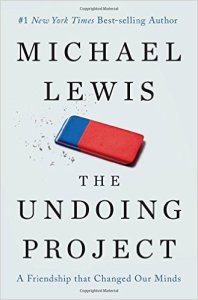
The Undoing Project: A Friendship That Changed Our Minds — Michael Lewis

The Undoing Project is entertainingly written, appears well-researched, and is also tremendously important—three things that, while not intrinsically opposed, occur together too infrequently. It’s so funny that I burst out laughing during class, while students were engaged in peer review, and every pair of eyes turned to me. I wanted to stop myself but couldn’t. It’s the best book I’ve read in recent memory and you should stop whatever else you’re doing to read it.

undoing_projectThe “tremendously important” part is important for many reasons, one being that most people don’t seem to even know the (many) biases humans are prone to, let alone that knowing the biases often isn’t enough to change the behavior. We can understand the problems and still not turn understanding into action.*

Still, there are steps we can consciously take to attempt to minimize or combat our biases. For example, “People had trouble seeing when their minds were misleading them; on the other hand, they could sometimes see when other people’s minds were misleading them.” That means we have to minimize hierarchy in many situations; empower people to speak up when they perceive problems; and listen to those who have differences of opinion, even if we want to immediately assume they’re wrong.

There are too many good sections in the book to cite them all. One example:

People did not choose between things. They chose between descriptions of things. Economists, and anyone else who wanted to believe that human beings were rational, could rationalize, or try to rationalize, loss aversion. But how did you rationalize this? Economists assumed that you could simply measure what people wanted from what they chose. But what if what you want changes with the context in which the options are offered to you?”

Conveying the humor in The Undoing Project is hard, maybe impossible, because so much of it is embedded in larger stories.

“Amos approached intellectual life strategically, as if it were an oil field to be drilled, and after two years of sitting through philosophy classes he announced that philosophy was a dry well. ‘I remember his words,’ recalled Amnon. ‘He said, “There is nothing we can do in philosophy. Plato solved too many of the problems. We can’t have any impact in this area. There are too many smart guys and too few problems left, and the problems have no solutions.”’”

I wonder if English lit suffers from the same (or a similar) problem. There’s been little progress since the advent of close reading, and the development of “critical theory” or “theory” is often if anything a step back. If there is anything interesting going on right now it seems to be in some aspect of applying computers to literature, but that is likely more a CS problem than an English lit problem.

We do get an ethnology of academia, too. Like:

Economists were brash and self-assured. Psychologists were nuanced and doubtful. ‘Psychologists as a rule will only interrupt a presentation for clarification,’ says psychologist Dan Gilbert. ‘Economists will interrupt to show how smart they are.’ ‘In economics it is completely normal to be rude,’ says economist George Loewenstein. ‘We tried to create a psychology and economics seminar at Yale. We had our first meeting. The psychologists came out completely bruised. We never had a second meeting.’ In the early 1990s, Amos’s former student Steven Sloman invited an equal number of economists and psychologists to a conference in France. ‘And I swear to God I spent three-quarters of my time telling the economists to shut up,’ said Sloman. ‘The problem,’ says Harvard social psychologist Amy Cuddy, ‘is that psychologists think economists are immoral and economists think psychologists are stupid.’

There seems to be no solution.

There also seems to be no solution for the systematic errors in human cognition. As I noted above, awareness is not enough. Even imagining possible futures is not enough, because one may come to predominate and stifle the others before they can be explored:

What people did in many complicated real-life problems—when trying to decide if Egypt might invade Israel, say, or their husband might leave them for another woman—was to construct scenarios. The stories we make up, rooted in our memories, effectively replace probability judgements. ‘The production of a compelling scenario is likely to constrain future thinking,’ wrote Danny to Amos. ‘There is much evidence showing that, once an uncertain situation has been perceived or interpreted in a particular fashion, it is quite difficult to view it in any other way.

The parallels to present world politics are too clear. We have forgotten the lessons of totalitarianism in just a generation and a half. We are too fond of constructing Kahneman’s rosy scenarios, which replace probability judgments. The probability of nuclear conflagration has grown in recent times. Yet we discount it. Recent elections in the U.S., U.K., Poland, and Hungary are systematic cognitive errors writ large.

The number of cognitive errors we’re subject to staggers. It’s “not just that people don’t know what they don’t know, but that they don’t bother to factor their ignorance into their judgments” (192). This book should above all make us doubt ourselves more, and especially doubt ourselves even when we think ourselves sophisticated. Over and over, we see people who receive training in statistics make basic statistical errors. We see people violate the law of small numbers.

I cannot recall all the times I’ve explained sample bias problems to people—rarely clients but more often students or friends—only to sense that no one is getting what I’m saying, or, if they do get it, they don’t care. The more one understands recurring cognitive weaknesses the more one sees them, the more I worry about succumbing to them myself. I myself succumbed to them in the last election, by substituting the opinions of people who are readily observable around me for the opinions of the much larger political body. And I myself wonder how often people have explained cognitive biases to me, or pointed out cognitive biases in action, only for me to ignore them.

The secret to the successful friendship between Kahneman and Tversky seems to have been pleasure: “‘We just found each other more interesting than anyone else,’ said Danny. ‘Even if we had just spent the entire day working together.’ They’d become a single mind, creating ideas about why people did what they did, and cooking up odd experiments to tests them.” The joint mind: It seems beautiful. I wonder how many of us accomplish such a feat. Lewis does cite a writer who began a book about productive pairs but never finished it. Another writer, Joshua Wolf Shenk, wrote and published Powers of Two: Finding the Essence of Innovation in Creative Pairs.

Lewis quotes his beautifully articulate subjects: “It is sometimes easier to make the world a better place than to prove you have made the world a better place.”

This is a kind of boring NYT review. This is a better New Yorker review, from Cass Sunstein and Richard Thaler, who are both cited repeatedly in the book itself. For example:

[Cass] Sunstein was particularly interested in what was now being called ‘choice architecture.’ The decisions people made were driven by the way they were presented. People didn’t simply know what they wanted: they took cues from their environment. They constructed their preferences. And they followed paths of least resistance, even when they paid a heavy price for it.

How are you paying?


* Maybe the robots do deserve to win.

Perfect Rigor: A Genius and the Mathematical Breakthrough of the Century — Masha Gessen

Perfect Rigor is the best and most fascinating book I’ve read recently, and it is the sort of book I often seek but too rarely find. The story concerns Grigory Perelman, the man who solved the Poincaré Conjecture and whose eccentricities and life history may or may not be related to his mathematical faculty but certainly make for bizarre, enlightening, and entertaining reading.

perfect_rigorPerelman was born into Soviet Russia, a place where the professional study and practice of math were frequently under peril. Soviet math survived Stalinism and the horror of the Soviet Union more generally in part from luck and in part from need, but they suffered from being cut off from the rest of the math world. Still, as Gessen writes:

mathematicians as a group slipped by the first rounds of purges because mathematics was too obscure for propaganda. Over the nearly four decades of Stalin’s reign, however, it would turn out that nothing was too obscure from destruction.

Plus, modern wars cannot be fought successfully without mathematicians. Many, many mathematicians. Math has another useful property from the perspective of Communists living in a resource-deprived, poorly organized society: good math can be done even in conditions of relative privation (which may not be true of, say, engineering).

So math in Russia survived Stalin, even while many other fields suffered. There is a fascinating historical counter-narrative in which Russia evades Communism and Germany evades Nazism via World War I not happening, or not happening the way it did. In that alternate world, tens of millions of people live and contribute to the betterment of humanity. Instead of that world, however, we have the world that World War I bequeathed us and the countless people lost to murderous state machines.

Perelman and his direct family at least were not killed. And in the Soviet Union, math continued to be practiced freely, or mostly freely:

In the after-hours lectures and seminars, the mathematical conversation in the Soviet Union was reborn, and the appeal of mathematics to a mind in search of challenge, logic, and consistency once again became evident. “In the post-Stalin Soviet Union it was one of the most natural ways for a freethinking intellectual to seek self-realization,” said Grigory Shabat, a well-known Moscow mathematician. “If I had been free to choose any profession, I would have become a literary critic. But I wanted to work, not spend my life fighting the censors.”

It was good to do math because there was so little else to do. The many pleasures offered by American or Western European work were not available. Creative freedoms were minimal. Math was among the few places a person could be creative.

Some sections Perfect Rigor are just novel and unknown to me, descriptions of a sub-culture that I’d never thought properly about:

Competitive mathematics is more like a sport than most people imagine. It has its coaches, its clubs, its practice sessions, and, of course, its competitions. Natural ability is necessary but entirely insufficient for success: the talented child needs to have the right coach, the right team, the right kind of family support, and, most important, the will to win. At the beginning, it is nearly impossible to tell the difference between future stars and those who will be good but never great.

I wonder how necessary “the will to win” is, especially given how much later in the book Gessen describes the professional world of math in different terms: “The mathematics community in the United States, and even the world, is very small and very peaceful.” Still, leaving that potential issue aside, the analogy to sport is a powerful one, since sports are more familiar to the average person than math.

More details: Gessen writes of herself:

My own first-grade teacher, in a neighborhood on the outskirts of Moscow that looked just like Perelman’s neighborhood on the outskirts of Leningrad, actually made me pretend my reading skills were as poor as the other children’s, enforcing her own vision of conforming to grade level.

Russia’s many afterschool math clubs did non conform to this bizarre, Harrison Bergeron vision. Which may be why Russia could continue to produce prodigious mathematicians even as much of the rest of its society decayed under the cruelties and absurdities of Communist rule. Those cruelties and absurdities are well-known, and they emerge in the way the Soviet Union sought contradictory goals:

The entire Soviet system of secondary education was based on the concept of uniformity: everyone was to be taught the same thing at the same time, using the same textbooks. But the Soviet Union still craved international prestige—in fact, that need became more and more pronounced as the technological rivalries of the second half of the century heated up.

Uniformity and excellence are mutually exclusive. As often happens, when ideology and reality diverge, ideology gives way, as it did to some extent for Perelman’s school. His school

let him avoid confronting the fact that he lived among humans, each with his or her own ideas and thoughts, to say nothing of emotions and desires. Many gifted children realize with a start as they mature that the world of ideas and the world of people compete for their attention and energy.

Perelman, it appears, never had to choose one over the other. He’s spent his life firmly in the world of ideas, rarely dealing with the world of humans. It is hard to say whether the world or humans or ideas is stranger; presented properly, either can seem strange. Perelman’s life seems strange but also pure and beautiful in a way that I would at times like to emulate but cannot, any more than I think he could emulate my life.

Perfect Rigor speculates some about Perelman’s motives and personality, or personalities, but cannot know them certainly. Sergei Rukshin is Perelman’s first serious math coach, and even very early he is happy with one of Perelman’s interests, or lack of interests: “He was never interested in girls,” unlike many of his classmates, who were caught “doing something as undignified and distracting as kissing a girl.” Life is about trade-offs and on some level Perfect Rigor encourages us to consider some of the tradeoffs some high-level mathematicians make (though not all: Feynman, for example, devotes some stories in Surely You’re Joking, Mr. Feynman! to understanding women).

Maybe lack of sexual interest is in part from the demand side as much as the supply side. Perelman himself is, when he is young, “an ugly duckling among ugly ducklings,” though that changes a little when he is older. One wonders about the links, if any, between physical appearance and math (or other intellectual) skill. The vigorous rejection of “surface” matters seems common among high achievers, though I wonder if I’m letting myself be subject to the availability heuristic.

Used copies of Perfect Rigor on Amazon are gloriously cheap. I don’t know how I missed the book when it first appeared in 2009.

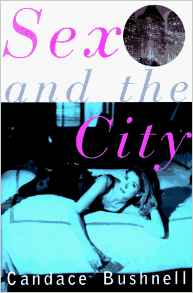
Candace Bushnell’s “Sex and the City” is distinctly contemporary

A reader suggested that in light of Date-onomics I get a copy of the original Sex and the City book. I see why. Though published in 1996, it feels shockingly contemporary, like something you’d read in New York Magazine, or Slutever, or 1,001 other places. If Sex and the City were a little more explicit (Bushnell prefers “unmentionable” to “penis” or “cock,” for example) and added in references to smartphones, Instagram, texting etiquette, and online dating, it would still have the basic set of issues and problems and challenges and behaviors of 2016. The tone of the stories feels bloggy and podcast-y (which is a descriptive observation, not a slur).

sex_and_the_cityOn the Internet you really can say whatever the fuck you want, including “fuck,” and becoming accustomed to that makes Sex and the City feel a little linguistically reticent. To be sure, it goes a lot of places in terms of description but it doesn’t get to all the explicit places the online-only writers do; Sex and the City generally stops at the bedroom door and resumes at the restaurant recap the next day.

Being originally part of a newspaper also means that the lows aren’t quite as low as the online writers, many of whom don’t have anyone to edit their material or tell them that piece x is filler and ought to be cut. But they also don’t have editors to tell them that piece x is in “bad taste,” which means that bad taste as a concept barely exists (here I am tempted to list some examples, but if you keep your eye around the Internet you’ll find some on your own). I hate the word “heteronormative,” but Sex and the City is more heteronormative than online writers are.

What else? Some modern books about love, sex, and dating often have a harder data edge: that’s the point of Dataclysm and Date-onomics. The big way our knowledge has collectively grown in the last twenty years in this domain comes from the revealed preferences of online dating. That lets us know things less through gossip and more through how people behave, at least in online interactions.

It is common to read claims about how the Internet has changed everything, and while data tells us a lot, the basic challenges that emerge in Sex and the City remain. Still, I prefer a Straussian reading of Sex and the City in which guys read the books in order to discover how they should present themselves, market themselves, and be.

Perhaps the book’s most important theme is the need for novelty and stimulation, maybe because novelty-seekers are drawn to New York, despite the city’s costs and many inconveniences. Boredom is a great sin: “You get tired of being around anyone after a while” (63). Or: “Miranda checked the labels: Savile Row—boring” (90). Or: “While many women would have killed to have a date with Scotty, the TV producer, Camilla told me she had been bored” (105). Or: “I already have too many Chanel bags. They bore me” (109; what do you do for the person who has everything, which is a larger number of people than is commonly assumed?). Or: “Where’s the new place to go? I want to make sure my ward here has a good time this evening. I think she’s bored” (141). Or: “The truth is, he bored me” (198).

Boredom is part of a simple paradox at the heart of many of the stories—a paradox prevents some of the characters from getting off the party carousel: “this was the kind of life she’d grown up believing she could have, simply because she wanted it. But the men you wanted didn’t want it, or you; and the men who did want it were too boring” (85). And there is no way in Bushnell’s world to avoid that paradox. Men might want to think about it too, and how it affects their own choices. The characters in Sex and the City are experiencing the problems and fruits of freedom: “[Edith] Wharton thought no one could have freedom, but [Henry] James knew no one wanted it,” and “Freedom’s unpalatable qualities are hard to accept.” So too is accepting the choices one makes. In first three quarters of the book, Samantha Jones makes occasional appearances to disparage her dates and men in general. By page 181, “Lately, Sam had been complaining about not having a boyfriend.” Er. She spends most of book engaging in boyfriend-incompatible thoughts and behaviors.

The women in Sex and the City are chronically outraged by male behavior while chronically and simultaneously rewarding it with sex. The phrase “revealed preferences” is relevant.

Snobbery is ever-present (“She’s like an auto mechanic from nowhere’sville”), almost a sport, in a way that would be hard to take, at least for me, in real life. The brand-name snobbery is much more irksome than much of the bedroom material.

Used copies on Amazon are cheap and plentiful, for good reason. It’s a fun, historically interesting read, but once is enough. Re-selling it is too time consuming for me, but I’m donating it to a thrift shop which will probably recycle it back onto Amazon.

But What If We’re Wrong? Thinking About the Present As If It Were the Past — Chuck Klosterman

But What If We’re Wrong? is consistently delightful in both sentence and idea quality: the chapters are full of astute observations, like “Something becomes truly popular when it becomes interesting to those who don’t particularly care.” Klosterman’s example here is football and that is indeed a winning way to describe football in U.S. culture (though see here for one account of how football may decline); I don’t care about football and perhaps unsurprisingly I select for friends who don’t really care about it, yet in January I went to a friend’s apartment for he Superbowl anyway because other friends who also didn’t care about football were going. On some level this makes no sense yet we did it anyway.

but what if were wrongReality TV has that quality too, and Klosterman discusses it in another chapter. I don’t care about it either, though it has spawned one amazing TV show (UnREAL), at least one excellent novel (Arts & Entertainments), along with lots and lots of good articles. Reality TV producers probably have a better grasp of human psychology than most psychologists. It’s also arguably affected the way people use Snapchat, Instagram, Facebook, and the plethora of other tools we have to broadcast our fabulous, highly edited lives in the sun and exotic locales and so forth. The Real World got to the unreality of living in front of cameras before the rest of us did.

Speaking of the unreal world, the most striking thing to me is the gap between the Facebook faces of the people I know well and the private conversations with those same people, since the former is inevitably sunny and the latter contains the usual set of human challenges and feelings, which are repressed or distorted by reality TV. For good reason, I might add: the makers of those programs are building specific media properties for entertainment purposes. They know their business well, and their job is to present a specific kind of information system that may or may not be “real,” much the way my job is to write a specific kind of information system that may or may not be real.

The preceding two paragraphs are mostly digression, but they are digression that may feel somewhat like a Klosterman digression. Klosterman makes one think and makes one want to have a beer with him. He makes me want to write more and better. Not all of the chapters are equally strong—the one that starts out with comments about the role of dreaming particularly stands out in this respect, and I also have found discussions about the simulation hypothesis boring since I first heard them. But the overall effect is to make one think and to make one think something apart from the usual battle lines and lines of thought one hears, and that is valuable in itself.

There are many other excellent facets to the book, which feels like the cleverest conversation you’ve ever had rather than a slog through tedious ideas. There are some predecessors—”What You Can’t Say” also wonders what the present will look like centuries from now, and it asks:

It seems to be a constant throughout history: In every period, people believed things that were just ridiculous, and believed them so strongly that you would have gotten in terrible trouble for saying otherwise.

Is our time any different? To anyone who has read any amount of history, the answer is almost certainly no. It would be a remarkable coincidence if ours were the first era to get everything just right.

So if you believe everything you’re “supposed” to believe, you’re probably doing something wrong (if you believe nothing that you’re “supposed” to believe, you’re probably also doing something wrong, or simply cannot operate in a society that depends on some level of order and coordination). I think Klosterman would agree, although if he said so explicitly I missed it. He does set up the book this way:

What about ideas that are so accepted and internalized that we’re not even in a position to question their fallibility? These ideas are so ingrained in the collective consciousness that it seems fool-hardy to even wonder if they’re potentially untrue.

The ideas that are so accepted are of course the ones we need to question.

Klosterman also recalls the history of failed predictions; my favorite is Paul Ehrlich, who, in 1968, wrote a book called The Population Bomb, about how over-population would annihilate the world; in Klosterman’s words, summarizing Ehrlich, “we should currently be experiencing a dystopian dreamscape where ‘survivors envy the dead,’ which seem true only when I look at Twitter” (that last clause is a good sample of Klosterman’s humor). As most of outside of Syria know, the living do not for the most part envy the dead, growth has continued, and on an inflation-adjusted basis commodities are cheaper than they’ve ever been. We’re on the verge of an energy revolution in which a combination of solar, wind, and nuclear energy will reduce our carbon footprint, while electric cars should dramatically reduce the flow of oil money that is currently propping up despotic regimes like those in Saudi Arabia, Russia, and Iran.

Those predictions are off. So are many predictions about who and what will matter in literature, music, and art. The cultural world of 2016 looks wildly different than the cultural world of 1950, 1900, or 1850, and all of those periods had artistic priorities and worlds vastly different from today’s. As we look backwards from today, the things we find valuable then are different than many of the things that people found valuable at the time. That implies that the cultural world of 2050 or 2100 will probably be different than the world of today, rendering many of our present values and works moot, but in ways that we probably can’t predict, and, “In fact, it often seems like our collective ability to recognize electrifying genius as it occurs paradoxically limits the likelihood of future populations certifying that genius as timeless.”

Wow.

So far this essay has only discussed a small part of But What If We’re Wrong. There’s much much more. It’s one of the best books I’ve read recently.

Briefly noted: Sweetbitter — Stephanie Danler

You may have read about Sweetbitter, which is a resolutely okay novel that you should not even consider unless you’ve already read and liked Kitchen Confidential and Love Me Back, both of which cover kitchen and restaurant stories (from page 9 of Sweetbitter: “When I got there they told me a lot of stories” about restaurants, Union Square, and New York). Like many New York novels, it has a masturbatory, self-important, and inward-gazing feel. Many of New York’s structural problems can be traced back to Matt Yglesias’s excellent book The Rent Is Too Damn High, but of course none of the characters in literary fiction ever read or know anything beyond what they themselves immediately experience.

sweetbitterYou will find many ridiculous lines like, “in New York City there are absolutely no rules.” The sort of lines that, spoken on a reality TV show, the literati would condescend to, justifiably, but here, in this package, it’s literature, or the sort of novel that makes literary moves. Maybe I’m unfair and the things that are profound or profound-seeming at 22 are different than the things that are profound or profound-seeming later. But there is too much, “Do you know what it means to be a server?” too much concern about “totems of who I was.”

There is also oddly little sex in a novel with too little else to recommend it. The protagonist, Tess, chases her own personal Mr. Big (although his name is appealingly Jake), and the results can either be predictable or more fairy tale than gritty realism.

I didn’t consciously realize until reading this novel and talking to a friend in the restaurant industry that the industry only really works for its employees if or when the employees get pre-tax food subsidies from other restaurants. Let me explain. Many mid- and high-end restaurant workers have an implicit or explicit deal you-scratch-my-back-I’ll-scratch-yours in which they give other “industry” people free food / booze, the value of which can probably add up to thousands of dollars a year, all of it untaxed. Since restaurant industry profits are notoriously low (some estimates are as low as 1 – 4%), some of the pay that would otherwise need to go to servers who’d get taxed on that pay instead goes to them in the form of food. And they expect that favor returned: On Monday you go to Joe’s restaurant, and on Tuesday people from Joe’s go to yours.

Still, it’s not worth reading the novel for that insight. It’s dubiously worth reading a novel with disconnected ejaculations like this all over the page:

“Appetite is not a symptom,” Simone said when I complained of being hungry. “It cannot be cured. It’s a state of being, and like most, has its attendant moral consequences.”

Okay, that’s deep, but so what?

There are good sentences, but they don’t add up to much. I neither regretted finishing nor skimming the second half. When people complain about “MFA fiction,” Sweetbitter is what they’re talking about. I’ll read the next thing Danler writes.

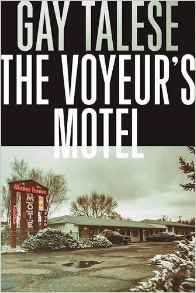
The Voyeur’s Motel — Gay Talese

The real lesson of The Voyeur’s Motel is not how depraved most people are, but rather how boring they are. In the story, Gerald Foos gets his start as a teenage voyeur by watching his aunt Katheryn “for five or six years,” and while she spent much time nude most of that time was spent “at her dressing table arranging her collection of porcelain miniature dolls from Germany, or her valuable collection of thimbles.” Who knew there even was or is such thing as a “valuable collection of thimbles?”

voyeursmotelMost of the people Foos observes over decades in his hotel are little more interesting; the epigraph to The Voyeur’s Motel could be that famous quote from Walden, “The mass of men lead lives of quiet desperation.” Except that most of the individuals and couples Foos observes seem not to know enough to even feel desperation. Instead, to the extent they have or show feelings, they seem to be consumed with petty bickering and bullshit. The number who are luminously full seem small.

Consider the preceding two paragraphs in light of complaints about smart phones and laptops and the Internet relentlessly distracting us, or Internet dating making us flightier or more demanding of partners or more likely to break up. Maybe smartphone distraction is a big improvement on what on preceded it, on arranging porcelain miniature dolls or thimbles. In 1980 Talese goes into the attic and spies on people staying in the hotel:

As I looked through the slats, I saw mostly unhappy people watching television, complaining about minor physical ailments to one another, making unhappy references to the jobs they had, and constant complaints about money and the lack of it, the usual stuff that people say every day to one another, if they’re married or otherwise in cohabitation, but is never reported upon or thought about much beyond the one-on-one relationship. To me, without the Voyeur’s charged anticipation of erotic activity, it was tedium without end, the kind acted out in a motel room by normal couples every day of the year, for eternity.

The things that people consider to be pleasures are also sometimes odd, as Foos says:

My observations indicate that the majority of vacationers spend their time in misery. They fight about money; where to visit; where to eat; where to stay; all their aggressions are somehow immeasurably increased, and this is the time they discover they are not properly matched [. . .] Vacations produce all the anxieties within mankind to come forward during this time, and to perpetuate the worst of emotions.

That’s been my experience, and I wonder if people do them anyway to say they’ve done them, or imagine the best parts of them. Maybe many of us would be better off if, as Rebecca Shuman suggests, more people took her advice in “Alone, Together: To avoid travel stress and major arguments, more couples should vacation together but fly alone.”

Is it real? Hard to say. Talese notes:

Indeed, over the decades since we met, in 1980, I had noticed various inconsistencies in his story: for instance, the first entries in his Voyeur’s Journal are dated 1966,m but the deed of sale for the Manor House, which I obtained recently from the Arapahoe County Clerk and Recorder’s Office, shows that he purchased the place in 1969. And there are other dates in his notes and journals that don’t quite scan.

“Don’t quite scan” may be an understatement. On June 30, Talese actually “disavowed” The Voyeur’s Motel:

Talese overlooked a key fact in his book: Foos sold the motel, located in Aurora, Colo., in 1980 and didn’t reacquire it until eight years later, according to local property records. His absence from the motel raises doubt about some of the things Foos told Talese he saw.

Still: Talese did see the hotel. He later walked back his disavowal. I’m a great believer in the power of fiction and the power of people to make shit up, but even by that standard making up the shit that Foos writes seems unlikely. I guess it to be more real than not real. It seems likely that no one will know.

Given the volume of material, The Voyeur’s Motel is oddly short. This long New Yorker article gives you much of the content and flavor. Still, do not listen to the negative reviews so far, which have mostly been uselessly negative and/or focused on the perceived ethics of the book; almost all of those articles about mostly about the author’s need to perform signaling and status functions, rather than the book itself.

As with Thy Neighbor’s Wife, people expecting nonstop prurience will be disappointed. In some ways the book can productively be read in conjunction with The Presentation of Self in Everyday Life, since Goffman’s book is about the social, public self and Talese’s book is about the private, supposedly unobserved and sexual self. To me and, I suspect, many readers and writers of novels the latter is more interesting and less likely to be foreseen.

The Voyeur’s Motel comes back over and over again to the need to reliever torpor. The first quotes are from the start of the book; around the midpoint we get this:

Ordinary life is boring, [Foos] concluded, not for the first time; no wonder that is always a big market for make believe: staged dramas, films, works of fiction, and also the legalized mayhem inherent in sports…

That most people do not try harder to alleviate boredom is an unsolved problem—perhaps most people don’t perceive boredom as Foos does, or they feel powerless, or both. Foos’ second wife is not immune. After retirement, she “devoted much of her free time to alphabetizing his millions of sports cards.” The sports cards are Foos’ thimbles.

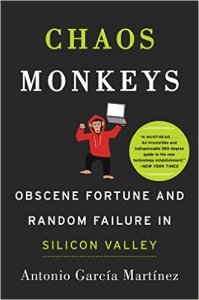
Briefly noted: Chaos Monkeys: Obscene Fortune and Random Failure in Silicon Valley – Antonio Garcia Martinez

Chaos Monkeys is supposed to be refreshingly honest but instead feels slimy; it feels like Martinez is ripping off other people’s good will and earnestness, which is deeply unattractive and raises the urge to altruistically punish. Martinez is aware of it enough to cite it but not enough to surmount it:

Cynicism is the last refuge of the shiftless. I don’t cite this absolutist tendency for the cheap sardonic joke, the asshole hipster who’s too cool for school to believe in anything. No, I cite it because I was as seduced as the next guy sitting there in Pong [the Facebook conference room], perhaps even more.

chaos_monkeysExcept that he is a cynic, he reaches for the sardonic joke, he is the asshole hipster, he grabs the clichés. He has much mud to sling, but he ought to also know the problem with mud as a weapon. What kind of person calls out everyone else for being a poseur and faker? It is odd to read about “a man [who] oozed an off-putting smarminess” in a book about a man who oozed an off-putting smarminess.

The sentence-by-sentence is okay and the content is often interesting. There are details of the ad world I didn’t know about and details about the startup world most people won’t know about. Then there are parts so conceptually and linguistically confused and muddled that I want to take back compliments like “okay” and “interesting:”

This was the major-league, serious shit, take-on-prisoners championship of thee tech entrepreneurship, and if you were going to play, you’d better show up ready to bite the ass off of a bear.

So the sentence moves from sports, to abstraction mixed with the scatological, to warfare, back to sports, to companies, to sports, and then to nonsense. It sort of works as long as you don’t pay too much attention. Chaos Monkeys rewards inattention. But you can’t get away from tone, which wafts through the book like a foul odor from a superficially attractive person. I don’t want to snark at others; I want to know, and Martinez makes snark seem like knowing, which may bedazzle or bamboozle the young or unwary but should put off the people who are building the future, not just manipulating social status symbols.

Like so many stories, the book is also about the madness of coastal real estate markets; in one year Martinez makes a million dollars, which in San Francisco feels justifiably middle-class due to outrageous land-use restrictions that drive up the price of housing and income taxes. I live in New York, which is afflicted with similarly maddening maladies that some subset of voters nonetheless likes.

Sections of the book are inadvertently revealing, which describe problems with the higher education system and the signaling madness that has overtaken it:

it would be my Facebook stock vesting yet to come that would pay for private high schools and Stanford, so Zoë and Noah wouldn’t have to sneak into this country’s elite through the back door from the cattle class, as I had to do.

Ignore even the extraneous “do” at the end of that sentence, as it should’ve been edited out. So much is wrong with that sentence and the mind behind it that my own mind boggles. Let me ignore most of it and I wonder if Zoë and Noah would prefer $300,000 in cash at age 22 rather than private high schools and Stanford. I know I would!

By far the worst part about Chaos Monkeys is that it’s an okay book within which there’s a great book—written perhaps by Tom Wolfe. Wolfe’s books reward attention. The more attention you give Chaos Monkeys, the more its weaknesses show.

The Truth: An Uncomfortable Book About Relationships — Neil Strauss

The Truth is poorly named but it’s also amazing and you should read it, preferably in the biblical, imitation-leather edition. Unfortunately, The Truth buries the lede: the weakest, most tedious section by far is the beginning, when Strauss goes to therapy for “sex addiction” (which may not exist, at least for reasonable definitions of “exist”).* Don’t give up. Get past the first third and pay special attention to the rest, where Strauss’s sharp, comedic / absurdist observations strike.

the_truthIn the first section, we learn that there is such a thing as “a CSAT,” that is, “a Certified Sex Addiction Therapist.” The therapists seem at least as mad as the patients, which seems to be a recurring theme in life (you know what they say about psych majors…). The treatment does not work, at least at first. Strauss, seeking answers, gets what appears to be an fMRI, hoping that his brain makes hedonic and novelty-seeking, only to be told that he chooses relationships or the chase. Score one for free will or something like it.

The middle section is about the chase. The chase is about women, yes, but it’s also about finding a way to be. Strauss meets people whose new-age and pseudo-religious or -mystical bullshit is vile. At one moment, meeting a woman who presents herself as a guru, “Common sense tells me to leave; curiosity drives me forward.” That’s the writer coming out. I wish I could say that I always follow common sense. I don’t, for the same reason. Strauss’s Guru attempts “mix spirituality with business” and then says, “Let me know if you have any ET experiences in Peru.”

He doesn’t. He runs.

Unfortunately he runs to a polyamory retreat that’s also infused with spirituality nonsense that should’ve died with the ’70s. That doesn’t work out either:

I look up and see a yoga stud from Kamala’s pod.

“Have you rounded up any more girls?” the orbiter asks him.

Kamala Devi and Shama Helena said polyamory was about loving relationships, not casual sex. But these guys seem more like next-level pickup artists, coming to these conferences with the intention of sucking any available women into their powerful reality.

Understanding things as they are, as opposed to how they “seem,” is rarely easy for anyone, anywhere—which may be one reason we have literature. The supposedly selfless caring for others that Strauss hears about is more like socialism, with its attendant problems: Equality for you and special privileges for me.

Later, things do not improve for Strauss: “This is truly the blackest day of my life: I’ve been kicked out of an orgy for eating popcorn.” He’s eating popcorn because he can’t fake bogosity at the level necessary for that world.

So he tries another (there are more worlds out there than most of us know). His next stop involves something like conventional swingers, if that phrase isn’t an oxymoron, at a club or party called Bliss. Towards the height of his first experience, he writes that “I would’ve paid every penny in the bank for this experience ten years ago—If I’d known it was even possible.” Many things are possible, but the mind holds us back; the same theme in a different context plays out repeatedly in Elon Musk: Tesla, SpaceX, and the Quest for a Fantastic Future. For Strauss, that moment is “the closest thing to heaven I’ve ever experienced.”

Then he passes out. He’s taken too much GHB.

So, in short, Strauss attends an orgy that should be everything he’s ever wanted, but he takes drugs he shouldn’t and doesn’t have the sex he should, or that he thinks he wants. While there, he meets a woman who seems mostly like a groupie but who also demands monogamy and yet goes to an orgy, chiefly because her “friend” is there (that people are not internally consistent or even interested in internal consistency could be a shadow theme of The Truth—or maybe it’s just been written by an “ambivalent,” as Strauss is, or is termed).

He goes to another and decides he is “determined not to wreck this orgy like all the others.” I won’t speak to what happens, but one does get the sense that Strauss is well attuned to self-criticism and understanding how others will see him.

Wanting to be a swinger or polyamorous person can make internal, logical, and consistent sense; one cannot say the same for what comes next, when Strauss, on his own, sticks three straight women in the same domicile and attempts to date all of them, simultaneously, while living with them. The preceding sentence’s length and complexity is deliberately designed to evoke the complexity of Strauss’s arrangement.

In sports there is a term called “unforced errors,” which occur when a player does something transparently wrong that is not caused by the opponent or some other outside force. What Strauss attempts is an unforced error and one that ought to be easily foreseen. But one might attribute this to that previous mentioned issue between common sense and curiosity. The three women more or less come to Strauss, in his telling. Mastering “the game” has evidently done things for him.

In The Truth Strauss ultimately assigns the genesis of his adult relationship habits to his upbringing. In his case maybe that’s true, but I’m reluctant to assume a casual relationship between upbringing and adult life: how many people who had childhoods similar to his grew up to be functional adults? Since at least the time of Freud it’s been popular to ascribe adult personality traits to childhood, but I’m not convinced those are robustly supported and that they’re more than just-so stories we tell ourselves to make sense of a deeply chaotic, multi-faceted world.

Psychiatry and psychology in particular are deeply troubled fields because we don’t have good models for the brain. In those domains it may be obvious when someone is too dysfunctional to live independently, but the supposed treatments and models are derived from poor or nonexistent premises. Imagine trying to start a car and discovering that one third of the time it starts, one third it doesn’t nothing, and another third of the time the engine dies. That’s close to the current state of real knowledge about psychiatry and psychology.

We tell ourselves stories, which is great—in some ways I am a professional storyteller—but we use science to figure out what’s reliably and consistently true, and the childhood traumas leading to adult reenactments does not appear to be reliably and consistently true. Perhaps the stories Strauss tells himself now allow him to live in a particular and better way, and in that sense they’re functional. But they may not be causal.

On page 10 of The Truth Strauss writes of his then-girlfriend and now-wife, “She is reliving her mother’s relationship with her cheating father. I am reliving my father’s secret sex life. We are repeating a pattern handed down by generations of lying, cheating assholes and the poor fools who trust them.” They specifically seem to be repeating generational trauma. The idea that we repeat our childhood experiences has been commonplace since Freud, but is it true? Do we really have any evidence of it, or, again, are we just telling ourselves stories? Pop culture loves Freudian ideas. I’m not so sure that the psychosexual narrative Strauss constructs is more real than one that accepts the null hypothesis.

By the end Strauss is married. I wonder how Strauss’s marriage will hold up over time. I wouldn’t bet on “well” without favorable odds. Many beliefs that feel firm at a given moment turn out to be provisional in the fullness of time. It’s striking that Strauss never, so far as I know, mentions his age or the age of his lover, Ingrid.

For all of his problems, I can’t imagine most guys doing what Strauss has done or accomplishing what Strauss has accomplished. For all the psychic trauma in his childhood, the outcome is impressive.

The Truth is the sort of book I can’t imagine being made, in any sort of honest way, into a movie. Oddly, perhaps, I can imagine The Game being made into a reasonably honest movie and am somewhat surprised that it hasn’t been.

The final truth about relationships is that there is no final, universal truth about relationships. We make things up as we go along and universal experiences aren’t universal. It’s not a real sexy truth. It also doesn’t require a book to say. Instead, we tell all our stories about relationships in the book of life and the stories we draw from it.**

Let us return to the beginning of The Truth again. Strauss starts by saying he is “the king of ambivalence.” He wants what he can’t have or doesn’t have at that moment. This is not good and is perhaps generalizable:

Most married people I know don’t seem to be any happier. One day Orlando Bloom, an actor I’d written a Rolling Stone article about, came over to visit. At the time he was married to one of the world’s most successful and beautiful women, Victoria’s Secret supermodel Miranda Kerr [. . .] And one of the first things out of his mouth? “I don’t know if marriage is worth it. I don’t know why anyone does it. I mean, I want romance and I want to be with someone, but I just don’t think it works.”

My other married friends haven’t fared much better.

Yet he does it anyway. To his credit, Esther Perel’s Mating in Captivity does eventually get name-checked, since Perel has done unusual work in questioning our usual arrangements. Still. On the first page Strauss considers a woman and writes a sentence that could be an alternate title: “Not my type, but I would.” The book processes his motion from “but I would” to “but I won’t,” even if she is his type (and it seems that most women are).


* Psychiatry and psychology in general aren’t in good epistemological shape. There is no good functional, reproducible model of the brain. Both fields may essentially be wielding beads and rattles rather than science and be closer to shamanism than medicine.

** This is a post I’ve meant to write for a long time, but it hasn’t been an easy write.