Life: Some things rarely change edition

“Have we not yet had enough of lightweight metaphysics and received ideas? The trouble all stems from our gigantic ignorance. Things that ought to be considered carefully are simply believed in, without any discussion at all. Instead of observing, people make assertions!”

Flaubert, in a letter dated 1871. Ignorance and assertion are constants, not variables.

Daily Rituals: How Artists Work — Mason Currey

Daily Rituals is charming, and almost every entry feels like the right length; if anything, I would have liked each to be slightly longer, perhaps because the quirks and weirdnesses of the famous artists described provide justification for the quirks and weirdnesses of non-famous artists.

daily_ritualsThe answer to the title is “divergently,” but with some patterns. Many like walks, routines, and stimulants. Exasperation with TV is common, and even the non-writer artists tend to read. Many artists also exasperated lovers and spouses through their compulsions and tics. Given the low remunerative value of art and the low probability of success through recognition, being an artist is a compulsion for many of those described within—Currey even uses the word in his description of Patricia Highsmith: “Writing was less a source of pleasure for her than a compulsion, without which she was miserable.” Daily Rituals may be best read by anyone romantically entangled with or biologically related to artists, as well as any artists who want to justify their own weird predilections. I love it when people explain myself to me.

Currey wants to answer questions like, “are comfort and creativity incompatible, or is the opposite true: Is finding a basic level of daily comfort a prerequisite for sustained creative work?” But they don’t have answers, because artists work in all sorts of places in all sorts of ways. It’s like asking about alcoholics: people who really want to drink will drink in elegant bars like Pouring Ribbons or chug Natty Lites in a dark Chinatown alley. Most might prefer the former to the latter but will settle for the latter when necessary. Currey also writes:

“The book’s title is Daily Rituals, but my focus in writing it was really people’s routines. The word connotes ordinariness and even a lack of thought; to follow a routine is to be on autopilot. But one’s daily routine is also a choice, or a whole series of choices.

Most of the artists in here establish routines whenever they can, much like the writers in Writers on Writing. The number of people who need routine, who need defaults, speaks to its utility, among artists or anyone trying to accomplish a task with an artist’s dedication (like entrepreneurs, who might be the artists of the modern age). Distraction might also be handier than ever, giving rise to essays like “Disconnection Distraction:

Some days I’d wake up, get a cup of tea and check the news, then check email, then check the news again, then answer a few emails, then suddenly notice it was almost lunchtime and I hadn’t gotten any real work done. And this started to happen more and more often.

If you get into that habit, you’ll be well-informed on unimportant news and less likely to make the thing that becomes the news. One question you might ask is: “Are you reading or making the news?” Aim for the latter. The former isn’t wrong, exactly, and it’s worth reading a lot, but as a secondary, not a primary, activity. Reading the news on the Internet or checking e-mail are especially dangerous in this regard because they can feel like working though they’re not.

I mentioned the compulsive aspect of art. That reappears again and again. Currey writes of Simone de Beauvoir that “when she took her annual two- or three-month vacations, she found herself growing bored and uncomfortable after a few weeks away from her work.” Long, pointless idleness is is boring, like binging on TV, but that’s because most artists seem to like what they do, or like it like an addict likes. Voltaire’s secretary “estimated that, all told, they worked eighteen to twenty hours a day. for Voltaire, it was a perfect arrangement. ‘I love the cell,’ he wrote.”

Such stories may be why, in Currey’s words, “Looking at the achievements of past greats is alternately inspiring and utterly discouraging.” The line made me laugh because of the juxtaposition of opposites, but also because he’s expressing a fundamental truth: if you look at the work as work, it can be “discouraging,” since so many artists do so much of it, but if you look at it as an extended form of play, it should be “encouraging.” It should also be “encouraging” because you can do it too—if you want to. Which means the limiting factor between you and art is you—which oscillates back to discouragement.

Still, Daily Rituals is at its heart a manual for dealing with and/or understanding someone with an artistic disposition, which might be described as imagination and execution. A surprisingly large number of people seem to imagine that being an artist is all about the “imagination” part and not much at all about the execution part; wandering around coffeeshops, bars, and parties, doffing a funny hat, and making enigmatic pronouncements is not the majority of what being an artist, broadly defined, is about. It’s about results, and Daily Rituals is about getting them and enabling the conditions necessary to get them. “Necessary” is the key word: a condition may be necessary but not sufficient, and it’s possible to treat a daily ritual as an empty ritual with no real output.

There are also a fairly wide range of ways to succeed. Some artists do spend a lot of time drunk or at parties. At least one prefers to work hungover, which would make me crazy. The artists appear approximately split between those who like noise and those who prefer quiet. I’m among the latter and can barely believe that anyone really gets anything done in noisy coffeeshops, tapping on laptops, but enough successful writers have testified to the contrary that I’m forced to believe them. The fundamental idea remains, however, that artists are artists because of their output. That’s it.

Some passages in Daily Rituals are funny; you wouldn’t expect this book to be a comedy and yet I laughed frequently. Two examples:

[John Cheever] had what appears to have been an unusually robust sex drive (the actress Hope Lange, who had a brief affair with Cheever, said that he was ‘the horniest man [she] ever met’) combined with frequent bouts of impotence, probably brought on by his alcoholism but no doubt made worse by his sexual guilt and a frequently rocky marriage. All of this was distracting from his work, especially since Cheever placed a high value on the salutary effects of erotic release. He thought that his constitution required at least ‘two or three orgasms a week’ and he believed that sexual stimulation improved his concentration and even his eyesight: ‘With a stiff prick I can read the small print in prayer books but with a limp prick I can barely read newspaper headlines.’

or:

The German poet, historian, philosopher, and playwright [Friedrich Schiller] kept a drawer full of rotting apples in his workroom; he said that he needed their decaying smell in order to feel the urge to write.

Jane Jacobs is everywhere, even when you don’t see her

In a Reddit thread someone recently asked:

Who the hell actually thinks Jane Jacobs has any influence on Seattle’s urban planning?

Through The Death and Life of Great American Cities, Jacobs has influenced urban planning in every American city at the very least and perhaps every city in the world, though I can’t speak to the experience of other countries.

Jacobs correctly observed that city planners, most notably and famously Robert Moses, were bulldozing important areas for highways and other sub-optimal uses, and that communities should have more of a say in what happens regarding development, especially development that uses eminent domain. In addition, she correctly observed that city planners were frequently disconnected from the way people actually live, which is somewhat similar to the way academic literary critics today are disconnected from the way people actually read.

But by now the pendulum between “planners ruler” and “community veto” has swung too far in the opposite direction: today NIMBYs and People United Against Everything (PUAE) have too much power, and we’re seeing the consequences in most places anytime anyone tries to build subways, rail, or housing. In many places, with San Francisco and New York leading the pack, supply restrictions on building have led to enormous housing cost increases, but markets can’t effectively respond because a small number of incumbent property owners can block new, private developments.

I’m optimistic about cities over the medium term, but in the short term the real problem faced by cities is not too little “community” input but too much, usually represented by a relatively small number of NIMBYs and busybodies—the process privileges existing homeowners and the fact that “only socially and psychologically abnormal people want to waste their evening showing up to neighborhood hearings.”

Still, Jacobs’ influence remains, and this essay by Edward Glaeser, comparing Jacobs and Robert Moses, demonstrates how their ideas have come to define a great deal of what people think about cities. This is especially important:

Moses was also right that cities need infrastructure. People cannot just argue forever on an unpaved street corner. They need homes to live in and streets to travel along and parks for relaxation. Jacobs underestimated the value of new construction—of building up.

Jacobs didn’t understand one important part of basic economics, which is that restricting supply in the face of increasing demand raises prices. Someone like Jacobs can’t afford to live in Greenwich Village today because the housing is too expensive. Most of Manhattan and much of New York more generally has priced out the middle class, in part due to the rules and laws that stem from Jacobs’ victories; instead of living in the city, those people are now driving cars in Atlanta, Houston, and Phoenix. Places like Seattle and Portland are somewhere between Atlanta and New York, but even Seattle won’t allow sufficient development to allow for middle-class growth.

The language Jacobs uses in The Death and Life of Great American Cities is sometimes dangerous, as when she says that “streets or districts which do have good primary mixtures and are successful at generating city diversity should be treasured, rather than despised for their mixture and destroyed by attempts to sort out their components from one another.” She’s right about mixed-use areas being valuable, but the word “treasured” is a problem: a mixed-used building that is three stories tall can be equally good at being mixed-use with thirty stories. Treasuring buildings that already exist can lead to the San Francisco problem, and San Francisco itself is only the furthest along example of what happens when supply can’t meet demand.

There is one thing I think Glaeser gets wrong in his article:

Jacobs was right that cities are built for people, but they are also built around transportation systems. New York was America’s premier harbor, and the city grew up around the port. The meandering streets of lower Manhattan were laid down in a pedestrian age. Washington Square was urban sprawl in the age of the omnibus. The Upper East Side and Upper West Side were built up in the age of rail, when my great-grandfather would take the long elevated train ride downtown from Washington Heights. It was inevitable that cars would also require urban change. Either older cities would have to adapt, or the population would move entirely to the new car-based cities of the Sunbelt. [. . . ] No matter what Jacobs thought, there simply was not a car-less option for New York.

The issue with older cities is less about cars than about older cities doing what they do well: density, public interfaces, and so forth. Instead of trying to capitalize on the strengths of older cities, older cities built the massive highways and parking lots Jacobs and her acolytes eventually learned to fight. Sometimes the response to a technology shift isn’t to attempt to ape the shift but to make sure you focus on doing your core strength better—which many cities have utterly failed to do.

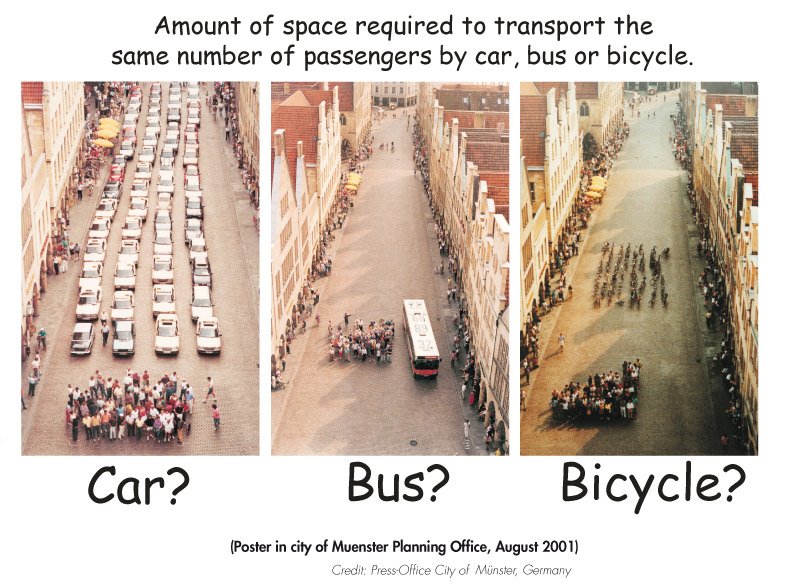
When the car began spreading in earnest in the 1920s, the total U.S. population was 106,021,537. In 1930 it was 122,775,046. Today it’s approximately 316,000,000. Moving to a highly car-dependent lifestyle made sense for a long time, but now a lot of urban areas are simply choked by them. This famous photo from the City of Muenster Planning Office succinctly demonstrates the problem, as does L.A. during rush hour:

Cities, buses, and bikes

Education is also part of the city puzzle, since it’s provided publicly and, usually, on a per-city basis. For much of the period from approximately 1970 – 2010, it was possible for parents to outrun well-meaning but poorly executed court degrees pertaining to school districting. It’s hard to measure the extent to which school busing and similar schemes drove many parents to the suburbs, even if they would’ve liked to stay in cities. This 2006 WSJ piece describes some of the pernicious consequences that are still reverberating in Seattle, which is a microcosm for the problems elsewhere. Schools and real estate both show the same basic principle: when principles meet self-interest, self-interest usually wins. Everyone favors low- and moderate-income housing in theory but don’t want it in their neighborhood, and everyone favors racial integration in theory unless their kid gets moved to the worse school.

Still, that’s tangential to Jacobs’s main points and how they affect contemporary decisions in cities. That I’m still citing Jacobs’ work more than 50 years later demonstrates its importance. To the extent any normal person has heard of anyone having anything to do with urban planning, they’ve heard of Jacobs and Moses. Pretty much anyone with any formal education in the subject has not only heard of them but read at least excerpts of their writing. It’s like being in English lit and wondering who this Shakespeare guy is.

The sex plot: a discussion for novelists and readers

I wrote to a friend:

I wonder about the extent to which novels in general are continuing to have trouble with sexual liberalization; so many major novels in the canon deal with that topic, but it’s much harder to use those tropes in a permissive age.

He replied: “This intrigues me, but I’m not sure what you mean. Can you elaborate?”

Yes!

The novel as a genre has tended to thrive on sexual repression, and has used steadily increasing sexual liberation as fuel for plots. Leslie Fiedler wrote about this in Love and Death in the American Novel, and Tony Tanner wrote about it in Adultery and the Novel. In taking courses about the novel as a genre, I was struck by how many times I heard or read phrases like, “X pushed the limits of the sexual mores of his / her day,” where X is any number of writers ranging from Richardson to Flaubert to Dreiser to Roth and Updike. (Weirdly, however, the Marquis de Sade has always been lurking beneath the history of the novel as a genre, mostly unacknowledged and often hidden from the reading public).

But working against sexual repression as such doesn’t really work so well as a plot device anymore because the barriers are mostly down. If you’re over age 18 today, you can more or less do whoever you want as long as they’re not under 18. This may be why professor-student plots are somewhat popular: it’s one of the few forbidden-but-plausible-and-not-gross relationships left.

There are only so many sexual lines one can cross, and too many books like 100 Strokes of the Brush Before Bed, to make the mere crossing of the few lines left all that interesting. When an entire society is set up to repress, re-channel, and control sexuality, a novel like Lady Chatterley’s Lover is shocking. In our society, it’s not. Today, if you want it, go get it—just don’t make promises you can’t keep. It’s not hard to live a life of constant sexual novelty and most parts of society won’t really censure you, provided that you don’t marry someone else, and even then lots of people divorce.

It’s much harder to get wring major consequences from affairs and what not. Don’t want to cheat? Don’t get married. It’s not impossible to use sex and romance plots—my to-be-self-published novel, Asking Anna, is a comedy about such subjects—to get material from these fields, but it’s a greater challenge than it used to be, and hard if not impossible to shock. A novel with the sexual politics of Stranger in a Strange Land wouldn’t have the same shock-value today then it did when it was published, though actually now that I think about it I still think it would raise a few eyebrows.

Some genres, like science fiction, don’t rely on sex plots as much, but even in SF sex plots are still often present. The growth of murder mysteries and thrillers may also represent some veering from sex plots, since premature death is still a big deal and is likely to remain so for the foreseeable future.

On a separate but related note, it also seems that many “literary” writers borrow SF-ish ideas. Think of Ian McEwan’s Solar. Not a great novel, but I liked a lot of what McEwan was doing by meshing discovery, politics, social ideas, environmentalism, science, and a not-very-nice character into one bunch. It’s McEwan, so the writing is good on a sentence-by-sentence level. The technical descriptions are also interesting and too uncommon in novels. I like the idea of writing about intellectual, social, technical, or business discovery as a motive. It’s underutilized as a driver of plot.

One section of Paul Graham’s essay “The Word ‘Hacker’” addresses this point and continues to have a profound impact on me:

Hacking predates computers. When he was working on the Manhattan Project, Richard Feynman used to amuse himself by breaking into safes containing secret documents. This tradition continues today. When we were in grad school, a hacker friend of mine who spent too much time around MIT had his own lock picking kit. (He now runs a hedge fund, a not unrelated enterprise.)

It is sometimes hard to explain to authorities why one would want to do such things. Another friend of mine once got in trouble with the government for breaking into computers. This had only recently been declared a crime, and the FBI found that their usual investigative technique didn’t work. Police investigation apparently begins with a motive. The usual motives are few: drugs, money, sex, revenge. Intellectual curiosity was not one of the motives on the FBI’s list. Indeed, the whole concept seemed foreign to them.

Most novels focus on money, sex, revenge. Why don’t they focus more on intellectual curiosity: perhaps how intellectual curiosity relates to money, sex, revenge, and similar topics? That seems like a fruitful avenue, especially because we might be moving towards a world where many people’s material needs are met, making money less immediately important; though of course many people are still driven by keeping up with the Joneses, in large swaths of the industrialized world we have plenty of money and plenty of stuff.

(A relevant side note about money: Among people interested in “game” and picking up women, it has become a common observation that additional money above the amount needed to buy drinks, dress reasonably well, and live independently doesn’t do much help most guys. A guy making $50,000 a year and a guy making $200,000 a year are mostly on a level playing field, and if the guy making $200,000 has to work 60+ hours a week, he’s at a disadvantage. Personalities and tenacity count far more than incomes, all else being equal. This could be seen as a variant on one of Geoffrey Miller’s points in Spent: Sex, Evolution, and Consumer Behavior.)

I don’t see money, sex, or revenge—and motives for revenge usually reduce to money and sex—becoming unimportant as long as humans remain humans and not brains in vats or on chips, but intellectual curiosity and a sense of wonder and discovery should be more emphasized in narrative. I think the tedium of Jonathan Franzen’s novels can in part be explained by the tedium of his characters: if those characters had a greater sense of discovery and possibility, they wouldn’t be so annoying. The other day I was listening to a friend describing single electron chain reactions in photosynthesis and how she misses research and life in the lab. It’s very interesting stuff, and the sort of thing that is rarely really discussed in novels.

But it should be!

Plus, the progression of science, technology, economics, and the attitudes that go along with them have ameliorated a lot of the money-revenge resource-distribution fights that used to define every aspect of human existence, instead of most aspects of human existence. To the extent major societal problems in the future are going to be solved—most obviously involving energy, but certainly involving other topics too—the solutions are going to come from intellectual curiosity and the intellectually curious. Maybe we, collectively, should be thinking about art that cultivates and glorifies those traits, instead of art that cultivates or glorifies simple status domination, or the ability to be cooler than the other guy or girl.

Another Paul Graham quote, from “How To Make Wealth:”

Making wealth is not the only way to get rich. For most of human history it has not even been the most common. Until a few centuries ago, the main sources of wealth were mines, slaves and serfs, land, and cattle, and the only ways to acquire these rapidly were by inheritance, marriage, conquest, or confiscation. Naturally wealth had a bad reputation.

Two things changed. The first was the rule of law. For most of the world’s history, if you did somehow accumulate a fortune, the ruler or his henchmen would find a way to steal it. But in medieval Europe something new happened. A new class of merchants and manufacturers began to collect in towns. Together they were able to withstand the local feudal lord. So for the first time in our history, the bullies stopped stealing the nerds’ lunch money. This was naturally a great incentive, and possibly indeed the main cause of the second big change, industrialization.

A great deal has been written about the causes of the Industrial Revolution. But surely a necessary, if not sufficient, condition was that people who made fortunes be able to enjoy them in peace. One piece of evidence is what happened to countries that tried to return to the old model, like the Soviet Union, and to a lesser extent Britain under the labor governments of the 1960s and early 1970s. Take away the incentive of wealth, and technical innovation grinds to a halt.

People still steal to get rich, and even more people make many movies and write many books about stealing, along with efforts to thwart thieves. Making stuff people want is, again, an under-explored avenue. It’s also harder to represent dramatically. The movie The Social Network does this successfully, albeit at the expense of accuracy; most of the important parts of Facebook actually happened in the heads of Zuckerberg and other programmers, not in interpersonal drama.

Still, The Social Network works as a movie, and it does something very different than yet another version of Fast & Furious, which is about sex, power, tribal loyalty, and blowing shit up—like most movies (sample from the link: “Like any reasonable person, I watch the Fast and the Furious film franchise primarily for its insights into moral philosophy and political economy. At a fundamental level, the franchise is about what Harvard philosopher Christine Korsgaard identifies in The Sources of Normativity as the ‘intractable conflicts” that arise from our conflicting practical identities'”). I like Solar despite its flaws in part because the protagonist, Michael, makes his money and gains status by discovering something that may turn out to be essential in solar panels.

Solar and The Social Network don’t deploy straightforward sex / family plots, and that’s refreshing. They’re part of an answer to the question of what happens in a world where you can, if you have sufficient skill or are sufficiently desirable, sleep with anyone who’ll have you? Because that’s the world most people above the age of 18 or 19 find themselves in. Marriage rates are dropping. Arguably the most interesting parts about marriage and children right now are economic: what’s happening with alimony and child support, and how those issues affect behavior and emotions.

Moreover, for the highly sexually experienced—people who’ve had their share of three-ways, sex work, group sex, etc.—the sex plot is going to be dull. Juvenile. If you’ve slept with five people in a week, agonizing over who you’re going to sleep with for the rest of your life isn’t going to seem that important. It’s going to be more important that you find someone who loves you but who also has an sufficient level of adventure compatibility. Arguably a more interesting question is what it takes to be a highly desirable person, which a lot of romance novels appear to be exploring (strangely enough) and how to become that desirable person if you aren’t already. Becoming the sort of person who can get the man / woman / men / women of your dreams is often more interesting than the immediate process of getting him / her / them.

Sex plots need a sense of the sacred attached to sex, along with the dangers of pregnancy that can be ameliorated by IUDs and other forms of birth control. Danger used to generate sacredness. Most people today still don’t want their significant others to sleep with random people, even though many obviously do anyway, but taking away or reducing the risk of pregnancy also reduces the fear and risk of affairs or multiple partners. One reason Vow: A Memoir of Marriage (and Other Affairs) got written is not just because of the affairs Plump and her husband have, but because he knocks up the other woman, or the other woman deliberately gets knocked up by him. Women tend to fear that their man will impregnate another woman and thus split his resources / time / affection, and men tend to fear that their woman will be impregnated by another man and thus stick them with the costs of raising another man’s child. While these fears can obviously be alleviated by the judicious use of birth control, not everyone is diligent about birth control and deeply seated fears aren’t always allayed by modern technologies laid over atavistic drives.

The highly adventurous and experienced probably don’t represent a hugely overwhelming portion of the general population, but they probably represent a portion that is either growing or coming out of the closet. Through divorce and other means, many people are already leading a serially monogamous and/or hypocritically adventurous life, though perhaps because they are bad at anticipating what temptation and desire feel like in the moment and good at rationalizing. The only thing missing is intellectual honesty, which may itself be rarer than fidelity.

There will probably always be challenges in admitting to fantasies or taboo desires, and it will probably always be difficult to find another person with roughly similar tastes, predilections, and preferences, but I’m not sure how easy it is to build a novel around those ideas. That question might be best answered in novel form.

Once you get away from the sex plot, where do novels go? Martha McPhee’s Dear Money is one successful recent example. Cryptonomicon is another. Solar, which I mentioned before, is a third. Ann Patchett’s State of Wonder is a fourth. More writers need to get this memo, and more readers need to use their attention to direct writers towards topics that matter instead of those that have been exhausted by the tradition.

Further discussion:

* Sexting and society: How do writers respond? Sample:

Questions like “What happens when people do things sexually that they’re not supposed to? How does the community respond? How do they respond?” are the stuff novelists feed on. They motivate innumerable plots, ranging from the beginnings of the English novel at Pamela and Clarissa all the way to the present.

Pamela and Clarissa are interesting as historical documents, but it’s not easy to project the modern mind backward into the dilemmas of someone with a very different set of social and intellectual concerns.

Lisa Levy, Alain de Botton and the meaning of intellectuals and their relationship to sex

Lisa Levy’s How to Be a Pseudo-Intellectual (actual title: “How To Think More (But Not Better): Alain de Botton’s School of Life”) isn’t really about de Botton’s How To Think More About Sex so much as it is about throwing rocks at de Botton’s intellectual middle road from the high road where most supposed scholars are unread, unloved, and unsexed.* It’s true that How To Think More About Sex is de Botton’s weakest book, to the point that I didn’t bother reviewing it because it’s so bad; any pop evolutionary psychology book from the last ten years offers more and better information, and sex is arguably the field least informed by the philosophy and philosophers most often in de Botton’s purview.

But his other books are fun and informative. Levy writes that “he often seems like a grad student who shows up to seminar having done just enough of the reading to participate by jumping on other people’s comments, but who never makes an original observation of his own.” Maybe “an original observation” is overrated in philosophy, especially compared to accessibility. Levy writes that “he tends to meander and summarize after a quotation rather than using it to drive his own argument forward,” but if de Botton meanders in an interesting way—which he usually does, in books like The Architecture of Happiness and his novel On Love, which is charming (a word that never appears among academics trying to prosecute dubiously original arguments)—then he’s at least doing one thing better than 90% of those allegedly being original. For one thing, he’s writing clearly enough to make a judgment about originality; how many doctoral dissertations and tenure books are written in impenetrable, deliberately misleading jargon, such that it’s difficult or impossible to tell whether an argument is original?

Most people trying to make “an original observation of [their] own” don’t seem to make actual original contributions but do bloviate quite a bit. If more people admitted to synthesizing and fewer had to pretend to originality, we’d probably live in a better original world. Levy says that “he’s not exactly Michel Foucault,” and I’d call that a very good thing.

That being said, however, Levy is right that “This might in fact be the most boring book ever written about sex.” Sex might also be the field that, of all that de Botton has addressed, philosophy is the least well-equipped to handle, especially compared to current psychology and biology.

Still, the funniest bits of The Consolations of Philosophy concern the number of aged philosophers in their twilight years who fall for vapid but hot teenage girls and adult women, which could arguably tell us more about the nature of life than all of their books combined; actions speak louder than words, as the cliché goes, and what one wants in the midst of composing a monumental manuscript may be different from what one wants when confronted with real people. De Botton describes how the 43-year-old Schopenhauer “turns his attentions to Flora Weiss, a spirited girl who has turned seventeen,” and feels “revolted” by his gift of white grapes. Nietzsche, similarly, faced rejection from “a twenty-three-year old, green-eyed blonde” named Mathilde Trampedach. From there, “a succession of similar rejections took their toll” in his marriage proposals, caused in part, perhaps, by “his extraordinarily large walrus mustache” and “his shyness.” Later still, he chased around a twenty-one-year-old hottie (my word), who “was more interested in Nietzsche as a philosopher than a husband.”

Perhaps we should consider philosophers’ work in light of their lives, and the lessons we should take are not necessarily those entombed in The World as Will and Representation or On the Genealogy of Morality. Alas, however, that de Botton might have instead worked to write original observations that go unread in a university library somewhere instead.


* Hannah Arendt and a few others famously excepted.

Social news sites and forums should encourage users to blog

In online forum culture, there’s a strong bias against linking to a poster’s own blog. That bias often slides into strict rule enforcement that degrades the quality of the forum itself, because most people who regularly produce substantive writing will want their own, ideally non-transient, forum for such writing. A blog provides that and most websites don’t. That means sites like Reddit—which has an overly strong opposition to what they call “blogspam”—tend towards intellectual vacuousness.

I’ve seen people on Slashdot, Hacker News, and most notably Reddit decry blogspam. The decrying is sometimes justified: writing a weak, sloppy post and linking to or submitting it is a play for readers at the expense of the reader’s time. But there’s a very good to encourage linking to longer, more thoughtful writing: it’s often higher quality than most of what one finds in online forums.

Let’s use myself as an example. Some posts here take hours to write and reflects many more hours of deliberate research—which few (though not zero) forum posts do. Forums and social media encourage the ad-hoc and fast (that’s sometimes appropriate). While blogs can do the same, there’s a stronger cultural tendency, especially since the rise of Facebook and Twitter, to write more thoughtfully, more essayistically. Clearly this is not universal. It’s possible to find deeply thoughtful forum posts and dumb blog posts, but as a general tendency the rule holds. Even those who don’t consciously make the distinction between work on a free-standing blog and a temporary forum post probably intuitively feel the difference, though they may not have articulated it.

And there’s a good reason for people writing blogs to prefer depth: on blogs, the writer controls, or should control, their own content. I can export all my WordPress posts and take them with me to whatever the blogging platform of 2020 might be. That’s not true of Reddit. Anyone who invested heavily in a Slashdot identity circa 1999 – 2004 now feels like an idiot: that identity is basically worthless. Few people read Slashdot anymore. Any substantive comments are trapped there, invisible in the eyes of Google and Bing (which is like being invisible in the eyes of God).

By contrast, many of the substantive blogs out there are still out there. Work I published in 2009 can, and often is, still be relevant, while I can’t even keep track of the forum posts I wrote in 2009. They’re too disparate. Blogs act as repositories. Social news sites live in a perpetual present, with little sense of history or books. Few evidence any sign of outside reading, or knowledge that they’re not the first to contemplate most issues or problems.

In addition, the proliferation of social media sites means that the comparative advantage for blog writers has been moving towards depth, since on social media sites one-liners or short responses rule.

Online culture comments obsessively on itself. This is one such form of commentary, and it’s really about the way form tends to shape data—or, to use McLuhan’s often misunderstood formulation, the way medium affects message. There are many subtle gradations of online media, and I find the near-war between quasi social sites like Reddit and blogs to be fascinating.

The dislike on Reddit for blogs makes the discourse shallower and, to me, more boring. It’s too bad and also ensures that many people who do know a lot—who are experts—won’t bother going. If mods can kill a post that someone spent ten hours writing and editing, so that morons who could answer their own queries with a simple Google search can ask yet another inane question, why bother?

I’m being deliberately inflammatory in the preceding paragraph, but that’s what the situation deserves. People who know a lot will tend to avoid areas with a lot of novices or fools, and as novices grow into being experts, the fora that gave them their start will tend to be abandoned.

(Universities, incidentally, are usually too focused on depth at the expense of breadth and impact. They should focus more on rewarding impact, since much of the nominal “depth” in humanities departments if faux, but that’s another issue.)

I’m going to use Reddit as an example: most of the semi-specialized sub-Reddits, like the ones devoted to photography and writing, are only useful to absolute novices. Anyone who gets past that phase will get tired of the same basic questions and issues arising again and again. At the same time, those sections prevent or discourage users from posting their own material. Consequently, as users become more sophisticated, they drift away and gather their own audience, often in blogs or Flickr accounts or elsewhere. What’s left are a steady stream of novices, which is very useful when one is a novice but not at all useful when one outgrows the novice phase and wants to explore the deeper implications of a subject, art, or craft.

A slice of the mind of the Democratic National Committee, as revealed in a survey

The Democratic National sent me a political survey, and their cover letter said that I’m a registered Democrat (which I don’t think is true—if I recall correctly, I haven’t identified with any party, although I might be wrong; I’ve registered to vote in many places). My responses to the questions are less interesting than what the questions themselves reveal about the minds behind the Democratic party. One section of this survey, for example, says this:

_MG_9289

This section is also representative of the survey as a whole. Notice how most of the questions are about power and fighting against Republicans, rather than what sorts of things Democrats actually want to do with that power. The party seems more obsessed with its opponents than its agenda. The rest of the survey is similarly focused on Republicans.

A survey is just a survey, and it might only reflect the thinking of the people or consultants who it, rather than being an indication about what the Democratic Party as a whole. But if it does reflect the mainstream of the thinking in Democratic party, I don’t think the party is focused on what it should be focused on. Pursuing power for its own sake is a constant temptation in politics, and it often seems like politicians are more enraptured with power itself than with the specific forms that power takes.

George Packer’s Silicon Valley myopia

It’s ironic that George Packer’s New Yorker article about the tech industry’s supposed political insularity is itself hidden behind a paywall (if this were a New Yorker article, I would cite statistics demonstrating the wealthy demographic served by the magazine and mention a telling detail about the luxury watches advertised within, perhaps with with the cost of the watches as a percentage of median household income used as a comparison). Packer makes a lot of noises about concern for the poor, but genuinely poor people might not be able to afford the magazine and now can’t even read the article about how San Francisco is alluringly pricing them out San Francisco for free.

Perhaps the weakest part of the article comes from references to housing prices, like “the past two years have seen a twenty-per-cent rise in homelessness, largely because of the soaring cost of housing.” But he doesn’t explain how limited supply in the face of increasing demand raises prices, as Matt Yglesias does in The Rent is Too Damn High or Edward Glaeser does in The Triumph of the City. There is a simple solution deploying century-old technology that can ameliorate San Francisco’s housing crisis.

Both Glaeser and Yglesias correctly observe that many urban jurisdictions prevent housing from being built; as a result, prices rise. But it’s not primarily tech companies or their employees who have driven housing prices in Silicon Valley: it’s residents themselves, and the courts that have given residents and politicians extraordinary powers to block development. That’s why “San Francisco is becoming a city without a middle class,” as Packer says in the article.

My own family was part of that exodus: my parents moved us from northern California to suburban Seattle in 1994 because housing prices were unreasonable and because California was becoming an increasingly bad place for middle-class people. Since then, housing prices have continued to drive most population growth towards places like Seattle, Phoenix, Las Vegas, and many of Texas’s cities, especially because urban development is easier in Sun Belt cities. Seattle, unfortunately, appears to be following in California’s footsteps by restricting the growth of housing stock and thus causing prices to rise.

The housing-price thing is one of my own pet peeves, since so few people connect supply restrictions, demand, and pricing; even Steven Berlin Johnson’s otherwise interesting rebuttal buys into Packer’s economic illiteracy. Beyond the housing issues, Packer writes:

Joshua Cohen, a Stanford political philosopher who also edits Boston Review, described a conversation he had with John Hennessy, the president of Stanford, who has extensive financial and professional tides to Silicon Valley. “He was talking about the incompetent people who are in government,” Cohen recalled. “I said, ‘If you think they’re so incompetent, why don’t you include in a speech you’re making some urging of Stanford students to go into government?’ He thought this was a ridiculous idea.”

Hennessy is more right than Cohen: if the system itself doesn’t work, why would anyone want to join it? Few highly competent people want to be ruled by incompetent people, and in government seniority rules. There’s often no way to make important changes from the bottom and no way to reach the top without going through the intermediate layers. That’s presumably why Hennessy doesn’t urge “Stanford students to go into government.”

In tech startups, if you think your company is doing something stupid and everyone ignores you, or ignores an obvious opportunity, you can leave and start your own startup. If you start your own version of government within the U.S., men with guns will show up to stop you.

Although Hennessy might not put it the way I have in the above paragraphs, such thinking is probably behind his statement (assuming, as I do, that Cohen is expressing it reasonably well). I’m writing this as someone whose business is to deal with various sections of federal and state government. It’s hard to imagine that Packer has this kind of experience; if he did, I doubt he’d have the worldview he does.

Packer does note that government investment in technology and research is partially responsible for the Silicon Valley of today (“The Valley’s libertarianism—which ignores the federal government’s crucial role in in providing research money—is less doctrinal than instinctive”), and that’s an important government contribution. But today, spending on science and medical research occupies about 2% of the federal budget; by contrast, spending on old people in the form of Social Security and Medicare occupies about 30%. Warfare, formally known as “Defense and International Security Assistance,” occupies 19%, and some of that goes to R&D of various kinds.

If federal R&D spending were higher as a proportion of the federal budget, Silicon Valley types would probably be much more pro-government. Note that this is a positive statement more than a normative one—that is, I’m not trying to argue that more money should be allocated to R&D and less to old people, but I do think we’d see a more positive view of government among Silicon Valley-types if we did.

There is this comment, which is somewhat myopic and somewhat accurate:

Technology can be an answer to incompetence and inefficiency. But it has little to say about larger issues of justice and fairness, unless you think that political problems are bugs that can be fixed by engineering rather than fundamental conflicts of interest and value

Regarding “larger issues of justice and fairness,” 300 years ago people who couldn’t work starved to death, median life expectancy was low, and numerous infants died of now-preventable diseases. Until the Industrial Revolution, starvation was a reasonably common and regular occurrence. Today, no industrialized countries have mass starvation, and that’s largely because of the technological and scientific progress that enables the social and monetary surpluses to provide important safety nets that Packer now takes for granted. “Political problems” are still real and still important, but so is a sense of progress that has enabled society, collectively, to worry much more “about issues of justice and fairness,” instead of working continually on farms. Technology actually has a lot “to say about large issues of justice and fairness,” because technology has given us the leisure to think about those issues and the wealth with which to address them.

In addition, Packer is mixing up questions about “fairness,” but, as as Roy Baumeister writes:

Fairness is important in all human social relations, whether large or small. But there are two different kinds of fairness. Experts call these equity and equality. Equality means treating everyone the same (obviously). Equity means giving out rewards in proportion to what each person contributed. Under equity, the person who contributes more or better work gets a proportionately bigger share of the reward (97).

Packer is focusing on equality, as he does throughout the article, but equity is important too, and New Yorker and New York Times articles almost always ignore this in discussions of “justice and fairness.” Fairness has to balance how rewards accrue to those who have made outsized contributions versus those who haven’t. That Packer doesn’t even acknowledge this distinction tells us a lot about the political glasses that color his world outlook but very little about how to think about the trade-offs involved with equality versus equity. There is a reasonable argument to be made about how governments should take more from major economic winners and give that to those who aren’t producing much of economic value, but Packer doesn’t even acknowledge these issues.

Vow: A Memoir of Marriage (and Other Affairs) — Wendy Plump

Vow is about adultery, and two people married to each other who both routinely commit it, and yet the most obvious question isn’t addressed until page 245 of 258:

People have asked me why Bill and I didn’t just have an open marriage. The answer is simple. We didn’t want an open marriage. If an open marriage is the route both spouses choose to go, that is one choice. It’s very cosmopolitan. I know a local couple who tried this for years, and it worked out to some degree. They had a lax attitude toward sleeping around. [. . .] But the idea doesn’t have much appeal to me. If we were able to do it, we would all do it. Almost no one I know could do it.

For a practice that “doesn’t have much appeal to me,” Plump sure did a lot of it; most people who don’t like Pilates don’t keep going to the classes. She effectively had an open marriage without labeling it as such, or getting the benefits, like hot threesomes. Not addressing the open marriage until the end is bizarre. Plumps and her husband appear to like the drama of lies more than the simplicity of truth.

A book like Never the Face (my essay about it is at the link) is about fundamentally more honest people: on its fifth page, David says to the narrator of his wife Maria, “She knows about it, and she’s okay with it.” The paragraph breaks: “What?“, the narrator thinks. Then: “For the next two days, my mind argued with itself.” Even if the narrator can’t conceptualize or accept the possibility of uncommon arrangements, her partner can. That’s what Plump and her husband are missing. Instead they get recriminations, and the problem of simultaneously wanting the other person to be monogamous while they don’t have to be. Cognitive dissonance is a bitch, and so is hypocrisy.

The overall effect yields the strangeness of art, from the level of the sentence to the level of the whole, which is why I feel compelled to write about Vow amid other projects and other purposes.

Still, Vow is spectacularly well written and yet spectacularly frustrating, because the simple, obvious solution to the problems between Plump and her husband is simply off the negotiating table. They don’t even try events like this one, slightly NSFW, described in Time Out New York.

Plump says that “I assume Bill approached the altar with every intention of doing the right thing. Don’t we all? I’m not sure that I did. Even as I took my vows, I was aware of some mocking little voice in my head, particularly when I got to that part about forsaking all others” (120). Then. . . don’t get married? Again, it’s the obvious solution to a book that’s about looking at the obvious and then doing something else.

Consequently, on some level Vow is one long yowl of cognitive dissonance and “I want.” Plump cheats, basically, because she feels like it: “So I was thrown off balance when I first met Tommy and felt an attraction so compelling I no longer cared that I was married” (8). That’s it, and at bottom it’s the reason most cheaters cheat. In Plump’s universe, feelings trump emotion; I’m not sure about the extent we should extrapolate her comments to all women, or all people, but there’s definitely a temptation to do so, though I’m going to refrain.

At one moment Plump writes:

I have tried many times to deconstruct allure. It is the least romantic of tasks, but it is marginally useful, if only to prove a point. When you take attraction apart, when you look back on what developed and how, you find that it is a physical impulse for about eight seconds before it moves on to something bigger. (50)

Many people, mostly guys, have worked to take attraction apart and to learn how to build it up. Neil Strauss is the most famous, but many others, like Roosh, have also field-tested what works in attraction, in allure. Women are now also producing their own material on overt allure. Note that I’m not necessarily endorsing Strauss, Roosh, or the linked Female Pickup Artists, but I am saying that they are attempting, through observation, trial, error, and research, to develop methods for attracting women or men—in other words, “to deconstruct allure.” Chances are that the peculiar alchemy involved in attraction will never be completely standardized, but pretending that there’s no way to “deconstruct allure” is just pointless and incorrect romantic mystification.

Plump says that “Immediately on standing next to Steven I felt a frisson snapping between us. Some neuron in my brain knocked itself loose and began rapping on my awareness, saying, Yo, are you still in there? Pay attention. You’re doing it again.” Chances are good that Steven was doing something, consciously or unconsciously, to make that attraction happen. Maybe he was just really hot. But maybe he’d begun systematically learning about what to do around women. Plenty of guys do.

Why does she sleep with these guys instead of some other guys? She doesn’t really say. What do they do? How do they behave? It’s lost to Plump, who isn’t asking why she likes what she likes: she’s just liking it. It’s the triumph of feeling and the reason so many guys, and some number of women, read The Game.

There’s also a lot of “I” in Vow: a lot of “I loved not only the way I felt with Steven, I loved who he was with me, as well.” There’s not a lot of thinking about what other people are thinking or feeling. That may explain the quality of Plump’s marriage, which demands “we” and “you” as much or more than “I.”

One also wonders why her husband, Bill, can’t or chooses not to understand presumed shifts in his relationship with his wife: “Sex with Bill became unwanted by comparison, through no fault of his. It changes utterly from an act of love and passion to an act of crushing obligation” (41). Perhaps she shouldn’t be married, then? Perhaps he should recognize what’s going on and leave? The obvious questions pile up, and Plump is telling us that she has no answers. Maybe there are none. There are only contradictions. She says that “Through it all, again, I was certain of one thing. I did not want our marriage to end. I was crushed but not finished.” For someone who doesn’t want her marriage to end, Plump behaves in strange ways.

Some niggling intellectual points bother; Plump, for example, must not have read much evolutionary biology: she writes that “They [friends] think I must have been aware that Bill was having an affair, as if suspicion were linked to some primal instinct we all have. I have no idea what imperative suspicion would serve Neanderthals such that it would repeat upward through the species to find its expression in us” (4). Leaving aside the question of mistaking Neanderthals for a major modern human ancestor, I can very easily imagine “what imperative suspicion would serve:” for men, suspicion is one way of ascertaining paternity. If you check a woman’s fidelity, her offspring are more likely to be yours. For women, jealousy is a form of resource guarding: if you want your mate’s resource capacity to be primarily devoted to you, and not to the hussy a few huts over, you want to make sure he’s not knocking her up (The Evolution Biology of Human Female Sexuality discusses these issues and empirical findings around them).

These obviously aren’t absolute, and the anthropological literature is filled with alloparenting, group sex, and other arrangements, but the basic utility of jealousy as an adaptation remains. Plump does note that her husband’s child with another woman “moved us into a whole new circle of deceit, into that tortured fraternity of women and men [ . . .] who are heaved by their loving spouses into the dirtiest of vortices—women who find out their husbands have fathered children elsewhere; men who find out their children are not biologically their own” (31). Right. It’s the “dirtiest of vortices” because of the tremendous resources invested in children. To have someone who is supposed to be investing your children investing in someone else’s is the cruel problem that jealousy is there, in part, to address.

I’m keeping Vow, though it’s the sort I would normally sell.

Links: John le Carre, the writer’s temperament, condoms, slut shaming, desire, transport, and more!

* John le Carre’s complete works discussed; I am most of the way through Tinker, Tailor, Soldier, Spy and am amazed at how good it is, and how taunt even repeated stories feel. I have started and sometimes completed le Carre’s novels from the last fifteen years but seldom liked them, even when I wanted to. There may be a fuller post here.

* David Brooks: “Engaged or detached?” “Writers who are at the classic engaged position believe that social change is usually initiated by political parties [. . .] the detached writer wants to be a few steps away from the partisans. [. . . ] She fears the team mentality will blinker her views.” Read the whole thing because the context is important, but as a writer I lean heavily towards the “detached” point of view.

* How ‘Slut Shaming’ Has Been Written Into School Dress Codes Across The Country, which should be obvious yet isn’t.

* “Why still so few use condoms;” spoiler: because it doesn’t feel as good.

* “What do you desire?, possibly NSFW.

* “Nobody Walks in L.A.: The Rise of Cars and the Monorails That Never Were” but should have been. L.A., Seattle, and other places have begun to recognize the obvious about the limits of car-based transport.

* “Who Killed The Deep Space Climate Observatory?” This story, along with pathetic “Superconducting Super Collider” debacle, is the sort of thing that, if the U.S. really does take an intellectual and cultural backseat to the rest of the world, will be cited by future historians as examples of how the U.S. turned away from the very traits and behaviors that made it successful in the first place. “Who Killed the Deep Space Climate Observatory?” is also an example of how the real news is very seldom the news you read in the headlines.

* “Documentary ‘Aroused’ explores what makes women turn to porn careers.”

* “[A]rtists and writers love to cast gigantic stores as misbegotten cathedrals.” I’m guilty.

* Frank Bruni on Amanda Knox and pervasive sexual double standards, with the somewhat stupid title “Sexism and the Single Murderess.”

* Why many streets are ridiculously wide.

* The role of a dictionary. People (most often students) often refer to me as a walking dictionary and say that I must not need one, and I usually say the opposite: I often use dictionaries, and in my experience most people who work with words do.