The Glass Room — Simon Mawer

The Glass Room is filled with portents, which, given its setting in 1920s Europe relative to its composition in more recent times, might seem unsurprising. But those portents become portentous, as defined by the Oxford American Dictionary built into OS X: “done in a pompously or overly solemn manner so as to impress.” The novel is ceaselessly concerned with tension between old and new, ancient and modern, the way of progress and the way of regression, but it tends to be delivered with the subtlety of a brick through a window:

* “Beneath the calm surface of the new country Viktor felt the tremors of uncertainty.”

* “It’ll be a revolution […] a casting off of the past. A new way of living.” Maybe, but I wouldn’t count on it: there is no such thing as a genuine casting off of the past.

* “I have laboured day and night, to the disadvantage of my current work. But the demands of true love are more powerful than mere artistic patronage.”

* “I’m certainly not going to tell you what I am letting him do. Some things are sacred.”
“My darling, these days nothing is sacred” (emphasis in original).

* “This is the artistic future of our country […] Vitulka and people like her. A young country with so much energy and so much talent.” Until the Nazis and then Soviets roll through, anyway.

And these are only a few obvious moments from the first 80 pages. I counted zero jokes in the same territory.

Have I not mentioned characters yet? There may be a reason for that. Viktor and Liesel Landauer are religiously mismatched (Jew, Gentile—or is it the other way around? Confusion would be easy) and eventually become erotically mismatched, with somewhat predictable affairs sprouting between a couple who cannot yet have read The Unbearable Lightness of Being. Rainer von Abt is the German architect who designs their “upside down” house/metaphor, where the bottom is made of glass, and is fond of pompous pronouncements like the one above regarding true love versus artistic patronage. There is also a pianist, who allows allusions to Dr. Faustus, and other minor characters of artistic bent who positively breathe meaning until they become suffocating.

The Glass Room isn’t a bad novel, but it’s one that I couldn’t get into. Why is it that some short books feel long (Ethan Frome), some long books feel short (Cryptonomicon, The Name of the Rose) and some mid-length to longish books feel longer than they are, like The Glass Room? I doubt I can find a consistent, unified theory regarding objective length and metaphysical length, but books that don’t have enough grab to feel short despite their length often get dropped before they’re finished. The Glass Room might fall into this category because it’s a novel that has aspirations towards being a novel of ideas, but it’s told chiefly through characters whose endless banal observations and cares don’t seem leavened with the promised ideas, and the narrator doesn’t provide them either. So I start skipping pages, waiting, waiting, hoping, hoping, and never finding until, eventually, I wander back toward the congenial fields of Alain de Botton and Francine Prose.
Rereading A.S. Byatt's Possession: A Romance

The key moment in A.S. Byatt’s Possession: A Romance comes when Roland Mitchell, a prematurely desiccated academic, wonders why he might have stolen letters written by an invented 19th Century poet from the British Library. In explaining why, he says, “Because they were alive. They seemed urgent[….]” Nothing else in his life does, which straddles comedy and sadness. The act propels the action of the novel as well as a return of urgency and of discovery to his own life, implying that when we lack such attributes, we begin to die ourselves.

I’ve previously discussed Possession here), and the novel concerns academics who begin emotionally dead, and their intellects are perilously close to the same state. The key to their resurrection—their return to what one might skeptically call “the real world”—comes in an act of very minor theft by Roland. It’s out of character but brings him rolling to a beautiful academic, to a secret, and to the double discovery of his own romance and of someone else’s. Tracing the path of another person’s romance teaches him how to live his own; without that signal, perhaps he would remain among the academic undead, or the undead more generally. A rare forbidden act—sex has lost its forbiddenness, so theft of an academic nature will have to do—has a rejuvenating effect, reminding us of the limits and limiting nature of bounds and boundaries, sexual, textual, and otherwise. For a novel that is composed heavily of invented texts, stealing carries a larger moral rigor that it might otherwise not, and it helps Roland see his own life and work in way that is, again, finally, urgent.

Ian McEwan and "The Use of Poetry"

The main use poetry in “The Use of Poetry” is seduction: specifically, the seduction of the liberal artist Maisie (recalling shades of Henry James: What did Maisie know?) by the scientist Michael Beard in the late 60s. Michael learns enough Milton to impress Maisie, with her artistic tendencies, a feat that I doubt I’d have the discipline for despite being another liberal artist; they go out, Michael realizes his disdain for what seems the foppish laziness of the liberal arts, and he reinforces the inferiority complex many English majors feel in the face of hard science.

Or maybe not: when we think we see Michael’s perspective on how easy it is to read “four of the best essays on Milton,” McEwan drops this in by airmail:

Many years later, Beard told this story and his conclusions to an English professor in Hong Kong, who said, “But, Michael, you’ve missed the point. If you had seduced ninety girls with ninety poets, one a week in a course of three academic years, and remembered them all at the end—the poets, I mean—and synthesized your reading into some kind of aesthetic overview, then you would have earned yourself a degree in English literature. But don’t pretend that it’s easy.”

That’s the only mention of the “English professor in Hong Kong,” who appears, nameless, only long enough to correct us. He or she disappears: there is no wrapping up, no coming together of the English professor and some deeper meaning. He or she is there to tell us, and “The Use of Poetry” seems like a rebuke to the “Show, don’t tell” school of writing: it is all telling, or nearly all, and it teasingly plays with real world correspondences. “The Use of Poetry” says:

This understanding was the mental equivalent of lifting very heavy weights—not possible at first attempt. He and his lot were at lectures and lab work nine till five every day, attempting to grasp some of the hardest things ever thought. The arts people fell out of bed at midday for their two tutorials a week.

A February 2009 profile of McEwan, also in the New Yorker, says:

McEwan enjoyed studying calculus—“It was like trying to lift a weight that was a little too heavy”—but he settled on literature, and showed enough promise that he was urged to apply for a scholarship at Cambridge.

Maybe McEwan fears the limits of our cognition, or his own cognition. Or maybe I am engaging the intentional fallacy. Surely the editors of The New Yorker noticed this correspondence in their earlier nonfiction piece and this later work of fiction. What, if anything, did they make of it? Were they as uncertain as me?

Finally, what to make of the title: “The Use of Poetry,” rather than “uses?” Apparently poetry has only one use, seduction, as I unfairly said in the first line of this post. But maybe it is not asking, “What is poetry used for?” but rather, “how and why is poetry used by a particular person—Michael—or people in general?” The title probably has other meanings too, like most poems, with their rascally habit of evading a single interpretation.

For some reason, I am reminded of Kundera’s The Unbearable Lightness of Being: both that novel and this story are highly directive, allusive, focusing on what love means in a modern context, using love to examine ideas and ideas to examine love. They both end, not with a statement or feeling of wholeness, but with a feeling of new sight but perpetual incompleteness, like that is our fate, no matter the math we learn or the poems we study. Could “The Use of Poetry” be to remind us of what we can never fully grasp, like Michael trying to understand the liberal arts, or Milton, who was in turn trying to understand us? Hard to say. But then, a lot in life is hard to say. The best we can do with it is try. Maybe with a poem.

Or a story.

EDIT: If you’re here because you’ve been assigned a paper on McEwan, you might find this post to be of great interest.

The computer, operating system, or word processor a writer or novelist uses doesn't matter much, although I still like Macs

Since around 2002, I don’t think that the computer a writer uses has mattered much for writers, chiefly because virtually all computers on the market since that time will do everything you need: conjure up a window and allow you to type as long as you humanly can. The same applies to most word processors: I can’t remember the last time I got a word processor to crash except for Microsoft Word, and even that’s a very rare event. Around the time Windows XP and Mac OS X 10.2 came out, operating system stability problems receded—in Linux, they often weren’t present in the first place—and by now both Windows XP and the more recent versions of OS X are so stable that writers barely have to think about their computers if those machines are used primarily for writing.

This post comes in response to Betsy Lerner, who recently observed that she doesn’t work for Best Buy and therefore doesn’t know if an aspiring writer should buy a netbook (as a professional writer and wannabe novelist, I have some opinions on this stuff). For those of you too lazy to click the netbook link, netbooks are small laptops that usually range from 7 to 11 inches in screen size. I’d argue against netbooks: they tend to have lousy screens, and I wouldn’t want to look at one for an extended period of time. A desktop sounds more reasonable.

I prefer desktops because they tend to be more reliable and cost less, as described at the link. The new 27″ iMacs are particularly nice, and the screen attached is as good on the eyes as one can get among consumer machines. But your computer doesn’t matter much: get a $400 Dell with a 20″ monitor and you’ll still have a very nice set up. What actually matters is the time you spend with your ass in the seat, not what you’re facing while you write.

I like Macs, as demonstrated by this shot of my desk. But Windows, Linux, or OS X are all decent; all have fine, stable word processors. For documents you don’t have to share regularly, Mellel is a sweet word processor, and it has the full screen mode some writers really like. By “full screen,” I mean that you can hit command-shift-f and bring up a screen that looks like this, except much bigger:

Mellel Full Screenshot

That’s a real screenshot: you don’t have any menus or distractions on your screen, just text and a scroll bar. I added the black border in WordPress. Some people also like Mac Freedom, a program that “disables networking on an Apple computer for up to eight hours at a time” and sounds like a useful way of Disconnecting Distraction. Spotlight is very cool, as is DevonThink Pro. Both are especially useful for nonfiction.

Nonetheless, that’s the .1% of writing that doesn’t really matter much; the 99.9% that does is sitting at your computer and writing. And you can’t buy that for any amount of money.

EDIT: See also Harold Bloom on word processors (and, for good measure, editing), which contains an appropriate passage I came across on this subject.

Pages For You — Sylvia Brownrigg

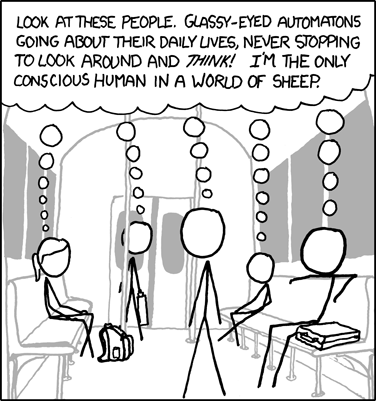
Like many teenager narcissists, Flannery Jansen thinks that she’s a special and unique sunflower “alongside such sour-souled people” as those she has to attend class and live with at college. By her own theory, “They were all planning to laugh at her, clearly, every single day, until she finally gave in and went back to the land of computers and eucalyptus, where everyone wanted you—sincerely—to have a nice day.” It’s a bit like the problem expressed so succinctly and beautifully in XKCD:

Alas, she’s probably not right, and we find out why in Pages For You, a novel that I want to be better than it is. The story follows Flannery as she chases and acquires Anne, a 28-year-old grad student in English whose idea of a good time is having or encouraging Flannery to write short quasi-diary entries about their relationship, and these pages form for the pages of the novel—the “you” in the title being Anne. The novel is written almost pornographically, in spurts that are supposed to represent Flannery’s daily writing assignments or letters to Anne.

As often happens to teenage narcissists—are we sensing a pattern here?—”Flannery had nothing to do but watch that mouth smoking, and though she couldn’t have said why it was so beautiful or described the thrill of its shape—she was too young to have anything like a vocabulary for such things—she could not stop herself from watching it, shaded a darkish persimmon that left its trace on the cigarette.” I like a nice mouth too, and having the vocabulary to describe it, but by the time I acquired the vocabulary to describe such a mouth I no longer needed said vocabulary. And smoking isn’t attractive. Even so, I like the phrase “shaded a darkish persimmon” enough that it saves the sentence from being turgid. Much of Pages For You feels like it’s about to become tedious, and then a moment later it recovers.

Take this description: Flannery stands “over a rickety kitchen table that had been flash-flooded with alcohol,” which so perfectly captures what those equally unruly college parties are like, with their sticky counters that were at least somewhat clean a few hours prior and probably won’t be clean again till much later. Long sections are oddly flat and affectless (“Flannery bundled up her items and took them away to the bookstore/cafe where she intended to enjoy them slowly, with a cup of decent coffee…”), but at least Pages For You is unusual in that it deals with a female/female romance, rather than the usual boy-meets-girl or vice-versa, then loses said boy/girl. It’s also refreshingly free of the professor-sex-plot machinations that drive many campus novels, like Francine Prose’s Blue Angel (which, to be fair, transcends its sex plot), or Bernard Malamud’s A New Life.

I like or want to like Flannery, who, even though she’s writing this at some point in the future, still doesn’t get who she was. But “Flannery did not know New York except as a movie and a myth,” much like me before I visited. And now I’d like to live there, if only it weren’t so damn expensive.

Chapters end before they really get going: that’s the major drawback for a novel structured like Pages for You, and the unusual form doesn’t have enough to do with the content to justify it. In another blow for equality, I’ve discovered something that I’ve always suspected: lesbian romances can be just as boring as their heterosexual counterparts for those not immediately involved in them. That being said, I like a coming-of-age story as much as the next fellow, and I rolled with this one to the last page, waiting for those phrases—”flash-flooded with alcohol”—that made me look again. And I kept waiting for Flannery to want something more than action and meaning, but the flash-floods of those epiphanies, alas, weren’t readily forthcoming.

Life: Children and The Children’s Book

“The young desire to be free of the adults, and at the same time were prepared to resent any hint that the adults might desire to be free of them.”

—A.S. Byatt, The Children’s Book (which is excellent and highly recommended so far).

Life: Children and The Children's Book

“The young desire to be free of the adults, and at the same time were prepared to resent any hint that the adults might desire to be free of them.”

—A.S. Byatt, The Children’s Book (which is excellent and highly recommended so far).

Malcolm Gladwell on Harper Lee's To Kill A Mockingbird

I have two fundamental problems with Malcolm Gladwell’s piece in the New Yorker concerning To Kill a Mockingbird: one is philosophical/moral, and the other aesthetic. The philosophical/moral problem is that incrementalism is not necessarily an invalid approach to major social injustice. Gladwell says:

Old-style Southern liberalism—gradual and paternalistic—crumbled in the face of liberalism in the form of an urgent demand for formal equality. Activism proved incompatible with Folsomism.

That’s true: but it doesn’t mean that the James Folsom approach—who was progressive by southern standards in the first of the twentieth century—wasn’t an improvement over what came later as part of the unjustified backlash. Gradual change can set the stage for radical change, as it did with the Civil Rights movement, and pragmatism is sometimes more effective than attempting to radically alter social, economic or political life.

The Stanford Encylopedia of Philosophy describes the philosopher Richard Rorty this way: “Rorty is a self-proclaimed romantic bourgeois liberal, a believer in piecemeal reforms advancing economic justice and increasing the freedoms that citizens are able to enjoy.” Rorty gives a convincing defense of those piecemeal reforms in his various books, and I’m not wholly convinced of Gladwell’s interpretation that To Kill a Mockingbird is problematic for that reason.

And this idea applies to more than politics. Megan McArdle just posted a piece on Federal Reserve Chairman Ben Bernacke that ended, “As it says in To Kill a Mockingbird, Bernanke did the best he could with what he had. It was not perfect. But looking around at the mostly employed people on the streets, I’m glad he was there.” From what I understand of the recent financial crisis, I basically agree with her assessment: Bernacke and the other players in Washington did the best they could given the information they had at the time, which is based on pieces like The Final Days of Merrill Lynch in The Atlantic and Inside The Crisis: Larry Summers and the White House economic team in the New Yorker.

The second problem is aesthetic: like Nabokov, I don’t think novels need to play the role of social arbiter or champion. A novel that is sufficiently abhorrent—like one that actively praises segregation in the fashion that Soviet novels would advance inaptly named social realism, or one that shills for retrograde religious ideals—would probably be bad by virtue of their social commentary, but I think To Kill a Mockingbird is subtler than that, and to me the novel’s most interesting component is the development of Scout as a person. That’s inherently tied up with morality and politics, of course, but how and whether the novel succeeds in that respect ought to be the major consideration in evaluating a novel.

In other words, once the novel passes the relatively low bar of not being actively abhorrent, it should be judged on other principles than whether it conforms to what appear to be a person or age’s moral norms.

Commencement — J. Courtney Sullivan

J. Courtney Sullivan’s Commencement is a less accomplished version of Claire Messud’s The Emperor’s Children, and it has all the narrative tension of an overcooked noodle. It shoots for modern-day Jane Austen and hits something closer to the chick-lit bulls-eye. I noted this to my girlfriend, who said that she could’ve told me it was chick-lit based on its teal dust jacket. I try not to judge a book by its cover, but in this case apparently my principles apparently wouldn’t have mattered.

The writing in Commencement isn’t bad, but it also isn’t good; I’m searching through pages, looking for a representative quote, or something that’s at least stylistically unusual enough to merit consideration and am finding… nothing. The prose conveys information effectively but without any pizzaz; it is what James Wood might call an efficient literary/commercial novel, having absorbed a few conventions of modernism while retaining a passionate eye and penchant for understatement. Wood says that “There is a familiar American simplicity, for instance, which is Puritan and colloquial in origin, ‘a sort of ecstatic fire that takes things down to the essentials,’ as Marilynne Robinson has it in her novel Gilead.” Sullivan doesn’t have that. She works for the New York Times, which might explain why Commencement reads like a long piece for the Sunday Styles or one of the other less rigorous sections.

I read Commencement based on a mostly positive review in the same paper. It says, for example, that “Sullivan’s characters are often motivated by urges that are taboo to admit in certain quarters: getting love and nurture from men, or staying protected in a cocoon of female friendship rather than confronting the larger world.” Outside of the Mormon church and some university Women’s Studies departments, I can’t imagine what those “certain quarters” might be. In an age of Sex and the City and Katy Perry’s “I Kissed a Girl (And I Liked It),” taboos aren’t very strong. One notable thing about the review is that while it comments extensively on the novel’s social content, it says virtually nothing about its style or prose. Perhaps that’s because the reviewer drew a blank, just as I did, and therefore fell back on sociology when aesthetics failed to rouse any feeling whatsoever.

Do editors still edit? A response in part based on Mark McGurl's The Program Era

Betsy Lerner tries to answer this reader query: “Is it true that editors no longer edit, and if so, why?” Her basic answer: “I think most do, and some quite brilliantly.” But it’s hard to say beyond anecdote: I’ve read various answers that range from hers to simply stating “No.” One letter to the editor in The New Yorker has a perceptive comment on the issue—the author is responding to an essay about Mark McGurl’s The Program Era:

The days of editors like Maxwell Perkins shepherding talented young writers through their early years are long over. With publishing houses now expected to turn profits of around fifteen per cent, as opposed to the three to four per cent of Perkins’s day, what editor can afford to give a latter-day F. Scott Fitzgerald the devotion, time, and professional advice needed to hone his talents? Creative-writing programs have stepped in to fill this void by teaching young writers, in effect, to be their own editors––an essential skill in the current publishing climate.

In the absence of hard figures, it’s difficult to tell whether this is true, and if it is, how true it is. McGurl does write about the “… wide distribution… of elevated literary ambitions, and the cultivation in these newly vocal, vainglorious masses of the habits of self-conscious attention to craft through which [their writerly ambitions] might plausible be realized…” I doubt this makes editors superfluous, but it might mean that, in the face of layoffs, increased workloads, and so forth, editors might be more likely to rely, implicitly or explicitly, on the skills that universities and other writing programs cultivate. Granted, this is based on speculation from someone peering in through the glass rather than someone with direct experience inside of publishing, but it at least seems plausible.

Furthermore, it might be easier for writers to learn some of what editors once might have provided because of the wide availability of pretty good books on the craft parts of writing. This doesn’t mean reading such books will automatically make one a good author, or that any book can substitute for good secondary readers (or editors), but they still might occupy a small part of the function professional editors once held.

(Incidentally: The Program Era is a wonderful book I keep meaning to write a post about. One reason I don’t is because there’s so much to talk about that I get overwhelmed. At some point, however, I’m just going to write that post, completeness be damned.)