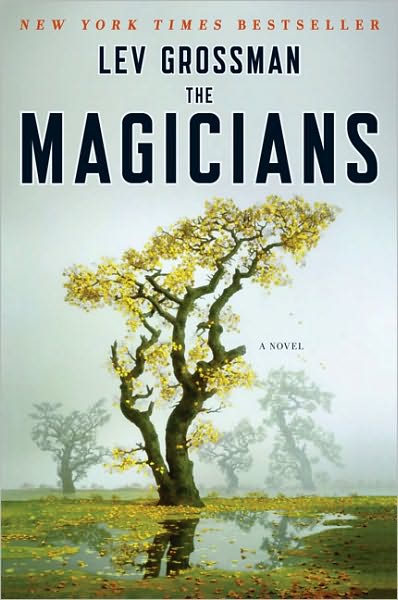
 Lev Grossman’s book tour is just about finished, and I caught up with him at Changing Hands in Phoenix on June 10 to talk about The Magicians. In the novel, Quentin Coldwater is a bright and unhappy high school student searching for meaning, happiness, and a place in the world—which he thinks he’ll find when he receives an invitation to Brakebills, a college for magic. Unlike Hogwarts, however, classes are a grind, students are filled with angst, and sexual politics are everywhere.
As I wrote about the novel:
The Magicians is a surprise and delight: its language is not overly showy and yet often contains an unexpected surprise, especially at the ends of sentences, as this early description shows: “Quentin was thin and tall, though he habitually hunched his shoulders in a vain attempt to brace himself against whatever blow was coming from the heavens, and which would logically hit the tall people first.” Until the last clause, one could be reading any novel, fantasy or otherwise, but saying that a blow from heaven would hit the tall first gives us Quentin’s personality in a single line, and yet its ideas are spun coherently across the entire novel.
The following is an edited transcript, and any links were added by me after the interview:
Jake Seliger: I first read about The Magicians on John Scalzi’s blog, “Whatever.” I don’t know if you’ve met him or not, but he wrote about it and I thought “That’s exactly the book I want to read.”
Lev Grossman: He runs that features “The Big Idea.” I actually wrote that. I ran into him at the World Con—that is the convention—and we got to chatting. He’s a friendly fellow. He let me post something on the blog.
JS: I’m really glad you did. Not every book is one I’ve really loved. He posted about a book called Mistwood, which I thought was okay, but flat in a way. The premise is really interesting—instead of talking from the premise of a human who gains special powers and becomes more than she is, it discusses a summoned creature or magical being who’s becoming more human and doesn’t want to become human.
LG: That sounds like a great idea.
JS: Yeah. The execution is one I didn’t love. It was a first novel. It was a lot of fun. As far as The Magicians goes, I was struck that there’s this repeated expectation or hope of finding another world, that of course gets fulfilled. Even really early on, on page 8, Quentin says, when his interviewer’s “back was turned Quentin would stumble on a mysterious cabinet or an enchanted dumbwaiter or whatever, through which he would gaze with wild surmise on the clean breast of another world.” So he’s looking for these enchantments, and it seems like by the end of the novel that he finds or we find that we either make our enchantments or don’t make our enchantments. Do you agree? Or is my reading off?
LG: No, I think that’s fair enough. I think that for a very long time—an embarrassingly long time—instead of solving problems, I tended to buffer them. Something would come up and I would think, ‘Well, that sucks,’ but I’ll stick it in the buffer, and when I get to Narnia, I’ll basically clear out the whole buffer. And not literally Narnia, but I would decide that if a certain that was coming up—if I got into college, for example—it would solve everything and I would never have any problems again. So I would ever really solve problems: I would put them off and lay them away for a time when they would get solved by the course of events.
JS: That’s funny because it makes it sound like a very passive kind of action. “The course of events” would solve them rather than “I would solve them.”
LG: Oh, it is very passive. I was a very passive person for a very long time. I didn’t really understand how to engage with reality. I didn’t really grapple with it on a basic level. I just let it roll over me. As a result, I made a huge number of mistakes that I wish I hadn’t made. Events made them for me.
JS: I guess that got transposed to the novel.
LG: Yeah, well, writing The Magicians was in a way working through my acceptance of the fact that I never would get to Narnia. Quentin essentially does, and what happens to Quentin is that his problems come with him.
JS: Many of them.
LG: Yeah. And it turns out that action is required of him, in fact, to solve them. Or accept the fact that they’re insolvable.
JS: It seems that’s where a lot of the rhetoric about reality comes from. And not only the reality parts of it, but the two worlds or multiple worlds idea. One of the things I found really intriguing when I got to the end of the novel is when Emily Greenstreet [whose brother dies by becoming a Niffin and who has an affair with Professor Mayakovsky, leading him to be banished to Antarctica] reappears. There’s this wonderful line, and we learn that “In different ways they had both discovered the same truth: that to live out childhood fantasies as a grown-up was to court and wed and bed disaster.” It’s an intriguing sentence because the sexual language doesn’t seem like a mistake. Part of the issue is that incorporating sexuality in life is important and becomes a proximate cause because that’s what actually gets them to Fillory. Alice goes and sleeps with Penny [as revenge for Quentin sleeping with Janet].
LG: Obviously in this book I’m confronting a powerful literary forebear, namely C.S. Lewis. You only do that if you truly truly love the forebear in question. But, one of the things I find maddening about his books is this sense that magic and wonder and ultimately meaning are not compatible with sexual maturity. He’s so in love with childhood that he imagines that there is no such thing as magic once you get older, or if there is, then it’s a debased, ignorant, evil kind of magic, like the magician in The Magician’s Nephew. And I wanted to explore the idea—as Philip Pullman did before me—that coming of age, becoming a whole adult sexual being, entails not a loss of magic but a different kind of magic. A richer kind of magic.
JS: And one that doesn’t always go particularly well, either in the real world or in the novel itself. It seems to me that Quentin in Alice become almost victims of their own sexual politics, in a sort of game theory way. When Quentin sleeps with Janet, which he knows he shouldn’t’ve done but he does anyway, and then they get in this tit-for-tat—
LG: Right. No pun intended. Yeah, it’s true. Things turn out to be very much less than zero sum. It involves taking on a certain kind of risk that you do not have in childhood and accepting that risk.
JS: And the sense of risk is very real in the novel because people die and there are rules in it. The risk feels real that often times in fantasy novels it doesn’t because you know that good is somehow going to triumph in the end even if it’s not complete.
LG: The moment where I attempted in an almost self-conscious way to bring that into the book is when the beast appears in the classroom.
JS: Right. That’s exactly what I was referring to because it’s unexpected, and the teachers don’t know what’s going on. And then there’s speech—I’m pretty sure it’s Dean Fogg who gives it—where he basically says, “There are things out there we don’t know, we don’t understand.”
LG: I want it to feel less safe than Hogwarts. And that was one of the ways I tried to announce that. Here’s a being which is not even evil, necessarily, in a way that is comprehensible to us. It’s almost arbitrary.
JS: It’s chaotic or indifferent.
LG: Which is almost more terrifying, in a kind of mustachio-twiddling villain. And I very much wanted there not to be a Gandalf-like figure, who is able to explain what happened and assume the risk for the kids. Fogg is just about as lost as they are.
JS: To me what’s interesting is in Lord of the Rings, Gandalf almost never has complete explanations. When he leads [The Fellowship] into the Mines of Moria, he doesn’t know what’s down there. That’s part of what reminded me of the beast and the Mines of Moria. In Lord of the Rings, Gandalf doesn’t know everything. And he constantly says that—”I don’t necessarily know what’s going on,” and there’re conjectures and so forth, and that’s a lot of what the Council of Elrond is and some other places in the novel, where they’re always talking about what they don’t know and recognizing their own limitations.
LG: Yeah, that’s very true. I have a bad habit of underestimating Tolkien. He’s always better than I think he is—the Mines of Moria being a case in point.
JS: It’s somewhat dangerous talking to me about it because The Lord of the Rings is one of my favorite novels and I actually reread it about a month and a half ago, and this time around one thing that struck me is how funny it is, because they’re all these little jokes in there, and the relationship between Sam and Gollum is funny, and Pippin is ceaselessly getting in the way, and the relationship between Legolas and Gimli is very funny as well. Once they become friends, everyone is shocked at it: Galadriel goes, “This is a strange friendship!” People are constantly going, “An elf and a dwarf? This doesn’t make any sense!” and they just do their thing.
LG: It’s one of my major weaknesses as a fantasist. I never really came to—there’s almost no Tolkien in The Magicians—
JS: There is that funny thing where Alice and Quentin are trying to get into the Physical Kids’ cottage—
LG: Right, right.
JS: —”speak, friend and enter.”
LG: It’s there. But I don’t really wrestle with Tolkien. I don’t understand him very well.
JS: How so?
LG: He’s just not easy pickings like Lewis is. Lewis wrote the Narnia novels—all of them—in the span of slightly over two years. And he’s an incredibly sloppy world builder, because Lewis’ threads are lying around all over the place.
JS: And you have Plover do some of the same things, especially when you describe the fifth novel. In The Magicians, Quentin describes the fifth Fillory novel as being unsatisfying because it just wanders off into nothing.
LG: Yeah. Plover wrote the second novel partly to plug the plot holes in the first one. Which was a vague allusion to The Magicians Nephew trying to explain what happens in The Lion, the Witch, and the Wardrobe, where the White Witch came from, which only ends up introducing a whole bunch of other plot holes. And just sort of, it’s turtles all the way down.
JS: “It’s turtles all the way down.” It’s funny you say that because it seems like Quentin is always look for some version of reality or happiness or whatever, but he doesn’t find it because—this is going to sound kind of trite—but he doesn’t find it because it’s either within you, or it’s not, and it’s not going to be imposed externally.
LG: Yeah, and he’s looking for some sort of safe, closed system, where risk is eliminated.
JS: If you don’t have religion, it seems like you don’t have that anywhere.
LG: Yeah. Well, I’m not very qualified to talk about religion. But certainly, I think what he ultimately has to do is become tolerant of risk and loss and imperfection. He has a tendency to say, “Oh shit, well that went wrong. This world sucks. I’m going to find another world, where it’s better.” But of course, he’ll just run forever—if that’s what he wants.
JS: Yeah, and it’s a little bit—the last world we see in The Magicians is when he’s at this firm he’s not particularly happy at, just making money. And he’s sitting there just before he’s rescued once again. He says, “With the coming of the bitter late fall weather the air-conditioning had gone silent and the heaters had sprung to life, and huge nebulae of steam curled off them in abstract whorls: hypnotic, silent, slowly turning shapes that never stopped and never repeated themselves. Smoke signals sent by no one, to no one, signifying nothing.” It seems like that becomes a metaphor for what Quentin is going through. Do you read a lot of Melville? Or a lot about Melville?
LG: I’ve read Moby-Dick.
JS: In Pierre—Pierre‘s a terrible novel, don’t read it—but there’s a funny section where the narrator announces, “Silence is the only Voice of our God.” James Wood describes Parker’s biography and how “[…] it is not until very late in his story that [Parker] considers Melville’s difficult relationship to his inherited faith, a relationship which is the absent, sunless center of all his greatest fiction, poetry, and letters.” The idea of that “absent center” in Melville is about God, and it seems like Quentin’s case is more about himself. I had a question in there somewhere, I just lost it along the way.
LG: I don’t disagree with what you’re saying—
JS: I think it’s that line, “Smoke signals sent by no one, to no one, signifying nothing.” He doesn’t pick up on that thread of his observation.
LG: He’s attempting to grapple with a world charged with mean and found it intolerably painful. He sought out a world from which meaning has been almost completely expunged—and therefore risk of any kind.
JS: Can you say more about the meaning being expunged?
LG: Well, when you talk about meaning you automatically head into a thicket of solecisms.
JS: That’s true, and maybe that’s part of reason why it’s interesting to talk about it, if one can.
LG: Yeah, but what I mean to say is that there are no stakes in that world. Nothing means anything to him.
JS: In Brakebills, or the corporate world?
LG: In the corporate world. He’s shuffling fungible papers and there’s just nothing at stake.
JS: So how do we if we are modern office workers and we don’t happen to have magic within us, find some things to be at stake.
LG: Yeah.
JS: You’re looking at me with an expression that says, “I have no fucking idea, why are you asking me this?”
LG: There should be an answer. And of course, the office he’s working in is my office, in the Time-Life Building, and the heaters are across the street—that’s the view from my window. Actually, I think they might not be any more, because I moved offices.
JS: To me it sounds hopelessly glamorous, living in New York and working in a very large office building, because New York itself seems glamorous. Maybe that’s ridiculous, and it’s like me looking at New York is like Quentin looking at Fillory.
LG: I don’t know. Well, I guess that’s fair. It has glamorous bits. It has good restaurants.
JS: You distinctly not—
LG: Well, you know, I’ve been there for a while. It’s very expensive, living in New York.
JS: That’s why I didn’t apply to grad schools there.
LG: And it’s causing me—one has to make great sacrifices to maintain a lifestyle there. Recently I’ve become very aware of that.
JS: Have you ever heard of a woman named Penelope Trunk, who writes a blog called Brazen Careerist?
LG: No.
JS: She’s written pretty extensively about her time in New York and why she decided to move from there, which are essentially the reasons you’re describing: the tremendous, tremendous expense of living there makes it impractical.
LG: I have a daughter from my first marriage. If my daughter didn’t live in Brooklyn, I’d probably leave.
JS: But Quentin is busy trying to run away from Brooklyn, at the beginning, and thinks that Brooklyn is tremendously boring and there’s no meaning in Brooklyn. Which is funny, because New York has this romantic ideal in the American imagination of being the center of things and moving to the big city. Quentin is already there and he’s not happy and he wants to move somewhere magical. And then he moves to somewhere magical and he finds out that it’s not as glamorous as he thought either.
LG: Yeah, it’s kind of like moving from Brooklyn to Manhattan. If you live in Brooklyn, everything’s happening in Manhattan.
JS: And when you live in Manhattan, I wonder where everything’s happening. At a cooler party than where you’re at?
LG: Yeah, I don’t know. It’s happening in L.A. I don’t know. It’s always somewhere else though.
JS: Right. And the chase of it doesn’t seem to work out.
LG: It’s always happening at the secret after party you weren’t invited to. That’s where the action is.
JS: Yeah. I have to ask a question: have you ever read a book called Stumbling on Happiness, by Daniel Gilbert?
LG: I started it, but I didn’t finish it.
JS: Really? I’m surprised, because it feels like Quentin is always searching for happiness, and he has this happiness rhetoric going on. And he’s thinking a lot about his own happiness. I mean, there’s one bit pretty early when it says, “He was experimenting cautiously with the idea of being happy, dipping an uncertain toe into those intoxicatingly carbonated waters. It wasn’t something he’d had much practice at.” As though you get better at being happy like you get better at baseball. “It was just too fucking funny. He was going to learn magic! He was either the greatest genius of all time or the biggest idiot. But at least he was actually curious about what was going to happen to him next.” It seems like there are a couple of things going on in the book there: one, this idea of happiness, and two, what’s going to happen next to him, as opposed to what is he going to make happen.
LG: Yeah, that’s true. I guess there’s a passiveness built into that. Honestly, that comes out of—if you read my blog enough, you’ll find me crapping on about depression. While I was writing this book, I was going through therapy for the first time, and I was kind of understanding a little bit about how challenging it is to be happy. It requires an effort to organize your psyche in such a way that happiness is possible. Being depressed is very, very easy. It’s a zero-energy state.
JS: It seems like Quentin doesn’t learn how to organize his psyche in that way. Although going to Fillory or having Alice die might make it considerably harder.
LG: Yeah, well, I think he needs to learn how to mourn. I want to say in the Freudian sense, although now I don’t remember exactly what happens in Mourning and Melancholia, but he needs to learn how to process loss and process grief, rather than having it just stop him cold. I think that’s a lesson that he learns at the end.
JS: It’s funny, because if he does learn that lesson at the end, I didn’t necessarily read it that way because to me it seemed like he was still somewhat passive because he’s gone back to this office, and until Julia shows up and they break his window down and say, “Quentin, you need to come with us—”
LG: Well, he could’ve stayed. My mother thinks that he’s having a hallucination and he’s committing suicide.
JS: Really?
LG: She said it as if it was the most natural thing in the world—”That’s what you meant, right? He’s killing himself, and they’re not really real.” I said, “No.”
JS: I definitely didn’t read that into it, if that’s the question.
LG: I found that disturbing, coming from my mother.
JS: Right. Well, it must be strange hearing all the various interpretations of your books, some of which you’ve now heard from me and some of which you’ve heard from others too. And if we are talking books, you mentioned you reacting to C.S. Lewis in a kind of Harold Bloomian way. Have you read The Anxiety of Influence?
LG: I have, or rather I’ve read about the first 50 pages, which is all that I found comprehensible. Once—
JS: Once the jargon starts, you check out?
LG: Once the Greek starts, I lost it. But I got a lot out of those pages, and I found them to be very true, and very smart.
JS: How so?
LG: This idea of mapping the Oedipal struggle onto literary forebears, I simply find it to be true. And I’m aware that I probably work that way in a more self-conscious way than a lot of writers. And I’m also conscious that as Bloom points out, when one works that way, one is rarely grappling with the literary forebear him- or herself, but rather a caricature of that person one creates oneself for the purpose of then knocking it down.
JS: Like a literary straw man.
LG: Yeah, sure. Just so you have something to push against.
JS: It seems like people have always been pushing against Shakespeare. And you have a line from The Tempest as your epigraph, which I didn’t actually look up—
I’ll break my staff,
Bury it certain fathoms in the earth,
And deeper than did ever plummet sound
I’ll drown my book
What made you choose that? Or did it just sound cool?
LG: Number one, it sounded cool.
JS: That’s a good reason.
LG: It’s about renunciation. That’s the moment where Prospero decides, “I’ve passed the point of life where magic will be of use to me, and now I will return to terrestrial life,” you know, much as the children return from Narnia. And it’s a bit of a fake out, I guess, because it was never my intention to have Quentin give up magic for good. But I wanted him to confront that possibility very seriously.
JS: It’s interesting that you say that, because in giving up magic Quentin then feels as superior as he did when he originally took up magic. At the very end, he says, “To be honest, Quentin felt superior to anybody who still messed around with magic. They could delude themselves if they liked, those self-indulgent magical mandarins, but he’d outgrown that stuff.” Quentin is very touchy about status in the novel—
LG: Very, yeah.
JS: —just like people are in life. People are constantly jockeying for position: school, elsewhere, magically, sexually, and other hierarchies in the novel. Were you consciously shooting for this kind of status stuff and these kinds of status games, or were you just trying to represent the hyper-competitive? This is a somewhat dangerous question because I’m thinking forward ultimately towards a dissertation that might focus on signaling and status in novels—
LG: Really. That’s very interesting to me.
JS: How so?
LG: I’m very interested in that topic. Of course Quentin is a hyper-competitive individual. He’s not like a baseline human in that respect. He I think has a very tenuous grasp on his own self-esteem, and he’s always looking for ways in which he can rate himself above people around him.
JS: I wonder if having sex with Janet is part of that.
LG: Oh sure, yeah, God. I feel like, he must be very aware that—I think at that point, there’s a moment where Alice says, “You know Josh has slept with Janet.” I have a feeling that that fact went into his brain and kicked around for a while and he was like, “Are you kidding? Josh hit that? I have to be above Josh in some respect, and to do that, I want to sleep with Janet.”
JS: Of course, when they’re at Brakebills South, I believe Janet is involved in some of the orgies. But the sex at Brakebills South doesn’t seem to count, I guess.
LG: Yeah, but I think Quentin would’ve been upset if Alice were involved in that. But yeah, on some level—the idea that it doesn’t really count—I went back and forth as to whether that was realistic, or whether it was a bit—I don’t know.
JS: Which part was realistic?
LG: The idea that they would engage in these orgies. You know, I guess I went on in college, but I never got invited to those parties.
JS: Another one of those regrets?
LG: Yeah. The status thing. Status—this is getting way, way overly competitive—but realizing how obsessed I was with status was a big thing in therapy, where I had to deal with that.
JS: Well, the status thing is interesting to me because as far as I know, no one has tried to write any kind of study as to how it really functions in novels, but now that I’m more attuned to it, it seems to be going on all the time: between characters, and with characters up towards the reader. Quentin seems to be aware of this but seems to always view himself as low status. I have this comment about him feeling superior and looking down on those with magic, which feels to me very much like overcompensating.
LG: Yeah, I think he always feels both exalted and degraded, and he’s trying to hang onto the exalted part. He always suspects he’s being humiliated in some way. My wife and I actually play a game after we’ve gone out at a party or whatever, and we’ll try to identify as many status hierarchies that were in play in a given interaction as you can. Because there’s always multiple ones in play.
JS: Right. Which must be hard, because you have probably people jockeying for financial position, and artistic position, and sexual position, and probably others that one isn’t even aware of.
LG: Well, the bizarre thing is how completely differently men and women, or at least my wife and I, analyze these situations. I’ll say, “Oh, you know, this guy is a lot taller than that guy, and they must care a lot about that.” And Sophie says, “That’s baffling, that makes no sense.” And she’ll point out, “Oh, this person is pregnant and that person is pregnant and this person is engaged and that person is engaged,” and I’m sort of, “Well, so what?” But she would argue that for women that is a status marker.
JS: What is? Being pregnant or engaged?
LG: Yeah.
JS: That’s interesting. Did you ever read Neil Strauss’ book, The Game?
LG: I have to admit, I picked it up out of morbid curiosity. I didn’t read it through, but I leafed through it.
JS: So did I. In that, he talks about the endless status and peacocking things that go on. And there’s a part of me that wants to slip Quentin a copy of it and say, “Quentin, it’s okay.”
LG: Yeah.
JS: But he’s neurotic about some of the sexual aspects and the magical aspects, and they intertwine for him.
LG: Oh, yeah sure. Well, everybody—the most obvious status hierarchy that’s in play is who’s the better magician.
JS: The hierarchy thing gets interwoven with the power, and to go back to the Emily Greenstreet thing, when her and Quentin meet at the end, she goes, “They’re just kids!” And then there’s a funny little line, “Just thinking about that place now gives me the howling fantods.” I have no idea what a fantod is.
LG: That’s a David Foster Wallace expression. I think it’s taken from him.
JS: Yeah, well I’ve never actually loved his work, which might explain why I don’t know what a howling fantod is.
LG: I read it in David Foster Wallace, and only now does it occur to me that he probably made it up and it’s not a generally used idiom.
JS: Well, that’s words always get started. You use howling fantod and now maybe I’ll start using it on my blog or elsewhere, and now suddenly people know what a fantod is. [EDIT: my spellcheck didn’t flag the word “Fantod,” and the Oxford American Dictionary that comes with OS X 10.6 defines it as “a state or attack of uneasiness or unreasonableness : the mumbo-jumbo gave me the fantods. ORIGIN mid 19th cent.: of unknown origin.”]
LG: In retrospect I’m surprised the copy-editor didn’t flag it.
JS: Maybe she just thought it was a magical term. Anyway, it’s funny because she says, “They’re just kids with all that power.” It seems like the power there—all kids and all people have power in their own way, whether it’s sexual or whether it’s working on something. Kids have power over their bodies and their world: to be or to kill or to be killed, to work or not to work. And so, I don’t know, her complaint there about magic in particular seems like it starts to have a broader resonance. How do kids grow up and deal with whatever it is that they’re doing?
LG: Yeah, I suppose that’s true. To be honest, when I wrote that dialog, the only thing in my head was, “She’s completely right.” I mean, it’s insane the way that institution is run, and it’s amazing that the whole thing hasn’t erupted before now.
JS: What I started to expect when they got to Brakebills, is that probably if you gave a bunch of male teenagers unusual power, some of them would presumably try to rape or sexually harass some of the girls there. So I kept waiting for the administration not to know what to do about that. Like some combination of Anita Shreve’s Testimony and something else. But you never went that route.
LG: No, I know. And it’s entirely plausible I think to do so. Yeah. I didn’t go down that road.
JS: But the idea of teenagers having power, people in general having power, even if they don’t realize it—even without magic, teenagers have a certain amount of power, and part of what growing up seems to me to entail is learning whatever power you have and how you’re going to realize it.
LG: Yeah, well I think that’s very true.
JS: And that actually goes back to The Lord of the Rings, because in The Two Towers when Gandalf comes back, he says something like that to Gimli and Legolas and Aragorn: he says, “You guys have power of your own too, whether you realize it or not.” It’s this process of realization: it seems like Quentin sort of realizes he has power but doesn’t really still understand it or can’t grapple with it.
LG: Yeah, well, I think he’s very afraid to sort of embrace it. To accept it–I think it’s very difficult for him to accept that he is in fact a powerful being, a being who’s capable of action and very concerted action.
JS: Yeah. And it seems like he’s using magic to try and find reality. Really early in the novel, he says, “James opened the door. The cold air was a pleasant shock. It felt real. That was what Quentin needed: more reality. Less of this, whatever this was.” That word real just recurs over and over again in the novel. But I read that and wanted to say, “It seems to me that reality is wherever you are and whatever you make of it.”
LG: Yeah, I suppose. But that is a lesson that Quentin has yet to learn. He’d rather somebody else make it.
JS: Right, which is hard. But it’s like he’s on a search for reality as much as he’s on a search for magic.
LG: Yeah. I think that’s fair to say.
JS: Were you consciously thinking about that when you were writing Quentin? Or just saying, I’m trying to represent someone growing up and dealing with these situations?
LG: I’m talking to the characters and trying to emulate their behavior as accurately as he can. And then you go back and read and think about whatever that means.
JS: I think Steven King said something like that in On Writing, which is that he doesn’t consciously think about symbols, or metaphors, or that kind of thing when he’s in his first draft—he’s just trying to tell the story. Then he goes back through and says, “What might I have meant by this stuff?”
LG: I’ve heard that book is very good. I’ve never read it.
JS: Yeah, it is, it’s pretty interesting. Mostly it moves pretty quickly. Which I think is very nice. I certainly liked it. And that little comment obviously stuck in my mind enough to come out here, when he talks about symbols and how things work. Another thing that I noticed in The Magicians is that there were a lot of mentions of shit. Probably more than in any other fantasy novel I’ve read. Quentin smells “the faint, bitter odor of shit” when the interviewer dies. And you keep finding shit in the novel.
LG: It seemed important that there were strong whiffs of shit and sex in the first chapter, anyway.
JS: Right: Quentin also thinks that he’s not going to sleep with Julia, and that makes him unhappy.
LG: And he’s sort of, all hot for that paramedic lady.
JS: Who turns out to be Jane, right?
LG: Right. It goes back to this C.S. Lewis thing. I wanted to explore the idea that power begins with sex rather than ends with it.
JS: Probably because so many of us acquire power in order to deploy it to gain sex in one way or another. Or to gain the financial means we need to either acquire sex or attention.
LG: Yeah. Whereas in Narnia, of course, as soon as Susan puts on lipstick and nylons, that’s the end of Narnia for her.
JS: Well, in Harry Potter too, because it seems like the motives are all to defeat Voldemort rather than to be the star. It seems like Harry Potter is not being the star of the Quidditch team so he can get laid, but, at least based on the people I went to high school with, I’m guessing some of the football and basketball players liked their sport, yes, but—
LG: I don’t really understand the way sex works in the Harry Potter universe. It seems to be quite…
JS: Because it’s childish! And that’s what A.S. Byatt was writing about—which I don’t know if you’ve read her pieces critical of Harry Potter
LG: Yeah, I have.
JS: But you really like Harry Potter, from what I can gather from your blog.
LG: Yeah. Well I think Rowling makes distinct choices what it is that she’s going to deal with and what she isn’t. One of the most significant things to me is that she opted out of having Harry be a reader. Harry comes to Hogwarts without ever having read a fantasy novel in his life, which is flatly impossible. If he had grown up in that household, in the abusive step-family’s household, in that tiny room, all he would’ve done was to read his Narnia books to shreds, and then he’d have all these strange ideas when he got o Hogwarts about how magic is supposed to work.
JS: And then it doesn’t work out right.
LG: Yeah. He goes there as if he’s never read a book in his life.
JS: Yeah. It’s funny that you say that, because in the context of when I first read about The Magicians on Scalzi’s blog, I, of course, like a lot of English grad students, I’m a wananbe novelist-type, and I was about two-thirds of the way through a novel called A Glimmer in the Dark that also had people with special powers—but “magic” is ever named, of if it is named it’s mocked a little bit, like in Tolkien. So I was about two-thirds of the way through this and characters are constantly referencing fantasy novels, because they’ve read fantasy novels too. So when I first heard about The Magicians, I thought, “Oh, shit.” My second thought was of course, “Obviously I have to read this novel.” It was hilarious because I was thinking along the same lines.
LG: Yeah, well I’m sure there’s plenty of room to run with it. I think that that kind of—for lack of a better word, “literary self-awareness”—is a very productive angle for fantasy. I don’t see a lot of self-interrogation in fantasy novels. Which I don’t think is necessarily a criticism, I’m just very curious about it. When I read Watchmen for the first time, it was a very primal reading experience for me: to read a superhero story that aggressively attacked the very foundations of the conventions on which superhero stories are built. I fucking got off on that. That was very important to me. And the result was the realist superhero story I ever read.
That’s the end of the first part of the interview; you can read the second part here. A few follow-up thoughts:
Regarding the issue of solving problems:
I think that for a very long time—an embarrassingly long time—instead of solving problems, I tended to buffer them. Something would come up and I would think, ‘Well, that sucks,’ but I’ll stick it in the buffer, and when I get to Narnia, I’ll basically clear out the whole buffer. And not literally Narnia, but I would decide that if a certain that was coming up—if I got into college, for example—it would solve everything and I would never have any problems again. So I would ever really solve problems: I would put them off and lay them away for a time when they would get solved by the course of events.
I’m reminded of the song “Mo’ Money, Mo’ Problems,” which points out that success brings with it problems of its own, just of a different kind than what might’ve come before. It seems that people, especially young people, think that if they can just achieve “X,” where X might be success, or the significant other of their dreams, or money, or whatever, they will have it made.
But that doesn’t seem to happen very often in the real world: we swap one set of problems for another, unanticipated set, and happiness more often comes from within regardless of one’s circumstances. I’m stealing that idea from two major sources: Stumbling on Happiness, as mentioned in the interview, and Viktor Frankl’s Man’s Search for Meaning, about how he survived the Holocaust through withdrawing within himself. Neither idea is especially new—Stoic philosophy got at some of the same principles millennia ago—but both offer fresh takes on how and why these kinds of issues exist.
But relatively few people seem to understand this idea. Maybe I’m projecting my own feelings, and those I sense from friends and acquaintances, but it’s nonetheless what I sense.
Grossman says, that “I didn’t really understand how to engage with reality.” Neither do I, and I’m busy trying to stop that from happening, because it seems like that’s not always a positive thing.
As far as Hogwarts versus Brakebills, Hogwarts never seems that scary, and there aren’t very many unknown unknowns—that is, things about which the professors and students know absolutely nothing. That lessens the sense of horror and wonder.
There are known unknowns, like the power of various enemies, but very little of the truly terrifying things that are completely unexpected and dangerous. It’s one of many reasons why I don’t find Harry Potter satisfying. And most things in the world aren’t good or evil: they’re self-interested. Too few fantasy novels acknowledge that. Maybe too few novels in general acknowledge it, but to me it seems more prevalent in fantasy than literary fiction, and I think The Magicians is a useful corrective in that respect. I hope more fantasy novels will grapple with it. I would like to think that A Glimmer in the Dark, which I mentioned above, does, but whether it will see its way to publication at some point remains to be seen.


 The Story's Story