TV had to learn everything novelists already knew: an example from The Sopranos

From Vanity Fair’s brilliant Oral History of The Sopranos:

ALLEN COULTER (director): Sopranos gave the lie to the notions that you had to explain everything, that you always had to have a star in the lead, that everybody had to be ultimately likable, that there had to be so-called closure, that there was a psychological lesson to be learned, that there was a moral at the center that you should carry away from the show, that people should be pretty, that people should be svelte. The networks had essentially thrown in the towel on good drama. It’s like changing the direction of an ocean liner. But Sopranos did it. They changed the game.

It’s strange to read this, because it feels to me like novelists have always known this, or have at least known it since the 1920s. I think of writers like Henry Miller or James M. Cain, who were experts at unlikable characters and showing the only “psychological lesson to be learned” is that there is no psychological lesson to be learned.

Later, I think of someone like George V. Higgins, who specialized in unpretty, ungainly characters. But I wonder if TV took so long to learn these lessons because a) it was a mass medium that required appealing to everyone and b) because up until recently, there were only a handful of real outlets that could afford to produce real shows. So there wasn’t the same kind of experimentation that novelists could conduct, since a novelist needed nothing but time and paper (or, today, time and a computer) and a publisher.

Today, Amazon, Barnes and Noble, Apple, and the Internet more generally are creating another shift, to the point where you don’t even need a publisher. We’ve already seen some fruit from that shift in the form of Belle de Jour and Tucker Max. Instead of the “ocean liner” that is television, writers get to pilot skiffs and other small craft that go places the big ships can’t or won’t go. In doing so, writers chart the courses that might one day be followed by the video people, who are so encumbered by budgets and specialization and accountants and executives.

(See also Edward Jay Epstein’s Role Reversal: Why TV Is Replacing Movies As Elite Entertainment.)

The life of the artist: The Salterton Trilogy edition

“Every old hand tells every novice that a life in music is a dog’s life. It’s not really true. If you’re a musician that’s all there is to it; there’s no real life for you apart from it.”

—Robertson Davies, The Salterton Trilogy. Replace “music” with any other art, including writing, and the idea holds.

Shaping Things and Bruce Sterling's technoculture

Design is hard to do. Design is not art. But design has some of the requirements of art. The achievement of greatness in art or design requires passionate virtuosity. VIRTUOSITY means thorough mastery of craft. PASSION is required to focus human effort to a level that transcends the norm. Some guitarists have passion, especially young ones. Some have virtuosity, especially old ones. Some few have both at once, and during some mortal window of superb achievement, they are great guitarists.

That’s from Bruce Sterling’s Shaping Things, and I admire the distinction between design and art, which overlap to some extent but not totally; his point about “passionate virtuosity” is one I’ve seen elsewhere but is worth repeating, because it seems like so many seemingly different fields require the same thing. Certainly writing does, and one sees too many people with the passion or the virtuosity but not both.

Another sample:

I do write a great deal about technology. That became my theme as an artist. The human reaction to technological change—nothing interests me more. I want and need to know all about it. I want to plumb its every aspect. I even want to find new words for aspects of it that haven’t as yet been described.

I would guess artists, especially of narrative arts, are going to have to pay steadily more attention to technology: it informs too many lives too much to ignore, and people have as many disparate response “to technological change” as they do to love.

The book itself—Shaping Things—is interesting without being captivating. It needs more examples and case studies, and fewer grand pronouncements; it resembles a lot of literary theory in this way. If you get a physical copy, you’ll also find terrible design, with all kinds of doodads, weird fonts, random backgrounds, and so forth, all of which distract from readability in the name of being weird (those capitalizations in the blockquote above are in the text). It’s a kind of anti-Apple product.

The book’s design is distinctive, but distinctive is automatically good, and as a mechanism for transferring ideas via text Shaping Things isn’t optimal because of those distractions. Nonetheless, the idea density is high, and I’m going to keep my copy, at least for the time being. Like Sterling, I’ve become steadily more interested in design and what design says about people and culture. I’m not sure how that’ll work into my fiction, but long-simmering ideas and interests tend to emerge in unpredictable ways. For example: I’ve thought about a novel in which a camera shows an emotionally stunted photographer—along the Conrad and Houllebecq lines—who thinks in the language of photography itself what the photographer takes to be the future. Or is it? Photographers have a rich array of metaphors to draw on, and they have to be attuned to light, shapes, and the interplay of things and colors. Cameras themselves are technologies, and in the last 15 years they’ve become computers, with rapid advancements from year to year and all of the technolust that implies.

I don’t know where this idea might go, or if it will go at all, but I’ve been mulling it for a long time. A character like the one or ones I’m imagine would be reacting to technological change. I won’t say “nothing interests me more,” as Sterling does, but human reaction to technology is certainly up there, as I increasingly think it has to be, for people in virtually any field, if one wants any real shot at understanding what’s going on.

Shaping Things and Bruce Sterling’s technoculture

Design is hard to do. Design is not art. But design has some of the requirements of art. The achievement of greatness in art or design requires passionate virtuosity. VIRTUOSITY means thorough mastery of craft. PASSION is required to focus human effort to a level that transcends the norm. Some guitarists have passion, especially young ones. Some have virtuosity, especially old ones. Some few have both at once, and during some mortal window of superb achievement, they are great guitarists.

That’s from Bruce Sterling’s Shaping Things, and I admire the distinction between design and art, which overlap to some extent but not totally; his point about “passionate virtuosity” is one I’ve seen elsewhere but is worth repeating, because it seems like so many seemingly different fields require the same thing. Certainly writing does, and one sees too many people with the passion or the virtuosity but not both.

Another sample:

I do write a great deal about technology. That became my theme as an artist. The human reaction to technological change—nothing interests me more. I want and need to know all about it. I want to plumb its every aspect. I even want to find new words for aspects of it that haven’t as yet been described.

I would guess artists, especially of narrative arts, are going to have to pay steadily more attention to technology: it informs too many lives too much to ignore, and people have as many disparate response “to technological change” as they do to love.

The book itself—Shaping Things—is interesting without being captivating. It needs more examples and case studies, and fewer grand pronouncements; it resembles a lot of literary theory in this way. If you get a physical copy, you’ll also find terrible design, with all kinds of doodads, weird fonts, random backgrounds, and so forth, all of which distract from readability in the name of being weird (those capitalizations in the blockquote above are in the text). It’s a kind of anti-Apple product.

The book’s design is distinctive, but distinctive is automatically good, and as a mechanism for transferring ideas via text Shaping Things isn’t optimal because of those distractions. Nonetheless, the idea density is high, and I’m going to keep my copy, at least for the time being. Like Sterling, I’ve become steadily more interested in design and what design says about people and culture. I’m not sure how that’ll work into my fiction, but long-simmering ideas and interests tend to emerge in unpredictable ways. For example: I’ve thought about a novel in which a camera shows an emotionally stunted photographer—along the Conrad and Houllebecq lines—who thinks in the language of photography itself what the photographer takes to be the future. Or is it? Photographers have a rich array of metaphors to draw on, and they have to be attuned to light, shapes, and the interplay of things and colors. Cameras themselves are technologies, and in the last 15 years they’ve become computers, with rapid advancements from year to year and all of the technolust that implies.

I don’t know where this idea might go, or if it will go at all, but I’ve been mulling it for a long time. A character like the one or ones I’m imagine would be reacting to technological change. I won’t say “nothing interests me more,” as Sterling does, but human reaction to technology is certainly up there, as I increasingly think it has to be, for people in virtually any field, if one wants any real shot at understanding what’s going on.

Triumph of the City: How Our Greatest Invention Makes Us Richer, Smarter, Greener, Healthier, and Happier — Edward Glaeser

When I lived in Seattle, I was driving a friend home when she said she didn’t like all the new buildings because they pushed poor people out of the city. I was confused by her argument and that building more housing units will make it easier for poor people—any people, really—to afford to live in the city, but she argued that wasn’t true because the existing buildings were “worse.” But that doesn’t matter much: if a given parcel of land goes from having four units on it to four hundred, that’s vastly more supply. The conversation’s already low level of intellectual content degenerated, but I thought of it as I read Triumph of the City, which gathers a lot of useful information about cities and what they offer in one place. Yes, the title is overwrought, but the content is useful, and I especially noticed this, about Jane Jacobs:

Because she saw that older, shorter buildings were cheaper, she incorrectly believed that restricting heights and preserving old neighborhoods would ensure affordability. That’s not how supply and demand work. When the demand for a city rises, prices will rise unless more homes are built. When cities restrict new construction, they become more expensive.

It’s basic supply and demand, but, from what I can tell, relatively few cities actually discuss supply, demand, and housing costs—which is unfortunate given the extreme costs of many desirable cities that offer intensive knowledge spillover effects. If how we live affects what we think and how we think, we should pay a lot of attention to how we live. Yet few of us do, though more of us should. Triumph of the City is the kind of book unmoored young people and people contemplating career changes need to read, because where you live affects so much of how you live. This part speaks to a dilemma I’m facing:

In the year 2000, people were willing to accept lower real wages to live in New York, which means that they were coming to New York despite the fact that higher prices more than erased higher wages. It’s not that New York had become less productive; the city’s nominal wages, which reflect productivity, were higher than ever. But housing prices, fueled by the robust demand to live and play in the city, had risen even more than nominal earnings. If housing prices rise enough relative to nominal incomes, as they do when cities become more pleasant, then real incomes can actually fall during a period of great urban success. Manhattan had changed from a battlefield to an urban playground, and people were willing to pay, in the form of lower wages, for the privilege of living there.

I’m likely to move to New York and live for at least two years. Which raises questions: am I willing to “accept lower real wages” because of the housing cost increases? How valuable is “an urban playground?” Perhaps not valuable enough to keep me there. I love New York and just wish I could live there. L.A. has similar problems, and I have some friends who want to leave Tucson—for which I blame them not at all—and are contemplating where to go; based on their disposition and temperaments, Seattle or Portland would be obvious choices. They’re much less expensive, and moving to either will probably result in an increase of 10 – 20% in real income terms, as Virginia Postrel shows in “A Tale of Two Town Houses.” (Glaeser speaks to L.A., too, however indirectly: “Cities grow by building up, or out, and when a city doesn’t build, people are prevented from experiencing the magic of urban proximity.” L.A. has replaced proximity with traffic.)

And there tend to be clusters of artists and other creative types in cities that offer dense environments, not totally dysfunctional politics, and cheap housing. The 1920s Paris immortalized by Hemingway and Fitzgerald, and recently recreated in Woody Allen’s Midnight in Paris was such a place; today, as Glaeser says, “Restrictions on new construction have ensured that Paris—once famously hospitable to starving artists—is now affordable only to the wealthy.” It’s a useful reminder that you can’t beat economics with raw policy alone, and so many articles about rising rent prices or changing demographics utterly fail to connect housing costs with the needs of the poor outsiders who will one day start startups or be artists (for a recent, positive example, see Megan McArdle’s post “Empty Apartments, Stupid Laws“).

Artists simply can’t afford Paris anymore, and New York is becoming expensive too.

The really famous, important parts of the world—New York, London, Tokyo, Beijing—are important because of what large networks of hundreds of millions of people have done with and to them. They’re not intrinsically important because of the land they occupy. Cities that want to emulate their example and distinguish themselves from surrounding suburbs and rural lands need to build up, not out (or not at all). New York’s housing prices are so high because lots of people want to live there—because it’s awesome. As Glaeser shows, we should want them to be able to live there, too. But we often can’t.

This doesn’t just hurt us as individuals, or economies composed of people who can’t live in spaces where they connect with one another: it also hurts the environment because: “Traditional cities have fewer carbon emissions because they don’t require vast amounts of driving. [. . .] Department of Energy data confirms that New York State’s per capita energy consumption is next to last in the country, which largely reflects public transit use in New York.” And:

Good environmentalism means putting buildings in places where they will do the least ecological harm. This means that we must be more tolerant of tearing down the short buildings in cities in order to build tall ones, and more intolerant of the activists who oppose emissions-reducing urban growth.

But I think he misses something here: for a lot of people, environmentalism is just a pose, a way to show they care—provided it doesn’t harm or affect their life in some immediate, substantial way (those of you firing up your e-mail clients to send me angry missives should hold off: this applies to lots of other subjects too, like religion). So the people who claim to be environmentalists are really claiming that they want you to think they care about the environment, and that’s a cheap stance until people start to complain about construction noise, or loss of a neighborhood’s dubious “character,” or whatever other excuse comes up. As Alex Tabarrok says in Launching The Innovation Renaissance, one major, underappreciated problem the U.S. faces is the sheer number of veto players who can affect any building project at any scale. Glaeser is in effect pointing to a single facet of this general principle.

In essence, there’s too much regulation of what happens in most cities. For example, take parking policies: if people (especially those who claim to be environmentalist) want good public transportation, one useful strategy is to raise the real cost of cars, which is an especially good idea because Free Parking Comes at a Price. And that price is innumerable underutilized parking spaces. I see this price every day in Tucson, where miles and miles of land are given over to hideous parking lots that make walking virtually anywhere impossible.

One interesting missing piece: a concrete theory of why cities offer the advantages they do. We have lots of indirect information showing the advantage of cities, combined with some theories about why they offer the things they do, but little else. Steven Berlin Johnson is similarly indirect in Where Good Ideas Come From; like Triumph of the City, it’s a fascinating book (and he speaks to cities as innovative environments in it), but it also has this gap that I don’t know how to fill. Perhaps no one can at current levels of technology and understanding.

A lot of the prose in Triumph of the City is uninspired, and occasionally garbled, like this: “Urban proximity enables cross-cultural connection by reducing the curse of communicating complexity, the fact that a garbled message increases the amount of information that is being transferred.” But the density of ideas makes up for the weakness of the language, and Glaeser is also a native economist, rather than a writer.


Here’s Slate’s (positive) review. I don’t think I’ve read any negative reviews; if you’ve seen any, post a comment.

Thoughts on the movies “Shame” and “Sleeping Beauty”

1) Both movies substituted sex for plot; this might’ve kind of worked in an era before Internet porn and HBO (and both also show why HBO’s original shows are successful), but these days people who want to see naked people are only a click away.

2) I mostly agree with Dan Kois in “Shame should be ashamed of itself,” especially when he compares it to The Social Network, which didn’t seem to have inherently riveting material—it’s a movie about a bunch of guys who type for a living—but is riveting. Notice this paragraph:

Shame [. . .] feels fraudulent in every way, from its gleaming surfaces to its laughably overblown soundtrack to the perfect teardrop rolling over Michael Fassbender’s perfect cheekbone in that perfect lounge where, in real life, no one would ever let Carey Mulligan sing a shoe-gaze “New York, New York.” Oh and what about the scene where he jogs to classical music? Or the part where his addiction drags him so deep into hell that he (gasp) gets a blowjob from a dude in a dimly-lit sex club? (As the writer Bryan Safi noted on Twitter, “I’d love to see a movie where a strung-out gay guy sinks so low and degrades himself so much for his addiction, he hooks up with a woman.”)

Shame has nothing to do with actual addiction, or the actual New York, or even actual human beings.

Yet Shame has gotten decent reviews, for reasons not obvious to me. Ditto for Sleeping Beauty. Are critics merely happy to have something other than blowing-shit-up-and-punching-bad-guys movies? To be fair, this is part of what inspired me to see them.

3) There’s no particular reason the movies had to be plotless; they look more like examples of giving up.

4) I’m reminded of my own process when I’m starting a novel and writing down ideas, premises, and characters—but long before I’m starting to link and weave those ideas, premises, and characters. Unfortunately, the people behind shame appear to have stopped at the first step. They were more like shorts than features, which is a problem I’m too aware of in novels, where the short-story-writers-cum-novelists sometimes don’t know where to go with 70,000 – 90,000 words.

5) For an example of movies like these (nudity, psychological tension, internal turmoil manifested in external ways) but better, try Swimming Pool.

6) Music is a complement to, not a substitute for, character development.

7) Is it a comedy and we are missing the joke?

A writer's complaint about realism

A writer friend: “I’ve suffered from too many books made boring in the name of realism to indulge it myself.”

Amen. If you have a trade-off between verisimilitude and cleverness, choose whichever will be the most fun. I’ll forgive hilarity but not tedium. Most of us are surrounded by boring people with incoherent, shallow thoughts all day long, and we don’t need to read about them too. Many of us are such people, however witty we may want or imagine ourselves to appear in our writing.

A writer’s complaint about realism

A writer friend: “I’ve suffered from too many books made boring in the name of realism to indulge it myself.”

Amen. If you have a trade-off between verisimilitude and cleverness, choose whichever will be the most fun. I’ll forgive hilarity but not tedium. Most of us are surrounded by boring people with incoherent, shallow thoughts all day long, and we don’t need to read about them too. Many of us are such people, however witty we may want or imagine ourselves to appear in our writing.

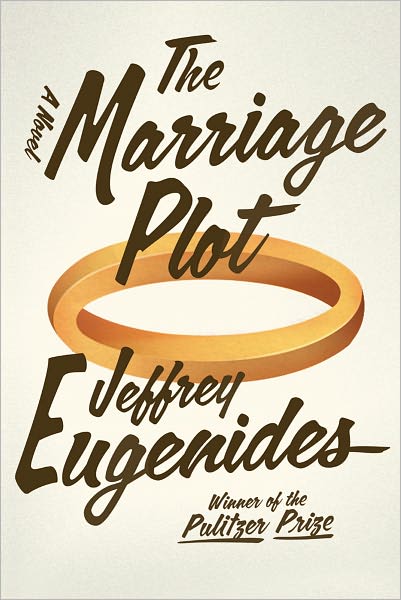
The Marriage Plot — Jeffrey Eugenides

The Marriage Plot is very competently done, and there’s nothing particularly wrong with it; some things may even be done particularly well. The problem is, as my faint praise indicates, a novel isn’t a student essay: it’s not enough for nothing to be particularly wrong. Something has to be smashing and fantastic for it to really matter. The Virgin Suicides, with its ceaseless questioning of what happened to the Lisbon sisters and its unusual narrative structure in the form of a chorus of outsider men who were once boys attempting to understand something they never quite can, had this quality. There’s a haunting, melancholy quality to the story and the way its told. Middlesex is imaginatively powerful because of Cal’s parents’ unusual relationship (does love conquer all, including biology?) and Cal’s own inter- or transexual state, which is so unusual amid novels that mostly cover straight people, occasionally cover gay people, but very seldom cover people whose bodies and minds don’t quite match like they should.

I keep copies of both Eugenides’ earlier novels, but I’m selling my copy of The Marriage Plot. I can’t imagine rereading it. In The Curtain, Milan Kundera wrote something that has long stayed with me because of how right he is:

Every novel created with real passion aspires quite naturally to a lasting aesthetic value, meaning to a value capable of surviving its author. To write without having that ambition is cynicism: a mediocre plumber may be useful to people, but a mediocre novelist who consciously produces books that are ephemeral, commonplace, conventional—thus not useful, thus burdensome, thus noxious—is contemptible.

Eugenides has that ambition. I concede The Marriage Plot might outlast its author. But I’m skeptical it will: the religious stuff Mitchell experiences doesn’t measure up, and the mostly banal problems faced by recent college graduates doesn’t quite live up to anything. Leonard is the only person with real problems, both in terms of his ailment (manic depression) and his work (as a biologist: he is confronting the natural world, and some of the most interesting sections describe both his efforts in taming yeast and his status in a science lab). Madeleine, like so many of us, is committed to love with a person who maybe isn’t worth it. In listening to her sister’s trouble, we find this: “like anyone in love, Madeleine believed that her own relationship was different from every other relationship, immune from typical problems.” She isn’t, and her relationship is more like that of other people than she’d like to imagine it to be. And The Marriage Plot is more like other novels than I want it to be.

There are long sections of background that we might not need. We find that “Leonard had grown up in an Arts & Crafts house whose previous owner had been murdered in the front hall.” Grisly, but not vital to the story. “[. . . ] Madeleine took the opportunity to make herself more presentable. She ran her hands through her hair, finger-combing it.” Nothing wrong with this: it’s just average. Maybe too Victorian. Later: “Ground personnel rolled a metal stairway up to the plane’s first door, which opened from inside, and passengers began disembarking.” Do we need this? Or can it be eliminated? On their own, these sentences are okay, and I’ve committed such sentences many times, despite Martin Amis warning me not to. I want to put this book on a diet, to convince it to render only the essential. Too much of it makes me want to cut more; I can also now say that the only thing worse than taking an essay test of your own is reading about someone else’s essay test, especially when that essay test involves religion.

There are also some strange sentences; this one makes me wonder if the last word is a typo: “Years of being popular had left her with the reflexive ability to separate the cool from the uncool, even within subgroups, like the English department, where the concept of cool didn’t appear to obtain.” What does “appear to obtain” mean? Perhaps it’s supposed to be “appear to apply.” The good ones are still good, though: “Dabney had the artistic soul of a third-string tight end.” I’ve met Dabneys. And I get what Madeleine gets: people who declaim one kind of hierarchy or status system are always setting up another, whether they recognize it or not. I also find it intriguing that Madeleine can be an intense reader and also intensely popular. The two seldom appear together in fiction. Perhaps the combination makes her an astute social reader of everyone but herself.

She also understands Mitchell, who acts as a beta orbiter for most of the novel. He provides her with extra male romantic attention mostly because he’s a fool, and she knows it on some level: “Mitchell was the kind of smart, sane, parent-pleasing boy she should fall in love with and marry. That she would never fall in love with Mitchell and marry him, precisely because of this eligibility, was yet another indication, in a morning teeming with them, of just how screwed up she was in matters of the heart.” Being “smart, sane” and “parent-pleasing” is another way of saying “boring.” He also doesn’t make a move when he’s effectively asked to. At one point, Madeleine takes Mitchell home and goes to his attic room wearing only an old shirt—then resents him for not making a move when he obviously wants to and she does too.

She has a point.

When Mitchell is too eligible, that “eligibility” gets held against him. And he buys into ideologies that encourage him to remain a fool. A priest says to Mitchell: “Listen, a girl’s not watermelon you plug a hole in to see if it’s sweet.” Tell that to most women who do the same of men. There are plenty of sexist assumptions in this statement alone to get a feminist writing an angry paper about women, innocence, desire, and sexuality. Perhaps you shouldn’t take romantic advice from someone sworn to a life of celibacy and thus ignorance in a realm that most of us take to be vitally important. To be fair, Mitchell mostly doesn’t, but that he’s seeking knowledge from a source like that tells us he doesn’t even know where to begin to look for help. And Madeleine exploits this weakness. She says, “[. . .] one night the previous December, in a state of anxiety about her romantic life, Madeleine had run into Mitchell on campus and brought him back to her apartment. She’d needed male attention and had flirted with him, without entirely admitting it to herself.”

Rather nasty. Even worse than he falls for it. The optimal solution for Mitchell: find another girl, ideally one hotter than Madeleine, and use the other girl as leverage. Moping around doesn’t get the girl. As Sean Connery says in an otherwise lousy movie called The Rock, “Losers always whine about their best. Winners go home and fuck the prom queen.” Mitchell hasn’t realized or internalized this. Contrast Mitchell’s neediness with that of his rival’s distance: “The more Leonard pulled away, the more anxious Madeleine became.” She’s desperate for Leonard, which enables him to make her like him even more. Mitchell is on the opposite side of this recusive dynamic. He should read Radway’s Reading the Romance, which describes how women like to read romance novels in which the heroine falls for major alpha males. Radway doesn’t use this term, of course, and works to explain away women’s preferences for alpha males, but the descriptions still shine through.

Still, there are funny bits to The Marriage Plot; on the same page where Madeleine assesses Mitchell as a beta, her mother says that she “saw a program about Indian recently,” as if “a program” on TV could convey much about the country—but wanting to say she’s seen it does convey a lot about her. She goes on to say, “It was terribly depressing. The poverty!” Mitchell says “That’s a plus for me [. . .] I thrive in squalor.” The unexpected reaction to Madeleine’s mother and reframing of expected values makes this funny and shows us that Mitchell isn’t the stiff he might otherwise appear to be. And the book isn’t the stiff it might otherwise be. It’s just not funny consistently enough or deep consistently enough. It’s a muddle, even when I do laugh at lines like, “Madeleine’s love troubles had begun at a time when the French theory she was reading deconstructed the very notion of love.” Love isn’t so easily eliminated, however: it only takes belief to sustain it.

And the characters are more self aware than I’ve sometimes depicted them here. Madeleine, for instance, knows that graduating from college, for a certain class of person who is expected to go to college, just isn’t that hard. On graduation day, “she wasn’t proud of herself. She was in no mood to celebrate. She’d lost faith in the significance of the day and what the day represented.” If college is mostly a test of showing up, it’s hard to blame her; and majoring in English probably isn’t very hard for most hard-core readers (it wasn’t for this one, anyway; to me reading was fun, which meant that I did so much more of it than most of my classmates that class itself wasn’t very hard). And she finds that the deconstructing education she receives isn’t much use when she’s confronted with the messy reality of interpersonal relationships, including her relationship with Leonard. Saying manic depression is a socially constructed discourse won’t get help like lithium will, even with lithium’s side effects.

Leonard’s stay at Pilgrim Lake, a biological research facility something like Cold Springs Harbor Laboratory, is among the novel’s most interesting sections. I would’ve liked it longer and Mitchell’s Indian sojourn shorter. Leonard is researching reproduction in yeast; this yields a predictable but impressive number of metaphors for human dilemmas. His work also can’t be solved by appeals to socially constructed discourse, and I suspect many of the scientists at the lab are more interesting than Madeleine at Mitchell. For example, Madeleine observes one of the very few female research scientists and observes:

Madeleine guessed that MacGregor [who just won a Nobel Prize] made people uneasy because of the purity of her renunciation and the simplicity of her scientific method. They didn’t want her to succeed, because that would invalidate the rationale for their research staffs and bloated budgets. MacGregor could also be opinionated and blunt. People didn’t like that it anyone, but they liked it less in a woman.

Tell us more about the “simplicity of her scientific method.” How does that relate to literary theory? Could we see MacGregor take more of an interest in Madeleine? Who are the people who “didn’t want her to succeed,” and how does she react to them? I wouldn’t want to turn the novel into Atlas Shrugged, but there are rich idea veins here that go unmined in favor of Mitchell’s noodlings. My suggestions are somewhat unfair, as I’m violating Updike’s first rule of book reviewing—”Try to understand what the author wished to do, and do not blame him for not achieving what he did not attempt”—but I think an exploration of gender in science more interesting than an exploration of gender and mating habits among relatively average 20-somethings. Maybe because I fit into that group I’m too close to the subject to find it remarkable, but I think the novel has a smaller-than-life quality to it, in the same way B. R. Myers describes Jonathan Franzen’s novel Freedom at the link:

One opens a new novel and is promptly introduced to some dull minor characters. Tiring of them, one skims ahead to meet the leads, only to realize: those minor characters are the leads. A common experience for even the occasional reader of contemporary fiction, it never fails to make the heart sink. The problem is not only one of craft or execution. Characters are now conceived as if the whole point of literature were to create plausible likenesses of the folks next door. They have their little worries, but so what? Do writers really believe that every unhappy family is special? If so, Tolstoy has a lot to answer for—including Freedom, Jonathan Franzen’s latest. A suburban comedy-drama about the relationship between cookie-baking Patty, who describes herself as “relatively dumber” than her siblings; red-faced husband Walter, “whose most salient quality … was his niceness”; and Walter’s womanizing college friend, Richard, who plays in an indie band called Walnut Surprise, the novel is a 576-page monument to insignificance.

The Marriage Plot is a much better novel than this, but one detects the same kinds of maladies at work: “dull minor characters,” a problem beyond “craft or execution” (which are, again, well done here), “little worries” for the most part (until an unconvincing ending), and a general feel that life is elsewhere. Around the same time, Bill Gates, Steve Jobs, Bill Joy, Richard Stallman, and many others were coalescing around Silicon Valley to change the world. I wouldn’t be communicating with you right now via this medium if it weren’t for their work. Which isn’t to say every novel set in the late 70s or early 80s should be about computers, technology, or technologists: but in the face of banality, I can’t help drifting toward thoughts of people whose work really, incredibly, resolutely matters.

Eugenides is clearly interested in the inner workings of people—the problem is that Mitchell and Madeleine do not have particularly interesting or engaging insides. Mitchell needs a copy of The Game to be time-warped to him, stat, and Madeleine needs to better realize what reading nineteenth-century novels should prime her to know: that she’s not the first person in the universe with unwise love decisions or family problems. Why doesn’t she better analyze her own situation in terms of the novels she loves so much? Why doesn’t she better realize that, yes, her life could be one of the fragments in Roland Barthes’ A Lover’s Discourse? It could be, as Eleanor Barkhorn says in “What Jeffrey Eugenides Doesn’t Understand About Women,” that Madeleine doesn’t have any real female friends, but I’m not convinced: I’ve met women who have few or no real female friends, and I don’t think that aspect of Madeleine’s life is unrealistic. The bigger problem is her lack of friends in general, so those friends can’t say the obvious to her: Why Leonard? Do you realize what you’re giving up? And if she does, and she gives up much of herself anyway, then the problem is her own blindness—a topic that I don’t find tremendously satisfying to read about, since it basically implies Madeleine is stupid. Characters can only be stupidly blinded by love for so long before one removed the “blinded” and turns “stupidly” back into a noun.

Most of my problems with the novel aren’t with its prose on a micro level, although it has those issues: it’s with the dearth of real ideas in the novel. It doesn’t quite go with the literary-theory-as-life metaphors, which drop out partway through. It doesn’t quite go with the alpha-beta-male decision that Madeleine faces. It doesn’t quite go with the manic-depression-as-serious-issue-maybe-linked-with-creativity issue that Leonard has. It’s a host of “almosts” that reminds me some of a sunnier version of Michel Houellebecq, especially in The Elementary Particles and Platform.

Houellebecq, however, is willing to engage in a kind of brutal realism—for lack of a better phrase—that Eugenides doesn’t get to. Yet that’s what the characters need: less understanding of their petty problems and more context, or a harder eye, or someone to smack Mitchell and Madeleine, then explain both their problems. I could explain their problems. I’ve met a million Mitchells and Madeleines. Hell, I used to be one in some respects. But the world has a habit of correcting your faults, if you’re paying attention to the signals the world is giving. Mitchell and Madeleine aren’t. That’s what makes them so unsatisfying. As three of the characters go, so does the very, very competent novel that doesn’t get past competence and into transcendence.


You can read my initial impressions here.

Thoughts on the first 100 pages of Jeffrey Eugenides' The Marriage Plot

1) I would have stopped reading The Marriage Plot if it weren’t also related to some of my academic work. It captures the feel of slogging through a 19th Century novel. As you might imagine, this isn’t a compliment.

2) Until about 100 pages in, no characters have real problems. They have fake, rich-college-student problems. I’m not opposed to such problems for the people experiencing them—I remember having similar ones and thinking they were significant at the time, too—but the real problem in the form of Leonard’s psychotic breakdown should arrive closer to page 40 or 50. Madeleine’s minor undergraduate affairs are much less interesting and hilarious than Karen Owen’s “An education beyond the classroom: excelling in the realm of horizontal academics” (which is a PowerPoint document). Owen’s work feels more honest.

3) If you want a better but less hyped novel about the undergraduate experience in an Ivy-League setting, try Tom Perrotta’s Joe College. Notice that you can also get the hardback for $4, shipped, from Amazon. Notice too how Danny in that novel has real problems: he’s a fish-out-of-water, his father’s business might be falling apart, and his actions have real consequences for him and others around him. He has to master a skill (being a lunch-truck driver) and understand that skill. Failure may result in his ejection from Edenic Yale. So far no one in The Marriage Plot has a real job; they’re like characters in Jane Austen. There may be consequences coming in the latter sections, but based on the dust jacket (a trip to India to find one’s self, a possible stint in grad school), I’m not optimistic.

4) Eugenides’ earlier novels both have major conflicts and problems from the beginning: Middlesex asks how to survive and adapt as a transexual (who as a group still have major problems in contemporary society, compared to average heterosexuals) and how to flee dictator-encumbered countries, while The Virgin Suicides (probably my favorite of Eugenides’ work) asks about what really happened to the Lisbon sisters—and, because of the very clever narrative structure, we can never really find out. It’s teasing yet effective, melancholy and happy, a meditation on how we understand the past, deal with love, grow up, don’t grow up, and much more. That last bit sounds grandiose and stupid, but in the context of the novel it’s not.

5) Given the timeline in the section I’ve read so far—late 1970s, early 1980s—I keep thinking about the most consequential thing happening in the world at that time: the personal computer revolution in Silicon Valley. Jobs, Wozniack, Gates, and millions of other, less famous names were building the future. This is an insanely unfair criticism of a novel, but it’s stuck in my mind anyway, like a background process that occasionally pops an alert into my consciousness: some people are doing real things. I dismiss the alert, but it’s set to go off occasionally anyway, and I don’t have the heart to sudo kill -9.

EDIT: I was reading Hacker News this morning and found this:

The offices of Zelnick Media were packed on a recent evening for #DigitalWes, an alumni gathering for the graduates of Wesleyan University who had made their way from jam bands and cultural theory to the warp-speed world of Silicon Alley. Guests nibbled shrimp and steak skewers while taking in a sumptuous view of midtown Manhattan from the roof deck. The hosts were Strauss Zelnick and his partner, Jim Freidlich, both class of ’79, whose Take Two Interactive has produced some of the best-selling and most controversial video games of the past decade.

Same demographic, same timeline, note the mention of “cultural theory.”

6) Reading The Game has spoiled me on excessive beta-male behavior. Watching Mitchell around the beautiful and distant Madeleine mostly makes me want to tell him what he’s doing wrong. The Game was published in 2005, so saying this about a novel set before The Game’s publication isn’t fair, but the book still crystalized for me a) what not to do, b) how to eliminate certain kinds of obviously unsuccessful mating behavior, and c) how to think systematically about useful principles in men dealing with women. Being a whiny hanger-on to a person with relatively high dating market value is not good for Mitchell or for Madeleine, the object of his desire. Note that this is not limited to men: I also have low tolerance for women who spend long periods of time throwing themselves on distant alpha males who at best hook up with and then dump them. Don’t want to be hooked up with and dumped? Don’t chase alpha males whose primary attraction appears to be their unattainability. I don’t love novels whose characters’ primary problems can be solved with a simple, one-line piece of advice that, if followed, will result in the solution to said problem.

7) Nineteenth-century novels are not good guides to behavior in the 21st century. Hell, they’re not even good guides to behavior in Brown in the 1979 – 1983 period. This is as true for Madeline and for others. Literary theory is also a pretty crappy guide to real life, which may be part of the reason theory’s hold on English departments has loosened in the last 30 years. Still, perhaps the most hilarious and best scene involves Madeleine throwing Roland Barthes’ A Lover’s Discourse, which alleges that there is no such thing as love, only the speaking of love, at the boy she loves.

8) I can follow the inside-baseball parts of literary theory (Barthes, Derrida, and other English-department heroes appear, mostly as signals of what various characters believe), but I doubt such things would be of great interest to anyone not in English departments. This relates to #5: it turns out that the really important stuff happening in this time period is happening among tech people, not among grad students in the humanities. A novel about someone who jumps from the one to the other might be interesting, and it could dramatize events with real consequences that don’t automatically revolve around sex and death. Intellectual curiosity is an underutilized motivation in fiction.

9) Another book to read if you want campus-war stuff: Richard Russo’s Straight Man, which is also much funnier.

EDIT: 10) See my full review here.