Morcock, Melville House, school, boundaries and norms, the greatest NCY pictures you’ve ever seen, and more!

* “The Anti-Tolkien,” about Michael Moorcock, is quite good and worth reading but it does one thing that consistently annoys me: it doesn’t tell new readers where we should start. Any piece about a long-established and/or prolific artist should have a suggested starting point. Few if any artists are equally good across dozens of works. In the case of Elmore Leonard, for example, I’d suggest starting with Get Shorty and Out of Sight in that order.

* Melville House on publishing The Senate Intelligence Committee Report on Torture. You “should” read it, though you probably won’t.

NYC_Skyline* Don’t be a full-time adjunct and don’t go to grad school, which ought to be obvious.

* The Unappreciated Success Of Charter Schools.

* Dr. Ali: On sexual boundaries, exotic lovers and three ways I answer your dating questions

* It’s always been hard to make a living in art.

* Incredible NYC pictures taken from 7,500 feet.

* Heat Death: Venture Capital in the ’80s is unexpected and well-cited.

What incentivizes professors to grade honestly? Nothing.

Same Performance, Better Grades: Academic achievement hasn’t improved much, so why are college-goers getting higher GPAs than ever before?” doesn’t cite Academically Adrift: Limited Learning on College Campuses, though it should. Both the article and the book observe that grade inflation is real and doesn’t reflect increased student knowledge. But neither book nor article bring up an obvious question: What incentive does an individual professor have to grade honestly (or, as students might call it, “harshly”)?

When an individual professor grades students harshly, the students give low evaluation scores (which the article does, to its credit, note), but more importantly they can create a lot of extra work in the form of emails to be answered and, to a lesser extent, office hour visits generated. Much of htat work is not rewarding, intellectually or remuneratively, although office hours can be. Professors are rewarded primarily by producing research and in some schools to a lesser extent for getting high student evaluations, and grading honestly is counterproductive for either of those goals; it’s like a professional athlete honing his knitting skills.

Helicopter parenting may also contribute to student expectations around grades, and administrator expectations that students’s input will be valued in terms of who to hire, fire, and promote. I haven’t experienced helicopter parenting first-hand, but I have heard the stories, and I have heard about grad students and adjuncts going to meetings based on low grades; the message gets disseminated even if it isn’t stated explicitly.

I’ve gotten lots of unhappy emails and, more rarely, calls from students. The perhaps most interesting ones come from students who plagiarized papers but thought I should excuse the plagiarism. In middle or high school perhaps that would be appropriate, but not college, and their efforts take time and mental energy to deal with. If even the plagiarizers want a hearing and elaborate negotiations and second chances, imagine the students who just wrote weak papers!

There’s no check on giving high grades, especially in squishy humanities courses like the ones I teach. The article says “Ultimately, grade inflation has severe consequences,” but then lists extremely un-severe consequences, like difficulty “for employers to vet the caliber of an applicant” (do employers actually do this?) or misleading students, “who often use their grades as benchmarks to help diagnose their strengths and weaknesses.” Some students do that but many don’t. The “severe consequences” paragraph feels like it was invented by a student for a paper.

Finally, the much-ballyhooed shift from tenured faculty to adjuncts means that even small or unjustified complaints can mean the difference between a given adjunct getting a course or not getting a course, if the opportunity is down to two, or a small number, of potential instructors. I’ve not heard of any adjunct, grad student, or instructor getting static for giving overly high grades. Give low grades or run a demanding class, though, and it can and does happen. Many adjunct decide to buckle up for safety’s sake, instead of going wild by not wearing that seatbelt.

Colleges mostly know that the students will pay tuition (or rather, their parents and their loan originators will) if they are happy with the educational product, and professors know they are more likely to keep getting paid if they have fewer student complaints rather than more. Colleges have set up programs that are designed to graduate students with limited skills but real tuition money. Paying for the Party by Elizabeth Armstrong and Laura Hamilton describes the consequences.

Want more serious grades? Provide the incentives to give them. Almost no one wants more serious grades.

See also “Subjectivity in writing and evaluating writing” and “The validity of grades.” Moreover, the NBER paper “Why Have College Completion Rates Increased? An Analysis of Rising Grades” finds that “grade inflation can explain much of the change in graduation rates. We show that GPA is a strong predictor of graduation rates and that GPAs have been rising since the 1990s. We also find that in national survey data and rich administrative data from 9 large public universities increases in college GPAs cannot be explained by student demographics, preparation, and school factors.” The paper seems consistent with anecdotal impressions.

Briefly noted: Decoded – Mai Jia

Here is The New Yorker on Decoded (“This unusual spy thriller has neither page-turning plot twists nor a master villain”) and here is The New York Times. The book is not bad, which I realize is damning, and it suffers in comparison to Cryptonomicon, a novel whose explanations of cryptography are brilliant. Both novels, interestingly and perhaps significantly, start with the parents or grandparents of the nominally central characters. There are comments in Decoded about the nature of stories:

It all happened so long ago that everyone who saw her suffer and die is now dead themselves, but the story of the terrible agony that she endured has been passed down from one generation to the next, as the tale of an appalling battle might have been.

How much are we to trust stories “passed down from one generation to the next?” Maybe only as little as we are to trust that cryptographic protocols have been properly implemented. The woman giving birth in this passage was part of a rich clan that, like most rich clans, can’t maintain its structure over time, since, “very few of the young people who had left were interested in returning to carry on the family business.” The family doesn’t get enmeshed in the new government, either, at least until the “hero,” Rong Jinzhen, comes along.

I’m looking for some evocative quote to give a sense of the writing, but it feels flat and there is very little dialogue. Perhaps I’m missing something as Tyler Cowen finds its compelling. Perhaps I’m blind to the novel’s psychology. But the book is too easy to put down and forget.

Links: Flying torches the planet, Birdman, books, crazy creative people, fertility, and more

* “Every Time You Fly, You Trash The Planet — And There’s No Easy Fix,” an underappreciated point; I know many people who see SUVs as environmentally evil and travel as virtuous, when their love of the latter more than offsets their hatred of the former.

* Oliver Peters on Birdman, which is an unusual and very good movie.

* Mark Zuckerberg discovers books.

OLYMPUS DIGITAL CAMERA* English PhDs can’t get jobs, which would-be English PhDs ought to know.

* The messy minds of creative people.

* “How California Bested Texas“—except in terms that arguably matter most, population growth.

* “Why do women know so little about their own fertility?” And that this issue gets mixed up in politics is itself depressing. The facts, people! Start with them.

* This Guy Took a Photo Every Time He Saw Someone Reading a Book on the Subway.

Life: Transience edition

“Reflect often on the speed with which all things in being, or coming into being, are carried past and swept away. Existence is like a river in ceaseless flow, its actions a constant succession of change, its causes innumerable in their variety: scarcely anything stands still, even what is most immediate. Reflect too on the yawning gulf of past and future time, in which all things vanish. So in all this it must be folly for anyone to be puffed with ambition, racked in struggle, or indignant at his lot—as if this was anything lasting or likely to trouble him for long.”

—Marcus Aurelius, Meditations; Lil’ Jon alludes to and was inspired by Aurelius in “Turn Down for What.” Note too that I’m not convinced the premise of the passage necessarily or sufficiently supports the conclusion.

Why bother observing inconsistencies?

A friend noticed that I tend to say things like this: “The number of people who are genuinely interested in this kind of social policy minutia is probably small, as the popular support for programs like UPK shows” and he asked: why bother if no one cares?

In some existential sense one could ask why anyone bothers doing anything. More specific to this case, I write to find out what I think—I’m not alone in this—and writing solely for yourself has a pointless, masturbatory quality. I also write the kinds of things I like to read, and to understand the world better. Not everyone is interested in that but I am and presumably many readers of this blog are.

Most ideas also have histories, and most beliefs about subjects outside of science don’t advance linearly.* They’re subject to fashion. So one way to determine current fault lines in social (and legal) thinking is to look at what other people in other places and other times have thought.

Take this example: In Sexual Personae Camille Paglia says that the Marquis de Sade’s work “demonstrates the relativism of sexual and criminal codes.” His major works were done more than 200 years ago. Is it not strange that the same points are made, over and over again, through the generations? One reading of this could be that posts like mine are useless: little changes, despite writers like me. Another could be that the optimist hopes tomorrow will be better, for some value of better, than today despite evidence to the contrary.

In Western society criminal codes are designed above all to regulate three things: violence, sex, and property. The relations among the three could be said to be the primary driver of life and hence literature. One could derive a general principle from lots of specific examples.

Virtually everything “big” starts small. This is true of startups, other businesses, novels, countries, and life itself (via evolution). In general it’s better to start with the specific and move towards the general. The more specific the better in most cases. While it is true that most people don’t especially care about hypocrisy, some do, and observing how a society or individual responds to hypocrisy or is hypocritical can be tremendously revealing. Some people don’t care about revelation, and that’s okay. My reasons for writing this blog and thinking about and observing things are similar to the ones Paul Graham enumerates:

I do it, first of all, for the same reason I did look under rocks as a kid: plain curiosity. And I’m especially curious about anything that’s forbidden. Let me see and decide for myself.

Second, I do it because I don’t like the idea of being mistaken. If, like other eras, we believe things that will later seem ridiculous, I want to know what they are so that I, at least, can avoid believing them.

Third, I do it because it’s good for the brain. To do good work you need a brain that can go anywhere. And you especially need a brain that’s in the habit of going where it’s not supposed to.

I tend not to get in too much “trouble” because I’m not well known enough to generate intense scrutiny or hate mail or misreadings. People misreading Graham are legion and frequently, unintentionally, hilarious. I don’t have nearly as many, but I still like to think I’m making a difference, however small, at the margins.


* This could be an argument for being in fields that unambiguously advance: at least you know when you’re right, as opposed to being merely morally fashionable.

Links: Tech changes culture, beyond the salacious, IKEA, pulp fiction, business, and more!

* “Sex and the Industrial Revolution,” though this has already made the blog rounds.

* “Beyond the Simply Salacious: Five Stories on Adultery,” though is it gauche to link to links posts? Tony Tanner’s Adultery in the Novel: Contract and Transgression also covered related grounds many years ago. It is striking how few modern works of criticism could be of interest to the general reading population.

* “Is the IKEA ethos comfy or creepy?” Both, though I have a special hatred of IKEA, plus an amusing-in-retrospect story that takes place in one. It relates to this: “Alan Penn [. . . ] conducted a study of the IKEA labyrinth and deemed it sadomasochistic.”

* “The birth of Pulp Fiction,” which is interesting for many reasons, one obvious one being between paperbacks and ebooks. I do think ebooks are vehicles for “for social and cultural enlightenment” and that they will further “de-provincialize the American public.” One can already see this in 50 Shades of Grey, for example, despite the bad prose. The intellectual elite is already mostly de-provincialized but political correctness and some related movements have re-provincialized large precincts of it.

* “On Triangl, maker of the ‘world’s [allegedly] hottest bikini’?” This is actually about making it in the apparel business and fulfilling customers desires.

* “Actually, Our Military Keeps Winning,” an essay contrary to current dominant narratives. If you aren’t reading James Fallows you should be! On New Year’s Eve we saw American Sniper, which was incredibly intense and whether it can be read as a pro- or anti-war movie probably depends on the viewer’s outside knowledge.

* People now move to the Southeast from California and the Northeast, not surprisingly since the Southeast is where the cheap housing is. While Californians and New Yorkers endlessly debate supposed income inequality they perpetuate it by forbidding new housing supply. I want to move to Austin or perhaps Denver. My parents left California for Seattle when I was a kid due to housing costs and crap schools, and now Seattle and environs are following California’s lead by pricing people out of the market. See Matt Yglesias.

* Behind the scenes of Australia’s prostitution boom.

Interesting books I read this year

“The best books of the year” articles are useful but annoying: useful because there are often interesting books I missed but annoying because a book isn’t worth reading simply because it was published in a given year. So I’m doing a list not of books published this year but that I read this year and think deserve attention.

* Mating in Captivity by Esther Perel: Almost nothing in pop culture prepared anyone for long-term relationships, and Perel’s book is about many, many things, among them what happens after most novels, movies, and TV shows end. When it came out Tyler Cowen called it “the most dangerous book I read this year,” and that was in 2006. It is not a good book to admit to liking publicly.

* Arts & Entertainments by Christopher Beha, about a failed actor who becomes an inadvertent teacher who becomes an inadvertent amateur pornographer who becomes an inadvertent reality TV personage. I laughed, and the book’s final dialogues are still funny but also offer unexpected, powerful commentary on our time. Why isn’t this book more popular and getting more attention?

* The Power of Glamour by Virginia Postrel, about a latent yet pervasive phenomenon that was until recently underrated and even ignored by me.

* Related to The Power of Glamour, The Rosie Project, as recommended by Bill Gates. It starts promisingly and ends brilliantly, with me laughing at almost every page; if you know any geek, nerds, or programmers, you need to both read this and give it to them.

* The Great Man, by Kate Christensen, also very funny and with sentences that delight from start to finish.

* Love Me Back by Merritt Tierce, another book that should be better known and hits many valences simultaneously.

* Zero to One by Thiel and Masters, which is notionally about startups but is really about the world.

* Echopraxia by Peter Watts, but do read Blindsight first. So good it’s hard to write about.

* Trust Me, I’m Lying, which I didn’t read when I first heard about it because I thought, “Meh, I already know.” I didn’t, and the prose is delightful. Note too the comments at the link.

* Bess adds Dear Leader: Poet, Spy, Escapee–A Look Inside North Korea, about a defector’s astonishing story. The sentences are strong, yet I feel like I already knew enough about North Korea prior to reading.

What have I missed?

5K / “Retina” iMac and Mac OS X “Yosemite” thoughts

Note added Jan. 29: Yosemite update 10.10.2 seems to have solved the software problems noted below. The hardware continues to be excellent. The next version of OS X, El Capitan (10.11), is said to be “a return to slow-but-steady improvement after Yosemite’s upheaval.” Let’s hope so.

I’ve had a Retina iMac with Yosemite installed for close to a month, which is long enough to form a mostly positive impression—except for the bad software situation. The iMac’s “Retina” screen is as beautiful as advertised and is a tangible reminder of progress. If you use it you won’t want to go back, any more than you’d want to go back to celibacy after losing your virginity. But Yosemite crashes about once a day for reasons mysterious to me and to Apple support. Yosemite is a step backwards.
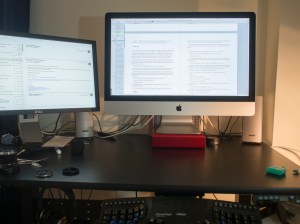
5k retina imacLet’s start with the headline feature: the screen difference between the preceding iMac and this one is real, but it’s not nearly as great as the difference between the low-resolution Macbook Pro and the Retina MacBook Pro. Retina MacBook Pros are not just better but insanely, can’t-go-back better than their predecessors. The Retina iMac is an improvement, a real improvement, but not as startling. If you’re in the market for an iMac-like computer and can afford the price premium, the better display is worth the cost. As noted above, you won’t want to go back. Standalone versions of the screen aren’t even available as of this writing; when they become available, they’ll likely cost $2,000 in and of themselves.

People who bought iMacs in the last two to three years should probably wait for the next iteration because it should be cheaper than this one. My last iMac came from 2010 or thereabouts and I was due for an upgrade, especially because I now do more with video than I previously had. Fast computers are to video what oil is to transportation: It’s almost impossible to have enough.

This iMac is not as quiet as my previous iMac, though it also isn’t noisy enough to make the fuss that would be necessary to return mine and try again. It has an annoying, intermittent buzz that’s noticeable in quiet rooms. I can imagine myself standing in an Apple store, most of which sound like an airplane engine is prepping for takeoff, and trying to get the support person to do what I want them to do, while the support person looks at me like I’m crazy.

In software terms the OS jumped from 10.6 to 10.10. The only day-to-day difference I notice is the addition of Messages, which lets me text to phones from my keyboard. Phone keyboards have always bothered me—which may be a sign of age—and Messages is a significant enhancement. Obviously there are numerous differences in the APIs and libraries available, which developers have leveraged or are leveraging, but they’re not as salient to me as the “headline” features. Still, I think about how every version of OS X from 10.0 – 10.6 saw major feature improvements that immediately made my life way better in an immediate, tangible way. I’m not seeing that in the 10.6 – 10.10 jump.

The major OS X features I love and constantly use were introduced years ago: Spotlight, Time Machine, Exposé. Messages could probably have been backported to 10.6 but wasn’t. Some cool new programs like Pixelmator seem to have been enabled by the backend OS work, but those programs don’t have a huge effect on my day-to-day life. Spotlight is harder to use and doesn’t seem to work as well as it did. Boolean operators also still appear to be absent.

The migration process from old iMac to new was painful and manual; Migration Assistant is notoriously unreliable and works terribly if a person, like me, is moving from two hard drives to a single drive. Permissions problems appeared, as they so often do. I could solve them with time and patience, but they might have stymied less sophisticated users. The general reluctance to upgrade any working computer is reasonable based on my experiences.

Once I had the basic migration done, I spent a lot of time turning off various “features.” Threaded mail messages in Mail.app don’t work very well for me, and the animations were annoying and slowed things down. Some pretty but non-functional could only be turned off through the command line. It would be nice to have a “fuck animations” checkbox in system preferences somewhere. Speed is of paramount importance.

Four years ago I wrote about my uninterest in upgrading from OS X 10.6 to 10.7, and recent experiences have borne out that reluctance. Most of the Apple operating systems since 10.6 appear to be less stable than 10.6. This Hacker News thread is full of stories about problems with Yosemite. Right now Yosemite is only on its .1 release, so the .2 release may solve some of the problems, but the stability issue should have been solved in beta. In addition to the WindowServer crashes linked to above, Flash crashes routinely in the browser. Final Cut Pro X is unusable because it crashes when attempting to import any new video. This will necessitate yet another call to Apple support. aFinder has crashed a couple times for mysterious reasons—despite the fact that the hardware in this machine is by every conceivable metric faster, better, and more tolerant than the hardware in the preceding machine.

What gives? I’m not the only one having these problems. In addition to the Hacker News thread, consider “AppleCore Rot,” another piece on Apple’s apparent quality problems. This in particular resonates: “Stuff that worked for years breaks, while new visual crapware is piled on endlessly.” I would like Apple to make it work first and make it pretty second.

In an email my Dad observed this about Yosemite and the linked Hacker news thread:

The first post [in the Hacker News thread] complains about the phone calling feature. About 22 years ago, I routinely made calls from the IBM PC 1 using Lotus Organizer 1.0 to dial from the address book with Windows 3.1 and the world’s slowest modem. But then again, Organizer was the best PIM [Personal Information Manager] ever and in some respects AmiPro and WordPro were better 20 years ago than Word is today.

I used to use Lotus WordPro too, and it was much stabler than Word today (although Word has been relatively stable in this version and the last version). Some software was better a decade ago than it is today.
That being said, many of the random waits that involved exporting photos from Lightroom or, to a lesser extent, videos from Final Cut Pro X have either disappeared altogether in the case of the former or shrunk dramatically in the case of the latter. That’s the few times FCP X has actually worked, however.  Some simple scripts run faster. Manipulating exifdata with Exiftool is faster. Web browsers no longer choke and sputter (that they did on a relatively modern machine could be the subject of another cranky post). Fast user switching is now genuinely fast. The advance of hardware, and what it enables, is not to be underestimated.

Still, there are other caveats. The larger hard drive is good, but Apple should really be offering four terabyte Fusion drives. I’m puzzled as to why it doesn’t, apart from simple cheapness. Large hard drives are one of the (dwindling number of) reasons people still use desktops.

My iMac had a 256 GB SSD and a 2 TB conventional drive; this one has 128 GB and 3 TB, respectively, which is anemic improvement in capacity terms (though the SSD is much faster and the interconnect between the SSD and CPU is also much faster). Still, 4 TB hard drives are widely available and there’s no good reason why Apple shouldn’t offer bigger hard drives. There are other nice-to-haves: USB 3 ports. Thunderbolt ports. External hard drive speeds are much faster. I’ve gone from having about 2 TB readily available to having 9 TB readily available, between a Drobo and the internal drives.
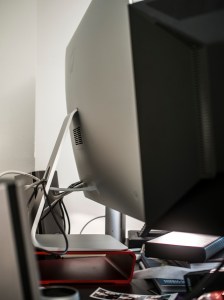
5k retina imac side viewAesthetics are a wash. From the front, the new iMac is visually indistinguishable from the old, and photos don’t convey the screen’s beauty. The profile shots show a much slenderer machine. Also notable in the pictures in the Elevation Stand, which began as a Kickstarter Project that I backed. It’s by far the best iMac stand I’ve found, and I’ve tried various solutions ranging from wood blocks to books to an expensive stand festooned with screws sold discovered through the Apple store. The Elevation Stand is expensive but it works. The space between the top and bottom of the stand will also fit external hard drives.

My desk is somewhat ugly and I’m perpetually telling myself I’ll clean it off and make it very pure and functional seeming, but for whatever reason it rarely actually happens and as soon as it does I end up re-covering it with books and cameras and cords and other crap. This is obviously not part of the iMac review.

The iMac itself is still beautiful. If you use a computer too much, as I do, you’ll want one.


Here is Farhad Manjoo’s paean to the iMac. Most tech reviewers are ecstatic, perhaps disproportionately to how ecstatic they should be, but they also know computers well and know that the screen is amazing given how expensive 4K and 5K screens cost. I have a 23″ side monitor and no desire or need to upgrade it.

Here is a Reddit thread that hits many of the same points I’ve made about OS stability. Here is Geoff Wozniak on why he quit OS X. You’ll recognize the themes I hit.

Links: Bogus authenticity, radicalizing the romanceless, universities, destiny, and more

* “Realer than you: How did authenticity become the hot new status symbol?” The contemporary obsession with travel as a somehow soul-enhancing experience is my favorite example of this general trend. Here is my review of The Authenticity Hoax.

* “Radicalizing the romanceless.” Maybe. Though this is my favorite link from this patch.

* “Promising solution to plastic pollution,” an underrated problem.

* “U.S. Is No. 1, China Is So Yesterday,” which is another underappreciated problem: demography is destiny.

* A totally indecent, untraditional, radical proposal: “universities should prioritize academics.” This may also ameliorate some of the current elite university admissions madness.

* “Kindle Unlimited pisses off Amazon authors;” note that this is one danger of competing on price.