Lost in translation: A 20 year espresso-machine odyssey from the Sylvia to Nespresso to the DeLonghi Magnifica S

My father, Isaac, wrote this.

In Lost in Translation, Bill Murray seems equally confused by Japanese pop culture and a middle aged guy’s uncertain emotions upon encountering the achingly beautiful Scarlett Johansson. Since much of the dialogue was purportedly improvised, I don’t think Bill was acting on either front. Over the past 20 years, I’ve had a series of mostly Italian espresso machines and my experience with these has also been lost in translation.

In 1997, Starbucks had yet to metastasize across most of America and the independent coffee house movement was nascent. So the only effective way for a writer like me to get an espresso jolt in the afternoon was to buy a machine. This was in the early years of web shopping (more Ask Jeeves than Google), but after researching products, I decided to by a Rancilio Sylvia machine, along with a Rancilio Rocky “dosing” burr grinder. I have no idea why an Italian company would decide to randomly name these machines Sylvia and Rocky (see the Lost in Translation note above), but both are still sold and get great reviews. My experience was good—sort of.

The main problem with the Sylvia was (and is) that it was (and is) gigantic. It weighs about 50 pounds. The Rocky is also huge for a burr grinder. Since I’d ordered them online, I was really surprised by their height, weight, and girth. I was even more surprised to see that the instructions for both were only in Italian! In this case, I was lost without translation.

After a series of long phone calls to the vendor back east, I was finally able to make coffee. The Sylvia makes great coffee and an enormous mess. It’s a semi-automatic machine, which means the user has to grind the coffee (hence the need for Rocky), tamp it into the espresso holder, shove the holder back into Sylvia, brew the espresso, and hand steam/froth the milk with the machine’s steam wand into a stainless steel pitcher for a cappuccino.

The good news for us coffee junkies is that the milk can be heated to 200 degrees, since it’s a manual. But steaming the milk at home also means that I had to buy a coffee immersion thermometer, adding to the countertop clutter. While this process can be fun for one or two cups, it’s exhausting to make cappuccino for a crowd. I got pretty good with the wand and could produce far better coffee than Starbucks, but I also had to clean up dry and wet coffee grounds and milk splatter. I felt like I should wear a rubber apron or Ghostbusters jumpsuit when making coffee. Still, I used this combo for about ten years.

About ten years ago, I was in Paris and encountered my first Nespresso machine. Nespresso machines use proprietary pods. This was a revelation—shove a pod into the machine, press a button and coffee, cappuccino, etc., appear with little fuss and no mess.

When I got home, I gave Sylvia to friend with a boat to use as an anchor and bought a compact machine, called “The Cube” (this model is no longer sold). The Cube only made espresso using pods and one had to use a separate frother to create a version of cappuccino. It was easy to use and created very little mess; I no longer needed the hulking Rocky next to it. The Cube system, however, produces frothed, not steamed milk, which means a lukewarm drink. The Cube is also owned by Nestle, a Swiss company, and not only were the instructions in English, but there is a help line staffed by giddy customer service reps. No translation issues with the Cube.

After about another five years, I grew tired of lukewarm coffee that wasn’t quite as good as it should have been and bought my second Nespresso machine, a DeLonghi Lattissima+. This baby was light years better than the Cube, because it is not only compact and easy to use with little mess but also produces actual steamed milk at a hotter temperature (albeit not the scalding temp of the Sylvia).

After about ten years of using Nespresso machines, I got tired of their basic problems. First, the pods have become ever more expensive with time. The pods now cost between $.70 and $1/per pod. I go through at least 10 pods per week, so this quickly rises to the Gillette razor blade problem; Nespresso could actually give away the machines, like a heroin dealer passing out samples. They know you’ll be back. The second issue, however, is insurmountable—no matter which of the so-called “Grand Cru” coffee varieties I bought, the coffee inside the pods is entirely “meh.”

After much googling and a referral from Jake (who reads Megan McArdle’s holiday gadget guides), I decided to give up on Nespresso and dig a new hole with a DeLonghi Magnifica S machine. This is my first “super automatic” machine, which means that it does everything with “one touch.”

Pour the beans of you choice in the hopper, milk in the integrated pitcher, water in the tank, select your brew and voila, there it is. The Magnifica S arrived Saturday. DeLonghi is yet another Italian company. Unlike the Sylvia, the instructions came in English, along with about 20 other languages. Unfortunately, the manual came on a DVD, and as a Mac guy, I haven’t had a DVD drive in years. Also, the first thing you encounter on opening the box is a large warning sheet in 100 point type: PLEASE TO NOT RETURN THIS ITEM TO THE STORE, CALL THE TECH SUPPORT TEAM. Hmmmm.

Back to Google to find the instructions online. For those interested in a Magnifica S, note that DeLonghi makes at least a half dozen machines, all called the Magnifca S, but different is some critical ways and with slightly different model numbers (DeLonghi could learn about product lineup from Apple). More lost in translation: why didn’t just give each one a distinct name, like Sylvia. I bought the Magnifica S model # ECAM 24.462, which has a two line display, as opposed to the 24.262, which uses a forest of pictograms like a McDonalds cash register. Word to the wise: get the 462.

The Magnifica turns out to be almost as big as the Sylvia I started with 20 years. While the instructions I found online were in English, they’d been badly translated from Italian and were incredibly complex and confusing. Now I understood why the warning sheet is included. It took me about an hour and a half to set up the machine—longer that it took me to set up my newest MacBook Pro in December. I’m confident that, while this machine has probably not ended as many relationships as assembling IKEA furniture has, it must have ended a couple.

After much fiddling and attempts to discern the odd instructions and ever stranger illustrations, I finally produced a terrific cappuccino—assuming you use good beans. The machine is indeed one touch when finally configured and, unlike the Nespresso machines, it’s self-cleaning. I used the Streetlevel blend from my favorite coffee shop and roaster, Verve Coffee Roasters. It was roasted last week and is the blend used in Verve coffee shops. Nespresso pods are never quite as good as they should be because the time between roast and use is too long. With the Magnifica, one doesn’t have to suffer mystery coffee, roasted who knows when, in expensive pods.
Links: Measuring atheism, housing and the good life, free speech, Laura Kipnis, and more!

* “How many American atheists are there really?” The question is not that interesting in and of itself but the methodology is fascinating, hilarious, and worthy of Kahneman and Tversky!

* (Possibly NSFW): “American Apparel’s Creative Director Explains the ‘Made in Bangladesh’ Campaign: Iris Alonzo on the controversial advertisement’s mission.” Improbable!

* (Also conceivably NSFW): Sex letters from famous authors, including Joyce, Proust, and others.

* “I Am Cancer,” on another angle of the eviction system; see also Matthew Desmond’s book Evicted.

* Japan shows the way to affordable mega cities.

* “The Arrogance of Blue America,” overstated to be sure but also not the usual.

* “2017 Could Prove to Be a Turning Point for Plug-In Hybrids;” this is extremely important news because plug-in hybrids are an easy bridge between gas- and electric-powered cars.

* “Canada fought the war on science. Here’s how scientists won.” Oddly (maybe? or “normally”), people trust individual stories and anecdotes more than data.

* “Colleges Think Women Having Sex Is Dangerous. Laura Kipnis Says They’re Wrong.”

* Crisis or Stasis?

* The books that made writers want to write.

* “College students aren’t the enemies of free speech,” which ought to be pretty obvious, except:

Part of what’s going on here could come down to preference intensity and opportunity. By which I mean that college students who are in favor of expanding restrictions on free speech might feel relatively more strongly about it than do their pro-free-speech peers, and they have highly visible opportunities to express those views by attempting to no-platform speakers they don’t like, or responding assertively to instances of perceived administrator insensitivity.

In other words, a noisy minority may get all the press—as I wrote in “Ninety-five percent of people are fine — but it’s that last five percent.” Don’t mistake the minority for the whole!

Briefly noted: Somebody with a Little Hammer — Mary Gaitskill

The essays are not interesting throughout, but the most interesting ones are very interesting; pay special attention to her piece on turning “Secretary” (the short story) into Secretary (the movie) and the piece about Gone Girl which is a brilliant reading that is also wrong and misses part of the point of the movie and, maybe, of art in general. Brilliant but wrong readings are underrated and still help us see art and the world in new ways, and Gaitskill articulates the dark side of Gone Girl, and its popularity, well. Who cares if she misses the point? I’d like more works that miss the point intelligently than get the point boringly (as I may sometimes do, though I prefer not to).

Some sections on topical gender issues are more interesting than the usual, and Gaitskill acknowledges some things that many of her peers don’t, like: “My parents and my teachers believed that social rules existed to protect me and adhering to these rules constituted social responsibility.”

Her reviews often feel more interesting than the books she’s reviewing. Some of those books and their topics haven’t aged well (does anyone care about someone named Joey Buttafuoco, whose name rings a distant semiotic bell and who was apparently a brief ’90s tabloid item?).

Then there are paragraphs that are just very good and make up for whatever isn’t:

Popular music is the most banal and most mysterious thing imaginable, and it’s almost impossible to write about. A good song carries in each phrase fragments of thought, feeling, and sensation, all going by in a flash. It refers to things everybody knows, but it’s rooted in the specific muck of whoever wrote it / sings it. If it’s live, it includes the quick, erotic language of the body, a language at once to subtle and fundamental to be understood by the mind. So, along comes the intellectual writer and—oops! He’s squeezing down on the poor thing so hard, you think he’ll kill it, except he can’t even get his hands on it.

(By the way, John Seabrook is very good on music and doesn’t squeeze down on the poor thing so hard.)

Or this, on the short story version of “Secretary,” which contrasts with the movie one for reasons primarily but not entirely commercial:

In any genuine piece of fiction, the plot is like the surface personality or external body of a human being; it serves to contain the subconscious and viscera of the story. The plot is something you “see” with your rational mind, but the unconscious and the viscera–what you can smell and feel without being able to define–are the deeper subjects of the story. This is particularly true of “Secretary,” the heroine of which is a knot of smothered passion expressed only obliquely and negatively in her outer self. I conceived her as someone of unformed strength and intelligence, qualities that have never been reflected back to her by her world and so have become thwarted, angry, and peculiar. The deeper subject of “Secretary,” then, is the tension between the force and complexity inside the heroine, and how it gets squeezed through the tiny conduit of a personality that she has learned to make small, so that she may live in a small and mute world.

I’m not sure I agree with the notion of plot being advanced here—I think the plot shows us much more, if the writer wants it to—but one sees how plot functions for Gaitskill. It also explains why her short stories are more interesting than her novels: you can evade plot easily for 30 pages but not so easily for 300, with the longer length becoming tedious if the characters don’t act and react to things around them.

Links: Western Civ, smartphones and culture, free speech, “American War,” and more!

* “The crisis of Western Civ.”

* “Smartphones Are the New Cigarettes.” See also me from 2012, “Facebook and cellphones might be really bad for relationships.”

* “The French, Coming Apart,” a surprisingly deep article about Christophe Guilluy.

* “Solarcoaster: The Promise and Pitfalls of Rooftop Solar Jobs.”

* “Free speech, but not for all?” A very bad academic trend.

* The new novel American War depicts 2075 and a nightmarish vision of America’s future.

* “Why doesn’t ancient fiction talk about feelings?” Interestingly, neither does Elmore Leonard or modern pornography.

* “Can China Replace the West?” No. Note that the piece is more intelligent than you may assume from the title. Also, when in doubt keep an eye on immigration and emigration rates; people who vote with their feet are much more compelling than those who do with their voice!

* “ The siren song of homogeneity.” Looking over this links post, I realize that most of it is about deep thinking about political patterns. Which is maybe appropriate, given Brexit and Trump.

Links: Google Books?, climate changes, what popularity means, Fitzgerald, and more!

* “Somewhere at Google there is a database containing 25 million books and nobody is allowed to read them.”

* For real innovation, try a desktop PC. In my view desktops have been underrated for a long time and along many dimensions.

* “We Just Breached the 410 PPM Threshold for CO2: Carbon dioxide has not reached this height in millions of years.”

* What effect does the persistence of media artifacts have on college students?

* “The Nightmare Scenario for Florida’s Coastal Homeowners: Demand and financing could collapse before the sea consumes a single house.” Definitely one of those, “Don’t say we didn’t warn you” scenarios.

* Remember When Popularity Was Cool? Now It’s Just Work.

* “A Requiem for ‘Girls,’” a more interesting piece than it sounds. I watched the first few episodes of Girls with a woman who observed that all of the characters need to get jobs.

* “The Afterlife of F. Scott Fitzgerald.”

* “The Crisis of Western Civ:” “Now various scattered enemies of those Western values have emerged, and there is apparently nobody to defend them.” Except me, maybe.

Ninety-five percent of people are fine — but it’s that last five percent

How Airline Workers Learn to Deal with Passengers” reminds me of something I’ve noticed about teaching and consulting: 95% of people are fine, but that last 5% can occupy disproportionate time and mental energy.* There’s a temptation to become somewhat armored against that last 5%, which negatively impacts interactions with the vast majority of normal, reasonable people.

A lot of public-facing professions seem to have this problem, including emergency medicine doctors, cops, retail workers, and public school teachers. Because the bottom 5% can be noisy and time-consuming, a kind of misanthropy can set in, as one begins to think the few represent the whole—even if, intellectually, one knows it does not. Mental, psychological, and emotional armoring can reduce one’s overall effectiveness; this is particularly obvious in teaching, in which person-to-person connection plays a stronger role than it does in consulting.

Something about the human mind seems to make one negative interaction stand out more than 10 positive or normal interactions. I didn’t realize this at first, so a small number of negative experiences affected me much more than they should have. There’s a kind of crowding-out effect going on. Now, when I have to deal with someone who is unreasonable or at least not representative of the whole, I try to actively, consciously remind myself that they don’t represent the whole. Behind every irrationally unhappy person there are probably 49 to 99 normal people who aren’t giving me unwarranted grief.

Colleges in particular have been in the news lately, and a lot of people have read stories about crazy social justice warriors or censorious students—like the Middlebury College thing or the Halloween costumes at Yale brouhaha. Sure, these stories are in fact outrageous, but, again, they’re also salient because they’re unusual. Because they’re unusual, they make the news (and these kinds of events do represent a problem, though the problem tends to be overstated).

Friends and acquaintances sometimes ask me about the activists students suppressing speech. Yeah, I do, a little, but not very much. The vast, overwhelming majority of college students, seem to want what college students have always wanted: to learn something; to get by; to get a job when they’re done; to get laid; to learn something about themselves and the societies they live in; to make friends; to individuate from their families. You could add other items. Many students feel a vague sense of worry about being excellent sheep, and that worry is itself a sign of intellectual health. Most students, if they’ve thought about free-speech issues at all, vaguely support it. But a minority of well-organized and angry activists can make a lot more noise and news than the silent majority! As Nassim Taleb says, “The Most Intolerant Wins: The Dictatorship of the Small Minority.” A motivated minority, especially given the college-complaint apparatus, can create a lot of bureaucratic hassle.

Professors and other students often feel a kind of chilling effect, and one related to my essay, “How do you know when you’re being insensitive? How do you know when you’re funny?” Similar issues play out in many fields beyond teaching and consulting. One angry, unreasonable, or irrational customer or client drowns out a lot of generically happy or satisfied ones. Or consider “I was a landlord: This is what it taught me about people.” Landlords have to be prepared for worst-case scenarios, and that preparation bleeds into their everyday scenarios and interactions.

Teaching, especially at the K – 12 level, suffers from defensive posture problem. A teacher who tries to be honest and interesting risks the ire of his or her angriest, unhinged, or most ideological students (and, even worse, their parents). Almost no teacher gets in trouble for being boring, but a teacher can get in trouble or can get in trouble for being many values of “interesting.” Even I’ve had that problem, and I’m not sure I’m that interesting an instructor, and I teach college students. Students who complain about school being boring get told that school is supposed to be boring. Students who complain about school being interesting (or “offensive,” or whatever) get much more attention.

It’s easy for outsiders to say teachers should stand up to the vocal, unhappy minority. But it’s less easy to do that when a teacher relies on their job for rent and health insurance. It’s also less easy when the teacher worries about what administrators and principals will do and what could happen if the media gets involved or if the teacher gets demonized. It would be helpful for more administrations to make public statements like the University of Chicago’s, confirming a commitment to free speech and open inquiry.

Social media probably amplifies many of the problem traits described above by allowing the least-reasonable people to organize, scream, and (not infrequently) lie. I don’t know what, if any, solution exists to these problems, apart from most individuals to attempt to be as reasonable as possible and not succumb to the noisy but unhinged minority. Not much of a rallying cry, is it? No one, or almost no one, rallies for free speech and free inquiry.


* You can change the ratios some; I doubt the number of problem students reaches 10% in most scenarios, and I also doubt that the number declines below 2% (among professions that face the general public).

Links: Cancer cures, the Duke Lacrosse Scandal reverberates, more on academia, Google Book Search, and more!

* “Why James Watson Has Become Optimistic about Curing Cancer: The genomic cancer strategy shift.”

* “The Duke Lacrosse Scandal and the Birth of the Alt-Right,” a good post and an underrated point. People like justice and like other people to get what they deserve (the technical term is “altruistic punishment”), and universities seem to have a problem with maintaining that notion consistently.

* “After Years of Challenges, Foursquare Has Found its Purpose — and Profits.” I didn’t realize Foursquare is still around, but I’ve started using it and find it more useful than I thought.

* “Bunga Bunga, American Style” (trigger warning: politics).

* “‘Unwanted Advances’ Tackles Sexual Politics in Academia.” Best line: “But it’s also hard to ignore the irony here: Universities are now terrible places to find political heterogeneity. Campus discourse has become the equivalent of the supermarket banana. Only one genetic variety remains.”

* “Interview with Mark Greif,” of n+1, I like especially the bit about modern friends.

* “Were College Students Better Off Before Social Media?” Increasingly I wonder if the answer is “Yes.” It’s also striking to me how many students use private or locked social media accounts that aren’t visible to the general public.

* “The Man Behind History’s Most Iconic Movie Posters, From Breakfast at Tiffany’s to James Bond,” a surprisingly moving and beautiful piece. I’m reminded of Paglia’s book Glittering Images.

* “How Google Book Search Got Lost: Google Books was the company’s first moonshot. But 15 years later, the project is stuck in low-Earth orbit.” I wonder too if books just feel less central to the culture than they did even 15 years ago. And the majority of books from the last five or so years are probably available widely and easily in digital formats already.

* “Has coffee gotten too fancy?” Probably, but I like the fancy and the whole ridiculous process.

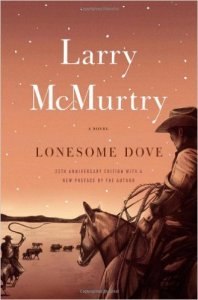
Briefly noted: Lonesome Dove — Larry McMurtry

Lonesome Dove is one of the best novels I’ve read, ever, and as much as I like physical books it may be easier to read on a Kindle: at more than 800 large, physical pages, it takes space. But that may be appropriate to the content, ranging as it does from Texas to Montana in the age of horse. I couldn’t decide whether the novel is any good until about 400 pages in, when a sudden-seeming shift happened. Lonesome Dove seems mostly comic, tonally, at first, with characters sitting around and speculating to each other. But then one finds that unexpected, brutal, and shocking shift, like a standard romantic comedy morphing into science fiction when the aliens land.

Don’t quit two hundred pages in, though you’ll be tempted to. As with The Name of the Rose, another of those fantastical, insane works I wish someone had forced me to read sooner than I got hold of it, patience is rewarded.

I’m reminded of James Wood’s remark about how good novels deploy “different registers:” “One way to tell slick genre prose from really interesting writing is to look, in the former case, for the absence of different registers. An efficient thriller will often be written in a style that is locked into place: the musical analogue of this might be a tune proceeding in unison, the melody separated only by octave intervals, without any harmony in the middle.” Richer novels are supposed to be polyphonic. Lonesome Dove isn’t. The narrative viewpoint scans from character to character, but they share a linguistic world that reflects their time and place. To Wood that’s a problem but to me it’s a shared world reflected in ideas and language. The common world has its own strange beauty, reflected in metaphors tied to the land and to fighting on horseback.

In Lonesome Dove characters often bury stories within stories within stories, sometimes in dialogue and usually not, describing the way things came to be. If those stories weren’t so damn interesting they’d be a crisis. But if “be interesting” is the first command to any artist, Lonesome Dove follows it. The world it depicts is implacable and hard and full of rational and irrational people. Like these:

The shadow of Augustus McCrae had hung over their courtship; Bob had never known why she chose him over the famous Ranger, or over any of the other men she could have had. In her day she had been the most sought-after girl in Texas, and yet she had married him, and followed him to the Nebraska plains, and stayed and worked beside him. It was hard country for women, Bob knew that. Women died, went crazy or left. The wife of their nearest neighbor, Maude Jones, had killed herself with a shotgun one morning, leaving a note which merely said, “Can’t stand listening to this wind no more.”

Leaving out the “a” in “It was hard country” seems odd but, again, part of the linguistic universe. One feels very rich, reading Lonesome Dove as a contemporary person with immediate access to infinite information, much as one feels rich and also terribly sad reading Behind the Beautiful Forevers. Other worlds exist now and have existed before, and it’s useful to remember them—and to think of how the future world will be different from the present.

Much of Lonesome Dove, on its own, seems basic, yet as a whole it’s beautiful. Like this:

The other men were easy to talk to, but they didn’t know anything. If one stopped to think about it, it was depressing how little most men learned in their lifetimes. Pea eye was a prime example. Though loyal and able and brave, Pea had never displayed the slightest ability to learn from his experience, though his experience was considerable. Time and again he would walk up on the wrong side of a horse that was known to kick, and then look surprised when he got kicked.

If I were James Wood I wouldn’t like “prime example” (it’s a cliché), but here it’s fine. The eye passes over it, and it’s the sort of cliché Call (who speaks here) would use. We see Call’s mind on horses, and we can generalize from the sort of person who is always surprised by a horse’s obvious behavior to a person we know, who is equally puzzled when he misses the obvious. Horses are as ubiquitous to Lonesome Dove as computers are to modern Americans.

There is an odd fatalistic determinism in the novel that is again not easy to parse out in a sentence quote but that is easy to feel. In the quote above we see that Pea Eye is who he is; the next paragraph starts, “Deets was different. Deets observed, he remembered,” as if that too arises from nothing. Almost no one in the novel has formal schooling, yet some minds race ahead while others are as lame as overriden horses. One sees other examples of this that I won’t share, because they spoil vital plot points.

It’s hard to say what you might expect going in, or what I expected going in, but whatever I expected wasn’t what I got. Usually novels about the west feel silly, pointless, and remote to me; this one is sophisticated, especially about ways of being and about gender relations. It’s never dogmatic, either: Augustus and Call are opposites in many ways, but the narrative voice never seems to choose one over the other as the two debate and act throughout the novel (in this respect the narrative voice is polyphonic, even if the characters think and sound characteristically similar).

The novel’s last sentences are strange and haunting.

There is enough in this novel to spend many years unpacking and experiencing it.

I fear to read the second one, for fear that the sequel won’t match the original, yet I also feel I have to do it.

Links: Management fails academia, Laura Kipnis in the news for campus sexual culture, the Mac Pro lives, and more!

* Every attempt to manage academia makes it worse.”

* On Laura Kipnis’s book Unwanted Advances: Sexual Paranoia Comes to Campus: “The Northwestern University professor strengthens her polemic against campus sexual culture.”

* Generation Why?

* “The Mac Pro lives,” to my surprise. I’d like a $1,200 – $1,500 Mac tower, but Apple hasn’t made such a machine in a long, long time. I’ll also note that I’m glad Apple isn’t totally ceding the tower-that-just-works market to Microsoft (a market Linux may be excluded from).

* “General Electric Wants Out of the Lightbulb Business.” Given how long LED bulbs last, this makes sense. By the way, the best LED bulbs I’ve found are from a company called Finally.

* “United Passenger ‘Removal’: A Reporting and Management Fail. Also: “Why flying in America keeps getting more miserable, explained.”

* “The Utter Uselessness of Job Interviews,” yet we keep doing them anyway. Maybe they’re just a signaling mechanism for seriousness about taking the job?

* “Great Barrier Reef at ‘terminal stage’: scientists despair at latest coral bleaching data.”

Links: Rigor in universities?, the culture of the U.S. and the Internet, small apartment buildings, SpaceX, and more!

* “AAUP report says adjunct professor was likely fired for insisting on rigor in courses.” Then again, who knows for sure? Still, see also my post, “What incentivizes professors to grade honestly? Nothing.”

* “The Like Button Ruined the Internet.” The best responses to this blog are always emails or other blog posts.

* “Toronto Schools to Cease Field Trips to U.S.,” and the Board cites “concerns that some students may be turned away at the border in the wake of President Trump’s latest travel ban and the American immigration authorities’ newly implemented ‘extreme vetting’ procedures.” Makes sense to me. I remember talking to a student with dual New Zealand and American citizenship and observing that, if I were her, New Zealand universities would be looking very good right now. See also “
Dr Peter Watts, Canadian science fiction writer, beaten and arrested at US border
.” One can see why Canadians would not be eager to visit!

* “America Needs Small Apartment Buildings,” and zoning reform more generally.

* “The age of offense.” See also me, “How do you know when you’re being insensitive? How do you know when you’re funny?

* “How Utah Keeps the American Dream Alive.” Unexpected throughout.

* “How SpaceX’s Historic Rocket Re-Flight Boosts Elon Musk’s Mars Plan;” by far the most important news last week is that SpaceX launched and re-landed a previously launched and landed rocket booster. The price of getting to space is about to plummet.

* “The Reckoning: Why the Movie Business Is in Big Trouble.”