Briefly noted: Delta-V, Permission, and The Stand

* Delta-V by Daniel Suarez is an SF novel with an SF novel’s typical poor writing. The second chapter begins with the scene: “The United States Senate Appropriations Subcommittee…” is in Washington DC. Two paragraphs later, “Three US senators sat…” Well, yes: would they be Mexican senators? Or Knesset members? Can’t we assume they’re US senators? Clumsy writing on almost every page made me give up, like “That meant eighteen people were definitely going into space on Joyce’s dime. Tighe hoped to be one of those people.” Suarez doesn’t need “of those people.” These basic errors are representative, not cherry-picked. Don’t be fooled, as the interesting premise can’t be sustained into a good novel because of consistently low prose quality.

There are some good moments; in one scene, on the first asteroid to be mined, two characters discuss creating metal parts via chemical vapor deposition (CVD):

“It’s existed since Ludwig Mond invented it back in 1890.”
“I’ve honestly never heard of it.”
“Back on Earth it’s less toxic to just use a blast furnace. Up here in space, though, CVD is going to be critical for precision manufacturing.”
[…] “It’s like alchemy.”
“No, it’s better than alchemy—it’s science.”

A fine point too rarely encountered, and a high end to the chapter.

* Permission by Saskia Vogel, an okay book but its timeline seems somewhat random and muddled to me. Too many novels are in the improbable reaches of the movie/TV glamor industries; people substitute “hope” for wages in those industries, with results that are often not good. In this novel, a dominatrix conveniently moves next door to a woman who becomes interested in her. Rather than what you may be thinking, more of the novel is like this: “Everything inside me, ocean. I inhaled with both my nose and mouth, greedy for air, feeling my lungs expand. My body was mostly water, but only mostly, still” than like this: “I was wearing a semi-sheer basque with a matching thong. He buried his face in my cleavage,” but there is some of both—like life, one could argue.

You have to be okay with the one-sentence paragraphs:

Only her.
Only this.
Only now.

So deep, man, right? Pass the joint. I didn’t regret reading it but am not sure it’ll stick with me, or most people. You could say that Nine and a Half Weeks got there first and is still colonizing this territory.

* I read Stephen King’s The Stand when I was 11 or 12, and it holds up better than Robert Jordan but not as well as I’d like: it has moments—a rural cop describes how his wife “neatens” the cells, for instance, the word being wholly appropriate—but it has some howlers in it too, like the doctor who says:

They are the symptoms of the common cold, of influenza, of pneumonia. We can cure all of those things, Nick. Unless the patient is very young or very old, or perhaps already weakened by a previous illness, antibiotics will knock them out.

Colds and influenzas are viruses, not bacteria, and antibiotics don’t affect them. If anyone had a cure for the common cold, they’d be a billionaire. It’s conceivable that we could today have a vaccine for the common cold, but the regulatory structure put in place by the FDA doesn’t favor it.

Still, the paranoid style in it is depressingly modern (look for all the mentions of not just government failure but active malice), although in the novel the paranoia and distrust are correct. It could be contrasted with the movie Contagion in “Bureaucratic Heroism,” a great essay with an unlikely title. Today, it feels like a product of disillusionment from the Vietnam war. But excess skepticism may be as bad or almost as bad as excess trust.

It’s also still scary, when the prose doesn’t interfere with the fear.

Links: The story around stories, the bored and the lonely, Danielle Steel’s mania, and more!

* “We don’t really know how to tell sociological stories.” Superficially, this is about why the last season of Game of Thrones has been terrible (it is), but it applies to many other stories. Highly recommended.

* “An Interview With A Man Who Eats Leftover Food From Strangers’ Plates In Restaurants.” Pairs well with The Righteous Mind by Jonathan Haidt; you’ll see why when he describes his “moral disgust” questionnaire that doesn’t include any harm but still elicits moral disgust from many participants. Could there be sociological elements to this story, too?

* “Why young South Koreans aren’t interested in dating,” a hugely depressing but also fascinating article. What do people think they are getting educations for? Jobs for? No wonder there are a lot of bored, lonely, isolated, and depressed persons out there. Does no one go one or two steps beyond whatever they’re told by their society to do?

* “Nuclear War Is Still Very Possible and Very Scary: Worry about nuclear weapons has faded, but the threat has not.”

* How the Hell Has Danielle Steel Managed to Write 179 Books? Speed, determination.

* Why books and lectures don’t work, but I’d ask what most people read books for (a common element in many of these links). This podcast with Michael Nielsen is also great, as he discusses spaced-repetition software like Anki and how it can be used to memorize great quantities of information. Raw memorization is presently underrated in the culture and education systems.

* “There’s a high cost to making drugs more affordable for Americans.” Almost no one is talking about this. We can likely force the cost of today’s drugs and treatments lower, at the cost of not having new drugs and treatments tomorrow. This seems like a poor tradeoff to me, but that’s a philosophical point. The interesting thing is that no one advocating for price cramdowns admits the tradeoff.

* Red Pills and Red Hats. See also my earlier comments about how the appeal of “Red Pills” is a failure of socialization, among other things.

* Dr. Ruth, “The Goddess of Good Sex,” probably the most amusing piece in this patch and relevant, at least, to links #2 and #6, above. I’ve never read any of her books.

* “Climate Stasis: German Failure on the Road to a Renewable Future.”

* U.S. 2018 Births Fall to Lowest Level in 32 Years. Kinda depressing.

* Is it possible to make academic philosophy worth a damn? Probably not, I’d guess, but maybe I’m wrong.

* This essentially explains why Apple no longer gives a shit about Macs.

* Memes, Genes, and Sex Differences—An Interview with Dr. Steve Stewart-Williams.

* “Resistance to Noncompete Agreements Is a Win for Workers.” This is an area where the left and right are aligned: the left worries about worker rights, and the right (putatively) worries about free markets.

* Anarchy is [even] worse than socialism.

* “Can ‘Indie’ Social Media Save Us?” No. It’s not addressing the problem as most people experience it; most people want a way to share

* When Boris Yeltsin went grocery shopping in Clear Lake.

* The New Right Is Beating the New Left. Everywhere.

* Impossible Foods’s empire of lab-grown clean meat. I tried Beyond Meat burgers and think they’re pretty good.

Links: Literary freedom, freedom of thinking, gigging, boredom and loneliness, code, and more!

* “The WIRED Guide to Open Source Software.”

* The U.S. Has a Battery Problem in the Race for Electric Car Supremacy.

* “Karl Ove Knausgård on Literary Freedom.”

* “Bret Easton Ellis Nails Contemporary America?” Unconvincing, but one never knows.

* “Down and Out in the Gig Economy: Journalism’s dependence on part-time freelancers has been bad for the industry—not to mention writers like me.” Journalists are taking part of their income in glamor, like actors, musicians, etc. When I graduated from high school, it was obvious that the Internet would fillet the journalism industry. What was obvious then is still obvious now.

* “UFOs Won’t Go Away,” due to radar and pilot sightings.

* “Maybe Europe Can’t Recover From the Financial Crisis.” It’s not just financial.

* “‘The Adjunct Underclass’ Review: Teachable Moments: College teaching has become a pickup job, like driving for Uber, for small stipends and little or no guarantee of permanence.” Or, as I wrote, “Universities treat adjuncts like they do because they can.”

* Bored and lonely? Blame your phone.

* The Coming Obsolescence of Animal Meat?

* A World Run with Code, by Stephen Wolfram of Mathematica fame.

* “What Explains the Resistance to Evolutionary Psychology?” and “The New Evolution Deniers.” Scientific ideas that conflict with deeply held beliefs about human nature or the human experience tend to be attacked.

* “Facebook’s Unintended Consequence,” better than 99% of the material you’ve read on the company.

* “Selective Blank Slatism and Ideologically Motivated Misunderstandings.” I read this piece after writing the tagline to the link two above.

* “‘Deep Sleep’: How an Amateur Porno Set Off A Massive Federal Witch Hunt.” Probably the most entertaining story of this batch.

* “Don’t Let Students Run the University.” Pretty obvious, but here we are.

* “Amazon Prime Pulls Back the Curtain on China’s Propaganda.” Odd that no one talks about this.

* “There’s a high cost to making drugs more affordable for Americans.” No one talks about this, either.

* On Tolkien’s story “Leaf by Niggle.”

* NuScale power’s nuclear plant design.

* They Got Rich Off Uber and Lyft. Then They Moved to Low-Tax States. Makes sense to me; California and New York are increasingly inhumane places to live.

* After Academia. Also, “Quit Lit,” another of those stories about people quitting academia. Somewhat boring by now, but word doesn’t seem to be quite out.

* “Private Colleges Offer Record Discounts as Tuition Costs Rise.” The complexity and secretiveness of the financial aid system is one of the unstated ways superficially progressive schools aren’t so progressive.

Recent books: The Earth Below, A Mind at Play, An Economist Walks Into a Brothel

* The Earth Below by Katy Barnett, a dystopian novel that seems promising but has way too much “My heart was racing and sweat poured down my face” and “for a moment his eyes lit up with an unalloyed smile” kinds of sentences. There isn’t much novel in the language of this novel, though “Then, like a drop of black ink diffusing through water, a dark thought spread across my mind” is impressive. Problem is, The Earth Below loses the war against cliché. I’d read the next one Barnett writes; The Earth Below shows promise.

* A Mind at Play by Jimmy Soni and Rob Goodman, an okay biography of Claude Shannon, a guy whose accomplishments happen almost entirely in the mind, leaving us not much of interest in his life itself. If you’re deeply interested in information theory and its history, this is probably good. If you’re looking for a good yarn, less so. The lives of brilliant intellectuals often don’t lend themselves to interesting biographies.

* An Economist Walks Into a Brothel: And Other Unexpected Places to Understand Risk by Allison Schrager. It sounds entertaining and is entertaining; there is a bit of the Gladwellian strategy or formula of story leads to research leads to conclusion, so if you’re tired of that structure you may not like this book so much. I wonder how many people are like this woman: “Before starting at the brothel, Starr lived a double life: marketing executive by day and exotic dancer on the site. Or it might be more accurate to say she was a high-paid exotic dancer ‘on the conference circuit’ who had a corporate job on the side.” There is also an implicit warning about academia, as Schrager describes her dissertation: “I shut myself away in the library and spent the better part of my twenties isolated, trying to solve that single math problem. Five years later, when I actually solved it, I expected something wonderful to happen; instead, everything fell apart. My relationship with my adviser deteriorated, and the sudden death of a close friend left me emotionally shattered. My worse enemy, however, was my ambivalence.” This would be an interesting book to read next to Lonesome Dove. Have you read Lonesome Dove? I saw copies of it many times before I did and wish I’d read it sooner.

* The Ape That Understood the Universe: How the Mind and Culture Evolve by Steve Stewart-Williams. This is more evolutionary biology; if you’ve already read a lot of it, you don’t need this one. The highs are high, though:

In many ways, the world today is a primate paradise. Compared to any other period in human history, we’ve got lower infant mortality rates, longer lifespans, less violence, greater wealth, and more opportunities to pursue the goals that suit us. We should be over the moon… but we’re not. Most of us are reasonably happy, sure. But we’re hardly ecstatic, and some of us are simply miserable. As Geoffrey Miller observes, the world has never been better, and yet many people have to take special medications to avoid suicidal despair. Now obviously, life has never been a picnic. However, some aspects of the modern world may be misaligned with human nature in ways that produce novel psychological problems – problems that, like breast cancer and endometriosis, are largely diseases of modernity.

or

We’re carnivores that sympathize with our food. We’re biological mechanisms designed to pass on our genes, but which fritter away our time playing games and weaving a web of fantasy around ourselves. We’re clusters of chemical reactions that contemplate deep truths about the nature of reality. And we’re little pieces of the Earth that can get outside our mother planet and venture to other worlds.

I found myself skimming a lot of familiar material.


As always if you know what I should read, let me know.

Links: UFOs and the military, Twitter is not America, Underland, transit, and more!

* “How angry pilots got the Navy to stop dismissing UFO sightings.” From the WaPo.

* “Twitter Is Not America: A new Pew study finds a gulf between the general population and Twitter users.” Notice, “As the platforms age, their devotees become more and more distinct from the regular person. For more than a decade now, many people in media and technology have been feeding an hour or two of Twitter into our brains every single day.”

* “The End of Being a Duke Professor and What It Means for the Future of Higher Education.”

* “Breathing Dirty Air Affects Children’s Health.” The more you learn, the more designing cities and everyday life around cars seems crazy.

* “The Scruton tapes: an anatomy of a modern hit job: How a character assassination unfolded on Twitter.” See also above, “Twitter Is Not America.”

* “We Don’t Have a Talent Shortage. We Have A Sucker Shortage.” True today, true tomorrow, and probably true for as long as humans are humans.

* “A Voting-Rights Debate Reveals Why Democrats Keep Losing.”

* “The desperate race to cool the ocean before it’s too late.” We’re doing (basically) nothing here.

* What lies beneath: Robert Macfarlane travels ‘Underland.’

* “What I Saw at Middlebury College.”

* “The antibiotics industry is broken—but there’s a fix.”

* “The 2008 financial crisis completely changed what majors students choose.” How could it not?

* “You can’t judge housing affordability without knowing transportation costs.”

* “Lambda, an online school, wants to teach nursing.” Good.

* On Oliver Sacks’ Obsession With Weightlifting.

* What the retiring French ambassador really thinks, another of the pieces that’s much more contentful than the title implies.

* A Quest to Make Gasoline Out of Thin Air: Prometheus.

* Everything I’ve written on Grant Writing Confidential.

Links: Dell and Linux and freedom, chestnuts, inequality and online dating, and more!

* Dell Opens Up About Its Linux Efforts And Project Sputnik. I gotta say, though, Dell’s website and comparison tools are insanely confusing. I feel like there has to be a better way. Like Apple’s way.

* On the greatness of the chestnut.

* The Northeast Is Becoming Apartment Country.

* How Europe learned to fear China. Too late, it seems.

* “Breaking up Big Tech would be a big mistake.” The problem is less with the companies involved than in us, the users.

* The anatomy of online dating has been revealed in unprecedented detail. Much of what’s been found is politically incorrect but simultaneously obvious. Also, “Attraction Inequality and the Dating Economy.” Does this sound familiar? In 2014 I wrote The inequality that matters II: Why does dating in Seattle get left out?“, and it stands up well today.

* “In L.A., Birthplace of Sprawl, Homes on Transit Fetch More.” Why would they not? Driving sucks and parking is expensive (not always in directly monetary terms, either).

* “Michel Houellebecq: Prophet or Troll?” Not the best essay and full of undergraduate errors, but parts resonate.

* “The Need That Democrats Aren’t Addressing: Candidates must challenge the public to give, not just promise the public more of what it gets.” This is consistent with my read. Likewise “How Not to Lose to Donald Trump.” A lot of what I read and hear in the media plays well to California and New York and academia and almost nowhere else, despite the fact that the vast majority of electoral college votes are in those other places.

* Linus Torvalds on social media (majority of the interview covers other topics, but I like his rant):

I absolutely detest modern “social media”—Twitter, Facebook, Instagram. It’s a disease. It seems to encourage bad behavior.

I think part of it is something that email shares too, and that I’ve said before: “On the internet, nobody can hear you being subtle”. When you’re not talking to somebody face to face, and you miss all the normal social cues, it’s easy to miss humor and sarcasm, but it’s also very easy to overlook the reaction of the recipient, so you get things like flame wars, etc., that might not happen as easily with face-to-face interaction.

This rant is consistent with Cal Newport’s book Digital Minimalism. A lot of people seem to be living crappier lives than they otherwise would due to social media.

* “The Corruption of the Republican Party.” I’d like to see a better Republican and Democratic party, as you can probably tell from this batch of links. If you identify too much with one party or the other, you are probably not thinking for yourself enough.

* Philip Pullman on loosening the chains of the imagination. We seem to be tightening those chains.

* A striking, unusual reading of modern British life, although it is not framed that way.

* The new, good decaf, yet it can’t get any respect. Dare I admit I like it?

* Boeing’s lax, fucked-up corporate culture and how it contributes to airline crashes. This is another example.

* The Legend of Keanu Reeves?

* A college president stands up for academic freedom. That this is notable, is depressing.

* Why we stink at tackling climate change. I’ve gotten reader pushback regarding stories about technological ways to ameliorate climate change. While I get the pushback, the current trajectory seems to be, “Let’s not do much of anything,” which has problems of its own.

Is literature dead?

Is Literature Dead? The question can be seen as “more of the same,” and I’ll answer no: plenty of people, myself included, still find most video-based material boring. It’s not sufficiently information-dense and represents human interiority and thought poorly. A reasonable number of people in their teens or 20s who feel the same way, despite growing up in iGen. Fewer, maybe, than in previous generations, but still some and still enough to matter.

Literature has probably always been a minority pursuit, and it has been for as long as I’ve been alive and cognizant. It’ll continue being a minority pursuit—but I don’t think it will go away, in part for aesthetic reasons and in part for practical ones. Reading fiction is still a powerful tool for understanding other people, their drives, their uncertainties, their strengths—all vital components of organizations and organizational structures. TV and movies can replace some fraction of that but not all of it, and it’s notable how often video mediums launch from literary ones, like a parasite consuming its host.

That said, the marginal value of literature may have shrunk because there’s a lot of good written material in non-literature form—more articles, more essays, more easily available and read. All that nonfiction means that literature, while still valuable, has more competition. I’ve also wondered if the returns to reading fiction diminish at some point: after the thousandth novel, does each one after stop being as meaningful? Do you see “enough” of the human drama? If you’ve seen 92%, does getting to 92.5% mean anything? I phrase this as a question, not an answer, deliberately.

The biggest problem in my view is that a lot of literature is just not that good. Competition for time and attention is greater than it was even 20 or 30 years ago. Literature needs to recognize that and strive to be better: better written, better plotted, better thought-out, and too often it does not achieve those things. The fault is not all with Instagram-addled persons. I still find readers in the most unlikely of places. They—we—will likely keep showing up there.

The Song of Achilles — Madeline Miller

The Song of Achilles is extremely brutal at the beginning and the end, although for different reasons—though know some elements of the The Iliad already, this version is told from Patroclus’s perspective. He’s born to a woman who is “simple” but whose family tricked Patroclus’s father into marrying her. On the first page:

When I was delivered, a boy, he plucked me from her arms and handed me to a nurse. In pity, the midwife gave my mother a pillow to hold instead of me. My mother hugged it. She did not notice a change had been made.

Brutal for the child denied his mother’s affection and brutal for the mother who doesn’t realize what’s happened to her. One can view The Song of Achilles as a U-shape, with extreme brutality at the start and end. One can also view it as being about the process of learning to speak; when Patroclus is to be a suitor to Helen, he makes a declaration and then “I had no more to say. My father had no instructed me; he had not thought that Tyndareus would ask me to speak.”

Patroclus was a prince who becomes a nobody who becomes Achilles’ central relationship, and in the process becomes somebody by proximity. In this telling, Patroclus always seems wrong-footed, not a warrior and not with a place in the political world. He is Achilles’s friend and lover and maybe a stand-in for the reader everyman: the person not special, but in this case near the special one.

Like the poem it’s based on, The Song of Achilles eschews a lot of psychological interiority. Characters do things because they do things—the modern love of motivation is mostly absent. Whether this is good or ill I cannot say, though to me it seems foreign—intentionally so, I have to think. So do other ideas: “In our lands a bow was mocked as the weapon of cowards.” This is curious, as it’s also the weapon of winners; if you can kill the other guy before he can kill you, you win.

It’s notable that in the ancient world many people focused on warfare and few if any focused on innovation. To me, winning is, in most circumstances, more important than winning the right way. Not here. As a novel, The Songs of Achilles feels closer to the humans than The Odyssey feels, whatever The Odyssey‘s other virtues (for a story to be passed through millenia, it must have some vital virtues apart from age itself). Yet overall I don’t know what to do with The Song of Achilles. I neither love nor hate it, reading it to the end and having it echo still in my mind, even as many other books have faded. There is something here, I think, but I cannot say what. Figurative language is restrained and metaphors rare. I look for evocative passages and find few. The fault might be in me.

Links: The outrageous medical bills, the great psychedelic debates, the mystery of fertility rates, the rise and fall of nations, and more!

* “We Make Tenure Decisions Unfairly. Here’s a Better Way.” This is really a “why to end tenure and move to long-term contracts” article, though it is not pitched that way.

* How to fight an outrageous medical bill, explained.

* On the Eve of the Great Psychedelic Debate.

* Putin Exodus. Makes sense to me. Russia’s future seems bleak. For almost all of Russian history, the smartest thing a Russian person could do is leave, and today that is still true.

* Why Do Fertility Rates Rise and Fall?

* “Why I remain a Never Trumper, and what it means.” Makes sense to me.

* “The Streets Were Never Free. Congestion Pricing Finally Makes That Plain..” Seems obvious to me.

* Christensen Scorecard: Data visualization of US postsecondary institution closures and mergers.

* What the private school counseling office grind is really like.

* “#NotMe: On Harassment, Empowerment, and Feminine Virtue.” The rare reasonable and cogent essay in this field.

* “What happens after rich kids bribe their way into college? I teach them.” Pretty close to my experience. Look at the incentives!

* “Student activists demand the punishment of a dissenting professor Samuel Abrams: The university’s response signals a worrying tendency in academia.” Remind me why we have tenure again, per link #1?

* “The invigorating strangeness of Friedrich Nietzsche.” He looks like another word game (or word salad) writer, who, when you investigate him deeply enough, you find nothing.

* The Memetic Tribes of Culture War 2.0. Much more interesting than the title implies.

* “The Corporations Devouring American Colleges.” I would frame this as college sellout more than anything else, but it is useful. I’ve been arguing for a while that colleges have incredible marketing, perhaps the best marketing of any industry in the United States.

* Another piece on why rent control fails.

* The symbiotic growth of the automobile industry and law enforcement..

* The age of robot farmers? Not quite yet, but impressive progress is being made.

* Halle Butler’s novel The New Me sounds good (review at the link) but also too depressing for me to read. If you brave it, report back.

Big Business: A Love Letter to an American Anti-Hero — Tyler Cowen

The question underlying Big Business: A Love Letter to an American Anti-Hero is, “How can problems best be identified and solved?” (Although the book is much more interesting than my question may imply.) Sometimes individuals acting alone are the best agents; sometimes groups of individuals who agree to be lassoed together under a corporate aegis are the best agents (that is a long way of saying “business”); sometimes government(s) are the best agents, depending on the type, scale, and fixability of the problem(s). Many political arguments are essentially arguments that want to move problem domains or solutions from one of these classes to another.
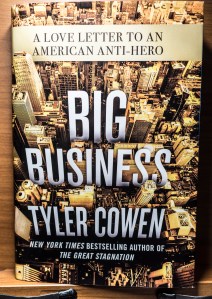
Pages 22 – 23 deal with industries that exist despite selling products that, at the very least, likely don’t do what proponents say they will do—industries like dentistry, stockbrokers, sales reps, and food. The food industry is particularly notable, as a lot of food is what Michael Pollan calls “edible foodlike substances.” Another way of looking at those products, though, is that they’re selling hope or reassurance, and people like buying hope much more than they like buying evidence-backed products. Consumer Reports is not all that popular and their evaluations rarely if ever go viral. Perhaps most importantly, a lesson from industries Cowen cites, like dietary supplements, is that most people have bad epistemic hygiene—and, in most circumstances, don’t care about it. I spent much time attempting to teach undergraduates research strategies and how to evaluate claims and sources, and most of the time I wasn’t very successful. It took too long for me to realize that, rather than start with peer review, publication reliability, and that kind of thing, I need to start with a question: “How do you know what you know?” From there, it’s possible to build out towards epistemic hygiene, but the overwhelming majority of students seemed not to give a shit, and, indeed, if you go around asking normal people questions like, “How do you know what you know?” they will at best look at you strangely and at worst leave to talk to someone else about fun topics—at least, I speculate that that may happen.

Human rationality is often not that strong, and we like to give ourselves reasons for our failures while castigating others for theirs. People working in businesses are often engaging in similar activities and ways of arguing.

“How do you know what you know?” is a context question, and Cowen is a great expert in context. He asks us to “step back and consider what standard we are measuring business against. The propensity of business to commit fraud is essentially just an extension of the propensity of people to commit fraud.” The problem is mostly within us, rather than in the specific structures of business.

The chapter “Is Work Fun?” resonates:

I am not trying to whitewash the burdens of the workday and the workplace. Nonetheless, a lot of the other evidence points us toward the more positive side of work. Work provides us with a lot of what we value in life, including affirmation of our social worth, a structure for problem solving combined with rewards, and an important source of social interactions [. . .]

Yet we can rarely say as much in public or among our friends. Why not?

This paragraph is also characteristic of Cowen’s thought, where words like “but” and “nonetheless” play key roles. He’s really trying to get us to rejigger our levels. The “burdens” are real, but so are the benefits, even if those aren’t emphasized. Cowen is great at connecting ideas that are underemphasized and not often foregrounded. Chapter 9 asks us, “If Business Is So Good, Why Is It So Disliked?” Many possible answers are advanced. I will add one that I didn’t see or that I missed: it is easier to blame abstract “business” than ourselves.

I want to quote the book’s last sentence and paragraph but would prefer you to experience it after reading all of Big Business.

One chapter discusses tech companies; many of the criticisms against tech companies are misguided, as you’ve read here. More vitally, I see those criticisms as really being criticisms of individual people. If we, collectively, wanted to, we could all switch to DuckDuckGo for search—a boon for privacy—and many of us could be using Linux as a primary desktop operating system, especially today, when so much software is delivered via the browser. Dell offers high-quality Linux laptops, and using Linux is probably an improvement for privacy; homing beacons and tracking seem much less prevalent in open-source software. Yet most of us—including me when it comes to Linux—don’t choose the privacy-focused option. We don’t choose free software. We choose convenience. Is that the fault of tech companies or individual choices? To me, it looks a lot like we see the faults of tech companies when we look in the mirror in the morning. The number of people who really care about freedom, broadly defined, seems to be small, and far smaller than the number of people who say they care about freedom. Most people want convenience more than freedom or privacy, just as most people want junk food more than they want physical health. To return to my photography examples, most people want greater sharing convenience than the best image quality or artistic effect.

It’s possible to imagine an even more pro-business book than this one; a company like Amazon is amazing, for example, in that what I order, almost always shows up, and it’s convenient too. Contrast that with the many dealings I’ve had lately with New York’s tax office; I could go into detail, but the reader would likely want to stab their eyes out, as I have often wanted to do.

Cowen touches on alternatives to for-corporations:

Another possible way to test the honesty of business would be to compare nonprofit and for-profit organizations. If you think profits induce corruption, you might then conclude that nonprofits should be especially trustworthy. The evidence, however, will show that for-profits and nonprofits, at least if we are comparing enterprises in the same basic economic sector, usually operate in pretty similar ways.

This has been my experience; it’s also apparent to me, having worked for nonprofits for years, that nonprofits are much more like businesses than most people realize. I’ve also spent a lot of time working in and around universities, and they are the ultimate businesses: just try taking classes for grades if you can’t pay tuition. Try returning a low-value, high-cost degree. For a while I’ve been advancing the argument that many parts of the university system are self-interested (and sometimes just bad) actors that have great marketing skills. Most people react to that argument skeptically, but as evidence of student loan burdens grows, the skeptical reaction seems to be declining.

I’m not against nonprofits and the best ones are very important. The science research function at most universities still works fairly well, despite having some well-known incentive problems. The gap between university-in-theory and university-in-practice, though, remains wide, and most universities don’t want to publicize some obvious truths—like the idea that not everyone should go, or that not everyone has the conscientious and IQ necessary to thrive in an academic setting.

Among nonprofits, one possible purpose of the grant system is to keep nonprofits both honest and effective. It is possible to be honest without being particularly effective, and vice-versa. Ideally one wants both. Few of us do both perfectly, despite the way we often demand that others do both perfectly.

One chapter asks whether CEOs are paid too much: Cowen mostly says no, they’re not, and he cites a lot of empirical evidence on the subject. But he also says, “it’s hard to find someone who can both run the day-to-day operations of a company and do these other things [like social media and PR, communication, Congressional and other testimony].” I wonder if it’s really hard to find people who can do those things, or if there’s a kind of weird selection and vetting process going on through which only a small number of people are considered by the relevant people, and thus the number seems smaller than it is because those doing the selecting won’t broaden their search criteria. Think of it as the CEO equivalent of companies that only want to hire from certain schools that reject as many qualified applicants as they admit. I also wonder what level of compensation, if any, is necessary for satiation: many CEOs seem to reach, and to have reached, that level long before. Can we shift from money to some other yardstick? If so, how?

Is the business world changing faster than it used to? If so, is agility more important than it used to be? Many businesses may not be “set it and forget it” anymore (if they ever were). My personal favorite example is camera companies: standalone camera shipments have been dropping for the last six years, and the response of photo company CEOs has mostly been to shrug. No companies have made substantial efforts towards making their camera bodies into smartphones combined with superior image sensors. As a result, Apple and Google have come to dominate the imaging and video worlds, while camera makers seem to lack the agility necessary to compete. In many consumer industries, competition seems to be increasing; to cite another example I’m familiar with, large bike companies like Trek are facing a host of Internet startups like State, Priority, and numerous others that source direct from China and Taiwan. Innovators in electric bikes have not been the biggest companies. Low agility may result in eroding market share and profits. The future is happening and it doesn’t seem to be happening evenly, to everyone.

The modesty of many Big Business claims stand out: “[CEO pay in the aggregate] could be better, but it works much more effectively than many people think.” “Much more effectively than many people think” could still be not all that effective; in this and in many other sections, Cowen is trying to move the needle a bit. He’s describing situations with a large number of potential analogue, intermediary places, and in this he’s moving against the modern Twitter tendency to see things as binary: good or bad, zero or one, shit or brilliant. Most of things in the most of the world are in this intermediary space, including all humans, however virtuous all Twitters may portray themselves to be (in contrast to their vile enemies).

Big Business is much more story-based than one might expect from Cowen, who argues that we should be more suspicious of simple stories. Fortunately, Big Business is not a simple book.

As with all the Cowen books I’ve read, there’s much to think about and much more I could write here; he is very good at finding the space where “rarely argued/articulated” and “possibly correct” intersect. Common arguments and ideas are common, and incorrect or ridiculous ideas are common, but finding the Cowen quadrant is too rare. I sometimes worry that my own ideas are too common to be worth repeating. Finding ones that hit the Cowen quadrant is satisfying, like a deadlift PR.

The world is filled with problems and our goal as humans is to solve them until we die. We very rarely see life formulated in that way, but maybe we should say this explicitly more often. “What problems have you solved recently?” may be a more valuable question than, “What do you believe?”