The Enchantress of Florence — Salman Rushdie

Salman Rushdie’s The Enchantress of Florence disappoints; Seldom has so great an ability to describe and so much seething talent been put to so little use as in this novel, where numerous sumptuous descriptions—though not so numerous or so skillful as Umberto Eco’s in Foucault’s Pendulum—add up to little more than yammering.

Take this artful idea, for example:

Travel was pointless. It removed you from the place in which you had a meaning, and to which you gave meaning in return by dedicating your life to it, and it spirited you away into fairylands where you were, and looked, frankly absurd.

Given that Jodha, who exists only in the mind of the king, says this, it works on multiple levels: she’s removed from the place where she would have meaning, and yet if she were removed from the emperor’s mind she’d have none because she wouldn’t exist—a neat paradoxical situation that nonetheless gets old a page later, when she says:

Now that the act of creation was complete she was free to be the person he had created, free, as everyone was, within the bounds of what it was in their nature to be and do.

That’s nice, but we’ve gone through pages and pages of meditation on what it means to be a creator and creative sort, and still more verbal games that become tiresome, especially with the double use of the word “free” in a situation that just doesn’t quite seem to merit it, even if we’re supposed to get the irony of her being “free” when by definition she can’t be free of his mind. Granted, she might eventually turn out to be a real person—this is magical realism, and I quit halfway after the fiftieth time I wondered, “What’s the point?”—but from here Jodha doesn’t go far.

Maybe there are more clever resonances among parts of the novel; the king thinks “No Man was ever free,” and yet the woman inside his head thinks she is free. Rushdie is striving for the intricate correspondence of Nabokov, but he doesn’t get there: the voice isn’t as firmly anchored to the characters as Nabokov in Pnin or Lolita, the characters are never quite so alive, and The Enchantress of Florence lacks that visceral sense of reality that a historical novel like Eco’s The Name of the Rose has. Adso of Melk sounds believable as a fourteenth century monk, immersed in the biblical culture that bound the thin educated class together at the time; in The Enchantress of Florence, we hear what could be a literary theorist natter, “They, too, saw their selves as multiple, one self that was the father of their children, another that was their parents’ child; they knew themselves to be different with their employers than they were at home with their lives—in short, they were bags of selves, bursting with plurality, just as he was.” What? Are we discussing modern workplace or family or feminist politics? And isn’t it obvious that the relationship one feels toward parents versus children is different? One could just as easily say, “You use different registers at work than you do at home.” Done. But I’m not sure Mughal kings were as concerned with this issue as middle-aged American accountants.

Yes, I understand what Rushdie shot for—Arabian Nights, The Canterbury Tales, The Decameron—except told through a post-modern, winking lens—and yet it doesn’t come together. Quotes from the novel don’t really show why, as much of the writing itself is good, but the plot at best meanders, and I feel like it shows utter dedication to the art of, say, cataloging obscure 80’s pop bands. Sure, you can, but should you? And does it matter? You can just imagine Rushdie pondering all the elements—mystical emperors, far off cities, narrative games, clever commentary on the point of myth versus legend—and all of them seeming so good and right. Then why did this omelette turn out so poorly when all the ingredients appeared so wonderful? It’s a question that, as I ponder, I can’t answer well.

The Enchantress of Florence comes with a bibliography, but this bit of scholastic detritus shows that you can study a period without living it. Contrast again The Enchantress of Florence with The Name of the Rose; the writer’s canard goes, “Write what you know,” and it’s often misinterpreted to mean that you should write autobiographically or something to that effect, but Eco has so long been immersed in the Middle Ages that he’s achieved the true writer’s alchemy and been able to live it as very few works of art do. By the same token, the marvelous TV show Friday Night Lights accomplishes the same effect with modern American high schools as few books or shows do; Curtis Sittenfeld’s Prep, despite its flaws, accomplished for boarding schools; and though many other novels try, they more often than not fail. To be sure, parts of Friday Night Lights, book and show, are no doubt exaggerated, just like Prep. One cannot fully recreated the Middle Ages in a novel, even one so wonderful as The Name of the Rose. Yet they have the verisimilitude in form and content that The Enchantress of Florence lacks. Eco knows the Middle Ages, Neal Stephenson knows hacker culture, and J.R.R. Tolkien knew Middle-earth better than I know Seattle. Alas: I’m not sure Rushdie knows the Moghul empire, the concerns of its people, and the age in which they lived. If he does, he didn’t prove it, and even if he did prove it, I’m sure that could’ve saved The Enchantress of Florence.


Rushdie visited Seattle recently, where he talked a little bit about The Enchantress of Florence and a lot about politics, both of the famous fatwah against him and the U.S. This was in response to questions, but given how little he spoke about his work and how little I thought of the book, I don’t have anything to write about that hasn’t been written about in more depth elsewhere. Search Google for his name, and you can’t help finding more concerning politics than books.
New workspace

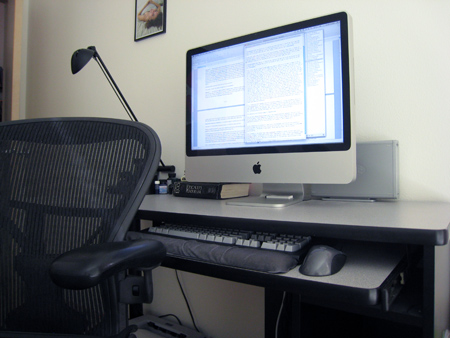
A year and a half ago, I uploaded a picture of my writing space. Things have changed, and Nigel Beale’s challenge inspires me to post another:

Notable features include an Aeron, the ultimate chair, ink bottles, a backup hard drive used with Time Machine, a gargantuan, wonderful iMac, and a Unicomp Customizer keyboard that inspired this rave—it’s now the most trafficked post on my site.

From Nigel’s blog I went to the Guardian and found out that Alain de Botton has an Aeron too, which obviously enhances the psychic connection established when I shook his hand and discussed Cooper Minis with him in Seattle. His fun novel Kiss & Tell was on my senior year AP English exam.

Notice also the ink bottles hiding between the lamp, book, and base of the computer. I have an anachronistic bend toward fountain pens, and these days I most often use an ink mix of Noodler’s luxury blue blended with Diamine Mediterranean Blue. Juxtaposing inks that Chaucer might have recognized with the computer he probably would not seems an appropriate homage to old and new.

I’d post bookshelves pictures too were my books not substantially packed in preparation for moving.

How Fiction Works, and how this review doesn't

I keep citing James Wood’s How Fiction Works without writing about it directly because the book feels so whole that it lacks the typical cracks that offer handholds. It asks the right questions and, inevitably, can only offer partial answers, but those answers are far more illuminating than almost anyone else’s, and its contents are encapsulated by the epigraph: ‘There is only one recipe – to care a great deal for the cookery.’ Henry James said, and James Wood lives it.

For reasons opaque to me this book hasn’t come out in the United States yet and won’t in July, yet it seemed essential enough to buy it from the U.K., and now I perceive that decision as a wise one. How Fiction Works joins good company stretching back at least to E.M. Forster’s Aspects of the Novel, which is addressed, and it goes beyond that—the book is part how-to, part criticism, part literary theory, and part history, and all the whole is greater than their sum, offering much to almost every reader. If that weren’t enough, it also comes with potential reading list—for example, the affection Wood, along with Jane Smiley and others, shows toward Henry Green makes me realize I should read him. Some writers—like Dawn Powell and William Maxwell—seem destined to be remembered only by other writers, their secrets moving through the years with only thin strands connecting them from person to person, forgotten by teachers, academics, and other keepers of the past. I wish I had more than two short paragraphs to say, but this is the rare book that I can only recommend you read, and then perhaps you will understand why. The reviews I’ve seen so far—representative samples are here and here, though this is better—so miss their target, or at least so fail to really engage it, that I hesitate to add to clamor, rather than music. The critic whose writing is consistently music instead of bombast is too rare, and consequently, I encourage you to listen.

How Fiction Works, and how this review doesn’t

I keep citing James Wood’s How Fiction Works without writing about it directly because the book feels so whole that it lacks the typical cracks that offer handholds. It asks the right questions and, inevitably, can only offer partial answers, but those answers are far more illuminating than almost anyone else’s, and its contents are encapsulated by the epigraph: ‘There is only one recipe – to care a great deal for the cookery.’ Henry James said, and James Wood lives it.

For reasons opaque to me this book hasn’t come out in the United States yet and won’t in July, yet it seemed essential enough to buy it from the U.K., and now I perceive that decision as a wise one. How Fiction Works joins good company stretching back at least to E.M. Forster’s Aspects of the Novel, which is addressed, and it goes beyond that—the book is part how-to, part criticism, part literary theory, and part history, and all the whole is greater than their sum, offering much to almost every reader. If that weren’t enough, it also comes with potential reading list—for example, the affection Wood, along with Jane Smiley and others, shows toward Henry Green makes me realize I should read him. Some writers—like Dawn Powell and William Maxwell—seem destined to be remembered only by other writers, their secrets moving through the years with only thin strands connecting them from person to person, forgotten by teachers, academics, and other keepers of the past. I wish I had more than two short paragraphs to say, but this is the rare book that I can only recommend you read, and then perhaps you will understand why. The reviews I’ve seen so far—representative samples are here and here, though this is better—so miss their target, or at least so fail to really engage it, that I hesitate to add to clamor, rather than music. The critic whose writing is consistently music instead of bombast is too rare, and consequently, I encourage you to listen.

J.K. Rowling, sexism, and literary merit

Colleen Lindsay’s The Swivet is worth reading, and from it comes an article about women in science fiction and fantasy that uses Harry Potter as a launching pad to argue that sexism animates some attacks on Harry Potter and female science fiction and fantasy authors more generally. I don’t think it motivates Bloom’s criticism of Harry Potter, and it certainly doesn’t motivate mine. The first two novels, which I read, weren’t all very good because they were cliché-laden and deprived of magic sentences. Why they’re so much more popular than the rest of the voluminous fantasy pile is unclear, and I attribute it to the vagaries and mysteries of books and place. Alas, some attackers of Rowling are fools, like at least one Harvard student:

Writing in the university paper, the Harvard Crimson, student Adam Goldenberg rips into Rowling as “a flash in the pan”, “a petty pop culture personality” who “tricked parents into letting their kids read books filled with sex, murder, and homosexual role models”. Furthermore, “writing bedtime stories is lame”.

One can, however, reach the right conclusion—that Harry Potter isn’t very good—using faulty reasoning, and just because someone uses faulty reasoning doesn’t mean their conclusion is incorrect in and of itself. If the article wanted to make a larger point not by citing Harry Potter, but one of the less-known female fantasy writers it deals with in the fourth paragraph—none of whom I know well enough to comment on.

I suppose that, being male, my argument could somehow be latent sexism emerging, though it seems unlikely given that one of the greatest fantasy, science, and speculative fiction writers of all time is Ursula K. Le Guin, who I used as an example of one of the few transcendent science fiction writers. Jane Smiley is one of my favorite modern writers—her work is uneven, but Moo and A Thousand Acres are excellent—and Flannery O’Connor’s short stories and novellas are masterpieces. Perhaps the “subtle mechanism” described only applies to fantasy and science fiction, but even there I’m not sure it’s truly at work, and separating where the many legitimate attacks on Rowling end and the possible sexism begins isn’t an easy task. Because there are so many legitimate attacks to be made, I’m not sure it can be done save through critics aren’t all that serious in the first place.

As long Rowling is in the air, I will give her credit for her commencement speech at Harvard, which has gotten a tremendous amount of deserved attention in blogs and the media: it’s funny and deep, while the temptation to keep throwing on positive adjectives is difficult to resist. I only wish Harry Potter had been up to the standards of that speech, in which case this post wouldn’t have been written.

So Many Books: Reading and Publishing in an Age of Abundance

Gabriel Zaid’s So Many Books: Reading and Publishing in an Age of Abundance contributes to the problem it describes: how we’re to comprehend millions upon millions of books, many of which strive for attention in a world limited by time more than anything else. Despite this, and books’ relatively low profile in the mass media, they retain individual power and power over individuals—as Zaid says, “[…] the conversation continues, unheeded by television, which will never report: ‘Yesterday, a student read Socrates’ Apology and felt free’ ” (11). On the same page, he calls a personal library one’s “intellectual genome,” a brilliant phrase that I’m sure I’ll be using. Delightful turns of phrase and ideas continue throughout what could easily devolve into a polemic but doesn’t.

So Many Books is surprising for being so witty, meditative, and fast; I half-expected a ponderous beast and instead found a lithe and economical essay. It tells us we can own books we haven’t read; that the library as trophy room is a somewhat silly metaphor (16), and that “Socrates criticized the fetishization of the book” (18) before I did. Zaid presents figures that demonstrate what the Dictionary of Literary Terms & Literary Theory, 4th Edition, says: “If proliferation is a sign of incipient death then the demise of the novel must be imminent.” As reading by the great studied mass declines or holds steady, writing proliferates, perhaps contributing to what I have long suspected: “To say ‘I only know that I’ve read nothing,’ after reading thousands of books, is not false modesty” (23). Indeed: after at least a 1,000, I’ve only begun to perceive the vastness of what’s out there, like the early astronomers who began to realize how cosmic the cosmos really are. We’re not left bereft of hope in this situation; statistics are inadequate representations of a journey, “and maybe the measure of our reading should therefore be, not the number of books we’ve read, but the state in which they leave us” (24). So many wonderful quotes in six short pages implies a great deal of thought per page.

Later chapters, like the cost of reading and the supply and demand of poetry, are closer to obvious. Still, Zaid’s observations about the time and storage cost of books are accurate, and he says: “Today it is easier to acquire treasures than it is to give them the time they deserve” (36) or “Just finding and keeping interesting books is very expensive, for readers and librarians” (87). The latter is particularly relevant as I ponder the five boxes of books sitting a few from me, representing just under half my owned intellectual genome, the entirety of which will shortly be transported with much labor and expense to Arizona. Zaid goes on spinning thread after thread of interrelated book thought, tying together ideas that seem disparate. He precedes John Lanchester, whose comments regarding the Library of America are encapsulated by Zaid’s description of complete works and critical editions as “monuments are designed for ceremonies, not conversations” (45). They can be a sign of an author’s worthiness and of the publishing diversity Zaid celebrates despite or because of his ruminations on how books affect us and our world.

Literature and science fiction redux, with taste as a bonus

Science Fiction, literature, and the haters spawned great comments and e-mails, including responses from both the agents I referenced. The one who gave a minimum word count said that the agency he and a partner founded is relatively new, and the advice regarding word count and sequels comes from editors, and until they have more experience, they’re hewing to those guidelines. The other agent said that calling Pearle Transit “too literary” was a poor choice of words and that, although he admired aspects of it, the novel didn’t get him excited. Both replies, in other words, were reasonable and show that the agents care. Other would-be authors might want to take note: rejection is rarely as personal as it might seem. In addition, I’m reminded of this passage from Orwell, who discussed the problems with book reviewing:

[…] the chances are that eleven out of the twelve books will fail to rouse in [the reviewer] the faintest spark of interest. They are not more than ordinarily bad, they are merely neutral, lifeless, and pointless. If he were not paid to do so he would never read a line of any of them, and in nearly every care the only truthful review he could write would be: “This book inspires in me no thoughts whatever.”

Most agents probably feel like that about most books. I just wrote a post expressing how Doctor Faustus roused nothing it me, though I perceive its technical merits. The latter can’t even be said of A Confederacy of Dunces, though it’s widely admired.

In other reactions, several people, including Big Dumb Object and agent Colleen Lindsay, pointed out the Clarke Awards shortlists. Thanks for the tip, and I’ll be reading some of them, although 2008 winner Richard Morgan’s first book, Altered Carbon, embodied some of the negative qualities discussed in my post. Still, very few authors write first books that are their best, and Thirteen is in my queue. I also noticed that Cryptonomicon was on the shortlist for 2000, but it’s not really science fiction.

One other thing I noted was the absence of any correspondents who said, “This is a great book that deserves a spot in the literary pantheon.” Likewise, I’d hoped for citations or links to essays that get deep inside great books. Where is the James Wood (see here too) of science fiction? Perhaps he already exists in Stanislaw Lem—his book Microworlds should arrive soon—but if the genre has as much material as some of the commenters and e-mailers say, it should also have its great critics. To paraphrase Saul Bellow without his racial connotations, I’d love to read them.

One commenter went in the opposite direction and said: “The reason as I see it that almost all science fiction writing falls short of literary merit is that its audience wants it that way.” I’m not convinced: although I pointed out a general trend toward the lack of literary merit in science fiction, it’s a law, and if it is, I’m wary of making correlation into causation. Furthermore, plenty of bad literary fiction exists, just like bad science fiction—but the literary canon pushes the upper bounds of knowledge and language in ways and volumes that science fiction hasn’t, at least to my knowledge so far. That’s in part why I’m writing these posts: it’s a process of searching, and I’m trying not to assume the very opinions I’m asking about it.

A few correspondents wrote that I had no idea what I was talking about and, implicitly, that there is no such thing as literary merit. I suppose both are possible, but they seem highly improbable; stating that there is an element of opinion in every artistic judgment is not the same as believing that every opinion is the same, and I also referred those writers to the “big three” books I’d mentioned about art and writing, which are the best reflections on what makes great literature and what makes great literature great I’ve found. Milan Kundera’s The Art of the Novel belongs there too. Alas, there is no short checklist that can be easily explained, and so the stack of reading necessary to really enter this conversation is intimidatingly high, and many of the accusers do not appear to have done it; such correspondents might not see the river because they’re in a valley and don’t have the fortitude to climb the mountain. Granted, at the top of the mountain they might look in the opposite direction I do, in which case I’d like to hear their opinions. Along these “everything is relative” lines, I once argued to a professor that Shakespeare and Joyce were way overrated and only read for historical reasons and because other people had read them.

Oh, how I want to take that back.

In Richard Feynman’s hilarious Surely You’re Joking, Mr. Feynman!, he writes about his lessons in art and his visit to the Sistine Chapel, when he recognizes the masterpieces and the lesser works without a guide:

This was a terrific excitement to me, that I also could tell the difference between a beautiful work of art and one that’s not, without being able to define it. As a scientist you always think you know what you’re doing, so you tend to distrust the artist who says, “It’s great,” or “It’s no good,” and then is not able to explain why, as Jerry did with those drawings I took him. But here I was, sunk: I could do it too!*

To be sure, there is an element of opinion in virtually any form of art and criticism, and just as there is in some fields more scientific: in economics, should we value making the resource pie larger through public policy like lower tax rates and flatter tax rates, or should we try and distribute what we have more evenly? Nonetheless, some people simply know much more about the trade-offs involved, and by the same token, some know far more about books and literature than others. The closer you get to hard sciences that are describing rather than interpreting the world—math, physics, chemistry, and the like—the farther you get from pure opinion, but as soon as you reach the application phase, judgment calls arise again: what would be more useful to sell—product derived from X or from Y? What would be a more useful use of physicists during World War II: having them build mechanical calculators and the like, or having them work on the atomic bomb? Someone had to make those decisions, and they’re closer in some respects to artistic choices than to ones regarding proof and experimentation.

In art and literature, there aren’t experiments, but taste exists. Not everyone’s is the same but not everyone’s is equal, either. Mine is well-developed enough to have some opinions of at least some validity, I hope, and I’m looking for others who can say the same, and who know something of science fiction—hence my appreciation of those who pointed out the Clarke Awards and made other suggestions. If I read through the Clarke books and decide I’m wrong, you’ll probably hear about it in a year or two. Although I’m not a scientist, I do have interest in all intellectually honest fields and all intellectually honest practitioners in those fields, and so I turn again to Feynman, who described what he wants to instill in Caltech grads and what they should inculcate in themselves: “It’s a kind of scientific integrity, a principle of scientific thought that corresponds to a kind of utter honesty—a kind of leaning over backwards.” Literary critics should hold themselves to the same standards, and I strive to. How well I succeed I will leave to others to argue.


* Although I quote poetry sometimes, I almost never analyze it here because I’m like the person without a real sense of what great visual art is: not having read widely and deeply enough in poetry to have developed my sense for what makes it bad, mediocre, good, and great poetry, I’m mostly silent, though appreciative.


EDIT: Added Feynman quote to the last paragraph.

To the Lighthouse

Are people afraid of Virginia Woolf, per the Edward Albee play, because she’s got the reputation of being a big tough writer, or because she’s genuinely hard to read and understand? As a a relative latecomer to her, the issue was at the forefront of my mind as I read To the Lighthouse, as was how glad I am to have come to her now as opposed to earlier, when I don’t think I would’ve been prepared. Now, I see To the Lighthouse as it was intended: as a vast artistic statement with much history behind it, which makes it a writer’s novel, or an intense reader’s; it reconciles so many opposites, being both fluid and structured, artificial and real, and yet at the cost, I suspect, of being easily understood through one’s first reading. To the Lighthouse demands such familiarity with what conventional narration is that to comprehend it with any fullness requires wide and deep reading as initiation. In Reflections on the Name of the Rose, Umberto Eco describes how he came to structure The Name of the Rose:

After reading the manuscript, my friends and editors suggested I abbreviate the first hundred pages, which they found very difficult and demanding. Without thinking twice, I refused, because, as I insisted, if somebody wanted to enter the abbey and live there for seven days, he had to accept the abbey’s own pace. If he could not, he would never manage to read the whole book. Therefore those first hundred pages are like a penance or an initiation, and if someone does not like them, so much the worse for him. He can stay at the foot of the hill (41).

Such a process isn’t built into To the Lighthouse, and without preparation, I suspect reading it would be like trying to understand trigonometry without knowing algebra. That might be an unfair comparison, especially given the hackles I’m sure it raises in the math phobic, but I make it for good reason: Woolf is built on understanding why and how she uses her great strength and technique: free indirect speech or limited omniscient narration, depending on the term you prefer, which allow her to peer into all her characters’ minds, allowing each to perceive the other’s limitations, weaknesses, foibles, and problems. Who’s afraid of Virginia Woolf? Those who wonder: Am I smart enough? Do I not get it? Am I like one of the characters, each of whom is shown with flaws more glaring than those of most hardboiled detective fiction?

The way we learn of those flaws also startles because of the novel’s shifting temporality: long paragraphs of thought explaining an interaction interrupt speech, so that the first statement and response to it are alienated. In later writers, like Raymond Carver, the speech and situation are simply assumed to be alienated from one another, the domestic situation strained or unspoken, and no longer interruptions necessary. But in Woolf, we have an explanation—but only from a character’s point of view. Here is one such passage, quoted at length because shortening it would defeat its purpose:

‘You won’t finish that stocking to-night,’ he said, pointing to her stocking. That was what she wanted – the asperity in his voice reproving her. If he says it’s wrong to be pessimistic probably it is wrong, she thought; the marriage will turn out all right.
‘No,’ she said, flattening the stocking out upon her knee. ‘I shan’t finish it.’
And what then? For she felt that he was still looking at her, but that his look had changed. He wanted something – wanted the thing she always found it so difficult to give him; wanted her to tell him that she loved him. And that, no, she could not do. He found talking so much easier than she did. He could always say things – she never could. So naturally it was always he that said the things, and then for some reason he would mind this suddenly, and would reproach her. A heartless woman he called her; she never told him that she loved him. But it was not so – it was not so. It was only that she could never say what she felt. Was there no crumb on his coat? […]
[This continues for much longer, until, finally—]
‘Yes, you were right. It’s going to be wet tonight.’ She had not said it, but he knew it. And she looked at him smiling. For she had triumphed again.

Triumphed? In what context? I hear Kurtz saying, “The Horror! The Horror!” and wonder, like an uncontacted tribe before a helicopter. The “triumph” comes at the end of To the Lighthouse’s first section, and it is as enigmatic as what proceed it. Notice that “he wanted something,” but it’s not clear that the thing he wanted or that she found so difficult is the love mentioned in the next part of the sentence. “Something” hangs ambiguously, like a writer trying to give the reader what the reader longs for but never knew they longed for.

Instead we long for something that we give imperfect names: depth of characterization, fastness of plot, reality, “entertainment,” symbolism, aesthetic experiences, or the other facets of a gem we call literature, or experience, or many other names. In Woolf, the mystery of that search comes from the deep internal lives of the characters and that contrast with their external lives—inside, they register knowledge, social orders, hierarchies, shifts, and even epiphanies, but all this happens beneath the veneer of social propriety and limited, clipped speech like “Yes, you were right. It’s going to be wet tonight,” ending an internal, gushing well of feeling that finds so little expression in speech. If someone like Robert Penn Warren strives to balance speech and internal monologue, making them reflect one another, abd Elmore Leonard pushes to strive almost entirely for description through speech, then Woolf, in contrast, pushes the seesaw almost solely on the side of the internal—which she can only accomplish through deft, extraordinary use of free indirect speech—otherwise we would have the hammering of a single and limited consciousness, which would deafen us with the repetition of its primary and perceptions, making us try to see through it rather than allowing the narrator to work. But the shifts aren’t easily perceived, making them different from novels where the narrators are clearly delineated, like Eliot Perlman’s Seven Types of Ambiguity.

These traits make Woolf an acquired taste but one essential for writers to sample, and it’s also one usually acquired after tiring of novels driven solely by plot and novels without the depth of characterization Woolf has. Maybe Faulkner is the same way: I’ve never enjoyed reading his novels even as I recognize their importance. Yet I think I see a dividing line with Woolf and Proust—another modernist favorite more cited than read—on one side and Faulkner and Joyce on the other, with moving toward the former rather than the latter. This post in part articulates why, but there’s much more I can’t yet articulate. All four writers offer mystery above all, and not one that can be explained by finding out whodunit; therefore, I’m left describing without adequately explaining.

What would Woolf make of starting this problem? I’m not sure, as I complete this slippery review that too often uses the word “I,” establishing myself as a single perspective against the many “I’s” in To the Lighthouse. Still, Woolf influences how I now write posts: acknowledging myself, my biases, and the problems with my own reading, as well as what others would say to critics over-fond of “I”: narcissistic, obsessed with their own response, and the like. To them I have no perfect answer, though Virginia Woolf seems a good one.

Life

“You live on the surface,” Lia told me years later. “You sometimes seem profound, but it’s only because you piece a lot of surfaces together to create the impression of depth, solidity. That solidity would collapse if you tried to stand it up.”

—Umberto Eco, Foucault’s Pendulum

Mid-June links: The Library of America and the book as an object

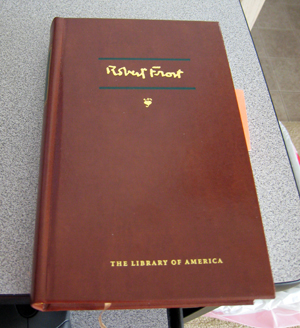
* John Lanchester writes that he finds it hard to read those gorgeous Library of American volumes.

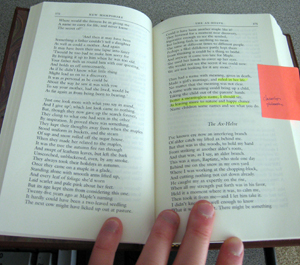
No such compulsion here! While I understand his feeling, I highlight when the need arises:

That’s one way of ensuring that the books exist to be read, not fetishized. Lanchester says, “A paperback is a paperback; the collected writings of a writer, any writer, have the air of belonging to Culture in the abstract. That’s off-putting.” I agree: responding to the author in the book itself is one way of ameliorating that problem.

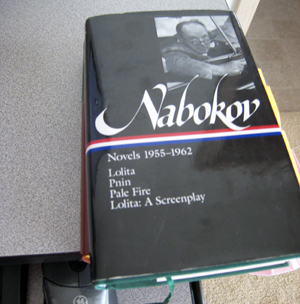
Sometimes I write a fair amount, as in Lolita:

Screw resale value. Then again, Amazon knocks about a third off the price, and the Library of America had a fire sale (haha) of Frost, perhaps explaining part of my cavalier attitude.

EDIT 6/18/08: Gabriel Zaid’s So Many Books explains more about books as monuments than I do here.

* Kingsley Amis’ fairly extensive writing about alcohol has now been published in a single volume called Everyday Drinking, as the New York Times reports.

“Serving good drinks,” he wrote, “like producing anything worth while, from a poem to a motor-car, is troublesome and expensive.”

And, as with good food or good writing, good drinks are best prepared for those who will appreciate them.

Although I’m tempted to buy Everyday Drinking, I’m afraid I’ve already laden myself with enough contrarian books, ranging from The Joy of Drinking to The Book of Vice. In addition, despite my apparent dedication to such topics, I feel that drinking is better experienced in person than through the medium of literature, even if reflection deepens the experience once sufficient experience has been had.

Transpose those thoughts to other endeavors at your own peril.

* Nigel Beale writes about “How to re-establish evaluative criticism as central to the academic study of literature.” Since I’m about to start graduate school in English, it’s a topic near to my mind. What he doesn’t mention, however, is that evaluative criticism does exist to a greater extent than he gives it credit for, and it even has its own place in English departments—just under the heading “creative writing,” and “MFA,” rather than in the usual classes.

* Nigel Beale part deux—he says a good book needs:

1) to find and revel in funny, beautiful, thought-provoking phrases, 2) dwell on profound paragraphs that contain useful truths about life and human nature, 3) lose myself in the lives of exceptional characters.

They correspond roughly to professionalism and aesthetic delight, searching for meaning in life, and pleasure at being able to occupy someone else’s mind. Defining what those mean will quickly bloat any discussion of them to the size that Beale is trying to avoid with brevity.

* Jason Fisher on Rereading Madeleine L’Engle’s A Wrinkle in Time. It’s on my to be read list, along with 100 other books.

* Since science fiction has been in the air, Marc Andreessen’s top books of the 00s (“oughts?”) can land here.

* Read this concerning genre and that great bender Michael Chabon.

* Lester Hunt speculates on the decline of the Western:

[…] a major source of the charm of westerns is that they are set in a situation in which the presence of the state is minimal or non-existent. In the wild West, you often have to enforce your own rights. If you wait for civil society to do it, you’ll be dead. In a word, westerns are about anarchy. They are fiction’s only constitutionally anarchist genre. As such, they represent a wild sort of freedom. Maybe, like the romance of property, that’s not such a popular idea any more, either.

Notice that one of the most popular genres nowadays is the police procedural, in which the protagonist is a government employee. Yecch! Is there any way you could get further away from the ethos of the western? (Try to imagine Ethan Edwards even saying the word, “procedural.”)

This might explain why I don’t much care for police procedurals. Still, I’d note that many of them portray the police as corrupt and incompetent, while the heroes often act outside the traditional police structure.

* By way of Anecdotal Evidence, William Maxwell on reading and aging.

* That the TSA is denying the ability to fly to people without papers is infuriating. Have they not read the innumerable books about dystopias (1984, Brave New World, We…) and history/society (Foucault) on the subject of state surveillance? Evidently not. Slashdot commenters are unusually articulate about the issue. See my thoughts on its relation to reading here.