Why unpublished novelists keep writing: why not? An answer as to why this one does

Alix Christie’s “We Ten Million” asks why unpublished novelists write, the number being an estimate of the number of unpublished novels out there (hat tip Heather Horn). Very few books get published; very few that do get any attention; very few of those even make any money; and delusion is a vital skill for many who continue writing. Rationally, most of these would-be writers would probably be better off if they quit writing and did something more economically and socially more productive with their time, like working for Wal-Mart, digging holes and filing them up, writing blogs about their cats, etc.

According to Horn, possible answers include: the idea of a craft, the importance of literature (even if it’s unread?), the need for story, and art as courage. I’m not sure I buy any of those, or any of Christie’s answers. I think the real reason is simpler: novelists keep writing because they basically like the act of writing novels. Publishing, fame, fortune, and all the rest would be nice, as they certainly would be for this unpublished writer with an inbox full of requests for fulls and partials (industry lingo for “send me the full manuscript” or “send me some chapters”) from agents, but the possibility of future and unlikely accolades don’t fuel the work on a daily basis. Instead, the daily drive to succeed is about the material itself. I’ve mentioned this famous quote before and will do so again: “Robertson Davies, the great Canadian novelist, once observed: ‘There is absolutely no point in sitting down to write a book unless you feel that you must write that book, or else go mad, or die.’ ”

The people writing unpublished novels are presumably doing so in lieu of going mad or dying. They feel they have to or need to write.

In a recent post, I wrote about an exchange with a friend who’s an undergrad:

A lot of my motivation comes from a fantasy of myself-as-_____, where the role that fills the blank tends to change erratically. Past examples include: writer, poet, monk, philosopher, womanizer. How long will the physicist/professor fantasy last? 

I replied:

This is true of a lot of people. One question worth asking: Do you enjoy the day-to-day activities involved with whatever the fantasy is? For me, the “myself-as-novelist” fantasy continues to be closer to fantasy than reality, although “myself-as-writer” is definitely here. But I basically like the work of being a novelist: I like writing, I like inventing stories, I like coming up with characters, plot, etc. Do I like it every single day? No. Are there some days when it’s a chore to drag myself to the keyboard? Absolutely. And I hate query letters, dealing with agents, close calls, etc. But I like most of the stuff and think that’s what you need if you’re going to sustain something over the long term. Most people who are famous or successful for something aren’t good at the something because they want to be famous or successful; they like the something, which eventually leads to fame or success or whatever.

“I basically like the work of being a novelist,” including the writing and so forth. That’s why I keep going. I think anyone who continues for any other reason is probably already mad, to use Davies’ term. Alternately, a lot of the would-be novelists out there are probably writing not because they want to get published, but to work out their inner demons, or signal something, or because they don’t know what else to do with their lives, or because they’re misinformed. They’re doing something other than really trying to write something that someone else might want to read.

I’m reminded of a passage from Norah Vincent’s nonfiction book Self-Made Man, in which she describes dressing like and passing as a man. Vincent, dressed as a man named “Ned,” describes going out with a woman met on an online dating site, who “was either the most conversationally inconsiderate person I’d ever met or the most socially impervious:”

Clearly she wasn’t ready to start dating again. She wasn’t looking for a relationship. She was looking for distraction and an ear to tell her troubles to. She didn’t have enough emotional energy left to get seriously involved with Ned [. . .]

A lot of would-be writers are probably doing much the same. I’d guess that relatively few of those ten million novels are publishable, or that many of the writers of those novels have any clue what something like publishable might mean (I didn’t when I started, which might’ve helped me; more on that below). As Laura Miller says regarding the “slush pile” of unsolicited queries agents and publishers get:

You’ve either experienced slush or you haven’t, and the difference is not trivial. People who have never had the job of reading through the heaps of unsolicited manuscripts sent to anyone even remotely connected with publishing typically have no inkling of two awful facts: 1) just how much slush is out there, and 2) how really, really, really, really terrible the vast majority of it is. Civilians who kvetch about the bad writing of Dan Brown, Stephenie Meyer or any other hugely popular but critically disdained novelist can talk as much trash as they want about the supposedly low standards of traditional publishing. They haven’t seen the vast majority of what didn’t get published — and believe me, if you have, it’s enough to make your blood run cold, thinking about that stuff being introduced into the general population.

So you can probably knock off at least 90% of those unpublished novels as not even being serious attempts, where “serious” means “at least thinking about what makes good novels good and bad novels bad.” Of those serious attempts, a lot of them are probably written by people who will one day be good but aren’t yet (Charlie Stross, the SF writer: “[. . .] I was averaging 1-2 novels a year, for very approximate values of “novel”. (They weren’t publishable. I was writing my million words of crap. You don’t want to read them, honest.)”). John Scalzi says something similar: “Writing an entire novel is something most people have to work up to,” and it’s really hard.

I started four novels and wisely abandoned them. I finally wrote two feature-complete novels in the sense that they started and had ends and had middles that led to the ends, kind of, but they were terrible, and I sent them to agents and got deservedly rejected. If you were one of those slush pile readers, I apologize, but those attempts were so far in the past that you’ve probably forgotten them. Then I wrote the last three novels over the last three or so years and started getting those requests for fulls and partials, which was a lot like the typical dating experience in that they ended with variations of “I like you, but not in that way.”

Nonetheless, I would like to think I can stand far enough back from myself to say that, at the very least, they’re publishable, and I think quite fun. Eventually I assume I will write something that gets a literary agent or press to agree with me—or I’ll go mad or die before that die arrives. Between now and the, I keep writing mostly because a) I’m an idiot (this shouldn’t be discounted) and b) I mostly like the work, as I described above. The second might seem a minor variation on what Christie says—”the only reason is my belief that I have got a story that I must tell”—but it’s a sufficiently important one that I’ll forward it here.

The function of stories in society and some of that other stuff is good, but I’m still guessing that my real reason (and, probably, hers) is that I like to write, which is slightly different from having a story to tell. I suspect the same is true of most artists and intellectuals and hackers; even most hacker/programmer types probably like the fact that they can change the world with their code, and so forth, but their big motivation is probably solving problems and writing code. Notice how the verb “writing” takes on a noun—code—that “writing prose” has lost. The word shows the similar impetus underlying both activities.

I’m not a hacker because, although I’ve written a little bit of code, I don’t like doing it all that much. If I did, it would’ve been vastly smarter to pursue that than it is to continue what I’m doing now. At least I’ve done enough to appreciate how hard it is to write code. And those write good code are rewarded for their skill. Good hackers, programmers, or computer scientists (pick your choice, each with its shades of connotation but denoting more or less the same activity) make a lot of money, and the smart ones often have an immediate, tangible effect on the world. This is sometimes but not always true of writers. But when I began writing fiction with some level of seriousness, I didn’t sit down and say to myself, “What is the optimal path?” I had some ideas and began typing. A depressingly large number of years later, I’m still doing the same basic thing in a way that might be detrimental to my own best interests. So why do I keep going? Why am I part of the ten million?

Because I like the work.

Reading James Joyce’s Ulysses for plunder

There’s a wonderful Paris Review interview with Robertson Davies, and the Interviewer says:

Bruce Chatwin once remarked that there were two ways of reading, reading for love and reading for plunder, in other words, reading to learn how writers accomplished certain effects, solved certain technical problems, or just in general went about doing their work. That’s a legitimate means of being influenced.

I’m precisely reading Ulysses (as previously discussed) for plunder. I find it hard to believe I will ever love Ulysses, but the number of technical effects (and the emotions they create) are astonishingly large and varied. More so perhaps than any other novel I’ve ever read. The amount of stuff worth plundering in Ulysses is tremendous, and its ability to convey a great deal in a small number of words through incomplete thoughts is showing me how to loosen up some in my own writing. At a few moments in the novel I’m working on now, I’ve come across sentences that make me say, “Yeah, that’s Ulysses‘ influence.”

Many of the novels I’ve read for grad school—The Crying of Lot 49, for instance—merely feel tedious. Ulysses, although I resisted it at first, feels like a trove of novelistic effects.

Note, however, that I’m not saying Ulysses is only good for those effects, as the kinds of emotional powers those effects create are equally impressive. But I’m reading much more for plunder.

Reading James Joyce's Ulysses for plunder

There’s a wonderful Paris Review interview with Robertson Davies, and the Interviewer says:

Bruce Chatwin once remarked that there were two ways of reading, reading for love and reading for plunder, in other words, reading to learn how writers accomplished certain effects, solved certain technical problems, or just in general went about doing their work. That’s a legitimate means of being influenced.

I’m precisely reading Ulysses (as previously discussed) for plunder. I find it hard to believe I will ever love Ulysses, but the number of technical effects (and the emotions they create) are astonishingly large and varied. More so perhaps than any other novel I’ve ever read. The amount of stuff worth plundering in Ulysses is tremendous, and its ability to convey a great deal in a small number of words through incomplete thoughts is showing me how to loosen up some in my own writing. At a few moments in the novel I’m working on now, I’ve come across sentences that make me say, “Yeah, that’s Ulysses‘ influence.”

Many of the novels I’ve read for grad school—The Crying of Lot 49, for instance—merely feel tedious. Ulysses, although I resisted it at first, feels like a trove of novelistic effects.

Note, however, that I’m not saying Ulysses is only good for those effects, as the kinds of emotional powers those effects create are equally impressive. But I’m reading much more for plunder.

Snapshot of the new workplace and the symbolic content of Karen Owen’s “horizontal academics”

Penelope Trunk’s “Snapshot of the new workplace: Karen Owen’s PowerPoint” is one of the very few insightful posts about “An education beyond the classroom: excelling in the realm of horizontal academics.” For those of you who haven’t been caught in the media blizzard, Karen Owen turned her sex life at Duke into a PowerPoint narrative. As Trunk says, “She has bullet points, charts, and graphs. How can you not admire a woman who can graph her sex life?”

Trunk is writing about the changing workplace, but the significance of this media event goes beyond that. I mentioned the story to a literary female friend and said that agents had started calling Owen. My friend read the PowerPoint and said that she couldn’t see where agents would go , and I replied that it didn’t matter: Owen is a hilarious (and unusually clear) writer. It’s harder to develop voice than any other trait; if you have voice, structure, plotting, and the like can follow, if the writer wants them bad enough. Owen might.

Notice too Owens’ command of genre: she combines PowerPoint (typically boring), a bloggy style (think Belle de Jour: The Diary of an Unlikely Call Girl) and narrative (which most PowerPoint presentations lack) to make something that defies expectation: PowerPoint is usually stodgy and bad; blogs are nice, but Bell de Jour doesn’t use graphs (to my knowledge); and the Owen’s subject (sex) is of near universal interest, especially when it violates conventional norms, which still exist enough for Owen to capture attention.

Of course, it’s easy to argue that this affair of the moment is trivial, and in the long term it certainly is. But the incident is also emblematic of larger changes. Karen Owen’s story isn’t only interesting because she’s a good writer or because she engages the questions of genre: it’s interesting because it marks an intersection or fault point between ways of living and codes of morality. Despite the sexual revolution, parents still engage in daughter guardian, per the 2008 Perilloux, Fleischman, and Buss journal article I’ve cited before, “The Daughter-Guarding Hypothesis: Parental Influence on, and Emotional Reactions to, Offspring’s Mating Behavior” (Evolutionary Psychology, 6, 217-233). They use strategies to restrict girls’ sexuality more than boys’, which probably contributes to the kinds of gender standards we see as adults.

Parents—who, by now, almost all came of age after the sexual revolution—still nonetheless attempt to shape the behavior of their offspring along more “traditional” lines than they might have wanted their own shaped. And that’s probably true beyond the sexual domain—consider what Paul Graham says in “Why To Not Not Start a Startup:”

… parents tend to be more conservative for their kids than they would be for themselves. This is actually a rational response to their situation. Parents end up sharing more of their kids’ ill fortune than good fortune. Most parents don’t mind this; it’s part of the job; but it does tend to make them excessively conservative. And erring on the side of conservatism is still erring. In almost everything, reward is proportionate to risk. So by protecting their kids from risk, parents are, without realizing it, also protecting them from rewards. If they saw that, they’d want you to take more risks.

“Parents tend to be more conservative for their kids” because parents will probably experience the ups more than the downs. Karen Owen presumably enjoyed her sex life (based on her description) and enjoyed writing her PowerPoint. Her parents probably derived near-zero pleasure from the former and a lot of grief from the latter, since she’s probably hiding out at home. For the rest of their lives, her parents will be hearing—”Karen Owen? Name rings a bell. Was she on TV for something?” and variations on that. Unless they’re unusually snarky, they’ll probably find it difficult to deal with queries about their offspring’s supposed failings.

Parents become “excessively conservative” for their children relative to themselves, and in protecting kids from the risks of sex, they also work to protect kids from its rewards. The same is probably true of work (as Graham says) and of expression: had Owen’s parents known about their daughter’s PowerPoint, they probably would’ve discouraged her from making it. But The same creative impulse that drove Owen to write her PowerPoint might also drive her in the working world, and that’s what Trunk wants to highlight.

I don’t see any route around these fundamental preference differences between parents and children. A lot of teenagers are, from what everyone has observed in popular culture, outraged at their parents’ seemingly cruel, capricious, and arbitrary rules. But those rules often have reasons behind them, as Perilloux, Fleischman, and Buss point out in the context of sex and Graham points out in the context of career, and when one looks at the cost-benefit analyses parents make, one begins to understand why parent-child conflicts exist: the two have different risk-reward profiles.

Parent-Offspring Conflict over Mating: The Case of Mating Age“, another article from Evolutionary Psychology says that:

Parents and offspring have asymmetrical preferences with respect to mate choice. So far, several areas of disagreement have been identified, including beauty, family background, and sexual strategies. This article proposes that mating age constitutes another area of conflict, as parents desire their children to initiate mating at a different age than the offspring desire it for themselves.

Conflicts are built into the family relationship system and are not incidental to it. This is not especially new; in his famous 1974 paper, “Parent-Offspring Conflict,” Robert Trivers discusses the problem and its implication from the perspective of biology. But realizing that this is a feature, not a bug, was new to me when I started reading more about evolutionary psychology three years ago.

One can re-read many of the various complaints about “youth these days” as ones chiefly about how preferences change as people age: younger people want fun, sex, and freedom; older people with children want their children to successfully reproduce and pass on their genes and culture, but what “successfully reproduce” means is different for younger people than older people. That conflict can sometimes be read along generational lines even when it’s more about preferences of the child versus preferences of the parent. In that light, “The New Dating Game: Back to the New Paleolithic Age” is less about what’s inherently good or bad and more about how time preferences function and how people are afraid of change, especially if they fear that change will hurt their economic or reproductive success.

Still, the social world is changing, and a concrete manifestation of abstract change can often become a major topic because it is really a symbolic repository for large-scale fears, hopes, desires, and conflict. Penelope Trunk says that the Karen Owen incident—notice the fear-mongering phrase I use because I can’t think of a better one—is about changes in the workplace and workplace power dynamics.

And this isn’t the first time female sexuality, writing disseminated online, and the workplace have come together: Heather Armstrong got fired for writing in her blog, Dooce, and the term “Dooced” now means to be fired for something one has written online. That she also sometimes wrote about religion and sex probably didn’t help, but they probably also widened her audience, and people like talking about religion because religious practices often function as control and regulation for sexual ones. Anna Davies addresses similar issues in I’m done writing about my sex life: It was a great way for a young woman like me to get published. But the cost of sharing sordid tales became too high. It got her published because people like reading about it—and it’s got Owen “published,” too, although perhaps not in the manner and forum she would prefer.

In his book Say Everything: How Blogging Began, What It’s Becoming, and Why It Matters, Scott Rosenberg calls the chapter on Heather Armstrong “The Perils of Keeping it Real.” Karen Owen is now being forced to navigate the same perils, and I don’t think it a coincidence that female writers face greater perils than men. Then again, Rosenberg points out that a man named Cameron Barrett might be the first person to lose his job over a blog or proto-blog post, since he “was fired […] in 1997 when colleagues found a mildly off-color piece of short fiction he’d posted to his personal website.” The issue of “mildly off-color” material arises in other circumstances, and Rosenberg cites

[…] Ellen Simonetti, a flight attendant who got sacked by Delta Airlines in 2004, apparently because she’d posted photos of herself in uniform revealing a bit too much leg (though nothing that would put a PG rating at risk). There was senatorial aide Jessica Cutler, whose salacious tales of Capitol Hill liaisons gained notoriety for her anonymous blog, Washingtonienne, but cost her her job once Wonkette named her.

Regarding the blog world, Rosenberg says that “[…] there was plainly something about blogging itself that made it hazardous to employment. Perhaps it lulled people into thinking that words in a post had a uniquely protected status and could be cordoned off from the rest of existence.” But one could remove “blogging” and put “the Internet” in place of it, or one could just acknowledge that it can be harder to maintain separate, authentic selves in a world where the reproduction of data is nearly frictionless for a large proportion of the population. The forward button can put your PowerPoint anywhere and everywhere, assuming people want to read it, and social norms haven’t caught up to that.

In Raymond Chandler’s The Big Sleep, the plot revolves around nude pictures of the sexually avaricious Sternwood daughters and whether those pictures will be revealed publicly. Today, we’re moving toward a world in which so many people have already given nude pictures to friends or lovers that real social punishment is becoming increasingly untenable. But those norms aren’t changing so fast that someone like Karen Owen can’t be caught up in the shift. Trunk says that “The rules are all different” and that “[Owen] illustrates why men are afraid of twentysomething women.” She’s right, and it’s probably unfortunate that Owen has unwittingly found herself the catalyst for those shifts. With a blogger, or a writer like Anna Davies, one knows in advance that the act of writing puts one’s self in the public. Owen didn’t consciously realize that the act of writing and e-mailing her PowerPoint could do the same, unwittingly.

In a way, we’re all academics now, in that we’re all judged (and might be fired) for what we’ve written. There’s a flipside to that, however: we might find jobs because of how our writing demonstrates expertise. Karen Owen has probably made some jobs harder to acquire (it’s difficult to imagine her getting past the Google screen of your average high school principal if she wants to be a teacher), but she’s probably also opened up others: hence the calls from editors and agents if she wants to be some kind of writer. If I had a new media company of some kind, I’d be trying to find Karen Owen’s number. Sure, my last sentence sets me up for dirty jokes, but, more importantly, it shows how work and life are changing.

Signaling, status, blogging, academia, and ideas

Jeff Ely’s Cheap Talk has one of those mandatory “Why I Blog” posts, but it’s unusually good and also increasingly describes my own feeling toward the genre. Jeff says:

There is a painful non-convexity in academic research. Only really good ideas are worth pursuing but it takes a lot of investment to find out whether any given idea is going to be really good. Usually you spend a lot of time doing some preliminary thinking just to prove to yourself that this idea is not good enough to turn into a full-fledged paper.

He’s right, but it’s hard to say which of the 100 preliminary ideas one might have over a couple of months “are worth pursuing.” Usually the answer is, “not very many.” So writing blog posts becomes a way of exploring those ideas without committing to attempting to write a full paper.

But to me, the other important part is that blogs often fill in my preliminary thinking, especially in subjects outside my field. I’m starting my third year of grad school in English lit at the University of Arizona and may write my dissertation about signaling and status in novels. My interest in the issue arose partially because of Robin Hanson’s relentless focus on signaling in Overcoming Bias, which got me thinking about how this subject works now.

The “big paper” I’m working on deals with academic novels like Richard Russo’s Straight Man and Francine Prose’s Blue Angel (which I’ve written about in a preliminary fashion—for Straight Man, a very preliminary fashion). Status issues are omnipresent in academia, as every academic knows, and as a result one can trace my reading of Overcoming Bias to my attention to status to my attention to theoretical and practical aspects of status in these books (there’s some other stuff going on here too, like an interest in evolutionary biology that predates reading Overcoming Bias, but I’ll leave that out for now).

Others have contributed too: I think I learned about Codes of the Underworld from an econ blog. It offers an obvious way to help interpret novels like those by Elmore Leonard, Raymond Chandler, and other crime / caper writers who deal with characters who need to convincingly signal to others that they’re available for crime but also need not to be caught by police, and so forth.

In the meantime, from what I can discern from following some journals on the novel and American lit, virtually no English professors I’ve found are using these kinds of methods. They’re mostly wrapped up in the standard forms of English criticism, literary theory, and debate. Those forms are very good, of course, but I’d like to go in other directions as well, and one way I’ve learned about alternative directions is through reading blogs. To my knowledge no one else has developed a complete theory of how signaling and status work in fiction, even though you could call novels long prose works in which characters signal their status to other characters, themselves, and the reader.

So I’m working on that. I’ve got some leads, like William Flesch’s Comeuppance: Costly Signaling, Altruistic Punishment, and Other Biological Components of Fiction and Jonathan Gottschall’s Literature, Science, and a New Humanities, but the field looks mostly open at the moment. Part of the reason I’ve been able to conceptualize the field is because I’ve started many threads through this blog and frequently read the blogs of others. If Steven Berlin Johnson is right about where good ideas come from, then I’ve been doing the right kinds of things without consciously realizing it until now. And I only have thanks to Jeff Ely’s Cheap Talk—it took a blog to create the nascent idea about why blogging is valuable, how different fields contribute to my own major interests, and how ideas form.

So you wanna be a writer: What Anthony Bourdain can tell you even when he’s not talking about writing

There’s a great essay called “So You Wanna Be a Chef” by Anthony Bourdain, who wrote Kitchen Confidential. Based on “So You Wanna Be a Chef,” culinary schools sound rather like MFA programs. Money drives both decisions, even when artistry is supposed to:

But the minute you graduate from school—unless you have a deep-pocketed Mommy and Daddy or substantial savings—you’re already up against the wall. Two nearly unpaid years wandering Europe or New York, learning from the masters, is rarely an option. You need to make money NOW.

You could replace “cooking” with “writing” and “being a chef” with “being a writer” in Bourdain’s essay and have more or less the same outcome. Going into the “hotels and country clubs” side of the business is like getting tenure as a professor. There are a few differences between the fields—you’re never too old to be a writer—but similarities proliferate. Like this:

Male, female, gay, straight, legal, illegal, country of origin—who cares? You can either cook an omelet or you can’t. You can either cook five hundred omelets in three hours—like you said you could, and like the job requires—or you can’t. There’s no lying in the kitchen.

You can either sit (or stand) at a computer for years, producing words, or you can’t. There’s no lying at the keyboard. If you want to be a writer, the keyboard is where you’re going to spend a lot of your time (Michael Chabon on book tour in Seattle for The Yiddish Policemen’s Union: “If you want to write a novel you have to sit on your ass.” I can testify that the same is true of writing a blog). All the chatter in the world about how how you prefer early Ian McEwan to late Ian McEwan isn’t going to help you produce words.

As with many disciplines, what’s important is not just being good or adequate—it’s being amazing. “There is, as well, a big difference between good work habits (which I have) and the kind of discipline required of a cook at Robuchon.” There is a big difference between good work habits and being an artist: a surprisingly large number of people can crap out a novel if given sufficient time and motivation. Milan Kundera in The Curtain:

Every novel created with real passion aspires quite naturally to a lasting aesthetic value, meaning to a value capable of surviving its author. To write without having that ambition is cynicism: a mediocre plumber may be useful to people, but a mediocre novelist who consciously produces books that are ephemeral, commonplace, conventional—thus not useful, thus burdensome, thus noxious—is contemptible.

This overstates the case: an indifferent or “mediocre” novel by a “mediocre novelist” does not tangibly hurt anyone, and its most likely fate is to be ignored—which is the most likely fate of any novelist. But the writer needs to aspire “to a lasting aesthetic value,” which means that merely existing and producing something isn’t enough. Hence my derogatory phrase: “crap out a novel.”

Instead of traveling to “Find out how other people live and eat and cook,” as Bourdain tells the chef to do, the writer must read widely and voraciously and omnivorously. If you’re writing in a genre, read the classics. If you’re a literary novelist, read some of the better genre fiction (it’s out there). Read books about writing. Read books not about writing to learn how the world works. Get out of your literary comfort zone with some frequency. You’ll need it.

Also wise: “Treating despair with drugs and alcohol is a time-honored tradition—I’d just advise you to assess honestly if it’s really as bad and as intractable a situation as you think.” Steven King writes in On Writing about his own problems with drugs. He points out that drinking or taking drugs doesn’t make you a writer—if you’re a writer, you might drink or take drugs, but skipping straight to the drugs doesn’t do anything for you.

The bottom line: creative fields and top performers in many disciplines appear to have more in common than not. From what I’ve read, the same basic dynamic described by Bourdain applies not just to cooking and writing, but to software hacking, most kinds of research, athletes, architecture, music, and most forms of art. Don’t pursue these fields unless you want to master them. And you probably don’t. And if you do, you might be better off not realizing how difficult they are before you start, because you might never start.

So you wanna be a writer: What Anthony Bourdain can tell you even when he's not talking about writing

There’s a great essay called “So You Wanna Be a Chef” by Anthony Bourdain, who wrote Kitchen Confidential. Based on “So You Wanna Be a Chef,” culinary schools sound rather like MFA programs. Money drives both decisions, even when artistry is supposed to:

But the minute you graduate from school—unless you have a deep-pocketed Mommy and Daddy or substantial savings—you’re already up against the wall. Two nearly unpaid years wandering Europe or New York, learning from the masters, is rarely an option. You need to make money NOW.

You could replace “cooking” with “writing” and “being a chef” with “being a writer” in Bourdain’s essay and have more or less the same outcome. Going into the “hotels and country clubs” side of the business is like getting tenure as a professor. There are a few differences between the fields—you’re never too old to be a writer—but similarities proliferate. Like this:

Male, female, gay, straight, legal, illegal, country of origin—who cares? You can either cook an omelet or you can’t. You can either cook five hundred omelets in three hours—like you said you could, and like the job requires—or you can’t. There’s no lying in the kitchen.

You can either sit (or stand) at a computer for years, producing words, or you can’t. There’s no lying at the keyboard. If you want to be a writer, the keyboard is where you’re going to spend a lot of your time (Michael Chabon on book tour in Seattle for The Yiddish Policemen’s Union: “If you want to write a novel you have to sit on your ass.” I can testify that the same is true of writing a blog). All the chatter in the world about how how you prefer early Ian McEwan to late Ian McEwan isn’t going to help you produce words.

As with many disciplines, what’s important is not just being good or adequate—it’s being amazing. “There is, as well, a big difference between good work habits (which I have) and the kind of discipline required of a cook at Robuchon.” There is a big difference between good work habits and being an artist: a surprisingly large number of people can crap out a novel if given sufficient time and motivation. Milan Kundera in The Curtain:

Every novel created with real passion aspires quite naturally to a lasting aesthetic value, meaning to a value capable of surviving its author. To write without having that ambition is cynicism: a mediocre plumber may be useful to people, but a mediocre novelist who consciously produces books that are ephemeral, commonplace, conventional—thus not useful, thus burdensome, thus noxious—is contemptible.

This overstates the case: an indifferent or “mediocre” novel by a “mediocre novelist” does not tangibly hurt anyone, and its most likely fate is to be ignored—which is the most likely fate of any novelist. But the writer needs to aspire “to a lasting aesthetic value,” which means that merely existing and producing something isn’t enough. Hence my derogatory phrase: “crap out a novel.”

Instead of traveling to “Find out how other people live and eat and cook,” as Bourdain tells the chef to do, the writer must read widely and voraciously and omnivorously. If you’re writing in a genre, read the classics. If you’re a literary novelist, read some of the better genre fiction (it’s out there). Read books about writing. Read books not about writing to learn how the world works. Get out of your literary comfort zone with some frequency. You’ll need it.

Also wise: “Treating despair with drugs and alcohol is a time-honored tradition—I’d just advise you to assess honestly if it’s really as bad and as intractable a situation as you think.” Steven King writes in On Writing about his own problems with drugs. He points out that drinking or taking drugs doesn’t make you a writer—if you’re a writer, you might drink or take drugs, but skipping straight to the drugs doesn’t do anything for you.

The bottom line: creative fields and top performers in many disciplines appear to have more in common than not. From what I’ve read, the same basic dynamic described by Bourdain applies not just to cooking and writing, but to software hacking, most kinds of research, athletes, architecture, music, and most forms of art. Don’t pursue these fields unless you want to master them. And you probably don’t. And if you do, you might be better off not realizing how difficult they are before you start, because you might never start.

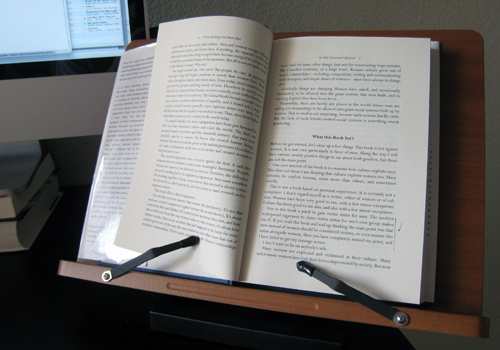
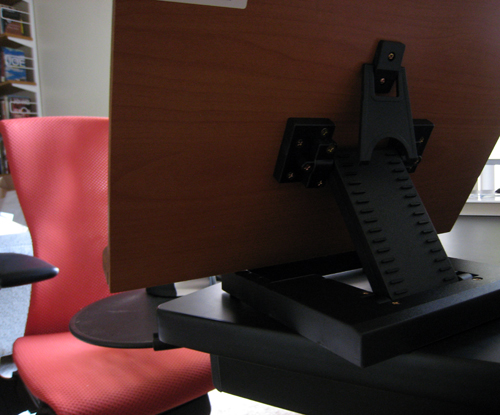
Highly recommended — the Best Book Stand “Jasmine”

A few months ago I realized that I needed a better way to hold books as I copy passages for both reviews on this blog and for my academic work. A bit of Googling found some really janky looking products that led me to sigh and rig a solution that consisted of a bunch of heavy anthologies (those of you who were English majors might remember the infamous Nortons; they’ve finally become useful again, albeit in a way slightly different from their intent) to lean a book against, while the heaviest of them all sat slightly in front to hold the relevant book up.

Then Kevin Kelly’s blog Cool Tools came to the rescue through a review of the Freesia Book Stand:

This is a simple but well-designed book stand that does exactly what it sets out to do. It is sturdy enough to hold big, heavy textbooks, but [it] looks nice. It is impressively adjustable, allowing for nearly any reading angle . Amazingly, despite the ability to hold heavy books, the stand itself is relatively light (around 3 lbs). The stand has an anti-skid coating on the bottoms so that it stays where I put it.

Exactly what I wanted. Thank you, Stephanie Misono, for suggesting this. She says, “I now wish I had gotten it years ago.” Me too; I chose the Best Book Stand Jasmine, and it would’ve been insanely useful as an undergrad, when I spent many hours looking at computer science textbooks in particular, going back and forth from page to screen.

The Freesia version is too big, so I ordered the smaller version. I have something similar for standalone printed papers, but even that isn’t nearly as satisfying; I was making edits to a novel earlier, and I flipped from one page to another with greater ease by using the Jasmine. So it’s not only good for copying passages from books, but for holding edited pages.

Does this sound minor? Maybe it is, but managing to find the perfect tool to fulfill a major need is incredibly satisfying, and this is perhaps the best solution I’ve found to a major problem in my life since reading “Tool for Thought” by Steven Berlin Johnson, which concerns DevonThink Pro. Although these tools are useful on a micro level, they probably also change the nature of what I do; as Nicholas Carr says in The Shallows:

Even as our technologies become extensions of ourselves, we become extensions of our technologies […] every tool imposes limitations even as it opens possibilities. The more we use it, the more we mold ourselves to its form and function. […] Whenever we use a tool to exert greater control over the outside world, we change our relationship with that world.

I’m probably more likely to copy marginal passages from books now that it’s become marginally easier both to do so and to organize the output once I have done so. The Jasmine hasn’t yet faded to the point of it reaching what Heidegger called “readiness-to-hand” or “Zuhandenheit,” which, to use Graham Harman’s formulation, “refers to objects insofar as they withdraw from human view into a dark subterranean reality that never becomes present to practical action any more than it does to theoretical awareness.” I’m entirely aware of the Jasmine, which is part of its pleasure, but when it fades “into a dark subterranean reality,” it will be really incorporated into my work (I suspect that writing the dissertation might force this state on me, as one book after another checks in and check out).

The Jasmine cost about $30, with about $10 in shipping. I probably would’ve paid $100 for it. Maybe more. It’s difficult to overstate its usefulness, given the kind of work I do. Students, academics, and bloggers are an obvious audience, but I’m sure other groups would find it useful too.

Highly recommended — the Best Book Stand "Jasmine"

A few months ago I realized that I needed a better way to hold books as I copy passages for both reviews on this blog and for my academic work. A bit of Googling found some really janky looking products that led me to sigh and rig a solution that consisted of a bunch of heavy anthologies (those of you who were English majors might remember the infamous Nortons; they’ve finally become useful again, albeit in a way slightly different from their intent) to lean a book against, while the heaviest of them all sat slightly in front to hold the relevant book up.

Then Kevin Kelly’s blog Cool Tools came to the rescue through a review of the Freesia Book Stand:

This is a simple but well-designed book stand that does exactly what it sets out to do. It is sturdy enough to hold big, heavy textbooks, but [it] looks nice. It is impressively adjustable, allowing for nearly any reading angle . Amazingly, despite the ability to hold heavy books, the stand itself is relatively light (around 3 lbs). The stand has an anti-skid coating on the bottoms so that it stays where I put it.

Exactly what I wanted. Thank you, Stephanie Misono, for suggesting this. She says, “I now wish I had gotten it years ago.” Me too; I chose the Best Book Stand Jasmine, and it would’ve been insanely useful as an undergrad, when I spent many hours looking at computer science textbooks in particular, going back and forth from page to screen.

The Freesia version is too big, so I ordered the smaller version. I have something similar for standalone printed papers, but even that isn’t nearly as satisfying; I was making edits to a novel earlier, and I flipped from one page to another with greater ease by using the Jasmine. So it’s not only good for copying passages from books, but for holding edited pages.

Does this sound minor? Maybe it is, but managing to find the perfect tool to fulfill a major need is incredibly satisfying, and this is perhaps the best solution I’ve found to a major problem in my life since reading “Tool for Thought” by Steven Berlin Johnson, which concerns DevonThink Pro. Although these tools are useful on a micro level, they probably also change the nature of what I do; as Nicholas Carr says in The Shallows:

Even as our technologies become extensions of ourselves, we become extensions of our technologies […] every tool imposes limitations even as it opens possibilities. The more we use it, the more we mold ourselves to its form and function. […] Whenever we use a tool to exert greater control over the outside world, we change our relationship with that world.

I’m probably more likely to copy marginal passages from books now that it’s become marginally easier both to do so and to organize the output once I have done so. The Jasmine hasn’t yet faded to the point of it reaching what Heidegger called “readiness-to-hand” or “Zuhandenheit,” which, to use Graham Harman’s formulation, “refers to objects insofar as they withdraw from human view into a dark subterranean reality that never becomes present to practical action any more than it does to theoretical awareness.” I’m entirely aware of the Jasmine, which is part of its pleasure, but when it fades “into a dark subterranean reality,” it will be really incorporated into my work (I suspect that writing the dissertation might force this state on me, as one book after another checks in and check out).

The Jasmine cost about $30, with about $10 in shipping. I probably would’ve paid $100 for it. Maybe more. It’s difficult to overstate its usefulness, given the kind of work I do. Students, academics, and bloggers are an obvious audience, but I’m sure other groups would find it useful too.

Working out the plot with the Rejector, Carlos Ruiz Zafón, and other friends

Over at the Rejecter, someone is asking whether an MFA program will teach her how to structure her novels. Actually, she’s asking about the professional and intellectual utility of MFA programs, but I want to focus on the plot issue, since that’s what the Rejecter doesn’t address. I had the same problems as the correspondent, but I don’t think I have them any more.

Specifically, the problem:

I have been writing novels since I was about seven. I literally think about it all the time. However, try as I might I have never been able to get beyond the 40,000 word mark before losing the plot and momentum of my story and deciding to start something else entirely. I’m a journalist on a big women’s glossy in the UK so it’s not getting the words down on paper that’s the problem, it’s rather getting my plot from A to B that stumps me.

That sounds really similar to me: the first two novels I actually completed are now, in retrospect, unpublishable, although I didn’t know that at the time and couldn’t have articulated why. Now I know: nothing happened. The novels had interesting premises but no action. There were a lot of bits of clever dialog and some good scenes, but nothing that held those scenes together. The novels lacked narrative tension.

The next two I wrote were and are publishable; they got a lot of agent activity and requests but no agents who took me on. Ditto for the latest, currently titled Asking Alice, which is still out. Look for my name in lights shortly.

One big thing changed between the first two unpublishable novels and the later three: I started writing outlines, which I’d previously considered unnecessary because I’m so smart that I can hold everything in my head (oops). Those outlines were and are pretty loose and fluid, but they’re outlines nonetheless, in which I asked myself essential questions about each chapter: what happens in it? Why? Why this chapter and not some other? What’s the central tension? What does each character worry about? These kinds of questions guided me toward writing better plots because I thought about how information was doled out and what kinds of things the characters are struggling to achieve. In addition, I thought about how drama works: is something important happening in this chapter? What is it?

If I can’t identify what’s important or why the characters should care, I’m probably doing something wrong.

This doesn’t mean each chapter has to end with someone getting shot, or the heroine declaring her love, or the revelation of a shocking fact, or an alien invasion.* But it does mean that I have to at least think about what the scene or chapter is conveying to the reader, what is happening to the characters, how it relates to the previous scene or the next scene, and, perhaps most importantly, what dilemmas it raise that have to be resolved in the future.

Every scene or almost every scene needs some kind of tension or uncertainty. Once again, this doesn’t necessarily mean a guy holding a gun: it could be highly cerebral. In Adam Foulds’ The Quickening Maze, the tension in some scenes concerns the interior dialog and sanity of John Clare: is he sane? Are we seeing the mind of someone else, or are we seeing his mind, which has assumed the shape of someone else? Those scenes can be quite tense but also quite subtle. Others can hinge on a piece of information, as when Randy Waterhouse realizes he’s actually building a datahaven in Cryptonomicon.

Over time, through reading and writing, you’ll learn where to end scenes and how the form of the novel works, and by “you” I mean “me.” You have to learn if you’re the kind of writer who wants to break that form successfully. I remember being on the high school newspaper and going to journalism contests. A lot of traditional news articles end with a whimsical or funny quote that’s not essential but does a good job of encapsulating the story. I’d read enough articles to have picked that idea up, and at one of the competitions I remember taking notes as a source spoke and putting a star next to something he said and thinking, “that’s my final quote.” I wrote the piece and later looked at what the judges had to say; I don’t think that was one of the times I won anything, but I do remember them commenting on the money quote at the end.

They did it because I’d successfully synthesized a principle no one had explicitly stated but that nonetheless made my article a little bit better.

Learning to write scenes is similar: you can’t enumerate all the principles involved, but over time you start to feel them. Once you become attuned to reading novels for what each scene does or what tensions exist in a scene, you’ll probably become better at plotting them for yourself—if you’re anything like me, at least. And you might start telling stories that build plots. I talked out a lot of Asking Alice, the novel making the rounds with agents right now, with a friend. It didn’t hurt and might’ve helped. Sometimes it’s also fun to make up a plot when you’re out. Michael Chabon portrays this in Wonder Boys, when the blocked English professor Grady Tripp and his gay editor, Crabtree, are in a bar:

‘Hey,’ said Crabtree, ‘look at that guy.’ […]
‘Who? Oh my.’ I smiled. ‘The one with the hair sculpture.’ […]
‘He’s a boxer,’ I said. ‘A flyweight.’
‘He’s a jockey,’ said Crabtree. ‘His name’s, um, Curtis. Hardapple.’
‘Not Curtis,’ I said.
‘Vernon, then. Vernon Hardapple. The scars are from a—from a horse’s hooves. He fell during a race and got trampled.’
‘He’s addicted to painkillers.’
‘He’s got a plate in his head.’

And they go on from there. They could be building a plot (telling the story of Hardapple’s rise and fall as a jockey) or they could be building the background. Either way, they’re doing something useful. Where do stories come from? Everywhere and nowhere. They’re not talking about plot, not just yet, but they begin moving in that direction.

The original querier to the Rejector has identified a particular weakness, which is a good start. My proposed solution: read some novels she admires; pick them apart and write outlines that focus on why characters do what they do, what information they reveal when, and so on. Some writers who I think do this particularly well: Ruiz Zafón, as mentioned; Elmore Leonard, especially in Get Shorty and Out of Sight, which I still think are his best; Anita Shreve in Testimony; Graham Greene in The End of the Affair; Umberto Eco in The Name of the Rose. Mystery and detective novels are often very good at plot because all they have is plot. Note that this path is not recommended.

If anyone out there is sufficiently interested, drop me an e-mail and I’ll send you my quick-and-dirty outline of The Angel’s Game, although I wouldn’t recommend reading it until after you’ve read the novel. Ruiz Zafón is astonishingly good at making each scene count in both this novel and The Shadow of the Wind; one shocking thing about reading The Prince of Mist is how weak that novel is in comparison. Ruiz Zafón is clearly someone who’s learned a lot about writing over the course of his publishing career, and he’s an example that makes me more hesitant to condemn not-very-good first novels—even those that gets published. People learn over time. I’ve read Saul Bellow’s The Dangling Man and thought it was okay—but no Herzog.

That’s not a slam: very few artists of any kind in any medium do their best work on their first try. Like anyone else in any other activity, artists learn as they go along, and they have to assimilate a huge body of material.

Anyway, I’m not sure how many MFA programs teach plot or tell their students some ways to think about plot; if I end up teaching in one, you can bet I’ll talk about it some. As an undergrad, I took a lovely novel writing course from a guy named Bill Tapply, who passed away last year. Although I got a lot out of his class, he seldom talked much about plot, which in retrospect I find curious because his Brady Coyne mysteries work very well in this respect. From chatting with others who’ve taken fiction writing classes, I gather that this is common: they talk about language and ideas and description and all kinds of things, but not plot. If I ever end up teaching one, I’m going to talk about plot—not to the exclusion of everything else, certainly, but enough to give a sense of what my 19-year-old self needed to hear. And, from what the correspondent to the Rejecter says, what she needs to hear too.

This is important because I’ve read so many novels with dynamite first halves and dreary second halves, especially in literary fiction (one reason I like Carlos Ruiz Zafón and have been writing about him a lot lately: his novels hold together). Sometimes otherwise very good novels fall apart plot-wise. I started Sam Lipsyte’s The Ask a few days ago, based on an agents advice,** but gave it up because it feels too episodic and disconnected; the novel strays so fair that it loses me as I find my mind wandering and myself thinking, “So what? What’s at stake here?” By halfway through, the answer frequently felt like “nothing.” Too bad: the first page of The Ask is terrific. A lot of the droll humor works. It just lacks…

something.

Too bad I can’t better define what that something is. But I can talk around it enough to know when it’s missing.***


* For the record, zero of my novels thus far have featured an alien invasion, although I’m not opposed to that sort of thing on principle and my eventually deploy it. One of my ambitions is to eventually write a novel that begins as a fairly straightforward love story about modern urban couples / triangles and angst that suddenly shifts, about halfway through, when aliens attacks. I think this would be totally awesome.

** It was a rejection, but not a form rejection, which counts for a lot when they pile up and you’re looking for some pattern with no more success than people who see secret signals in the white noise of a random universe: “I hope you receive that as no more damning than had I written ‘I like hamburger dill pickles, but I love capers.’ ”

*** I’d like a book on plot that’s as good as How Fiction Works, which I could then add to my post on The very very beginning writer. Suggestions would be appreciated. The books I’ve found that deal with plot tend to be of the “heroine reveals her love” variety that I mocked above, instead of the, “this is how literature might work” variety that James Wood and Francine Prose offer.

Someone has probably already written a lot of what I wrote above. I just don’t know who that person is or where their work is.