On “50 Shades of Grey” and Alan Moore’s “Lost Girls”

There are good parts of 50 Shades but it feels like a luxury “lifestyle”* commercial, written and executed by people with no experience of actual rich people imagining what rich people might be like. It also feels like a bondage story by people with no experience of actual BDSM imagining what BDSM people might be like. Reality is of course often not the primary purpose in a given movie but reality can be bent in an intelligent way to make a significant point or in an unintelligent way that detracts from the point.

fifty-shades-of-grey_poster50 Shades of Dull” gets it right: boredom is the movie’s real enemy, and the movie is unwilling to go “all the way,” with “all the way” defined broadly. The male lead is like a walking piece of injection-molded plastic. The woman is better but both have an essentially impossible acting test. On the way out of the theater I mentioned that he seems more like a serial killer than lover, and someone else said that he’d actually played a serial killer before. Makes sense.

The real fairy tale or fantasy aspect is that a guy like Christian Grey would pick out and obsess over a girl with nothing special about her. This is an interesting reversal of many movies and TV shows, in which a pretty girl improbably picks the quirky, initially low-status guy (“Don’t follow Hollywood movie examples if you want to get laid” analyzes this well, though I don’t endorse everything in the post or indeed much of the site). Anastasia is annoying and generically pretty, without any personality, and yet this very high status guy chases her around—and in ways that, if he were low status, would elicit a restraining order. “Creepy” is a term most often used to describe someone sexually interested in someone who does not reciprocate that interest. Both of us agree that the roommate and brother seem like they’re having a better time and are much more fun than the protagonists.

Still, the lighting was astoundingly good, particularly compared to the movie’s likely relevant comparison pieces. An unrated DVD edition may be a better movie. Much analysis focuses on the audience / societal signals the movie’s popularity emits, rather than the qualities of the movie itself, because the latter are so weak and the former much richer and more interesting. Something is being said, but by the consumers much more than the producers.

Auden said that “the proof that pornography has no literary value is that, if one attempts to read it in any other way than as a sexual stimulus, to read it, say, as a psychological case-history of the author’s sexual fantasies, one is bored to tears.” By this standard 50 Shades is porn but another book, commonly described as porn, is not: Lost Girls.

lost_girls_mooreLost Girls describes the way entire societies decided they hated each other much more than they loved themselves. The really horrific, shocking acts in the book are not threatened rape or young girls or incest; they’re wholescale industrialized death. Next to the latter the former may be serious and vile on an individual level but death is so final, and the delusions around war are even more powerful than the delusions around erotic life. Lost Girls is much weirder, scarier, and truer than 50 Shades and for that reason it will never be as popular, at least in its own time. But 50 years from now, I suspect people will still pick up Lost Girls and the rest of the Moore oeuvre. Like American Sniper, Lost Girls is vehemently anti-war, but it comes to an anti-war place from a much different direction and cannot be reliably read as a pro-war movie, as many have read American Sniper.

Lost Girls is also a novel or set of novels that bend reality in interesting ways that convey the characters’s psychological states, fears, desires, and lives. In this sense too it is not pornography. Sexuality is not automatically pornographic, and though this point is often made I don’t think most people act or interpret as if it’s been accepted.

Lost Girls is art and 50 Shades is commerce. Neither is really porn. Readers of either or watchers of 50 Shades should read Geoffrey Miller’s book Spent: Sex, Evolution, and Consumer Behavior, in which Miller points out that most women judge men much less on their material possessions and much more on their health, bodies, and minds. Men tend to do the same. For most people most of the time it’s not about the money, though the money is nice. Men who say women only want money are usually covering for their own deficiencies (this embarrassing post may be relevant).

As usual, books can go deeper and have fewer restrictions on them than movies. Even today there is a freedom-to-depict in books that doesn’t extend into movies and TV, at least in the U.S. It’s also possible to turn a book that’s not very good on the level of the sentence into a movie (or TV show) that’s better.

50 Shades’s great antecedent is the Marquis de Sade; like de Sade, the movie is actually funny when read properly. But the movie is unlikely to be read properly (Tyler Cowen’s post “Two misunderstood movies, two Rorschach tests” is relevant here. Camille Paglia’s chapter on de Sade is excellent.

Despite the above I didn’t regret seeing 50 Shades and you probably won’t either. It’s a very popular movie but not a stupid one, unlike, say, Transformers, or many action movies. I wonder if (following link NSFW) X-Art.com is doing unusual business this weekend.


Here is the NYT on the movie’s director. Here is a characteristically elegant evisceration, from The New Yorker. The London Review of Books is also good: “When it comes to erotic writing, the more explicit it gets – the more heaving, the more panting – the more I want to laugh.” There was much laughter in my theater.

* The term “lifestyle” is so vague and yet so popular among marketers. If you hear a real person use it, be wary. She’s probably been  corrupted by marketers and marketing language. Despite saying this I feel like participating in modern life makes everyone who pays attention a connoisseur of marketing talk.

GeekDesk “Max” sit-stand desk review: Two years with a motorized desk

The single, most important thing about this GeekDesk review can be encapsulated in a single sentence: I’d never return, full-time and voluntarily, to a conventional desk. The rest is mere commentary. Detailed commentary, to be sure, but the important stuff should be up front.

I’m going to divide this review into two major sections: the first is about using the sit-stand desk, and the second is about installing it.

Usage

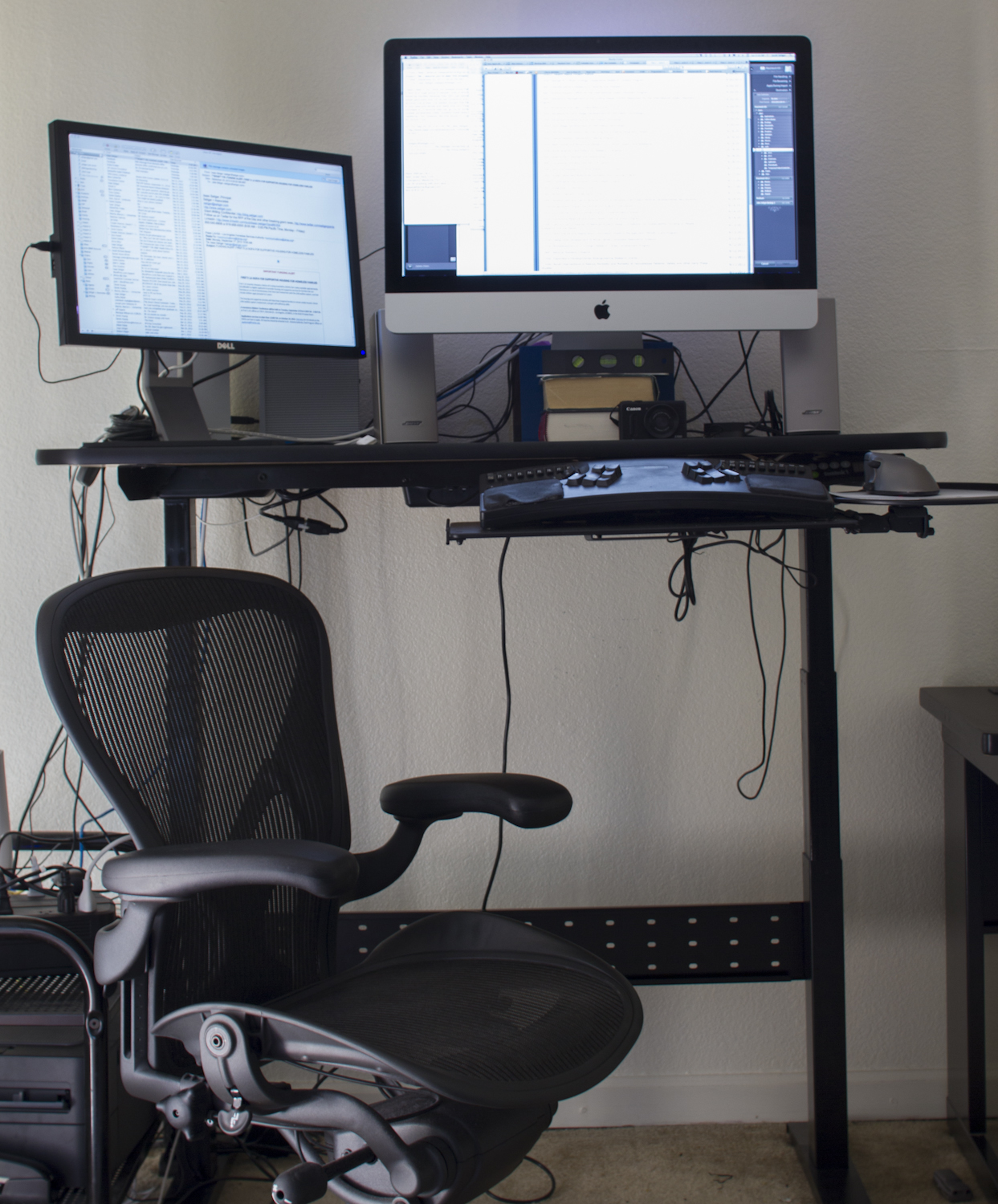
Geekdesk_and_iMac_2There is by now extensive evidence that sitting for long periods of time is terrible for both health and for concentration. The former has only recently hit the news; see this New York Times story or “The health hazards of sitting” from The Washington Post. Others may be easily found. Yet standing for long periods is also unlikely to be good for you, as anyone who has worked retail or restaurants already knows. Hence the sit-stand desk. Sites like Hacker News are rife with testimonials about standers. Let me add to the cacophony.

The latter issue—concentration—is less easily measured, but many of us who do brainwork at desks know the impossible-to-ignore feeling that we must stand and pace. A standing desk facilitates that kind of concentration.

For a long time I got a magical “wow” feeling when I tire of standing and watch the desk lower, or when I tire of sitting and watch the desk rise. Very few products of any sort offer that “Wow.” By now, however, having a sit-stand desk is mundane. We can acclimate to almost anything—and in one particular domain acclimation is called the “Coolidge Effect“— but, as mentioned earlier, I wouldn’t want to go back.

Like any sort of change there is a break-in period, and someone used to sitting for most of the day shouldn’t go to standing for most of it. Start with half an hour or an hour at a time. To the extent I have a method it’s simple: when I’m tired of standing I sit and vice-versa.

Geekdesk_and_iMac_3One other point: pretty much everyone I’ve seen who has tried a mat recommends getting a mat (see, for example, this thread for a wide array of testimonials). I haven’t seen anyone who tried a mat and didn’t like or recommend one. The good ones cost at least $60. Geekdesk now sells a mat, and I’m sure theirs is fine.

Otherwise, I don’t have much to report about usage—which is probably good; like any tool, a desk exists to support some other end. The memory feature on the GeekDesk Max works well. I haven’t thought about it in ages. The desk’s motor (or, more properly, motors: I believe it has one in each leg) is quiet and smooth. In the years I’ve had mine I’ve discerned no changes in the quality of the motor. I suppose it could die tomorrow, and the official warranty is only for two years, but GeekDesk seems like the kind of company that’ll either replace the desk if it dies the day after the warranty expires or cut you a deal on a new one. More on the quality of the company is below.

My desk also has a Humanscale keyboard tray attached. The Humanscale systems have become much more expensive since I bought mine, but I don’t know much about the alternatives. I do know that used versions are available on eBay and Craigslist. I also know that the keyboard trays will last for decades because my parents originally bought ones about twenty years ago. Most of the keyboard trays also offer 360 degree ranges of motions, which can be handy.

The motor—or more properly motors, because I believe there is one in each leg—is still quiet and smooth after about two years of use.

Cost

I like to imagine money spent on computer / desk setups to be allocated pretty damn well, considering how many hours a week I spend working at a computer. But people are funny about money: Dan Ariely describes some of the ways people mis-allocate money based on anchor points in Predictably Irrational.

Most people, if you press them, have some important indulgence they think “worth” spending money on. It might be shoes, lingerie, cars, boats, sports, travel, or hobbies, but it’s almost always there. The surprise at the expense of really good desks is, to my mind, an indication of priorities more than any comment on the absolute value or lack thereof in a workspace.

It’s almost impossible to say whether something like this is “worth it” to another person, but the usual points in favor a sit-stand desk are simple: many people spend 20 to 60 hours a week at a desk. On a cost-per-day basis, a good desk costs less than coffee or ramen. Put that way the upfront costs seem much smaller. It is interesting that many people are willing to pay four figures for minor car creature comforts but spend much less on desks or beds, which are often occupied for ten times as long as a car. Nonetheless anchoring effects are strong and perhaps they can’t be overcome.

I don’t know how long the motor on this desk will last. A conventional desk can probably endure for decades, and that’s obviously not true of a desk with moving parts. This desk comes with a two-year warranty. I’m guessing too that GeekDesk the company will either knock some cash off a new version or do something else nice if the desk dies the day after the warranty expires.

Installation

If you’re not accustomed to using power tools and building things on your own, pay the $95 or so to have your desk built for you. If I’d done this, I would’ve saved a lot of time and hassle. When I first bought the desk, I had no idea what I was doing and screwed up the screwing-in process by not having a drill-bit extender. Seems like an obvious point in retrospect, but at the time I messed up in the installation and ended up stripping a screw and installing others at an angle. In addition, although the screws Geekdesk sent were “self-starting,” they should still be installed with pilot holes.

desk_problems-7416I’m jumping ahead of myself, and I could tell the long and somewhat boring story about how this happened, but the short version is that I called GeekDesk not really sure about what I’d fucked up. GeekDesk’s customer service is insanely fabulous. About 80 – 85% of the problems were my own damn fault, and I should’ve been more careful when I assembled the desk, and I should’ve been more careful with the screws. But I wasn’t, and when I gave up and punted, Isaiah actually hired the installer at GeekDesk’s expense. I volunteered to pay, but they said they’d do it. Very few companies go this far.

The installer was a third-party company; perhaps not surprisingly, GeekDesk does not have a horde of desk installers across the nation. Unfortunately, the guy GeekDesk sent installed the screws at an angle just like I did, and in the process of screwing around (haha!) with them, managed to strip two heads, which then caused him to go to Home Depot for some more screws. This doesn’t inspire confidence in him, or in the self-starting screw system.

stripped_screw-7394In my case, I’ve seldom had any need to use power tools and am an amateur. But his entire profession involves putting things like desks together correctly. He was also ready to leave the mis-screwed screws, until I pointed out that the desk was still wobbling.

Anyway, for the Humanscale track I drilled small pilot holes, and now the desk doesn’t wobble, provided that it’s braced against a wall sufficient to absorb shock but not so much as to impede the motor. The desk doesn’t feel as solid as the Maxon Series 1000 desk it replaced, but I haven’t notice any monitor shake either.

(A side note: most reviews for newspapers or magazines appear after the writer has tried the product for a few days or weeks. I prefer to write them after a few months or years: that’s often how long it takes to really evaluate value.)

There are other, similar sit-stand desks, like the NextDesk Terra, but it’s $1,500 and I can’t discern any obvious improvements. It’s also wider, at 63 inches, than the GeekDesk. The Wirecutter‘s reviewers like it better; still, I’d rather save the money and use the Geekdesk.


Here is an earlier post on GeekDesk; note the datestamp.

5K / “Retina” iMac and Mac OS X “Yosemite” thoughts

Note added Jan. 29: Yosemite update 10.10.2 seems to have solved the software problems noted below. The hardware continues to be excellent. The next version of OS X, El Capitan (10.11), is said to be “a return to slow-but-steady improvement after Yosemite’s upheaval.” Let’s hope so.

I’ve had a Retina iMac with Yosemite installed for close to a month, which is long enough to form a mostly positive impression—except for the bad software situation. The iMac’s “Retina” screen is as beautiful as advertised and is a tangible reminder of progress. If you use it you won’t want to go back, any more than you’d want to go back to celibacy after losing your virginity. But Yosemite crashes about once a day for reasons mysterious to me and to Apple support. Yosemite is a step backwards.

5k retina imacLet’s start with the headline feature: the screen difference between the preceding iMac and this one is real, but it’s not nearly as great as the difference between the low-resolution Macbook Pro and the Retina MacBook Pro. Retina MacBook Pros are not just better but insanely, can’t-go-back better than their predecessors. The Retina iMac is an improvement, a real improvement, but not as startling. If you’re in the market for an iMac-like computer and can afford the price premium, the better display is worth the cost. As noted above, you won’t want to go back. Standalone versions of the screen aren’t even available as of this writing; when they become available, they’ll likely cost $2,000 in and of themselves.

People who bought iMacs in the last two to three years should probably wait for the next iteration because it should be cheaper than this one. My last iMac came from 2010 or thereabouts and I was due for an upgrade, especially because I now do more with video than I previously had. Fast computers are to video what oil is to transportation: It’s almost impossible to have enough.

This iMac is not as quiet as my previous iMac, though it also isn’t noisy enough to make the fuss that would be necessary to return mine and try again. It has an annoying, intermittent buzz that’s noticeable in quiet rooms. I can imagine myself standing in an Apple store, most of which sound like an airplane engine is prepping for takeoff, and trying to get the support person to do what I want them to do, while the support person looks at me like I’m crazy.

In software terms the OS jumped from 10.6 to 10.10. The only day-to-day difference I notice is the addition of Messages, which lets me text to phones from my keyboard. Phone keyboards have always bothered me—which may be a sign of age—and Messages is a significant enhancement. Obviously there are numerous differences in the APIs and libraries available, which developers have leveraged or are leveraging, but they’re not as salient to me as the “headline” features. Still, I think about how every version of OS X from 10.0 – 10.6 saw major feature improvements that immediately made my life way better in an immediate, tangible way. I’m not seeing that in the 10.6 – 10.10 jump.

The major OS X features I love and constantly use were introduced years ago: Spotlight, Time Machine, Exposé. Messages could probably have been backported to 10.6 but wasn’t. Some cool new programs like Pixelmator seem to have been enabled by the backend OS work, but those programs don’t have a huge effect on my day-to-day life. Spotlight is harder to use and doesn’t seem to work as well as it did. Boolean operators also still appear to be absent.

The migration process from old iMac to new was painful and manual; Migration Assistant is notoriously unreliable and works terribly if a person, like me, is moving from two hard drives to a single drive. Permissions problems appeared, as they so often do. I could solve them with time and patience, but they might have stymied less sophisticated users. The general reluctance to upgrade any working computer is reasonable based on my experiences.

Once I had the basic migration done, I spent a lot of time turning off various “features.” Threaded mail messages in Mail.app don’t work very well for me, and the animations were annoying and slowed things down. Some pretty but non-functional could only be turned off through the command line. It would be nice to have a “fuck animations” checkbox in system preferences somewhere. Speed is of paramount importance.

Four years ago I wrote about my uninterest in upgrading from OS X 10.6 to 10.7, and recent experiences have borne out that reluctance. Most of the Apple operating systems since 10.6 appear to be less stable than 10.6. This Hacker News thread is full of stories about problems with Yosemite. Right now Yosemite is only on its .1 release, so the .2 release may solve some of the problems, but the stability issue should have been solved in beta. In addition to the WindowServer crashes linked to above, Flash crashes routinely in the browser. Final Cut Pro X is unusable because it crashes when attempting to import any new video. This will necessitate yet another call to Apple support. aFinder has crashed a couple times for mysterious reasons—despite the fact that the hardware in this machine is by every conceivable metric faster, better, and more tolerant than the hardware in the preceding machine.

What gives? I’m not the only one having these problems. In addition to the Hacker News thread, consider “AppleCore Rot,” another piece on Apple’s apparent quality problems. This in particular resonates: “Stuff that worked for years breaks, while new visual crapware is piled on endlessly.” I would like Apple to make it work first and make it pretty second.

In an email my Dad observed this about Yosemite and the linked Hacker news thread:

The first post [in the Hacker News thread] complains about the phone calling feature. About 22 years ago, I routinely made calls from the IBM PC 1 using Lotus Organizer 1.0 to dial from the address book with Windows 3.1 and the world’s slowest modem. But then again, Organizer was the best PIM [Personal Information Manager] ever and in some respects AmiPro and WordPro were better 20 years ago than Word is today.

I used to use Lotus WordPro too, and it was much stabler than Word today (although Word has been relatively stable in this version and the last version). Some software was better a decade ago than it is today.
That being said, many of the random waits that involved exporting photos from Lightroom or, to a lesser extent, videos from Final Cut Pro X have either disappeared altogether in the case of the former or shrunk dramatically in the case of the latter. That’s the few times FCP X has actually worked, however.  Some simple scripts run faster. Manipulating exifdata with Exiftool is faster. Web browsers no longer choke and sputter (that they did on a relatively modern machine could be the subject of another cranky post). Fast user switching is now genuinely fast. The advance of hardware, and what it enables, is not to be underestimated.

Still, there are other caveats. The larger hard drive is good, but Apple should really be offering four terabyte Fusion drives. I’m puzzled as to why it doesn’t, apart from simple cheapness. Large hard drives are one of the (dwindling number of) reasons people still use desktops.

My iMac had a 256 GB SSD and a 2 TB conventional drive; this one has 128 GB and 3 TB, respectively, which is anemic improvement in capacity terms (though the SSD is much faster and the interconnect between the SSD and CPU is also much faster). Still, 4 TB hard drives are widely available and there’s no good reason why Apple shouldn’t offer bigger hard drives. There are other nice-to-haves: USB 3 ports. Thunderbolt ports. External hard drive speeds are much faster. I’ve gone from having about 2 TB readily available to having 9 TB readily available, between a Drobo and the internal drives.

5k retina imac side viewAesthetics are a wash. From the front, the new iMac is visually indistinguishable from the old, and photos don’t convey the screen’s beauty. The profile shots show a much slenderer machine. Also notable in the pictures in the Elevation Stand, which began as a Kickstarter Project that I backed. It’s by far the best iMac stand I’ve found, and I’ve tried various solutions ranging from wood blocks to books to an expensive stand festooned with screws sold discovered through the Apple store. The Elevation Stand is expensive but it works. The space between the top and bottom of the stand will also fit external hard drives.

My desk is somewhat ugly and I’m perpetually telling myself I’ll clean it off and make it very pure and functional seeming, but for whatever reason it rarely actually happens and as soon as it does I end up re-covering it with books and cameras and cords and other crap. This is obviously not part of the iMac review.

The iMac itself is still beautiful. If you use a computer too much, as I do, you’ll want one.


Here is Farhad Manjoo’s paean to the iMac. Most tech reviewers are ecstatic, perhaps disproportionately to how ecstatic they should be, but they also know computers well and know that the screen is amazing given how expensive 4K and 5K screens cost. I have a 23″ side monitor and no desire or need to upgrade it.

Here is a Reddit thread that hits many of the same points I’ve made about OS stability. Here is Geoff Wozniak on why he quit OS X. You’ll recognize the themes I hit.

Sharp Objects — Gillian Flynn

The first time through Sharp Objects I though it totally absurd, since the characters in it behave like fantastical morons perpetually rolling on ecstasy or akin to faeries from Jonathan Strange & Mr Norrell. The plausibility of the plot is so low that I almost gave up, exasperated.

But I kept reading the first time and was curious enough to reread the second time and realize that Sharp Objects is not about a realistic story of realistic detection; instead, it’s a mythic-Freudian* work about the anxiety that comes from two related phenomena: transitions to adulthood and the muddying of lines between the generations. Camille, the protagonist, is supposed to be an adult (she’s a reporter for paper, she covers murders, she pays the rent) but around her mother she acts like a child and around her 13-year-old sister she acts like a peer.

Sharp_ObjectsOnce this alternate reading became clear, Sharp Objects became pleasant. It’s not supposed to be realistic (or, if it is, it fails so badly at its purpose that it might as well be read my way). It’s a fairy tale with a bit of media critique thrown in, and it says that girls and women have the dark urges that are often absent from fiction and from the news. Camille needs to reconcile her family relationships and her family’s history in order to understand the murders she’s investigating. Conventional reportorial skills and abilities are of little use; at best one might say she employs some aspects of New or Gonzo Journalism, since she does in fact drop ecstasy at one point.

In the novel Camille is dispatched by her editor to her home town to investigate a murder that becomes a series of murders of girls. The novel signals its intentions early. Camille is describing the home town she came from, and she ends the first chapter with this:

When I was still in grammar school, maybe twelve, I wandered into a neighbor boy’s hunting shed, a wood-planked shack where animals were stripped and split. Ribbons of moist, pink flesh dangled from strings, waiting to be dried for jerky. The dirt floor was rusted with blood. The walls were covered with photographs of naked women. Some of the girls were spreading themselves wide, others were being held down and penetrated. One woman was tied up, her eyes glazed, her breasts stretched and veined like grapes, as a man took her from behind. I could smell them all in the thick, gory air.

At home that night, I slipped a finger under my panties and masturbated for the first time, panting and sick.

The blurred mental lines between sexuality, animals, reproduction, and early age remain a theme that runs through the novel.

Attention is also a scarce resource in the novel: Camille constantly seeks it from her mother, even at the risk of being dangerous, and also seeks it from men (at least at first). Her sister is repeating Camille’s experience. Parents are either absent (from page 21: “I wondered where their mother was”) or overwhelming. Family sexuality recurs; here is one early example, from Camille’s narration:

The Victorians, especially southern Victorians, needed a lot of room to stray away from each other, to duck tuberculosis and flu, to avoid rapacious lust, to wall themselves away from sticky emotions. Extra space is always good.

“Stray” is an exact quote. And if extra space is always good, why then does Camille go to her mother’s house? She returns to a point of danger in search of information, like Little Red Riding Hood entering the Wolf’s house. The novel itself keeps pointing to Fairy Tales. Amma, Camille’s sister, says:

now we’re reunited. You’re like poor Cinderella, and I’m the evil stepsister. Half sister.

A few pages later, Camille speaks with a boy who says that he saw a “woman” take the second girl, who turns up murdered. She thinks this of him:

What did James Capisi see? The boy left me uneasy. I didn’t think he was lying. But children digest terror differently. The boy saw a horror, and that horror became the wicked witch of fairy tales, the cruel snow queen.

No one believes that the killer is a woman because women don’t behave that way. But wicked and evil women are pronounced in fairy tales.

This details occurs in Camille’s mother’s house:

Walking past Amma’s room, I saw her sitting very properly on the edge of a rocking chair, reading a book called Greek Goddesses. Since I’d been here, she’d played at being Joan of Arc and Bluebeard’s wife and Princess Diana—all martyrs, I realized. She’d find even unhealthier role models among the goddesses. I left her to it.

There are more. These are enough.

Seemingly no one grows up in Sharp Objects. Nearly every woman in Wind Gap still gossips like she’s in high school. Growing up is hard and harder for some of us than others. Perhaps we never fully leave childhood behind. Camille can’t. Her sister Amma is in some ways eager to leave childhood (she behaves like a pro when it comes to the inciting the desires of men) but in other ways wants its protections. In our culture, she can legally at least get both,** and she behaves in both ways. At one moment Amma is behaving like an infant:

Amma lolled sleepy as a newborn in her blanket, smacking her lips occasionally. It was the first time I’d seen my mother since our trip to Woodberry. I hovered in front of her, but she wouldn’t take her eyes off Amma.

In others she doesn’t, as when she says that after her mother takes care of her, “I like to have sex.” Then:

She flipped up her skirt from behind, flashed me a hot pink thong.
“I don’t think you should let boys do things to you, Amma. Because that’s what it is. It’s not reciprocal at your age.”

Camille’s counsel is distinctly odd, coming from someone who did similar things at similar ages and, it would appear, for similar reasons. But she doesn’t at this moment have the power to break the familial cycle, with its hints and implications of incest. That waits until later.

Camille’s decision to enter this cauldron of weirdness reinforces the idea that Sharp Objects is more about family patterns and dynamics than detection. In one of the flimsier rationales in the book, Camille stays with her mother, her stepfather, and her adolescent sister, ostensibly for the sake of saving the paper money, but this decision is insane given her relationship to the family. That she continues to stay as events become more and more macabre and surreal are equally insane and implausible. Camille should leave, and that’s obvious to any sane reader and should be obvious to her. That she stays anyway indicates that the story has motives different than the ones I initially assumed.


* Freud has a much stronger mythic element to his work than is commonly supposed—and so I’m justified in using myth and Freud in this way. Much of his work is unfalsifiable, giving what is nominally a scientific body of work a distinctly literary quality, and the supposed universality of many of his concepts (the death drive, the Oedipus complex, etc.) are not supportable.

* Let me reproduce the footnote at the link:

As Judith Levine notes in Harmful to Minors: The Perils of Protecting Children from Sex: “One striking pair of contradictory trends: as we raise the age of consent for sex, we lower the age at which a wrongdoing child may be tried and sentenced as an adult criminal. Both, needless to say, are ‘in the best interests’ of the child and society.” And, as Laurie Schaffner points out in a separate essay collection, “[…] in certain jurisdictions, young people may not purchase alcohol until their twenty-first birthday, or may be vulnerable plaintiffs in a statutory rape case at 17 years of age, yet may be sentenced to death for crimes committed at age 15 [….]”

Laws [. . .] reflect race and gender norms: white girls are the primary target of age-of-consent laws, while African American youth are the target of laws around crime and delinquency. The contradictory trends are readily explained by something rather unpleasant in society.

I didn’t elaborate on what the “unpleasant” thing may be and won’t here, either, but you’re welcome to take a shoot at your best interpretation in the comments.

Sex, Drugs, and Cocoa Puffs: A Low Culture Manifesto — Chuck Klosterman

Pop-culture essays age in dog years while retaining the occasional long-term insight that stays fresh by accident. I’m reading Sex, Drugs, and Cocoa Puffs: A Low Culture Manifesto and mostly noticed age spots but also saw a few prescient moments, like this:

But Junod claims that he [made up details about Michael Stripe of R.E.M. in an article] in order to make people reevaluate how the press covers celebrity, and that’s valid. It’s valid because conventional celebrity journalism is inevitably hounded by two problems: Either the subject is lying, or the writer is guessing. Junod just happened to embrace both of those obstacles simultaneously.

The relationship of the Klosterman essay to say John Jeremiah Sullivan’s more recent Real World essay, “Leaving Reality” essay is obvious, but I think Kloosterman is also forgetting—or doesn’t want to simply say—that people read celebrity profiles in part because they want to be lied to. There is more than a little complicity in the lie, which changes the relations of the liar to the person being lied to. Or perhaps people want to feel false intimacy, which can be achieved partially through lying.

klostermanThe “subject” of these profiles—like the Michael Stripe one, or others in its genre—is probably trying mostly not to say or do anything that will make him or her look like an asshole when taken out of context. This can be shockingly hard to do, since the subject can’t tell when the writer is “guessing” or what the writer is “guessing.” In this context “guessing” can be another word for “interpretation.” One reason to read the New Yorker, incidentally, is that its writers appear to attempt to be scrumptiously fair and to avoid gossip—yet those are the very qualities that can give rise to accusations of being “boring.” One person’s boring is another’s accurate.

Imagine someone followed you around, all the time, for a couple of days and maybe for longer, and that the person has some bad will, or at least wants to make your life into a story. Could the person get some stuff that would make you look bad? Probably. I know that someone who could observe everything I wrote, and watch everything I do could make me look really bad. So smart celebrities avoid the real press, or only interact with the relatively small, non-jerk parts of the press—like The New Yorker.

Let’s take a specific example of an article about the world behind celebrity journalism: Sarah Miller’s hilarious “Anna Nicole Smith Kind of Made a Pass at Me.” I dramatically read parts of it to some friends the other night. This paragraph stands out in particular:

I wrote a first draft, in which, without spelling everything out, I attempted to give some real sense of that day. “I can’t publish this,” my editor said, and in her defense, I’m sure she was right. I wrote another version that made it sound like I’d had fun, which took hours and hours, because it was not real; writing something that is not real is not impossible, but it is very close to it. Through every long moment I worked on it I cursed myself for not taking that stupid trip to Magic Mountain, which would have made it all so much easier. Anyway, they published that version, and I got my money.

Miller describes what actually happened this way:

“Sarah Miller,” [Anna Nicole Smith] said, “You’ve got the prettiest blue eyes.” If we were in a movie, she’d have added, “I do declare.”

“Thank you,” I said formally.

“You ever had sex with a girl?”

It was none of her business, but I thought being honest might somehow give her back some of the dignity my mind had robbed her of, and I thought she might sense it, and that we might have a real conversation. “Yes, actually, Anna. I have.”

“Well, did you like it?” The word “like” lasted for several seconds.

“I actually did not,” I said. “It was a…misbegotten adventure.” I was pleased at how much I sounded like my father.

But that can’t be published, not at the time Miller was trying to get the story. Her editor, however, doesn’t want “real.” The number of readers who do is small. How many people watch PBS versus celebutainment shows? How many read The New Yorker versus US Weekly? The truth is hard and amusing fictions easy, so we choose the latter. In the introduction to Sex, Drugs, and Cocoa Puffs Klosterman writes that “accelerated culture [. . .] doesn’t speed things up as much as it jams everything into the same wall of sound. But that’s not necessarily tragic.” I’m not convinced there is such a thing as “accelerated culture,” but I am convinced that elements of what passes for low or contemporary or whatever culture do emerge from the collective decisions of millions of individuals.

But it is also worth stepping back and looking for larger patterns, which is what Klosterman almost but doesn’t quite do. He is a little too fond too of grand pronouncements. Like:

The main problem with mass media is that it makes it impossible to fall in love with any acumen of normalcy. There is no “normal,” because everybody is being twisted by the same forces simultaneously. You can’t compare your relationship with the playful couple who lives next door, because they’re probably modeling themselves after Chandler Bing and Monica Geller. Real people are actively trying to live like fake people, so real people are no less fake. Every comparison becomes impractical. This is why the impractical has become totally acceptable; impracticality almost seems cool.

What is an “acumen of normalcy?” I’m not sure either. I had to check Google for “Chandler Bing” and “Monica Geller.” And has it ever been the case that “real people” have not tried to model themselves on “fake people?” If you read major religious texts as fundamentally mythological, as I do, the answer is “no:” people have been trying to emulate the Christian Bible and the Old Testament for literally thousands of years. Early novels with melodramatic endings encouraged their readers to attempt to reenact those ending. We seek narrative fiction in order to learn how to live—and that isn’t at all new. I don’t think there has ever been as firm a normal as we’d like to project on the past.

Eventually, with paragraphs like the quoted section, one comes to the conclusion that either everything is “fake” or everything is “real”—which is the sort of conclusion high freshmen hit when they’re in their dorm rooms at 2:00 a.m. The next day they still get up for class and go to breakfast. What is one supposed to do differently if one decides that real people are fake?

Perhaps not surprisingly, the next essay in the Kloserman collection concerns the video game “The Sims.” Also not surprisingly, some SF writers have wondered what might happen if we get a wholly immersive and wholly fake world. One possible solution to the Fermi Paradox is that sufficiently advanced civilizations make video games that are so cool that they’d rather live in constructed worlds than explore the real universe.

That’s an interesting thought experiment, but like the high freshmen mentioned above no one does anything differently today based on it. Klosterman tells tales about meaningless arguments. Eventually, however, generative people come to realize that arguments that don’t lead to any sort of change or growth are pointless, and they get on with their lives. One sign of “low culture” may be that winning or losing the argument means nothing, and the participants should go build or make something instead.

Love Me Back — Merritt Tierce

Love Me Back is compelling, worth reading, and strange: it is a novel almost without psychology, in which the protagonist, Marie, acts without asking herself why she acts (“Whatever is in me that makes decisions is now full of an accretion of plaque”). It is a strange book too to read back-to-back with Peter Thiel and Blake Masters’s Zero to One: that book is about startups, innovation, change, and societies, while Love Me Back is about Sisyphean repetition, ancient industries, grunt labor, and sex. The two books o occupy different market worlds, and Thiel and Masters mention restaurants repeatedly as the sort of low-margin high-competition businesses one doesn’t want to be in. Marie is in the business from necessity and because it provides opportunities she wouldn’t have otherwise: opportunities for sex and drugs, and opportunities to turn her mind off and make the money she can’t or couldn’t make otherwise.

Love_Me_BackThe novel’s chronology is chopped in an appealing way: Marie starts the story as an experienced worker and then jumps back and forward. It’s disorienting in a way that perhaps mirrors the disorientation of service at a restaurant. She is observational, though, from the start, imagining a customer thinking, “Would I be like Jordan?”, since Jordan “was a young blond waitress liberated by one of her customers.” The word “liberated” is key and yet Marie doesn’t seem to want to be liberated: she wants not slavery but structure. The novel is partially addressed to her daughter, who Marie bears as a teenager and whose father is unnamed, and in one early encounter with a man who “reminded me of a hairless mole we’d seen at the zoo” she snorts coke and then says:

I imagined her sitting on the counter, her short legs hanging off, swinging. I went back into the bedroom and said, I’m sorry, I have to go, I’m not well. I was shaking and I felt beautiful. I thought how beautiful it was that I had only one garment to put back on, my black cocktail dress there on the floor. I pulled it over my head. I don’t wear underwear. See you, I said. He didn’t try to stop me.

There is no antecedent to the pronoun “her:” we infer that Marie is speaking of her daughter. For a moment Marie feels something; it isn’t obvious that she often feels beautiful despite the action she gets. She senses without articulating it the power of glamour (one of her first restaurant men wears aviators, an object Postrel specifically discusses at the link). Marie is ambiguous in general; at moment she says “I hated staying the night because it was always different in the morning.” Was it? Is it? Why? The party ends, yes, and perhaps the illusion can’t be sustained and Marie wants the illusion. But relationships of any duration are the breaking of the illusion and the creation of something else in its place.

It is impossible to intelligently discuss Love Me Back without mentioning sex and the restaurant business. When Marie begins she says:

That was the best body I ever had, and the worst mind. I was seventeen. I was slender and strong and I also had swollen C-cup breasts. [. . . ] my mind was an open sore. It was black. I couldn’t tell if I was deep inside it or totally outside it. I would imagine being fatally cleaved all day long.

She never stops imagining being “fatally cleaved,” or so it would appear. The next three paragraphs spoils the novel to a minor extent, but the novel ends with Marie’s description of her getting ready for work, in a “professional” manner (with “professional” repeated often enough to make us skeptical of the term) and she says:

He starches everything to spec, so my long bistro apron can stand on its own and the creases in my sleeves will be so pointy that even at ten thirty tonight when I walk up to my last table for the first time they will see those creases and they’ll trust me just a little. My name is Marie, and I’ll take care of you tonight.

She’s where she started. Nothing changes in the restaurant business, or change happens so slowly that it isn’t perceived by the workers in the business. The work is cyclical, mythic, like economics prior to the Industrial Revolution. Hence the jarring feeling of reading Thiel and Masters next to Tierce. Love Me Back is about elemental matters, sexual and economic, and their book is about change. Both are beautifully written but in very, very different ways; Love Me Back took longer to enter but its proffered rewards turned out to be real.

The restaurant business is ugly and fascinating and un-PC. One man, Christopher, dispenses this advice, before he fucks teenaged Marie: “There’s only two times in a restaurant: before and after. You walk in, you white-knuckle it, try not to fuck up till it’s over and then it’s over. You made your money or you didn’t.” The third time in a restaurant business might be when you write about it. Marie likes it because exhaustion keeps her from thinking: she is “always that heavy, iron kind of tired” and her “exhaustion was metallic.” She likes it. She doesn’t have to think and doesn’t want to, which is curious given another seemingly throwaway detail: Marie has been admitted to Yale but shows few real interests or abstract thoughts. What is she interested in? Art? Science? Startups? Philosophy? We don’t see much. Certainly plenty of otherwise vapid students with good grades and test scores get into high-status, highly marketed schools, but Marie seems an extreme example.

She does learn outside of work:

I learned a lot of things while I worked [at Chili’s]. I learned how to sweep aggressively and efficiently. I learned how to anticipate and consolidate, which is all waiting tables is. I learned how to use work to forget. I learned how to have an orgasm and I learned I was a bad wife.

Many of those things are not like other things; they are so disparate that one learns both much and little about Marie at once. Marie learns that “there were rules to being a waitress. The main one was don’t fuck up.” Arguably that’s a rule of relationships too; the lack of punctuation, italics, or some other separation between the word “was” and “don’t fuck up” is also characteristics of the novel’s overall tone, which is chatty but not shallow. It seems like one should tire of it by the end, but I didn’t.

Marie rejects the support system she has: she leaves her parents because they treat her daughter more like their daughter, and while when she first leaves “They didn’t live far from us” she “didn’t know what to report. I hate that I hate my life?” The language here is clever: a weaker writer would’ve simply said “I hate my life,” but hating that she hates her life makes sense, and makes me pause: she chose her life and as such it doesn’t make sense to hate it. She’s too smart for simple teenage hate, but the perpetual restaurant life and the perpetual need for cash don’t sound fun either. Reading between the lines might also make Love Me Back a very subtle argument for making IUDs widely available, since they are tremendously effective and safe. But that would require acknowledging what people and especially teenagers want, and we live in a culture where that doesn’t happen; Marie doesn’t quite want to acknowledge what she wants, either. Want is somewhere in the rush to perpetual action, whether at the job or through sex. Let’s not ask why.

I hesitate to include the above paragraph because it makes the novel sound like a policy brief, which it isn’t. But it will in some quarters be read as one. Marie’s poverty is too persistent; for one holiday she says that “Thanksgiving dinner was the rice and beans with the onion and Ro*Tel added for flavor, which is what we usually ate, and the pie. He said the pie was the best thing he had ever eaten in his life.” But that’s also the night her husband learns that “it hurts when I piss,” and Marie knows why: “I knew that I had given Danny chlamydia and I knew I’d slept with my husband since then.” That undercuts whatever domestic success Thanksgiving might otherwise have entailed. One of the guys she chooses to fuck is described this way:

On his chest the tattooed face of a pit bull he said was the best friend he’d ever had, on his left calf a beckoning, bare-titted mermaid. Over his entire back a flaming skull, the fire burning up toward the nape of his neck [. . .] On his wedding finger a black band where a ring would go.

He is signaling his beliefs and attitudes effectively. During a three-way with two men, neither of whom is her husband, Marie says that one “Held me in place like that and I kept myself taut against him almost as if I were trying to resist or get away but it was the best thing I had ever felt with a man.” The divorce is almost foreordained. The other guys are too good, the variety too fun. A different sort of person could say, “Be wary of marrying teenage mothers.”

Does Marie learn over the course of the book? I think not. She does, however, speak, and her voice keeps me reading, and keeps me thinking about Love Me Back after I’ve moved onto other books, other worlds, other words. Marie’s words stay with me. She is like the narrator in True Things About Me or Catherine Millet in The Sexual Life of Catherine M. bizarrely, powerfully honest. I wish I’d read all three books long ago—perhaps the trajectory described in detail here would have been faster. But then again I might not have had the base of knowledge I do know, and into which Marie’s life can be incorporated and seen for what it is, rather than what others wish it to be.


Love Me Back is too intense to be for everyone and yet as you can gather above I love it. Here is an interview with Tierce, and here is a visual review.

Drugs Unlimited: The Web Revolution That’s Changing How the World Gets High — Mike Power

Drugs Unlimited is an excellent companion to Daniel Okrent’s Last Call, since both are about the madness of the laws that forbid or restrict mind-altering substances. But Drugs Unlimited shares a flaw and strength with Last Call, too: both books are repetitive, with tons of minute historical detail that feels easy to skip. Unless you wish to become an expert in the subject both are better checked out of libraries than bought.

Drugs Unlimited follows a pattern and cites many, many examples of that pattern: Chemist or enthusiast comes up with a novel drug or drug variation; people try and like it; governments eventually ban it (there are chapters devoted to “LSD in the 1960s, heroin in the 1980s and Ecstasy in the 1980s and 1990s”). The process then repeats, though we’re now in a stage in which it’s difficult for governments to ban or regulate every conceivable substance, leading to an online free-for-all.

Drugs_unlimitedShould you wish to enter the free-for-all Drugs Unlimited provides an introduction and useful guidance. Drugs have become more widely available than ever in the last ten years, and perhaps the most interesting thing about their availability has been their lack of impact on society, which continues to function. Nonetheless we get a chronicle of the new drug world: “Widely available and hugely popular, mephedrone was the first mass-market ‘downloadable’ drug, in the sense that it was, uniquely for the mass market, originally only available online.” That I’ve never heard of mephedrone makes me feel uncool.

It’s appropriate that I’m discussing this book on a blog, since Power writes:

Conventional academic research and government-sponsored investigations into attitudes and use patterns are being supplanted in their authority by the unmediated voices of users themselves, as social networks become central to the daily experience of a new generation of drug users.

He doesn’t cite Scott Rosenberg’s Say Everything: How Blogging Began, What It’s Becoming, and Why It Matters but he might as well: one could take out the word “drug” and replace it with “readers” or “listeners” or any number of other verbs. Still, there is a persistent feeling that “the unmediated voices of users” are better informed than the highly mediated voices of the media, or of academics.

Drugs Unlimited is also a media critique: “Saunders also detailed [Ecstasy’s] darker, more negative sides in an honest appraisal that was sorely lacking in mainstream coverage.” Or: “My responses to [Ecstasy] and its surrounding culture, and those of everyone I knew, were markedly different from the media’s representation of them.” Or: “hysterical media coverage of the perceive threats of new drugs and corresponding knee-jerk government action seem to be [. . .] guaranteed.”

Power likes drugs: he’s taken them, and he writes sensuously of the way “drugs can send users into bizarre internal spaces, imaginary realms where mind and body are dissociated from each other, and where the only limits to the experience are those of the imagination.” He should perhaps more strongly emphasize the dangers of mixing different drugs, since that along with poorly manufactured drugs is how people die. The extent to which schools, the “responsible” media, and other authority figures systematically lie about drugs is shocking. Although “Most People With Addiction Simply Grow Out of It. Why Is This Widely Denied?” came out after Drugs Unlimited, it would fit into Power’s narrative.

Drugs Unlimited is lightly technical, and you’ll find sentences like these: “PIHKAL reveals in practical detail the chemical synthesis and human dosage of hundreds of psychoactive substances, each of which are in the phenethylamine class.” The book is neither well nor poorly written. It would not surprise me, however, were copies to travel to many unexpected places and inspired many unexpected people. Perhaps you’re one.

Zero to One — Peter Thiel and Blake Masters

Zero to One: Notes on Startups, or How to Build the Future is out and you, like everyone, should read it; the book is of course about startups but its deeper themes are philosophical in nature: how we should think about and relate to the world. The writing is elegant and clear without having a distinctive style that can be easily labeled by calling attention to itself. It is Robertson Davies’s plain style, used well here.

Those who have already read Blake Masters’s CS 183 classnotes—I have—may be disappointed, since they form the core of the book. Nonetheless those notes have been cleaned up, organized, and updated with more recent examples. The thrust Zero to One is also beautiful and optimistic: the future is important, it can be shaped and improved, and individual choices matter. In believing those three things, and especially the second two, Thiel and Masters are swimming upstream against much of contemporary culture.

zero to oneOthers can no doubt comment on the technical aspects of the book, but I will note that much of what Thiel and Masters write sounds like an artists’ manifesto: “The act of creation is singular, as is the moment of creation, and the result is something fresh and strange.” I very rarely read about business as “strange,” and yet the word is apt: all things are strange before they become domesticated by time and ubiquity. Artists usually focus directly on creating new things, but Zero to One describes “how to build companies that create new things.” More people extend the reach of what a single individual can do, but though Thiel has “noticed many patterns [. . .] this book offers no formula for success.” There is none, because innovation is by definition strange and new. He is trying to “help my students see beyond the tracks laid down by academic specialties to the broader future that is theirs to create.”

Academia has many problems and he notices them; I don’t think he uses this as a specific example, but one issue is treating school like a job or primary occupation. It shouldn’t in most cases be. It should be a day job that enables and ideally complements the other things one does. Teachers and professors rarely inculcate this attitude, however, because they themselves have been selected by the school system and have bought into its prejudices and cultures. Charter schools are important for many reasons, one being that they give an opportunity to create new schooling cultures. Montessori is specifically attempting to do that, and it is striking how many successful tech guys went through Montessori schools.

They note that “The business version of our contrarian question is: what valuable company is nobody building?” This question is harder than it looks” (23). The novelists’ version is, “What valuable novel is nobody writing?” One challenge, of course, is that different people have different values for “valuable:” I find most “thrillers” to be boring and un-thrilling, and most thriller readers probably find literary fiction the same.

This could be a description of most narrative fiction: “Our ancestors lived in static, zero-sum societies where success meant seizing things from others. They created new sources of wealth only rarely, and in the long run they could never create enough to save the average person from an extremely hard life.” Romance, the driver of so much fiction, is usually zero-sum: if the protagonist wins the guy or girl, no one else can; if the rival wins the guy or girl, no one else can, while in the real world there are a de facto infinite number of good guys or girls, provided the protagonist—that is, you—are willing to find and attract them. There are an infinite number of jobs, too, and one person getting a job doesn’t prevent someone else from getting another, or making another. Much narrative fiction taps into the zero-sum dynamic. Maybe it shouldn’t, or should more often explicitly question that dynamic.

Thiel and Masters are writing about everything, though they write specifically about startups. They discuss the nature of mass delusion (“Usually, it’s considered weird to be a 40-year-old graduate student. Usually, it’s considered insane to start a half-dozen companies at once. But int he late ’90s, people could believe that this was a winning combination”) and the psychology of founders (“Of the six people who started PayPal, four had built bombs in high school” and “We alternately worship and despise technology founders just as we do celebrities”); there is a hint of a Paglian reading of myth here, and such readings are too rare in a de-mythologized, de-ritualized society. There is more of the journey of the mythic hero in tech startups than is commonly supposed.

Psychology and cultural criticism have a long border; Thiel and Masters write that “competition is an ideology—the ideology—that pervades our society and distorts our thinking” (35). The opposite of competition, which may be something like cooperation or stasis, could be even worse: static societies and companies do not appear to do well or even exist in a world of competitive societies. But I don’t think Thiel and Masters are going in this direction: they are rather reminding us that it is useful to remember that we don’t live in a zero-sum world, largely because of technology and specialization. Most of human existence probably was zero sum, however, and that may explain some psychological quirks that aren’t terribly adaptive in contemporary information and industrial societies.

Competitive ideology has another problem too: it encourages us to compete with everyone, all the time. Picking good competitors is probably almost as important as picking good friends. Most competitive arenas are pointless. People often fight for control, and against other people like them:

Consider the opening line from Romeo and Juliet: “Two houses, both alike in dignity.” The two houses are alike, yet they hate each other. They grow even more similar as the feud escalates. Eventually, they lose sight of why they started fighting in the first place.

I’ve noticed this continually among professors, often specialists in the same area, who are from the outside identical and yet bash each other over minor differences. People more generally seem to seek fights for the sake of fighting, and without realizing that direct fighting is usually a terrible way to change minds—as has been known for decades. It’s often better to not respond to critics and instead to make something new. As Thiel and Masters write: “Rivalry causes us to overemphasize old opportunities and slavishly copy what has worked in the past.” One can see this at an individual level or even a national level: think of the petro-states that exist as they do primarily because they can sell oil to innovation states.

I mentioned psychology already; here is another passage on that theme that also applies to artists, who are often skilled at ignoring or repudiating group beliefs / delusions:

The hazards of imitative competition may partially explain why individuals with an Asperger’s-like social ineptitude seem to be at an advantage in Silicon Valley today. If you’re less sensitive to social cues, you’re less likely to do the same thing as everyone else around you. If you’re interested in making things or programming computers, you’ll be less afraid to pursue those activities single-mindedly and thereby become incredibly good at them. Then when you apply your skills, you’re a little less likely than others to give up your own convictions: this can save you from getting caught up in crowds competing for obvious prizes.

“Making things:” properly read, Zero to One is a recipe book for makers across disciplines. And “getting caught up in crowds competing for obvious prizes:” I remember talking about college sexual adventures with a friend who went to an Ivy-League school and who lamented that so many of the girls were, in his view though not in his words, neurotic achievement-obsessed basket cases. Maybe he misunderstood what those girls were seeking, but maybe he chose the wrong environment for that part of life.

Making things happens at large and small scales. Though we are still somewhat good at making things happen at small scales—as, say, the iPhone shows, or many Kickstarter projects show—we have become less ambitious and too obsessed with vetoes on large projects. Launching the Innovation Renaissance discusses this; so too does Thiel, in a cultural-political context: In the 1950s, people welcome big plans and asked whether they would work. Today, a grant plan coming from a schoolteacher would be dismissed as crankery, and a long-range vision coming from anyone more powerful would be derided as hubris.” We are collectively unable to even muster the political will to build denser cities and reasonable public transportation systems, let alone next-generation nuclear plants and systems for getting cheaply into space. This is a dark problem too rarely discussed by anyone.

It is also a tremendous and tremendously dangerous problem: “Without new technology to relieve competitive pressures, stagnation is likely to erupt into conflict. In case of conflict on a global scale, stagnation collapses into extinction.” There is a direct, underappreciated link between novelty, innovation, and survival. Artist and scientists are arguably at the forefront of ideas, though not always good ideas. Still, there is a brilliant statement at the end, which I’ve read more often in books targeted at novelists:

Only by seeing our world anew, as fresh and strange as it was to the ancients who saw it first, can we both re-create it and preserve it for the future.

This is not an ordinary book about “business.” It is a book about everything, as the best books always are.

Almost every human endeavor is also about relationships, whether we want it to be or not:

The lawyers I worked with ran a valuable business, and they were impressive individuals one by one. But the relationships between them were oddly thin. They spent all day together, but few of them seemed to have much to say to each other outside the office. Why work with a group of people who don’t even like each other? Many seem to think it’s a sacrifice necessary for making money. But taking a merely professional view of the workplace, in which free agents check in and out on a transactional basis, is worse than cold: it’s not even rational. Since time is your most valuable asset, it’s odd to spend it working with people who don’t envision any long-term future together. If you can’t count durable relationships among the fruits of your time at work, you haven’t invested your time well—even in purely financial terms.

This is again a good description of academia, and it’s also a restatement of the Coase theorem, which I wrote about in similar terms at the link. In most life domains a purely transactional model makes everyone poorer in the ways that count.

Thiel and Masters note that in school “Students who don’t learn best by sitting still at a desk are made to feel somehow inferior, while children who end up defining their identities in terms of this weirdly contrived academic parallel reality.” If you’re awake and paying attention to the school system, it’s hard not to notice its many bizarre perversities—and its problems harm not only the low achieving students but also the high achieving students. Although I spent years being a dumbass, I mostly got tracked to the high-achieving parts of school, and as an adult discussions with others who were stuck on the high-achieving track involve the ways the value system of that track warps those on it. But no one or almost no one tells students that at the time, and parents, teachers, and administrators are in on the conspiracy. Maybe that’s why so many Silicon Valley bigwigs want their kids in Montessori or similar schools.

Moreover, the prestige / rivalry system reinforces a zero-sum mindset, at least for those who buy in, as Thiel did (and only barley escaped):

Higher education is the place where people who had big plans in high school get stuck in fierce rivalries with equally smart peers over conventional careers like management consulting and investment banking. For the privilege of being turned into conformists, students (or their families) pay hundreds of thousands of dollars in skyrocketing tuition that continues to outpace inflation. Why are we doing this to ourselves?

I wonder if Thiel and Masters have read Excellent Sheep yet. Deresiewicz has similarly scalding views, though he comes from a different vantage point and throws some pointless, ill-formed bombs at startup culture. Thiel and Masters, however, ask the deep questions, and give major structural advice that one rarely hears from professors: “You should focus relentlessly on something you’re good at doing, but before that you must think hard about whether it will be valuable in the future.” I have focused relentlessly on writing better novels, but so far it has not proven valuable in a financial sense. If it weren’t for other ways of monetizing my skills, I would be doing something else, and probably not even writing this post.

Let me return, for a moment, to relationships, since your friends and surroundings count, as Tolkien knew and many others know: “it’s hard to develop new things in big organizations, and it’s even harder to do it by yourself. Bureaucratic hierarchies move slowly, and entrenched interests shy away from risks.” This is another, accurate, critique of academia, and a reminder to attend to our environment. Thiel does say that “a lone genius might create a classic work of art or literature, but he could never create an entire industry.” Even the lone-genius model appears less true than is often imagined: reaching into the biographies of famous artists tends to reveal an ecosystem of friends, rivals, mentors, and helpers. Hemingway famously derided creative writing classes, but he spent much of his early working life showing drafts of his work to Gertrude Stein and Sherwood Anderson. Few of us succeed fully in art or business without helpers along the way: hence, perhaps, the Joseph Campbell model that calls for such helpers in The Hero With a Thousand Faces. Even in myth the hero does not succeed alone: Frodo and Aragorn need Gandalf. Luke Skywalker needs Han and Obi-Wan. In His Dark Materials Lyra finds an array of helpers.

There are sections I think wrong, like the one on page 78 when Thiel and Masters criticize contemporary Silicon Valley buzzwords, which may reflect generations of learning about startups and the startup environment. Thiel and Masters say that “Secrets about people are relatively underappreciated,” while the opposite is true: we call secrets about people “gossip,” and most narrative art is relentlessly focused on personality, competitive, and “secrets” about people that almost always turn out to be about sex, money, and death. The supposed “secrets” that people hold tend to be more uniform than not. That pattern has persisted in Western art for millennia: the ultimate “secret” at the heart of Oedipus the King (first written circa 400 BC) and Game of Thrones is the same. The only human secret that matters is that one shouldn’t be surprised by human secrets.

These are quibbles about an otherwise great book. Great books do not have to be long. This one isn’t. They have to pack a lot of ideas in the space they h ave. This one does.

To reiterate the first paragraph of this post, you need to read this book. The less you think you need to read it, the more you do. It is in some ways similar to Rework, another anti-conventional-business business book written by nerds. Zero to One is a tremendously important book; although I admire and appreciate trivial books, particularly because most books including my own are, find one that is important—which does not mean “pompous” or “serious”—matters. You should read it. Your friends should read it. Its ideas should be common currency, readily known whether accepted or rejected. It is possible that the future of the world depends on Zero to One finding the right person at the right time, which is true of few other books.

The physical book is itself nicely made; though the binding appears to be glue rather than thread, the paper quality is high, and much higher than most books in its class and most contemporary books, period. The physical book reflects their emphasis on long-term thinking, as too few physical books do. One can read publishers’s opinions on their own works in the ways they choose to manufacture books. Those opinions do not appear to be high. If publishers have a low opinion of their own products, what should investors think?


Here is a good Fortune profile of Thiel. And

Briefly Noted: “The Fever” — Megan Abbott

I’ve already reviewed The Fever—it’s just under the title Dare Me, with its similar subject matter (high-school girls, transformation, darkness in women, sexuality) and style (half-knowing, unwilling to admit, chopped up narrative). This is not a criticism, Dare Me readers who want more of the same will find The Fever delivers. Like Dare Me the principle concern is female rivalry over high-status guys and female judgment of each other’s sexuality. I won’t say it’s a critique of those topics, though it could be read that way. It could also be seen as a commentary on the eternal conflict between children and parents.

Similarity is not always a bad thing—Elmore Leonard’s many caper novels consistently delivered similar characters, styles, and plots, and again that could be read as weakness or strength as he played with variations around a central concern or set of concerns (which I read as coolness and silence—subjects for an academic paper yet to be written).

the_feverThere is a Paglian tinge to Abbott’s last two novels (sample: “In the school’s hallways, Tom could see it: Gabby carried the glamour of experience, like a dark queen with a bloody train trailing behind.” Unlikely, but poetic, and it tells us about Tom’s overwrought perspective). They may be of less interest to those far from high school or offspring in high school. Abbot is willing to probe darkness in a way rarely seen in TV or movies, which tend to lag books by decades in terms of their willingness to portray what lurks within. Even the better TV stations like HBO and Showtime need to appeal to “Heads of Households,” which explains why the teen series tend to be on network TV or basic cable.

There are comparisons to be made with Caitlin Flanagan, and Abbott wins them; Flanagan’s book Girl Land was published in only 2012 and already the hardcover is justifiably available for $.01 from Amazon. I think I read a library copy. Both the Flanagan essays and the Abbott novels show how little we tend to know about things when we’re young and have no context or framework for understanding them. One could argue that the knowledge for understanding the world is out there, and most teenagers choose not to access it. This leads to confusion. That confusion is reproduced to good effect in the narrative voice and structure of The Fever:

I’m next, Deenie thinks, a few minutes and it’ll be me.
If only she’d gotten it over with a year ago. But she’d heard about how much it hurt and no one else had done it yet, at least not anyone she knew.
Now she’s one of the last one.

The tense moves from present to past back to present, with the “it” deliberately ambiguous in that it sounds like sexuality but may actually be the fever of the title. Naturally hypocrisy appears too, with slightly incestuous overtones, when Eli thinks that “Since then, he could only ever think about his sister, one wall away. And how he hoped Deenie never did things like this. With guys like him.” To be thinking about his sister in this context seems like a mistake of focus. About some things there is little to say; people are people and want what they want, as teenagers are probably taught not to know or admit. The characters are also mostly ignorant: Deenie thinks, “Why did everything have to be about sex, she wondered. Didn’t it make a lot more sense that it was something else?” She hasn’t read or probably even heard of evolutionary biology or Darwin’s The Descent of Man and Selection in Relation to Sex. I hadn’t either in high school, and I don’t remember my first introduction, but I do know that a couple books on the subject made a lot of previously puzzling behavior fall into place. It’s true that not everything is about sex but so much is about it because we’ve evolved to pay close attention to matters relating to survival and reproduction.

Simple principles give rise to dizzyingly complex behaviors and patterns. Deenie doesn’t know that and in some ways her society conspires with her towards ignorance. One reading of Abbott’s last two novels could be as a move from utter ignorance to slightly greater knowledge. Jealousy is a perpetual companion because there are so few real status ladders to climb in high school (“Everything was so easy for Skye, with her older boyfriends, the way her aunt bought her cool old-time lingerie from vintage shops, the strip of birth control pills she once unfurled for them like candy.”) Skye, however, probably doesn’t think things are easy for Skye, but few high schoolers have the ability to get out of their own heads and into the heads of their companions. The last two paragraphs may be unfair, like saying that Faulkner is merely writing about the machinations of slack-jawed southern yokels who need education and functioning political infrastructure, but there is also some accuracy to them.

The question of whether the fever has supernatural, psychological, microbiological, or other origins does get resolved, but its mechanics are dubious.

Briefly noted: The Magician’s Land — Lev Grossman

(For background see this 2009 post on The Magicians and this less positive post on its sequel, The Magician King. Without those for context this post won’t make sense, and, as with most books towards the end of a series, the latest only matters to those who have read the earlier.)

At the beginning of The Magician’s Land we see a metaphor for post-2008, or maybe post-1973, diminished expectations, when things that are supposed to happen to other people happen to us (“It’s a recession when your neighbor loses his job and a depression when you lose yours”):

Stuff like this was for people on the fringes of the magical world, people scrabbling to get in, or who’d lost their footing somehow and slipped out of the bright warm center of things, all the way out to the cold margins of the real world. All the way out to a strip mall in Hackensack in the rain. Things like this weren’t for people like him.

But they are, as literature reminds us. It can always get worse and at times the only thing we change is our reaction. Quentin is getting better at changing his reactions to circumstances and one could read the trilogy as a commentary on his shifting ability to do precisely that. As an alternate reading, it could be seen as the latest in a long line of works asking what is real: “This all seemed a hell of a lot more real than it had half an hour ago.”

MagiciansLandWelcome to the desert of the real. One professor in grad school, who otherwise took many dubious positions to the point of seeming like a character in an academic novel, liked to say that the real is what hurts. It’s a good working definition. I’d add that the real is what hurts or what works. The latter explains much of what’s wrong with philosophy, and its literary studies branches.

Quentin has also taken on some of the dullness of middle age, and though in the process he has gained the loss of most of his early petulance. Many of the description, including descriptions of family and friends, still resonate and hurt:

When he thought of his parents it was almost like they were old lovers, so distant now that he couldn’t even remember why his link to them had once seemed to real and urgent. They’d managed the neat trick of bringing up a child with whom they had absolutely nothing in common, or if there was something none of them had risen to the challenge of finding it.

Friends are arguably the family you choose, but friends are also hard to sustain in world of growth, evolution, and changing circumstances: people must grow together or apart, and in many cases friendships do not survive circumstances. One could be sad or stoic about such things.

The book raises other questions. What do the many odd metaphors and pop-culture references mean (“He’d been a good person, or good enough, but mostly what he’d showed Quentin was how to move through the universe while disturbing it as little as possible, and how to compile and maintain the world’s most complete collection of Jeff Goldblum movies on Blu-ray, apart, presumably from Jeff Goldblum’s” or “fairies thought all this military stuff was pretty silly, but they went along with it for the same reason that fairies ever did anything, namely, for the lulz”)? They undercut fantasy tropes but also make the characters highly associative. Another sample: “It was like a box with a whole herd of Schrödinger’s cats in it. With a little magical know-how you could alter the order in which your cards came out; with a little more you could guess what your opponent was going to play before she played it” (note that this comes just a few pages after Quentin explains his poverty—why not just do this in Vegas?).

Other notes: There is a MacGuffin. The initial plot about Quentin needing money seems unlikely; he has long had the same problem as the girls on Girls: he needs to get a job, or find a purpose greater than himself. Leading a generative life is important and yet we often get little guidance in this regard. One purpose of novels could be to give us guidance to leading a generative life. Novels show both failure and success, and arguably occasional transcendence towards a quasi godhood rarely if ever achieved by those of us outside books.

I would argue that Quentin succeeds or seems to at the end of The Magician’s Land—attend to that language about bridges and other connectors—but the possibility of success is there from the beginning, when Quentin finds himself in a bookstore, and “he felt at home in a bookstore. [. . . ] It didn’t matter where you were, if you were in a room full of books you were at least halfway home.” Bookstores represent what is effectively infinite possibility: they are like the Neitherlands, the world between the worlds.

I can’t get excited enough about the book to write extensively about it, which may say something about the book or may say something about this writer. Nonetheless, here is an interview on Vox. Here is Slate. Here is The Atlantic. Here is Grossman explaining how not to write your first novel. I think he said in my interview with him that publishing as an industry is no fair and fairly random, which the linked essay perhaps supports.


Note: This is based on a review copy.