The Professor in the Cage: Why Men Fight and Why We Like to Watch — Jonathan Gottschall

How many people are willing to admit: “I concluded that I’d been wrong about MMA people, fighters and fans alike?” Admitting to being wrong is a paradoxical show of power: the power to say that you’re weak, rather than pretending to be strong, which only the strong can do. The Professor in the Cage is full of paradox, beginning maybe with the author himself: a cerebral professor who pursues fighting. I get why he does and why he gets the reactions he does. I don’t do MMA but people are surprised that I run and lift. Are those activities in natural opposition to cerebral writers? To anyone in cerebral professions? Not to me, but, evidently, to many.

prof_in_cageA lot guys start MMA because they fear for their own masculinity and want to prove it: “Football captains and bullies don’t need martial arts. They already know they are strong and tough. Guys turn to martial arts when they fear they are weak.” Or, at least, they do in situations—like most of the contemporary Western world—when their physical safety is mostly assured. Much later, in the final chapters, Gottschall says, “half my reason for taking the fight was to try to do a brave thing—to redeem myself, at least in my own eyes, for all the times I’d flinched when I was young.” There may be other possibilities for redemption. Like, say, letting go.

Or channeling your energy in different directions.

The stories of entrepreneurial competition are legion. Gottscahll puts his energy in physical direction, in part because he’s an English professor by day—and a failing one at that. We have certain things in common, Gottschall and me, except I got out earlier, and I haven’t published the books he has. In some ways, though, Gottschall is a warning: How can someone who has done so much interesting work still get no traction in English departments? He could be a cautionary tale in my own warning essay about grad school.

Towards the end of the book Gottschall writes,

I’ve said I took up fighting partly in hopes of getting fired. But that’s only half-true. Becoming a real college professor has been the great ambition of my adult life, and a big part of me is still reluctant to give up on it. In truth, I probably feared being fired as much as I hoped for it.

He also observes that, contrary to what he thought he should do, he finds that “if you train in MMA, it’s hard to stay in the closet about it.” Which may true of any passion or activity that makes you feel most alive. However much you’re supposed to hide it, it’s hard to suppress that instinct. It’s who you are. It makes you slightly evangelical. For Gottschall, too, he finds himself “on crutches, or limping in a walking boot,” which makes MMA fighting particularly hard to ignore. I sometimes reach for metaphors related to lifting and running because they’re handy and relatively easy to understand. They’re also what I know. All of us have stocks of experience and knowledge and that’s part of what colors, filters, or constructs our world.

At base Gottschall is looking for life. In this respect he is like a novelist. He finds it fighting more, maybe, than fucking (or perhaps another book on that subject is yet to emerge). It may not be a mistake that one of James Wood’s books is The Nearest Thing to Life and it in turn discusses novels. Life and life-feeling are tricky to define yet continually sought. Cooperation and competition are perpetually cooperating and competing with each other. In The Professor and the Cage they are physically embodied. That physical embodiment propels the book forward. I don’t think I’ll spoil the book by saying that its denouement is a 47-second fight. In ritualized fighting the journey is the destination.

We find life in many places. Gottschall finds it in the cage.

Other have written about him. “Survival of the Fittest in the English Department: Jonathan Gottschall tried to save literary studies. Instead he ruined his career” is interesting throughout. Is it a surprise that three of the most interesting academics in and around English—Gottschall, Camille Paglia, and William Deresiewicz—have such a strained relationship with the rest of the discipline? I don’t have their fortitude or seeming indifference to material possessions. Give me a new iMac and a $14 hipster cocktail stat. More importantly, Paglia’s two-decades-long protest has led to near-zero change. The structure of the system impedes change and will at least until tenure goes away. In the meantime, though, there is life in the cage.

The Song Machine: Inside the Hit Factory — John Seabrook

You know The Song Machine is going to be good from the fourth page, in this close reading of the song “Right Round:”

The nation was near the bottom of its worst economic collapse since the Great Depression, but you wouldn’t know it from “Right Round.” Like a lot of CHR [Commercial Hit Radio] songs, it takes place in “da club,” where Pitbull oils his way around the floor, calling women “Dahling” and remarking on their shapely behinds. The club is both an earthly paradise where all sensual pleasures and the arena in which achievement is measured: the place where you prove your manhood.

The_Song_MachineThe understatment from the “Social realism” sentence is enough to express skepticism but not so much as to be overbearing. Seabrook is good at, over and over again, hitting the right description and the right tone. He notices much and picks the right things to make readers notice along with him; his restatement of the place of da club makes da club seem ridiculous, but in a way that’s easy to forget in the context of the fantasy of a song. Seabrook pierces that fantasy like a finger through a bubble, yet the image of the club as paradise remains, and it remains enough to enchant millions of people into clubs every weekend. I’m not a routine clubgoer and to my eyes da club seems to not be a place of great happiness to most people, most of the time, unless they’re made artificially happy—as Seabrook says of the songs his son likes, which seems both a short and a long way from the “soulful ballads played by the singer-songwriter” he listened to:

The music reminded me a little of the bubblegum pop of my preteen years, but it was vodka-flavored and laced with MDMA; it doesn’t taste like “Sugar, Sugar.” It is teen pop for adults.

I don’t care much about pop music and yet this book made the subject fascinating. Comparisons between Seabrook and John McPhee, another master of making many topics mesmerizing, are apt. Though I may not care especially about pop, I hear it and sometimes like it and know how universal it is. A few times in discussions with students, alcohol’s effects on characters in novels and stories have arisen, and I sometimes write on the board, “Blame it on the a- a- a- a- alcohol:” Most students know, immediately, the reference, and laugh.

Seabrook is also aware that hit makers exist yet mostly aren’t known:

Who are the hit makers? They are enormously influential culture shapers—the Spielbergs and Lucases of our national headphones—and yet they are mostly anonymous. Directors of films are public figures, but the people behind pop songs remain in the shadows, taking aliases, by necessity if not choice, in order to preserve the illusion that the singer is the author of the song.

The Song Machine seeks to change that, but Seabrook also fingers an important reason why hitmakers stay away: the “illusion” that must be preserved, insofar as possible, or at least not have attention drawn to it. We seem to want the illusion, or, more likely to not care how the song is made: only that the sound is good, regardless of whose hands and ears it passes through before it gets to us.

I’m probably just too old to be the target audience for most pop music, and even when I was in pop’s demographic sweet spot I found much of it annoying—not out of allegiance to weirder and more interesting music, but because I’m not that musically driven a person. To me, most music boils down to, “I’m romantically desirable” or “You done me wrong” or “I’m better than my romantic rival,” or some combination thereof. They’re sentiments I of course agree with—we all do, which is why it’s pop—but at some point I’d prefer a wider array of ideas, sentiments, or emotions. Yet that wider array isn’t easily expressed in three-minute intervals. These views are pretty weakly held, but they are mine, for now at least, and apparently almost no one listens to the lyrics and wonders what they might mean. The market for people who want lyrics that might make sense is small, though maybe larger than the market for contemporary poetry.

There are many fascinating details in The Song Machine. The three-woman group TLC rejected the famous Britney Spears song “Hit Me Baby (. . . One More Time).” Oops. Spears captured the zeitgeist for years and in some ways still has it. Her image was in many ways a lie but in a few ways real: she knew that a video that portrays her as a sexy schoolgirl checking out “hot guys” was wiser than what an industry veteran proposed. Still, that’s a rare example of the amateurs winning over the professionals; one subtext of the book is that, most of the time, professionals win: that’s why they’re pros.

Spears, by the way, later rejected the song “Umbrella,” which launched Rihanna’s career. Why? “In trying to fathom how Britney could have rejected ‘Umbrella,’ Tricky notes drily that ‘her personal life was . . . a little out of control’ at the time.” She may never have heard the song.

Another detail, this time about Asia, from the chapter on K-pop:

In a classic example of ‘soft power,’ Korean cultural exports erased South Korea’s regional reputation as an unsophisticated emerging industrial nation and replaced it with images of prosperous, cosmopolitan life. Thanks to Winter Sonata middle-aged Japanese women now swoon over Korean men, while complaining about the ‘grass-eating—that is, lacking in virility—males of Japan. Korean ancestry used to be a stigma in Japan; now it’s trendy.

I’ll leave this without comment, beyond this post.

Many, many parts of The Song Machine reminded me of Tyler Cowen’s Average is Over; the latter book is about topics far removed from pop music, but in many respects The Song Machine can be seen as a specific application of the general principles Cowen describes. For example, Seabrook writes, “Whole subcultures of musical professionals—engineers, arrangers, session musicians—are disappearing, unable to compete with the software that automates their work.” Yet those who can work effectively with software, like Denniz PoP, Max Martin, and Dr. Luke, can still make enormous amounts of money and have influence that is in some ways vaster and longer term than virtually any musician who came before them. At the same time, though, it is hard to say what many modern artists stand for, apart from the party:

On sheer vocal ability, the new artists fell short of the pop divas of the early ’90s—Whitney, Mariah, Celine. And who are these artists? Britney? Kelly? Rihanna? Katy? Kesha? What do they stand for as artists? Their insights into the human condition extend no further than the walls of the vocal booth. And who really writes their songs?

The Song Machine answers that last question. As for “sheer vocal ability,” that doesn’t matter as much in a Pro Tools and social media age (though it still matters somewhat: Rihanna is initially feared to be too “pitchy” to make it as a singer). The social media age may not seem to affect the need to have a great voice, but social media means that lifestyles, persona, and image are relatively more important than they once were and, in many respects, harder to control. Being “harder to control” and of great importance means that stardom selects for the ability to control persona and image. The selection filters change.

Consider, for example, Rihanna being beaten by her ex-boyfriend is in The Pop Machine a crisis of investment: Rihanna had already had millions of dollars and much valuable, irreplaceable time and attention put into her. Being hit by her boyfriend threatened to undo that (the reaction of her fans may also say something important about the influence of contemporary “feminism,” although what that may be I’ll leave to the reader).

But back to Average is Over: Seabrook recounts briefly how much technology influences the music industry when he writes that in the 80s and 90s “Other song-making machines arrived—Roland and Prophet polyphonic synths, the Linn drum machine, Fairlight and Synclavier samplers. The ‘MIDI’ interface between a keyboard and the computer . . .” We are our technologies, in all domains, even music, fantasies of purity and authenticity aside. And while we have the technologies they are not easy to use:

In 1997, Denniz [PoP] told a reporter, “It’s easy to say producing this music is equal to pushing a button in the studio. But that’s like saying writing a novel is a simple push of a button on your typewriter.” Denniz liked to say that no matter how technically adept you were at programming, sometimes you just had to “let art win.”

Letting art win is hard and sometimes unknowable. Much later in the book, Seabrook hears an early cut of a song and thinks it garbage, though he is too polite to say. It turns out to be Katy Perry’s song “Roar,” which goes on to be a number one. I’m oddly glad Seabrook doesn’t like it—I’ve heard it too many times and still find it insanely annoying—but its sheer popularity remains.

The Song Machine is best read with Spotify open.

I finished it, turned it around, and re-read it.

The Right Stuff — Tom Wolfe

How Tom Wolfe Became … Tom Wolfe” inspired me to re-read The Right Stuff, which is still excellent today and still worth dropping everything to read, today. In the foreward to my edition Wolfe writes that “This book grew out of some ordinary curiosity.” That “ordinary curiosity,” however, didn’t have ordinary results. He notices things that others don’t; few people noticed the possibility for the “Serious treatment of the drama and psychology of this new pursuit, flying high-performance aircraft in battle…” How many people don’t notice fields that today call for serious treatment yet don’t get them?

the_right_StuffIn the book Wolfe recounts, numerous times, the square footage of houses, and, sometimes explicitly and sometimes implicitly, what that square footage means. For one test-pilot couple—the wife essentially assumes her husband’s position in this world—an 1,100 square-foot-house is made bigger by the way the couple “designed it themselves.” The story is often about men who feel they are doing it themselves, though they aren’t: they’re part of a vast human network, and they’re made the figureheads of the network. The Right Stuff can be read well with Kelly: More than My Share of It All, since Kelly is about the engineer and engineering behind the flying machine and The Right Stuff is about the pilots and the lives of those strapped into the nose. Wolfe is a much better writer—there’s no way to ignore that—but while the perspectives differ the romance remains. Wolfe is fond of denigrating technocrats, or having his characters denigrate them—he does, repeatedly, in A Man in Full, for example—but that denigration may spring from the steady elevation of technocrats. Lewis notes as much:

The world needed them to be heroic pilots, and so they played the part, but no one (except for one American writer) thought to look more deeply into the matter. No one noticed the best story. Process had replaced courage. Engineers had replaced warriors. A great romantic way of life, a chivalric code, had been trampled by modernity. Not for the first time! (As Wolfe might write.) It’s the story of the American South in the 20th century—or at least the story a lot of white southern men told themselves.

Was there ever a real chivalric code? I’d guess not: a chivalric code is most useful as a way of waving one’s hand in one direction while the other hand picks a pocket or preps itself for a punch. But hierarchy! That exists and probably always will. Wolfe is towards the top of the hierarchy of writers: he notes, in an almost throwaway moment, how flying does things to “the gyroscope of the soul.” He writes, from the fighter pilots’s perspective, how in flying test craft the very top steadily leave others behind. And, moreover, the test works because it works on belief in masculinity itself:

Why, it seemed to be nothing less than manhood itself. Naturally, this was never mentioned, either. Yet there it was. Manliness, manhood, manly courage . . . there was something ancient, primordial, irresistible about the challenge of this stuff, no matter what a sophisticated and rational age one might think he lived in.

The romance and death are linked. Wolfe notes that “More fighter pilots died in automobiles than in airplanes.” But death in airplanes is news; death in cars is distressingly prosaic. Today, countless billions are spent fighting statistically unlikely terrorism—the snapping hand—while the other hand—the punch hand—is increasing the likely number of people who’ll die on the road. Romance seizes attention and attention is today the scarcest resource in existence. Wolfe gets that, I think, and got it long before most of the rest of us.

Wolfe is unafraid, too, to be enthusiastic:

My God!—to be part of Edwards in the late forties and early fifties!—even to be on the ground and hear one of those incredible explosions from 35,000 feet somewhere up there in the blue over the desert and know that some True Brother had commenced his rocket launch . . . in the X-1, the X-1A, the X-2, the D-558–1, the horrible XF-92A, the beautiful D-558–2 . . .

The sentence rambles on, itself feeling rocketlike. Edwards then is like Silicon Valley today. The center of the world may shift at times, but the keen listeners and seers attend not to where it’s been, but where it’s going. A pity that short-sighted noisy NIMBYs have made it nearly impossible for normal people to visit the center of the universe. Instead, that center has to spawn extra branches in Seattle, Austin, and even New York—New York!—New York is now cheaper than San Francisco. It’s a madness Wolfe would get, with his attention to housing and the status implied by housing.

One more moment from The Right Stuff. Wolfe writes:

To fighter jocks it was bad enough to have doctors of any sort as your final judges. To find psychologists and psychiatrists positioned above you in this manner was irritating in the extreme. Military pilots, almost to a man, perceived psychiatry as a pseudo-science. They regarded the military psychiatrist as the modern and unusually bat-brained version of the chaplain.

The fighter jocks were and are right. Maybe romance isn’t dead.

Becoming Freud: The Making of a Psychoanalyst — Adam Philips

Becoming Freud could be called “Reading Freud” or “Defending Freud,” because it has little to do with how Freud became Freud—there are decent, let alone good, answers to this question—and much to do with other matters, worthy in their own regard. The story—it is only tenuously a biography—is consistently elegant, though not in a flashy way; Philips reminds me of Louis Menand and the better New Yorker writers in general in this regard. Consider this: “Freud developed psychoanalysis, in his later years, by describing how it didn’t work; clinically, his failures were often more revealing to him than his successes.” Twelve words before the semicolon are balanced by eleven after, and the paradox of failure being more “revealing” than success is unexpected and yet feels right. As the same passage shows, Becoming Freud is also pleasantly undogmatic, unlike many modern-day Freudians, or people who claim Freud’s mantle or cite his work. I ran into some of those people in academia, and the experience was rarely positive on an intellectual level. Some were lovely people, though.

becoming_FreudIt is hard to get around how much Freud was wrong about, yet Philips manages this deftly by interpreting him interpreting others, rather than on his conceivably disprovable claims. Freud in this reading is literary. In Becoming Freud we get sentences like:


Freud’s work shows us not merely that nothing in our lives is self-evident, that not even the facts of our lives speak for themselves; but that facts themselves look different from a psychoanalytic point of view.

But this sounds like a description of language or of literary interpretation, rather than the final statement on the relation of facts to the mind.Plus, I’m not sure facts are all that different—but I sense that Philips would argue that’s because of Freud’s influence. Philips further tells us that “We spend our lives, Freud will tell us in his always lucid prose, not facing the facts, the facts of our history, in all their complication; above all the facts of our childhood.”

In short, Becoming Freud is closer to literary interpretation than to biography, much as Freud was closer to a literary critic than a psychologist. I’m not the first to notice that he writes of patients more like characters than like people. Philips reminds us that Freud’s “writing is studded with references to great men—Plato, Moses, Hannibal, Michelangelo, Leonardo da Vinci, Goethe, Shakespeare, among others—most of them artists; and all of them, in Freud’s account, men who defined their moment, not men struggling to assimilate to their societies. . .” These passages also, I think, show the book’s interpretative strengths and its sometimes exhausting qualities.

There is no real summing of Freud’s influence, when remains even when few will take his supposed science seriously. Yet despite the unseriousness of the science, talking therapy is still with us. The word “despite” seems appropriate in discussions of Freud: Despite the dubious effectiveness of talking therapy it remains in widespread use because we don’t have good alternatives. Many of us are socially isolated and lack friends; Bowling Alonew is prescient and TV and Facebook are not good substitutes for coffee or 3 a.m. phone calls. For centuries the West has valorized individual freedom and attempted to vaporize community bonds. We may be victims of our own success in this respect, and we’re now tasked with building communities based primarily on common interests. In therapeutic terms, we use the tools we have not because they are good but because they are better than nothing. Freud is in contemporary respects not good but he did articulate some of the ideas that would define the 20th Century. Getting a couple of major peaks is often more important than consistently being minorly right. I may be more inclined temperamentally towards the latter.

Sentences like this abound: “In this period of Freud’s life—as in any period in anyone’s life—the discrepancy between the documented and the undocumented life is striking, and can only be imagined.” Yet such issues sort of defeat the purpose of biography, no? It may also be why novelists like writing the lives of famous people: one gets to imagine their inner and outer selves without the pesky need for proof.

Philips’s Freud is an idealized person and for that reason I like this Freud better than most writers’s Freud. As Philips points out repeatedly the book is inadequate as a biography; he says all biographies are, which may be true to some extent, but the fewer the facts the less adequate the interpretations that might be drawn from them. Becoming Freud is similar to Alain de Botton’s Kiss & Tell, though Botton’s book is a novel. Here is The New Yorker’s take. There is a novel in there somewhere. We don’t know and likely can never know Freud. Few modern writers have such privilege, unless maybe they delete their entire email histories before they die.

There is not enough known about Freud to even make his biography feel novelistic. Whether this is good or bad depends on the reader.

Review: The CODE Keyboard (With Cherry MX “Clear” switches)

In the last three months, a bunch of people have written to ask if I’ve tried any keyboards since 2011’s “Further thoughts on the Kinesis Advantage, Unicomp Space Saver, and Das Keyboards” (evidently Google has brought my keyboard articles to the top of its search rankings again). The short answer is yes, but only one, and I bought it: the 87-key CODE Keyboard with Cherry MX “Clear” switches. The switches are slightly quieter than the Kinesis Advantage’s Cherry MX “Brown” switches, while still retaining excellent tactile feel. If I were using a conventional keyboard, I’d very slightly prefer the Unicomp Ultra Classic to the CODE keyboard, but in real-world usage the difference is tiny. Anyone who is noise sensitive or works in the same room as other people should use the CODE Keyboard, however, which is substantially quieter at little cost to feeling.

87-key CODE keyboard

There isn’t much more to say about the CODE Keyboard: it has backlighting, which is nice if you care about that sort of thing (I don’t). It comes in a 87-key version, which is also nice because it’s smaller and because many of us don’t need extensive number pad use. It feels durable and in the two or so years I’ve had it I haven’t detected wear. The Unicomp Ultra Classic has a slight edge in the durability rankings because its predecessors—the IBM Model M—have been in service for decades. Unicomp and IBM keyboards are so good that Unicomp suffers because it sells a product that doesn’t need to be replaced. The CODE Keyboard is likely to be similarly durable, though it’s only been on the market for a couple years. If it has any weaknesses they’re not apparent to me. The profile is close to as slim as it can be without compromising function. I’ve never been a fan of Apple’s chiclet-style keyboards, though they’re obviously necessary for laptops.

I haven’t been posting about keyboards, though, because companies haven’t been sending them lately—I guess that since Anandtech and Ars Technica have begun reviewing keyboards, a site targeting writers and readers rather than hackers and gamers gets bumped to the bottom of the priority queue. Outlet proliferation is even greater: there’s an active Reddit subsection devoted to them, and Googling “mechanical keyboards” brings up more background than I have time or inclination to digest. Writers also tend to be less vocal about their love for gadgets than tech people.

I’m also much less interested in experimenting with different keyboards because I don’t perceive much room for improvement over the good keyboards we have now. Until neural implants get developed and keyboards become as weird a curiosity as Victorian-era telegraph machines are today, we’ve probably gotten to be around as good as we’re likely to get.

87-key CODE keyboardWhen I first bought a Unicomp Ultra Classic I was in college and a couple tiny companies made mechanical keyboards, including Unicomp and Matias (whose early products were so screwed up I never tried the later ones). Today web startups are common and people are used to buying things online; dozen companies or more are making mechanical keyboards, and it’s hard to pick a bad keyboard. Any of them will be much better than the keyboards that ship with most computers.

Plus, as said earlier, the good options have mostly driven out the bad, or forced the weak early keyboards to be improved. Matias’s more recent keyboards apparently don’t have the ghosting that made earlier versions useless. Companies like Vortex are producing physically small keyboards that have programmable keys, as is the obnoxiously named POK3R. Other companies have produced wireless Bluetooth versions and versions with extra USB ports, neither of which matter to me. A profusion of ultra minor variations is a hallmark of maturity. Most of the keyboards still have Darth Vader or computer nerd aesthetics, but that probably speaks to their target audience. Except, possibly, for the CODE Keyboard, none of the current mechanical keyboards seem like Apple made them.

87-key CODE keyboardBut the real news is no news: a bunch of keyboards exist and they’re all pretty good. The word “slight” appears three times in the first two paragraphs because there aren’t clear winners. If you type a lot and aren’t interested in the minutia, get a CODE Keyboard and put the rest out of your mind. If you want a more ergonomic experience and have the cash, get a Kinesis Advantage and learn how to use it (and be ready for weird looks from your friends when they see it). Options are beautiful but don’t let them drive you mad.
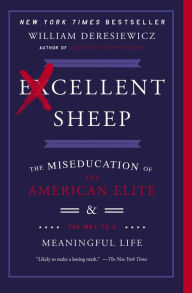
Briefly noted: Excellent Sheep: The Miseducation of the American Elite and the Way to a Meaningful Life — William Deresiewicz

Excellent Sheep is great though polemical—snide remarks about tech companies are neither true nor useful—and one gets a sense of its contents from “Solitude and Leadership: If you want others to follow, learn to be alone with your thoughts,” which went viral for the best of reasons (as opposed to the worst, which is more common). “Eros in the Classroom” is also good, though curiously erotically attenuated, and could be read profitably in tandem with Laura Kipnis’s “Sexual Paranoia Strikes Academe.” The two point to the need for satirization of contemporary academic mores, but that satirization is already so thorough that its failure to make much of a dent inside academia is obvious.

excellent_SheepBut Excellent Sheep is comprehensive, despite its overreach. But major orators know that if they have the audience the audience will forgive much, as such is the case here. The book is situated as one that fills a need and one that speaks to the author’s earlier self:
This book, in many ways, is a letter to my twenty-year-old self. It talks about the kinds of things I wish someone had encouraged me to think about when I was going to college—such as what the point of college might be in the first place.

I was like so many kids today (and so many kids back then.) I went off to college like a sleepwalker, like a zombie. College was a blank. College was the ‘next thing.’ [. . .] Up ahead were vaguely understood objectives: status, wealth, getting to the top—in a word, ‘success.’

I was perhaps slightly less blank but barely so. That being said, I often try to talk to current college students about what college is about and usually get resistance. So it may be that Deresiewicz’s twenty-year-old self wouldn’t listen to older Deresiewicz anyway. And, like almost any book of this sort, Excellent Sheep probably won’t be read by many of the students who could most benefit from reading it. Many who might be handed it might resist it. Slightly analogously, I’m struck by Emily Nussbaum’s description of Mary Gaitskill’s Bad Behavior: “In 1988, when her short-story collection Bad Behavior came out, it became a dorm-room bible for women I knew: Finally, here was a fiction writer unafraid to walk straight through the feminist battlefields of that very strange period.” I’ve assigned it before and it’s not been treated as a Bible; some students cottoned to it but some strongly resisted, though I also don’t think of it as dealing with “the feminist battlefields” of anything: I think of the stories as being about individuals, not dreary ideologies or ideological think-pieces.

Deresiewicz has a keen grasp of what’s happening in contemporary academia and, often, life itself. He writes of a “system,” or “a set of tightly interlocking parts,” including “private and affluent public high schools; the ever-growing industry of tutors and consultants, test-prep courses and enrichment programs; the admissions process itself; [. . .] the brand-name graduate schools and employment opportunities that come after the BA [. . .]” and of course much more. But this paragraph is the most interesting:

What that system does to kds and how they can escape from it, what it does to our society and how we can dismantle it—those are the subjects of this book. I was teaching a class at Yale on the literature of friendship. One day we got around to talking about the importance of being alone. The ability to engage in introspection, I suggested, is the essential precondition for living the life of the mind, and the essential precondition for introspection is solitude. My students took this in for a second—introspection, solitude, the life of the mind, things they probably had not been asked to think about before—then one of them said, with a dawning sense of self-awareness, “So are you just saying that we’re all just, like really excellent sheep?”

He goes on: “The system manufactures students who are smart and talented and driven, yes, but also anxious, timid, and lost, with little intellectual curiosity and a stunted sense of purpose.” I’ve noticed those things. They are of course not pervasive. But I also find them impossible to miss.

Excellent Sheep is a truer work of philosophy than 99% of the stuff published under the banner of “philosophy.”

Already I’ve chewed through a thousand words and two long blockquotes and have gotten to page three of Excellent Sheep. That should speak to the book’s quality. To attend to its every argument would be to almost write another book. As I said before, don’t trust everything. But do read it. It is also interesting to me that this article about Peter Thiel describes his mistrust of the education system, which partially evolved from his unhappiness with a track-based life and system. Yet this system persists for reasons, some of which Megan McArdle articulates in “What Really Scares Helicopter Parents.” The system has been in construction for decades. Startups are one route around them. Self-publishing is another. One can no doubt imagine more.

Many people are bad at being and bad at purpose. Including, possibly, me. Excellent Sheep challenges them, which is to say, us.


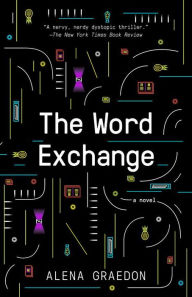
Briefly noted: The Word Exchange — Alena Graedon

The best criticism of this novel is “Human, All Too Inhuman,” in which James Wood, among other things, defines hysterical realism. “Human, All Too Inhuman” was written before The Word Exchange but still applies to it. The novel is good on a sentence-by-sentence level but is poorly and tediously plotted; malformations on the macro level are hard to describe but easily noticeable. I’ll happily start the next Graedon novel because this one shows much promise. The Word Exchange concerns a near-future world in which Anana works with her father, Doug, on the world’s last paper dictionary. Her father disappears, the Dictionary as a product and institution are attacked, and Anana needs to find out why. Yet on page 75 she writes:

But this was no ordinary book burning. Our digital corpus was also being dismantled, by pale, nimble hands. Who, I wondered, would want to destroy the Dictionary? Did Doug know? Was that why he’d vanished?

Word_Exchange_cover this point something more should have happened than random thoughts, discussions about Hegel, Anana’s time in college, her relationship with pseudo-friend Max, and many other threads so random that one has to wonder if or when they’ll cohere.

The novel channels many others: Stephenson, Gibson, even Carlos Ruiz Zafón, all of whose complete works you should try first, especially Snow Crash and Pattern Recognition.

There are echoes, maybe unintentionally, of The Name of the Rose (think of the moment when Ubertino and William are speaking together and William says, “I like also to listen to words, and then I think about them,” which one could say also of Anana and the other characters in The Word Exchange, though they lack Williams’s rigor.) Yet that novel, for all its abstruse Catholic metaphysics, is bound by a murder; people like murder stories because the stakes are plain: Death is bad, preventing it is good, and murderers need to be subjected to justice. In The Word Exchange no stakes are clear. By page 130 the narrative is still wandering and navel gazing; it’s only in the 130 – 140 range that things start to cohere, slightly.

Writers are fond of murder for a reason; if not murder, then comedy, and though there is a disappearance in The Word Exchange there is no murder. John Updike’s novelistic alter ego Bech knows the draw of murder:

Murdering critics is something most writers, I suspect, have wanted to do. The device of poisoning an envelope flap was used, I discovered later, in an episode of Seinfeld, but by then it was too late, my die was cast.

Art imitates other art even unintentionally. Murder and mystery are good too to emulate, and The Word Exchange is conscious, maybe too conscious, of its emulations. It is not consciousness enough of the pleasures of narrative, of structure, of figuring out the “why” and not just the “how.”

In The Word Exchange I want less… Brooklyn? It’s hard to choose an adjective. The novel feels written or narrated by a bright and precocious but ultimately annoying student who has not yet learned how to be in the world. Even the acknowledgements page is annoying, beginning as it does with “I have a real community of minds to thank.” As opposed to a false community of minds? Why not just say, “Group of people?” The sheer number of people thanked may be indicative of the problems with the story: Too many people said too many things and no central person adequately controlled the outcome.

The praise for The Word Exchange indicates why one can’t trust critics.

Briefly noted: “Mate” is out and it’s good — Tucker Max and Geoffrey Miller

As previously noted, Mate: Become the Man Women Want is out and it’s good.* As the book says in the introduction, “Your culture has failed you and the women you’re trying to meet.” The book is part of the remedy. When I read the draft a couple months ago I told Tucker, “I wish I could teleport a copy of Mate back in time and give it to my 13-year-old self, and then instruct him to read it once a year for the next decade.” That’s still true. If you know any teenage or early 20s guys who are likely straight, give them a copy of this book. It is not going to be useful for everyone and indeed I expect some of you to strongly dislike it. People like how-to in many fields but often not this one.

Mate_CoverThe book emphasizes empathy: “If you always try to understand the woman’s perspective—what they want, why they want it, and how to ethically give it to them—then you will find it much easier to become attractive to them, and you’ll be much more successful with your mating efforts.” There are no shortcuts. For a while I’ve been describing the empathy gap, because I increasingly think that the average man doesn’t much understand or try to understand the average woman—and vice-versa. That’s why books like Mate, or Self-Made Man: One Woman’s Year Disguised as a Man, are valuable: they work to close the empathy gap.

Parts of the book will be obvious to older guys who have their lives together—that showering and grooming are important will not be news, but most of us can also probably remember the shambling smelly kids in school. Other parts counteract some of the more dubious parts of our culture, like the claim that women are attracted most by money and that all women are “gold diggers.” For most women most of the time other things matter most, like how “individual women just your fuckability by your social network. So you had better have proof—social proof—that it exists.” Most people, men and women, who want a relationship reasonably want to know the person they’re having a relationship with, and that means knowing friends and family—and knowing they exist. Many of us have had the experience of sleeping with someone who keeps us totally separate from the rest of their lives. Sometimes that can be good—we don’t “count”—but for actual relationships it’s not.

There are still hilarious metaphors and comparisons, like “[A lot of guys think they need to have a ton of money,] then the women will just magically appear, like monarch butterflies to milkweed, flies to honey, rappers to Scarface posters.” But there are fewer of them: The book is entertaining but it leans informational. I at least felt rueful for my teenage and college self when I read some sections. Perhaps my favorite moment occurs two-thirds through the book, when Max and Miller are noting some of the artistic skills that women like, like music, storytelling, and, saliently for this quote, drawing:

The key thing here is to cultivate actual skill rather than indulge in modernist expressionism or abstract art. The poet John Ciardi pointed out, “Modern art is what happens when painters stop looking at women and persuade themselves they have a better idea.”

I’ve never read as concise and accurate description of why so much modern art is so bogus.

The bibliography is useful.


* As also previously noted, I now know Tucker well enough to not be an unbiased critic.

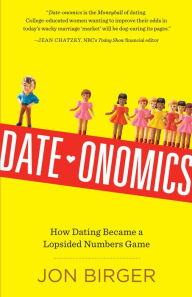
Briefly noted: Date-onomics: How Dating Became a Lopsided Numbers Game — Jon Birger

Date-onomics is charming and worth reading for anyone who is single, who is at risk of becoming single, or curious about how markets are created and how people interact with markets in this domain. Apparently there are relatively few members of that last group: “I realize that most people do not want to think about supply and demand when contemplating matters of the heart.” Perhaps is right, but rejecting knowledge seems to me like madness. Birger also notes that there “is an assumption that the perceived shortage of college-educated men [. . .] is actually a mirage.” Except that Birger says it’s not a mirage: there are more single college-educated women than men, especially in particular cities (like New York).

For men the simple takeaway might be: move to New York or an equivalent city with many more women than men in it. For women the simple takeaway might be: Silicon Valley, Seattle, and Denver are waiting for you, since in those areas straight women will have more market power than straight men.

The book, read properly, tells you where you should think about living and/or going to school. Guys working at big tech companies in particular should think carefully about the differences they’re likely to encounter between working the Bay Area versus working in those same companies’s New York City offices. Date-onomics attempts to solve an information asymmetry problem, since very few people actively consider how gender ratios affect their romantic, sexual, and reproductive lives. Search costs are high and underappreciated in dating.

Birger writes, “Why is it that women like Donovan struggle to find marriage-material men even as male counterparts with less going for them seem to have little trouble with the opposite sex?” Has Birger missed the vast literature on pickup artistry that’s emerged in the last two decades? Is he aware of the Tucker Max and Geoffrey Miller book Mate? For most men much of mating life seems to be a tremendous struggle, and it’s one Birger (mostly) dismisses. The dating sections of Norah Vincent’s Self-Made Man: One Woman’s Year Disguised as a Man are among the most compelling, because she tries being a man—noting that she expects to get all the advantages and pleasures of the “patriarchy” that she’d been told about for years in women’s studies classes and feminist books.

Instead Vincent finds struggle, rejection, and hardship—and she’s very happy to go back to being a woman. Being a man doesn’t turn out to be the patriarchal cornucopia she imagines, and that Birger implicitly imagines for men.

In Date-onomics, Birger refers repeatedly to “good men” (2), “ambitious men” (7), “eligible men” (13), “good single guys” (14), and meeting “a decent man” (29). There are others. Rarely does he consider what men might be looking for in a woman, or what the kinds of adjectives used in the preceding sentence might conceal. That framing is unfortunate.

It’s especially unfortunate because in the real world people who can assess themselves accurately, improve themselves reasonably, and compromise pragmatically tend to get decent results. Those who can’t, don’t. (From Date-onomics: “Problem is, wealthy women are far less likely than wealthy men to marry down”).

Despite that general fact, Birger argues that many of us don’t have the facts:

The North Carolina high school guidance counselor quoted in the last chapter told me that she has never once had a parent or student ask about the 60:40 ratio at UNC Chapel Hill—despite the fact that this gender ratio is now a dominant feature of UNC social life. “It’s not even on their radar,” the guidance counselor told me.

It should be.

He’s right: It should be. His book, and this blog post, is an attempt to put that issue on the radar. Women may, at the margin, want to go to engineering schools. Men on the margin of going to college or not may want to be aware that college is increasingly where the women are. Knowledge affects behavior, but it isn’t diffused through society uniformly or easily. Despite the many virtues of this book, many of the people who may most need to know what it says are unlikely to pick it up.

Date-onomics is at its best when it’s focusing on facts and anecdotes and at its worst when it’s barely aware of its own framing. That dark matter, though, is obvious to me. I wonder how many will miss it.

EDIT: Hello readers from The Browser! If you like this piece, you’ll probably also like my latest novel, THE HOOK. You should check it out at the link.

Echopraxia — Peter Watts

Echopraxia is among the best books I’ve read, ever, and is as weird and good as its predecessor, Blindsight. If you haven’t read Blindsight start with it.

Like Blindsight, I had only some idea about what was happening throughout the first read and less about why. Why that is is itself an interesting: The characters in many books about “smart” people—let’s take Harry Potter as an example—seem like dumb people’s ideas of what smart people are like. In Science Fiction that’s often less true, and in Echopraxia it isn’t true at all. The novel is a smart person’s idea of what intelligence beyond human comprehension but still observable might be like. Too few novels have characters who feel intelligently intelligent, as opposed (possibly) to emotionally intelligent, or simply unintelligent. In many thrillers and detective novels characters are cartoonishly intelligent, through unearned insight; in this respect they have more in common with characters in, say, romance novels than with those in Echopraxia. That is a less popular subject than who is doing what to whom. References in Echopraxia range from Plato’s cave to Dawkins to imaginary future scientists. Minds are often analogized to computers, as in this moment the start of the novel, when vampires rebel against their jailers and creators:

She towered over Sachie like an insectile statue, motionless, even her breathing imperceptible. Moments from death and with nothing better to do, some subroutine in Sachie’s head ticked off the morphometrics: such inhumanly long limbs, the attenuate heat-dissipating allometry of a metabolic engine running hot.

echopraxia_coverWhat is “better to do” moments from death? And are subroutines the right metaphor for the brain? I don’t know, but Echopraxia asks what, if anything, is essential for “humans” (or whether “humans” are essential). The novel takes place fourteen years after the Firefall from Blindsight, but “Fourteen years is a long time for a species raised on instant gratification.” In this world zombies are real, some viral and some surgical: every consciousness is trying to get on top of and sometimes overwhelm another consciousness. Watts is fond of the third-person plural “they” without distinguishing who “they” are in a given moment or situation.

The form of the narrative mirrors the mental state of Brüks—that is, characters are continually having epiphanies that the readers must catch up with later, if we ever do (Why exactly is the Bicameral order being attacked, again, and, more importantly, by who? I think I can answer but am not entirely sure). This is disorienting and at least for me doesn’t stop being disorienting throughout the novel. Was it equally disorienting to write Echopraxia, I have to wonder?

The lack of pronoun referents goes deeper than an observation. One could see Watt’s novels as an extreme version of a theory from the introduction of Umberto Eco’s The Open Work:

[Modern open work] through its lack of conventional sense and order [. . .] represents by analogy the feeling of senselessness, disorder, “discontinuity” that the modern world generates in all of us. Thus, although open works are not the only kind of art to be produced in our time, they are the only kind that is appropriate to it; the conventional sense and order of traditional art reflects an experience of the world wholly different from ours, and deceive ourselves if we try to make this sense and order our own. (xiv)

In Echopraxia the structure of the book is not precisely shocking—it proceeds more or less chronologically through time, and its narrator is not as far as I can tell trying to be deceptive. But if the present has increased “the feeling of senseless, disorder, ‘discontinuity,'” then the post-human and fast-paced technological future will increase that sense further and faster, especially if and when humans create beings (I use the word because I lack a better one) incomprehensible to humans. The future’s experience in this reading will be a “world wholly different from ours,” and imaginative art is one way to prepare for the possibility of that future. For much of human history technology has been a positive force (though anyone caught in the battle of the Somme, or by Russia’s secret police, or by Agent Orange will have reason to disagree), but past returns are no guarantee of future returns.

Technology, Echopraxia implies, can turn myth or nightmare into fact. I did not catch any references to Pandora’s Box, perhaps because such a mythic allusion is too obvious in a book that eschews obviousness at virtually every level, but the applicability is obvious. In The Open Work, Echo writes that “Art knows the world through its own formative structures.” So does consciousness. But what if consciousness is in turn limited by its own formative structures? Verbal and written expression are already tremendously limited, which is part of what gives both, and especially written language, their powers. Addressing those limits in words themselves is a serious and perhaps impossible challenge.

Still, some points recur. The word “gut” appears at least three times that I counted, and maybe more. There is much discussion of “the species” and what traits or habits maintained it in the past but might not be useful in the distant future. There is no such thing as “nature” or “natural life,” and there are no guarantees that humanity as we know it will survive. That there is no real fundamental “you” or “me” is an ancient fear, and Echopraxia terrifies and confuses by saying: “Maybe this fear will yet come to pass.” One reading of the novel is as a description of the transition point from human to non-human. Michel Houellebecq’s The Elementary Particles engages similar themes but without overt death, and without the psychological manipulations of Watts. The Elementary Particles does not have the same kind of biohacking and especially viral biohacking. Echopraxia feels more about emergent phenomena and how difficult they are to control—which may explain why Jim Moore’s son Siri Keaton needed, for reasons essential to the story, to experience what he did.

Eco also says that “nowadays, in our technological civilization, objects have become so pervasive, so sophisticated, so autonomous that we feel threatened by them.” The distinction between “objects,” “life,” and “humans” is slowly breaking down. To take one personal example, I, like millions of other humans, have a piece of plastic inserted in my body. In my case, that plastic mimics bone. What happens when it mimics brain? What happens when the greatest threat from pervasive objects is not visible? The answers may be a long time coming and may not involves aliens or vampires.

Science fiction is different from most fiction in that most plots in most fiction devolve to posturing for wealth, sex, status, or political positioning. Echopraxia is particularly different, because it imagines a world so far from our own, and it imagines what a transition point from humans to non-humans might look like, both from the humans’s perspective and, to the extent possible, from the perspective of non- or trans-humans who wish to explain themselves, to the extent they can, to humans. Language is a funny thing; it relies on some level of shared referents in order to work, and trans-humans may come to utterly lack shared referents. Humans may bootstrap trans-humans into being—both because humans want to, and, as Echopraxia and Blindsight imply, because perhaps we must: we must keep advancing in order to try to save ourselves from ourselves.

There is much else to write about Watts. If a novel is a machine for generating interpretations, Echopraxia and Blindsight generate more than most. They are also beautiful, weird, and like no other books I’ve ever read.


Here is The LA Review of Books. Here is Watts on Reddit. Here is a Locus Online review. I don’t remember who first inspired me to read Watts but if I did I’d thank them.