Never the Face: A Story of Desire — Ariel Sands

Never the Face starts with the narrator recalling a dream. Or, rather, the dream seeks here, and she “found myself hurtling back across the years, back to a spring morning in California when I was—
Awake.”

This implies she isn’t awake while she’s writing. Notice too how she’s abrogated responsibility for her actions: she “found [herself] hurtling back across the years,” instead of going there willingly. She doesn’t make the choice, implying that she’s metaphorically asleep, waiting for someone to wake her again because she can’t awaken on her own. Dreams run throughout the novel (although this novel feels more like a memoir, given its intimacy and tone). On its penultimate page, the narrator is “Afraid that those fabulous, shimmering dreams he had dreamt for me—for us—were about to shatter.” She’s right, since dreams can’t last forever outside of science fiction. Even at the end of A Midsummer Night’s Dream, the characters must leave Titania’s forest. The same is true of Never the Face, but maintaining the dream isn’t the responsibility of the protagonist—notice how David, the “he” of this love story, is the one who “had dreamt for me—for us.” He does this through sexual bondage. The details are interesting but essential; read the book if you want them. Read this post if you want some of them and some idea of what they might mean.

The narrator says that she had dreams about David, and not about anything else. Still, there’s hesitation: “a dream was one thing. Did I want the reality? Assuming that it was real?” Judging by the 200 pages to follow, we can guess the answer is yes. She feels more real when she’s told what to do. When they begin having sex, David instructs the narrator to open herself. She does. He speaks to her like an animal:

‘Good girl. Now, what do you say?’
I said nothing.
‘You say, “Please fuck your bitch.” ‘
With the involition of someone in a dream, I heard my voice saying, ‘Please fuck your bitch.’

David “accepted the invitation.” The narrator is giving up agency, which gives the encounter its power. We have an effectively infinite array of choices. To have them removed is taboo, and in violating the taboo she feels pleasure. She is both dreaming and awake. Later, the narrator says that she “climbed into bed and surrendered myself to dark dreams, dreams I didn’t like to acknowledge even to myself. I am chained up, spread-eagled. But my lover is ignoring me. Another woman kneels in front of him, and he is fondling her breasts, he is about to—” We don’t know what. The “dark dreams” end, and the narrator “pulled my mind back.” It’s too much, which is strange, given what her fantasy life is like. She says, “I felt as if I was cradling a bomb that at any moment might explode and blow my head off. I pulled the blankets tight around my body.” Maybe she’s missing a sense of danger, and while some might fill that sense of danger with climbing mountains, she fills it with sex. One is socially valorized, the other socially castigated. The sentences the narrator ends with an em-dash represents those places even she feels she can’t go, the places where she needs to break off.

Those points of breaking off leave things to the imagination. At one point, David tells the narrator to “Tell me your fantasies.” She resists, momentarily, but that resistance feels perfunctory, like all or almost all of her descriptions of resistance. She says that she “took a deep breath, snuck up to my place of dark dreams, and opened the door. I am tied up, legs spread. Men, I cannot see their faces—” She says aloud that that she fantasizes about “Rape. Especially gang rape. That’s probably my most common fantasy.” Another metaphor appears here, this time about opening doors instead of sleeping / wakening. Such metaphors point to understanding, growth, development, knowledge, whatever word you want to choose. Of becoming by being.

The narrator notes that she doesn’t “really want to be raped,” and David says, “I know you don’t, Kitten. No one does. It’s the idea that’s powerful. Giving up control.” It’s not just giving up control, however, but giving it up to the right person; in their book Why Women Have Sex, David Buss and Cindy Meston describe some of the research around rape and say that “In erotic rape fantasies, the male is typically attractive, dominant, and overcome with sexual desire for the woman […] the fantasy typically contains no realistic violence.” Those are all traits the narrator sees in David. In addition, you don’t fully need fantasy to become reality; you need enough fantasy to alter your reality. It’s hard to imagine the narrator going back to the Bobbies of the world after she’s been with a David.

Bobby was the narrator’s former lover. While the narrator is speaking with a friend, she says:

A memory from years before came into my head. I am naked. Bobby is whispering, “I’m going to kiss you all over.” He begins kissing my neck, my shoulders, my ears. I know I am supposed to find this sexy, romantic. But while my body is lying there being kissed (now he’s at the small of my back, now at the back of my knees), my mind is thinking about calculus problems, and whether anyone might have taken my clothes out of the dryer.

Note the contrast between what the narrator is “supposed” to feel and what she actually feels. That conflict generates the narrator’s erotic tension; so does the way she wants to live in the radical present. David achieves that through pain. Bobby doesn’t: he lets her mind think “about calculus problems,” instead of jerking her mind into the now, away from the daily grind and towards the moment. She wants to live in the present tense, which is incredibly hard for some people. The narrator understands this to some extent: she says thinks it difficult “To generate a feeling of safe danger.” She’s looking for an oxymoron, and someone who can deliver it is special. She is “Exploring places you don’t normally go, scary places, with someone you trust. It’s very controlled.” The places are slightly physical but mostly mental; they’re about making the mind and body fuse. It helps that David has the traits of a romantic hero: he is self-assured, powerful, knowledgeable. She thinks, “I wonder if he’s good at [going down on women]. He’s good at everything else” (Emphasis in original). Being skilled and competent is attractive; he’s also conveniently rich, a man who “was on the waiting list” for a country club with “a joining fee of $70,000.” Maybe she thinks it easier to trust someone rich.

Regardless, his competence lets her trust. David tells her that what they’re doing “is about surrender, giving up control. It has nothing to do with liking pain or wanting to be hurt.” That’s specious: if it had nothing to do with pain, pain wouldn’t be the mechanism used to achieve the end David perceives as surrender. He would use some other mechanism. You can’t separate ends from means no matter how much you might want to. You don’t beat someone without that beating being somewhat about beating. In this case, the beating also serves as contrast, with poor Bobby being the punching bag. Midway through the novel, the narrator says:

I thought of Bobby, how he always fell asleep after he came. For a moment, I conjured him, sprawled on top of me as if I was part of the bed. He could sometimes manage sex twice a day. But David—

He’s superhuman. No: Superman. I’m fucking Superman!

Or, rather, she makes him into Superman. One wonders if Bobby could’ve been molded in the same way. Still, Bobby’s kisses are quite different than sex with David. When David comes in, he “twisted my hand in my hair, forced my face upward, and kissed me. The kiss was rough, violent.” He leaves, and the narrator’s body reacts in a way that will grow predictable but still perturbs her on some level: “Trying to ignore how aroused I was, I turned back to my books.” She can’t control the way her body feels, which is part of what she likes. It’s part of her divided mind. David has a theory about this: “Pain quiets your mind and opens you to pleasure.” Under this theory, pain is a borderland between normal existence and extraordinary existence. The question remains: how do we get to extraordinary existence? How can we travel there through experience? He says: “It’s that when you cry, I know I’ve got you. I know you’re completely present, a body reacting and responding. You’re not thinking about anything, or worrying: you’re just there.” It’s so hard to live in the present, especially among a certain segmented of the highly educated, highly repressed, highly skilled part of the population. It takes an effort to live in the specious present. You wouldn’t want to live there all the time, but for a while, it can be extraordinarily powerful because we do so so infrequently. Habit becomes stultifying: we need to break from it, at least if we’re unusually open to new experiences. This passage, a conversation between the narrator and her friend Sally, captures the idea:

“Well. I don’t know what your experience has been—do you find that sex with most guys is more or less the same?” I said.
“Yes,” she said, rolling her eyes slightly. “Yes.” She laughed. “Some of them like to carry you about more than others. But that’s about it.”
“This was different. Totally different.”

Difference can be scary; it also can’t be fully explained. Sally wants explanation; the narrator can’t fully give it. She prevaricates, because what else can she do? It’s a bodily experience unlike almost any other. The narrator knows how it would be judged, and she’s internalized her friends’ reactions; at one moment, she says, “I thought of what Sally would say if I told her, ‘You wore his wife’s skirt? To a restaurant? Are you insane?’ ” But that’s the point: to transgress. You aren’t supposed to have affairs, even with the wife’s blessing; you aren’t supposed to be a masochist, even if you are; if you do those two things, you definitely aren’t supposed to wear the wife’s skirt. The question starts to become, where are the lines? If you don’t have any, you become scary. Dangerous. The sort of person who might steal someone else’s mate, who is threatening the foundations of social order. Hence you have to be labeled as “insane.” The idea is hardy a new one: Hester Prynne gets her famous Scarlet Letter for transgression. She’s achieved the state David Axelrod describes in his article “Laws of Life:”

‘Internalization’ is the word psychologists use to describe the compliance with norms out of feelings of right and wrong. A norm is internalized if violating it is psychologically painful even when the consequences are otherwise beneficial. Thus, cheating on an exam might result in persistent guilt even if it were not punished and did succeed in raising the student’s grade […] if everyone [strongly] internalized a norm […], there would be no incentive to defect and the norm would remain stable.

Families and societies work hard to achieve exactly this effect, especially in educating the impressionable young, and they sometimes succeed. Still, it is rare for a norm to be so thoroughly internalized that no one in a group is tempted to defect.

Violation is psychologically painful but also satisfying. In Never the Face, the narrator’s main manifestation of guilt comes from the writing of the novel, and we can’t help but think that guilt is awfully minor. She doesn’t look into where that guilt comes from, but the usual suspects are out there: society, other women, religion, schools. In “Sexual Economics: Sex as Female Resource for Social Exchange in Heterosexual Interactions,” Roy Baumeister and Kathleen Vohs posit that in many societies women are responsible for restricting female sexual agency. They might be right. But Ariel Sands isn’t asking those questions, even though they arise in my mind. Dan Savage said that “When it comes to human sexuality [. . .] deviation from imaginary and tyrannical ‘norms’ is the norm.” He’s probably right. Books like Never the Face make you think “probably” might not be strong enough.

The narrator says that “Those desires, those dark desires that lurked in the shadows of my mind—most of the time I tried to hide them, even from myself. I had never let myself speak of them.” She hasn’t, and relatively few others have. David has a theory, that at her “core,” the narrator is “Someone who wants to surrender, to be taken.” She “started to protest” but doesn’t. What is there to be said? This novel also arouses the fear that, if these “dark desires” lurk in the mind, others might too. What happens if they are awakened? What might we find there? The worst answer might be “nothing.”

While David leaves, the narrator “stood on the sidewalk, thighs and buttocks smarting, my body alive with desire.” If it’s alive with desire, is it dead the rest of the time? Or asleep? If so, then she should be glad: we like being woken up. It disturbs us to be asleep, to be unaware; that’s why so many stories deal with entering an unknown and previously unperceived world. In “The Unreal Thing: What’s wrong with the Matrix?“, Adam Gopnik writes that, in The Matrix, “reality is a fiction, programmed into the heads of sleeping millions by evil computers.” In this book, we get the sense that reality is, if not a fiction, then at least a tedious drag, programmed into the heads of sleeping millions by social convention that binds us without our knowing it. Notice how Gopnik, too, resorts to the language of slumber to convey his point. He goes on to point out the idea’s history:

The basic conceit of “The Matrix”—the notion that the material world is a malevolent delusion, designed by the forces of evil with the purpose of keeping people in a state of slavery, has a history. It is most famous as the belief for which the medieval Christian sect known as the Cathars fought and died, and in great numbers, too. The Cathars were sure that the material world was a phantasm created by Satan, and that Jesus of Nazareth—their Neo—had shown mankind a way beyond that matrix by standing outside it and seeing through it. The Cathars were fighting a losing battle, but the interesting thing was that they were fighting at all. It is not unusual to take up a sword and die for a belief. It is unusual to take up a sword to die for the belief that swords do not exist.

The idea of “what you see is what you get” probably goes back even further: hence the idea of what we might now term magical thinking among many pre-agrarian hunter-gatherers, who so often believe that spirits control and animate the world. Or contemporary people who send mental notes conventionally referred to as prayer, to a fellow who goes by various names but sits (if we imagine him being corporeal) in a cloud, seeing everything and noting down a demerit every time you masturbate. Whether you’r the narrator of Never the Face, Neo in The Matrix, a hunter-gatherer tribesperson, or a modern monotheist, you don’t want your everyday existence to be all there is. You want something more, but how do you get there? Through kinky sex, appeals to the spirits, gathering in a group of people and reciting chants / songs? Given the choice, I know which one I’d choose, but the similarity of the goal—transcendence, extra-normal power—makes me wonder what could connect all these practices, especially given how practitioners often dislike those using other methods. The highly kinky and heavily religious do not appear to have much overlap.

One thing that sets The Matrix apart from the innumerable comic book movies in which good guys and bad guys try to kick each other’s asses is the underlying idea that reality might not exist (Gopnik says the sequel “is, unlike the first film, a conventional comic-book movie, in places a campy conventional comic-book movie”). One thing that sets Never the Face apart from the innumerable books of erotica that describe, in detail, how things feel is the discomforting sense that maybe we never really will awaken from everyday life without the assistance of some activities described in the book; I shy away from using the book’s direct language—do I feel I haven’t earned it? Gopnik says that “the idea that the world we live in isn’t real is one that speaks right now to a general condition,” and I would posit that Sands feels the same way, or that her narrator does. But for her, the fake world is fake because it has been stripped of sensuality, of tactile sensations, of intensity; those feelings have been denuded by Big Macs, large personal spaces, telephones, and a social sense that forbids discussing erotic life for fear of any number of things, including political correctness. We don’t want to acknowledge what we might want if we really freed our minds.

It’s notoriously hard to look past our cultural and biological conditioning, even when part of our cultural conditioning is to recursively question our cultural conditioning. But we try anyway, because a certain number of us don’t like not being to think something that we could possibly think. To return to Gopnik, “In a long article on the first “Matrix” film, the Princeton philosopher James Pryor posed the question “What’s so bad about living in the Matrix?,” and, after sorting through some possible answers, he concluded that the real problem probably has to do with freedom, or the lack of it.” The “freedom” answer, however, still smells to me of cultural conditioning, but I buy it. Plus, it seems like cultures that value “freedom” appear to be better, on average, at getting along with their neighbors and not murdering their neighbors.*

And I buy the value of Never the Face not just for the dirty bits, but also because it seems like we should be free to want to be hit if we want to be hit, regardless of the important political and social convictions we might justifiably hold in other aspects of our lives. As Paul Graham says in his essay “What You Can’t Say,” “To do good work you need a brain that can go anywhere. And you especially need a brain that’s in the habit of going where it’s not supposed to.”** Freedom applies to sexual freedom too, and being able to explore your desires so long as those desires don’t hurt others.

For the narrator, sex and the activities around it let her live in the now. She says, “As usual after a savage beating, I was in a daze. My mind had gone blank; the internal monologue was silent. I as just there, in the now, without thought.” With Bobby, she thought about calculus; with him, she thinks nothing, which might be the greatest challenge for intellectuals. You wouldn’t want to go blank all the time, but for the moment it’s thrillingly, astonishingly different. In the novel’s rhetoric, it wakes her up, as discussed above.

Being awake lets the narrator see and feel things she wouldn’t otherwise. She sees the essential. She feels it. David says that beating someone is “Way more intimate than fucking. [. . .] Because it strips away pretense and self-consciousness, it reduces you to your essence.” The sex and bondage the narrator experiences isn’t, under this reading, about sex and bondage; they’re about understanding yourself and the world around you. The same thing that sports books say sports are about and that art books say art is about. The difference is that sports and art are valorized by society, while sexual exploration isn’t and probably never will be. It’s not just about the sex, either; as David explains in a perhaps self-serving way, the bondage “takes trust [. . .] You don’t need to trust someone to fuck them. But to put yourself in someone else’s power, to make yourself that vulnerable—that takes trust. [. . .] That’s why it brings such closeness.”

Is he right? The question is beside the point: he’s right in the narrator’s eyes. If he wasn’t, she wouldn’t stay with him. She wouldn’t want their relationship to continue when he breaks it off to stay with his wife, who knows about his relationship with the narrator. She encourages it. But the novel ultimately implies that such an arrangement can’t last. Society must be paid its dues. Plus, one challenge is simple: where does it end? Towards the novel’s end, the narrator says that David “had set upon me with if possible, a new level of ferocity.” Eventually, the logical conclusion becomes death, which I doubt the narrator wants. Neither does David. But you have to reach some maximum this side of the underworld.

Normally, I wouldn’t include spoilers in an essay about a book, but in this case “what happens” is besides the point, and the narrative tension doesn’t really exist. The book isn’t about what happens, but how and why it does. The answer is ultimately pre-verbal, like the reason for the adventure that propels Donna Tartt’s The Secret History. We can use language to approximate the feelings invoked by experience, but in this case the approximation is wider than most art. That, I think, is what feels so subversive: Never the Face suggests that you will never understand without trying it for yourself. If you do try for yourself, you will be indulging a set of possible desires that social life tells you you shouldn’t have, and if you do have them, they should be repressed, and if they can’t be repressed, they at least shouldn’t be spoken, and if they are spoken, they at least shouldn’t be written and distributed, and if you write and distribute them, you at least shouldn’t let others read it. The layers of taboo violation go deep.

She says that she had dreams about David, not about anything else. Still, there’s hesitation: “a dream was one thing. Did I want the reality? Assuming that it was real?” Judging by the 200 pages to follow, we can guess the answer is yes.


* Neal Stephenson discusses how our culture propagates itself visually in “In the Beginning was the Command Line,” which should be required reading for people who want to know how things work.

** Graham, later: “If you can think things so outside the box that they’d make people’s hair stand on end, you’ll have no trouble with the small trips outside the box that people call innovative.”

This Beautiful Life — Helen Schulman

I heard about This Beautiful Life in a New York Times review and immediately worried: the novel sounded similar to the novel I’m working on that doesn’t have a title (I’m referring to it as “The Teacher Novel”). But reading This Beautiful Life makes me happy because the Teacher Novel is definitely not worse and almost certainly better. This Beautiful Life is too frequently boring; it’s disconnected from itself (the very short first and last chapters are effective and engaging, however). Anita Shreve’s Testimony and Tom Perrotta’s Election cover similar territory far, far better.

Other comparisons work too. Reading the first long section of This Beautiful Life, which belongs to Liz, the mother, made me reread the first three chapters of The Great Gatsby, because Gatsby isn’t just better, it’s on a whole different plane, even though it’s also covering the banal problems of rich New Yorkers. Gatsby retains its ability to amaze, especially at how deftly Fitzgerald transitions from scene to scene. He’s so damn technically good that 1) I wonder / doubt if I’ll ever do anything as good and 2) Schulman looks unfortunate in comparison (funnily enough, Jake, the 15-year-old boy, reads Gatsby towards the end; I wonder if he learns anything).

Schulman avoids transitions by not writing much in scenes. There are some good sentences (one example: Liz, Jake’s mother, notes his height and says that “It was as if, suddenly, three extra vertebrae had been added to the staircase of his spine”) and amusing bits, but most of the novel isn’t composed of scenes, and the writing isn’t quite enough to make up for that. I feel like I’m reading weekend New York Times articles on overly yoga-ified Upper East Siders. The novel lacks the fiery pop at the end of Election‘s chapters, as it does tension. The father, Richard, has the strongest section, mostly because he actually does something, instead of sitting around being acted on.

Like Testimony, This Beautiful Life has the problem of having a single, main event, without any other plot points or subsidiary issues, but Testimony has more voice. It has more knowledge of itself. This Beautiful Life also got a moral problem: a 13-year-old girl named Daisy sends a 15-year-old guy named Jake a sex tape, and he forwards it to one person. Who cares? She did it willingly, and although she’s young it’s apparent she has sufficient knowledge and agency of what she’s doing to make the question of her agency unimportant. The novel is set in 2003, which is essential: if it were set closer to the present, the idea of a sex tape becoming a social conflagration beyond the confines of high school would be wildly improbable.

I feel like the New York Times reviewer, Maria Russo, read an entirely different book than I did, or hasn’t read This Beautiful Life’s predecessors. Schulman teaches in New York, and I wonder if getting the cover of the book review was a sweetheart deal with Russo, her agent, and/or the book review editor (if so, I’d love such a deal). Not everything that makes the NYT Book Review cover is aesthetically or intellectually interesting (here I’m thinking of Angelology, an utterly forgettable book). Russo assume that social and cultural mores are permanent (“What can the future hold for unformed, vulnerable kids who bumble their way into the lowliest realm of the permanent record that is the Internet? (Or, in Daisy’s case, reach it by simulating sex with a toy baseball bat.) Should their parents be held responsible, or are they equally victimized by the seductions and traps of digital life?”) instead of fluid. Russo gets to the idea that cultural mores, but not until the last paragraph. I would’ve liked a stronger historical sense. These criticisms may be due to the brevity of the venue: the NYT only allows so many words, and I think her review is in the neighborhood of 1,200.

I suspect that, if it hasn’t happened already, sexting will be pretty normal and not enough to drive plots in the near future. For guidance on changing mores, look to the past. In 1900 – ~1965, you could drive plots using the question of whether teenagers have sex, given how much of society was set up against that. Today, if you did the same, you’d have to use religious prohibition or something similar to drive the plot, which isn’t very satisfying because the solution (“stop being a religious wacko; your parents are unreasonable”) is obvious. Caitlin Flanagan get some, but not all of this—I’ve seen her work in The Atlantic. We’re seeing the phenomenon of “shocking” behavior becoming normal much faster than we used to, which makes me worried about the Teacher Novel, because it might not age well if behavior considered daring or inappropriate today becomes obvious tomorrow. Fortunately, I think the central questions avoid sex tape plots, but still: looking at changes throughout history make me wonder what’ll happen next.

For example, one grad seminar assigned Dreiser’s famous novel Sister Carrie, which was apparently shocking for its day (IIRC, it was published in 1900, though it might be a little later—1910?). Reading it now is banal. Who cares if a woman divorces one guy and marries another? I wonder if these narratives about teenage sex tapes will have the same effect in the nearish future, once people who’ve grown up with sending naked pictures of yourself as a standard practice; Penelope Trunk gets this, but she’s uncommonly opened minded, and I sense a generation gap (am I on the wrong side, I wonder?).

The first and last pages of This Beautiful Life are very good and describe Daisy. The sex acts that begin this novel (and Testimony) are effective attention-getters because most people don’t believe or want to believe that 12- and 14-year-old girls can be sexual (raising the question: have most people forgotten what it’s like to be 12 – 14?). The second paragraph is a single sentence: “Still think I’m too young?” It’s a provocation, but the description isn’t sexy: she has “a hunky ponytail” and “A little roll of ivory fat nestled above the waistband” of her skirt. The suggestion is powerful anyway, and the pages to follow are largely the lead-up and comedown from the two that begin the novel. This has the unfortunate side effect of draining narrative tension; Election avoids this problem through a shadow story about how the party happens, which isn’t revealed until the very end of the novel. This, along with the sheer diversity of voices, makes it a better novel.

Still, This Beautiful Life is a reminder that the novel as a genre is still going places movies and TV can’t or won’t. If a director portrayed a video of a girl who in this scene: “The breasts inside were small, and at first she covered them with her palms, fingers splayed like scallop shells. Then she unhooked the bra in front and they popped out as if on springs”, she’d be arrested for depicting someone under 18 in a sexualized circumstance with nudity. The director could hint and imply but couldn’t show what the novel describes.

I have to read the first paragraph of the second section ironically: “As with so many things of consequence, it all began with a party.” It seems highly unlikely that many “things of consequence” started with a party; an idea, a conversation, a scribble in a notepad, maybe, but a party? Seems improbable. Pages 10 and 11 of the hardcover have a lot of superfluous stuff. I took a picture of a page with my edits, where I remove sentences the book doesn’t need. In rereading of Gatsby, part of what’s so amazing is how essential most of it feels. So mysterious. We don’t even meet Gatsby until chapter three, and then by accident. One of the novel’s letdowns is in Chapter 6, where Nick suddenly regurgitates a bunch of stuff about Gatsby’s supposed background (this is similar to what Mark Sarvas mentioned in 2007: that it’s important not to become overawed by the great). Too much of the novel should be tightened like the face of the mothers Liz lives among. On page 100, “Richard felt the skin on his face tighten.” You could remove that sentence and lose nothing. There’s also a strange mistake: Schulman writes URLs as “feigenbaum/blogspot.com,” when Blogspot URLS are always in the form feigenbaum.blogspot.com. It’s minor, but it galls.

So do aspects of the characters. Take this early scene from Liz:

It’s your butt or your face—you can’t have both, Liz thought. Some movie star had said this; she’d read it or heard something like it somewhere, and had stored a smudged replica of the quote in the hash of celebrity trivia her brain had accumulated without effort, along with all the other stuff and nonsense that passed for knowledge these days from print magazines and whatever: TV, the Net, idle chitchat, the air . . . But it was true, about your butt or your face.

The “hash of celebrity trivia” is what’s so odd to me about Liz: she used to be an art historian. She got a PhD in art history. Yet little to no knowledge of art, art theory, aesthetics, or related subjects trickles into her thought. By now I’ve met lots and lots of academics, and the ones who stick it out to the PhD don’t do so for the money, which is practically nonexistent; they do do so for the love of their subject. It’s bizarre that Liz imparts so little of this in her thinking; she says that “her dissertation had distinguished itself because she’d focused on the synthesis of art, design, and dance in a new and radical way” {Schulman “Beautiful”@38}. But what way is that? How does it differ? Liz “couldn’t remember the subtitle” of that dissertation, which is understandable: titles are easy to forget. But much of the content appears to have gone the way of that subtitle. If art plays a real role in her present life, it’s well-hidden.

People’s professions cast shadows over their conversation, but Liz’s appears to be a veneer that lies no deeper than the letters after her name. What happened to all the knowledge she must have acquired? Why doesn’t she ever think in ideas? Characters content to surf on the world of everyday minutia are boring; one thing that sets science fiction apart from other kinds, at least in the view of Neal Stephenson, is its focus on ideas. He elaborates in this Salon interview, where he defines science fiction’s big tent as

Fiction that’s not considered good unless it has interesting ideas in it. You can write a minimalist short story that’s set in a trailer park or a Connecticut suburb that might be considered a literary masterpiece or well-regarded by literary types, but science fiction people wouldn’t find it very interesting unless it had somewhere in it a cool idea that would make them say, “That’s interesting. I never thought of that before.” If it’s got that, then science fiction people will embrace it and bring it into the big-tent view of science fiction. That’s really the role that science fiction has come to play in literature right now. In arty lit, it’s become uncool to try to come to grips with ideas per se.

Knowing something of celebrity gossip doesn’t automatically preclude one from having ideas, thinking about ideas, or thinking about what might go beyond the tiny halo of an individual life. Thinking about ideas also isn’t incompatible with worry about the body, sexual attractiveness, how others respond to the body, and so forth. But this moment is emblematic of why Liz, as a character, tends to be boring: she doesn’t have access to those ideas. The writing isn’t as crisp and mysterious as Fitzgerald’s (but then again, whose is?). The structure isn’t as sharp as Shreve’s or Perrotta’s.

If Liz had really been the house intellectual, the person who understands the deeper cultural structures underlying what her family is going through, she could’ve been a fascinating character. Instead she seems to have hung up her mind when she became a former. I suspect not all women do. The noun she uses in the passage above—”trivia”—is the problem: her life appears to have become trivia. This isn’t a fact that dooms her altogether, but if you can’t rise beyond trivia, then why bother? And I’m not asking that she cite Foucault or tedious theoretical windbags; I’m just asking for more awareness of her own situation. Give me some cool ideas about what things are about. Literature that endures has ideas; Jane Austen, whatever her faults, is constantly questioning how families and social relationships should work. Her characters are attuned to the minutest questions of status. I’d like to see the same here.

Liz has some faint idea of her problem, since she notes the “nonsense that passed for knowledge.” But it doesn’t pass for knowledge “from print magazine and whatever:” it passes for knowledge because she consumes it. Anytime she wants, she can skip US Weekly and pick up The Atlantic. But she doesn’t.

This passage isn’t bad on its own; if it were embedded in a story with more power, I’d take from it what I think Schulman was shooting for: Liz’s struggle with the wealthy but stultifying environment she’s in and can’t easily leave without harming her family and her husband’s work. It’s a worthy struggle, but a frustrating one because Liz should have the intellectual and financial tools to understand it. But she chooses not to use them, and a character who seems pointlessly helpless is a tedious character too. And Liz does have some real thoughts. In this scene of self-criticism, she’s looking at her ex-flings writing and says:

He was smart, funny, but still immature. He hadn’t seemed to have developed distance from his own dilemmas or learned how to structure a narrative. At what point did potential, budding and nascent, turn into stagnancy? At what point did stagnancy equal tragedy? Is that what made midlife unendurable for so many? Is that what made each and every day feel so damaging?

All this is plausible, and notice how she moves from the guy’s writing to her own life: she stats off talking with him, and by the second sentence you still think she’s talking about him. By the third—”At what point did stagnancy equal tragedy?”—you get the idea that she’s not talking about someone else. She’s talking about herself, as critics so often are when they write criticism. So she gets some self-analysis by the end of the story.

So does her son. Jake is uncommonly knowledgeable, like so many adolescents in fiction; he notes how teenagers mostly “walked around, calling out to one another, ‘S’up. S’up.’ It was rhetorical, not ever a question. Nothing was up, usually, unless something was. They were kids; they were terminally looking for something to do.” They don’t find it. At the very least, this passage feels dangerous, knowing what we know about the novel from the dust jacket and the first two pages. There’s a sense of a transgression. But you’ve read these scenes before, especially if you’re a regular young adult reader, but Jake’s crush on a girl of Chinese descent is endearing; he notices what she wears and “thought Audrey’s haircut made her look French, although he had no idea really what that meant.” Who does, really? Maybe someone who’s read La Seduction. That he wants Audrey drives him forward and toward Daisy, who wants him and sets about luring him via video. Lesson: people do strange things for love. Perhaps it’s a lesson we already know, but so it goes.

He understands Daisy slightly better than his mother does: Liz says of Daisy, “That poor, wretched, stupid girl. Marjorie says the mother’s always away somewhere, that even when she was little she was always picked up by a nanny.” As if someone who wasn’t picked up by a nanny would automatically never make a sex tape. Plus, Daisy presumably wouldn’t have made the tape if she didn’t think it was a good idea; perhaps she has a high discount rate, and adults, with lower discount rates, are thus unhappy because they’re judging someone they don’t understand. Her husband does the same thing, but intentionally, to a reporter. He says that of the video “It looked like a junior league Debbie Does Dallas. I don’t know where the girl learned this stuff.” The answer is obvious: the Internet. Of course, lots of people “learn” stuff of this nature from the Internet and turn out to be perfectly okay, as Daisy does.

But Richard understands something that he doesn’t want to define; he watches the video (all the adults do, and one gets a prurient swirl of surveillance). When he does, he uses standard moralistic language, but he also notes, basically, that it’s also hot, a way similar to some of the comments in Testimony, when either Mike or Rob is describing the tape of Sienna. If someone is being intellectually honest, they have to acknowledge that erotic power isn’t flipped on like a switch when one turns 16 or 18. In some people it develops early. When Richard sees the video, he also says:

And for all the video’s dismal raunch, its tawdriness, for all its sexual immaturity and unknowingness, there is something about the way this girl has revealed herself, the way that she has offered herself, truly stripped herself bare, that is brave and powerful and potent and ridiculous and self-immolating and completely nuts.

He’s right; the nuttiness, the sense of going beyond the bounds, gives the video its power (does this language sound familiar? It’s similar to how I described Ariel Sands’ Never the Face). In the end, there can be something about such a video. Richard doesn’t understand everything; he says that “It looked like a junior league Debbie Does Dallas. I don’t know where the girl learned this stuff.” The answer is obvious: the Internet. Of course, lots of people “learn” stuff of this nature from the Internet and turn out to be perfectly okay, as Daisy does. The novel needs to be set in 2003, because if it were set in 2011, a viral sex tape wouldn’t be so shocking, and I’m somewhat confident that high school students have developed antibodies for the event (from what students tell me, that’s true).

What’s normal today may not be normal tomorrow, and, thus, the worries about the tape might eventually be as strange to us as Seventeenth Century European schisms and wars. Manufactured drama around sex can make the amorality of Gossip Girl attractive by comparison. What would Blair say to Jake and Daisy?

Virtually everyone in this novel is reacting to things. Jake reacts to Daisy. Liz reacts to circumstances. Richard reacts to Jake. The only person who really acts on their own volition in the novel is Daisy; if anyone’s the hero, she is. That the hero gets to say so little is unfortunate. Notice how The Great Gatsby is driven by several great wants: Gatsby’s for Daisy; Daisy for excitement or some way out of her stultifying life with Tom (he who cites The Rise of the Coloured Empires), Nick’s for figuring out who Gatsby really is. Without all that want, like the voice of “I want, I want” in Henderson the Rain King, you wouldn’t have a story in The Great Gatsby. You’d have a series of still lifes. This Beautiful Life is more animated than a still life but less than The Great Gatsby. It shows so much promise, and The Great Gatsby keeps creeping up in it.


She’s gotten a lot of good press. The NYT review is above; the Paris Review blog interviewed her. The Washington Post has a banal review not worth linking to. Reading such reviews reminds me of why I like James Wood so much, even when I disagree with his assessments.

Flashback — Dan Simmons

There are shades of Philip K. Dick’s The Man in the High Castle all over Flashback. Problem is, they don’t really go anywhere. The novel opens in the near future with a mystery: Hiroshi Nakamura is a wildly wealthy Japanese man who needs Nick Bottom to solve the mystery of his son’s death using a drug called Flashback, which lets one relive in the past as if it’s the present. The setup is clever; Nick, rather than being a classic detective-alcoholic, is a flashback addict and feels “the flashback itch crawling in him like a centipede. He wanted to get out of this room and pull the warm wool covers of then, not-now, her, not-this over himself like a blanket.” He wants his time warped, in other words, as the centipede tells him. He wants to retreat to childhood: hence the blanket. It’s a nice image, and double so because the novel doesn’t have many of them.

Flashback is frustrating because it has so much promise that goes unfilled. There are lots of “as-you-know-captain speeches” (as there were A Game of Thrones), like this one, six pages in:

The polishes cedar floors and fresh tatami mats, in contrast, seemed to emanate their own warm light. A sensuous, fresh dried-grass smell rose from the tatami. Nick Bottom had had enough contact with the Japanese in his previous job as a Denver homicide detective to know that Mr. Nakamura’s compound, his house, his garden, this office, and the ikebana and few modest but precious artifacts on display here were all perfect expressions of wabi (simple quietude) and sabi (elegant simplicity and the celebration of the impermanent.

How do you have fresh dried grass? Shouldn’t it be fresh or dried? Beyond that, the phrase “Nick Bottom had had enough contact” signals that we’re about to be told a bunch of stuff. In and of itself, that’s fine. The problem is the sheer number of times the story pauses for no particular reason to regurgitate stuff at us. Susan Bell’s essay “Revisioning The Great Gatsby” (part of The Writer’s Notebook: Craft Essays from Tin House) details how deftly F. Scott Fitzgerald avoids such problems in The Great Gatsby, with the help of Maxwell Perkins. We’re not so lucky here. In Neal Stephenson’s Cryptonomicon, digressions feel organic. Here they feel forced.

So do the italics that give us Nick’s thoughts; toward the end of chapter one, he thinks, “You know why you’re going to hire me for this job, jerkwad. Let’s get to it. Yes or no.” I’ve heard similar sentiments in a thousand detective novels and movies. They don’t add anything to the story or Nick’s character. They’re distracting. The problems in the first chapter continue throughout.

There are good bits, as when Nick decides not to flashback to sex: “he was simply glad that his video-recorded idiot’s face wouldn’t be showing the uncoordinated spastic echoes of his orgasms from eighteen years earlier.” We get the self-loathing, the professional’s unhappiness at being caught unaware, the thought of “uncoordinated spastic echoes” that capture a look in a way that’s fresh and vital. Such moments are just too rare. The book is too fat. It deals with balkanization and terrorism in ways that are interesting and imagines a future without state or national infrastructure, which is a scary one. It just doesn’t do so well. There’s a palpable fear of Muslims and what, for lack of a better word, I would call multiculturalism or pluralism; a character thinks:

Los Angeles [was] celebrating the events of that old holiday called 9-11, September 11, 2001, the date—as Val had been taught in school—of the beginning of successful resistance to the old imperialist American hegemony and a turning point in the creation of the New Caliphate and other hopeful signs of the new world order.

We get a lot of conservative ideology here: the distribution of dangerous ideas in schools; the idea that liberals see American hegemony as dangerous and imperialist; and the fear of Islamists taking over the world. Women “in full burkas” sit, and one has “bright blue eyes” who Val says “was Cindy from his Wednesday Social Responsibility class.” None of these fears seem likely, and after the Arab Spring, they seem even more ludicrous. The world is mostly inching toward liberalism, not authoritarianism, bikinis, not burkhas, despite the United States’ present penchant for spying on its own citizens. A college professor begins to question his own received wisdom, and experiences “Doubt [about] whether America’s eventual retreat from the rising success of radical Islam’s influence around the world was the wisest course.” Except that the U.S. is successful precisely because its culture promotes letting people live as they choose, so long as they don’t harm others: this is part of the reason why the U.S. is very good at integrating minorities, while Europe struggles. The idea that the U.S. will ‘retreat,” whatever that means in the context, is ludicrous.

I’m not opposed to novels with political messages, as long as those messages are thoughtful, reasonable, and well-integrated, and dumb politics aren’t limited to the right (on the left, see: John Steinbeck). I’m opposed to novels with dumb politics, like this one, but I’m even more opposed to weak writing.

You can have a book with little plot and spectacularly unusual sentences or language use; this is basically what Joyce and John Banville do (or, think of Banville’s alter ego detective fiction writer, Benjamin Black). You have a book with lots of plot and uninteresting or banal sentences, which is what a lot of thrillers do. But it’s really hard to have little plot and average sentences, which is what you see in Flashback. It’s got a great premise and doesn’t deliver. I got to page 200, mostly because I had time to kill while waiting to meet a friend. Flashback did fill time and did offer an intriguing premise. It didn’t do much else.


EDIT: I am not the only one who is disappointed in Flashback.

Slam — Nick Hornby

Slam starts with great promise: a list of bullets that show a lot of Sam’s life in a short space and show why it’s going well (“For example: Mum got rid of Steve, her rubbish boyfriend.”) It’s got a fun, fantastical conceit in that Tony Hawk talks to the narrator and comes to represent a kind of externalized consciousness, giving Sam a dialogic way of bouncing ideas off another person. But the novel itself meanders. I look for the great sentences and don’t find them. To be fair, there are strong sections.; for example, in analyzing (as best he can) his family, Sam says:

The story of my family, as far as I can tell, is always the same story, over and over again. Someone—my mum, my dad, my grandad—starts off thinking that they’re going to do well in school, and then go to college, maybe, and then make pots of money. But instead, they do something stupid, and they spend the rest of their lives trying to make up for the mistake they made. Sometimes it can seem as though kids always do better than their parents. You know—someone’s dad was a coal miner, or whatever, but his son goes on to play for a Premiership team, or wins Pop Idol, or invents the Internet. Those stories make you feel as though the whole world is on its way up. But in our family, people always slip up on the first step. In fact, most of the time they don’t even find the stairs.

Notice the metaphor at the end: most of the world “is on its way up,” without noting the transportation method (flight? an elevator?), but his family doesn’t “even find the stairs.” It’s a bittersweet passage, with him not exactly castigating his family but still fundamentally aware of social class. Yet why not start the metaphor at the beginning of the paragraph? His family’s story is always the same, with them looking up as other people go by, or being on the ground floor of a building whose top they can’t even conceptualize, or something to that effect? You could do much better than the ideas I’ve come up with in 30 seconds, but the point is that there’s no reason not to extend the metaphor—maybe throughout not just the paragraph but the book. We appreciate that Sam’s awareness is a step on the road to change, but he could be slightly more aware without harming the fundamental structure of the story.

Perhaps not surprising, some of the story’s tension involves whether Sam will continue the family tradition or break it. He meets a higher class, very attractive girl named Alicia. They talk music. He works to avoid being subservient to her, but later thinks that “I knew that I didn’t want to be [Alicia’s] friend, if you know what I mean, and I was worried that her being friendly to me meant that I didn’t stand a chance with anything else. I know that’s wrong. Mum is always telling me that friendship has to come first, before anything else.” Sam knows the score even when his mother doesn’t, or doesn’t want him to know. She is, in essence, pitching him the idealized version of romance, which he has internalized to the extent that he says he knows that not wanting to be Alicia’s conventional friend is “wrong,” imputing a sense of morality on an act that’s more about strategy than morality. In a different world, friendship would come first. If you search Google for “Friend Zone, you’ll find a wide array of articles with advice on how to avoid becoming “just a friend.” Sam’s Mum is trying to give him advice that isn’t highly applicable to the real world.

If you’re already aware of these dynamics, however, the novel will feel like old news. It’s not bad, exactly, but it’s not exciting, either. A lot of the book is fun. It just feels average, unlike Francine Prose’s Touch. I’m looking for ways that make it more than average and not finding them. Hornby’s best book, by far, is still High Fidelity. Maybe it always will be. I often think about it when writing contemporary novels that feature love stories; he fundamentally understands that such love stories tend towards comedy, that indecision is the great modern problem, and that love stories need more than just a should-I-or-shouldn’t-I plot. Whenever I read High Fidelity, I’m impressed again at how surprisingly well constructed it is. I keep trying his other books (A Long Way Down, How to be Good, Slam) in search of the same kind of mastery. I keep not finding it.

Further thoughts on the Kinesis Advantage, Unicomp Space Saver, and Das Keyboard—two years later

EDIT: Since writing this, I’ve switched, as of 2023, to a Kinesis 360 keyboard. Someone who wants to try a Kinesis keyboard more cheaply should check eBay and sell the keyboard to someone else if it doesn’t work out.

The series of reviews I wrote in my search for the perfect keyboard continue to rack up dozens or hundreds of hits per week; the most extensive posts cover the Kinesis Advantage, Unicomp Customizer / Space Saver, and the Das Keyboard. The Unicomp review in particular has become a repository for thoughts on the keyboard, with 60 comments so far and new ones popping up regularly.

By now I’ve spent two years using the Advantage as my primary keyboard, and since then people have e-mailed me an array of questions about it. The latest comes from a guy who is curious about how it compares to the Das Keyboard, especially regarding the key switches, and whether his size (at more than 6′ 7″) might make the keyboard impractical.

The keys on the Kinesis Advantage are “Cherry Brown” switches, and those on the Das Keyboard are “Cherry Blue” switches (if you didn’t see the Das Keyboard Review, look now, especially at the video). There’s some difference between the Browns and Blues, but I think if you gave me the Coke-Pepsi challenge by blind-folding me, putting a keyboard with Browns under my fingers and then swapping it for an identical one with Blues, I doubt I’d care, apart from the Blues being nosier. In terms of feel, they’re a distinction without a difference.

If you said, “Here’s a Kinesis Advantage with Model M-style buckling springs,” I’d take it. But the difference between the buckling springs and Cherry switches is slight at this level of quality. It’s like the Nikon, Canon, and Sony camera aficionados duking it out over recent DSLRs. The differences between Canon’s Rebels and the Nikon’s  consumer “D” series cameras are marginal. Most people wouldn’t notice. And since most pictures are being shrunk for Flickr or Facebook anyway, the importance of marginal quality improvements declines further.

I’ve used the Advantage close to every day for years, and I can’t see or feel any difference in the keys over time. Normal keyboards, like the ones that ship with generic desktop computers, get “sticky” or otherwise problematic after a lot of use. This one doesn’t. Searching for “Kinesis Advantage longevity” and similar strings (like durability) doesn’t bring up any horror stories. The Advantage doesn’t have the extreme reputation that IBM Model Ms have, but Kinesis also hasn’t been making them since the 1980s and the Advantage is, by its cost and the commitment necessary to retrain yourself, a much more niche product.

I’m 6’1″, not 6’7″, but I don’t very tall guys are likely to have problems with the Kinesis. Maybe if you have Shaq-size hands you might need or want larger keys, but that’s a niche case. My elbows aren’t turned in at all when I use the Advantage; yours might have to slightly, if you’ve got especially broad shoulders, but again, I don’t think the effect will be too pronounced. I’ve also seen women as short as 5’4″ use the keyboard (note: this is not a euphemism) without any obvious ergonomic problems.

Anyone having trouble with wrists, should get a desk / chair combination that keeps the elbows at a 90 degree angle, likely via a sit-stand desk. The top of the screen should be at your eye level. I have three books stuck under my iMac, lifting the screen to the desire height, and a Humanscale Keyboard tray to accomplish this. If you’re using a laptop and it spends most of its life in one place, try to get an external monitor, and get the external monitor at the desired height, or buy a laptop stand (the Griffin Elevator is popular). This might not be practical or might be too expensive, depending on where you work, but if you can do it you’ll have a better overall experience. Just adjusting the height of your monitor and chair might do more for you than a very expensive keyboard.

EDIT: There’s a worthwhile Hacker News discussion about this essay; sometimes HN will generate thousands of visitors who leave virtually no comments, because they comment on HN itself. The top two comments say the Kinesis Advantage is quite durable, and both people report that they’ve keyboards for more than ten years. One says Kinesis will repair keyboards that’ve been caught “drinking” soda. They allay the longevity worry, especially if Kinesis offers service. It would be a major bummer to have to re-buy a $300 keyboard every five years because it breaks, but $300 also buys high-quality keys that can take a lot of clacking.

Summary Judgment: Naked on the Internet — Audacia Ray

I had high hopes for Naked on the Internet: Hookups, Downloads, and Cashing in on Internet Sexploration, but it turned out to be shallow and to lack real depth. Read Belle de Jour’s Diary of an Unlikely Call Girl instead.

Ray points out:

Women avidly use technologies like chat, blogging, and photo- and video-hosting services as recreational ways to explore their sexuality and meet partners for all kinds of sexual play, as well as for relationships. They use these online tools to build and strength relationships and to capitalized on their sexuality in big and small ways [. . .]

Isn’t this obvious? Elsewhere, she makes the point that blogging isn’t therapy, even if it may have some therapeutic aspects. We learn that. . . only therapy is therapy. Most of her work is built around interviews of dubious value, which is okay if there’s an original story to be told or real analysis to be presented.

I think I’m disappointed because because Naked on the Internet promises to cover the intersection of technology and culture, which I find fascinating. But it lacks substance. The Internet lets people evade conventional gatekeepers and do their own work without substantial oversight. The flourishing of material that might’ve never been created otherwise is a powerful testament to the possibility of creativity and discovery. I keep looking for people who are chronicling this.

Effi Briest — Theodore Fontane, with a side of James Wood and Samuel Delany's Paris Review interview

Despite what I wrote in this post, I got a copy of Effi Briest. And you know what? I couldn’t finish it. There were some great lines—my favorite is Effi’s father saying, “There’s nothing so good for one as a wedding, provided of course it isn’t one’s own”—but I couldn’t take the rest, even though I stopped reading the very nice introduction by Helen Chambers after realizing it was prejudicing me against the book:

The sexual dimensions of the age gap [between Effi and her husband] remain beneath the surface of this discreet and allusive novel. They are suggested, as is much that is vital in the inner action, by the symbolic texture of the narrative. Effi’s sexual inexperience at the beginning of the novel is beyond question, and the premature loss of her virginity is prefigured by the twins calling her back to the garden through a window framed by Virginia Creeper

This explains why little seems to happen, since “remain beneath the surface” feels like another phrase for “buried so deeply that you need an even dirtier mind than mine to excavate it. In a Paris Review interview, Robertson Davies says:

I do not respond quite so immediately and warmly to writers in the United States, because their concerns are different from mine and their approach to them is different from mine. They seem to be infinitely concerned with very subtle details of feeling and life. I find this exemplified, for instance, in many stories in The New Yorker where whether the family will have pumpkin pie or something else on Thanksgiving Day is a decision with infinite psychological and sexual repercussions. I take this quite seriously. I admire their subtlety—but I get so sick of it. I wish they would deal with larger themes.

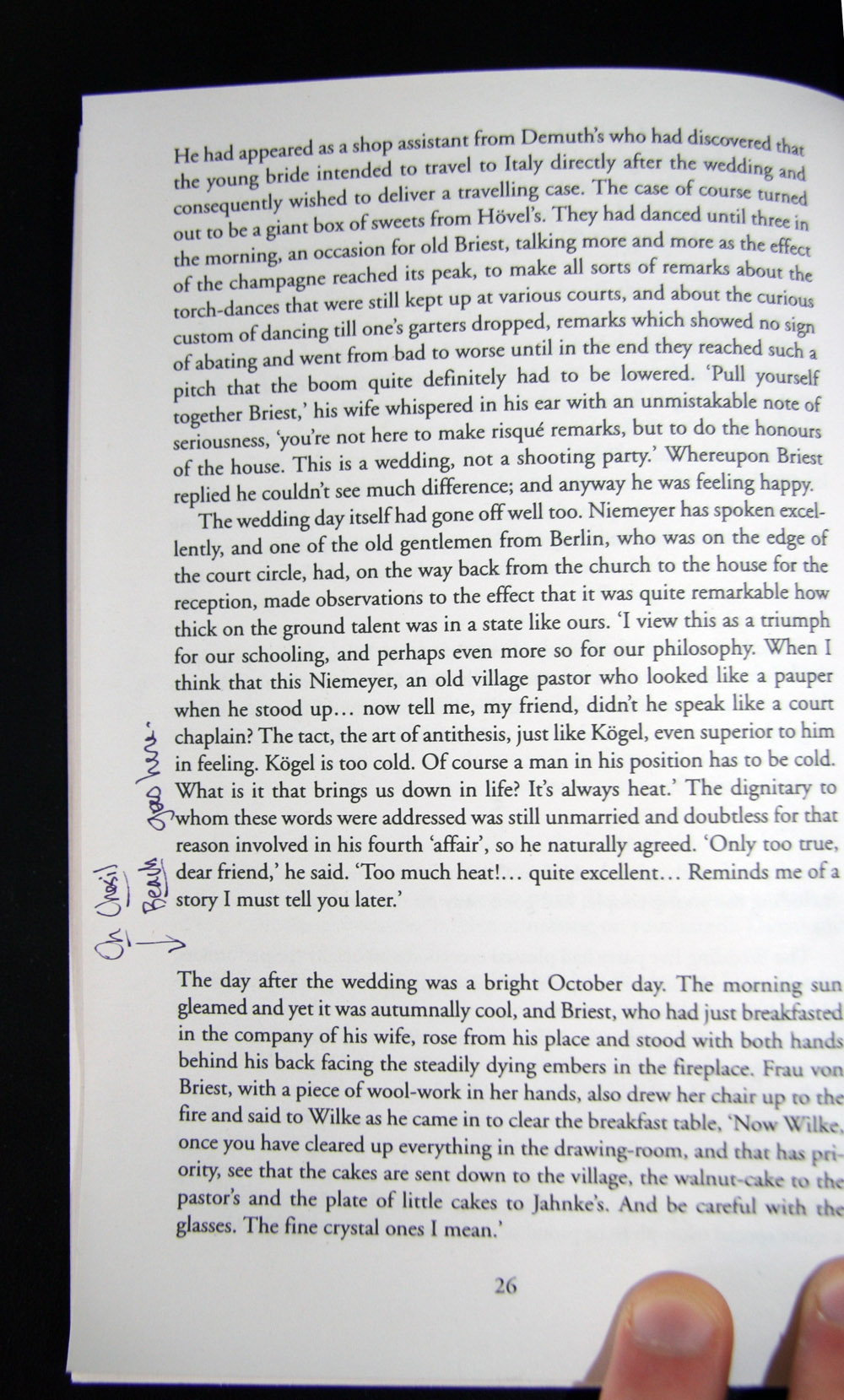
With enough subtlety, substance disappears, and I love his characterization of American Thanksgivings as portrayed in stories. Anyway, Chambers also says of Effi’s husband, “It seems that after years of self-discipline and mortification of the flesh Innstetten has regulated his natural urges into a state of atrophy.” In the margin I wrote, “Yawn,” a judgment that still seems reasonable a week later. Practically the entire text of Ian McEwan’s On Chesil Beach could fit between the end of the wedding scene on page 26 and the next paragraph, which begins, “The day after the wedding was a bright October day,” as if one of the presumably major events of Effi’s life hadn’t just happened. And I’m not talking about the wedding.

I was thinking about Effi Briest when I read Samuel Delany’s Paris Review interview in the Summer 2011 issue. He talks about two characters in his work Nova who almost have an incestuous relationship. The interviewer begins this exchange:

Did you intentionally want to make something the reader could only speculate about, rather than be certain of?

Delany: Certainly as far as the incest goes. Suggestion is a literary strategy. But when, in 1968, works like Henry Miller’s Tropic of Cancer and Black Spring and Lawrence’s Lady Chatterley’s Lover were legal to publish and sell in this country, the age of innuendo and the coyly placed line of white space, as the hero envelops the heroine in his arms, ended. Fifteen years later, AIDS rendered them permanently obsolete.

Today, I watch seminar rooms full of graduate students misread both [Alfred] Bester and [Joseph] Conrad, because they no longer have to wonder about the possibility of such illegal elements occurring in the story and the compensating possibility of suggestion as a writerly strategy for representing sex and violence.

I am one of those graduate students, and I evidently don’t have the exquisitely tuned sex detector that pre-’68 readers might have developed. This became especially clear in a seminar on Henry James’ The Golden Bowl, when one of my professors at the University of Arizona began to point out the many euphemisms and double entendres left by James, beginning with the name “Assingham” and proceeding from there. I mostly wondered what the big fuss was about, given the modesty of the phrases in questions, but I didn’t realize how generational my readings were until I discovered the Delany interview an hour ago.

Delany is right—I don’t have a lot of tolerance of “innuendo and the coyly placed line of white space.” That doesn’t mean I want every novel to be wildly explicit, or that I want pornography to merge with literary fiction, but it does mean that a lot of older books seem coy. Like Effi Briest. Today, when McEwan’s aforementioned novel takes those white spaces and turns them into entire works of their own, it’s hard to accept the white space, or an extraordinarily “discreet and allusive novel” where Virginia Creepers (or pumpkin pie) have “infinite psychological and sexual repercussions”

I didn’t expect to have my malady so accurately and suddenly diagnosed, however, and it wasn’t until I read Delany that I was able to write this post. He makes me want to be a more careful and considerate reader. Or maybe novels do have a sense of technological progression, or something like progress, or even progress itself. James Wood speculates on the subject in his review of Chang-Rae Lee’s The Surrendered:

Does literature progress, like medicine or engineering? Nabokov seems to have thought so, and pointed out that Tolstoy, unlike Homer, was able to describe childbirth in convincing detail. Yet you could argue the opposite view; after all, no novelist strikes the modern reader as more Homeric than Tolstoy. [. . .] Perhaps it is as absurd to talk about progress in literature as it is to talk about progress in electricity—both are natural resources awaiting different forms of activation. The novel is peculiar in this respect, because while anyone painting today exactly like Courbet, or composing music exactly like Brahms, would be accounted a fraud or a forger, much contemporary fiction borrows the codes and conventions—the basic narrative grammar—of Flaubert or Balzac without essential alteration.

If literature progresses technologically, it still doesn’t do so in quite the same way as technology: no one would use a camera from 1925 unless they were a masochist, had a historical fetish, or were trying to achieve some very peculiar artistic effect. The rest of us use digital cameras manufactured in the last five years, or phones, given the obvious advantages of convenience. But many writers from 1925 still feel quite modern—Fitzgerald, most obviously, but many others too. Yet I don’t find that much 19th Century fiction really moves me (exceptions: Moby-Dick, The Scarlet Letter). Contemporary writers have a greater and perhaps infinite rein to express what they need to express, and by contrast older writers do seem coy, even if this is an unfair judgment on my part—or the kind of judgment that might be tempered by age. The more I think about the idea, the more I see how others have considered it. For example, this review of William Deresiewicz’s A Jane Austen Education is bizarre because it’s like reading about myself, right down to the love for Madame Bovary:

In 1990, William Deresiewicz was on his way to gaining a Ph.D. in English literature at Columbia University. Describing that time in the opening pages of his sharp, endearingly self-effacing new book, “A Jane Austen Education,” Deresiewicz explains that he faced one crucial obstacle. He loathed not just Jane Austen but the entire gang of 19th-century British novelists: Hardy, Dickens, Eliot . . . the lot.

At 26, Deresiewicz wasn’t experiencing the hatred born of surfeit that Mark Twain described when he told a friend, “Every time I read ‘Pride and Prejudice’ I want to dig her up and hit her over the skull with her own shinbone.” What Deresiewicz (who has considerable fun at the expense of his pompous younger self) was going through was the rebel phase in which Dostoyevsky rules Planet Gloom, that stage during which the best available image of marriage is a prison gate.

Sardonic students do not, as Deresiewicz points out, make suitable shrine-­tenders for a female novelist whose books, while short on wedding scenes, never skimp on proposals. Emma Bovary fulfilled all the young scholar’s expectations of literary culture at its finest; Emma Woodhouse left him cold. “Her life,” he lamented, “was impossibly narrow.” Her story, such as it was, “seemed to consist of nothing more than a lot of chitchat among a bunch of commonplace characters in a country village.” Hypochondriacal Mr. Woodhouse, garrulous Miss Bates — weren’t these just the sort of bores Deresiewicz had spent his college years struggling to avoid? Maybe, he describes himself conceding, the sole redeeming feature of smug Miss Woodhouse was that she seemed to share his distaste for the dull society of Highbury.

I’m 27. Maybe I’ll have considerable fun at the expense of my pompous younger self one day.

I bought A Jane Austen Education, which shouldn’t be surprising given my feelings about Deresiewicz. Maybe he will teach me to read Austen more kindly, more attentively (Wood has succeeded at least somewhat in that respect: his discussion of free indirect speech in How Fiction Works finally gave me the tools to figure out why people like Austen). I’m still not sure that it will bring Effi Briest to life, and even if it does, it might be more like reanimating a corpse (which, as genre fiction teaches us, is replete with dangers) than interacting with a live person.

Effi Briest — Theodore Fontane, with a side of James Wood and Samuel Delany’s Paris Review interview

Despite what I wrote in this post, I got a copy of Effi Briest. And you know what? I couldn’t finish it. There were some great lines—my favorite is Effi’s father saying, “There’s nothing so good for one as a wedding, provided of course it isn’t one’s own”—but I couldn’t take the rest, even though I stopped reading the very nice introduction by Helen Chambers after realizing it was prejudicing me against the book:

The sexual dimensions of the age gap [between Effi and her husband] remain beneath the surface of this discreet and allusive novel. They are suggested, as is much that is vital in the inner action, by the symbolic texture of the narrative. Effi’s sexual inexperience at the beginning of the novel is beyond question, and the premature loss of her virginity is prefigured by the twins calling her back to the garden through a window framed by Virginia Creeper

This explains why little seems to happen, since “remain beneath the surface” feels like another phrase for “buried so deeply that you need an even dirtier mind than mine to excavate it. In a Paris Review interview, Robertson Davies says:

I do not respond quite so immediately and warmly to writers in the United States, because their concerns are different from mine and their approach to them is different from mine. They seem to be infinitely concerned with very subtle details of feeling and life. I find this exemplified, for instance, in many stories in The New Yorker where whether the family will have pumpkin pie or something else on Thanksgiving Day is a decision with infinite psychological and sexual repercussions. I take this quite seriously. I admire their subtlety—but I get so sick of it. I wish they would deal with larger themes.

With enough subtlety, substance disappears, and I love his characterization of American Thanksgivings as portrayed in stories. Anyway, Chambers also says of Effi’s husband, “It seems that after years of self-discipline and mortification of the flesh Innstetten has regulated his natural urges into a state of atrophy.” In the margin I wrote, “Yawn,” a judgment that still seems reasonable a week later. Practically the entire text of Ian McEwan’s On Chesil Beach could fit between the end of the wedding scene on page 26 and the next paragraph, which begins, “The day after the wedding was a bright October day,” as if one of the presumably major events of Effi’s life hadn’t just happened. And I’m not talking about the wedding.

I was thinking about Effi Briest when I read Samuel Delany’s Paris Review interview in the Summer 2011 issue. He talks about two characters in his work Nova who almost have an incestuous relationship. The interviewer begins this exchange:

Did you intentionally want to make something the reader could only speculate about, rather than be certain of?

Delany: Certainly as far as the incest goes. Suggestion is a literary strategy. But when, in 1968, works like Henry Miller’s Tropic of Cancer and Black Spring and Lawrence’s Lady Chatterley’s Lover were legal to publish and sell in this country, the age of innuendo and the coyly placed line of white space, as the hero envelops the heroine in his arms, ended. Fifteen years later, AIDS rendered them permanently obsolete.

Today, I watch seminar rooms full of graduate students misread both [Alfred] Bester and [Joseph] Conrad, because they no longer have to wonder about the possibility of such illegal elements occurring in the story and the compensating possibility of suggestion as a writerly strategy for representing sex and violence.

I am one of those graduate students, and I evidently don’t have the exquisitely tuned sex detector that pre-’68 readers might have developed. This became especially clear in a seminar on Henry James’ The Golden Bowl, when one of my professors at the University of Arizona began to point out the many euphemisms and double entendres left by James, beginning with the name “Assingham” and proceeding from there. I mostly wondered what the big fuss was about, given the modesty of the phrases in questions, but I didn’t realize how generational my readings were until I discovered the Delany interview an hour ago.

Delany is right—I don’t have a lot of tolerance of “innuendo and the coyly placed line of white space.” That doesn’t mean I want every novel to be wildly explicit, or that I want pornography to merge with literary fiction, but it does mean that a lot of older books seem coy. Like Effi Briest. Today, when McEwan’s aforementioned novel takes those white spaces and turns them into entire works of their own, it’s hard to accept the white space, or an extraordinarily “discreet and allusive novel” where Virginia Creepers (or pumpkin pie) have “infinite psychological and sexual repercussions”

I didn’t expect to have my malady so accurately and suddenly diagnosed, however, and it wasn’t until I read Delany that I was able to write this post. He makes me want to be a more careful and considerate reader. Or maybe novels do have a sense of technological progression, or something like progress, or even progress itself. James Wood speculates on the subject in his review of Chang-Rae Lee’s The Surrendered:

Does literature progress, like medicine or engineering? Nabokov seems to have thought so, and pointed out that Tolstoy, unlike Homer, was able to describe childbirth in convincing detail. Yet you could argue the opposite view; after all, no novelist strikes the modern reader as more Homeric than Tolstoy. [. . .] Perhaps it is as absurd to talk about progress in literature as it is to talk about progress in electricity—both are natural resources awaiting different forms of activation. The novel is peculiar in this respect, because while anyone painting today exactly like Courbet, or composing music exactly like Brahms, would be accounted a fraud or a forger, much contemporary fiction borrows the codes and conventions—the basic narrative grammar—of Flaubert or Balzac without essential alteration.

If literature progresses technologically, it still doesn’t do so in quite the same way as technology: no one would use a camera from 1925 unless they were a masochist, had a historical fetish, or were trying to achieve some very peculiar artistic effect. The rest of us use digital cameras manufactured in the last five years, or phones, given the obvious advantages of convenience. But many writers from 1925 still feel quite modern—Fitzgerald, most obviously, but many others too. Yet I don’t find that much 19th Century fiction really moves me (exceptions: Moby-Dick, The Scarlet Letter). Contemporary writers have a greater and perhaps infinite rein to express what they need to express, and by contrast older writers do seem coy, even if this is an unfair judgment on my part—or the kind of judgment that might be tempered by age. The more I think about the idea, the more I see how others have considered it. For example, this review of William Deresiewicz’s A Jane Austen Education is bizarre because it’s like reading about myself, right down to the love for Madame Bovary:

In 1990, William Deresiewicz was on his way to gaining a Ph.D. in English literature at Columbia University. Describing that time in the opening pages of his sharp, endearingly self-effacing new book, “A Jane Austen Education,” Deresiewicz explains that he faced one crucial obstacle. He loathed not just Jane Austen but the entire gang of 19th-century British novelists: Hardy, Dickens, Eliot . . . the lot.

At 26, Deresiewicz wasn’t experiencing the hatred born of surfeit that Mark Twain described when he told a friend, “Every time I read ‘Pride and Prejudice’ I want to dig her up and hit her over the skull with her own shinbone.” What Deresiewicz (who has considerable fun at the expense of his pompous younger self) was going through was the rebel phase in which Dostoyevsky rules Planet Gloom, that stage during which the best available image of marriage is a prison gate.

Sardonic students do not, as Deresiewicz points out, make suitable shrine-­tenders for a female novelist whose books, while short on wedding scenes, never skimp on proposals. Emma Bovary fulfilled all the young scholar’s expectations of literary culture at its finest; Emma Woodhouse left him cold. “Her life,” he lamented, “was impossibly narrow.” Her story, such as it was, “seemed to consist of nothing more than a lot of chitchat among a bunch of commonplace characters in a country village.” Hypochondriacal Mr. Woodhouse, garrulous Miss Bates — weren’t these just the sort of bores Deresiewicz had spent his college years struggling to avoid? Maybe, he describes himself conceding, the sole redeeming feature of smug Miss Woodhouse was that she seemed to share his distaste for the dull society of Highbury.

I’m 27. Maybe I’ll have considerable fun at the expense of my pompous younger self one day.

I bought A Jane Austen Education, which shouldn’t be surprising given my feelings about Deresiewicz. Maybe he will teach me to read Austen more kindly, more attentively (Wood has succeeded at least somewhat in that respect: his discussion of free indirect speech in How Fiction Works finally gave me the tools to figure out why people like Austen). I’m still not sure that it will bring Effi Briest to life, and even if it does, it might be more like reanimating a corpse (which, as genre fiction teaches us, is replete with dangers) than interacting with a live person.

Nine and a Half Weeks: A Memoir of a Love Affair — Elizabeth Mcneill

Most novels (and memoirs) leave you with a sense of distance, a sense of being at a comfortable remove. Nine and a Half Weeks doesn’t: it’s too graphic, too immediate, too flat. One sees this effect in the first sentences, without any preamble as to who these people are and how they came to be: “The first time we were in bed together he held my hands pinned down above my head. I liked it. I liked him. He was moody in a way that struck me as romantic; he was funny, bright, interesting to talk to; and he gave me pleasure.” One senses quickening thoughts and pulses in those short sentences, and even in the long one, where semicolons could be periods, and the last descriptor—”he gave me pleasure”—is the really important one. You don’t get the very ironic tone of a book like Alain de Botton’s On Love, letting us see that love is irrational but really understandably so. Alain, the narrator of On Love is basically a needy, endearing, neurotic weakling; his self-consciousness contrasts so much with the man in Nine and a Half Weeks that they’re practically different species.

There are clever phrases in the memoir, as when the narrator says of her lover, “His face turns attractive when he talks;” I like the strange word choice, as if the head is physically turning, or as if he has two, or multiple, faces. A few moments are archaic—the man describes a friend or rival coming over as “This dope” (emphasis in original), which hasn’t been currently slang in decades and stands out in a book that otherwise stands out for not being part of any particular time. The prose holds up, and the narrator has an eye for tedious rituals, as when she tells of a “statistical tale,” where the contrast of statistics and narrative stands out:

In the middle of the statistical tale he’s requested from me—brothers and sisters and parents and grandparents, hometown, schools, jobs—I stop and close my eyes . . . please, I think, inarticulate even in my own mind, unable to turn to him and make the first move, please . . .

There’s a pervasive fear of dullness running through the memoir. The narrator notes that she and her lover looked like “An attractive, well-educated couple in New York City, average, middle-class, civilized.” That contrasts with what came before and will come after. Or does it? The memoir teases us by making us wonder if the the narrator isn’t so unusual as public discourse would make her out to be. I think the story’s flatness, the unwillingness to engage in direct commentary on what’s happening, points us in this direction, as when the narrator says, “I am standing, nearly on tiptoes, across the room from him, my arms raised above my head. My hands are tied to the hook on the wall on which his one large painting hangs during the day.” She’s hung like a painting and enjoys it. There is no further morality or analysis. Sixty Minutes plays in the background, a reminder of the middle America the narrator feels like she’s leaving behind even when she imagines it as a foil to her own actions.

Images repeat through the memoir. Scarves reappear. The words “like” and “love” are reconfigured like body parts. One senses Nabokovian echoes in the prose that one distantly hears on the first read but can’t make out. The narrator also feels her internal sense of self discombobulating, like a washing machine that shakes itself apart from within. She knows this is happening and imagines the reactions of otherwise course, until she writes of her experience.

We don’t know what the narrator wants beyond the obvious: sexual satisfaction. That she might only want the obvious might be the most frightening thing of all. What if everything else she has—a job, presumed communal respect, literary and political opinions—don’t matter very much? What if your real self isn’t those frontal cortex developments, but something deeper, more primal? I find posing the questions unsettling. The answers implied by Nine and a Half Weeks are more so. The patina of everyday experience conceals so much, especially in the realm of inchoate desire that social life is designed to channel. What happens when the channeling breaks? What happens when we want it to break? I’m reminded of Donna Tartt’s The Secret History, which also features the discarding of the mind in pursuit of a mental state or feeling very unlike the one most of us presumably inhabit most of the time—the mental state worried about how much money we have, what other people think about us, whether we’ll get the job / life partner / degree / accommodates of our dreams.

The narrator likes the man’s dominance above all other traits, which derive from that dominance. He says of a friend or rival, “he’s got no guts whatsoever.” Note what she likes in the contrast he offers by comparison. He shows mastery by reading Gide in French and Kafka in German, both implying continental expertise and sexuality. Some moments are obvious, as when the narrator reads with “his thick pen solid and comfortable in my hand.” One doesn’t need to be Freud to imagine that the pen is not just a pen. In the same scene, the narrator says, “I write the letter (‘. . . met this man a few days ago, nice start, very different from Gerry, who’s more than happy with Harriett these day, you remember her . . .’)” (sic). The dig at her ex-boyfriend is subtle but present: he isn’t dominant, won’t tie her up, and presumably has settled with a lesser woman.

He demonstrates great knowledge too: “[. . .] whatever else he may do [in] it, this man clearly does read his original-language books in bed; why would anyone want to miss out on one of the most satisfying pleasures available? All he’d need is a better bulb, a few more pillows, and a reading lamp. . . .” The room sounds sad and denuded, but it doesn’t matter much, even if the narrator is right about beds, which are good for more than just sleeping and that other thing. He offers commands, as when the narrator says:

He guides my hands between my legs and says, ‘I’d like to watch you make yourself come.’

He is sitting idly, comfortably, one leg crossed over the other, the creases sharp in the freshly cleaned suit. I do not try to move my hands. He waits. ‘You don’t understand.’ My voice cracks. ‘I never . . .’ He is silent. ‘I’ve never done that in front of anybody. It embarrasses me.’ “

She does, of course. That it embarrasses her is part of the point. What embarrasses her in the moment becomes the fodder for memoir, even under a pseudonym, long after. She likes giving power to him, which she does by letting him watch her masturbate. She also does by repeating how much she loves him, but I don’t think he ever says it back. It’s like he doesn’t need to, and by withholding the confirmation of his love he creates a neurotic fear in her. Only at one moment does he crack, when “All at once he is a decade my junior, a very young man asking me to have a drink with him, expecting to be refused.” But that doesn’t last long. Little does in this memoir, including their relationship, whose duration is given away by the title. But the narrator learns a lot in a short period. She says, “If you’ve never screamed, out of control, you can’t imagine how it feels. Now I know how it feels, it’s like coming.” She never goes the Biblical or mythological root and thinks there are things we shouldn’t know. For her, all knowledge is knowledge.

You can see that McNeill’s memoir doesn’t sit well with current ideals of equality and mutual respect in all fields. As Laura Kipnis says in “Off Limits: Should students be allowed to hook up with professors?” for Slate.com, “Feminism has taught us to recognize the power dynamics in these kinds of relationships, and this has evolved into a dominant paradigm, the new propriety.” Feminism has taught us to recognize power dynamics, but it should also teach us to recognize points of view. The narrator gets this; she thinks the man’s room is “too plain to be called plain. It’s austere, if you want to be charitable, or chic, if you want to be snide, or boring, if you want to be honest. It is not, in any event, a room you’d call cozy” {McNeill “Love”@9}. So the narrator is aware of angles, points of view, possibilities. I’ve been told I use “or” a lot in my own writing. It’s a useful word for people who perceive many ways of describing things, and here it betrays an openness to experience that the memoir exploits. She has a strong theory of mind that weakens as she awakens to herself.

I should point out that I call the narrator “the narrator” as opposed to “McNeill” or something more conventional because she feels like a fictional person more than a real person (which is strange, given how many fictional characters seem real, but that’s a topic for another time). Elizabeth McNeill is itself a pseudonym. We don’t know who the real author is. The man is never given a name—he’s only given traits, like his penchant for Brooks Brothers and sadomasochism (sometimes, especially when it comes to belts, simultaneously). So I don’t entirely know what to call them, or what to call their madness, if it is indeed madness. Can we find pleasure in madness? The narrator’s point is that many of these normally distinct categories eventually blur. I think that’s one of Tartt’s points in The Secret History too. There is more to be written about the book—its strange tenses, leaping from past to present to future, to what extent we should indulge in or avoid attempting to apply universal lessons—but this gives flavor of it and why its merits still show.

A Billion Wicked Thoughts: What The World’s Largest Experiment Reveals About Human Desire — Ogi Ogas and Sai Gaddam

A Billion Wicked Thoughts is good but not great; it covers a lot of much-discussed studies from an angle that, although novel, isn’t quite novel enough. The book is like Why Women Have Sex: both are written by pairs of popularizing intellectuals who probably want to earn more money and affect the social conversation more than they could through writing purely academic work. Anyone really interested in issues around sexuality and evolution is better served by The Evolutionary Biology of Human Female Sexuality, which is insanely detailed and concomitantly worth reading.

In A Billion Wicked Thoughts, the forward by Catherine Salmon notes, “There is a lot of truth to the belief that if you can imagine it, you can find it as Internet porn.” If you can imagine it and can’t find it, you probably have a good business model. Or you can make the porn yourself. But the ubiquity of online porn, combined with its breadth, makes it a trove of information about behavior that, as Ogas and Gaddam point out, most people are reluctant to share. If they do share, what they share and how they shade information can render that information nearly useless. In contrast, the Internet feels anonymous enough to let your search engine rip. So Ogas and Gaddam decided to study search queries, sort them (apparently using Amazon’s Mechanical Turk), classify them, and analyze them. We also get lots of specific sample search queries, like “family nude beach” (167), “anal sex benefits” (168), and “nude construction workers” (168). These illustrate important points, I’m sure, and I’m not including them in this post purely to ensnare unwary search engine users.

Using Internet search queries reduces some forms of bias while presumably introducing others—like what we know about people who don’t use the Internet. What can see about all those searchers who aren’t looking for porn? What can we say about sample bias?
The authors are aware of this and say, for example:

The male desire for older women is also reflected in the popularity of ‘mom’ searches on PornHub (since teen content is highly visible and easily accessible on PornHub, users may be more likely to manually type in searches for content they don’t immediately seen.

But how do we know about the proportions of searchers to non-searchers? This may be an example of the old joke about the “Streetlight Effect:

A policeman sees a drunk man searching for something under a streetlight and asks what the drunk has lost. He says he lost his keys and they both look under the streetlight together. After a few minutes the policeman asks if he is sure he lost them here, and the drunk replies, no, that he lost them in the park. The policeman asks why he is searching here, and the drunk replies, “this is where the light is.

Internet searches are where the light is right now.

Still, the project is interesting, and, in the absence of other data, it makes some sense to use what’s available. Ogas and Gaddam structure the book as a series of chapters that use Internet porn search classifications as headers, note some of those searches, and explain what those searches might mean using research that draws from evolutionary biology, evolutionary psychology, sexology, and similar fields. It’s a readable introduction, but it’s also part of a torrent of pop sex books over the last decade, which you can find through Amazon’s “if you bought this, you’ll also like this. . .” feature. If you’ve read enough of those books, you probably don’t need this one. Read this Salon Q&A instead.

The prose in A Billion Wicked Thoughts is competent—and, unlike Sex at Dawn‘s whacky metaphors and comparisons that strive for style and instead hit silliness, it rarely strays into the ludicrous. Although the purpose of nonfiction is to convey information, the best nonfiction goes beyond that stage to become art (Umberto Eco makes this as a subsidiary point in Confessions of a Young Novelist). A few jokes might even be intentional—I particularly like “On the web, group sex porn has exploded into a variety of sub-genres” (emphasis added)—but A Billion Wicked Thoughts doesn’t quite get there, although there’s nothing wrong with it.

Having little wrong isn’t enough to be right, and they still use coinages like “The Miss Marple Detective Agency” to describe a large body of research demonstrating that women’s physical reactions to sexual stimuli often differ markedly from their psychological reactions to sexual stimuli. You can get a lot of the material in this chapter from the New York Times article “Women Who Want to Want,” starring psychologist Lori Brotto instead of psychologist Meredith Chivers instead of psychologist Lori Brotto.

The upshot shot of the chapter is that many women appear to physically respond to sexual stimuli even when their conscious minds aren’t responsive or even find it disturbing—and those same women are frequently unaware of the phenomenon. Ogas and Gaddamn analogize the situation to the mind-body problem in philosophy (which also happens to be the name of an excellent novel by Rebecca Goldstein). The upshot: “women need to be psychologically aroused.” This appears to be true, but although the research points in that direction, it isn’t perfect; we have effects, but the causes remain uncertain.

There’s still evidence in that direction, and Ogas and Gaddam discuss much of it, including the female penchant for romance novels (which, although sexual, also focus much more on narrative and emotional connection than porn) and the male penchant for porn featuring anonymous sex focused in particular on body parts. They’re also aware of their own biases, as when they note “We all have our favorite theories that fit our experiences and prejudices.” That’s true, and it’s hard to shake ideology out of sex research. It’s also hard to shake one’s own training, and mine in literature makes me think some of their literary analysis is suspect, but they’re good at a naive version of Franco Moretti’s distant reading, as when they note how rare it is for heroes in romance novels to be truly, consistently poor:

In modern romances, the heroine often has a high-powered, high-paying job of her own. Romances feature women who are corporate executives, politicians, and financiers. Since such heroines no longer require a man to provide for their needs, has this cultural transformation led to more romance heroes with limited resources?

Not at all. If a heroine is rich, then the hero is even more rich.

They cite Janice Radway’s Reading the Romance, which studies the genre from a politically inflected but still fascinating perspective. They cite a lot in general, and their notes / bibliography is close to 100 pages. I always admire a book with a very, very big bibliography. In this respect, A Billion Wicked Thoughts satisfies.