Gary Shteyngart on humor in the novel

Humor is what I have […] without humor, I can’t go on, and I doubt many of my readers would go on either. Humor is so important. I am here to have fun, too, with my work. I’m here to entertain people. Remember when you used to wake up and think well God, I gotta run to the bookstore and X’s book is coming out, I can’t wait to read it, it’s going to be funny, it’s going to be sharp, I can’t wait to get my hands on it. Somehow, that kind of literature has begun to escape. I mean, there’s a very kind of mass market literature, but a lot of the other kind of literature has become very academic. A lot of it is taught at MFA programs […] A lot of it can be beautifully sculpted, wonderfully written, like a a little Fabergé egg, and at the same time miss the vitality, the humor, the feelings of being in love, and the worry about death that often gives rise to the highest order of humor of all […] I want fiction to remain a vital force for entertainment, and not just for contemplation.

That’s from Shteyngart’s interview on Fresh Air. Maybe one problem is that, as Milan Kundera says in Encounter, “… only a sense of humor can discern the humorlessness in others.” The humorless can speak to each other more easily than the humorless can speak to the humored, or vice-versa. Or, as Christopher Hitchens writes in his memoir, Hitch-22, “[Martin Amis] once rebuked some pedantic antagonist by saying that the man lacked any sense of humor, but added that by this accusation he really intended to impugn his want of seriousness.” Maybe the ultimate seriousness is a return to the playful style of childhood, which gets beaten out and eventually re-embraced over time.

Hilarity in Delaware: Christine O’Donnell and J.R.R. Tolkien, sitting in a tree…

As almost everyone now knows, Christine O’Donnell won the Republican Senate primary in an upset, and, as almost everyone now knows and will forget six months from now, she’s also unintentionally hilarious. One of her better moments comes from a 2003 essay on Tolkien discussed in “The Republican Senate candidate’s analysis of “Lord of the Rings” reveals her views on feminine roles.” Unfortunately, Salon’s copy of O’Donnell’s essay has been removed, but not before I caught this bit: “Even as I researched this article, the only writings on Tolkien and feminism I found were on websites for freebee high school essays.”

As Jason Fisher said in an e-mail, “Not a promising opening. When the only writings you can find are high-school level, it’s a strong indication that your research techniques are only high-school level.” Indeed: by 2003, Jane Chance had published extensively on Tolkien. Splintered Light: Logos and Language in Tolkien’s World came out in 2002. Tolkien Studies hadn’t been founded yet, but a lot of the material cited by it stretches back decades.

Even if you couldn’t find that material for whatever reason, the number of books about gender, gender construction, and gender symbolism in fiction is simply staggering; much of it could be and is being productively applied to Tolkien.

I sometimes say to my students that there is a world of ideas beyond the Internet or not available on it. They often don’t believe me, or if they do, don’t act on that belief. Now at least there’s a concrete example of failing to act on that belief in action.

Since humor is in the air like pheromones, it’s worth pointing to the Borowitz Report: “Delaware Masturbators March Against O’Donnell.” Where’s that parody coming from? See Christine O’Donnell, masturbation socialist on Slate.

I seldom comment on politics because I think most political discussions are really about people signaling what they perceive their values to be, not about the exchange of real information or ideas about the world beyond the individual espousing a particular point of view. But the opportunity to do so here is too rich to ignore and has led to a very amusing juxtaposition of post tags, and with O’Donnell, even Frank Rich gets into the spirit, writing for the New York Times:

But history will always remember her for taking a fearless stand against masturbation, the one national pastime with more fans than baseball.

Our great country has truly come a very long way if being anti-masturbation is now coded as being anti-American. In a world where drug stores are selling sex toys, how could it not be?

Every so often politicians emerge for whom pot shots are the optimal method of engagement; Slate writes from the left and so mostly attacks Republicans, but this bit is pretty hilarious:

And I guess it was those terrible experiences that led her to spend her life telling girls never to feel lust, which is a sensible and realistic thing to recommend.

Just say no to fun has been working well for centuries, whether from the early Progressives on Prohibition, the modern-day versions of the, or the anti-sex Republicans. Telling people not to feel lust is pretty close to telling people not to feel hungry; sure, you find the occasional monk who manages to fast for very long periods of time and primarily eats tea, bread, and fruit. The rest of us, however, will ask you to pass the potatoes, be generous with the wine, and ask whether you’ve tried the sumptuous French-Vietnamese fusion place up the street, the one with the amazing Pho.

Every so often, my students imply (usually they don’t say it outright) that English classes don’t matter, that what they learn in school doesn’t matter, and that they’ll succeed regardless. And every so often, the world offers up a story that implies they may be right.Christine O’Donnell is one such example.

Columbia or prison: similarities and differences?

Terry Gross’ interview with Scott Spencer (of A Man in the Woods) notes that the author has “taught fiction writing at Columbia University, and in prison” (1:10; I think she says “in prison,” although it might be “at prisons”). The tone sounds like this sort of trajectory is completely normal, like a sandwich and soup. To me, it invites questions:

  • Can I be the only one who finds the juxtaposition of those two fine American institutions curious or notable?
  • How many writers or professors have taught at an Ivy League school and a penal facility?
  • Is teaching at the one pretty much like teaching at the other?
  • If you’ve currently got a gig at a prison, how do you make the transition to Columbia? I assume relatively few people want to make the opposite leap.

Jane Austen, Emma, and what characters do

I’m rereading Jane Austen’s Emma and realized that when the characters in the novel debate the validity, respectability, or wisdom of the minor actions of other characters in the novel—which is essentially all that happens—they are really judging themselves and their own choices. For example, there’s a moment when Emma is considering Knightley’s observations about Elton’s real motives:

He had frightened her a little about Mr. Elton; but when she considered that Mr. Knightley could not have observed him as she had done, neither with the interest, nor (she must be allowed to tell herself, in spite of Mr. Knightley’s pretensions) with the skill of such an observer on such a question as herself, that he had spoken it hastily and in anger, she was able to believe, that he had rather said what he wished resentfully to be true, than what he knew any thing about.

When Emma says that Knightley “could not have observed him as she had done,” she’s really saying that she’s a more able observer than Knightley and that she doesn’t merely base things on what she “wished resentfully to be true.” This is proved wrong, of course, like many of her comments and ideas, and it shows that while she thinks she values seeing things clearly, given her “skill” as “such an observer,” she actually sees no more clearly than anyone else. The reader figures out that Emma is self-deceptive, while within the novel she is proclaiming that her own choice of Elton as a sexual partner for Harriet is an appropriate one.

Emma also tends not to have much meta-cognition—instead, we, the readers, act as her meta evaluator. For example, she moves briefly in this direction after Elton foolish declares her love, but she pulls back before it can come to fruition:

She had had many a hint from Mr. Knightley and some from her own heart, as to her deficiency—but none were equal to counteract the persuasion of its being very disagreeable,—a waste of time—tiresome women—and all the horror of being in danger of falling in with the second-rate and third-rate of Highbury, who were calling on them for ever, and therefore she seldom went near [the Bates, who she considers inferiors].

Whatever hints Knightley drops Emma ignores through most of the novel—likewise the ones “from her own heart.” Her own choices must be right because they come from her, even when those choices spring from unarticulated values that don’t hold up to Knightley’s clarifying vision. Emma never interrogates what “the second rate and third rate” mean: that’s one of the frustrating parts about this novel and so many others. The characters lack the ability to explicitly question their own values, even as they express what values they hold by denigrating the values of other characters. This is part of the joke and the irony of the novel, of course, but I tend prefer characters with somewhat greater self-awareness.

But the pleasure of Emma is realizing that its characters lack much of the self-awareness we think they should have. They debate values when they should be debating their debate on values. That, instead, is left to the critics.

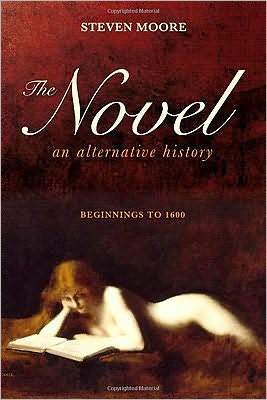
The Novel: An Alternative History — Steven Moore

Novels really start when an important technology (the printing press) allows novelists to respond to one another.

Steven Moore’s The Novel: An Alternative History: Beginnings to 1600 is a very alternative history that points even more than most histories of the novel to the question of what defines the genre. But it answers that question with less satisfaction: a novel is any prose work of some length that is what we would now call fiction. But the idea of fiction / nonfiction weren’t particularly well established until the late eighteenth century, as discussed in some of those conventional histories, like The Rise Of The Novel: Studies In Defoe, Richardson And Fielding and Institutions of the English Novel: From Defoe to Scott.

Without that epistemological distinction, critics lack the intellectual scaffolding necessary to really talk about fiction: you have a muddle of stuff that people haven’t really figured out how to deal with. In The Disappearance of God, J. Hillis Miller puts it differently: “The change from traditional literature to a modern genre like the novel can be defined as a moving of once objective worlds of myth and romance into the subjective consciousness of man,” but he’s getting at a similar idea: the “objective worlds of myth” turn out not to be as “objective” as they appear, and the “subjective consciousness of man” reevaluates those worlds of myth. We get at distinctions between what’s true and what’s false based on our ability to recognize our own subjective position, which the novel helps us do.

Moore discusses these issues, of course: he notes the standard history I’m espousing and his reasons for doubting it:

And today our best novelists follow in this great tradition [from Defoe, Swift, and Richardson to the 19th Century realists through Joyce and Faulkner to the present]: that is, realistic narratives driven by strong plot and peopled by well-rounded characters struggling with serious ethical issues, conveyed in language anybody can understand.

Wrong. The novel has been around since at least the 4th century BCE […] and flourished in the Mediterranean area until the coming of the Christian Dark Ages.

That’s on page three. I’ve responded to the philosophical and intellectual aspects of what I think problematic, but there’s another issue: Moore’s argument ignores the technological history that enabled the novel to occur. I’ll return to my first paragraph.

Without the printing press, it’s wrong-headed to speak of novels. They couldn’t be sufficiently read, distributed, and disseminated, to enable the “speaking to each other” that I think of in fiction. There wasn’t a “creativity revolution” along the lines of the runaway Industrial Revolution of the eighteenth century (see, for example, Joel Mokyr’s The Enlightened Economy, which I discuss at the link). Books didn’t react enough to other books; that’s part of what the novel got going, and this aspect was enabled by the Industrial Revolution and the press. The two are fundamentally linked.

Some works that we would now classify as fiction definitely were written or compiled, as Moore rightly points out, but they didn’t gain the epistemological distinctions that we grant novels until much later, and novels evolved with a mass reading public that could only occur when novels were mass-produced—produced in numbers that allowed them to be read and responded to by other writers. Claiming that early quasi-fiction forms are novels is like saying that a play and a TV show are the same thing because both rely on visual representations of actors who are pretending to be someone else. In some respects, that’s true, but it still misses how form changes function. It misses the insights of Marshall McLuhan.

He almost gets to this issue:

Sorting through the various ancient writings that have come down to us on cuneiform tablets, papyri, scrolls, and ostraca (potsherds or limestone flakes), it is not difficult to find prototypes for literary fiction and what would eventually be called the novel. What’s difficult is sorting prose from poetry, and fiction from mythology and theology.

But the problem of sorting deserves more attention. Until it can be discussed with greater depth, it misses essential features of the genre. Accounts of the novel need to take two major issues into their reading: a technological one and an intellectual one. The technological one, as mentioned, is the invention and improvement of the printing press, without which the sheer labor necessary to produce copies of novels would have prevented many writers from working at all; you can read more about this in Elizabeth L. Eisenstein’s The Printing Press as an Agent of Change The second is the growth of subjectivity and the acknowledgment of subjectivity in fiction, as also discussed above. Without those technological and the intellectual facets, I don’t think you really have novels, at least in the way they’re conceived of in contemporary times.

The other thing I’d like to note is that Moore is doing more a taxonomy than a history: it has brief sections on more than 200 books with relatively little analysis of each book. This lessens the depth of his book and makes it more tedious as we go from culture to culture without a great deal of discussion about what common items link novel to novel. But that’s part of the problem: proto-novels weren’t linked because their authors didn’t know of one another or of what made fiction fiction and nonfiction nonfiction. Moore is left with this basic shape for The Novel: An Alternative History by his material; in short, form undercuts argument. Too bad, because it’s an argument worth paying attention to if for no other reason than its novelty.

Signaling, status, blogging, academia, and ideas

Jeff Ely’s Cheap Talk has one of those mandatory “Why I Blog” posts, but it’s unusually good and also increasingly describes my own feeling toward the genre. Jeff says:

There is a painful non-convexity in academic research. Only really good ideas are worth pursuing but it takes a lot of investment to find out whether any given idea is going to be really good. Usually you spend a lot of time doing some preliminary thinking just to prove to yourself that this idea is not good enough to turn into a full-fledged paper.

He’s right, but it’s hard to say which of the 100 preliminary ideas one might have over a couple of months “are worth pursuing.” Usually the answer is, “not very many.” So writing blog posts becomes a way of exploring those ideas without committing to attempting to write a full paper.

But to me, the other important part is that blogs often fill in my preliminary thinking, especially in subjects outside my field. I’m starting my third year of grad school in English lit at the University of Arizona and may write my dissertation about signaling and status in novels. My interest in the issue arose partially because of Robin Hanson’s relentless focus on signaling in Overcoming Bias, which got me thinking about how this subject works now.

The “big paper” I’m working on deals with academic novels like Richard Russo’s Straight Man and Francine Prose’s Blue Angel (which I’ve written about in a preliminary fashion—for Straight Man, a very preliminary fashion). Status issues are omnipresent in academia, as every academic knows, and as a result one can trace my reading of Overcoming Bias to my attention to status to my attention to theoretical and practical aspects of status in these books (there’s some other stuff going on here too, like an interest in evolutionary biology that predates reading Overcoming Bias, but I’ll leave that out for now).

Others have contributed too: I think I learned about Codes of the Underworld from an econ blog. It offers an obvious way to help interpret novels like those by Elmore Leonard, Raymond Chandler, and other crime / caper writers who deal with characters who need to convincingly signal to others that they’re available for crime but also need not to be caught by police, and so forth.

In the meantime, from what I can discern from following some journals on the novel and American lit, virtually no English professors I’ve found are using these kinds of methods. They’re mostly wrapped up in the standard forms of English criticism, literary theory, and debate. Those forms are very good, of course, but I’d like to go in other directions as well, and one way I’ve learned about alternative directions is through reading blogs. To my knowledge no one else has developed a complete theory of how signaling and status work in fiction, even though you could call novels long prose works in which characters signal their status to other characters, themselves, and the reader.

So I’m working on that. I’ve got some leads, like William Flesch’s Comeuppance: Costly Signaling, Altruistic Punishment, and Other Biological Components of Fiction and Jonathan Gottschall’s Literature, Science, and a New Humanities, but the field looks mostly open at the moment. Part of the reason I’ve been able to conceptualize the field is because I’ve started many threads through this blog and frequently read the blogs of others. If Steven Berlin Johnson is right about where good ideas come from, then I’ve been doing the right kinds of things without consciously realizing it until now. And I only have thanks to Jeff Ely’s Cheap Talk—it took a blog to create the nascent idea about why blogging is valuable, how different fields contribute to my own major interests, and how ideas form.

So you wanna be a writer: What Anthony Bourdain can tell you even when he's not talking about writing

There’s a great essay called “So You Wanna Be a Chef” by Anthony Bourdain, who wrote Kitchen Confidential. Based on “So You Wanna Be a Chef,” culinary schools sound rather like MFA programs. Money drives both decisions, even when artistry is supposed to:

But the minute you graduate from school—unless you have a deep-pocketed Mommy and Daddy or substantial savings—you’re already up against the wall. Two nearly unpaid years wandering Europe or New York, learning from the masters, is rarely an option. You need to make money NOW.

You could replace “cooking” with “writing” and “being a chef” with “being a writer” in Bourdain’s essay and have more or less the same outcome. Going into the “hotels and country clubs” side of the business is like getting tenure as a professor. There are a few differences between the fields—you’re never too old to be a writer—but similarities proliferate. Like this:

Male, female, gay, straight, legal, illegal, country of origin—who cares? You can either cook an omelet or you can’t. You can either cook five hundred omelets in three hours—like you said you could, and like the job requires—or you can’t. There’s no lying in the kitchen.

You can either sit (or stand) at a computer for years, producing words, or you can’t. There’s no lying at the keyboard. If you want to be a writer, the keyboard is where you’re going to spend a lot of your time (Michael Chabon on book tour in Seattle for The Yiddish Policemen’s Union: “If you want to write a novel you have to sit on your ass.” I can testify that the same is true of writing a blog). All the chatter in the world about how how you prefer early Ian McEwan to late Ian McEwan isn’t going to help you produce words.

As with many disciplines, what’s important is not just being good or adequate—it’s being amazing. “There is, as well, a big difference between good work habits (which I have) and the kind of discipline required of a cook at Robuchon.” There is a big difference between good work habits and being an artist: a surprisingly large number of people can crap out a novel if given sufficient time and motivation. Milan Kundera in The Curtain:

Every novel created with real passion aspires quite naturally to a lasting aesthetic value, meaning to a value capable of surviving its author. To write without having that ambition is cynicism: a mediocre plumber may be useful to people, but a mediocre novelist who consciously produces books that are ephemeral, commonplace, conventional—thus not useful, thus burdensome, thus noxious—is contemptible.

This overstates the case: an indifferent or “mediocre” novel by a “mediocre novelist” does not tangibly hurt anyone, and its most likely fate is to be ignored—which is the most likely fate of any novelist. But the writer needs to aspire “to a lasting aesthetic value,” which means that merely existing and producing something isn’t enough. Hence my derogatory phrase: “crap out a novel.”

Instead of traveling to “Find out how other people live and eat and cook,” as Bourdain tells the chef to do, the writer must read widely and voraciously and omnivorously. If you’re writing in a genre, read the classics. If you’re a literary novelist, read some of the better genre fiction (it’s out there). Read books about writing. Read books not about writing to learn how the world works. Get out of your literary comfort zone with some frequency. You’ll need it.

Also wise: “Treating despair with drugs and alcohol is a time-honored tradition—I’d just advise you to assess honestly if it’s really as bad and as intractable a situation as you think.” Steven King writes in On Writing about his own problems with drugs. He points out that drinking or taking drugs doesn’t make you a writer—if you’re a writer, you might drink or take drugs, but skipping straight to the drugs doesn’t do anything for you.

The bottom line: creative fields and top performers in many disciplines appear to have more in common than not. From what I’ve read, the same basic dynamic described by Bourdain applies not just to cooking and writing, but to software hacking, most kinds of research, athletes, architecture, music, and most forms of art. Don’t pursue these fields unless you want to master them. And you probably don’t. And if you do, you might be better off not realizing how difficult they are before you start, because you might never start.

So you wanna be a writer: What Anthony Bourdain can tell you even when he’s not talking about writing

There’s a great essay called “So You Wanna Be a Chef” by Anthony Bourdain, who wrote Kitchen Confidential. Based on “So You Wanna Be a Chef,” culinary schools sound rather like MFA programs. Money drives both decisions, even when artistry is supposed to:

But the minute you graduate from school—unless you have a deep-pocketed Mommy and Daddy or substantial savings—you’re already up against the wall. Two nearly unpaid years wandering Europe or New York, learning from the masters, is rarely an option. You need to make money NOW.

You could replace “cooking” with “writing” and “being a chef” with “being a writer” in Bourdain’s essay and have more or less the same outcome. Going into the “hotels and country clubs” side of the business is like getting tenure as a professor. There are a few differences between the fields—you’re never too old to be a writer—but similarities proliferate. Like this:

Male, female, gay, straight, legal, illegal, country of origin—who cares? You can either cook an omelet or you can’t. You can either cook five hundred omelets in three hours—like you said you could, and like the job requires—or you can’t. There’s no lying in the kitchen.

You can either sit (or stand) at a computer for years, producing words, or you can’t. There’s no lying at the keyboard. If you want to be a writer, the keyboard is where you’re going to spend a lot of your time (Michael Chabon on book tour in Seattle for The Yiddish Policemen’s Union: “If you want to write a novel you have to sit on your ass.” I can testify that the same is true of writing a blog). All the chatter in the world about how how you prefer early Ian McEwan to late Ian McEwan isn’t going to help you produce words.

As with many disciplines, what’s important is not just being good or adequate—it’s being amazing. “There is, as well, a big difference between good work habits (which I have) and the kind of discipline required of a cook at Robuchon.” There is a big difference between good work habits and being an artist: a surprisingly large number of people can crap out a novel if given sufficient time and motivation. Milan Kundera in The Curtain:

Every novel created with real passion aspires quite naturally to a lasting aesthetic value, meaning to a value capable of surviving its author. To write without having that ambition is cynicism: a mediocre plumber may be useful to people, but a mediocre novelist who consciously produces books that are ephemeral, commonplace, conventional—thus not useful, thus burdensome, thus noxious—is contemptible.

This overstates the case: an indifferent or “mediocre” novel by a “mediocre novelist” does not tangibly hurt anyone, and its most likely fate is to be ignored—which is the most likely fate of any novelist. But the writer needs to aspire “to a lasting aesthetic value,” which means that merely existing and producing something isn’t enough. Hence my derogatory phrase: “crap out a novel.”

Instead of traveling to “Find out how other people live and eat and cook,” as Bourdain tells the chef to do, the writer must read widely and voraciously and omnivorously. If you’re writing in a genre, read the classics. If you’re a literary novelist, read some of the better genre fiction (it’s out there). Read books about writing. Read books not about writing to learn how the world works. Get out of your literary comfort zone with some frequency. You’ll need it.

Also wise: “Treating despair with drugs and alcohol is a time-honored tradition—I’d just advise you to assess honestly if it’s really as bad and as intractable a situation as you think.” Steven King writes in On Writing about his own problems with drugs. He points out that drinking or taking drugs doesn’t make you a writer—if you’re a writer, you might drink or take drugs, but skipping straight to the drugs doesn’t do anything for you.

The bottom line: creative fields and top performers in many disciplines appear to have more in common than not. From what I’ve read, the same basic dynamic described by Bourdain applies not just to cooking and writing, but to software hacking, most kinds of research, athletes, architecture, music, and most forms of art. Don’t pursue these fields unless you want to master them. And you probably don’t. And if you do, you might be better off not realizing how difficult they are before you start, because you might never start.

What an unappealing book description looks like: Jean-Christophe Valtat’s 03

In an essay about Jean-Christophe Valtat’s novella 03, James Wood writes that the work is an “eight-one-page monologue, written in one unbroken paragraph, about a teenage boy’s unrequited love for a mentally handicapped girl he sees every day at the bus stop […]”

Although I can’t give a complete theory of what makes a novel unappealing, I do know that Wood’s description of 03 has many elements I might include: very little probably happens in terms of narrative, if the story occurs chiefly a bus stop. A whole book composed of a “monologue” sounds unappealing: the dialogic aspects, to use Bakhtin’s conception, of novels makes them fun and gives their stories urgency as people’s desires collide. I want plot. And “one unbroken paragraph” reads to me suspiciously like a gimmick, and, beyond seeming like a gimmick, this would make the book hard to read. The title, 03, also has the whiff of a gimmick or of existentialism.

The short description Wood offers tells me one major thing: I don’t want to read this book. I would much rather read Wood writing about this book than the book itself; he offers insights that are probably more important, in this case, than the work he’s writing about, which is never a good sign for a novel.

Various writers have raised the rally cry against writers who engage in confusing postmodern game playing for its own sake: this, more or less, describes B.R. Myers’ A Reader’s Manifesto, Tom Wolfe’s “Stalking the Billion-Footed Beast“, Lev Grossman’s “Good Books Don’t Have to Be Hard,” and, most recently, Justin Peacock’s “The New Social Novel,” which actually isn’t new, but I’m willing to spot him the adjective in this case. Although I wouldn’t endorse everything every writer says in each of these essays, I do think they point towards a general idea: give us novels of substance, although we don’t always know what we mean by novels of substance and can’t necessarily define them.

I’m guessing 03 isn’t one, however.

What an unappealing book description looks like: Jean-Christophe Valtat's 03

In an essay about Jean-Christophe Valtat’s novella 03, James Wood writes that the work is an “eight-one-page monologue, written in one unbroken paragraph, about a teenage boy’s unrequited love for a mentally handicapped girl he sees every day at the bus stop […]”

Although I can’t give a complete theory of what makes a novel unappealing, I do know that Wood’s description of 03 has many elements I might include: very little probably happens in terms of narrative, if the story occurs chiefly a bus stop. A whole book composed of a “monologue” sounds unappealing: the dialogic aspects, to use Bakhtin’s conception, of novels makes them fun and gives their stories urgency as people’s desires collide. I want plot. And “one unbroken paragraph” reads to me suspiciously like a gimmick, and, beyond seeming like a gimmick, this would make the book hard to read. The title, 03, also has the whiff of a gimmick or of existentialism.

The short description Wood offers tells me one major thing: I don’t want to read this book. I would much rather read Wood writing about this book than the book itself; he offers insights that are probably more important, in this case, than the work he’s writing about, which is never a good sign for a novel.

Various writers have raised the rally cry against writers who engage in confusing postmodern game playing for its own sake: this, more or less, describes B.R. Myers’ A Reader’s Manifesto, Tom Wolfe’s “Stalking the Billion-Footed Beast“, Lev Grossman’s “Good Books Don’t Have to Be Hard,” and, most recently, Justin Peacock’s “The New Social Novel,” which actually isn’t new, but I’m willing to spot him the adjective in this case. Although I wouldn’t endorse everything every writer says in each of these essays, I do think they point towards a general idea: give us novels of substance, although we don’t always know what we mean by novels of substance and can’t necessarily define them.

I’m guessing 03 isn’t one, however.