Sexual Personae — Camille Paglia

It is shocking to me that I have gone for my entire adult life without anyone recommending Sexual Personae: Art and Decadence from Nefertiti to Emily Dickinson. The book is marvelously full of ideas, making it easy to find ludicrous assertions next to brilliant ones. Rarely have I read a book so full of life yet with so much that is wrong. For example she writes that “Female tragic protagonists are rare. Tragedy is a male paradigm of rise and fall, a graph in which dramatic and sexual climax are shadowy analogy.” The analogy might be “shadowy,” but it is also strained and dubious: there is no reason why sexuality has to be connected to tragedy. But Pagilia also writes from a different underlying philosophical perspective than most of her academic peers:

This book takes the point of view of Sade, the most unread major writer in Western literature. Sade’s work is a comprehensive satiric critique of Rousseau, written in the decade after the first failed Rousseauist experiment, the French Revolution, which ended not in political paradise but the Reign of Terror. [. . .] For Sade, getting back to nature [. . .] would be to give free rein to violence and lust. I agree. Society is not the criminal but the force which keeps crime in check.

sexual_personaeYet few modern sophisticates realize as much. Some contemporary fiction reflects the Paglian-Sadean view—Donna Tartt’s The Secret History is a sterling example—but for the most part it is absent. This passage is also admirable for being comprehensible; compare it to, for example, the passage quotes in “What happened with Deconstruction? And why is there so much bad writing in academia?
Paglia has an important virtue not common to contemporary English professors: she writes clearly and therefore what she says can be evaluated.

The excerpt above is included to give a flavor for Paglia’s writing, but Sexual Personae is impossible to effectively excerpt from, since the book moves from analyses of ancient times up to the late 19th Century, and although common threads bind various sections together it is easy to lose sight of how exactly someone like, say, Emily Dickinson is related to Goethe. I can’t imagine many people will read or want to read the whole book from beginning to end; it covers a fabulous number of artists and periods, and for me the 19th Century and Romantic artists were the least interesting, though you may of course differ. The long introduction and the strongest chapters more than make up for the weakest ones. Even if I had or wanted to develop the knowledge necessary to write such a book I doubt I’d be able to sustain sufficient interest.

Contemporary humanities scholarship has become too focused on pedantry and minutia at the expense of being interesting. Perhaps humanities scholarship has always been like this but the problems are especially evident in an era when relatively few scholars appear to even believe that such a thing as “good writing” can exist. Still, I would like to see a stronger emphasis on “being interesting” and personal experience in most humanities journals. In talking with English professors at conferences about Harold Bloom, I’m struck by their high, level of hostility.

Not all sections are equally strong; the sections on Shakespeare, Sade, and Spencer are amazing, but the closer Paglia draws to the present the less plausible her interpretations become. But her attention to myth, to pattern, and to the ways art and life draw on each other excuse other flaws, which may be the flipside of strengths. As noted above, however, the number of fascinating moments is high:

Theatrical self-transformation, a seductive principle of our time, can never be reconciled with our time. From antiquity on, professional theater has been under a moral cloud. Autocrat, artist, actor: freedom of persona is magical but destabilizing. [. . .] Art remains an avenue of escape from morality. Actors live in illusions; they are skittish shamans, drenched in being.

and one senses that Sexual Personae is a virtuosic display that needs more attention. Hence this post.

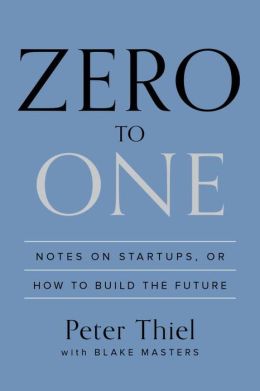
Zero to One — Peter Thiel and Blake Masters

Zero to One: Notes on Startups, or How to Build the Future is out and you, like everyone, should read it; the book is of course about startups but its deeper themes are philosophical in nature: how we should think about and relate to the world. The writing is elegant and clear without having a distinctive style that can be easily labeled by calling attention to itself. It is Robertson Davies’s plain style, used well here.

Those who have already read Blake Masters’s CS 183 classnotes—I have—may be disappointed, since they form the core of the book. Nonetheless those notes have been cleaned up, organized, and updated with more recent examples. The thrust Zero to One is also beautiful and optimistic: the future is important, it can be shaped and improved, and individual choices matter. In believing those three things, and especially the second two, Thiel and Masters are swimming upstream against much of contemporary culture.

zero to oneOthers can no doubt comment on the technical aspects of the book, but I will note that much of what Thiel and Masters write sounds like an artists’ manifesto: “The act of creation is singular, as is the moment of creation, and the result is something fresh and strange.” I very rarely read about business as “strange,” and yet the word is apt: all things are strange before they become domesticated by time and ubiquity. Artists usually focus directly on creating new things, but Zero to One describes “how to build companies that create new things.” More people extend the reach of what a single individual can do, but though Thiel has “noticed many patterns [. . .] this book offers no formula for success.” There is none, because innovation is by definition strange and new. He is trying to “help my students see beyond the tracks laid down by academic specialties to the broader future that is theirs to create.”

Academia has many problems and he notices them; I don’t think he uses this as a specific example, but one issue is treating school like a job or primary occupation. It shouldn’t in most cases be. It should be a day job that enables and ideally complements the other things one does. Teachers and professors rarely inculcate this attitude, however, because they themselves have been selected by the school system and have bought into its prejudices and cultures. Charter schools are important for many reasons, one being that they give an opportunity to create new schooling cultures. Montessori is specifically attempting to do that, and it is striking how many successful tech guys went through Montessori schools.

They note that “The business version of our contrarian question is: what valuable company is nobody building?” This question is harder than it looks” (23). The novelists’ version is, “What valuable novel is nobody writing?” One challenge, of course, is that different people have different values for “valuable:” I find most “thrillers” to be boring and un-thrilling, and most thriller readers probably find literary fiction the same.

This could be a description of most narrative fiction: “Our ancestors lived in static, zero-sum societies where success meant seizing things from others. They created new sources of wealth only rarely, and in the long run they could never create enough to save the average person from an extremely hard life.” Romance, the driver of so much fiction, is usually zero-sum: if the protagonist wins the guy or girl, no one else can; if the rival wins the guy or girl, no one else can, while in the real world there are a de facto infinite number of good guys or girls, provided the protagonist—that is, you—are willing to find and attract them. There are an infinite number of jobs, too, and one person getting a job doesn’t prevent someone else from getting another, or making another. Much narrative fiction taps into the zero-sum dynamic. Maybe it shouldn’t, or should more often explicitly question that dynamic.

Thiel and Masters are writing about everything, though they write specifically about startups. They discuss the nature of mass delusion (“Usually, it’s considered weird to be a 40-year-old graduate student. Usually, it’s considered insane to start a half-dozen companies at once. But int he late ’90s, people could believe that this was a winning combination”) and the psychology of founders (“Of the six people who started PayPal, four had built bombs in high school” and “We alternately worship and despise technology founders just as we do celebrities”); there is a hint of a Paglian reading of myth here, and such readings are too rare in a de-mythologized, de-ritualized society. There is more of the journey of the mythic hero in tech startups than is commonly supposed.

Psychology and cultural criticism have a long border; Thiel and Masters write that “competition is an ideology—the ideology—that pervades our society and distorts our thinking” (35). The opposite of competition, which may be something like cooperation or stasis, could be even worse: static societies and companies do not appear to do well or even exist in a world of competitive societies. But I don’t think Thiel and Masters are going in this direction: they are rather reminding us that it is useful to remember that we don’t live in a zero-sum world, largely because of technology and specialization. Most of human existence probably was zero sum, however, and that may explain some psychological quirks that aren’t terribly adaptive in contemporary information and industrial societies.

Competitive ideology has another problem too: it encourages us to compete with everyone, all the time. Picking good competitors is probably almost as important as picking good friends. Most competitive arenas are pointless. People often fight for control, and against other people like them:

Consider the opening line from Romeo and Juliet: “Two houses, both alike in dignity.” The two houses are alike, yet they hate each other. They grow even more similar as the feud escalates. Eventually, they lose sight of why they started fighting in the first place.

I’ve noticed this continually among professors, often specialists in the same area, who are from the outside identical and yet bash each other over minor differences. People more generally seem to seek fights for the sake of fighting, and without realizing that direct fighting is usually a terrible way to change minds—as has been known for decades. It’s often better to not respond to critics and instead to make something new. As Thiel and Masters write: “Rivalry causes us to overemphasize old opportunities and slavishly copy what has worked in the past.” One can see this at an individual level or even a national level: think of the petro-states that exist as they do primarily because they can sell oil to innovation states.

I mentioned psychology already; here is another passage on that theme that also applies to artists, who are often skilled at ignoring or repudiating group beliefs / delusions:

The hazards of imitative competition may partially explain why individuals with an Asperger’s-like social ineptitude seem to be at an advantage in Silicon Valley today. If you’re less sensitive to social cues, you’re less likely to do the same thing as everyone else around you. If you’re interested in making things or programming computers, you’ll be less afraid to pursue those activities single-mindedly and thereby become incredibly good at them. Then when you apply your skills, you’re a little less likely than others to give up your own convictions: this can save you from getting caught up in crowds competing for obvious prizes.

“Making things:” properly read, Zero to One is a recipe book for makers across disciplines. And “getting caught up in crowds competing for obvious prizes:” I remember talking about college sexual adventures with a friend who went to an Ivy-League school and who lamented that so many of the girls were, in his view though not in his words, neurotic achievement-obsessed basket cases. Maybe he misunderstood what those girls were seeking, but maybe he chose the wrong environment for that part of life.

Making things happens at large and small scales. Though we are still somewhat good at making things happen at small scales—as, say, the iPhone shows, or many Kickstarter projects show—we have become less ambitious and too obsessed with vetoes on large projects. Launching the Innovation Renaissance discusses this; so too does Thiel, in a cultural-political context: In the 1950s, people welcome big plans and asked whether they would work. Today, a grant plan coming from a schoolteacher would be dismissed as crankery, and a long-range vision coming from anyone more powerful would be derided as hubris.” We are collectively unable to even muster the political will to build denser cities and reasonable public transportation systems, let alone next-generation nuclear plants and systems for getting cheaply into space. This is a dark problem too rarely discussed by anyone.

It is also a tremendous and tremendously dangerous problem: “Without new technology to relieve competitive pressures, stagnation is likely to erupt into conflict. In case of conflict on a global scale, stagnation collapses into extinction.” There is a direct, underappreciated link between novelty, innovation, and survival. Artist and scientists are arguably at the forefront of ideas, though not always good ideas. Still, there is a brilliant statement at the end, which I’ve read more often in books targeted at novelists:

Only by seeing our world anew, as fresh and strange as it was to the ancients who saw it first, can we both re-create it and preserve it for the future.

This is not an ordinary book about “business.” It is a book about everything, as the best books always are.

Almost every human endeavor is also about relationships, whether we want it to be or not:

The lawyers I worked with ran a valuable business, and they were impressive individuals one by one. But the relationships between them were oddly thin. They spent all day together, but few of them seemed to have much to say to each other outside the office. Why work with a group of people who don’t even like each other? Many seem to think it’s a sacrifice necessary for making money. But taking a merely professional view of the workplace, in which free agents check in and out on a transactional basis, is worse than cold: it’s not even rational. Since time is your most valuable asset, it’s odd to spend it working with people who don’t envision any long-term future together. If you can’t count durable relationships among the fruits of your time at work, you haven’t invested your time well—even in purely financial terms.

This is again a good description of academia, and it’s also a restatement of the Coase theorem, which I wrote about in similar terms at the link. In most life domains a purely transactional model makes everyone poorer in the ways that count.

Thiel and Masters note that in school “Students who don’t learn best by sitting still at a desk are made to feel somehow inferior, while children who end up defining their identities in terms of this weirdly contrived academic parallel reality.” If you’re awake and paying attention to the school system, it’s hard not to notice its many bizarre perversities—and its problems harm not only the low achieving students but also the high achieving students. Although I spent years being a dumbass, I mostly got tracked to the high-achieving parts of school, and as an adult discussions with others who were stuck on the high-achieving track involve the ways the value system of that track warps those on it. But no one or almost no one tells students that at the time, and parents, teachers, and administrators are in on the conspiracy. Maybe that’s why so many Silicon Valley bigwigs want their kids in Montessori or similar schools.

Moreover, the prestige / rivalry system reinforces a zero-sum mindset, at least for those who buy in, as Thiel did (and only barley escaped):

Higher education is the place where people who had big plans in high school get stuck in fierce rivalries with equally smart peers over conventional careers like management consulting and investment banking. For the privilege of being turned into conformists, students (or their families) pay hundreds of thousands of dollars in skyrocketing tuition that continues to outpace inflation. Why are we doing this to ourselves?

I wonder if Thiel and Masters have read Excellent Sheep yet. Deresiewicz has similarly scalding views, though he comes from a different vantage point and throws some pointless, ill-formed bombs at startup culture. Thiel and Masters, however, ask the deep questions, and give major structural advice that one rarely hears from professors: “You should focus relentlessly on something you’re good at doing, but before that you must think hard about whether it will be valuable in the future.” I have focused relentlessly on writing better novels, but so far it has not proven valuable in a financial sense. If it weren’t for other ways of monetizing my skills, I would be doing something else, and probably not even writing this post.

Let me return, for a moment, to relationships, since your friends and surroundings count, as Tolkien knew and many others know: “it’s hard to develop new things in big organizations, and it’s even harder to do it by yourself. Bureaucratic hierarchies move slowly, and entrenched interests shy away from risks.” This is another, accurate, critique of academia, and a reminder to attend to our environment. Thiel does say that “a lone genius might create a classic work of art or literature, but he could never create an entire industry.” Even the lone-genius model appears less true than is often imagined: reaching into the biographies of famous artists tends to reveal an ecosystem of friends, rivals, mentors, and helpers. Hemingway famously derided creative writing classes, but he spent much of his early working life showing drafts of his work to Gertrude Stein and Sherwood Anderson. Few of us succeed fully in art or business without helpers along the way: hence, perhaps, the Joseph Campbell model that calls for such helpers in The Hero With a Thousand Faces. Even in myth the hero does not succeed alone: Frodo and Aragorn need Gandalf. Luke Skywalker needs Han and Obi-Wan. In His Dark Materials Lyra finds an array of helpers.

There are sections I think wrong, like the one on page 78 when Thiel and Masters criticize contemporary Silicon Valley buzzwords, which may reflect generations of learning about startups and the startup environment. Thiel and Masters say that “Secrets about people are relatively underappreciated,” while the opposite is true: we call secrets about people “gossip,” and most narrative art is relentlessly focused on personality, competitive, and “secrets” about people that almost always turn out to be about sex, money, and death. The supposed “secrets” that people hold tend to be more uniform than not. That pattern has persisted in Western art for millennia: the ultimate “secret” at the heart of Oedipus the King (first written circa 400 BC) and Game of Thrones is the same. The only human secret that matters is that one shouldn’t be surprised by human secrets.

These are quibbles about an otherwise great book. Great books do not have to be long. This one isn’t. They have to pack a lot of ideas in the space they h ave. This one does.

To reiterate the first paragraph of this post, you need to read this book. The less you think you need to read it, the more you do. It is in some ways similar to Rework, another anti-conventional-business business book written by nerds. Zero to One is a tremendously important book; although I admire and appreciate trivial books, particularly because most books including my own are, find one that is important—which does not mean “pompous” or “serious”—matters. You should read it. Your friends should read it. Its ideas should be common currency, readily known whether accepted or rejected. It is possible that the future of the world depends on Zero to One finding the right person at the right time, which is true of few other books.

The physical book is itself nicely made; though the binding appears to be glue rather than thread, the paper quality is high, and much higher than most books in its class and most contemporary books, period. The physical book reflects their emphasis on long-term thinking, as too few physical books do. One can read publishers’s opinions on their own works in the ways they choose to manufacture books. Those opinions do not appear to be high. If publishers have a low opinion of their own products, what should investors think?


Here is a good Fortune profile of Thiel. And

“All American fiction is young adult fiction: Discuss”

Via Twitter Hollis Robbins offers a prompt: “‘[A]ll American fiction is young-adult fiction.’ Discuss.” Her takeoff is A. O. Scott’s excellent “The Death of Adulthood in American Culture,” which you should go read; oddly, it does not mention the show Entourage, which may be the best contemporary narrative artifact / fantasy about the perpetual party.*

American fiction tends toward comedy more than “young-adult” because comedy = tragedy – consequences. AIDS fiction is tragic because people die. Most contemporary heterosexual love stories are comedy because the STIs tend to be curable or not that important; people who are diligent with birth control rarely get pregnant. Facing death, starvation, or other privations have always been the adult’s lot, and adults who made sufficiently bad choices regarding resource allocation or politics died. Think of the numerous adults who could have done everything they could to flee the area between Russia and Germany in 1914 and didn’t, or the ones who didn’t after 1918 and before the Holocaust. The example is extreme but it illustrates the principle. Frontier and farm life was relentlessly difficult and perilous.

Today by contrast we live in the a world of second chances. America is a “victim,” although that is the wrong word, of its own success. If you color more or less inside the lines and don’t do anything horrendous, life can be awesome. People with an agreeable and conscientious disposition can experience intense pleasures and avoid serious pain for decades; not everyone takes to this (see for example the works of Michel Houellebecq) but many do. The literary can write essays, the scientists can do science, the philosophers can argue with each other, the business guys have a fecund environment, and the world’s major problems are usually over “there” somewhere, across the oceans. If we ever get around to legalizing drugs we’ll immediately stabilize every country from Mexico to Chile.**

What are the serious challenges that Americans face as a whole? In the larger world there is no real or serious—”serious” being a word associated with adulthood—ideological alternatives to democracy or capitalism. Dictatorships still exist but politics are on the whole progressing instead of regressing, Russia and parts of the Middle East excepted.

One could reframe the question of all American fiction being young adult fiction to: “Why not young adult fiction?” Adults send young people to war to die; adulthood is World War II, us against them, thinking that if we don’t fight them in Saigon we’ll have to fight them in Seattle. Adults brought us Vietnam. Young people brought us rock ‘n’ roll, rap, and EDM. Adults want to be dictators, whether politically or religiously, and the young want to party and snag the girl(s) or guy(s) of their dreams.

Adulthood is associated with boredom, stagnation, suburbs, and death. Responsibility is for someone else, if possible, and those who voluntarily assume responsibility rarely seem to be rewarded for it in the ways that really count (I will be deliberately ambiguous on what those ways are). Gender politics and incentives in the U.S. and arguably Western Europe are more screwed up than many of us would want to admit, and in ways that current chat among the clerisy and intellectual class do not reflect or discuss. If adulthood means responsibility, steady jobs, and intense fidelity, then we’ve been dis-incentivizing it for decades, though we rarely want to confront that.

Many people are so wealthy and safe that they are bored. In the absence of real threats they invent fake ones (vaccines) or worry disproportionately about extremely unlikely events (kidnapping). Being a steady person in a steady (seeming) world is often thus perceived as being dull. In contemporary dating, does the stolid guy or girl win, or does hot funny and unreliable guy or girl win?

A lot of guys have read the tea leaves: divorce can be a dangerous gamble while marriage offers few relationship rewards that can’t be achieved without involving the legal establishment or the state more generally. A shockingly large number of women are willing to bear the children of men they aren’t married to: 40.7%$ of births now occur to unmarried women, and that number has been rising for decades.

Why take on responsibility when no one punishes you for evading it and arguably active irresponsibility is rewarded in many ways, while safety nets exist to catch those who are hurt by the consequences of their actions? That’s our world, and it’s often the world of young adulthood; in fiction we can give ourselves monsters to fight and true enduring love that lasts forever, doesn’t have bad breath in the morning, and doesn’t get bored of us in four years. Young adult fiction gives us the structure lacking in the rest of our lives.

Moreover, there has always been something childlike in the greatest scientists and artists. Children feel unconstrained by boundaries, and as they grow older they feel boundaries more and more acutely. I’m not about to argue that no one should have boundaries, but I am going to argue that retaining an adult version of the curiosity children have and the freedom they have is useful today and in many cases has always been useful.

The world has gotten so efficient that vast pools of money are available for venture capitalists to fund the future and tech guys to build or make it. The biggest “problem” may be that so many of us want to watch TV instead of writing code, but that may be a totally bunk argument because consumption has probably always been more common and easier than production.

In this world fiction should tend towards comedy, not the seriousness too typically associated with Literature.

If American fiction is young adult fiction, that may be a sign of progress.***


* Another show, Californication, mines similar themes but with (even weaker) plots and total implausibility. Here is an essay disagreeing with Scott: Adulthood Isn’t Dead.

** Breaking Bad and innumerable crime novels would have no driving impetus without drug prohibition. The entire crime sector would be drastically smaller almost overnight were we to legalize drugs and prostitution. That would be a huge win for society but harmful to fiction writers.

*** Usually I eschew polemics but today I make an exception.

Life: Do it for the pleasure edition

“A man rarely succeeds at anything unless he has fun doing it.”

—Dale Carnegie, How to Win Friends and Influence People, a book I’m shocked not to have read yet and that ought to be mandatory reading for academics, who are very bad at applying its lessons. Not everything in the book I buy but overall it is much more interesting than I expected and much better written. Note that this is the pre-1981 version, which means some references to gangsters and “popular” figures are dated, but as often happens with very old books it is revealing about its own time in ways not intended by its author.

I often see the point quoted above said regarding writing, coding, and any number of other activities. Yet I rarely see it said regarding, say, tax law, or accounting, or proctology, or garbage hauling.

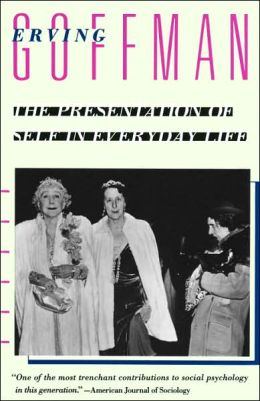
Erving Goffman’s “The Presentation of Self in Everyday Life” for novelists

The Presentation for Self in Everyday Life endures because while it is nominally about sociology, its observations fit into other fields too: One could read it as a work of literary criticism but without literature, or a novelist’s handbook about how people behave around other people. It is filled interesting observations, like “not a few psychotherapists find employment in [. . .] making their living by telling individuals the facts of other people’s lives.” Or, colloquially, one reason people like fiction, memoirs, and blogs is to figure out how fucked up other people’s lives are. Few of us wish to advertise the fucked up parts of our lives and so in everyday experience those parts are hidden. I for one wish that I’d realized as much when I was younger.

Goffman gets the game theory aspect of punishing defectors from collective norms:

Similarly, a girl at a party who is flagrantly accessible may be shunned by the other girls who are present, but in certain matters she is part of their team and cannot fail to threaten the definition they are collectively maintaining that girls are difficult sexual prizes. Thus [. . .] teammates are often persons who agree informally to guide their efforts in a certain way as a means of self-protection and by doing so constitute an informal group.

Goffman selfThe sexual double standard is maintained more by women than by men, which Goffman got in 1959. He describes the way “teammates everywhere employ an informally and often unconsciously learned vocabulary of gestures and looks by which collusive staging cues can be conveyed.” Novelists should attend to that vocabulary and those clues when they discuss characters in specific worlds. One’s cultural world and coworkers color one’s viewpoint. A professional photographer cannot help but seeing the world partially through photography terms, and lawyers see cases waiting to happen everywhere. In the underworld this is most obvious, which is one reason why The Friends of Eddie Coyle works.

Goffman gets the way that people are groupish and feel conflicting loyalties towards their groups and towards outsiders who may be taken advantage of. In my own life, I feel more loyalty to readers than to the nonprofits and governments I write about in Grant Writing Confidential. The same is true of many bloggers in many fields who choose to pull back the curtain, so to speak; doctors and lawyers have scads of blogs devoted to that topic, as do hookers like Belle de Jour (whose Diary of an Unlikely Call Girl is good).

The Presentation of Self in Everyday Life is also a defense of privacy, and novels are generally experienced in private.

There are sections that are dated or dubious, as when Goffman writes that

we may have some sympathy for those who have but one fatal flaw and who attempt to conceal the fact that they are, for example, ex-convicts, deflowered, epileptic, or racially impure.

By now being “deflowered” is generally a positive, being epileptic is a medical condition, and racial purity is itself a bogus concept. Nonetheless the number of abstract lessons is large and Goffman’s observations are sharp. I haven’t exhausted the book based on a first reading. Much of human life is about politics. Human life will always have a strong political component because everyone learns from everyone else and there is no way to be as effective acting alone as one can act in groups.

Echopraxia, the new Peter Watts novel, is here

Echopraxia - Peter Watts

I’ll be offline, in many senses of the word, until it’s done. Here are posts mentioning his novel Blindsight, and here are posts mentioning him.

Briefly Noted: “The Fever” — Megan Abbott

I’ve already reviewed The Fever—it’s just under the title Dare Me, with its similar subject matter (high-school girls, transformation, darkness in women, sexuality) and style (half-knowing, unwilling to admit, chopped up narrative). This is not a criticism, Dare Me readers who want more of the same will find The Fever delivers. Like Dare Me the principle concern is female rivalry over high-status guys and female judgment of each other’s sexuality. I won’t say it’s a critique of those topics, though it could be read that way. It could also be seen as a commentary on the eternal conflict between children and parents.

Similarity is not always a bad thing—Elmore Leonard’s many caper novels consistently delivered similar characters, styles, and plots, and again that could be read as weakness or strength as he played with variations around a central concern or set of concerns (which I read as coolness and silence—subjects for an academic paper yet to be written).

the_feverThere is a Paglian tinge to Abbott’s last two novels (sample: “In the school’s hallways, Tom could see it: Gabby carried the glamour of experience, like a dark queen with a bloody train trailing behind.” Unlikely, but poetic, and it tells us about Tom’s overwrought perspective). They may be of less interest to those far from high school or offspring in high school. Abbot is willing to probe darkness in a way rarely seen in TV or movies, which tend to lag books by decades in terms of their willingness to portray what lurks within. Even the better TV stations like HBO and Showtime need to appeal to “Heads of Households,” which explains why the teen series tend to be on network TV or basic cable.

There are comparisons to be made with Caitlin Flanagan, and Abbott wins them; Flanagan’s book Girl Land was published in only 2012 and already the hardcover is justifiably available for $.01 from Amazon. I think I read a library copy. Both the Flanagan essays and the Abbott novels show how little we tend to know about things when we’re young and have no context or framework for understanding them. One could argue that the knowledge for understanding the world is out there, and most teenagers choose not to access it. This leads to confusion. That confusion is reproduced to good effect in the narrative voice and structure of The Fever:

I’m next, Deenie thinks, a few minutes and it’ll be me.
If only she’d gotten it over with a year ago. But she’d heard about how much it hurt and no one else had done it yet, at least not anyone she knew.
Now she’s one of the last one.

The tense moves from present to past back to present, with the “it” deliberately ambiguous in that it sounds like sexuality but may actually be the fever of the title. Naturally hypocrisy appears too, with slightly incestuous overtones, when Eli thinks that “Since then, he could only ever think about his sister, one wall away. And how he hoped Deenie never did things like this. With guys like him.” To be thinking about his sister in this context seems like a mistake of focus. About some things there is little to say; people are people and want what they want, as teenagers are probably taught not to know or admit. The characters are also mostly ignorant: Deenie thinks, “Why did everything have to be about sex, she wondered. Didn’t it make a lot more sense that it was something else?” She hasn’t read or probably even heard of evolutionary biology or Darwin’s The Descent of Man and Selection in Relation to Sex. I hadn’t either in high school, and I don’t remember my first introduction, but I do know that a couple books on the subject made a lot of previously puzzling behavior fall into place. It’s true that not everything is about sex but so much is about it because we’ve evolved to pay close attention to matters relating to survival and reproduction.

Simple principles give rise to dizzyingly complex behaviors and patterns. Deenie doesn’t know that and in some ways her society conspires with her towards ignorance. One reading of Abbott’s last two novels could be as a move from utter ignorance to slightly greater knowledge. Jealousy is a perpetual companion because there are so few real status ladders to climb in high school (“Everything was so easy for Skye, with her older boyfriends, the way her aunt bought her cool old-time lingerie from vintage shops, the strip of birth control pills she once unfurled for them like candy.”) Skye, however, probably doesn’t think things are easy for Skye, but few high schoolers have the ability to get out of their own heads and into the heads of their companions. The last two paragraphs may be unfair, like saying that Faulkner is merely writing about the machinations of slack-jawed southern yokels who need education and functioning political infrastructure, but there is also some accuracy to them.

The question of whether the fever has supernatural, psychological, microbiological, or other origins does get resolved, but its mechanics are dubious.

Briefly noted: The Magician’s Land — Lev Grossman

(For background see this 2009 post on The Magicians and this less positive post on its sequel, The Magician King. Without those for context this post won’t make sense, and, as with most books towards the end of a series, the latest only matters to those who have read the earlier.)

At the beginning of The Magician’s Land we see a metaphor for post-2008, or maybe post-1973, diminished expectations, when things that are supposed to happen to other people happen to us (“It’s a recession when your neighbor loses his job and a depression when you lose yours”):

Stuff like this was for people on the fringes of the magical world, people scrabbling to get in, or who’d lost their footing somehow and slipped out of the bright warm center of things, all the way out to the cold margins of the real world. All the way out to a strip mall in Hackensack in the rain. Things like this weren’t for people like him.

But they are, as literature reminds us. It can always get worse and at times the only thing we change is our reaction. Quentin is getting better at changing his reactions to circumstances and one could read the trilogy as a commentary on his shifting ability to do precisely that. As an alternate reading, it could be seen as the latest in a long line of works asking what is real: “This all seemed a hell of a lot more real than it had half an hour ago.”

MagiciansLandWelcome to the desert of the real. One professor in grad school, who otherwise took many dubious positions to the point of seeming like a character in an academic novel, liked to say that the real is what hurts. It’s a good working definition. I’d add that the real is what hurts or what works. The latter explains much of what’s wrong with philosophy, and its literary studies branches.

Quentin has also taken on some of the dullness of middle age, and though in the process he has gained the loss of most of his early petulance. Many of the description, including descriptions of family and friends, still resonate and hurt:

When he thought of his parents it was almost like they were old lovers, so distant now that he couldn’t even remember why his link to them had once seemed to real and urgent. They’d managed the neat trick of bringing up a child with whom they had absolutely nothing in common, or if there was something none of them had risen to the challenge of finding it.

Friends are arguably the family you choose, but friends are also hard to sustain in world of growth, evolution, and changing circumstances: people must grow together or apart, and in many cases friendships do not survive circumstances. One could be sad or stoic about such things.

The book raises other questions. What do the many odd metaphors and pop-culture references mean (“He’d been a good person, or good enough, but mostly what he’d showed Quentin was how to move through the universe while disturbing it as little as possible, and how to compile and maintain the world’s most complete collection of Jeff Goldblum movies on Blu-ray, apart, presumably from Jeff Goldblum’s” or “fairies thought all this military stuff was pretty silly, but they went along with it for the same reason that fairies ever did anything, namely, for the lulz”)? They undercut fantasy tropes but also make the characters highly associative. Another sample: “It was like a box with a whole herd of Schrödinger’s cats in it. With a little magical know-how you could alter the order in which your cards came out; with a little more you could guess what your opponent was going to play before she played it” (note that this comes just a few pages after Quentin explains his poverty—why not just do this in Vegas?).

Other notes: There is a MacGuffin. The initial plot about Quentin needing money seems unlikely; he has long had the same problem as the girls on Girls: he needs to get a job, or find a purpose greater than himself. Leading a generative life is important and yet we often get little guidance in this regard. One purpose of novels could be to give us guidance to leading a generative life. Novels show both failure and success, and arguably occasional transcendence towards a quasi godhood rarely if ever achieved by those of us outside books.

I would argue that Quentin succeeds or seems to at the end of The Magician’s Land—attend to that language about bridges and other connectors—but the possibility of success is there from the beginning, when Quentin finds himself in a bookstore, and “he felt at home in a bookstore. [. . . ] It didn’t matter where you were, if you were in a room full of books you were at least halfway home.” Bookstores represent what is effectively infinite possibility: they are like the Neitherlands, the world between the worlds.

I can’t get excited enough about the book to write extensively about it, which may say something about the book or may say something about this writer. Nonetheless, here is an interview on Vox. Here is Slate. Here is The Atlantic. Here is Grossman explaining how not to write your first novel. I think he said in my interview with him that publishing as an industry is no fair and fairly random, which the linked essay perhaps supports.


Note: This is based on a review copy.

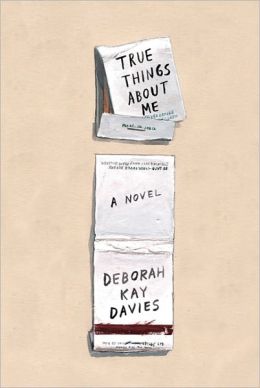
True Things About Me — Deborah Kay Davies

True Things About Me is disturbing and compelling, especially because it doesn’t want to explain. Its unnamed protagonist doesn’t want to explain. She just wants to act and in acting without explanation she may in some ways be truer to life, in which we so often act and then come up with rationalizations about why we acted after the fact. The disturbing implication of the novel may be that our reasons for doing things are opaque even to us and always will be. Like markets, we just can’t predict our own behavior.

True_things_about_meIn the novel the unnamed narrator has unplanned, unexpected sex with a man just out of prison who is registering for benefits. It is unexpected, a disjunction, a call to action in a mythic sense, and beyond the initial bang, so to speak, True Things About Me is at most loosely plotted. The scary thing about the story is not that it may be sick but that it may be normal, or at least more common than is commonly supposed, despite the evidence in fiction and art that few of us, Paglia aside, want to face. Much of the online commentary mentions “mental illness,” which is a comforting but wrong misreading. Desire can be neither legislated nor medicalized away. It will reemerge in different forms, and its verbal component is weak or nonexistent. When Alison, the narrator’s boring foil friend, wants to know what’s happening with the narrator, the narrator says “Somehow I couldn’t be bothered to explain it all.” “Somehow:” why bother analyzing what can’t be fully analyzed?

Her parents are either delusional or right; when the narrator invents a boyfriend for her parents’ benefit her mother says, “I just hope he’s a nice boy.” The irony is obvious. Her mother describes Alison as “so sensible,” which may read here as a synonym for boring. There may be no greater modern relationship sin than being boring or needy.* When madness intrudes in normal life we don’t know how to react, unless perhaps we live a continually mad life, like a different Alison, the protagonist in Story of My Life. For the narrator of True Things About Me everything is permitted and nothing matters, which may be the nature of modern adulthood for many nulliparous people.

For the narrator internal changes inspire external changes. After her encounter she thinks that “It seemed to me that I hadn’t looked at clothes properly before.” The clothes she buys says things other than what her old clothes presumably said: “a pair of low-slung cream linen trouser, and a scarlet and cream striped bustier” are new to her, and make one see fashion as part of the story. Silence is power, which is strange in a book composed of words; at one point she says that “He didn’t say much.” What and how he does counts.

Alison and her coworkers are twits. At one moment “They were talking about a television programme. Everyone was really into it. Alison was the most knowledgable.” There is nothing wrong with being into a TV show but in this context the TV show is a stand-in for a life the coworkers are too scared to live. The narrator becomes an outsider by dint of secret knowledge. She drifts away or is separated from from Alison’s world and that is arguably an improvement. Halfway through the novel she considers getting “back into the real world,” raising the usual question of what constitutes reality beyond knowing it when you see it.

In Nine and a Half Weeks one gets many sentences like “His face is blank. The gray pupils on which mine are focused reflect two miniature faces.” There are many descriptions of movement (same page: “I walk slowly across the carpet”) but few of feeling or context. Here is one extended, reasonably representative passage from True Things About Me, and it’s representative in both style and in raising questions about whether one should trust this narrator:

I began to see how it was, how it had always been. Alison was one of those types who loved to sit on the sidelines of someone else’s fascinating life and shout advice at them. She fed off me, and I let her. It made people like that feel even more smug about themselves when they could observe another human being struggling. Unravelling, if they were lucky. . . . She sounded like a second-rate actress in a daytime soap.

Who does the narrator sound like?

True Things About Me may be obliquely related to Susan Minot’s Rapture. Both could be construed as arguments that things don’t matter—people and experiences do. True Things About Me is also a commentary on soulless bureaucratic jobs and their deadening effects on the human condition.

At one point an old woman says, “That girl is on the game [. . .] living off immoral earnings. It’s disgusting. Someone ought to come round and investigate.” The contemporary term “hater” describes her well. The old woman hates the player because she is “living like she doesn’t have a care in the world. It shouldn’t be allowed.” Why not? The narrator doesn’t ask and the old woman doesn’t volunteer. The narrator is about to live without a seeming care in the world either. She leaves her work as an anonymous, Houellebecq-esque bureaucrat processing welfare claims forms to meet a dissolute but presumably sexy man. She blows off her friend, Alison, who is the voice of boredom, restraint, wisdom, and creation, to go “underground.”

There are numerous references to going underground, with connotations that go back to Persephone if not earlier. While there her mind “had stretched and blanked, like a washed sheet on a clothes line.” Is that how the best sexual encounters always happen? Maybe. But the metaphor can be extended through the novel, in which her mind is never really not “blank.”

True Things About Me is probably too uncomfortable to be of interest to most people; in this respect it resembles Never the Face, an underrated and under-known book. I imagine True Things About Me doing better in Europe than here, based solely on stereotype. The truth is out there, the book implies, and you will not like it.

See also Rebecca Barry’s NYT review, although she doesn’t get the novel and wants to throw around the word “abuse,” as if the novel is a cautionary, modern liberal, story about leading a sanitized life purged of dark impulses. Camille Paglia would be the ideal reviewer: she might not like the book—in some ways it may stick too close to the tradition—but she would get it.


* Reminder: Linking does not imply endorsement.

The Magician’s Land arrives:

It arrives:
OLYMPUS DIGITAL CAMERA

I have been writing about Lev Grossman’s Magicians novels since 2009, not long after I started this blog, and enough time has passed to elicit nostalgia.

The actual publication date is Aug. 5.